


With the hot weather hitting the you might not think the increased temperatures will have too much of an effect on your car. However, it is essential to regularly check and top up your engine coolant level when needed. Don’t dismiss the warm weather’s impact on your vehicle, as letting your engine coolant level drop too low could have disastrous consequences.
Burning petrol or diesel in an engine releases a lot of energy, which means your motor’s exhaust gases are super-hot when they exit the engine – over 1,000 degrees C in some cases.That means the metal heats up rapidly. If the engine block and cylinder head weren’t somehow cooled, the engine could overheat and the metal parts fuse themselves together – that’s why it’s important to keep an eye on your engine coolant levels. Especially in summer when your car has to work harder to stay cooler due to a higher outside air temperature.
Checking your engine coolant level
- Park the car on level ground and open the bonnet, but make sure the vehicle hasn’t been running for too long or is too warm.
- Locate the coolant reservoir – this will be a clear plastic tub with a funny coloured liquid inside (we’ll explain later). The cap should be marked with a warning saying “Caution – hot” or something similar.
- On the side of the tub there’ll be a ‘Min’ and ‘Max’ scale, just like on your brake fluid reservoir. Make sure the coolant level is within these tolerances.
If it isn’t, you’ll need to top it up…
Topping up engine coolant
To top up your engine’s coolant, you can simply open the reservoir cap (be careful the engine is not too hot and use a cloth wrapped around the cap to open it, as there could be some residual pressure left in the system) and add to the fluid level – what you use to do this is very important though.
- Use a proper engine coolant bought from your local dealer or autocenter. It’s not advised to just add normal water, as any microscopic organisms or contaminants could build up somewhere inside your engine and cause coolant pipes to ‘fur’ up, potentially blocking the internal waterways. However, its far better to use regular water than to let your coolant level drop too low, if that is all you have.
- An alternative to shop bought coolant is to use distilled water. This is purified and so doesn’t contain the contaminants that can damage your pipes.

Draining engine coolant
Engine coolant systems need to be periodically drained and re-filled – it’s routine maintenance just like changing your brake fluid to make sure the coolant is in correct working order.
To do this:
- Locate the lowest accessible point in the coolant system – this will generally be where a coolant hose attaches to the bottom of the radiator. Have a bucket ready to catch all of the coolant, as the anti-freeze in it can be harmful to the environment, even in its diluted form. Undo the hose and leave it to drain into the bucket, disposing of the waste coolant in an ecological way. Your local council waste center will be able to advise you on how to do this. It is also important to know that Anti-freeze is very poisonous to animals. So after you’ve drained it, pour it into a concealed container until you are able to dispose, because in hot summer months pets and wildlife may treat it as a nice thirst quenching drink.
- Once all the engine coolant has been purged from the system (or as near as you can get to a full drain – a few drops don’t really matter) remember to do the radiator hose back up tight. You wouldn’t want fresh coolant to go straight through once you top it up again…
Refilling engine coolant
Your car’s owner’s handbook should give you an idea how much coolant the vehicle holds, as well as the concentration of coolant anti-freeze needed.
It’s important to add this as it will stop the fluid freezing in cold temperatures over winter. If this does happen, plain water inside the engine could freeze, expand and actually crack the engine block causing a leak and potentially irreparable or extremely costly damage.
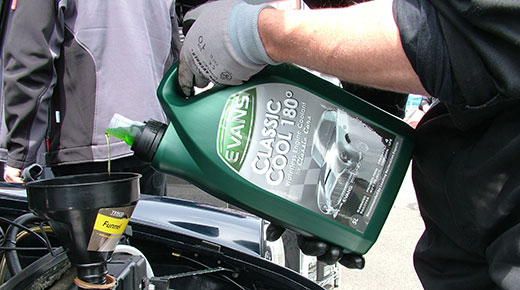
- Make up the coolant solution with the right ratio of anti-freeze to pure, distilled water beforehand (if you don’t have distilled water you could boil a kettle and let it cool, as this has a similar affect) and begin pouring it into the coolant header tank reservoir.
- Once up to the ‘Max’ line, turn the engine on and let it run for a few minutes without the cap – this will hopefully force any air bubbles in the cooling system to the top and bleed the system.
- It’s worth using the bleed screw on the radiator to ensure as much air as possible is forced out. Make sure the car hasn’t been running for too long when you do this, but still be mind full any fluid that dribbles out could be warm.
- Locate the bleed screw and undo it until a trickle of water flows out – what you’re looking for is a constant stream of pressurised coolant, as this will tell you no air is present in the system. Once you’ve got to this point, do the screw up again.
- It’ll probably mean the level in the coolant reservoir drops lightly, so give the level a final top-up to the ‘Max’ mark and replace the head tank cap.
You should should always monitor your car’s temperatures on dashboard