

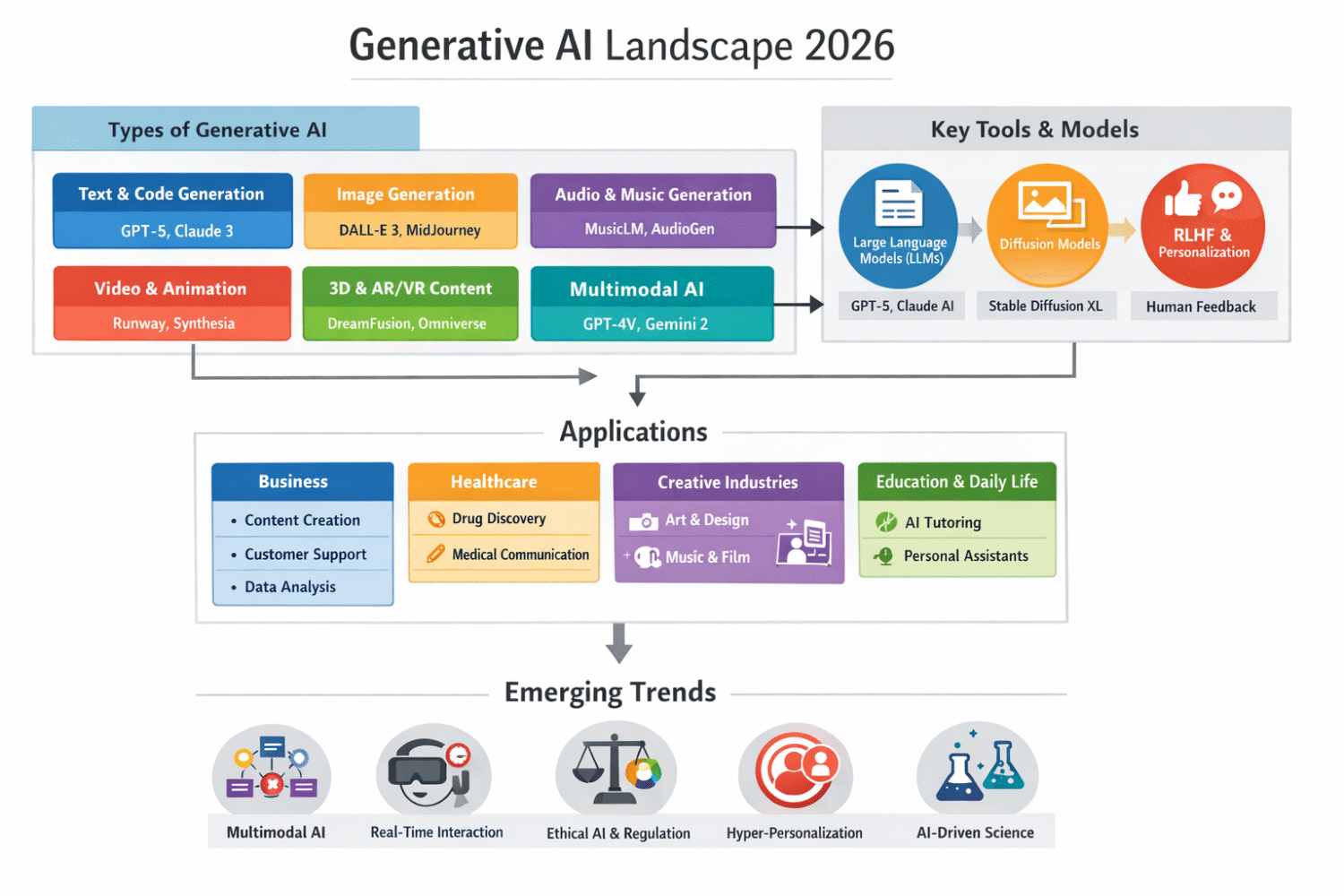
Chat Generative AI, also called conversational AI, is a branch of generative artificial intelligence that focuses on producing human-like dialogue. Unlike traditional chatbots that rely on pre-programmed rules, Chat AI uses large language models (LLMs) and multimodal generative techniques to understand context, maintain conversation history, and respond dynamically.
By 2026, chat AI has become ubiquitous, integrated in education, healthcare, business, and everyday personal productivity. It is no longer limited to answering questions but can generate essays, code, visual content, summaries, and even assist in decision-making.
2. Mechanisms Behind Chat Generative AI
2.1 Understanding Input
- Chat AI begins with Natural Language Understanding (NLU), which interprets the user’s text for intent, context, sentiment, and entities.
- Modern systems also accept multimodal input: images, audio clips, and videos for richer conversations.
2.2 Contextual Response Generation
- Uses Large Language Models (LLMs) such as GPT-5, Claude 3, or Mistral.
- Transformers allow chat AI to maintain long-term context across multiple turns in a conversation.
2.3 Reinforcement and Human Feedback
- Reinforcement Learning from Human Feedback (RLHF) is used to improve response alignment with user expectations and ethical norms.
- The AI continuously learns from corrections and user interactions.
2.4 Memory and Personalization
- Advanced chat AI can store user preferences, prior conversations, and content styles, providing highly personalized responses over time.
- Example: Remembering a student’s learning progress for tutoring purposes.
3. Examples of Chat Generative AI Tools (2026)
| Tool | Capabilities | Use Case |
|---|---|---|
| ChatGPT (GPT-5) | Text generation, coding, summarization | General-purpose conversation, research assistance |
| Claude 3 (Anthropic) | Long-form reasoning, ethical alignment | Enterprise AI, safety-critical conversations |
| Bard (Google AI) | Real-time web-connected answers | Live Q&A, dynamic content |
| Perplexity AI | Summarization and QA | Academic research, information retrieval |
| Microsoft Copilot Chat | Productivity, document summarization | Office 365 integration for business |
| Character.ai | Roleplay, personas | Interactive storytelling, simulations |
| Replika AI | Companionship, wellness | Personal AI companion |
4. Applications of Chat Generative AI
4.1 Business
- Customer Support: AI handles inquiries, troubleshooting, and escalations.
- Sales & Marketing: Generates personalized pitches, emails, and social media content.
- Enterprise Productivity: Drafts reports, creates meeting summaries, and organizes workflows.
4.2 Education
- Tutoring: Offers interactive lessons, explanations, and personalized learning paths.
- Research Assistance: Generates summaries, literature reviews, and answers complex academic questions.
4.3 Healthcare
- Patient Communication: Explains medical instructions in simple language.
- Mental Health Support: Provides guided wellness exercises, stress management, and social companionship.
4.4 Personal Life
- Productivity: Drafts emails, organizes calendars, and provides reminders.
- Entertainment: Engages in storytelling, interactive roleplay, or conversational games.
- Accessibility: Converts text to speech, explains visual content, or acts as a learning aid.
4.5 Gaming and Interactive Media
- Dynamic NPCs (Non-Player Characters): AI can simulate realistic dialogue in games.
- Story Generation: Produces branching narratives and interactive adventures.
5. Emerging Trends in Chat AI (2026)
- Multimodal Chat Systems
- Integration of text, audio, images, and video in a single conversational interface.
- Example: GPT-4V interpreting an image and generating descriptive or instructional responses.
- Long-Term Memory
- Retains context from past interactions for continuity and personalization.
- Example: A student AI tutor remembering prior lessons to customize new exercises.
- Voice and Speech Integration
- Conversational AI now produces human-like speech with emotion and intonation.
- Real-Time Assistance
- Embedded in live streaming, conferencing platforms, and productivity software for instant guidance.
- Ethical Alignment
- Safety protocols to reduce bias, misinformation, and harmful outputs.
- Example: Claude 3 emphasizes ethical reasoning in sensitive topics.
6. Technical Architecture Overview
- Input Layer
- Accepts user text, images, or audio.
- Applies tokenization for text or feature extraction for images/audio.
- Encoder Layer
- Converts input into a mathematical representation the AI can process.
- Transformer/Attention Mechanism
- Maintains context and relevance across multiple conversation turns.
- Decoder Layer
- Generates the output text or content, integrating multimodal cues.
- Post-Processing & Feedback Loop
- Ensures output quality, ethical alignment, and personalization.
(Optional diagram could visually map this flow: Input → Encoder → Transformer → Decoder → Output)
7. Challenges and Limitations
- Hallucination: Produces plausible but incorrect information.
- Bias: Reflects societal or dataset biases.
- Privacy Risks: Sensitive information could be misused if AI retains user data improperly.
- Over-Reliance: Users may depend too heavily on AI for decision-making.
- Resource Intensive: Requires significant computational power for training and real-time operation.
8. Future Outlook
By 2030, chat generative AI will likely:
- Combine text, voice, image, and video for fully immersive conversations.
- Serve as personalized assistants in work, healthcare, learning, and entertainment.
- Assist in research, business analytics, and creative industries, becoming a co-creator rather than a simple assistant.
- Integrate with AR/VR environments, IoT devices, and smart cities for ubiquitous AI-driven interaction.
9. Conclusion
Chat Generative AI has evolved from rule-based systems to intelligent, multimodal, context-aware conversational agents by 2026. It is revolutionizing business, education, healthcare, and personal life, offering efficiency, personalization, and creative support. While challenges like hallucination, bias, and privacy exist, the technology’s potential continues to expand, positioning Chat AI as a central pillar of modern generative AI applications.