


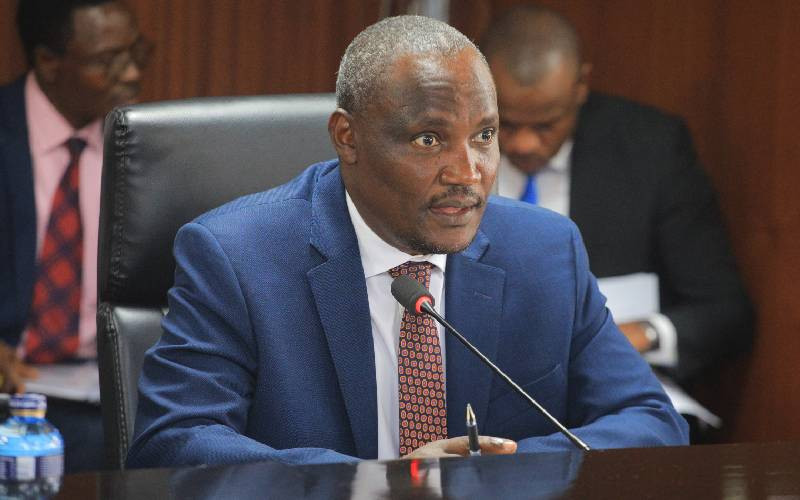
Treasury Cabinet Secretary John Mbadi appeared before a joint parliamentary committee on Tuesday to defend a high-stakes partial divestiture of the government’s stake in Safaricom PLC.
This comes as the state intends to offload 15 per cent of its 35 per cent controlling interest to South Africa-based tech giant Vodacom.
The transaction, structured as a strategic sale rather than a retail offer, is expected to generate approximately $1.576 billion (Sh204.3 billion).
According to an instant analysis, this represents a 19 per cent premium over the current market price of roughly Sh28.5 per share.
Financing Infrastructure through Tech Capital
Lawmakers, including Daniel Manduku (Nyaribari Masaba) and David Mboni (Kitui Rural), challenged the CS on the security of the proceeds.
Consequently, Mbadi assured the Finance and National Planning and Public Debt and Privatization committees that the Sh204 billion would be strictly ring-fenced as “seed capital” for commercially viable projects.
“The money is not to fill our fiscal deficit, it will be used to set seed capital for commercially viable infrastructure projects,” Mbadi stated. “Kenyans objected to any more taxes and borrowing; therefore, we have to think of innovative steps of raising revenues.”
The CS confirmed that these funds will not support the 2025-26 budget but will instead prioritize:
-
Energy and Water infrastructure.
-
Roads and Airports.
Protecting the Safaricom Workforce and Local Identity
A major point of contention during the joint sitting, chaired by Kuria Kimani and Shurie Abdi, involved the potential for tech-sector layoffs.
In response, the Treasury CS revealed that the agreement with Vodacom includes specific safeguards for Safaricom’s workforce.
Key Labor and Governance Commitments:
-
Job Security: A moratorium on acquisition-related redundancies for three years post-transaction.
-
National Identity: Requirements that the Chairman and independent directors remain Kenyan.
-
Social Impact: Continued support for the Safaricom Foundation.
However, Kitui MP Irene Kasalu criticized the three-year window as “too short,” noting the difficulty of the current job market.
Strategic Rationale: Why Vodacom and Not an IPO?
Lawmakers questioned why the government settled on Vodacom without a competitive bidding process or a local retail offer.
Mbadi defended the “Economics 101” behind the decision, arguing that a mass retail dump of shares would have crashed the stock price.
Moreover, the CS highlighted several strategic advantages:
-
Market Stability: Avoiding a price distortion caused by a sudden increase in share supply.
-
Foreign Currency: Attracting significant inflows of US dollars.
-
Efficiency: Avoiding the underwriting costs of a retail offer, which would have coincided with the planned divestiture of the Kenya Pipeline Company.
Independent Valuation and Transaction Costs
To ensure transparency, the National Treasury engaged KCB Capital as a transaction adviser for an independent valuation.
The government incurred Sh3 billion in transaction costs, representing 1.36 per cent of the total deal value.
Mbadi noted that this was well within the 1.8 per cent legal limit allowed for such transactions.
By opting for a strategic partner with a long history in the telecommunications industry, the CS argued that the state is maximizing value for money while reducing the long-term debt burden on taxpayers.