


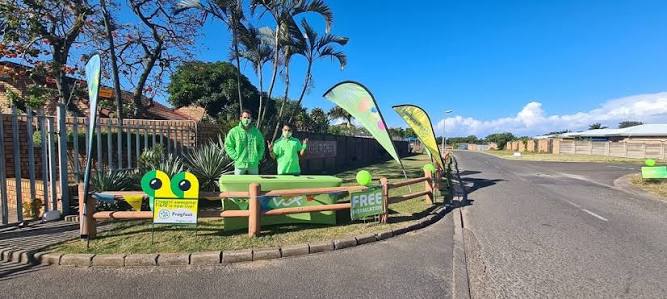
Sabvest Capital is investing about $47 million in South African telecommunications companies Frogfoot and Vox, betting that faster fiber expansion into lower-income communities can unlock growth in a market where millions of households remain without high-speed internet.
The investment holding company will subscribe for new shares in Frogfoot and Vox for $47 million, giving it an interest of at least 8.97% in the businesses. The transaction values the combined operations at about $900 million on an enterprise-value basis and about $525 million after debt. The figures are converted from South African rand at roughly 16 rand to the dollar on Aug. 24, 2026.
The deal gives Sabvest exposure to one of South Africa’s most important broadband infrastructure plays at a time when fiber operators are shifting their attention from affluent suburbs and business districts to townships and lower-income communities.
Frogfoot is South Africa’s fourth-largest fiber network operator and provides open-access fiber infrastructure for homes, businesses and other customers. Vox operates as a national internet service provider serving households, businesses and public-sector customers, with services spanning connectivity, voice, cloud, collaboration and cybersecurity.
The transaction also includes Hypa, Vox’s prepaid broadband business, which is targeting lower-income households through networks including Frogfoot Rise, Vuma Reach and Openserve.
Betting on the next wave of broadband growth
The investment comes despite the companies’ recent financial challenges.
Frogfoot and Vox reported a combined net loss after tax of about $16 million for the year ended Aug. 31, 2025, while their combined net asset value was negative by roughly $42 million.
Sabvest is therefore not making a conventional investment in profitable telecom operations. Instead, it is backing the value of the underlying fiber infrastructure and the potential for higher network utilization as the companies expand into markets that have historically been poorly served by fixed broadband.
That opportunity is substantial.
The companies are targeting as many as 15 million homes that could potentially be connected to high-speed internet, compared with about 4.5 million homes currently connected, according to Frogfoot Chief Executive Officer Abraham van der Merwe. The group plans to increase annual fiber deployment fourfold to about 360,000 homes a year, with much of the expansion focused on townships.
That makes the investment as much about market expansion as infrastructure ownership.
South Africa has one of the continent’s most developed telecommunications markets, but broadband access remains uneven. Fiber operators have traditionally concentrated on areas where household incomes and customer density can support the economics of network construction. The next stage of growth is likely to depend on whether operators can make fiber commercially viable in lower-income areas.
Capital to accelerate rollout
Sabvest’s investment forms part of a broader financing and shareholder restructuring involving several investors.
The largest shareholder grouping will be a consortium led by DNI 4PL Contracts and including Sabvest, Masimong Group and Draper Gain International. The consortium will hold about 34.8% of the companies, with DNI itself holding 18.13%. Sabvest currently owns about 19.4% of DNI directly and indirectly.
The wider transaction values the companies at about $900 million, comprising roughly $525 million of after-debt equity value and about $375 million of debt.
For Sabvest, the investment will be funded through new term bank debt rather than existing cash resources.
That financing structure highlights the investment thesis: Sabvest is committing capital to an infrastructure-heavy business where the payoff depends on scaling the network and increasing the number of paying customers connected to it.
Townships become the next fiber battleground
The shift toward townships reflects a broader change in South Africa’s broadband market.
For years, fiber companies focused on affluent residential neighborhoods and commercial centers, where customers were more likely to afford relatively expensive fixed broadband packages. The market is now moving toward prepaid and lower-cost offerings designed for customers with less predictable incomes.
Vox’s Hypa business is part of that strategy, while Frogfoot recently introduced Frogfoot Leap, a prepaid fiber service designed to provide uncapped broadband without long-term contracts.
The economics could become increasingly attractive if operators can reduce the cost of deploying networks while building sufficient customer density.
Van der Merwe has described the new capital as a way to significantly increase rollout velocity, particularly in townships and lower-income communities. The companies estimate that their addressable market could reach millions of additional households.
For consumers, the expansion could mean greater access to high-speed internet for education, digital financial services, remote work and small businesses. For investors, the opportunity is to turn previously underserved communities into a large new broadband customer base.
Sabvest takes an infrastructure bet
Sabvest, which has a market value of about $344 million, is making the investment through its wholly owned subsidiary Sabvest Finance and Guarantee Corporation.
The size of the investment is significant relative to Sabvest’s own market value, underscoring the importance of the transaction to its portfolio.
The investment also brings Sabvest closer to the operational growth strategy of Frogfoot and Vox, while the broader transaction brings together financial investors and an experienced management team.
Frogfoot has operated for more than 25 years and has built a substantial open-access fiber network across South Africa. Vox provides the customer-facing layer, giving the combined group exposure to both infrastructure and retail broadband economics. (Business Day)
That combination could become increasingly valuable as fiber penetration grows and operators compete for customers beyond the traditional middle- and upper-income market.
Transaction set for October
The boards of Frogfoot and Vox have approved the transaction, with the relevant agreements already executed. The investment is scheduled to become effective on Oct. 1, 2026, subject to the outstanding conditions being fulfilled by Sept. 24.
The deal leaves Sabvest with a minority position, but gives the investment group exposure to a broadband market that is entering a new phase of expansion.
The bigger bet is whether South Africa’s fiber industry can make the economics of connecting lower-income communities work at scale.
With a potential market of millions of unconnected homes and a target of 360,000 new homes passed or connected each year, Frogfoot and Vox are positioning fiber as less of a suburban premium service and more of a mass-market infrastructure business.
For Sabvest, the $47 million investment is a wager that the next significant growth opportunity in South African broadband will come not from connecting the richest neighborhoods, but from bringing high-speed internet to the communities that have been left behind.