


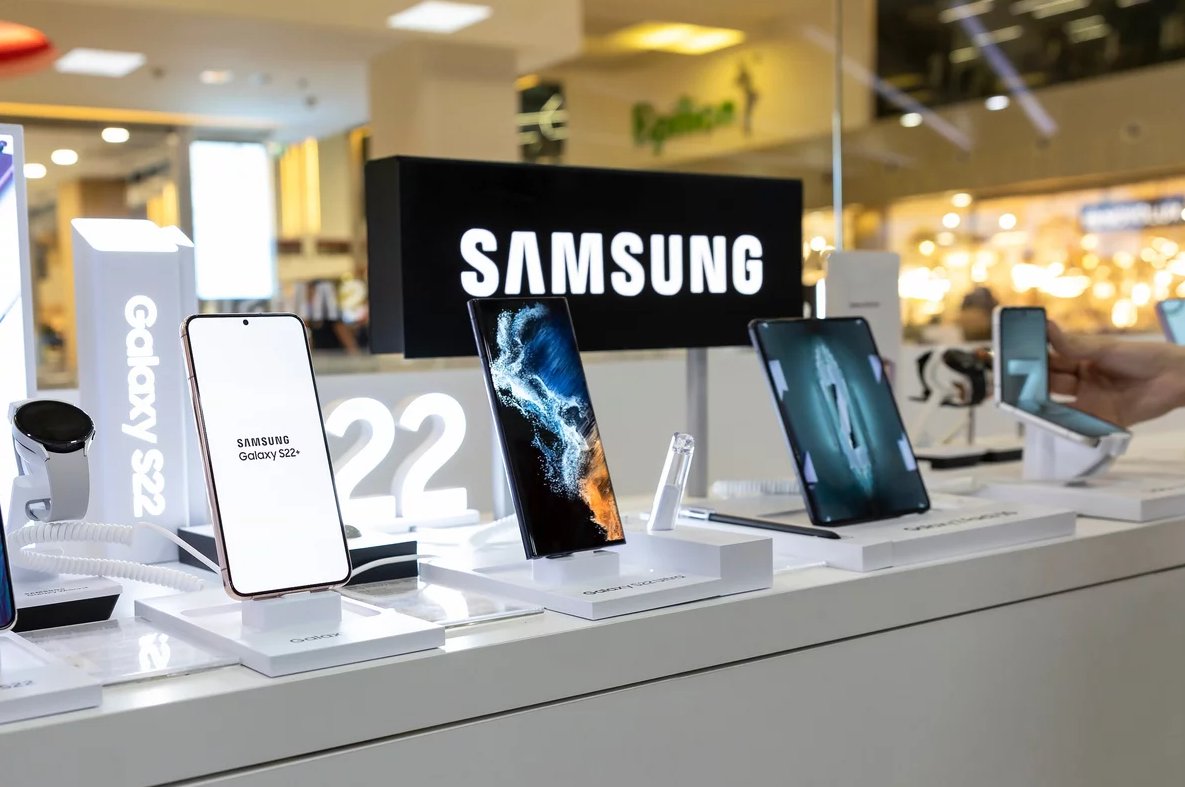
Samsung gained market share in the Middle East and Africa during the second quarter as a 10% decline in regional smartphone shipments and a memory-component shortage squeezed manufacturers concentrated in the entry-level segment.
Smartphone shipments across the Middle East and Africa fell 10% year over year in the second quarter of 2026, according to Counterpoint Research, with the market lacking a major sales-driving occasion during the period. The decline was uneven across manufacturers, with Samsung, realme and Apple recording significant growth even as several rivals lost share.
The result marks a shift in a market historically driven by affordable smartphones. With overall demand declining, Samsung’s gains largely came at the expense of competing manufacturers rather than from an expansion of the total market.

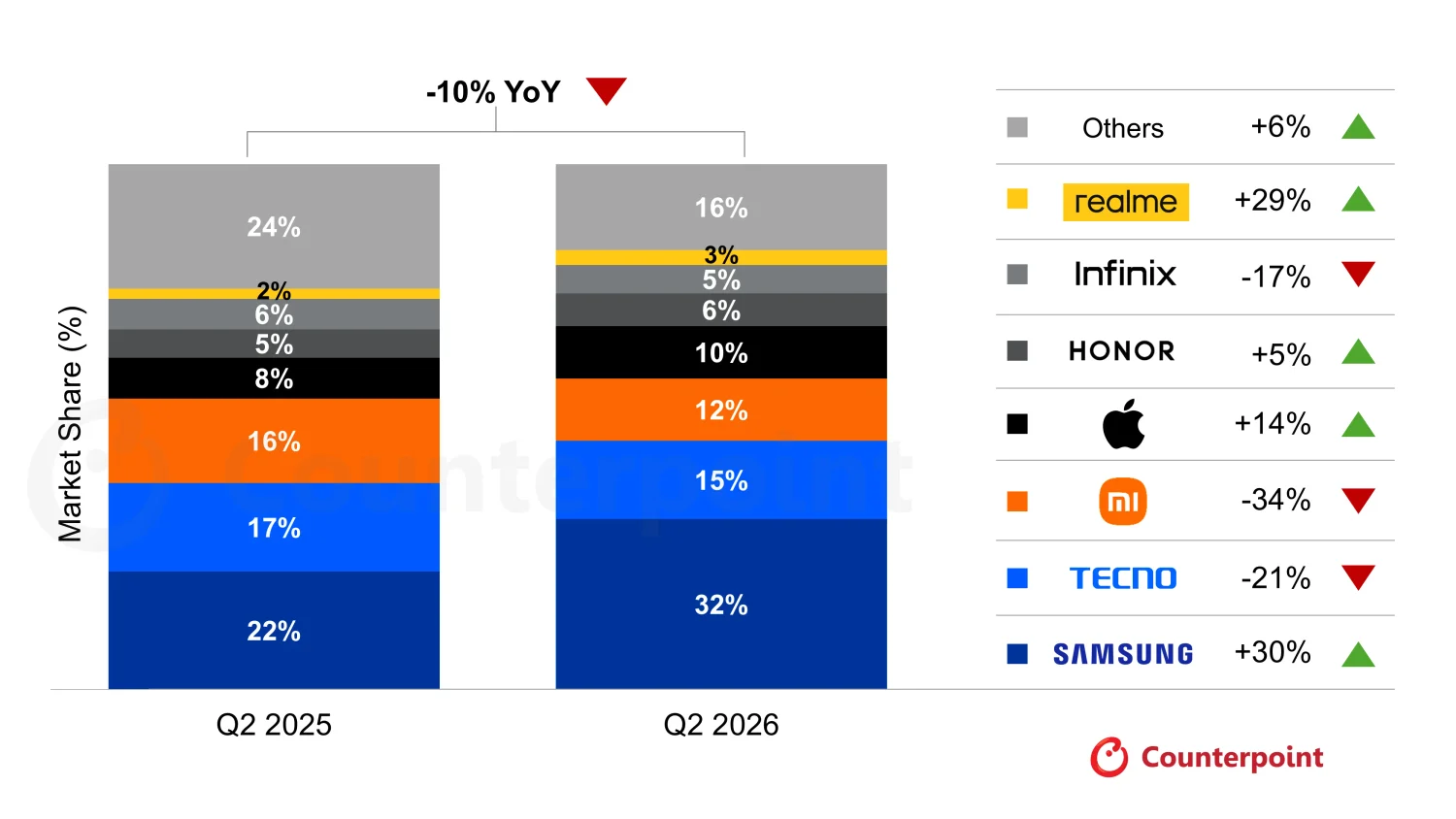
“Every unit Samsung gained came out of Infinix, TECNO and Xiaomi’s shares,” Counterpoint said, highlighting the scale of the competitive shift.
Samsung’s performance was supported by its Galaxy A07 and A17 models, as well as its recently launched Galaxy S26 flagship lineup. The combination gives the company exposure across both mass-market and premium price segments at a time when supply constraints are changing the economics of the smartphone industry.
Budget Phones Take the Biggest Hit
The sharpest pressure was concentrated at the bottom of the market.
Smartphone shipments priced below $250 declined 26% year over year in the second quarter, the steepest decline among all price bands, according to Counterpoint. The segment’s contraction weighed heavily on the overall MEA market because entry-level devices account for a significant share of smartphone volumes across the region.
The decline is closely linked to the ongoing memory-component shortage. Manufacturers facing constrained and more expensive memory supplies have been forced to prioritize higher-margin devices, reducing the availability of lower-priced models.


“The memory crisis hit the market hard, though unevenly,” said Ahmad Shehab, an analyst at Counterpoint Research.
“Transsion and Xiaomi were hit hardest,” Shehab said, because their sales volumes are concentrated in the entry-level segment, which is particularly exposed to the increase in memory costs.
That dynamic puts brands such as Infinix and TECNO, which are part of Transsion’s portfolio, under greater pressure in a market where affordability has traditionally been a major driver of smartphone adoption.
5G Moves in the Opposite Direction
While overall smartphone shipments declined, 5G shipments in MEA increased 8% year over year during the quarter.
That compares with global 5G smartphone shipment growth of only 1%, according to Counterpoint. The regional increase reflects both the relatively low 5G base in the second quarter of 2025 and the continued expansion of 5G networks and supporting policies across MEA.
Samsung and Apple were the primary contributors to the region’s 5G growth.
The divergence between total smartphone shipments and 5G shipments illustrates the changing composition of the market. Consumers are not necessarily rushing to buy more smartphones, but a greater share of the devices being sold are connected to newer networks and positioned higher up the technology and price curve.
For manufacturers, that creates an unusual form of premiumization.
The market is becoming more expensive not simply because consumers are demanding higher-end devices, but because component shortages are making it harder and less attractive for manufacturers to maintain aggressive volumes at the lowest price points.
Samsung Benefits From the Shift
Samsung is well positioned for that transition because its portfolio spans entry-level Galaxy A models through premium Galaxy S devices.
Its ability to serve multiple price points means the company can capture demand displaced by competitors while also benefiting from growth in higher-value smartphones.
The second-quarter results therefore give Samsung more than a temporary boost in market share. They could strengthen its competitive position if the supply constraints continue and consumers become accustomed to a market with fewer choices below $250.
Counterpoint said the gains made by Samsung, realme and Apple could make it more difficult for declining brands to recover their lost share because the market did not generate enough additional demand for every manufacturer to grow simultaneously.
That creates a potentially more durable competitive advantage for the companies that were able to maintain supply during the downturn.
Realme Turns Supply Into a Competitive Weapon
Realme’s performance provides another example of how manufacturers are responding to the constrained market.
The company expanded its presence in MEA even as its global smartphone shipments declined 23% year over year in the second quarter.
Rather than securing entirely new supply, realme allocated significantly more units to MEA, diverting supply from markets including India and China.
The strategy allowed the company to take advantage of demand that was left underserved as other manufacturers struggled with component constraints.
It also highlights a broader change in smartphone competition: in a supply-constrained market, market-share growth can increasingly depend on where manufacturers choose to send their available inventory.
For realme, MEA’s budget-oriented market became a strategic destination for that supply.
A Structural Shift for MEA’s Smartphone Market
The second-quarter results point to a smartphone market undergoing more than a temporary slowdown.
MEA’s traditional dependence on entry-level smartphone volumes is colliding with higher component costs and limited memory supply. The result is a market where the lowest price segment is shrinking rapidly while 5G and higher-priced devices gain ground.
Counterpoint expects the second quarter to be the weakest quarter of 2026, with the memory crisis adding to the impact of the shift in the Islamic calendar, which concentrated major first-half sales occasions in the first quarter.
For Samsung, the downturn has created an opportunity to widen its lead.
For Transsion and Xiaomi, the challenge is more difficult. Their exposure to entry-level volumes makes them particularly vulnerable when manufacturers have to ration scarce components toward more profitable devices.
The competitive landscape could therefore look different even after the memory shortage eases. Brands that lose distribution, shelf space and consumers during the downturn will have to spend to win them back, while Samsung can use its broader ecosystem and product portfolio to retain customers who move into higher-priced devices.
The central question for MEA’s smartphone industry is no longer simply how many phones consumers will buy. It is increasingly which manufacturers can secure enough supply, at which price points, and in which markets. For the second quarter, Samsung had the stronger answer.