


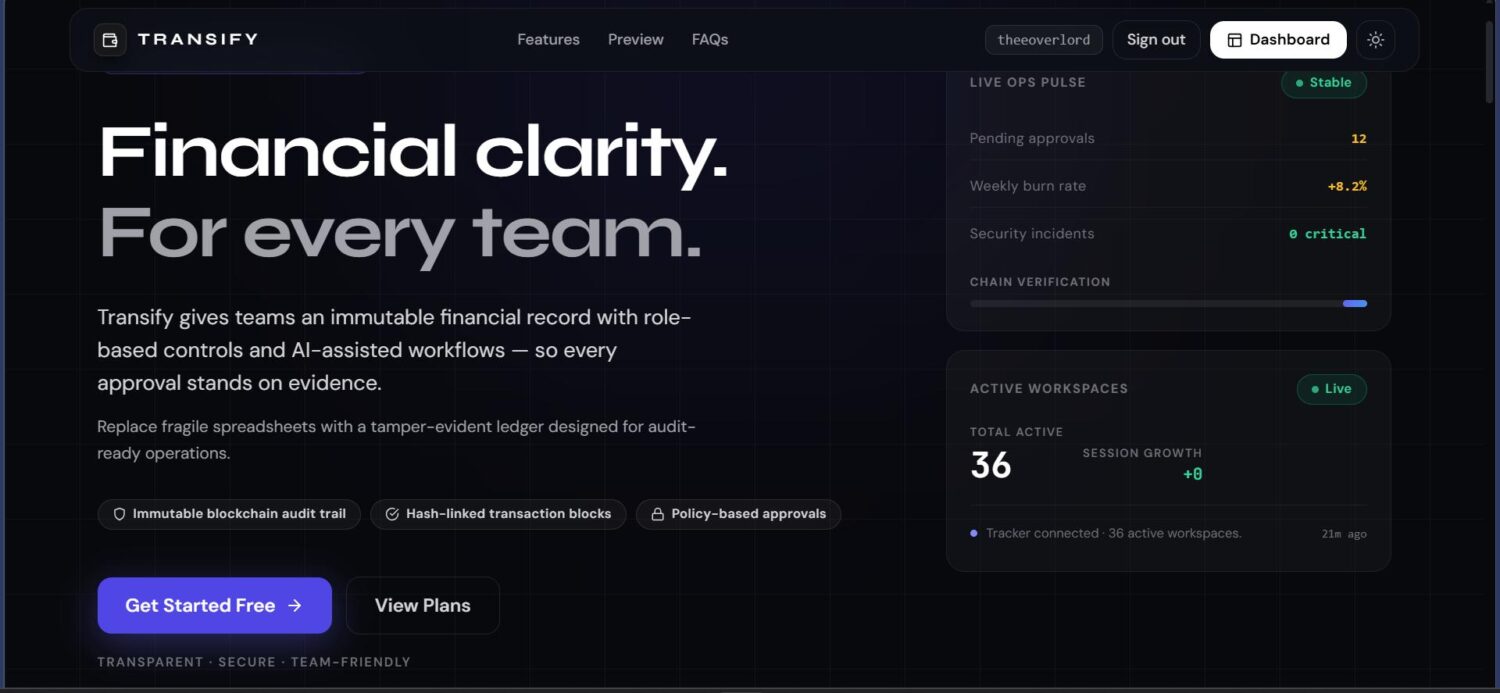
Transify, a Uganda-built financial governance startup targets SMEs, NGOs and schools with software that connects transactions to approvals, policies and audit trails.
Jay Egonda founded Transify around a question that many organisations struggle to answer: can they trace not just where their money went, but why it was spent, who approved it and whether the decision followed internal policies?
The Uganda-built business-to-business software-as-a-service (B2B SaaS) platform connects financial transactions with the approvals, supporting documents and decisions behind them. It also analyses financial activity to help organisations identify unusual patterns and potential risks.
Conceived in February 2026, Transify is now publicly available, with a free Basic plan alongside paid subscriptions. Rather than holding or transferring money, the platform operates as a financial governance and intelligence layer around existing financial activity.
Egonda is targeting small and medium-sized businesses, non-governmental organisations (NGOs), schools and donor-funded projects that need stronger financial controls without the cost of enterprise systems.
In this edition of TechMoran’s CEO Weekends, Egonda discusses the problem behind Transify, its subscription model, competition and plans to expand beyond East Africa.
What inspired you to build Transify, and who is on your founding team?
I started with a question: why should serious financial governance and intelligence be something only large corporations and governments can afford? Small businesses, NGOs and schools have just as much at stake in how money is managed, yet many still rely on spreadsheets, email, WhatsApp approvals and disconnected receipts. I wanted to make stronger financial visibility and control accessible to these organisations. Transify grew out of that idea.
How does Transify work, and what makes it different from accounting software?
Most finance tools tell you what was spent. Transify connects each transaction to the policy that applied, the evidence supporting it and the people who approved it. Organisations can establish budgets, spending limits, approval requirements and documentation rules, then use the platform to check transactions against those requirements. It also analyses financial activity to identify patterns and potential risks. We are not replacing accounting, banking or payment systems. We are building the intelligence and governance layer around them.
How does Transify make money, and what does each subscription plan offer?
We use a subscription model with three tiers. Basic is free, giving individuals and smaller organisations access to the core platform. Pro costs $29.99 per month and adds greater workspace and team capacity, unlimited transactions, AI-assisted transaction review, receipt scanning, summaries and data imports and exports. Elite costs $79.99 per month and adds board-ready reporting, behavioural insights, risk flagging, advanced analytics and additional administrative and security controls. Every tier includes an audit trail and tamper-evident sealing.
How big is the market, and which customers are you targeting first?
Our initial focus is SMEs, NGOs, donor-funded projects, schools and other organisations that need stronger financial visibility but lack the resources for enterprise systems. NGOs need to demonstrate accountability for funds, while growing businesses need better oversight as financial decisions become more complex. We are starting in East Africa, where we can build relationships directly and understand the operating environment. Our broader ambition is to serve organisations across African markets and eventually the Gulf.
Who are your main competitors, and how does Transify stand out?
We compete in a landscape that includes accounting software, expense-management tools, procurement systems and governance platforms. Our distinction is the combination of financial intelligence and governance. We connect the transaction to the rules, approvals and evidence behind it, while analysing financial activity for patterns and potential risks. During a meeting with an officer at a government procurement agency, I was struck when she compared the platform’s underlying model to their national e-procurement system. It reinforced my belief that this kind of infrastructure can be made accessible beyond governments and large enterprises.
How are you acquiring customers, and what are your plans for expansion?
We are starting in East Africa, where we can build direct relationships with organisations that need stronger financial controls. The platform is publicly available, including its free Basic plan, which gives prospective users an opportunity to explore it. As we expand into other African markets and eventually the Gulf, partnerships will be important. Our focus is on making the platform useful to organisations that need better oversight without adding the cost and complexity of large enterprise systems.
What is your long-term vision for Transify?
We want Transify to become a financial intelligence and governance infrastructure layer for organisations across African markets. We are starting with transactions because that is where financial accountability becomes concrete, but the opportunity extends to understanding financial behaviour, identifying risks earlier, enforcing internal policies and giving decision-makers a clearer picture of how money is managed. Africa has made significant progress in digitising financial transactions. We believe the next opportunity is to make the intelligence and governance around those transactions just as digital.