


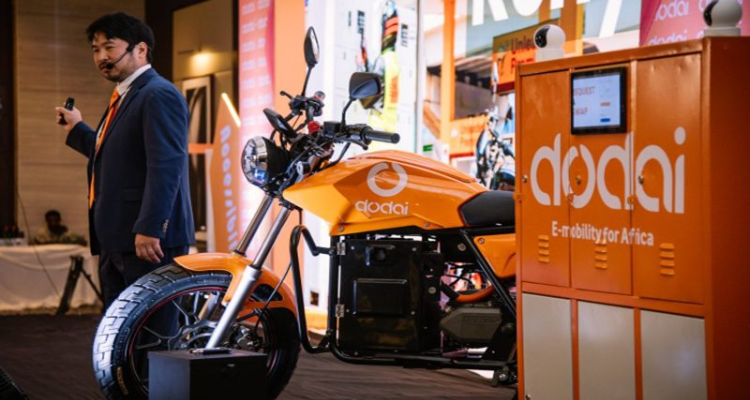
Ethiopian electric mobility startup Dodai has raised an additional $3 million from investors including Japanese energy giant Tokyo Gas and Singapore-based Kaneto Capital Management, bringing its Series A financing to $16 million as it accelerates the rollout of electric motorcycles and battery-swapping infrastructure in Africa’s second-most populous nation.
The latest investment follows a $13 million financing round announced in April, comprising $8 million in equity and $5 million in debt. Tokyo Gas participated through its wholly owned investment subsidiary, Acario Investment One, marking another move by Japanese investors into Africa’s emerging electric mobility industry.
The new funding will support Dodai’s expansion in Addis Ababa, where the company is building a network of battery-swapping stations designed to make electric motorcycles a commercially viable alternative to petrol-powered bikes.
Founded in 2023 by Yuma Sasaki, Dodai has deployed more than 2,000 electric motorcycles and employs approximately 100 people, most of them Ethiopian. Its business model combines motorcycle assembly and distribution with battery-swapping services, allowing riders to exchange depleted batteries for charged ones rather than wait for conventional charging.
The company says its electric motorcycles can reduce fuel and maintenance expenses by as much as 80% to 90%, a potentially significant saving for commercial riders and delivery operators whose earnings are heavily influenced by transport costs.
The investment comes as Ethiopia pursues one of Africa’s most aggressive transitions away from petrol-powered vehicles, creating opportunities for electric mobility companies while raising questions about whether the country’s electricity and charging infrastructure can support rapid adoption.
Ethiopia’s Electric Vehicle Push Attracts Foreign Capital
Ethiopia has emerged as an important testing ground for electric mobility following government restrictions on imports of fossil fuel-powered vehicles.
The policy has created a potentially lucrative market for companies offering electric alternatives, particularly as businesses and consumers seek to reduce exposure to fuel costs and supply constraints.
According to Ethiopia’s Ministry of Transport and Logistics, approximately 100,000 electric vehicles are operating on the country’s roads, although the industry remains concentrated in major urban centres.
For investors, Ethiopia presents an unusual combination of regulatory support, growing demand and significant infrastructure challenges.
While restrictions on conventional vehicle imports encourage adoption, unreliable electricity supplies, limited charging infrastructure and high insurance costs remain obstacles to the widespread use of electric vehicles.
Dodai is attempting to address part of that challenge through battery swapping, a model that separates the time required to recharge a battery from the time a motorcycle spends on the road.
Instead of leaving motorcycles idle for hours, riders can exchange discharged batteries at designated stations and resume operations within minutes.
The approach is particularly attractive to commercial motorcycle operators, whose ability to generate income depends on keeping vehicles in service.
Japanese Investors Deepen Africa’s Electric Mobility Exposure
The participation of Tokyo Gas adds a major Japanese energy company to Dodai’s investor base, highlighting growing international interest in Africa’s transition toward electric transport.
The company’s earlier Series A financing attracted British International Investment, Value Chain Innovation Fund, UTokyo Innovation Platform, Nagase & Co., Persistent ACV Fund, For Seasons, CBC Co. and Inclusion Japan.
The latest investment also brings Kaneto Capital Management, a Singapore-based family office investment firm, into the round.
The structure of the additional $3 million financing, including how much was provided as equity or debt, has not been disclosed.
For Tokyo Gas, the investment provides exposure to an emerging electric mobility market where the development of battery infrastructure could create opportunities beyond vehicle sales.
Dodai’s model depends not only on expanding its motorcycle fleet but also on developing a sufficiently dense network of swapping stations to support daily commercial operations.
That infrastructure requirement makes electric mobility a capital-intensive business, with operators needing to finance vehicles, batteries, charging equipment and distribution networks before achieving significant scale.
Competition Intensifies Across Africa
Dodai’s latest financing comes amid increasing investment in African electric motorcycle companies, particularly those combining vehicle distribution with battery-swapping infrastructure.
Kenyan electric mobility company ARC Ride recently secured $33.3 million through a combination of asset-backed debt and equity to expand its electric motorcycle operations and battery-swapping network.
Spiro, another major competitor, has attracted substantially larger investments, including $100 million announced in October 2025 and an additional $215 million in equity financing in June 2026.
Spiro says it has deployed more than 100,000 electric motorcycles and developed approximately 2,500 battery-swapping stations across markets including Kenya, Rwanda, Uganda, Togo, Benin, Nigeria and Cameroon.
The financing underscores growing investor appetite for electric two-wheelers, which are increasingly viewed as a practical entry point for transport electrification in African markets.
Motorcycles are widely used for commercial transport, deliveries and logistics, making them attractive targets for electrification because of their relatively high daily mileage and recurring fuel expenses.
Yet the sector’s rapid fundraising has also increased pressure on operators to demonstrate that their businesses can become profitable.
Battery-swapping networks require substantial upfront investment, while profitability depends on vehicle utilisation, battery replacement costs, electricity prices and the number of paying riders using each station.
For companies such as Dodai, the challenge will be converting growing demand for electric motorcycles into sustainable revenue without allowing infrastructure costs to outpace customer growth.
Dodai Targets 30,000 Riders and 1,000 Battery-Swapping Stations
Dodai plans to use the additional funding to expand its battery-swapping network and increase motorcycle adoption in Addis Ababa.
The company previously outlined plans to reach 3,000 active battery-swapping users supported by 30 stations within 12 months of its April 2026 funding announcement.
Over the following three years, Dodai aims to serve 30,000 users through a network of 1,000 battery-swapping stations in the Ethiopian capital.
That would represent a substantial expansion of its existing operations and require continued investment in batteries, charging infrastructure and customer acquisition.
Beyond Ethiopia, the company has identified Abidjan in Côte d’Ivoire, Kinshasa in the Democratic Republic of Congo and Accra in Ghana as potential future markets.
However, expanding into other African cities would expose Dodai to different regulatory environments, electricity infrastructure constraints and competitive dynamics.
The company has not disclosed its valuation, revenue or profitability, making it difficult to assess how its growing funding base translates into financial performance.
For investors, the more immediate test will be whether Dodai can achieve sufficient utilisation across its battery-swapping stations to support expansion without relying indefinitely on external capital.
Ethiopia’s policies have created an unusually favourable environment for electric vehicle adoption, but regulatory support alone may not guarantee commercial success.
Dodai’s $16 million Series A gives it additional capital to pursue that opportunity. Its ability to turn Ethiopia’s electric vehicle ambitions into a scalable and profitable business will determine whether it can compete with better-funded rivals across Africa.