



SEACOM has activated a new terrestrial fibre route between Nairobi and Kampala, expanding its East African backbone as demand for regional data transit capacity accelerates.
The corridor, which runs through Kisumu and connects major backbone nodes between Kenya and Uganda, increases the resilience and throughput of traffic flowing from Mombasa’s subsea cable landing systems into inland markets. The upgrade places additional capacity on one of the region’s busiest digital transit paths, which underpins cloud services, mobile operators and enterprise connectivity.
SEACOM said the route forms part of a broader effort to scale infrastructure along high-growth East African corridors as data consumption rises across financial services, cloud computing and digital platforms.
“We are strengthening a route that already plays a central role in regional connectivity,” said David Kariuki, chief technology officer at SEACOM. “This ensures the corridor is served by a high-capacity, carrier-grade network that can support the scale and performance required by today’s digital economy.”

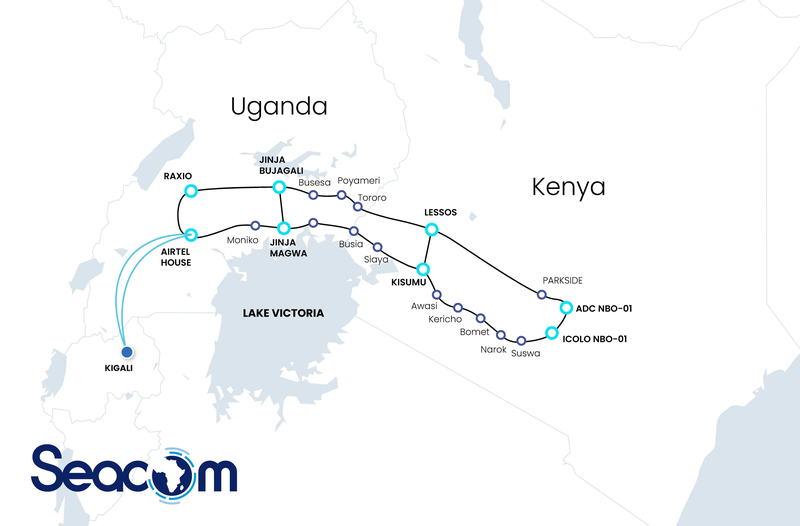
The Nairobi–Kampala link is a key segment in East Africa’s terrestrial fibre architecture, carrying traffic between Kenya, Uganda and onward to Rwanda, Burundi and South Sudan. Industry operators increasingly rely on such routes to balance latency, redundancy and international bandwidth access.
SEACOM said the system is built with Automated Switched Optical Network (ASON) technology, enabling traffic rerouting in under 50 milliseconds in the event of disruption. The company has also introduced route diversity across the A104 highway corridor and an alternative path via Narok, Kericho and Kisumu.
The network incorporates dual international border crossings at Malaba and Busia, reducing reliance on a single transit point and improving route resilience for cross-border data flows.
At launch, the corridor provides 1 terabit per second of capacity, scalable to 30 terabits per second. The system supports 1GE, 10GE, 100GE and 400GE interfaces, targeting carriers, cloud providers and enterprise customers.


Latency on the route is approximately 7 milliseconds to Nairobi and 13 milliseconds to Mombasa, according to the company.
The upgrade adds to SEACOM’s ongoing expansion of its East African backbone, as regional operators increase investment in fibre infrastructure to meet rising demand for cloud connectivity and digital services.