


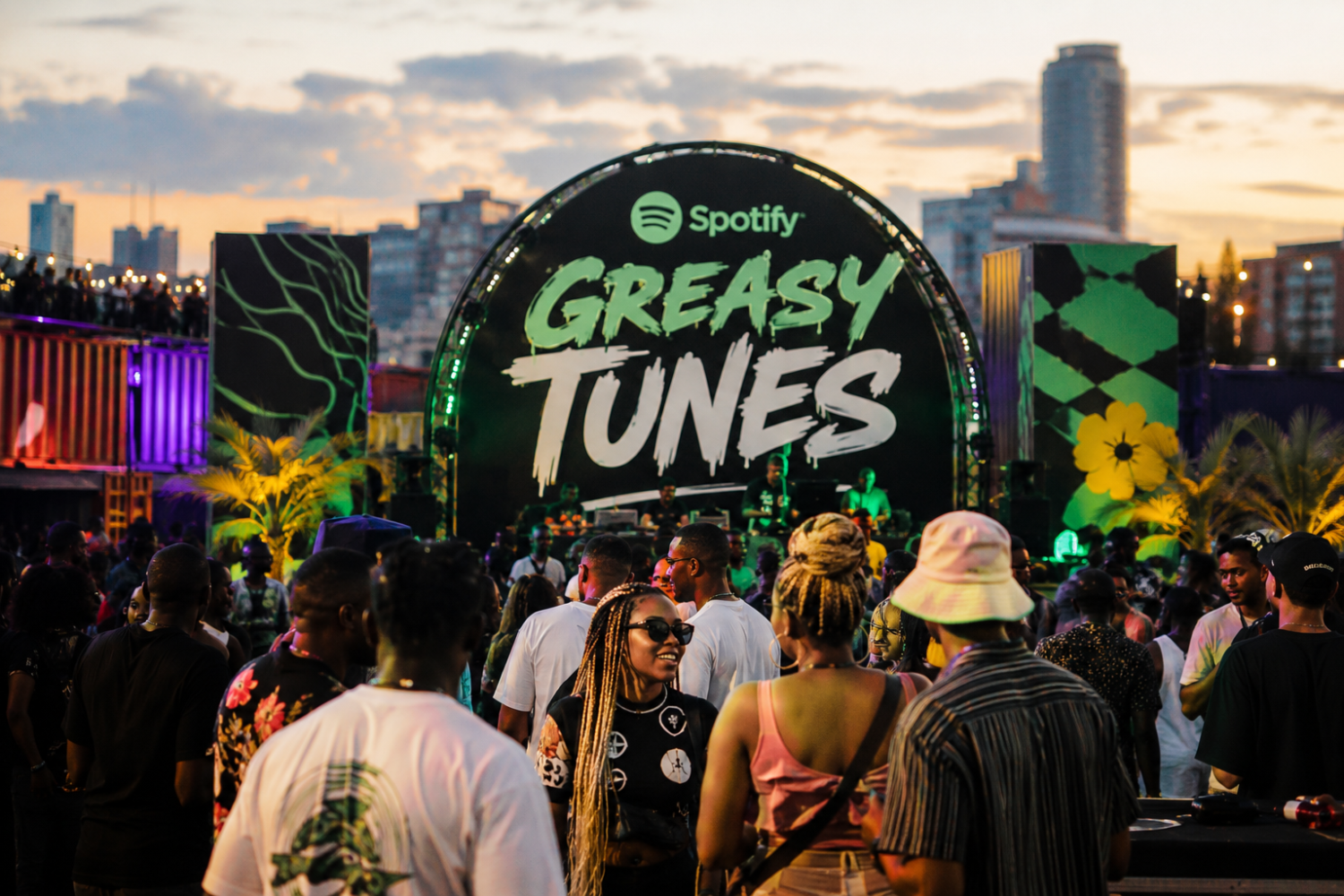
When Spotify launched Greasy Tunes in Johannesburg in July 2023, it looked like an experimental pop-up marrying music and food. Three years later, after expanding to Lagos in October 2025 and Nairobi from July 15–26, 2026, the initiative has evolved into something far more strategic: a blueprint for how the world’s largest audio streaming company plans to deepen its foothold in Africa.
Rather than relying solely on playlists, algorithms and digital advertising, Spotify is investing in physical experiences that bring together musicians, podcasters, chefs, fashion brands and creators betting that cultural relevance will prove as important as technology in winning the continent’s next generation of streaming users.
The strategy comes as global streaming platforms face slowing subscriber growth in mature markets and intensifying competition for attention from TikTok, YouTube, Instagram and Netflix. Africa, with the world’s youngest population and rising smartphone adoption, represents one of the industry’s largest long-term growth opportunities.
“Streaming has become table stakes,” said a Nairobi-based digital media executive familiar with the creator economy. “The platforms that win will be the ones that become part of people’s everyday lives.”
Three Markets, One Strategy
Spotify’s expansion of Greasy Tunes has followed a deliberate path.
The concept debuted in Braamfontein, Johannesburg, in July 2023, before moving to Lagos in October 2025, where it featured live podcast recordings and collaborations with local creative communities under the leadership of Phiona Okumu, Spotify’s Head of Music for Sub-Saharan Africa. Nairobi became the third African city to host the programme, with a 12-day activation running from July 15 to July 26, 2026, at Heltz House in Ngara, Nairobi.
The Kenyan edition was developed in partnership with The BAG, one of Nairobi’s best-known nightlife and events platforms, and Jikoni Studio Nairobi, bringing together 20 events spanning music, podcasts, comedy, sport, fashion and food.
Among the featured communities were Studio 18, Blueprint, Fishermans Experience, Standup Collective, Strictly Soul, Assembly, Nakili Session, Bambika TV and Ongeza Volume, alongside live recordings of Mic Cheque Podcast and 30 Percent Podcast.
Data Before Decisions
Unlike traditional brand activations, Greasy Tunes is built on Spotify’s own listening data.
According to the company, listeners aged 18 to 24 account for 53.7% of all Spotify streams in Nairobi, compared with 44.4% in Lagos and 29.9% in Johannesburg, making Kenya’s capital one of the platform’s youngest and most engaged streaming markets in Africa.
Spotify also found that the 6 p.m. to 9 p.m. period represented the largest food-related listening window for Nairobi’s Gen Z audience, accounting for 20.9% of daily listening among users in that age group.
Rather than treating those insights as internal analytics, the company transformed them into a marketing strategy centred on food.
The Greasy Tunes Café Kitchen was designed around the idea that “Nairobi’s dinner table has a soundtrack,” blending Kenyan street food with live music and community programming.
“What stands out in this data is not just that Kenyan artists dominate the dinner playlist, but that they sit naturally alongside names like Dave, Tems and Drake,” said Agnes Opondo, Spotify’s Artist and Label Partnerships Manager for East Africa, in announcing the Nairobi activation.
Building More Than a Streaming Platform
For Spotify, the business case extends well beyond customer acquisition.
By bringing together musicians, podcasters, comedians, chefs, designers and community organisers, the company is building an ecosystem that creates value for creators, advertisers and brand partners alike.
The approach mirrors strategies employed by companies such as Nike Inc., which built global running communities around its products, and Red Bull GmbH, whose investment in sports and entertainment transformed an energy drink into a media business.
Spotify appears to be following a similar path positioning itself not merely as a streaming service, but as a cultural platform.
That distinction matters in a market where music catalogues are increasingly similar and switching costs between streaming services remain low.
Why Kenya Matters
Spotify’s increased investment in Nairobi also reflects Kenya’s growing importance within Africa’s digital economy.
The country has become a regional hub for fintech, startups, digital media and creator businesses, while Kenyan artists continue gaining visibility across East Africa and beyond.
Spotify’s own June 2026 listening data showed Kenyan artists occupying seven of the top ten most-streamed tracks among Nairobi listeners aged 18–24 during the evening dinner window, led by Ywaya Tajiri, Wakadinali, Mutoriah, Toxic Lyrikali, Sauti Sol and Njerae, alongside international acts including Dave featuring Tems, Drake, and a regional collaboration between Alikiba and Bien.
For Spotify, those trends demonstrate that local music is no longer competing against international catalogues—it is increasingly growing alongside them.
The Bigger Bet
Greasy Tunes may look like a festival. For Spotify, however, it represents something more consequential: an investment in long-term market positioning.
As technology companies increasingly compete for attention rather than downloads, the companies that shape culture may ultimately prove more resilient than those that simply distribute content.
Africa’s next wave of streaming growth may therefore depend less on who offers the biggest music library and more on who becomes most embedded in the lives of the consumers listening to it.