


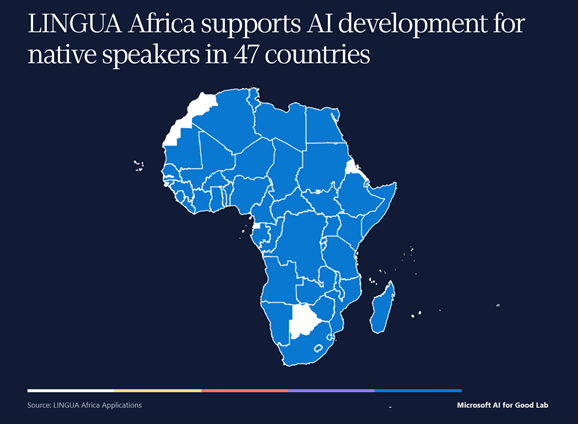
Twenty-six projects backed by Microsoft, Gates Foundation, Google.org and Masakhane will build African-language AI for healthcare, agriculture, education, justice and digital inclusion.
Africa’s AI revolution is expanding beyond the languages that have traditionally dominated the technology.
Twenty-six projects have been selected under LINGUA Africa, an initiative aimed at strengthening the language data, models and tools needed to make artificial intelligence more accessible to African communities. Together, the projects cover more than 50 African languages, dialects and sign languages spoken by more than 500 million people across 47 countries.
The initiative brings together the Microsoft AI for Good Lab, Gates Foundation, Masakhane African Languages Hub and Google.org, which are providing support designed to help African researchers, startups, universities, nonprofits and community-led organisations build language resources and practical AI applications.
The selected languages range from widely spoken languages such as Kiswahili, Hausa, Amharic, Wolof and Luganda to less digitally represented languages including Awngi, Tjwao, Doma, Medumba and Ghomala’. The projects are focused on areas where language can determine whether people can actually access and use digital services.
Healthcare, agriculture and education
Healthcare is one of the biggest areas of focus.
The World Health Organization’s Kenya-based AFYA-LINGUA project will build a community-grounded African-language layer for health covering Kiswahili, Hausa, Yorùbá, Lingala, Amharic, isiZulu, Chichewa, Wolof, Kinyarwanda and Crioulo.
At Makerere University in Uganda, researchers will build what the initiative describes as a maternal and child health speech dataset covering Luganda, Acholi, Dholuo, Dinka and Juba Arabic.
Crails will develop an open Luganda medical speech corpus and foundational models for clinical AI, while projects in Sierra Leone and Rwanda will explore AI-powered telemedicine and tools for community health workers.
Agriculture is another major focus. The Mohamed bin Zayed University of Artificial Intelligence will develop a multimodal vision-language AI system for agricultural advisory services across 10 African languages, including Hausa, Yoruba, Igbo, Twi, Wolof, Kiswahili, Amharic, Afaan Oromo, Luganda and Kinyarwanda.
In Kenya, AntuGrow will develop SemaShambani, a voice-first agricultural advisory and credit-literacy platform covering Kiswahili, Gĩkũyũ, Kikamba, Dholuo, Luhya and Kalenjin. The Alliance for a Green Revolution in Africa will also develop MlimiVoice Malawi, an AI platform designed to support smallholder farmers in Chichewa and Tumbuka.
Kenya emerges as a key participant
Kenya has several projects among the 26 selected initiatives. Besides the WHO and AntuGrow projects, Algedi Intelligence Labs has been selected for RADA, a project covering Kiswahili, Gĩkũyũ, Kamba, Dholuo, Maa, Kalenjin and Somali.
Ushahidi will work on open language resources for health and education in Tonga, Tjwao and Doma. The Kenyan projects reflect the broader objective of LINGUA Africa: creating AI resources that can work with languages people actually use in their communities rather than relying predominantly on English and other globally dominant languages.
The data problem behind Africa’s AI gap
One of the biggest barriers to developing effective AI for African languages is the lack of high-quality digital data. Many languages have limited collections of speech recordings, written material and other datasets needed to train modern AI systems. LINGUA Africa is therefore putting significant emphasis on creating open speech, text, multimodal and sign-language datasets, alongside automatic speech recognition and text-to-speech technologies.
HausaNLP, for example, will develop DialectBridge, focusing on Hausa dialects spoken in Kano, Sokoto, Zaria and Katsina. The Bantu Language Initiative will develop open voice infrastructure covering Lingala, Kituba and Kikongo in the Congo Basin. In Tanzania, Arusha Technical College will build TSL-Open, an open, community-led resource for Tanzanian Sign Language.
Other projects will develop resources for languages that have received relatively little attention from mainstream AI development, including Awngi in Ethiopia and Ghomala’, Medumba and Fe’efe’e in Cameroon.
Building AI around African realities
The 26 awardees include universities, startups, nonprofits, international organisations, research institutions and community-led initiatives.
Their projects span healthcare, agriculture, education, justice, journalism, public services and cultural preservation. That diversity points to a broader shift in African AI development: the focus is moving from simply adopting AI technologies to building the underlying infrastructure needed to make those technologies relevant to African users.
“AI only delivers value when people can actually use it, and language is the bridge,” said Inbal Becker-Reshef, Managing Director of the AI for Good Lab.
The same principle applies across sectors. An agricultural recommendation delivered in a language a farmer does not understand may never become useful advice. A health service that cannot communicate effectively with patients faces a similar limitation.
A bigger opportunity for African AI
The LINGUA Africa programme comes as governments, businesses and technology companies across the continent increase investment in artificial intelligence. But Africa’s AI opportunity is not only about building larger models or deploying more sophisticated applications.
It is also about ensuring those systems can understand the languages, cultures and contexts of the people they are designed to serve. The 26 projects selected by LINGUA Africa could help create that foundation by making more African-language data openly available and turning it into practical tools for healthcare workers, farmers, students, journalists, legal practitioners and communities.
With 50+ languages representing more than 500 million people, the initiative is targeting one of the most fundamental gaps in Africa’s AI ecosystem: making sure the continent’s linguistic diversity is represented in the technology shaping its digital future.