


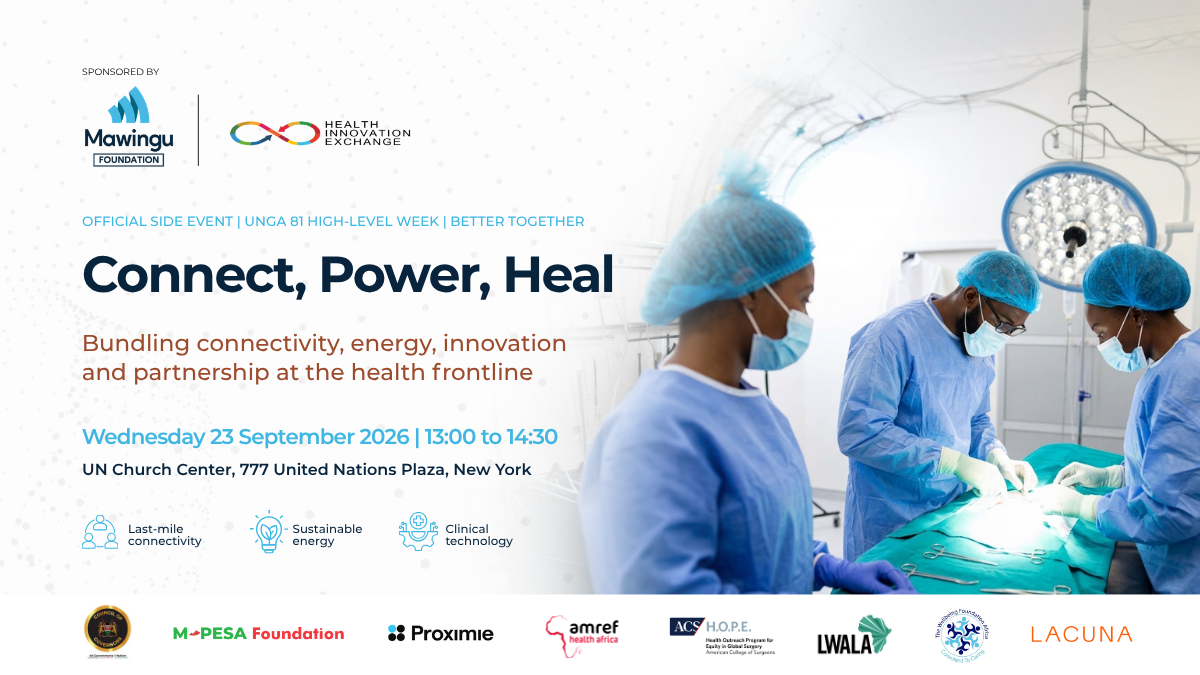
Mawingu Foundation is taking its push to expand internet access in underserved African communities to the United Nations this week, arguing that connectivity alone will not be enough to transform healthcare unless it is paired with reliable electricity, clinical technology and financing.
The foundation will convene government officials, healthcare providers, technology companies, development organizations and investors in New York on Wednesday for a discussion on how those pieces can be deployed together in rural and underserved communities.
The event, “Connect, Power, Heal: Bundling Innovation and Partnership at the Health Frontline,” comes as African healthcare systems face a familiar challenge: sophisticated medical technologies are becoming increasingly available, but the infrastructure required to operate them reliably remains uneven.
Mawingu says the problem is particularly acute outside major cities, where hospitals and clinics can have trained healthcare workers and modern equipment but lack dependable internet connections, electricity or access to specialists.
The company is seeking to shift the conversation from deploying individual technologies to building integrated infrastructure around the needs of frontline healthcare facilities.
“Healthcare transformation cannot be achieved through technology alone,” Farouk Ramji, chief executive officer of Mawingu, said. “Reliable internet connectivity, reliable energy, clinical technology and strong partnerships need to come together around the realities of the communities and health workers we are seeking to serve.”
From connectivity to healthcare infrastructure
Mawingu has built its business around providing internet access to rural and peri-urban communities, areas that have historically been less attractive to conventional telecommunications infrastructure providers.
The company says it now connects more than 35,000 homes and businesses across 31 counties in Kenya and operates more than 200 base stations. Founded in Nanyuki in 2012, Mawingu expanded into Tanzania in 2024 through the acquisition of Habari Tanzania.
The foundation, its social-impact arm, has increasingly focused that connectivity on institutions such as health centers, schools and technical and vocational education facilities.
That experience is now being applied to healthcare, where the foundation sees connectivity as enabling infrastructure rather than an end product.
A rural health facility may, for example, have a clinician capable of performing a complicated procedure but lack a reliable connection to a specialist elsewhere. Likewise, a hospital may have advanced equipment but insufficient power to operate it consistently.
“Reliable connectivity is what enables access to specialist surgical services in rural and underserved communities,” said Dr. Shannon Shibata-Germanos, head of global health at Proximie.
The foundation’s argument is that these infrastructure constraints are interconnected. Solving only one of them can leave the underlying healthcare system unable to take advantage of the others.
Makueni, Kilifi provide test cases
The discussion at the UN will draw on projects already underway in Kenya.
Mawingu says it has worked with partners to connect 17 public health facilities in Makueni County, while the Council of Governors, Amref Health Africa and the M-PESA Foundation have been involved in bringing Proximie technology to Kilifi County Referral Hospital.
Those projects illustrate the model Mawingu wants to expand: connectivity, clinical technology and eventually reliable power delivered around a specific healthcare need rather than developed as disconnected infrastructure projects.
For Proximie, which provides technology designed to support remote surgical collaboration, the availability of a dependable connection can determine whether specialists are able to participate in procedures taking place far from major medical centers.
“No single operator, funder or technology partner can do that alone,” Shibata-Germanos said, adding that the next step is to incorporate reliable power and develop a model that can be replicated across East Africa and other underserved markets.
The financing problem
The bigger challenge may be financial.
Deploying broadband, energy systems and clinical technology simultaneously can require more capital upfront than funding each intervention separately. Mawingu wants governments, investors and technology companies to consider financing structures around the combined outcome rather than individual pieces of equipment or infrastructure.
That means developing partnerships in which governments provide an enabling policy and delivery environment, technology companies build around existing infrastructure constraints, healthcare organizations identify clinical priorities and investors create financing mechanisms capable of supporting longer-term deployment.
The objective is to turn successful pilots into repeatable infrastructure projects that can be deployed across multiple facilities and markets.
“Scale requires a different approach to partnership,” Ramji said. “We need to move from isolated projects to models where technology providers, governments, investors and healthcare organisations can align around a shared outcome.”
That question is increasingly important for African governments and development organizations as digital healthcare initiatives move from pilot programs toward broader deployment.
Mawingu’s UNGA discussion will therefore focus less on whether the technologies exist and more on whether the surrounding infrastructure and financing systems are capable of supporting them at scale.
From UN commitments to implementation
The event also comes roughly a year after partners made commitments during the UN General Assembly to advance digital surgical capabilities and last-mile connectivity across sub-Saharan Africa.
Mawingu says the focus has now shifted from commitments to implementation: what has actually been delivered, which models have worked, what obstacles have emerged and what can be learned from the healthcare workers implementing the technologies.
For the foundation, the distinction is important.
In underserved communities, the problem is often not a shortage of potentially useful technology. Instead, the difficulty lies in creating the infrastructure and financing environment that allows those technologies to operate consistently and reach patients.
A broader digital inclusion strategy
The healthcare initiative forms part of Mawingu Foundation’s broader digital-inclusion agenda.
The foundation works with local and international partners to connect community institutions, including health centers, schools and technical and vocational education centers. Through partnerships including one with Microsoft, it has helped connect educational and community institutions, including special schools serving more than 2,523 pupils with special needs.
It has set an objective of positively impacting 1 million Africans by 2028, reflecting a strategy that goes beyond providing household internet access to using connectivity as infrastructure for access to education, healthcare and economic opportunities.
The healthcare push could extend that model into one of the most infrastructure-intensive areas of public service delivery.
Rather than treating broadband as the final product, Mawingu wants it positioned alongside electricity, medical technology and capital as part of the infrastructure required to deliver healthcare in places where specialist services and advanced facilities are often concentrated in urban centers.
What comes next
The UNGA81 session will be a 90-minute moderated dialogue and will include a short film showing conditions on the healthcare frontline.
The discussion will center on three questions: how connectivity, energy and clinical technology can be integrated; how such deployments can become financially sustainable; and how successful projects can be expanded beyond individual hospitals and communities.
The event is being convened by Mawingu under the auspices of the Health Innovation Exchange and Proximie, with the Council of Governors, M-PESA Foundation, Amref Health Africa, Wellbeing Foundation Africa, Lacuna Global Health and other partners participating.
For Mawingu, the longer-term opportunity is to demonstrate that digital infrastructure can play a larger role in public-service delivery across Africa.
The foundation says the goal is not simply to connect a hospital, provide electricity to an operating theatre or install clinical technology separately, but to treat the health frontline as a single infrastructure system.
The New York meeting will test whether governments, investors, technology companies and healthcare organizations can turn that concept into projects that are commercially and operationally sustainable.
“Better Together is more than a theme,” Ramji said. “It is a practical principle for how we need to approach some of the most complex development challenges.”
The UNGA81 side event will take place on Sept. 23, 2026, from 1 p.m. to 2:30 p.m. at the UN Church Center, 777 United Nations Plaza, New York.