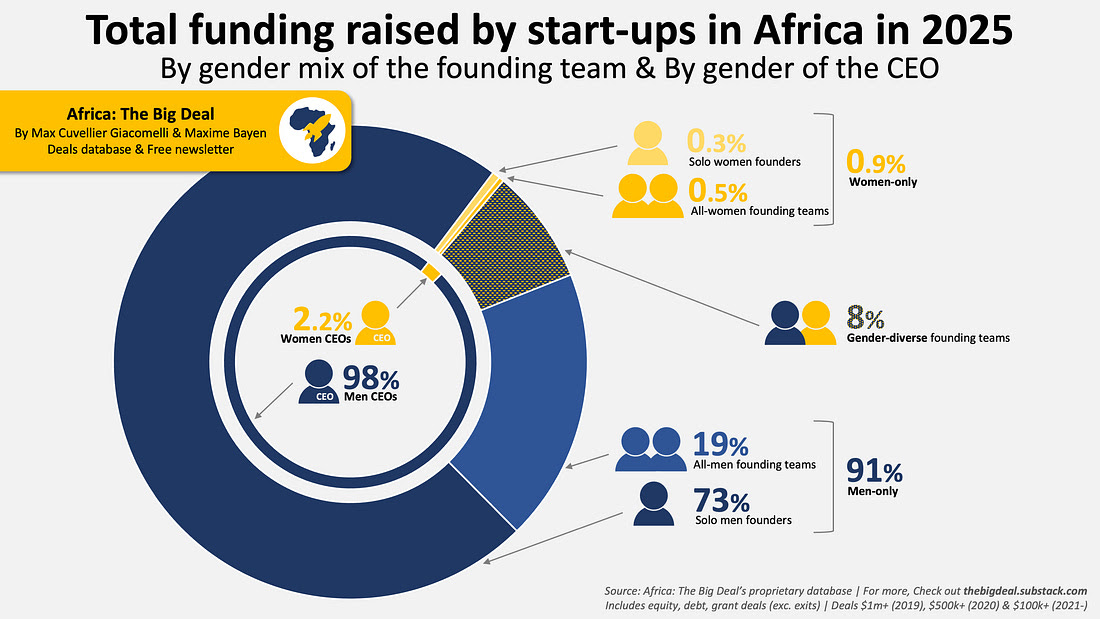
The gap between male and female entrepreneurs in Africa has reached a startling new low, as fresh data reveals that women-led start-ups are receiving a smaller slice of the investment pie than they were four years ago.
In a report titled ‘Crumbs, basically’, analysts at Africa: The Big Deal have highlighted a “dismal” trend in the continent’s tech ecosystem.
“Despite years of advocacy for diversity, the proportion of funding flowing to all-male teams has actually increased, leaving women-led ventures struggling for survival,” the report stated.
According to the report, back in 2021, the funding split already appeared heavily skewed, with less than 1% of capital going to all-female teams, 18% to gender-diverse teams, and 81% to all-male teams.
However, four years of supposed progress has resulted in a regression.
By 2025, the report highlights that the share for all-male teams surged to 91%, while gender-diverse teams saw their portion plummet to just 8% and all-female founding teams remained stagnant at less than 1%.
“While these figures represent a marginal technical improvement over 2024, where male teams took 93%, industry experts argue there is “no real cause for celebration.“
There is, however, one area where women appear to be competing on equal footing: the world of non-dilutive grants. In 2025, women claimed a significant 20% share of all grant funding, while gender-diverse teams secured 42%.
Nevertheless, this “silver lining” is thin. Grants represented a mere 1.5% of the total capital invested in African start-ups last year, amounting to only $46m out of a total $3.2bn pool.
The struggle is particularly evident when looking at the “big ticket” rounds. When examining the number of individual start-ups raising at least $100,000, the split is slightly less dramatic: 7% for women, 17% for diverse teams, and 75% for men. Yet, this remains the lowest share recorded for female-involved ventures since 2021.
Furthermore, the leadership statistics are equally “dreadful.” In 2025, only 2.2% of all funding on the continent was invested in companies with a woman CEO.
“This is the lowest proportion recorded since tracking began in 2019, falling even below the previous record low of 2.3% in 2024.If debt and grants are removed from the equation, the share of female-led companies raising significant capital falls to just 8%—another all-time low,” the report highlighted.
Despite the “startling new low” in funding statistics, Kenya remains a powerhouse for female-led innovation.
Below are several prominent startups founded by solo women or all-women teams, categorized by their sector.
Health-Tech & Med-Tech
Lami Technologies: Founded by Jihan Abass (Solo Founder). Lami is a digital insurance platform that enables businesses to offer insurance products via API. It has raised over $1.8M in seed funding.
AshaCare: A health-tech startup providing tailored community healthcare solutions. It recently secured KES 1.3M in seed funding from the 2025 Standard Chartered Women in Tech (WiT) cohort.
UzimaNexus: A digital healthcare operating system focused on patient transparency and efficiency.
Fintech & Business Services
Pezesha: Founded by Hilda Moraa (Solo Founder). A digital marketplace that connects small businesses with working capital through a collaborative approach.
Juakali Workers: Founded by Judith Owigar (Solo Founder). An online platform that connects skilled manual workers in the informal sector with clients.
MAMA Social Ventures: Founded by Kitawa Wemo. A venture builder and support network specifically for female-led social enterprises.
Sustainability & Agritech
Kavalian Limited: Founded by Anna Chari. This startup manufactures eco-friendly construction tiles from recycled plastic and agricultural waste.
Pollen Patrollers: An agritech startup building IoT and AI hive-monitoring technology to reduce bee colony loss.
Grounded: A women-run manufacturer of non-toxic, eco-friendly cleaning products made from local Kenyan ingredients.
Consumer & Creative Industries
Busu Skincare: A beauty brand developing natural skincare products using locally sourced African ingredients.
Tuwe Bora: A sustainable textile brand producing handcrafted fashion and recycling textile waste.
While the overall “investment pie” for women has shrunk, specialized accelerators continue to bridge the gap. In November 2025, the Standard Chartered Women in Tech program awarded KES 9.1 million ($70,000 approx.) specifically to seven female-founded Kenyan startups to help them scale.