

A young Kenyan HR-tech start-up, Hafinen, is repositioning itself as a connected people platform, arguing that as organisations grow, human resources can no longer remain an administrative afterthought.
The venture was Co-founded in 2024 by Janis M’imiemba and Sam Wakeneya.
“When we first launched Hafinen, the goal was simple: help teams bring structure to their people operations,” says co-founder and Chief Executive Officer (CEO), Janis M’imiemba.
At the outset, organisations used the platform to manage staff records, handle basic HR processes and coordinate early hiring workflows.
However, as clients expanded, the founders say a new reality emerged.
“But as our customers grew, something became clear very quickly: HR challenges don’t scale linearly.”
Indeed, growth, they argue, introduces complexity — “More people. More roles. More compliance. More accountability. More need for visibility and alignment.”
At that stage, HR shifts from being “administration” to becoming operations.

It is against this backdrop that the three-person company decided to rebuild its product architecture.
“This is why we rebuilt Hafinen — not to add more features, but to create a connected people platform that reflects how modern teams actually work,” Ms M’imiemba explains.
At the heart of the overhaul is what the start-up calls a “unified operational core”. The premise, the founders say, is that any effective HR system must deliver three fundamentals: visibility, control and consistency.
Consequently, the redesigned platform connects previously siloed functions into a single structure.
A comprehensive dashboard now brings together workforce statistics, hiring trends, staff growth data, announcements and a shared organisational calendar for meetings, holidays and events.
Rather than switching between separate modules, teams can view a real-time snapshot of activity across the organisation.
In addition, as companies scale, governance becomes critical. Hafinen has introduced role-based access control, fine-grained permissions per module and a clear separation between administrative and operational roles.
The aim is to protect sensitive data while maintaining collaboration.
More broadly, Hafinen says it operates across the full employee lifecycle, with a focus on enabling data-driven people decisions at scale.
Its platform spans talent acquisition, payroll, workforce analytics, performance management, employee engagement and retention, bringing what it describes as “traditionally siloed functions into a unified intelligence layer”.
“The goal is not simply to digitize HR workflows, but to equip decision-makers with actionable insights that improve both business performance and employee outcomes,” Ms M’imiemba says.
Geographically, the company operates across Kenya and other East African markets, with expansion underway in West Africa.
As it grows, it says it localises for regulatory, cultural and labour law differences to ensure responsible support for global organisations.
In essence, Hafinen positions itself as a strategic partner to HR and business leaders seeking to attract, develop and retain talent in an increasingly competitive, data-driven environment.
The rebuild extends into multiple operational areas.
Staff management now serves as the backbone of the platform, covering employee profiles and records, promotions, transfers and trips, awards, warnings, complaints and disciplinary actions, resignations and terminations, as well as performance goals, indicators and reviews. Supporting structures, including branches, departments, designations, contract types, document types, onboarding checklists and announcements — are designed to promote consistency.
Attendance and leave management have been integrated with organisational calendars.
The system supports leave policies and balances, leave applications and approvals, attendance tracking and regularisation, shift management and attendance policies.
Holidays can be categorised and applied organisation-wide to reduce scheduling conflicts.
Meanwhile, contracts and company documentation now sit within a structured system.
Employers can create and manage staff contracts, track renewals and contract history, store policies and procedures, require and record employee acknowledgements and use document templates for standardisation.
Training and development modules allow organisations to create training programmes, schedule sessions, track participation and classify training types, aligning learning initiatives with performance goals.
The platform also incorporates meeting management enabling teams to schedule meetings, track attendees, record minutes and assign and follow up on action items; alongside time tracking tools that log work hours and project time, with approval workflows and reporting features.
Recruitment covers job requisitions and postings, candidate sourcing and tracking, interviews, assessments and feedback, as well as offers and onboarding.
Job categories, locations, interview types, candidate sources and offer templates aim to introduce structure into hiring processes.
In addition, asset management tools allow organisations to register company assets, assign them to staff, track usage and maintenance, and monitor depreciation and asset reports.
Payroll functionality includes salary components and configurations, payroll runs and employee payslip access and downloads.
A centralised media library enables teams to upload and organise files, store documents and images, and reuse assets across the platform.
Funding ambitions and future plans
Despite its broad product scope, Hafinen remains lean. The firm has five employees including and is currently seeking funding.
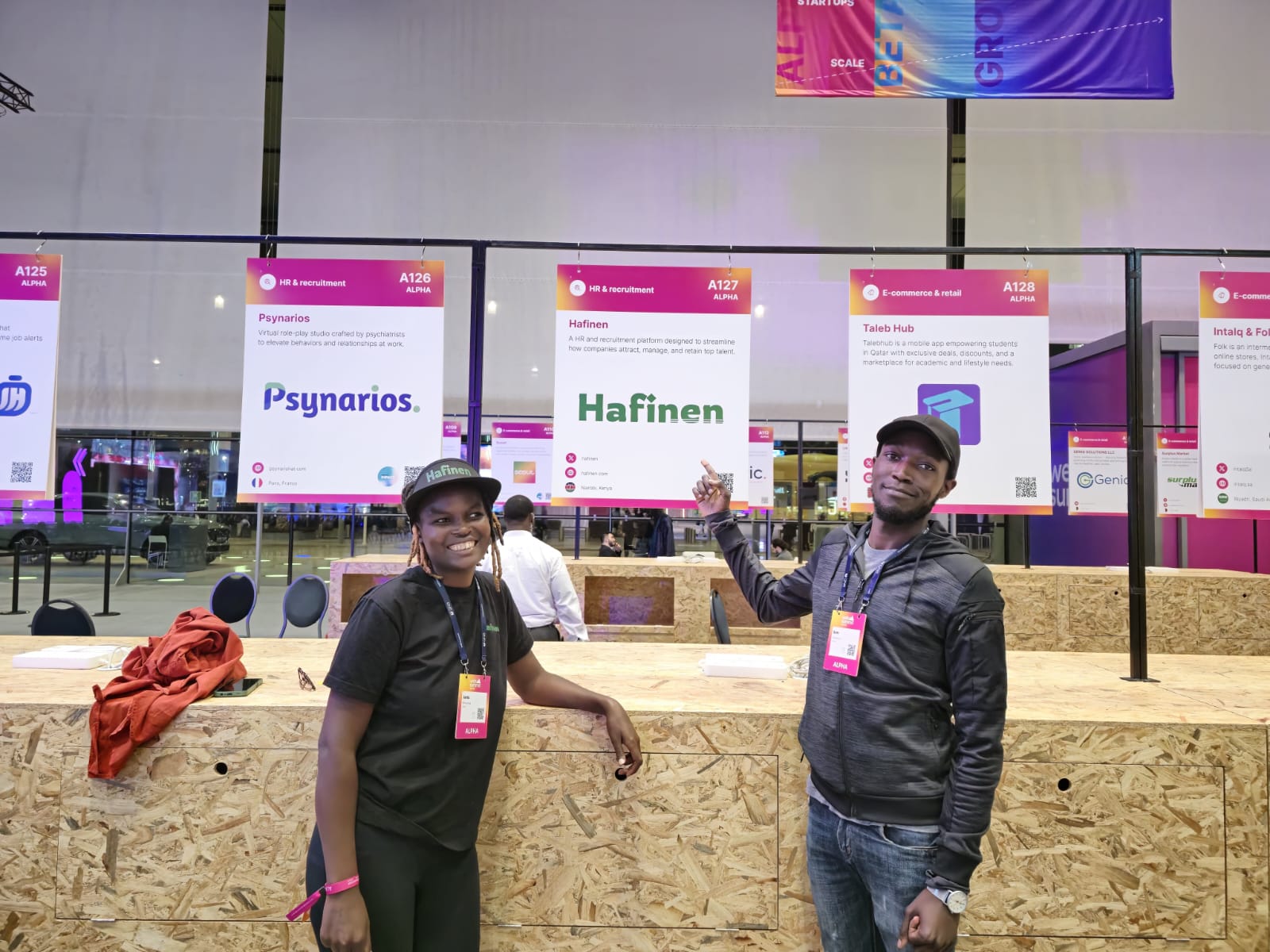
Its founders have participated in lots of tech networking events in Kenya and beyond, notably Africa Tech Summit side events and Web Summit in Qatar.
Looking ahead, the company says its five-year ambition is to become a category-defining workforce intelligence platform.
“Over the next five years, our goal is to become a category-defining workforce intelligence platform,” Ms M’imiemba says. “We plan to deepen our AI capabilities so companies can move from reactive HR processes to predictive, data-driven workforce decisions.”
This, he adds, will include expanding beyond hiring into skills intelligence, internal mobility, performance, payroll and retention — “all powered by responsible, explainable AI”.
Geographically, Hafinen aims to scale beyond Africa into a stronger global presence, while also moving further upmarket into large, global enterprises.
“In short, our five-year vision is to become the intelligence layer behind modern people strategy, helping organizations build, deploy, and retain talent more effectively at scale.”
For existing customers, the company says the underlying concepts will remain familiar, but the system is now “deeper, more connected, and more scalable”.
“This rebuild focuses on preserving continuity, improving clarity, reducing fragmentation, supporting growth without workarounds,” Ms M’imiemba notes.
And while the overhaul marks a significant milestone, he insists it is only the beginning.
“This rebuild is not a finish line. It’s a foundation.”
As Kenya’s HR-tech sector continues to evolve, Hafinen is betting that connected data — rather than disconnected tools — will define the next phase of workplace management.