



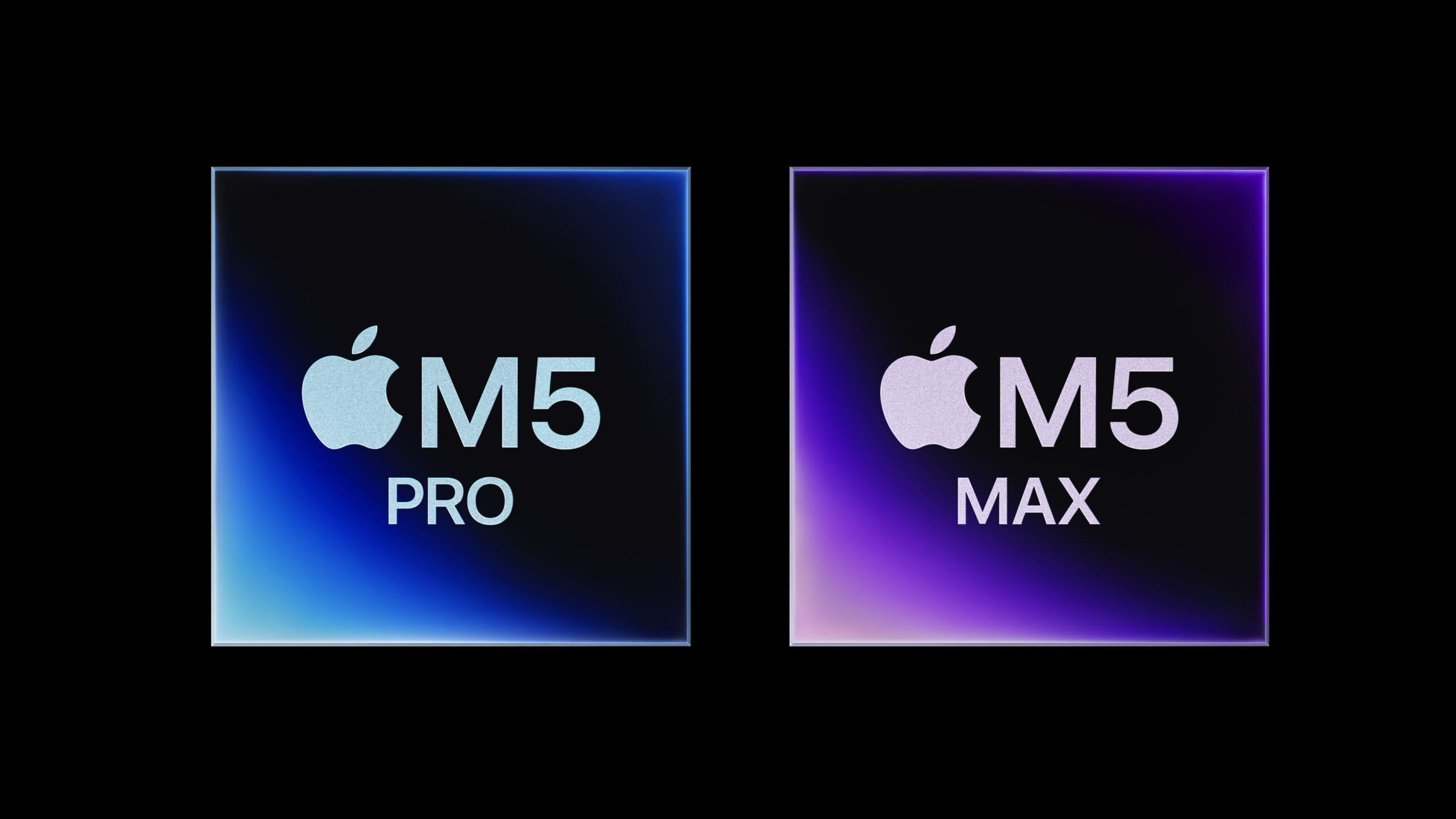
Apple on Tuesday unveiled its new M5 Pro and M5 Max chips, introducing an Apple-designed Fusion Architecture aimed at delivering major gains in CPU, GPU and on-device AI performance for professional users.
The new processors will power the latest MacBook Pro models, which Apple said will be available for pre-order starting Wednesday, with shipments beginning March 11.
Built using third-generation 3-nanometer technology, M5 Pro and M5 Max combine two silicon dies into a single system-on-a-chip (SoC), integrating the CPU, GPU, Neural Engine, Media Engine, unified memory controller and Thunderbolt 5 support. Apple says the design delivers higher bandwidth and lower latency while maintaining power efficiency.
Both chips feature a new 18-core CPU made up of six high-performance “super cores” and 12 newly designed performance cores optimized for multithreaded workloads. Apple said the architecture delivers up to a 30% performance boost for demanding professional tasks, with multithreaded performance up to 2.5 times faster than the M1 Pro and M1 Max.
Graphics performance also sees a significant jump. M5 Pro supports up to a 20-core GPU, while M5 Max scales to as many as 40 GPU cores. Each GPU core includes a Neural Accelerator, enabling Apple to claim more than four times the peak GPU compute for AI workloads compared with the previous generation. Ray-tracing performance improves by up to 35% on M5 Pro and up to 30% on M5 Max versus their M4 counterparts, Apple said.
Memory bandwidth has also been expanded. M5 Pro supports up to 64GB of unified memory with bandwidth reaching 307GB/s, while M5 Max supports up to 128GB with bandwidth up to 614GB/s — a key advantage for large 3D scenes, simulations and large language model workloads.
“M5 Pro and M5 Max are a monumental leap forward for Apple silicon,” said Johny Srouji, Apple’s senior vice president of Hardware Technologies. “They deliver an unparalleled combination of performance, efficiency and on-device AI capabilities for MacBook Pro.”
Additional features across both chips include a faster 16-core Neural Engine, an updated Media Engine with AV1 decode and ProRes acceleration, always-on Memory Integrity Enforcement for enhanced security, and Apple’s most advanced implementation of Thunderbolt 5 to date.
Apple said the improved performance-per-watt of the new chips also supports its Apple 2030 goal to make the company carbon neutral across its entire footprint by the end of the decade.