


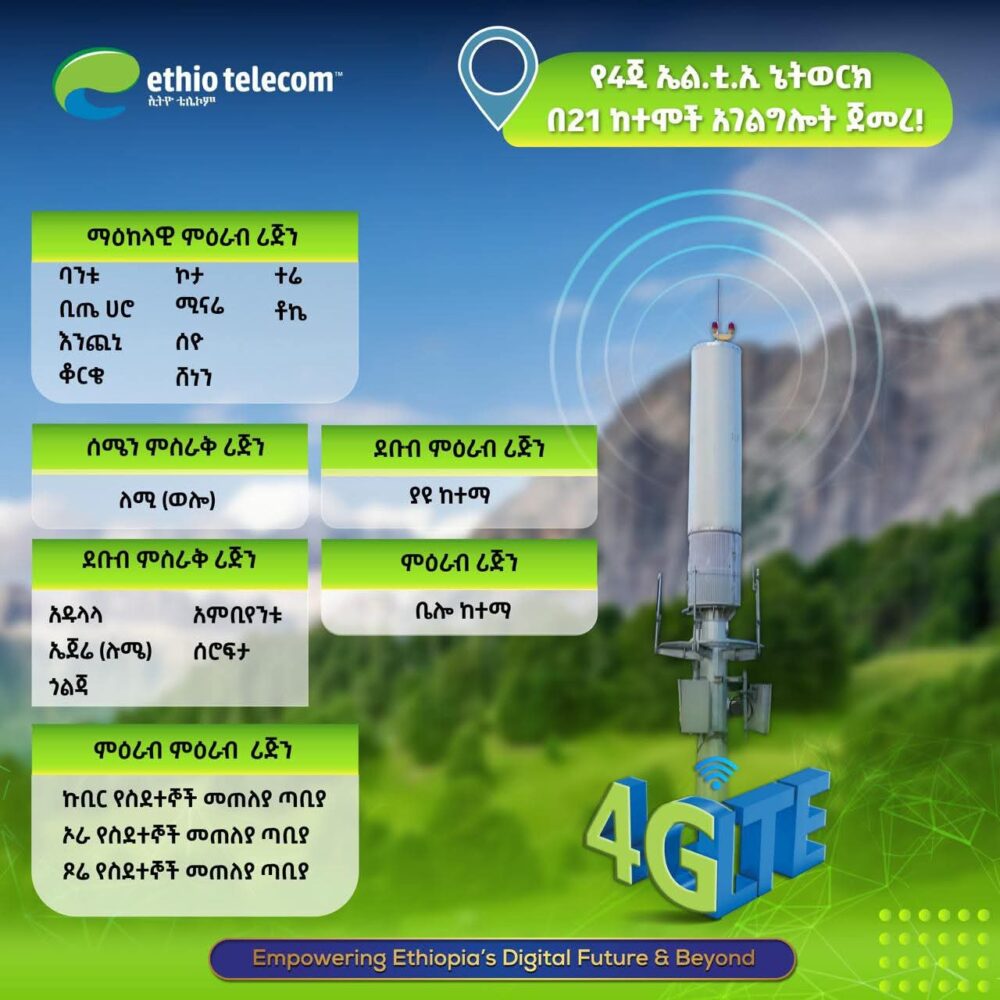
Ethio Telecom has expanded its 4G LTE mobile network to 21 additional cities across Ethiopia, significantly extending high-speed mobile broadband access to a broader range of urban populations and economic zones.
The rollout introduces enhanced mobile data capabilities in a mix of regional capitals and fast-growing secondary cities, reflecting the operator’s continued push to bridge connectivity gaps beyond the country’s primary metropolitan areas such as Addis Ababa. By targeting emerging urban centers, Ethio Telecom is positioning itself to support Ethiopia’s decentralizing economy, where growth is increasingly driven by regional trade, manufacturing hubs, and digital entrepreneurship.
This expansion is expected to improve access to faster, more reliable internet services for both consumers and businesses. For individuals, it enhances everyday digital experiences such as streaming, mobile banking, e-learning, and social connectivity. For enterprises—particularly small and medium-sized businesses—it unlocks opportunities for e-commerce, cloud-based operations, and digital payments, all of which are becoming critical to competitiveness in a rapidly digitizing economy.
The deployment builds on Ethio Telecom’s broader network modernization strategy, which includes continuous upgrades to infrastructure, increased investment in fiber backhaul, and optimization of existing mobile sites. By strengthening its 4G LTE footprint, the operator is enhancing network capacity and reducing congestion, ultimately improving service quality and user experience as mobile data consumption continues to surge nationwide.
The expansion also comes at a time when Ethiopia’s telecommunications sector is undergoing gradual liberalization and increased competition, prompting incumbents like Ethio Telecom to accelerate innovation and service delivery. Strengthening 4G coverage not only helps retain and grow its subscriber base but also lays the groundwork for future technologies, including 5G, which will rely on a strong and widespread 4G foundation.
While Ethio Telecom retains a dominant position with a significantly larger subscriber base and nationwide footprint, Safaricom has been steadily building out its network with a strong focus on modern infrastructure and high-quality urban coverage.
Backed by the Vodafone Group and global partners, Safaricom Ethiopia has positioned itself as a digital-first operator, emphasizing data performance, customer experience, and innovation in mobile financial services. Its rollout strategy has largely prioritized major cities and high-traffic economic corridors, creating pockets of strong competition in areas where both operators are active.
In contrast, Ethio Telecom’s strength lies in its scale and legacy infrastructure, enabling faster expansion into secondary and regional cities. The extension of 4G LTE to 21 additional locations reinforces this advantage, particularly in areas where competitor presence remains limited. However, ensuring consistent service quality across such a broad footprint remains a key operational focus.


Across East Africa, similar dynamics are shaping telecom strategies. In Kenya, Safaricom PLC continues to deepen 4G coverage while accelerating 5G deployment in urban centers, leveraging its mature mobile money ecosystem to drive data consumption. Meanwhile, operators such as MTN and Airtel in Uganda and Rwanda are aggressively expanding 4G networks, often focusing on affordability and rural inclusion to capture the next wave of users.
Compared to its regional peers, Ethio Telecom is operating at a unique inflection point—transitioning from a state monopoly to a competitive market player. Its current expansion strategy reflects a dual approach: defending market share in high-density urban areas while rapidly scaling coverage in underserved regions to secure early adoption.
As competition deepens, differentiation is likely to extend beyond coverage to pricing, network quality, and digital ecosystems—particularly in mobile money and enterprise solutions. In this evolving landscape, Ethio Telecom’s ability to combine scale with service innovation will be critical in sustaining its market leadership.
Beyond competition, the broader impact of expanded 4G access is expected to contribute to Ethiopia’s national development agenda. Increased connectivity in regional cities can accelerate digital inclusion, support e-government services, and expand access to online education and healthcare. It also creates a foundation for local innovation ecosystems to emerge outside traditional urban centers.
As demand for data continues to rise across East Africa, Ethio Telecom’s latest expansion signals a sustained commitment to strengthening digital infrastructure and supporting Ethiopia’s transition into a more connected, digitally enabled economy.