KCB Bank, Kenya’s biggest bank by assets plans five-year programme to channel capital into renewable energy, climate resilience, affordable housing and businesses
KCB Group plans to establish a Medium-Term Note Programme of up to $2.3 billion over five years as the bank seeks to channel more capital toward environmental and social projects across East Africa.
The programme, equivalent to KSh300 billion, will be issued by KCB Bank Kenya under the group’s newly launched Sustainability Bond Framework, subject to regulatory approvals and market conditions.
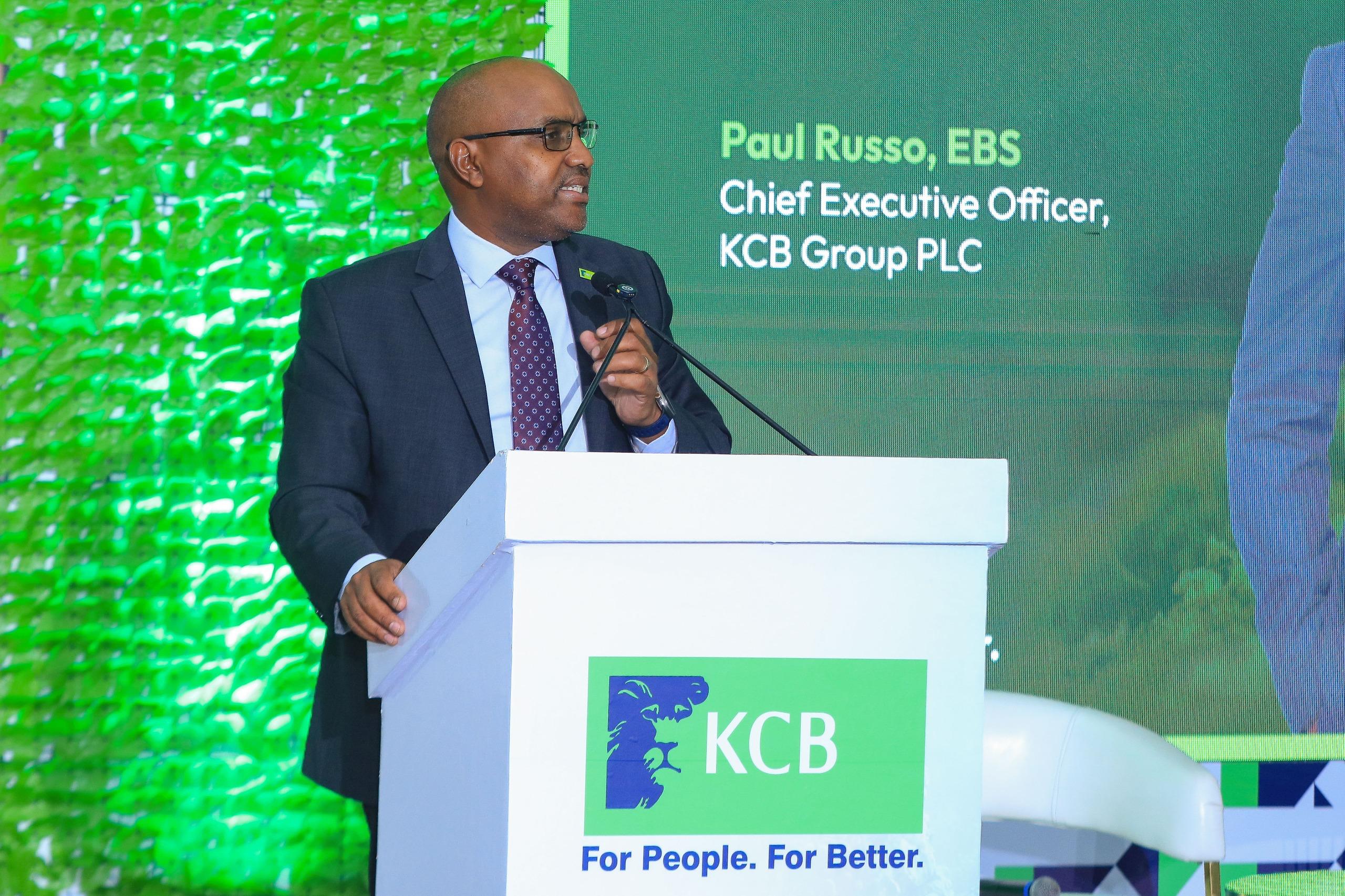
Speaking at the launch of the framework at the KCB Leadership Centre in Karen on Wednesday, KCB Group Chief Executive Officer Paul Russo said the initiative is intended to move sustainability beyond corporate commitments and into the allocation of capital.
“Banking is ultimately about enabling progress,” Russo said, adding that KCB’s responsibility increasingly involves determining not only how much capital it mobilizes, but where that capital goes, what it enables and the lasting impact it creates.
The proceeds from the programme will be ring-fenced for eligible Green, Blue and Social projects, with KCB tracking allocations and reporting on the impact achieved.
Under the Green category, the bank will finance projects supporting a low-carbon and climate-resilient economy. These include renewable energy such as solar power, energy-efficient buildings, clean and low-emission transportation, sustainable agriculture, and water and wastewater management.
The Blue component will support projects focused on marine and coastal ecosystems, including initiatives designed to improve the resilience of coastal and freshwater communities.
Social financing will target underserved and vulnerable populations through areas including affordable housing, micro, small and medium-sized enterprises, women and youth-led businesses, employment and livelihood creation.
Russo cited KCB Foundation’s 2Jiajiri programme as an example of how access to capital can generate broader economic benefits, including job creation, enterprise growth and stronger household incomes.
The framework comes as East Africa faces significant financing requirements for infrastructure and economic development while contending with climate change, food insecurity, unemployment, inequality and gaps in access to affordable long-term capital.
Russo said the region has substantial opportunities in infrastructure, agriculture, manufacturing, energy, housing, healthcare, education, technology and trade, but that sustainability must increasingly be embedded in how capital is allocated.
KCB’s sustainability strategy has evolved over nearly two decades.
The bank formally anchored sustainability into its business in 2008 around financial, economic, social and environmental pillars. It published its first Sustainability Report in 2009 and expanded its alignment with the United Nations Sustainable Development Goals from nine goals in 2017 to 14 of the 17 SDGs today.
In 2019, KCB adopted the UNEP Finance Initiative’s Principles for Responsible Banking. In 2020, KCB Bank Kenya became the first bank in Kenya to receive accreditation from the Green Climate Fund, strengthening its ability to mobilize and deploy climate finance.
KCB subsequently committed to achieving net-zero emissions by 2050 through its membership of the Net-Zero Banking Alliance in 2021 and joined the Forward Faster Initiative in 2023.
The sustainability bond framework has also received external validation. Moody’s awarded it a Sustainability Quality Score of 2, rated “Very Good,” according to KCB.
Russo said the framework is built around three principles: capital, purpose and accountability.
The objective, he said, is to mobilize capital at scale, direct it toward projects East Africa needs and demonstrate transparently what that capital achieves.
“The true measure of sustainable finance is not the size of the bond, but the scale of the impact it creates,” Russo said.
For KCB, that impact will ultimately be measured through lives improved, businesses strengthened, ecosystems protected, jobs created and opportunities unlocked.
The launch marks KCB’s latest effort to connect the region’s capital markets with financing for projects aimed at making East Africa greener, more resilient and more inclusive.