Fuliza is Safaricom’s M-PESA overdraft service allowing users to complete a payment, send money, buy airtime or pay a bill even when their M-PESA balance is low, up to a limit they have been approved for.
Fuliza is provided with Safaricom’s partner banks, NCBA Bank Kenya and KCB Bank Kenya, which carry the lending risk. Safaricom charges a one-off 1% access fee and a daily maintenance fee of between KSh1 and KSh30, depending on the amount borrowed.
Safaricom launched Fuliza ya Biashara with KCB in 2023 so business owners can use the overdraft too, and raised customer limits in January 2026. By March 2026, Fuliza had become part of everyday life for millions of Kenyans used by 17.7 million M-PESA customers, up from 7.9 million the year before. Fuliza disbursements rose 49% to KSh1.47 trillion over the same year and the average loan was about KSh218, which points to quick top-ups for daily needs rather than big loans.
Why Fraudsters Target Fuliza
Because 17.7 million M-PESA customers have used Fuliza and borrowed over KSh1.47 trillion, fraudsters see that scale and see opportunity. When millions of people rely on Fuliza, a promise to “double your limit” reaches a ready audience. Remember: your limit is set by Safaricom and its partner banks, not by an ad, a page or a stranger who asks for a fee.
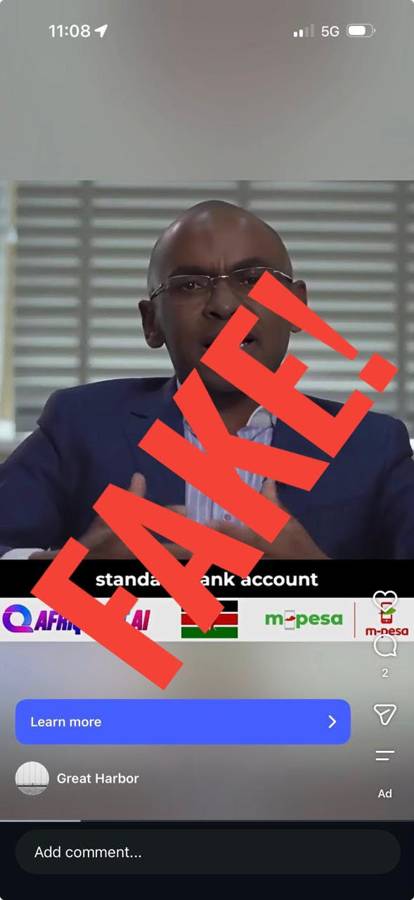
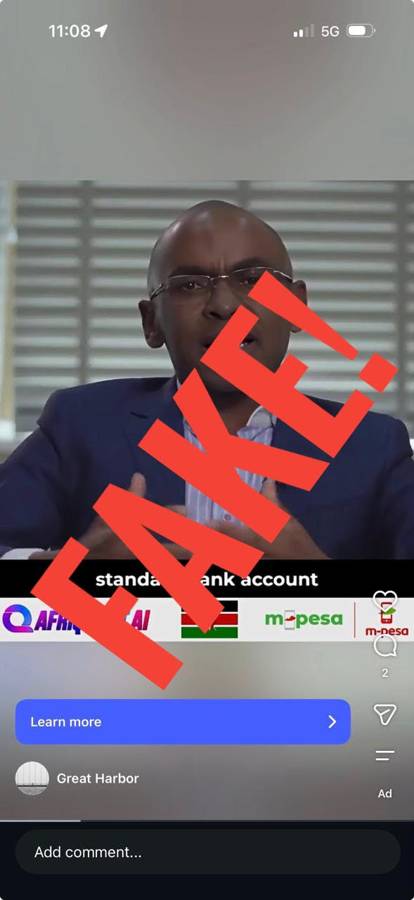
Imagine you are scrolling through your phone after a long day. A video appears. A well-dressed man, who looks and sounds like a senior company executive, speaks calmly into the camera. Official logos run across the screen. He announces that your Fuliza limit is about to double, or that a small deposit will unlock big returns. A bright “Learn more” button sits just below the video.
It looks real. It sounds real. It is not.
Quick Generative AI Tools
This is the new face of fraud. With generative AI tools, criminals can copy a person’s face and voice, then stitch them into slick video ads. They add real-looking Safaricom and M-PESA branding and send you to cloned web pages built to steal your money, your PIN or your personal details.
The good news is you do not need to be a tech expert to stay safe. You only need a habit. We call it Stop, Think, Act/Verify. This is not a hypothetical, deepfake scams are already hitting Kenyans. Fact-checkers and security researchers have already documented the pattern in Kenya.
- A fake investment interview. In 2025, Africa Check examined a Facebook ad that appeared to show a well-known Kenyan TV journalist interviewing a businessperson about an “investment opportunity.” The original interview, from August 2024, was about politics. The ad promised KSh130,000 a week from a KSh32,000 start. Africa Check found at least 12 active versions in the Facebook Ads Library and more than 286,000 views.
- Fake Fuliza pages. Africa Check has also debunked Facebook pages claiming they can increase Fuliza overdraft limits, and a fake “Fuliza Loans” page whose contact number could not be found on Safaricom’s website.
- A growing trend. In February 2026, cybersecurity firm ESET warned that deepfake-driven investment fraud is a top risk for Kenya.
The fraudsters use a trusted face, a big promise and a link asking for more details step by step. The details change, but the structure does not.
Why deepfake scams work
Traditional scams were easy to spot as the frausters could have a badly spelled SMS, a strange number, a clumsy story. Deepfakes use things we trust most such as a familiar face and voice.
- Borrowed authority. When a known leader appears to say something, we assume it must be true.
- Manufactured urgency. “Today only.” “Limited slots.” “Your limit will be reset in 10 minutes.” Pressure shuts down careful thinking.
- Irresistible promises. Doubled Fuliza limits, free giveaways, guaranteed returns. Everyone wants good news about money.
Anatomy of a deepfake scam: five moves from ad to empty wallet
- The bait. A sponsored video shows a familiar face announcing good news about money.
- The hook. A “Learn more” button, a WhatsApp link or a form invites you to act “before it ends.”
- The clone. The link opens a page imitating a real brand. It asks for your phone number, ID number, and sometimes your PIN or a one-time code.
- The fee. You are told to pay a small “activation,” “processing” or “verification” fee. The amount is kept low so it feels harmless.
- The squeeze. More fees follow, or your details are used elsewhere. When you stop paying, the page disappears.
Every move depends on you continuing. Stopping at move one or two breaks the chain, which is why Stop comes first.
Step 1: STOP
Never act on urgency created by an online ad or an unfamiliar voice call.
Real offers from real companies do not vanish in ten minutes. Urgency is a tactic, not a deadline. When you feel the pull to act:
- Do not click the “Learn more” button or any link in the ad.
- Do not share your M-PESA PIN, OTP, ID number or any personal detail.
- Do not send any “activation,” “processing” or “verification” fee.
A useful trick: put the phone down for two minutes. Scammers hate delay, because the longer you wait, the more likely you are to question the offer.
Step 2: THINK
Ask yourself: does this add up? Use our simple Macho, Masikio, Akili (Eyes, Ears, Mind) check.
Macho (Eyes): watch the face
- Mismatched lips and words. Does the mouth lag behind the voice or move oddly?
- A stiff face or strange blinking. Deepfakes often blink too little, too much, or look “frozen.”
- Blurry or flickering edges around the hair, jaw and glasses.
- Warped hands or a shifting background.
- Pasted-on logos. Branding laid over a video does not make it official.
Masikio (Ears): listen to the voice
- A robotic or flat pitch. Real people vary their tone. Cloned voices often sound even and monotone.
- Odd pauses or a stitched-together rhythm.
- Pushy language: “Act now,” “don’t miss out.”
Akili (Mind): question the offer
- Is it unrealistically generous? Free money, doubled limits and guaranteed returns are classic bait.
- Who is really speaking? A paid ad from an unfamiliar page is not an official announcement.
- What do they want from you? A PIN, an ID number, a fee or a link click are all red flags.
A simple rule of thumb: a Fuliza limit is not something you can buy or “unlock” by paying a fee or following a link in an ad.
Myths and facts about Fuliza and M-PESA offers
| What people think | What is actually true |
|---|---|
| “A page can double my Fuliza limit if I pay a small fee.” | Fact-checkers have debunked pages making this claim. Use Safaricom’s own channels to check your limit. |
| “If it shows Safaricom and M-PESA logos, it is official.” | Logos are easy to copy onto any video or page. Check the channel, not the branding. |
| “If it sounds like a leader, it must be true.” | Faces and voices can now be cloned. A paid ad from an unknown page is not an announcement. |
| “A caller who knows my name must be genuine.” | Names are easy to find. Safaricom staff never ask for your PIN, and its genuine calls come from 0722 000 000. |
| “I will just click to see what it is.” | One click can take you to a cloned page designed to collect your details. |
| “Only careless people get scammed.” | These scams are built to convince careful people too. Speed and pressure are the weapons. |
Step 3: ACT / VERIFY
Check only official Safaricom channels, or call customer care, before making any transaction.
- The My Safaricom app, downloaded from your official app store.
- The official website: safaricom.co.ke. Type it yourself. Never use a link from an ad.
- The M-PESA menu on your phone (*234#).
- Customer care: dial 100 (PrePay) or 200 (PostPay) from your Safaricom line.
- Verified Safaricom social media pages. Look for the official verification badge.
Remember: Safaricom staff will never ask for your M-PESA PIN, SIM passcodes or passwords. Pin yako, siri yako.
Be careful with phone calls too
- Safaricom’s published guidance says its official outbound customer care number is 0722 000 000, and that even then staff will not ask for your PIN or personal details.
- If someone calls from any other number claiming to be Safaricom, end the call and dial 100 or 200 yourself.
- Never follow instructions from an unknown caller to dial codes, switch off your phone or visit an agent.
Cloned voices and the family code word
Fraudsters can clone a voice from a short audio clip. A call from “your son” or “your sister” in an emergency, asking for money right now, may be an imitation. Agree a family code word that only your close circle knows, hang up and call back on the number you have saved, and forward scam texts to 333.
What would you do?
| What you see | What to do |
|---|---|
| A video ad says “Double your Fuliza limit today” | Stop. Do not click. Verify on the My Safaricom app or call 100. |
| A caller says they are from Safaricom and asks for your PIN | Hang up. Safaricom never asks for your PIN. Report the number to 333. |
| An ad with a “leader” promising investment returns | Think. Check the lips, voice and offer, then report it. |
| A link asks you to “verify” your details to keep your account | Do not open. Go directly to official channels. |
| A friend forwards a “giveaway” on WhatsApp | Pause. Check official channels before clicking or sharing. |
Already clicked, shared details or sent money?
Do not panic and do not feel embarrassed. Smart, careful people get caught by convincing scams. What matters is acting quickly.
- Call customer care on 100 or 200 and explain what happened.
- Report the fraud by forwarding the message and the number to 333, or use the report option in the My Safaricom app.
- Change your M-PESA PIN immediately. Do not reuse an old one.
- Check your M-PESA statement for transactions you do not recognise.
- Report to the police so the incident is on record.
Talk to the people most at risk
Scammers target people who are busy, trusting or new to digital tools. Take five minutes this week to share the 3-step rule with parents and grandparents, young people who spend long hours on social media, small business owners tempted by “boosted limit” or “investment” offers, and your family and community WhatsApp groups. A single forwarded message can save someone’s savings.
Frequently asked questions
Is the video of a leader in my feed real?
Treat any paid video promising money as suspect. Run the Macho, Masikio, Akili check, then confirm on an official Safaricom channel before doing anything.
How do I know a website is the real Safaricom?
Type safaricom.co.ke into your browser yourself, or use the My Safaricom app. Never rely on a link from an ad, SMS or WhatsApp message.
Can I pay to raise my Fuliza limit?
No. No ad, page or agent can raise a limit in return for a fee. Offers like this are scams.
I already entered my PIN or an OTP. What now?
Call 100 or 200 immediately, change your M-PESA PIN, and check your statement.
Does reporting really help?
Yes. Forwarding a scam message and number to 333 helps Safaricom flag the number and track fraud patterns. Report even when you did not lose money.
Quick reference. STOP: ignore the urgency. THINK: lips, voice and too-good promises. ACT/VERIFY: official Safaricom channels only. NEVER share your PIN. REPORT scams to 333.
Criminals can copy a face, a voice and a logo. They cannot copy your habit of stopping, thinking and verifying therefore before you do anything. Jiulize kama ni ukweli. Stop. Think. Act/Verify. #JiulizeKamaNiUkweli