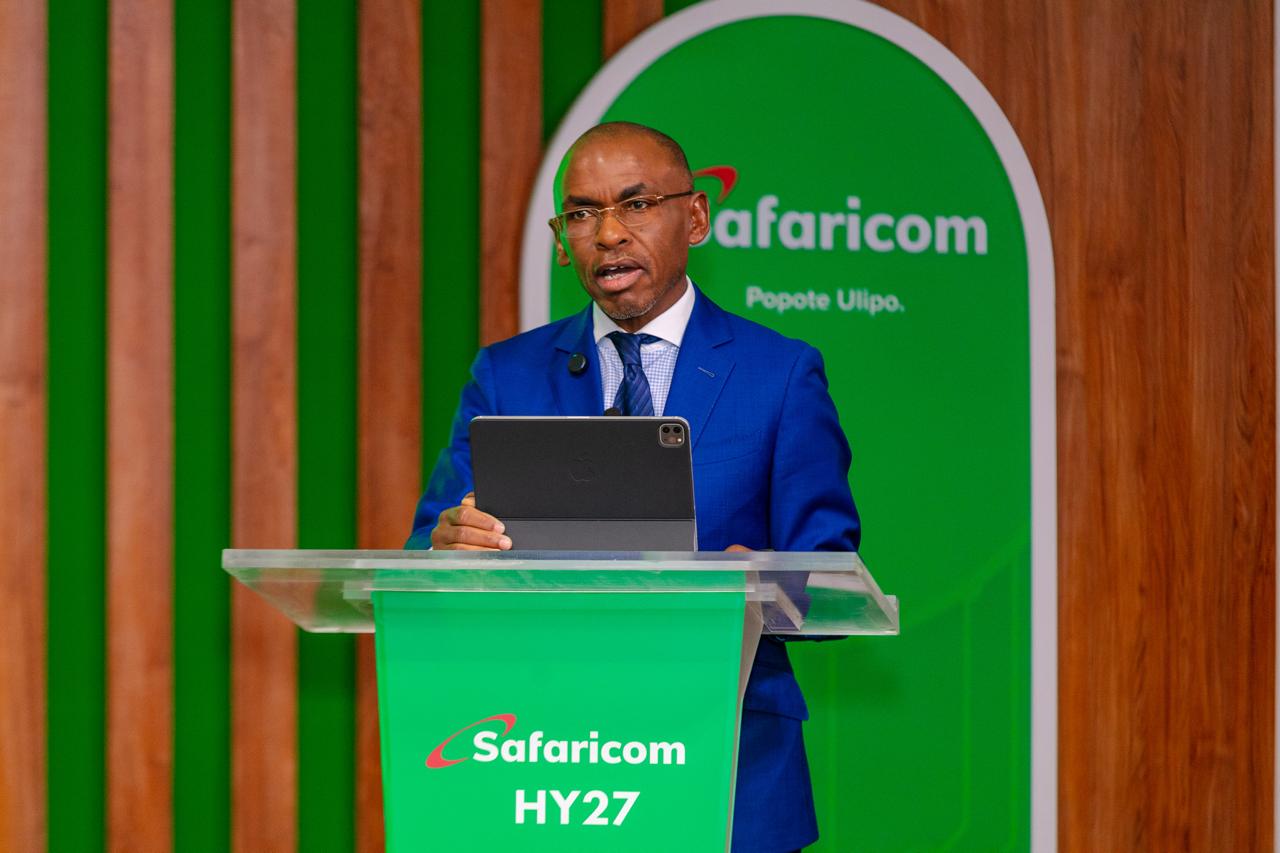
Safaricom Plc’s Ziidi investment platform recorded an 82.9% increase in assets under management to Sh23.36 billion in the six months ended September 2026, as Kenya’s largest telecommunications operator expanded its presence in the country’s wealth management and capital markets industry.
Assets across Safaricom’s broader wealth management portfolio increased 69.7% to Sh25.56 billion, while active wealth management customers more than doubled to 3.4 million from 1.3 million a year earlier, according to the company’s HY27 financial results.
“The social value created by M-PESA was estimated at KES 478.1 billion in FY26,” Safaricom Group Chief Executive Officer Peter Ndegwa said during the launch of the company’s 15th Sustainable Business Report in October, highlighting the platform’s expanding role in enabling customers to transact, save, invest and access credit.
Safaricom is leveraging an M-PESA customer base of 42.3 million monthly active users, up 11.6% from 37.9 million a year earlier, to distribute investment products alongside payments, credit and other financial services.
The company’s growing wealth management portfolio comprises Ziidi Money Market Fund, Ziidi Shariah Money Market Fund and Ziidi Trader, which enables customers to buy and sell shares listed on the Nairobi Securities Exchange directly through the M-PESA application.
From mobile payments to wealth accumulation
Safaricom’s expansion into investments marks a significant departure from its original mobile money business, which was primarily designed to facilitate domestic transfers.
M-PESA has since evolved into a financial services ecosystem encompassing merchant payments, international remittances, digital credit, savings and investments.
The platform generated Sh100.1 billion in group revenue during the first half of FY27, representing a 13.6% increase from a year earlier.
Its contribution to Safaricom’s Kenyan service revenue rose to 46.3%, compared with 45.4% in the corresponding period.
The expanding wealth management portfolio provides Safaricom with opportunities to diversify its financial services income while strengthening customer retention.
During the financial year ended March 2026, active customers across Safaricom’s wealth management products increased to approximately 2.2 million, compared with 628,244 a year earlier.
Assets under management more than doubled to Sh21.1 billion from Sh9.8 billion before increasing further to Sh25.56 billion by September.
The growth demonstrates rising demand for investment products distributed through mobile technology, particularly among customers who have historically faced barriers to accessing conventional wealth management services.
While the assets represent customers’ invested funds rather than Safaricom’s revenue, their growth provides opportunities for the company and its financial services partners to expand investment-related income.
Opening Kenya’s stock market to millions
Launched in February 2026 in partnership with the Nairobi Securities Exchange and brokerage firm Kestrel Capital, Ziidi Trader allows customers to purchase as little as one share.
The service integrates investment onboarding, trading and portfolio monitoring within the M-PESA application, reducing some of the practical barriers associated with conventional stockbroking.
“Ziidi Trader is a powerful step in democratizing wealth for our customers,” Ndegwa said in remarks delivered by Chief Finance Officer Dilip Pal during the platform’s launch.
By March 2026, Safaricom had recorded approximately 511,000 Ziidi Trader opt-ins, including 84,000 traders.
By June, cumulative turnover on the platform had reportedly surpassed Sh1 billion, with more than 350,000 trades, highlighting growing interest in mobile-based stock market investment.
The launch comes as the Nairobi Securities Exchange seeks to attract nine million active retail investors by 2029, including Kenyans living abroad.
Historically, the exchange has struggled to convert registered investors into regular market participants despite periods of strong stock market performance.
According to Reuters reporting at the time of the launch, early Ziidi Trader activity accounted for about 40% of the number of trades on the exchange but approximately 5% of daily trading volume, illustrating the relatively small size of individual retail transactions.
For first-time investors, the ability to purchase individual shares provides an opportunity to build investment portfolios gradually without committing substantial initial capital.
For the NSE, the partnership offers access to millions of potential investors through a financial platform already embedded in everyday economic activity.
Expanding access to Shariah-compliant investments
Safaricom is also targeting customers seeking investments aligned with Islamic finance principles.
Its Ziidi Shariah Money Market Fund, launched in October 2026 in partnership with GulfCap Investment Bank, provides access to Shariah-compliant investment products through M-PESA.
The fund allows customers to begin investing with Sh100, with subsequent contributions starting at Sh10.
The product operates separately from the conventional Ziidi Money Market Fund and invests in Shariah-compliant financial instruments under the oversight of GulfCap’s Shariah Supervisory Board.
The expansion enables Safaricom to address a segment of the investment market whose financial preferences may not be adequately served by conventional interest-based products.
Safaricom is also exploring opportunities to expand mobile investment into fixed-income securities.
Speaking during the launch of the company’s 2026 Sustainable Business Report, Ndegwa indicated that Safaricom was engaging the Central Bank of Kenya on opportunities to broaden access to fixed-income investments.
Such an expansion could potentially provide another distribution channel for government securities, including Treasury bills and bonds, subject to regulatory requirements.
The company has not announced a commercial launch date for such a service.
A global shift towards digital savings
Safaricom’s wealth management expansion reflects a broader transformation across developing economies, where mobile technology is facilitating access to financial products previously distributed predominantly through conventional financial institutions.
The World Bank’s Global Findex 2025 report, based on surveys of approximately 148,000 adults across 141 economies, found that formal savings increased substantially between 2021 and 2024.
Approximately 40% of adults in developing economies saved through formal financial accounts in 2024, compared with 24% three years earlier.
In Sub-Saharan Africa, formal savings increased by 12 percentage points to 35% of adults.
The World Bank also found that approximately 23% of adults across Sub-Saharan Africa used mobile money accounts to save, with Kenya among five African economies where at least half of adults used mobile money for savings.
The expansion of digital savings is particularly important for economies seeking to mobilise domestic capital for infrastructure development, enterprise financing and long-term investment.
For Kenya, where mobile money has already achieved widespread adoption, investment products distributed through smartphones could help convert transactional financial inclusion into longer-term financial resilience.
Closing Kenya’s investment gender gap
Despite Kenya’s progress in financial inclusion, disparities persist between men and women in access to formal financial services and savings products.
According to the World Bank’s Kenya financial inclusion profile, 87% of women had a financial account in 2024, compared with 94% of men.
Approximately 49.1% of women saved formally during the year, compared with 59.9% of men.
Digital payment adoption also showed a gender disparity, with 83% of women using digital payments compared with 93% of men.
The figures highlight an opportunity for mobile-based investment platforms to expand access among underserved groups, particularly women, informal sector workers and lower-income households.
For individuals with irregular earnings, investment products that allow relatively small contributions could provide greater flexibility than conventional investment arrangements requiring substantial initial deposits.
Financial sustainability and inclusive growth
Safaricom’s 15th Sustainable Business Report estimated that the company generated approximately Sh1.25 trillion in wider societal value during the financial year ended March 2026, representing a 10% increase from the previous year.
The company’s True Value assessment estimated its economic impact at Sh654 billion and social impact at Sh503.6 billion, alongside Sh95.6 billion in financial profit and estimated environmental costs of Sh6.43 billion.
Its operations and extended business ecosystem sustained more than 1.4 million jobs and livelihoods, including those supported through agents, dealers, suppliers and other commercial partners.
M-PESA processed 46.4 billion transactions worth Sh41.68 trillion during FY26, compared with 37.1 billion transactions worth Sh38.27 trillion a year earlier.
The transaction figures underscore the scale of the financial infrastructure through which Safaricom is now distributing investment products.
Kenya’s formal financial inclusion rate increased from 26.7% of adults in 2006 to 84.8% in 2024, according to the FinAccess Household Survey.
As financial inclusion reaches higher levels, the next challenge is ensuring that access translates into improvements in savings, investment and financial resilience.
Mobile investment platforms could contribute to that transition by reducing minimum investment requirements and simplifying onboarding procedures.
Competition and investor protection
Safaricom’s entry into wealth management is intensifying competition for household savings among commercial banks, asset managers, stockbrokers and financial technology companies.
For traditional stockbrokers, the emergence of mobile-based brokerage services introduces both competitive pressure and opportunities to participate in new distribution models.
However, expanding access to investment products also increases the importance of investor education, cybersecurity, transparent pricing and reliable technology infrastructure.
Money market funds, listed equities and government securities carry different levels of risk. Investors must understand that historical returns do not guarantee future performance and that share prices can decline.
Safaricom’s ability to maintain customer confidence will become increasingly important as its financial services ecosystem expands from facilitating everyday transactions into managing access to customers’ accumulated investments.
The company’s group service revenue increased 13.1% to Sh226.06 billion during the first half of FY27, while net income attributable to shareholders increased 35.9% to Sh58.15 billion.
With more than Sh25 billion already invested across its wealth management products, Safaricom is seeking to establish a deeper financial relationship with customers whose interactions with M-PESA have traditionally centred on payments, transfers and short-term borrowing.
For Kenya’s capital markets, mobile investing offers an opportunity to mobilise domestic savings at a scale that conventional investment distribution channels have struggled to achieve.
Having transformed how millions of Kenyans move money, Safaricom is increasingly seeking a role in how they save, invest and accumulate wealth.