


 confirmed the rollout at Jomo Kenyatta International Airport (JKIA) following a live demonstration of the technology during passenger clearance.)
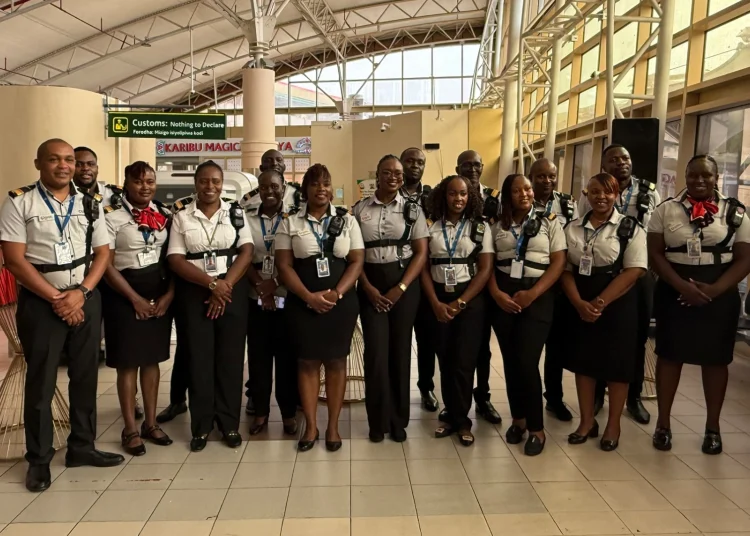
Customs officials at Kenya’s main international gateway are to be fitted with body-worn cameras as the country’s tax authority moves to digitise its fight against corruption.
The Kenya Revenue Authority (KRA) confirmed the rollout at Jomo Kenyatta International Airport (JKIA) following a live demonstration of the technology during passenger clearance.
This move marks a significant shift in oversight for the Customs and Border Control department, a division the authority admits is one of its most “exposed and contested frontlines.”
By introducing the devices, the KRA aims to transform the daily interactions between officers and the thousands of travellers, importers, and traders who pass through Kenya’s ports of entry.
For years, the KRA has acknowledged that disputes at border points have been hampered by a lack of objective evidence, often devolving into a stalemate of an officer’s word against a traveller’s.
In a statement released ahead of the launch, the authority noted that these unresolved complaints have historically eroded public trust.
However, they believe the new technology will fundamentally “change that equation entirely,” as every interaction will now be a verifiable record.
Consequently, disputes that previously took weeks to investigate could potentially be resolved in a matter of hours.
Beyond acting as a deterrent for misconduct, the initiative is a core component of the KRA’s 9th Corporate Plan.
The authority intends to use the footage as a broader management tool to identify process gaps and refine officer training.
Furthermore, the cameras are being positioned as a protective measure for the officers themselves.
By providing a documented record of their work, the technology offers a shield for staff who conduct themselves professionally against unfounded accusations.
The urgency of this rollout is underscored by recent reports of revenue leakage and internal misconduct.
During the 2023/2024 financial year, the Auditor General flagged the loss of 9.6 million excise stamps, a gap that suggests a market increasingly vulnerable to counterfeit goods.
Meanwhile, the KRA’s internal crackdown on graft has intensified; between July and September 2024, the authority dismissed 25 members of staff for corruption—a sharp increase compared to previous reporting periods.
Kenya is joining a growing list of nations using wearable technology to secure their borders.
Kenya’s adoption of body-worn cameras (BWCs) at JKIA follows an established global trend where major economies use wearable technology to secure borders and verify official conduct.
The following details outline how other nations have implemented similar technology, citing relevant policies and reports:
The UK Border Force has been a pioneer in deploying body-worn video (BWV) to enhance transparency.
According to the UK Home Office and the Metropolitan Police’s 2024 BWV Policy, cameras are utilized to provide a “verifiable record” of events, specifically to protect both officers and the public during high-pressure encounters.
Most UK agencies follow a 31-day auto-deletion protocol for non-evidential footage to balance accountability with the UK GDPR and Data Protection Act (2018).
Also, U.S. Customs and Border Protection (CBP), the largest federal law enforcement agency in the U.S., launched a massive BWC program to address “use of force” complaints.
By 2024/2025, the agency had integrated thousands of cameras across land and air ports of entry.
The CBP’s Incident-Driven Video Recording System (IDVRS)directive mandates that footage be used to investigate misconduct and “vindicate the majority of agents” who perform their duties professionally.
On it’s part, Singapore Customs has integrated bodycams as part of its “Customs Modernization” strategy. Beyond simple recording, Singapore has moved toward using AI and data analytics to review footage.
Research published in 2024/2026 indicates that Singapore and Hong Kong utilize algorithmic auditing to identify “unusual patterns” in officer verbalizations, helping to proactively improve professionalism.
In the Netherlands and Belgium, the introduction of bodycams has been a direct response to organized crime attempting to infiltrate ports like Antwerp and Rotterdam.
A 2026 report by the European Public Prosecutor’s Office (EPPO) highlighted that while customs fraud damage remains high (estimated at €45 billion across the EU), the use of “objective digital witnesses” (BWCs) has been critical in prosecuting corrupt officials involved in excise and VAT fraud schemes.
Nevertheless, some questions remain regarding the long-term implementation of the programme.
The KRA has not yet publicly detailed the specific mechanisms for footage storage, the duration for which data will be kept, or the protocols for accessing recordings during a dispute.
As the rollout matures, these administrative details will likely determine whether the initiative leads to genuine institutional transparency or remains a well-publicised gesture.