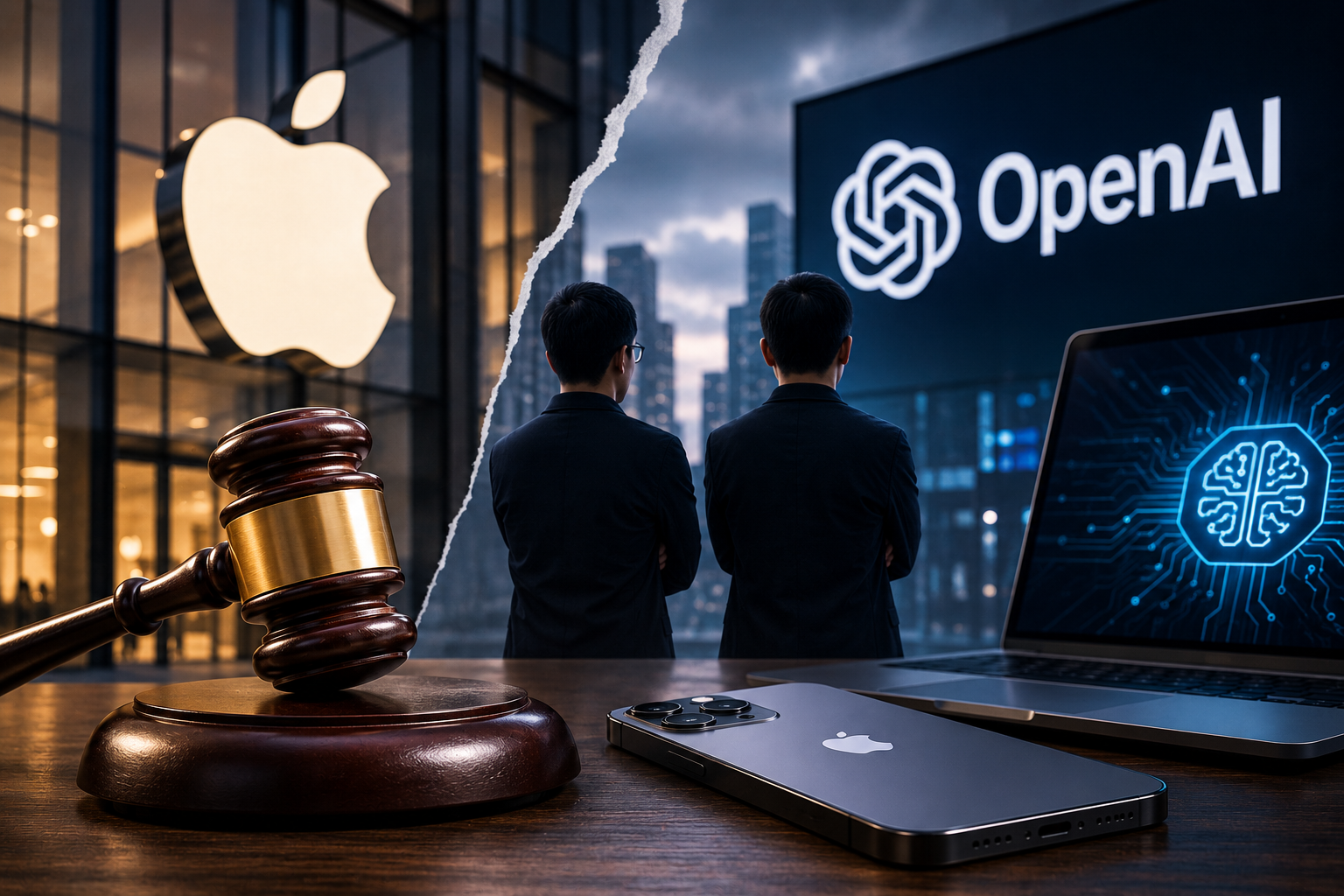
Apple has sued OpenAI and two former Apple engineers, accusing the artificial intelligence company of benefiting from the alleged theft of confidential hardware trade secrets as it accelerates its push into consumer devices, marking a dramatic escalation in tensions between two companies that have also been strategic partners.
The lawsuit, filed in U.S. federal court on July 10, alleges that former Apple executives Tang Tan and Chang Liu improperly retained and transferred proprietary information related to Apple’s hardware development and global supply chain before joining OpenAI. Apple claims the information could provide an unfair advantage as OpenAI expands beyond software into AI-powered consumer hardware.
The case does not involve OpenAI’s large language models or ChatGPT technology. Instead, Apple’s complaint centers on confidential engineering documents, product development processes and supply chain information that it says constitute valuable trade secrets developed over years of research and investment.
According to the lawsuit, Apple alleges that the two former employees took sensitive internal information before leaving the company and that OpenAI either encouraged the acquisition of the materials or knowingly benefited from them while recruiting Apple engineers for its growing hardware division.
OpenAI has denied the allegations.
The company said it develops its products independently and has no interest in obtaining or using competitors’ proprietary information. OpenAI said it intends to vigorously defend itself against Apple’s claims in court.
The legal battle underscores the rapidly shifting competitive landscape in artificial intelligence, where leading technology companies are increasingly competing not only in software but also in consumer hardware designed around generative AI.
The dispute is particularly significant because Apple and OpenAI have maintained a high-profile commercial partnership. Since 2024, Apple has integrated ChatGPT into Apple Intelligence, allowing users to access OpenAI’s conversational AI capabilities across iPhone, iPad and Mac devices for certain requests.
While that partnership remains in place, OpenAI has been investing heavily in building dedicated AI hardware, hiring engineers with expertise in industrial design, product engineering and manufacturing. Those ambitions have increasingly positioned the company as a potential competitor to Apple in next-generation consumer devices.
Industry analysts say the lawsuit highlights how competition for experienced hardware engineers has intensified as AI companies race to build products that move beyond smartphones and traditional computers. Talent recruitment has become one of the industry’s biggest competitive battlegrounds, with companies offering lucrative compensation packages to attract engineers from rivals.
Trade secret disputes involving departing employees have become increasingly common across Silicon Valley, particularly in industries where proprietary manufacturing techniques, supply chain strategies and product roadmaps represent critical competitive advantages.
For Apple, protecting confidential product development information has long been central to its business strategy. The company is known for maintaining strict internal secrecy around future products, manufacturing partners and engineering processes.
Legal experts note that Apple’s filing represents allegations that have yet to be tested in court. To succeed, Apple will need to demonstrate that legally protected trade secrets were misappropriated and that OpenAI knowingly used or benefited from the confidential information.
The litigation is expected to proceed through months of discovery, during which both sides could be required to produce internal communications, engineering records and recruitment documents. A trial, if the case is not settled beforehand, could still be years away.
The outcome could have broader implications for the fast-growing AI hardware sector, where established consumer electronics companies and AI startups are increasingly converging in the race to define the next generation of intelligent devices.