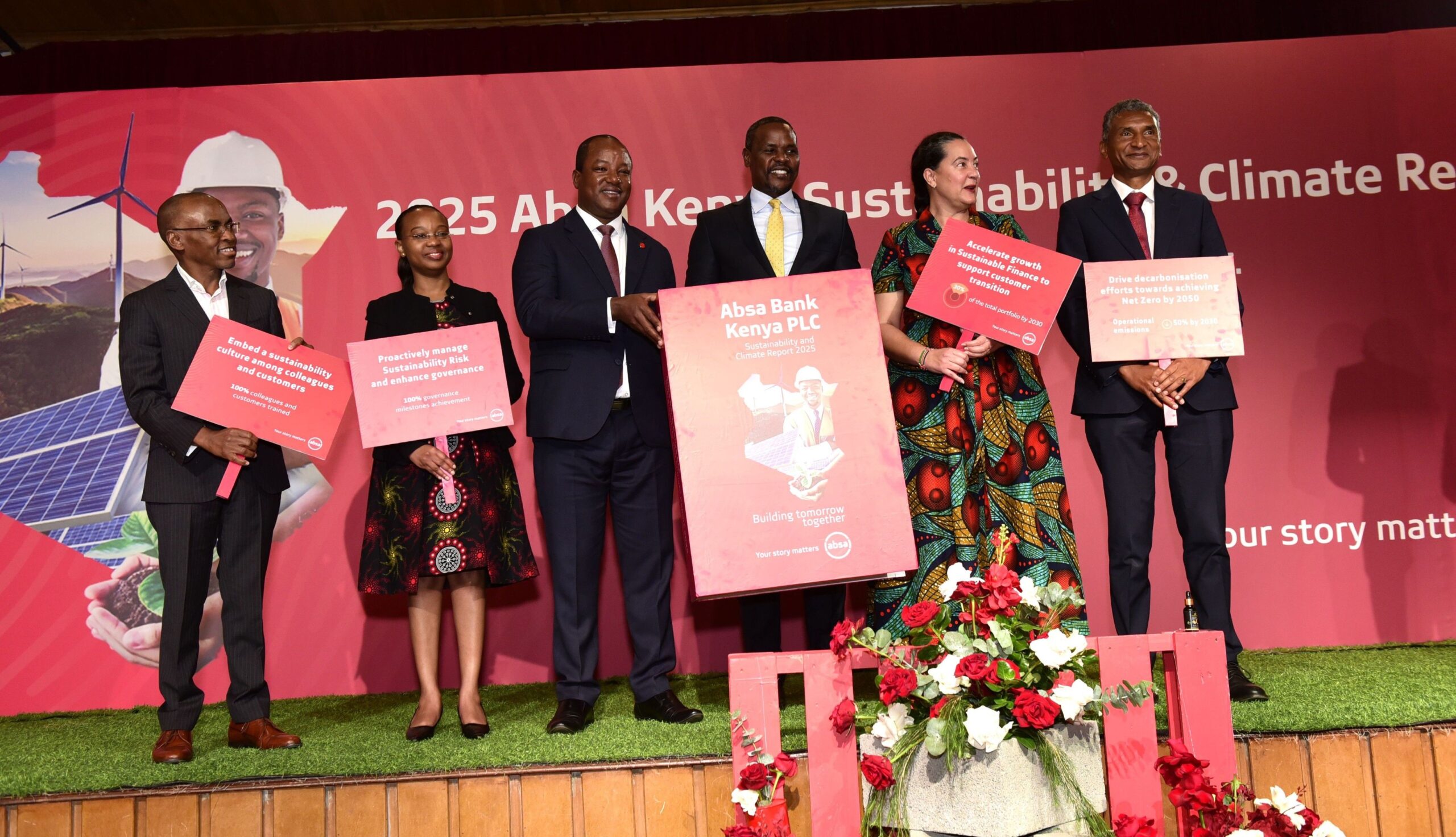
Absa Bank Kenya has disbursed more than KES 204 billion in sustainable finance since 2022, with green and inclusive lending accounting for 30% of its gross loan disbursements in 2025, three times its original annual target.
The bank’s 2025 Sustainability and Climate Report shows sustainable finance disbursements rose to KES 55.3 billion in 2025 from KES 47 billion a year earlier. Of that, KES 48.8 billion supported SMEs, women-led businesses, youth entrepreneurs and underserved communities, while KES 6.5 billion financed renewable energy, green buildings, energy efficiency and climate-smart agriculture.
“Our 2025 Sustainability and Climate Report highlights what we have achieved under our 2021–2025 sustainability strategy,” Interim CEO Yusuf Omari said at the report’s launch in Nairobi.
Beyond lending, Absa planted nearly 284,000 trees during the year, lifting its cumulative total to more than 1.5 million. The bank also achieved a 96.4% waste recycling rate and cut its operational energy footprint by 41% as it advances toward its net-zero ambitions.
On the social front, nearly 38,000 young people received employability and entrepreneurship training through the ReadytoWork programme in 2025, bringing total beneficiaries to more than 300,000.
The Absa Kenya Foundation also reached more than 50,000 people through education, entrepreneurship and natural resource management initiatives.
Principal Secretary for Environment and Climate Change Dr. Festus Ng’eno said climate finance is now an economic imperative as climate risks intensify.
Absa also aligned its sustainability disclosures with the International Sustainability Standards Board’s IFRS S1 and IFRS S2 standards, strengthening transparency around climate-related risks.
The lender has launched a new sustainability strategy built on four pillars: maintaining at least 30% of loan disbursements in sustainable finance, achieving net-zero emissions by 2050, strengthening sustainability risk management, and embedding sustainability across its business.