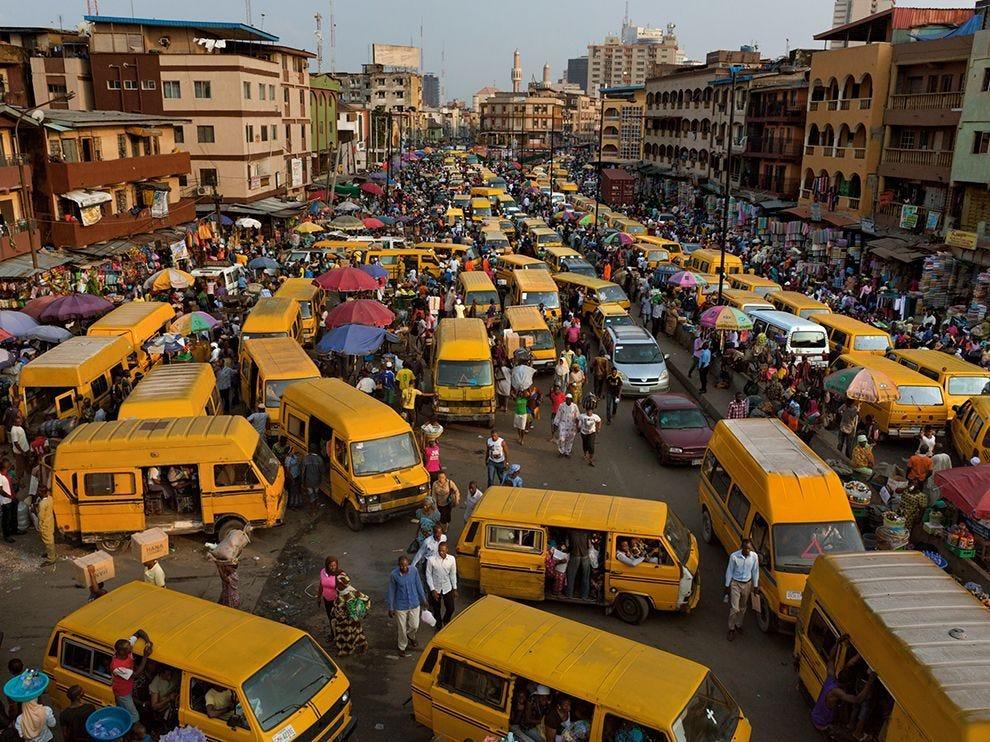
Lagos Life, a browser-based life simulation that turns the daily hustle of Nigeria’s commercial capital into a game allowing players create a character and attempt to build a life in a virtual Lagos, earn money, find somewhere to live, navigate the city, develop skills, socialize and keep their finances and personal needs under control.
The concept is familiar to anyone who has played a life simulator, but the details are distinctly Lagos, a city of 31.91 million people, according to the Lagos Bureau of Statistics’ 2025 estimate, making it one of Africa’s largest urban markets. It is also Nigeria’s biggest internet market, with 18.60 million active internet subscriptions recorded in 2025, up 5.53% from 17.62 million a year earlier. The figures point to a large connected population for digital businesses and entertainment products built around the city’s culture.
Instead of simply managing a generic character, players have to deal with 6 basic needs — hunger, energy, fun, social, hygiene and bladder — while virtually every activity consumes in-game time. Money comes from jobs, gigs and other activities, while rent is due every Saturday, creating the kind of recurring financial pressure familiar to anyone trying to make it in the city.
Work is at the heart of the game’s economy. Lagos Life offers 25 careers, each with 5 levels, ranging from an Okada Rider to an Oil Executive. Players can take gigs and develop skills to improve their prospects, with promotions linked to the skills they actually build. The game therefore turns career progression into another strategic decision: players must decide how much time to spend working and how much they can afford to devote to the rest of their virtual lives.
That balance is where much of the game’s humor and entertainment comes from. A player can spend too much time chasing money and neglect hunger, energy or hygiene, or spend so much time socializing and having fun that rent becomes a problem. Even the character’s bladder is part of the equation. Lagos Life takes ordinary inconveniences and turns them into consequences that players have to manage, giving the game some of the absurdity of real city life without requiring the player to take any of it too seriously.
Housing provides another layer of progression. The game has 5 homes, ranging from a face-me-I-face-you arrangement in Mushin to a home in Lekki Phase 1 with a private bathroom. Players can also buy and place 61 pieces of furniture, while groceries can be purchased and used to cook meals. The virtual housing market therefore becomes a measure of progress, allowing players to see their circumstances improve as they earn more.
Moving around Lagos is part of the simulation as well. Players have 6 transport options such as walking, danfo, keke, okada, cab and car with journeys priced and timed according to distance. The game even incorporates the familiar go-slow into travel, making transportation a decision involving both money and time. The virtual city includes 23 locations, among them Amala Shitta, Quilox, Elegushi Beach, Balogun Market, a church and a mosque.
The developers have filled the game with other details aimed at giving it a Nigerian identity. Players can listen to 7 Naija radio stations as they move around the city, while characters have 10 traits, 5 aspirations, 22 wishes and 91 moodlets that shape their virtual experiences. There are also 261 actions across 9 skills, giving players plenty of ways to spend their limited in-game time.
Politics is built into the game too. A weekly governor’s race allows players to vote on candidates and policies, with the outcome affecting elements of the virtual economy such as transport fares, pay and prices. That makes politics part of gameplay rather than simply a background reference to the real Lagos government.
Lagos Life also experiments with its own virtual advertising market. The game has 38 billboards and 24 lagoon plots that players can rent using in-game naira. A billboard costs ₦100,000 for 7 days, while a lagoon plot costs ₦50,000 for the same period. Players can choose an emoji for their billboard, and the rented spaces appear on a shared city map where other players can see who holds them. The developers stress that these are in-game rentals rather than real advertising space or real property.
That feature points to a potentially interesting commercial direction for locally built games. Rather than treating advertising as something outside the game, Lagos Life has incorporated it into the virtual economy itself. As African gaming grows, digital environments built around recognizable cities could offer brands another way of reaching audiences, particularly when the virtual world reflects places and cultural references that players already understand.
The timing is notable. Lagos is not only one of Africa’s biggest population centers but also its largest state-level internet market. The 18.60 million active internet subscriptions recorded in 2025 represented the highest total among Nigerian states, according to data compiled from the National Bureau of Statistics and Nigerian Communications Commission.
Lagos Life currently runs in a web browser, with Android and iPhone applications listed as coming soon. The browser-first approach removes the need for a large installation and allows a player to begin with nothing more than an account and an internet connection.
The bigger question is whether local culture can become a competitive advantage in African gaming. Global games have spent decades putting players in fictional worlds or cities inspired by North America, Europe and Asia. Lagos Life takes a different approach by making the neighborhoods, transport systems, jobs, food, entertainment, politics and financial pressures of one of Africa’s most recognizable cities central to the experience.
That gives the game an unusual mix of familiarity and escapism. A player can work a shift, take a danfo across town, buy food, meet friends, listen to Nigerian radio, improve a skill, return home and discover that their character is exhausted. The problems are familiar, but the consequences are safely virtual. Players can experiment with careers, housing and spending decisions without having to pay the real-world price of getting them wrong.
For now, Lagos Life is less about escaping Lagos than seeing the city through a different lens. Its rules are simple enough: make money, manage your 6 needs, develop your skills, pay the rent, improve your home and find time to enjoy yourself. The city’s frustrations become challenges, its landmarks become destinations and its hustle becomes entertainment.
That may ultimately be the game’s most interesting proposition. Lagos is already a major economic and cultural force, with a 31.91 million population estimate and 18.60 million active internet subscriptions providing a substantial potential audience for locally relevant digital products. Lagos Life is betting that the city’s chaos, ambition, humor and everyday economics can be more than the setting for a game. They can be the game itself.