
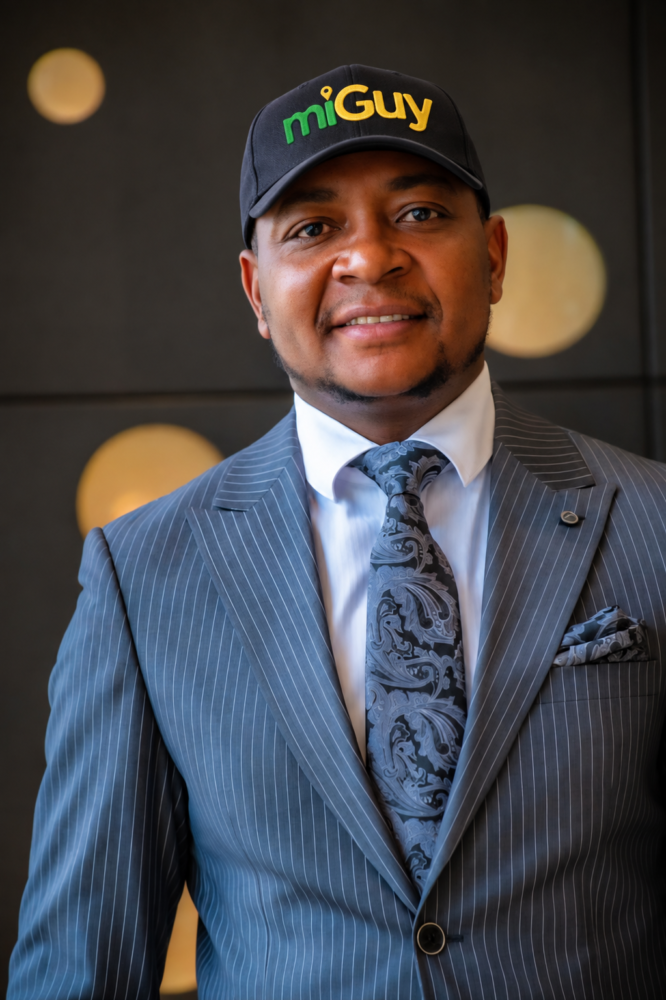
Sila Kaloki is the founder of miGuy, a digital services marketplace owned and operated by Asazia Technologies Limited, a Kenyan technology company. The platform connects customers with service providers across everyday and professional services, from plumbing and electrical work to legal, medical and automotive services.
Kaloki leads business strategy, business development, partnerships and the company’s overall vision. His ambition is to make it easier for customers to find service providers while giving skilled individuals and businesses greater visibility and access to potential customers.
TechMoran caught up with Sila Kaloki for this session of CEO Weekends and to see what inspired a digital services marketplace spanning 42 categories, its business model and plans to expand into South Africa and Ghana.
What inspired you to start miGuy?
The inspiration for miGuy came from something I experienced personally and something I repeatedly observed around Nairobi.
As a consumer, I had often found myself looking for reliable people to handle everyday jobs such as a mechanic, plumber, electrician, painter, cleaner or another professional. The process was usually the same: you call a friend, a relative or a colleague and ask, “Do you know someone who can do this?”
The answer was almost always some variation of, “I know a guy.”
At the same time, while driving around neighbourhoods such as Kilimani, Lavington, Kileleshwa and Westlands, I would regularly see a man in his late 50s or early 60s standing at road junctions holding a placard saying he was a painter looking for work, with his name and phone number underneath.
That really made me think. Here were people with skills who were actively looking for work, while on the other side there were customers looking for exactly those skills. The problem was that the two sides were often disconnected.
I began asking myself: why should a skilled person have to stand on a roadside to find a customer in the digital age?
That became the starting point for miGuy. We spent considerable time researching the market, understanding consumer behaviour and speaking to people on both sides of the services economy. We realised there was an opportunity to create a trusted digital platform that could make finding a service provider easier while giving skilled individuals and businesses a much larger digital marketplace in which to showcase what they can do.
The name miGuy itself comes from the Kenyan phrase “I have a guy” or “I know a guy.” We wanted to take that very familiar African experience and turn it into a technology platform.
Who are the founders, and how big is the team today?
miGuy is owned and operated by Asazia Technologies Limited, a Kenyan technology company. I am the founder, and my primary responsibilities are business strategy, business development, partnerships and driving the overall vision of the company.
We have deliberately built the company as a lean startup. Rather than having a large corporate structure at this stage, we have a technology team responsible for product development and the platform, alongside teams working on marketing, customer care, service-provider onboarding and compliance.
That structure allows us to remain agile. At our current stage, we need people who can solve problems quickly, take ownership and work across different areas of the business.
As the platform scales, we expect the team to grow significantly, particularly across technology, operations, customer experience, sales, marketing, compliance and country management.
How does miGuy work for customers and service providers?
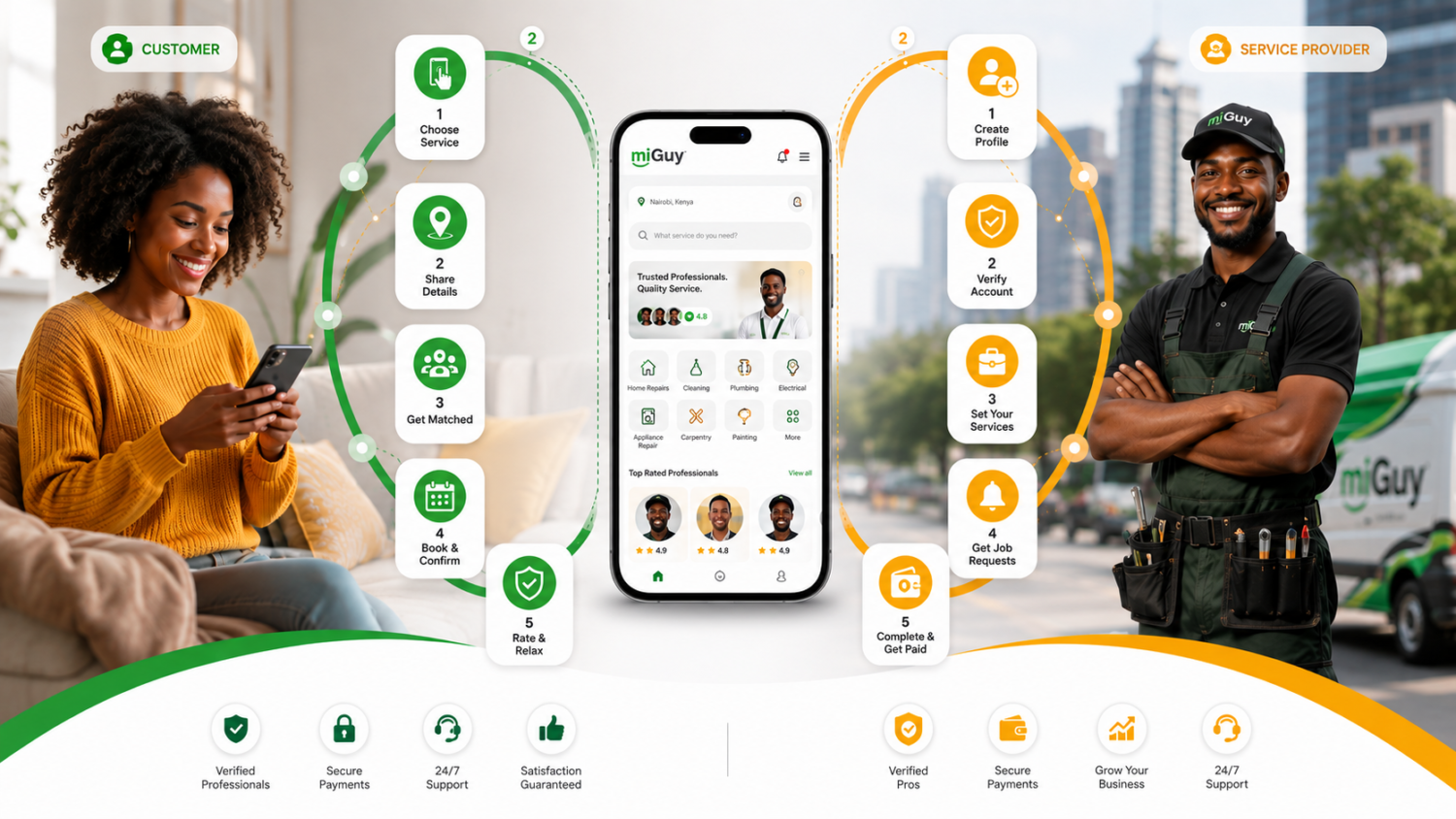
The concept is designed to be simple for both sides. For a customer, miGuy provides a place to discover service providers across a wide range of everyday needs. Instead of relying entirely on personal referrals or searching through multiple platforms, the customer can use miGuy to find professionals based on the service they require.
We currently have 42 service categories, covering everything from plumbing, electrical work, cleaning, painting, carpentry and appliance repair to automotive services, IT, legal, medical, religious services, surveying, valuation, landscaping and other professional services.
For service providers, miGuy becomes a digital marketplace and a customer-acquisition and retention channel.
A provider can create a professional profile, identify the services they offer, specify their service areas and availability, and make their skills discoverable to potential customers.
The bigger idea is to move the services economy from fragmented personal contacts into a more structured digital environment, a miGuy Operating System.
We want a customer to think: “I need a service. miGuy must have the solution.” And we want the service provider to think: “I have a skill or service. I must be on miGuy.”
Which services are most in demand on the platform?
We are still relatively early in our operating journey, so we are being careful about presenting early interest as a definitive long-term demand ranking.
What we are seeing is strong interest across a broad range of everyday services, particularly categories such as plumbing, legal, medical, valuation, electrical services, cleaning, painting, automotive services, appliance repair, construction-related services and various professional services.
One of the interesting things about the platform is the breadth of the opportunity.
People don’t only need services when something breaks. They need professionals when they move into a new house, renovate, maintain property, start a business, deal with legal matters, require medical assistance, need technology support or simply need help with an everyday task.
That is why we deliberately built miGuy around a broad service ecosystem rather than limiting it to one category.
As our transaction volumes grow, we will have much richer data around demand by category, location, time and customer behaviour. That will allow us to become increasingly intelligent about matching customers with the right providers.

How do you build trust and verify service providers?
Trust is the currency. Trust is one of the most important parts of our business.
A marketplace is only as strong as the trust that customers have in the people they find on it.
Our onboarding process therefore involves collecting information from service providers and, depending on the nature of the service, requesting relevant identification, professional or skills documentation and other compliance information.
For professional categories where qualifications or licences are important, those requirements become particularly significant.
We also believe trust is not created by verification alone.
It is built through the entire customer experience: provider profiles, service information, customer feedback, ratings, reviews, responsiveness, successful completion of jobs and appropriate platform policies.
We are therefore building miGuy around multiple layers of trust rather than treating verification as a one-time checkbox.
There is also a responsibility on us to continually improve the system as we grow. A marketplace operating across dozens of categories and eventually multiple countries needs strong processes around provider onboarding, compliance, customer complaints and quality assurance.
Our goal is for customers to gradually develop the confidence that when they open the miGuy app, they are not simply finding a person who claims to provide a service; they are finding a service provider within a structured ecosystem.
What is miGuy’s business model?
miGuy has three principal revenue streams. The first is transaction commissions. When a service is successfully booked and completed through the platform, miGuy earns a commission from the transaction.
The second is service-provider subscriptions. Providers and businesses can access enhanced functionality and greater opportunities for visibility through paid subscription plans.
The third is in-app advertising.
Because miGuy brings together consumers who are actively looking for services and businesses that provide those services, we believe the platform can eventually offer valuable targeted advertising opportunities. These can include different forms of in-app advertising and business visibility.
The model is therefore designed to have multiple revenue streams as the marketplace matures.
However, we are still in the early stages of commercialisation. We have only recently started operations, so our immediate priority is building transaction volume, customer retention and a strong provider network rather than presenting premature profitability figures.
We believe that if we can solve the fundamental marketplace problem — connecting customers with the right service providers efficiently, the monetisation opportunities become significantly larger as the network grows.
Who are your main competitors, and what sets miGuy apart?
Competition exists at several levels. There are online classifieds, social-media groups, WhatsApp communities, Google searches, traditional referrals and specialised service platforms.
But we see our biggest competitor as the way people currently find service providers.
In Kenya, someone needing a plumber may call a friend. Someone looking for a mechanic may ask a colleague. Someone looking for a painter may receive a phone number through a WhatsApp group because currently, there is no digital platform that jumps into one’s mind like Uber for cab-hailing or Jiji for selling items.
That informal referral system works to some extent, but it is fragmented and difficult to scale. Our ambition is to organise that behaviour digitally.
What sets miGuy apart is our focus on everyday services across a broad range of categories, combined with a marketplace designed specifically around the relationship between customers and local service providers.
We are not trying to replace human recommendations. We are trying to make the process of finding the right person much easier and more scalable.
The long-term vision is that instead of asking ten people, “Do you know a guy?”, you can simply open miGuy. For service providers, we are designing miGuy to eventually become the miGuy Operating System, or miGuy OS.
In that sense, miGuy is essentially taking the African concept of “I know a guy” and building technology around it.
What are your plans for growth in Kenya and across Africa?
Kenya is our foundation market. We are currently operating in Nairobi and its environs, Mombasa and Kisumu, and our immediate objective is to deepen our presence in these markets before expanding aggressively.
We want to build density: more customers, more quality service providers, more transactions and better experiences within each market. But our ambition is not limited to Kenya.
We are already working on the registration, regulatory and compliance requirements for South Africa and Ghana, which are among the next markets we are preparing to enter.
The broader African opportunity is significant because the fundamental problem exists across many markets: millions of skilled people and small businesses are providing services through informal networks, while consumers often struggle to find reliable professionals efficiently.
Our strategy is therefore to build a model in Kenya that can be replicated internationally.
We don’t want to simply launch an app in different countries. We want to develop a repeatable marketplace infrastructure and an operating system covering provider onboarding, verification, payments, customer support, service discovery and local operations.
Ultimately, our ambition is for miGuy to become miGuy OS, Africa’s leading service operating system for discovering and engaging trusted service providers.
We believe Africa does not have a shortage of skilled people. In many cases, what is missing is visibility, connectivity and access to customers.
That is the problem we are trying to solve.
And if we can successfully connect those two sides of the economy, the person who needs the job done and the person who knows how to do it, we believe miGuy can become much bigger than a marketplace. It can become an important piece of the digital infrastructure supporting Africa’s growing services economy.
What do you want miGuy to achieve in the long term?
Our ambition is for miGuy to become Africa’s leading service operating system for discovering and engaging trusted service providers.
We want to build more than a marketplace. We want to develop the infrastructure that supports how customers find professionals and how service providers connect with people who need their skills.
Africa does not have a shortage of skilled people. In many cases, what is missing is visibility, connectivity and access to customers.
If we can successfully connect the person who needs a job done with the person who knows how to do it, miGuy can become an important piece of the digital infrastructure supporting Africa’s growing services economy.