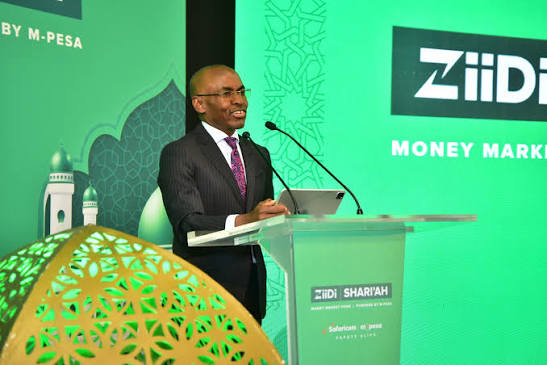
Safaricom’s Ziidi Trader accounted for more than two-thirds of retail applications in Quickmart Plc’s KSh 15 billion initial public offering, underscoring the growing role of mobile investment platforms in opening Kenya’s stock market to individual investors.
The platform processed 12,426 of the 18,178 retail applications received during the supermarket chain’s IPO, representing 68.4% of the total, according to the company’s official allocation results. Applications submitted through Ziidi Trader were valued at KSh 170.54 million.
Quickmart’s offering attracted KSh 18.41 billion in applications against the KSh 15 billion on offer, representing a subscription rate of 122.7%. Retail investors submitted applications worth KSh 2.387 billion, highlighting demand for shares in one of Kenya’s supermarket operators.
The retailer made its debut on the Nairobi Securities Exchange on Thursday, November 12, with its shares trading at approximately KSh 10, compared with the IPO price of KSh 7.50, representing a premium of about 33%.
For Safaricom, the participation through Ziidi Trader provides an early indication of how mobile investment services could reshape access to Kenya’s capital markets, traditionally dominated by institutional investors and individuals using conventional stockbroking channels.
The platform’s contribution was particularly significant in terms of application volumes. While Ziidi Trader accounted for more than two-thirds of retail applications, the KSh 170.54 million submitted through the platform represented approximately 7.1% of the total retail application value.
The difference suggests that Ziidi Trader attracted a large number of relatively small applications, reinforcing its potential to make stock market participation more accessible to individuals investing smaller amounts.
The development could have implications for future public offerings in Kenya, where companies seeking broader shareholder participation may increasingly turn to mobile financial platforms to reach investors beyond traditional brokerage networks.
Quickmart’s IPO also stands out for its dividend policy, which promises to return a substantial proportion of future earnings to shareholders.
According to its prospectus, the retailer targets a dividend payout equivalent to 95% of its profit after tax for the 2026 financial year, followed by 90% in 2027. Thereafter, the company intends to maintain a minimum annual payout ratio of 80%.
Dividends are expected to be distributed semi-annually, with the first payment anticipated in the first half of 2027, subject to financial performance, available distributable profits and the necessary approvals.
The proposed policy could appeal to investors seeking regular income from listed equities, although the high payout ratios would leave a relatively limited portion of annual earnings available for reinvestment.
Unlike a conventional capital-raising IPO in which a company issues new shares to finance expansion, Quickmart’s offering involved the sale of existing shares held by Sokoni Retail Kenya Limited. The proceeds therefore accrue to the selling shareholder rather than directly financing the supermarket chain’s operations.
The transaction nevertheless provides Quickmart with access to public equity markets and a broader shareholder base, while giving investors an opportunity to participate in the retailer’s future financial performance.
For Kenya’s capital markets, the offering demonstrates the potential of combining a recognizable consumer business with digital investment distribution channels.
Safaricom’s Ziidi Trader could become an increasingly important route for retail participation in future listings, particularly as mobile financial services extend beyond payments and savings into investment products.
The longer-term test will be whether the thousands of retail applications processed through Ziidi Trader translate into sustained investment activity after the IPO.
For Safaricom, the opportunity extends beyond a single listing. If mobile investment platforms can consistently attract smaller investors into public offerings and secondary-market trading, they could help expand the country’s investor base and deepen participation in the Nairobi Securities Exchange.