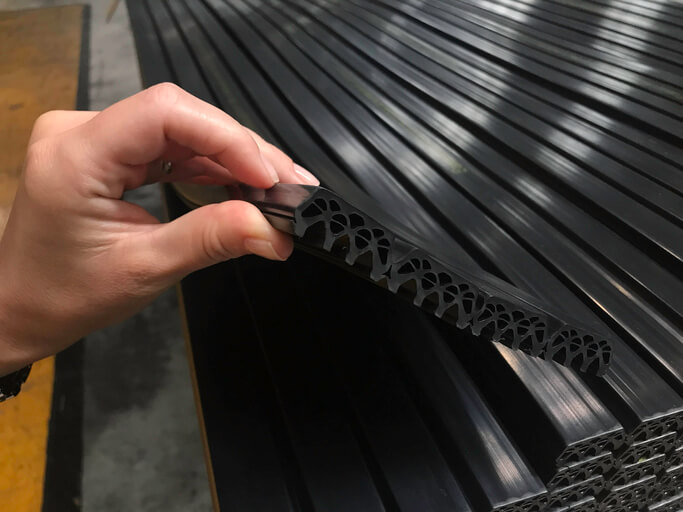
A team in Nairobi or Lagos can now get a PCB fabricated, a housing machined and a carton printed inside a month. What still stalls the launch is rarely the clever part. It is the long, hollow, open-section plastic component that holds everything together: the cable duct, the edge trim, the draw runner, the irrigation line, the window profile, the pallet spacer. That part is extruded, not moulded, and it is usually the last item on the bill of materials to be sourced locally — if it can be sourced at all.
Extrusion is the quiet backbone of light manufacturing, and in markets where freight is expensive relative to material value, it is also where import substitution is easiest to justify. A container full of air is a terrible way to move plastic. Yet the process has design and tooling rules that differ sharply from injection moulding, and teams that treat the two as interchangeable pay for it twice: once in tooling, once in scrap.
What Extrusion Does That Moulding Cannot
In extrusion, molten polymer is pushed through a die and the resulting continuous profile is cooled and pulled away under tension. The cross-section stays constant for the length of the run. That single constraint explains both the process’s economics and its limits.
The useful consequences are practical. Length is a free variable: a 4-metre conduit and a 40-millimetre one come off the same die, and you cut to order. Hollow sections with thin walls are cheap, because the die does the shaping rather than a cavity under pressure. Multi-material co-extrusion lets a rigid substrate carry a soft TPE lip in one pass, which is how most modern window seals and cable grommets are made. And output is measured in kilograms per hour, not shots per minute, so cost per metre falls steadily with line speed.
If you want the mechanics — die design, calibration, haul-off, the difference between profile, sheet and pipe lines — this guide to how the plastic extrusion process works covers the sequence properly. For sourcing decisions, the two facts that matter are that tooling lives in the die, and that dimensional control depends on cooling and pull speed rather than on cavity pressure.
Where Extrusion Beats Moulding On Cost — And Where It Loses
The comparison people usually get wrong is tooling. A profile die is typically a fraction of the cost of an injection mould for the same envelope — commonly quoted in the low thousands of dollars against five figures for a comparable mould. The reason is not that die-making is simple; it is that a die has no ejector system, no cooling circuit in a cavity block, no runner, and no clamping force requirement.
That advantage reverses quickly once geometry becomes three-dimensional. Extrusion cannot produce a boss, a snap-fit, a living hinge across the flow direction, or a closed end. If the part needs features along its length, you either extrude and then machine, punch, weld or print them as secondary operations, or you mould it.
A rough decision rule that holds up in practice: if the cross-section is constant and the part is longer than about four times its width, extrude. If the part is a container, a bracket or an assembly of features, mould it. The grey zone is populated by parts that are technically extrudable but need enough secondary work that the labour cancels the tooling saving — and that zone is exactly where inexperienced buyers lose money, because secondary operations are quoted per piece and rarely appear in the first comparison.
Four Design Decisions That Set Your Die Cost
Wall thickness uniformity. Extruded walls want to be even. A section with a 1.5 mm web next to a 5 mm rib cools at two rates, and the thin side freezes while the thick side is still shrinking. The result is bow, twist, or a profile that only meets tolerance after a straightening jig. Aim for walls within roughly 10 to 15 percent of each other, and add ribs for stiffness rather than thickness.
Hollow cores and internal webs. Hollow profiles need a spider die or a bridge die, with a mandrel supported from upstream. Each internal web adds a support leg and a weld line where polymer streams re-join. Aesthetically the weld line is invisible in black uPVC and obvious in translucent PC. Functionally, it is a weak point under hoop stress.
Corners and radii. Sharp internal corners concentrate stress and are hard to fill. A minimum inside radius of about 0.5 mm is normal; below that, expect cracking during cutting or installation. External corners should be radiused too, because a sharp edge is a handling hazard and a paint-adhesion problem.
Material and shrinkage. Unfilled PP shrinks on the order of 1.5 to 2 percent, uPVC far less, glass-filled grades less again. The die is cut oversized to compensate, but the compensation is only accurate for one grade and one set of line conditions. Change supplier or add a UV package and the profile may drift out of tolerance. In high-UV, high-temperature markets this matters more than in temperate ones: a stabiliser package is not optional, and a profile specified for European sun will chalk and embrittle within a couple of seasons.
Tolerances, Heat and the Weather
Extruded profile tolerances are normally quoted against a class system rather than a single figure — DIN 16941 is the reference most European-trained die shops still use — with tighter classes meaning slower lines, more calibration and higher price. Buyers who demand a single ±0.1 mm across a 60 mm profile usually discover that the tolerance was achievable, but only at a line speed that erased the cost advantage.
Two environmental effects deserve a line in the drawing notes. First, thermoplastic profiles continue to shrink for up to 24 hours after extrusion, so a dimension checked at the end of the line and again the next morning will not agree; acceptance criteria should specify the measuring time. Second, thermal expansion for PVC is roughly five to seven times that of steel per degree Kelvin. A 6-metre profile moving through a 30 °C daily swing grows about 2 mm. On a fixed frame with butt joints and no allowance, that is enough to buckle panels or pop clips. Specify slip joints and slotted fixings.
This is the point where a specialist shop earns its fee: a custom plastic extrusion supplier should be able to tell you, before the die is cut, which tolerance class your application actually needs and where the expansion allowance belongs.
What Local Capacity Really Has To Include
A line with an extruder and a water tank is not a supplier. The capabilities that determine whether a local source can replace an import are less glamorous:
- In-house die making or a trusted local die shop. Die trials and rework are iterative; if every correction crosses a border, the schedule dies.
- Downstream calibration, not just a water bath — vacuum sizing tanks for hollow profiles, and a haul-off with enough pull force to hold dimension on heavy sections.
- Secondary operations under one roof: cut-to-length with square ends, punching, notching, ultrasonic or hot-plate welding, and print or laminate if the profile is visible.
- Material discipline. A supplier who buys regrind without telling you will deliver a profile that passes first article and fails in service six months later.
- Measurement. A profile projector or a shadowgraph, plus a documented first-article report. If the only instrument on site is a caliper, tolerances are aspirational.
A Sourcing Checklist
Before issuing a purchase order, get written answers to eight questions:
- Which tolerance class are you quoting, and on which drawing dimensions?
- Is the die cut for my exact grade and colour, and who owns it after the project ends?
- What is the scrap rate on first run, and who pays for it?
- What secondary operations are included, and what is charged per piece?
- What is the packing length, and does it survive local transport without bow?
- What is the lead time from die approval to first shipment, and what is the minimum run in kilograms?
- Which stabiliser and UV package is in the compound, and is there a data sheet?
- What happens to tolerance if I reorder in a different season or from a different resin lot?
Where The Value Actually Sits
Extrusion is not a technology story; it is a logistics story. Profiles are bulky, low in value per kilogram and easy to damage in transit, which means the economics of making them 500 kilometres from the assembly line rather than 8,000 are unusually favourable — provided the die work and the secondary operations exist locally.
For founders, the strategic implication is simple. A product built around extruded components can localise its supply chain earlier and more cheaply than one built around moulded housings, because the tooling barrier is an order of magnitude lower and the equipment is general-purpose. The teams that win are the ones who design for a constant section from the start, specify tolerances they can actually inspect, and treat expansion, UV and weld lines as design inputs rather than as problems discovered on site.