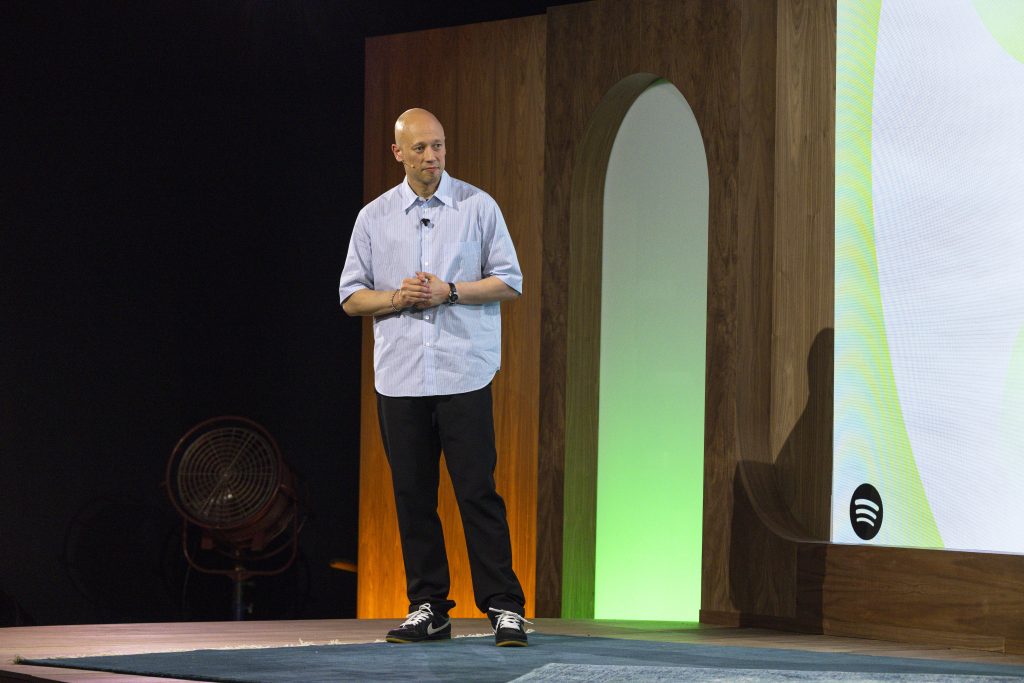
Spotify Technology SA is betting that artificial intelligence and higher-value subscriptions will power its next stage of growth, as the streaming company moves to expand margins and push toward a long-term goal of one billion users.
The company said it has reached 761 million monthly active users, underscoring its scale across global markets and reinforcing its position as one of the largest audio platforms in the world. Executives used its 2026 Investor Day to signal a shift in strategy from broad-based user expansion to monetizing its most engaged listeners.
Shift Toward Higher-Value Users
Spotify is increasingly focused on increasing revenue per user rather than sheer growth, pointing to what executives described as a “power law” dynamic in its business, where a smaller segment of heavy users drives a disproportionate share of value.
To capitalize on that, the company is expanding beyond its core subscription offering with new paid features and add-ons, including audiobook bundles and AI-driven tools designed to deepen engagement and increase lifetime value.
AI Becomes Core to Product Strategy
At the center of the company’s roadmap is its proprietary “Large Taste Model,” which leverages billions of daily user signals across music, podcasts and audiobooks. Rather than competing directly in building general-purpose large language models, Spotify is applying AI to personalize and generate audio experiences based on user behavior.
Executives described a shift from traditional recommendation systems toward “generation,” where users can actively shape playlists, podcasts and other audio content in real time using natural-language prompts.
Early deployments of AI features have shown increased engagement, including improved discovery and higher interaction rates with personalized tools such as Spotify’s DJ product.

Gustav
Expanding Beyond Music Streaming
Spotify is also pushing deeper into adjacent formats:
- Music: Licensing deals and new tools enabling AI-assisted remixes and covers, alongside fan-focused features such as early ticket access
- Podcasts: A profitable segment with new subscription tools for creators under development
- Audiobooks: Rapid catalog growth and rising engagement among younger users
The company said both its music and non-music businesses now operate above 30% gross margins, reflecting improved monetization across the platform.
Competing for Attention
Executives reiterated a strategy centered on “time well spent,” positioning Spotify as a platform built around user intent and satisfaction rather than maximizing engagement at any cost.
That framing places the company in competition not only with other streaming services, but also with social and video platforms such as TikTok, YouTube and Netflix in the broader fight for user attention.
Financial Targets Through 2030
Spotify outlined long-term targets that include mid-teens revenue growth, gross margins of 35%–40% and operating margins above 20%.
Management said these goals will be supported by continued expansion in subscription pricing power, new monetization layers, and AI-driven personalization.
Spotify’s push toward one billion users hinges on the effectiveness of its freemium model and its ability to convert engagement into higher-priced offerings.
The company’s core bet is that AI will not only improve discovery, but also reshape how users interact with audio content—turning passive listening into a more interactive, personalized experience that users are willing to pay for.