
Three Kenyan startups are among 16 ventures selected as regional finalists for the 2026 American Society of Mechanical Engineers Innovation Showcase (ASME ISHOW), putting Kenya at the centre of a global cohort of hardware startups developing solutions for agriculture, healthcare, mobility, food storage and environmental challenges.
Ecomobilus Technologies Limited, KilimoChills Solution and Orienta, all based in Nairobi, are among eight African ventures and eight ventures from the Americas selected for the accelerator following online pitches and design and engineering reviews conducted between July 6 and August 6.
The 16 finalists will compete for six places in the 2026 global ISHOW cohort. Those selected will receive a share of grant funding, technical support, design services and access to ASME’s international network of engineering and industry experts.
The finalists will be announced during a virtual awards ceremony on August 11, with Jit Bhattacharya of Kenyan electric-mobility company BasiGo scheduled as the guest speaker.
Ecomobilus Technologies is taking to the accelerator its e-Mkoko, a solar-powered electric handcart designed for last-mile logistics. The technology targets informal traders who rely on manual transportation to move goods, potentially reducing physical labour while improving the efficiency of small-scale commerce.
KilimoChills is addressing a different infrastructure problem: food spoilage. Its solar-powered cold storage room is designed as a modular solution for small-scale food vendors, providing refrigeration without relying entirely on conventional electricity infrastructure.
Orienta’s technology focuses on accessibility. Its HVAD smart glasses are designed to help visually impaired people navigate streets, identify people and access information through an offline, hands-free platform.
Together, the three Kenyan ventures reflect a broader shift in the country’s technology ecosystem toward physical products designed around specific infrastructure and social challenges.
The African finalists also include BMTA&C Energy from Morocco, which has developed a solar-powered refrigeration system combining thermal storage and intelligent energy management; Kumva Insights from Rwanda, whose Farm Smarter Platform uses sensors and IoT technology to help farmers and agribusinesses monitor environmental and operational conditions; Team CannaSave from Uganda, which has developed a monitoring system to detect neonatal nasal cannula displacement; and Yaaka Investment Limited from Zambia, which is developing an e-waste recycling plant.
AISHA, based in Pennsylvania, is the eighth African-region finalist despite being headquartered in the United States. Its technology uses an AI-powered voice assistant deployed on low-cost hardware to provide healthcare information to patients and healthcare workers in underserved communities.
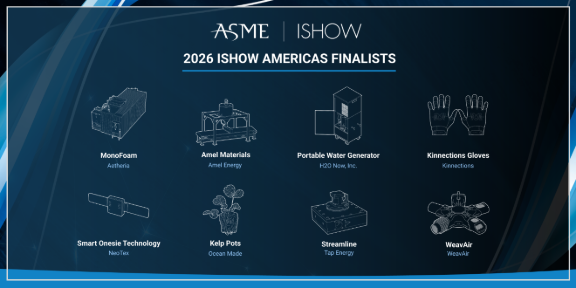
The Americas finalists span a similarly broad range of technologies.
Aetheria, based in the Netherlands, has developed MonoFoam, a mobile system designed to capture gases from end-of-life insulation foam while recovering materials for reuse and recycling. Amel Energyv in Massachusetts is developing PFAS-free materials intended as alternatives to conventional binders and solvents used in lithium-ion battery manufacturing.
H2O Now is working on a solar-powered portable water generator designed to produce potable and agricultural water in water-scarce environments. Kinnections in Texas has developed a wearable glove using controlled fingertip vibrations for people living with Parkinson’s disease.
Other finalists include NeoTex, which has developed a sensor-equipped infant garment for monitoring vital signs; Ocean Made, whose biodegradable Kelp Pots are designed to reduce plastic use in plant production; Tap Energy, which is developing an in-pipe micro-hydroelectric turbine for industrial water systems; and Canada’s WeavAir, an environmental and infrastructure monitoring platform designed to support asset management and climate-risk monitoring.
The final six ventures will become part of ASME’s 2026 global ISHOW cohort and will participate in the organisation’s annual ISHOW Bootcamp during the winter.
The bootcamp will provide customised design and engineering reviews aimed at helping the ventures move from prototypes and early-stage products toward commercial scale. Participants will also receive design services and become members of the ISHOW alumni network.
For Kenyan startups, the programme offers a route into an international hardware ecosystem at a time when the country’s technology sector is increasingly moving beyond software and mobile applications.
The three selected companies operate in markets where hardware remains critical to solving problems that cannot be addressed through digital platforms alone: moving goods, preserving food and improving independent mobility for people with visual impairments.
ASME will hold the third regional ISHOW event in Chennai, India, on September 3–4 alongside the ASME International Mechanical Engineering Congress and Exposition. Ventures selected across the Africa, Americas and India regional events will form the 2026 global cohort.
The awards ceremony for the Africa and Americas finalists will take place virtually on August 11 at noon Eastern Daylight Time.

)