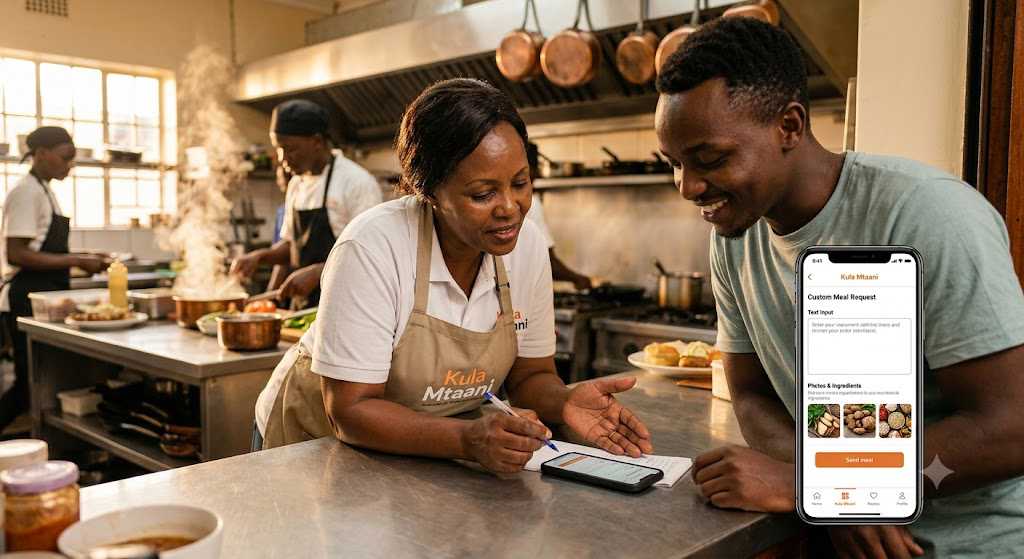
Brian Otieno, a Kenyan technology entrepreneur, is building KulaMtaani, a food-commerce platform designed to help restaurants, food vendors and private chefs manage their operations, receive orders and coordinate business activities through one system.
Launched in June 2025, KulaMtaani is targeting operational challenges faced by food businesses that rely on WhatsApp messages, phone calls, notebooks, spreadsheets and disconnected applications to manage daily activities. Through his company, Rorik-Asilic Infotech Group Limited, Otieno aims to bring these processes together while making business technology more accessible to smaller enterprises.
The startup has engaged with more than 70 food businesses, particularly around Nairobi, as it works to validate its product and strengthen its market position.
Rather than positioning KulaMtaani solely as a food delivery marketplace, Otieno wants to build a broader operating platform covering digital storefronts, order management, point-of-sale operations, delivery coordination, supplier procurement and business reporting.
The ambition comes with the challenges of building a technology company from the ground up. Otieno says much of the development has been funded through personal resources, requiring the business to balance product development with customer acquisition, infrastructure and merchant onboarding.
In this edition of CEO Weekends, Otieno discusses the inspiration behind KulaMtaani, the problems it seeks to solve, lessons from early engagement with food businesses, the realities of bootstrapping a technology startup and his vision for the future of food commerce in Kenya and other African markets.
What inspired you to start KulaMtaani, and what else have you built before this?
My name is Brian Otieno, a Kenyan technology professional and entrepreneur with a background in Business Information Technology and experience building software solutions for business operations. My work has exposed me to how technology can solve practical problems when it is designed around the needs of the people using it.
KulaMtaani grew out of my interest in making technology more accessible to everyday businesses, particularly in the food industry. I saw an opportunity to build something that would help restaurants, food vendors and private chefs manage their businesses more efficiently without needing expensive or complicated systems.
Through Rorik-Asilic Infotech Group Limited, the company behind KulaMtaani, I am working towards a broader goal of developing practical technology products that help businesses operate, serve customers and grow. My experience building software has taught me that creating a product is only part of the job. The real challenge is building something people genuinely need, can afford and will continue using.
What problem did you see in the food business that led to KulaMtaani?
I saw that running a food business involves much more than preparing and selling food. Business owners have to manage orders, communicate with customers, coordinate deliveries, track sales, source ingredients and keep daily operations moving. In many small and growing businesses, these activities are handled through separate applications, phone calls, WhatsApp messages, notebooks and spreadsheets.
That creates unnecessary complexity. Information gets scattered, orders can be missed, and business owners spend valuable time coordinating activities instead of focusing on their customers and products.
At the same time, many existing digital solutions focus primarily on helping customers discover food and place delivery orders. I saw an opportunity to approach the problem from the business owner’s side: what if a food business could manage more of its operations from one platform?
That question became one of the foundations of KulaMtaani.
What makes KulaMtaani different from other food-commerce platforms?
KulaMtaani is not being built simply as another food delivery marketplace. Our goal is to create an operating system for food commerce that brings together the tools food businesses need to sell, manage orders and coordinate their operations.
The platform is designed to support different parts of the food business, including order management, business storefronts, point-of-sale operations, delivery coordination, professional food services, supplier procurement and business reporting.
We also recognise that food businesses operate differently. A restaurant serving walk-in customers has different needs from a private chef taking bookings or a food vendor receiving orders online. We want the platform to support these different business models without forcing everyone into the same workflow.
The bigger difference is the direction we are taking: rather than focusing only on the transaction between a customer and a restaurant, we are building the operational infrastructure around that transaction as well.
How does KulaMtaani help food businesses run their day-to-day operations?
KulaMtaani is designed to bring several business activities into one connected environment.
A business can use its digital storefront to present its products and receive orders, while order management tools help organise incoming requests. Point-of-sale capabilities support counter sales, and delivery coordination helps businesses manage fulfilment through their available delivery arrangements.
We are also developing the broader operational side of food commerce. For example, the supplier and procurement functionality is intended to help food businesses request supplies, generate purchase orders, review costs and track supplier responses. Reporting and notifications help businesses keep track of relevant activities.
The objective is to reduce the need to switch between disconnected tools and make everyday operations easier to coordinate. We want business owners to spend less time managing fragmented processes and more time improving their products, serving customers and growing their businesses.
What have you learned from testing KulaMtaani with businesses so far?
One of the biggest lessons has been that building a useful product requires more than adding features. You have to understand how businesses actually work, what they struggle with every day and what they are willing to change about their existing processes.
Our early engagement with food businesses has helped us appreciate the importance of simplicity, affordability and practical value. A business owner does not adopt a platform simply because it has many capabilities. They need to see how it makes their work easier, helps them serve customers or improves the way they manage the business.
We have also learned that different businesses have different priorities. Some may care most about receiving online orders, while others need better control over counter sales, deliveries or procurement. That has influenced our decision to build KulaMtaani as a broader platform rather than a single-purpose application.
We are treating this stage as an opportunity to keep refining the product, improve onboarding and establish a model that can work for businesses of different sizes.
What traction has KulaMtaani achieved since launching?
Since launching in June 2025, KulaMtaani has engaged with more than 70 food businesses, particularly around the Kimbo and Kiambu areas, as we work to validate the product and its usefulness to the market.
The journey has not been entirely straightforward. We experienced an early setback when a hosting interruption resulted in the loss of our initial business database, forcing us to rebuild and continue from a new foundation. That experience was difficult, but it also reinforced the importance of reliable infrastructure and building a business that can withstand operational setbacks.
Our progress so far has been driven largely by our own resources. We are now focused on improving the platform, strengthening merchant onboarding and turning early market interest into consistent, active usage.
We see the initial business relationships as a foundation rather than the finish line. Our next milestone is to demonstrate repeat usage, establish a sustainable customer acquisition process and grow a stronger base of businesses that rely on KulaMtaani in their daily operations.
What has been the biggest challenge in building the platform?
The biggest challenge has been balancing product development with the resources required to take the product to market.
As a technology founder, I can invest time in designing and building functionality, but a good product does not automatically attract customers. Reaching businesses, demonstrating value, supporting onboarding and building trust all require time, money and consistent engagement.
We have had to make difficult decisions about what to build first, how to maintain the infrastructure and how to grow without spending beyond our means. Much of the work has been funded from personal resources, which places limits on how quickly we can execute our commercial plans.
That experience has changed how I think about entrepreneurship. It is not enough to prove that you can build technology. You must also prove that you can distribute it, retain customers and build a sustainable business around it.
Our focus now is to turn the work already invested in KulaMtaani into measurable adoption and a stronger commercial foundation.
What is your vision for KulaMtaani over the next five years?
Over the next five years, I want KulaMtaani to become a trusted operating platform for food businesses in Kenya and, eventually, across other African markets.
I see a future where a restaurant, private chef or food vendor can manage a substantial part of their business through one connected system: from presenting products and receiving orders to handling sales, coordinating deliveries, purchasing supplies and understanding business performance.
Beyond individual businesses, I want KulaMtaani to help connect the wider food-commerce ecosystem, including merchants, suppliers, delivery providers and customers. This could make everyday business processes more coordinated and create opportunities for businesses that have traditionally operated with limited access to integrated technology.
We intend to grow in stages, starting with proving consistent value for food businesses in our initial markets before expanding geographically and deepening the platform’s capabilities.
Ultimately, I do not want KulaMtaani to be known only as a place to order food. I want it to become part of the infrastructure that helps food businesses operate better, reach more customers and build sustainable enterprises.