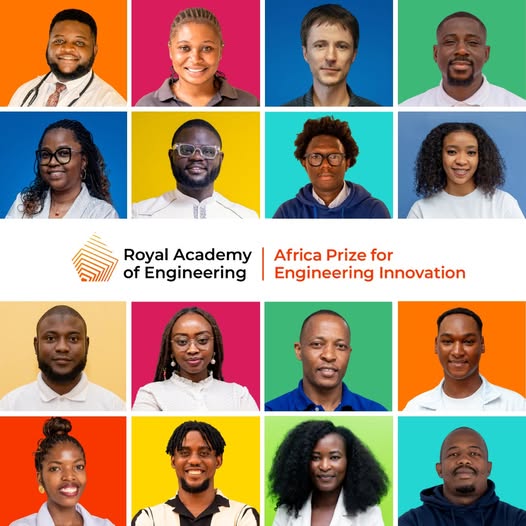
The Royal Academy of Engineering has shortlisted 16 innovators for the 2026 Africa Prize for Engineering Innovation, an eight-month programme of training, mentoring and networking opportunities ahead of the final in October.
Shortlisted innovators will receive expert business, technical, and sector-specific engineering mentoring, alongside access to the Academy’s extensive network of engineers and business leaders across the UK and Africa.
The programme’s panel of judges will then select four finalists who will pitch to win the 2026 Africa Prize at a live final event in Johannesburg in October.
The winner of the Africa Prize will receive £50,000, while the three runners up will each be awarded £10,000. The audience will then select the winner of this year’s ‘One-to-Watch’ award for the most impactful pitch, worth £5,000.
All shortlisted candidates will join the Africa Prize alumni community of more than 160 innovators, gaining access to exclusive opportunities for funding, development, and ongoing support. Since 2014, the alumni have introduced nearly 700 products and services to the market in more than 40 countries across five continents, and developed solutions linked to each of the UN Sustainable Development Goals on a local level.
Shortlisted innovations and entrepreneurs from Ghana, Kenya, Lesotho, Malawi, Niger, Nigeria, Rwanda, Senegal, South Africa, Tanzania, Zambia have each been selected for their solutions to critical environmental, educational and health challenges in their communities:
- Fusion Wind Turbine, created by Johannes Amo-Aye in Ghana, is a hybrid wind and solar microgrid system that delivers reliable, clean electricity to off-grid communities, supports and reduces reliance on diesel generators.
- MoyoECG, developed by medical doctor Alice Muhuhu in Kenya, is an AI-powered, wearable electrocardiogram device enabling rural clinics to deliver hospital-grade cardiac screening without internet access or mains electricity and support early detection of heart and potential maternal complications.
- Renal Roads is a mobile dialysis unit designed by Naom Monari in Kenya to bring hospital-grade kidney care directly to rural communities so that patients can access life-saving treatment without regularly travelling long distances.
- Automated Vermicomposting Device by Royford Mutegi from Kenya is a solar-powered solution that converts food waste into pest-resistant fertiliser pellets, enabling smallholder farmers to restore soils and reduce reliance on imported chemical fertilisers.
- Farmflex is an AI-enabled smart farming platform by Mochesane Mpali in Lesotho, helping African smallholders to grow more food with less water, reduce risk and gain direct access to credit, insurance and new markets.
- MalawiDrop by Tadala Mtimuni from Malawi is a low-cost, refillable household water treatment device delivering safe drinking water at the point of use for off-grid rural communities, removing the need for complex manual dosing.
- Likita Care, created by Mamane Kabirou in Niger, is a locally manufactured monitoring kit for hospitals and clinics, combining vital signs, cardiac and prenatal monitoring with offline AI decision support and digital protocols to improve triage and patient safety.
- Efiwe, developed by Chidi Nwaogu in Nigeria, is a mobile-first coding platform that runs offline on basic smartphones, enabling young people excluded from traditional digital education to learn web development with AI support in 189 languages.
- Just Add Water by Derick Nwasor from Nigeria is a quantum and AI-optimised regenerative fuel cell technology, providing clean energy and medical-grade oxygen to healthcare facilities, reducing dependence on fossil fuels and third-party oxygen delivery.
- HarakaPlus is a smart mobility platform created by Millicent Kariuki in Rwanda that provides live bus location and passenger-demand data, helping commuters and transport operators to make public transport more reliable across African cities.
- Peecycling is a solution by Dyllon Randall in South Africa, transforming human urine into safe liquid fertiliser and reusable water, helping cities to conserve water and reduce dependence on imported fertilisers.
- LabZero is a virtual tissue culture lab designed by Sincengile Ntshingila in South Africa that enables students to practise growing and maintaining cells safely on a digital platform, reducing contamination, cutting plastic waste, and widening access to biomedical research training.
- Jangalma, created by Moustapha Diop in Senegal, is an AI-powered education platform providing affordable, personalised learning and tutoring to secondary school students across Francophone Africa, regardless of income, location or connectivity.
- ZaidiApp by Allen Kimambo from Tanzania is an eco-fintech platform helping cities to digitise waste collection, formalise informal recycling work, and unlock financial services for waste workers and contractors.
- WaterBank, developed by Faith Kuya in Tanzania, is a solar-powered, self-running water utility that filters and desalinates water, uses AI to prevent breakdowns, and enables cashless access via prepaid radio frequency ID cards for off-grid communities.
- DawaMom is an AI-enabled maternal and reproductive health platform created by Tafadzwa Kalisto in Zambia to help women access trusted guidance in local languages, alongside diagnostics, triage and referrals through community and clinic-based care.
Applications for the next Africa Prize shortlist will open in mid-July and close in mid-September 2026.