The DFINITY Foundation unveiled Internet Computer 2.0 and the Caffeine AI platform, the world’s first self-writing apps platform during the World Computer Summit (WCS).
Held in Zürich, the one-day event gathered over 1,000 attendees from around the globe, including developers, policymakers, academics, entrepreneurs, and Web3 pioneers. The summit focused on critical themes shaping the evolution of the open internet, such as decentralized computing, sovereign cloud infrastructure, AI on-chain, and data autonomy.
Hosted by DFINITY, the foundation behind the Internet Computer blockchain, WCS25 provided a platform for thought leadership and innovation across the decentralized ecosystem. The event featured keynote addresses, live demos, and panel discussions with speakers from notable organizations, including Animoca Brands, the United Nations Development Programme (UNDP), Cisco, ETH Zurich, Credit Agricole Italia, and the Boston Consulting Group.
Caffeine AI Demo Ushers in the Era of Self-Writing Applications
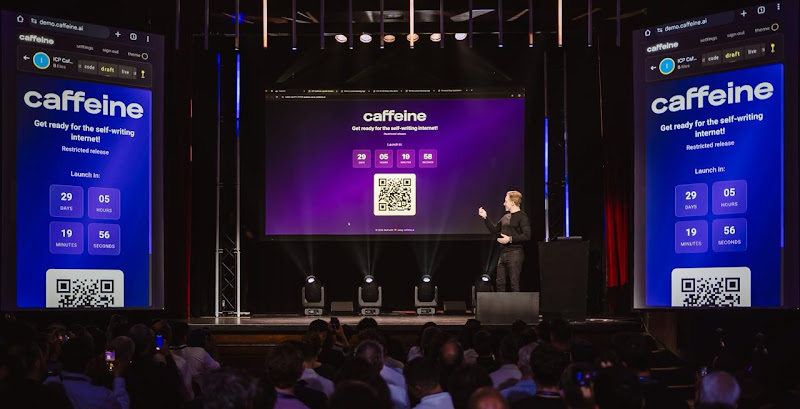
The highlight of the summit came when Dominic Williams, Founder and Chief Scientist of the DFINITY Foundation, took the stage to unveil Caffeine AI—a revolutionary platform that enables users to build decentralized applications (dapps) using natural language prompts, eliminating the need for coding.
In a world-first, Williams performed a live onstage demonstration, showing the audience how anyone, regardless of technical background, can use Caffeine’s intuitive interface to create secure, fully functional web applications in just minutes.
“Caffeine is not just a product; it’s a paradigm shift,” said Williams. “We are proud to introduce the world’s first self-writing apps platform, empowering people everywhere to build on the internet simply by speaking or typing in natural language.”
The alpha version of the platform is now open for early access at join.caffeine.ai, with a public beta expected within a month.
A Technological Leap: Internet Computer 2.0
Alongside Caffeine, DFINITY announced the evolution of its flagship blockchain into Internet Computer 2.0—a decentralized, sovereign cloud computing environment designed to natively host AI, autonomous infrastructure, and next-generation dapps.
Unlike traditional blockchains, the Internet Computer offers full-stack capabilities, allowing smart contracts (called canisters) to serve web experiences directly to users. This eliminates the reliance on centralized cloud providers like AWS or Azure. The upgrade also includes native integration for on-chain AI agents, expanding use cases in finance, governance, education, and public services.
“With Internet Computer 2.0, we’re moving from proof-of-concept to production-grade infrastructure,” Williams explained. “This is the next frontier for the open internet.”
Builder Ecosystem Takes Center Stage
A key feature of WCS25 was the emphasis on community development and real-world application building. The event’s Ecosystem Stage showcased projects developed on the Internet Computer, many of which highlighted the protocol’s unique capabilities.
Among the featured projects were:
– KongSwap: A decentralized exchange platform with innovative tokenomics.
– Liquidium: Enabling decentralized lending against staked ICP tokens.
– PiggyCell: A gamified savings tool designed to onboard users into DeFi.
– Omnity Network: A digital identity and data-sharing protocol with cross-chain ambitions.
These presentations, alongside others focusing on DeFi, Agentic AI, and real-world asset (RWA) tokenization, demonstrated the protocol’s growing versatility and adoption.
DFINITY also used the summit to provide updates on key infrastructure tools, including OISY Wallet a lightweight, secure crypto wallet and Chain Fusion, which enhances interoperability between the Internet Computer and other blockchains like Ethereum and Bitcoin.
Decentralization, Regulation, and the Future of the Web
Beyond technology, WCS25 addressed critical questions surrounding digital sovereignty, regulatory frameworks, and investment trends. Speakers discussed how decentralization can promote more democratic control of data and services and emphasized the need for cross-sector collaboration to navigate legal and governance challenges.
The participation of organizations like Heidrick & Struggles, 21Shares, and the UNDP highlighted the growing convergence of traditional institutions with decentralized technologies.
“Decentralization is no longer a niche experiment—it’s a serious, scalable solution,” remarked one speaker. “This summit proves that the ecosystem is ready to lead.”
DFINITY’s announcements mark a new chapter not just for the foundation but for the broader decentralized ecosystem. With Caffeine AI lowering barriers to entry and Internet Computer 2.0 expanding possibilities, the movement toward a more open, sovereign, and intelligent internet is truly underway.