
 Eweje, a Nigerian-American scientist and co-founder of Procure Bio, is not the kind of scientist who accepts limitations)
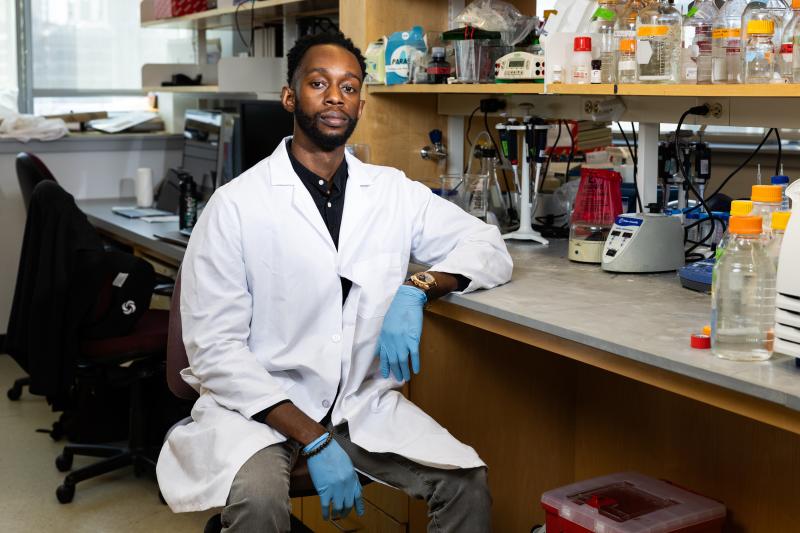
Feyisayo (Sayo) Eweje, a Nigerian-American scientist and co-founder of Procure Bio, is not the kind of scientist who accepts limitations. Whether he is clicking through a Rubik’s Cube or wrestling with one of medicine’s most stubborn questions such as how to deliver gene editors into the right cells, he has built his career on the belief that every problem has an elegant solution waiting to be discovered.
Born and raised in North Carolina, Dr. Eweje grew up surrounded by the values of education, persistence, and service. The son of immigrant parents who emphasized learning as the gateway to opportunity, he saw early that knowledge could change not just his own life but entire communities.
That conviction led him to pursue the demanding Harvard-MIT M.D./Ph.D. program in Medical Engineering and Medical Physics, a dual path that allows him to think like both a clinician and a scientist. One that thinks about patients and transforming healthcare systems at scale led him to develop new technologies for delivering RNA and protein therapies focusing on the design of non-viral, protein-based nanoparticles for the targeted delivery of nucleic acid and protein therapeutics.
Today, at Harvard’s Wyss Institute for Biologically Inspired Engineering, Dr. Eweje is developing a self assembling human protein nanoparticle system derived from the elastin protein, a technology known as ENTER capable of transporting gene editors into the body more efficiently and more safely than existing methods.
Gene editors such as CRISPR are powerful, but fragile: they are degraded easily by enzymes and cannot naturally cross cell membranes. Dr. Eweje’s delivery system protects them, escorts them directly into the cell nucleus, and enables them to correct genetic mutations from within.
This work could redefine treatment for inherited disorders like cystic fibrosis and sickle cell disease. While recent medical breakthroughs have allowed sickle cell gene editing outside the body, patients must undergo chemotherapy and endure complex logistics involving extraction and reinfusion of stem cells. Dr. Eweje wants to bring that complexity inside the body. No chemotherapy. No off-site editing. Just a direct therapeutic fix where the cells already live.
Behind the science lies a deeper motivation: the patient at the end of the struggle. Dr. Eweje does not separate research from humanity. He is animated by the future individuals who will breathe more easily, who will live without chronic pain, who will inherit a life no longer defined by disease. Every iteration in the lab is a step toward that reality.
His entrepreneurial mindset fuels that journey. At Wyss, scientific research is never an academic trophy, but a product pipeline. Dr. Eweje works closely with commercialization experts, the Cystic Fibrosis Foundation, and collaborators from George Church’s lab to move from discovery to deployment. His passion for building solutions naturally aligns with a startup future in biotechnology, one driven by African ingenuity and global ambition.
That matters. Though Dr. Eweje is American, Africa urgently needs innovation in genomic medicine. The shutdown of 54gene, once the continent’s most celebrated biotech company exposed how fragile progress can be when local capacity is still developing. Investors became wary. Scientists lost momentum. But the need for genetic research did not disappear; it only grew more obvious.
The founder went ahead to launch Syndicate Bio’s which operates Direct by Syndicate Bio, a genetic testing and precision medicine service designed to deliver actionable insights to patients, providers, and consumers across Africa. The firm also launched a sequencing laboratory in Lagos, enabling world-class genomic and multi-omics testing powered by AI-delivered locally for Nigeria’s 200 million citizens and the global diaspora.
Syndicate Bio’s Direct by Syndicate Bio offers a wide range of genetic testing, including Non-Invasive Prenatal Testing (NIPT), carrier screening in reproductive health, BRCA1 & BRCA2, hereditary cancer testing, solid and myeloid tumor profiling in Oncology, helping patients and doctors understand how genes affect drug response in Pharmacogenomics and nutrition, fitness, and preventive health insights in health and wellness.
 Beyond testing, Dr. Eweje’s work will build infrastructure for not just for the US but also for Africa powering clinical research in Nigeria and across the continent, enabling large-scale studies that reflect Africa’s genetic diversity and advancing precision medicine for the world.
South Africa’s African Genomics Centre, Kenya’s Molecule, and Nigeria’s DNA360 are building infrastructure for sequencing, diagnostics, and precision medicine. What they lack is a commercially viable delivery system for advanced gene therapies, the very challenge Eweje is solving.
His path will open doors for a new phase for African biotech, one where Nigerian-American innovators lead global breakthroughs that circle back to uplift their ancestral homes and the continent as a whole. Diseases like sickle cell disproportionately affect African communities, a Nigerian-led solution would be both scientifically and symbolically transformative.
Outside the lab, Dr. Eweje is disarmingly relatable. He is a basketball fan who grew up watching Duke and UNC games. He has developed a surprising passion for birding, wandering parks with his camera trying to capture gray catbirds and Baltimore orioles mid-flight. He still speed-solves Rubik’s Cubes. And he shares his journey with an identical twin brother, Sope, who is now starting his medical residency.
If he were not researching gene therapies, he says, he would teach to pay forward the educational foundation his parents built for him. In truth, he is already teaching, simply through a different classroom, showing what science looks like when innovation is guided by compassion, rigor, and purpose.
It is daunting work, slow, frustrating, sometimes lonely. But for Dr. Eweje, who previously served Co-VP of Clinical Operations at Nucleate, the future keeps calling louder than the setbacks. His nanoparticles may ultimately reshape how we treat genetic disease. His startup path may strengthen a biotech renaissance and introduce the next medical revolution.
His work at Dr. Elliot Chaik at Beth Israel Deaconess Medical Center and Wyss led him to start Procure Bio, a startup that aims to advance these delivery systems for in vivo gene editing, with a focus on cystic fibrosis and delivery to the lungs, as well as inherited blood disorders. This will enable gene editing-based treatments without the need for the high-dose chemotherapy or myeloablation that patients with inherited blood disorders currently endure.
“Protein materials, particularly human-derived protein materials, are far less likely to trigger immune responses, which is one major advantage. The other thing that we’re actively working towards in the lab is leveraging the programmability and precise structure of recombinant proteins. We’re exploring applications ranging from gene editing in the lungs to immunotherapy and novel approaches to cancer treatment.” Dr. Eweje said in May as a Roivant Social Ventures (RSV) inaugural Convergence Forum Fellow.