Home Blog Page 14

CEO Weekends: Andrew Kibe on Building Inner Circle and Fixing Africa’s Creator Economy

0

Africa’s creator economy is growing rapidly, but for many creators, turning influence and expertise into sustainable income remains difficult. Global platforms were largely built around payment systems such as PayPal and Stripe that do not work reliably across much of the continent, leaving creators to depend on fragmented tools to connect with paying audiences.

It is this gap that Andrew Kibe, a technology leader with experience building digital and financial infrastructure across Africa, is seeking to address with Inner Circle, a platform designed to help creators monetise their expertise through paid sessions, subscriptions, priority messages and group experiences.

Founded in May 2026 and already serving creators across eight African markets, Inner Circle is betting that the next chapter of Africa’s creator economy will be built on infrastructure designed for Africa from the start.

TechMoran caught up with Kibe and this is what he told us.

When was Inner Circle founded and what inspired you to do this?

Inner Circle was founded in May 2026 by Andrew Kibe and a small founding team based in Nairobi, Kenya. I am a seasoned technology leader and engineer with over two decades of experience shaping Africa’s digital and financial ecosystems. As Group CTO at 4G Capital, a leading African neobank, I steered the company’s technology vision and infrastructure, contributing to its growth and successful fundraising of over $23.1 million.

Previously, I was instrumental in the rise of TopUp Mama, driving its tech strategy and execution as the company scaled rapidly to $4.8 million in sales within 18 months and raised over $2.7 million in funding. Most recently, as CTO at Lemonade, one of Kenya’s mobile payment platforms, I led engineering for cross-border payment rails across multiple African markets. My career reflects a rare blend of technical depth, strategic leadership, and a proven track record of building scalable systems that power real impact across Africa’s emerging markets.

The inspiration for Inner Circle came from a simple observation: Africa has an enormous creator economy comprised of musicians, coaches, entrepreneurs, doctors, lawyers, fitness experts but almost none of the monetisation infrastructure that exists in the West works reliably for them. Platforms like Patreon and Cameo require PayPal or Stripe, both of which are either unavailable or unreliable across most of Africa.

African creators were giving away their expertise for free on Instagram and TikTok with no way to convert it to income. Inner Circle was built to fix that.

Is the company bootstrapped or venture capital funded?

Inner Circle is currently bootstrapped and founder-funded. We made a deliberate decision to build and validate the model with real creators and real revenue before raising external capital. The platform is live, processing real transactions, and growing organically. We are open to strategic conversations with investors who understand the African creator economy and the payments infrastructure required to serve it.

How many registered users so far?

Inner Circle has 109 active vetted creators on the platform across Kenya, Nigeria, Ghana, Uganda, Tanzania, Zambia, Senegal and Benin, with over 2,000 registered fans. We are selective, every creator is reviewed and approved personally. We are not a marketplace where anyone can sign up. This keeps quality high and protects fans from wasting money on creators who are not serious about their time. So far, more than 600 sessions have been handled through the platform, giving people the opportunity to have direct, paid conversations with experts they already follow or want to learn from.

How does the revenue-sharing model work between Inner Circle and creators?

Creators keep 90% of every transaction, sessions, subscriptions, priority DMs, paid questions, and group rooms. Inner Circle takes 10%. This is the best split in the industry. Cameo takes 25%. Patreon takes up to 12% plus payment processing fees that can push the effective take to 20%+ in practice. Intro.co takes 20% on every booking. Passes.com takes between 15–20% depending on the creator’s tier. On Inner Circle, a creator charging KES 1,500 for a session receives KES 1,350 directly to their mobile wallet, same day. There are no monthly fees, no setup costs, and no minimum earnings threshold to receive a payout.

Which countries are officially supported?

Inner Circle currently supports Kenya (KES), Nigeria (NGN), Ghana (GHS), Uganda (UGX), Tanzania (TZS), Zambia (ZMW), Senegal (XOF) and Benin (XOF), 8 markets across East, West and Southern Africa. Payments are processed via mobile money and bank in each market. We are actively expanding and have the infrastructure to add new African markets rapidly.

What differentiates Inner Circle from similar platforms? Why should African creators choose it over these existing alternatives?

Most platforms serving African creators are either global tools that barely work in Africa such as Patreon, Cameo, Calendly + PayPal or local solutions that solve one problem booking or payments but not both together.

Inner Circle is the only platform built end-to-end for African creators that combines:

1.​ Native mobile money & bank payments — M-Pesa, MTN MoMo, Airtel Money and others, with no card required

2.​ Multiple income streams in one place — 1-on-1 sessions, subscriptions, priority DMs, paid questions, and live group rooms

3.​ Same-day payouts — directly to mobile money, and bank account

4.​ Built-in video — sessions happen on Inner Circle, not a third-party tool the creator has to manage separately

5.​ Multi-market from day one — a Kenyan creator can receive a booking from a fan in Nigeria, Ghana or Uganda and get paid in their local currency

The closest local comparison would be assembling Calendly + M-Pesa PayBill + Zoom + WhatsApp Business but Inner Circle replaces all of that with one link.

What safeguards are in place to protect creators and users against fraud, abuse or chargebacks?

Several layers of protection are built into the platform:

●​  Creator vetting — every creator is manually reviewed and approved before going live.

Fans know they are booking a real person, not a ghost account.

●​ No-show protection — if a creator misses a session without notice, the fan isautomatically refunded in full. If the fan misses, the creator is still paid.

●​ Payments via regulated infrastructure — all payments go through LemonadePayments,a crossborder payments platform. Funds are not held on our platform.

●​ Session recording consent — sessions happen on our inhouse powered videoinfrastructure with clear consent flows.

●​ Dispute resolution — fans can flag sessions and our team reviews attendance datafrom the video platform to resolve disputes objectively.

●​ Refund channels — every market has a configured refund channel. Refunds areprocessed back to the original payment channel within 24 hours.

What is the roadmap for Inner Circle over the next 12 months?

Our priorities over the next 12 months:

1.​ Market expansion — South Africa (ZAR) and Egypt (EGP) are next. We are in conversations with payment partners for both markets.

2.​ Strategic Partnerships — working with talent management agencies, media houses, and creator networks across Africa to bring established talent onto Inner Circle with managed profiles, dedicated booking support, and co-marketing. This includes partnerships with platforms like Aktivate to tap into their existing roster of verified African creators and give them a direct monetisation channel.

3.​ Fan communities — giving creators a space to host their subscribers beyond individual sessions.

4.​ Creator storefront — enabling creators to sell digital products directly through their Inner Circle profile — templates, guides, presets, courses, and downloadable content — giving fans a way to buy from their favourite creators without booking a live session, and giving creators a passive income stream alongside their session earnings.

5.​ Creator discovery — improving how fans find the right creator through intent-based search and category browsing.

6.​ Group rooms at scale — enabling creators to host paid live sessions with up to 1,000 participants.

7.​ Referral and gifting — letting fans gift sessions to others, and rewarding fans who bring new creators or fans to the platform.

8.​ Low-bandwidth mode — optimising the video experience for users on 3G connections across Africa.

9.​ Mobile apps — native iOS and Android apps for both creators and fans.

10.​Creator Analytics Dashboard — giving creators deeper insight into their earnings, fan behaviour, session completion rates, and subscription churn so they can make smarter decisions about their content and pricing.

11.​Verified creator programme — a structured tier system that rewards top-performing creators with higher visibility, lower platform fees, and promotional support from Inner Circle.

12.​Localised content and onboarding — onboarding flows, support, and creator resources in Swahili, Yoruba, Twi and French to serve our expanding francophone West African markets (Senegal, Benin, and Côte d’Ivoire).

13.​Brand partnerships — enabling brands to sponsor creators directly through the platform, opening a new revenue stream for creators beyond fan payments.

Payments are broken in Africa despite thousands of fintech platforms. How do you aim to fix this?

This is the core problem Inner Circle was built to solve, and it shaped every infrastructure decision we made from day one. Let’s be clear about what is actually broken. The problem is that global platforms were never designed for African payment infrastructure. They assume Stripe, PayPal, or a Visa card, none of which work reliably across most of Africa. When PayPal cuts off users or Stripe declines African cards, creators lose access to their income overnight. That is not a payment problem. That is a dependency problem.

Inner Circle was built to eliminate that dependency entirely. Our entire payment infrastructure runs on African mobile money and bank rails through Lemonade, a payments platform operating across more than 8 African markets. We have no Stripe integration. No PayPal dependency. No exposure to the decisions of Western payment companies.

Our approach in practice:

●​ Same-day payouts — creators receive their earnings directly to M-Pesa, MTN MoMo,Airtel Money, or a bank account on the same day a session completes. No 3–5 day delays, no minimum balance to unlock a withdrawal.

●​ Transparent, low fees — 1.5% collection fee on KES transactions with a flat KES 20payout fee. No hidden charges, no percentage taken on withdrawals.

●​ True multi-currency — a creator in Nairobi can receive a booking from a fan in Lagos,Accra, or Kampala. Each party pays and gets paid in their local currency. No manual conversion, no wire transfers, no friction.

The broader challenge across Africa is infrastructure fragmentation — every country has different rails, different regulators, and different mobile money operators. Most platforms treat this as a reason not to expand. We treat it as The Opportunity. By building on Lemonade’s unified infrastructure, we can add a new African market in days, not months. A creator on Inner Circle today has access to fans across 8 countries. Within 12 months, that number will be significantly higher.

The payments problem in Africa is not unsolvable. It just requires building with Africa in mind from the start, not retrofitting a Western product for a market it was never designed for. That is exactly what we did.

Three Kenyan Startups Among 16 African, American Ventures Selected for ASME’s 2026 ISHOW Accelerator

0

Three Kenyan startups are among 16 ventures selected as regional finalists for the 2026 American Society of Mechanical Engineers Innovation Showcase (ASME ISHOW), putting Kenya at the centre of a global cohort of hardware startups developing solutions for agriculture, healthcare, mobility, food storage and environmental challenges.

Ecomobilus Technologies Limited, KilimoChills Solution and Orienta, all based in Nairobi, are among eight African ventures and eight ventures from the Americas selected for the accelerator following online pitches and design and engineering reviews conducted between July 6 and August 6.

The 16 finalists will compete for six places in the 2026 global ISHOW cohort. Those selected will receive a share of grant funding, technical support, design services and access to ASME’s international network of engineering and industry experts.

The finalists will be announced during a virtual awards ceremony on August 11, with Jit Bhattacharya of Kenyan electric-mobility company BasiGo scheduled as the guest speaker.

Ecomobilus Technologies is taking to the accelerator its e-Mkoko, a solar-powered electric handcart designed for last-mile logistics. The technology targets informal traders who rely on manual transportation to move goods, potentially reducing physical labour while improving the efficiency of small-scale commerce.

KilimoChills is addressing a different infrastructure problem: food spoilage. Its solar-powered cold storage room is designed as a modular solution for small-scale food vendors, providing refrigeration without relying entirely on conventional electricity infrastructure.

Orienta’s technology focuses on accessibility. Its HVAD smart glasses are designed to help visually impaired people navigate streets, identify people and access information through an offline, hands-free platform.

Together, the three Kenyan ventures reflect a broader shift in the country’s technology ecosystem toward physical products designed around specific infrastructure and social challenges.

The African finalists also include BMTA&C Energy from Morocco, which has developed a solar-powered refrigeration system combining thermal storage and intelligent energy management; Kumva Insights from Rwanda, whose Farm Smarter Platform uses sensors and IoT technology to help farmers and agribusinesses monitor environmental and operational conditions; Team CannaSave from Uganda, which has developed a monitoring system to detect neonatal nasal cannula displacement; and Yaaka Investment Limited from Zambia, which is developing an e-waste recycling plant.

AISHA, based in Pennsylvania, is the eighth African-region finalist despite being headquartered in the United States. Its technology uses an AI-powered voice assistant deployed on low-cost hardware to provide healthcare information to patients and healthcare workers in underserved communities.

The Americas finalists span a similarly broad range of technologies.

Aetheria, based in the Netherlands, has developed MonoFoam, a mobile system designed to capture gases from end-of-life insulation foam while recovering materials for reuse and recycling. Amel Energyv in Massachusetts is developing PFAS-free materials intended as alternatives to conventional binders and solvents used in lithium-ion battery manufacturing.

H2O Now is working on a solar-powered portable water generator designed to produce potable and agricultural water in water-scarce environments. Kinnections in Texas has developed a wearable glove using controlled fingertip vibrations for people living with Parkinson’s disease.

Other finalists include NeoTex, which has developed a sensor-equipped infant garment for monitoring vital signs; Ocean Made, whose biodegradable Kelp Pots are designed to reduce plastic use in plant production; Tap Energy, which is developing an in-pipe micro-hydroelectric turbine for industrial water systems; and Canada’s WeavAir, an environmental and infrastructure monitoring platform designed to support asset management and climate-risk monitoring.

The final six ventures will become part of ASME’s 2026 global ISHOW cohort and will participate in the organisation’s annual ISHOW Bootcamp during the winter.

The bootcamp will provide customised design and engineering reviews aimed at helping the ventures move from prototypes and early-stage products toward commercial scale. Participants will also receive design services and become members of the ISHOW alumni network.

For Kenyan startups, the programme offers a route into an international hardware ecosystem at a time when the country’s technology sector is increasingly moving beyond software and mobile applications.

The three selected companies operate in markets where hardware remains critical to solving problems that cannot be addressed through digital platforms alone: moving goods, preserving food and improving independent mobility for people with visual impairments.

ASME will hold the third regional ISHOW event in Chennai, India, on September 3–4 alongside the ASME International Mechanical Engineering Congress and Exposition. Ventures selected across the Africa, Americas and India regional events will form the 2026 global cohort.

The awards ceremony for the Africa and Americas finalists will take place virtually on August 11 at noon Eastern Daylight Time.

Clea Launches Vendor Payments to Simplify International Supplier Payments

0

Clea, a Nigerian cross-border payments startup has launched Vendor Payments, a new feature designed to help businesses pay international suppliers, vehicle auction platforms and shipping companies directly through its platform, as it expands beyond foreign exchange and cross-border transfers into broader trade finance infrastructure.

The launch comes as the company reports strong early growth. Clea says it processed more than $20 million in transaction volume within six months of emerging from stealth in December 2025. The new Vendor Payments feature has already been adopted by more than 50 businesses during its pilot phase, highlighting demand for simpler ways to settle overseas supplier invoices.

The feature enables businesses to pay supported vendors, including U.S. vehicle auction platforms Copart and IAA, directly from their Clea accounts. Customers select a vendor, enter payment references such as buyer numbers, lot numbers or invoice details, and authorize the transaction. Because vendor details are preconfigured within the platform, payments can be completed without manually entering beneficiary banking information. Clea said it plans to add more suppliers and payment destinations over time.

The company said the launch reflects its strategy of building a single platform for African businesses managing international trade. By integrating supplier payments alongside cross-border transfers, Clea aims to reduce the operational complexity businesses face when sourcing goods from overseas markets.

“African businesses are increasingly trading across borders, but managing international supplier payments remains unnecessarily fragmented,” said Sheriff Adedokun, Founder and CEO of Clea. “We’re building more than a payments platform. We’re building the financial infrastructure businesses need to trade globally with confidence.”

Initially, Vendor Payments is available to eligible verified Clea business customers making U.S. dollar payments to selected suppliers in the United States. Businesses can fund their Clea accounts in Nigerian naira, convert funds into foreign currency within the platform and complete international payments through a single workflow.

The launch places Clea among a growing group of African fintech firms expanding beyond remittances and foreign exchange into integrated business banking and trade infrastructure. As cross-border commerce continues to grow, platforms are increasingly competing to offer businesses end-to-end services ranging from payments and foreign exchange to invoice management and supplier financing.

Clea said future updates will expand its global vendor network, allowing businesses to discover approved suppliers, manage invoices, build trusted vendor relationships and automate recurring international payments through a unified platform.

How to Unlock an Android Phone Fast: Step-by-Step Guide

You might forget your Android unlock pattern after not using it for a while. You can also become locked out by entering the wrong PIN too many times. As a result, you may be locked out of your device and unable to access your apps, files, or personal data. 

In such situations, if you wonder how to unlock an Android phone, this practical guide will help you out. Learn what the lockout means and how Dr.Fone – Screen Unlock (Android) outshines traditional unlock methods. 

Part 1. Android Lock Mechanisms: What You’re Up Against

Android phones use PINs, patterns, passwords, and biometrics to protect your device. However, forgetting your screen lock credentials can leave you locked out. Your PIN, pattern, or password helps protect encrypted data, making it inaccessible without the correct credentials. Biometrics provide convenient access but still require your primary screen lock after a restart or certain security events. 

These lock options are protected by Android’s built-in security features, including hardware-backed protection on supported devices. Hence, the basic tricks cannot bypass any Android screen lock.

Part 2. Will Your Data Survive the Unlock Process?

When an Android mobile unlock attempt is made, your local data will be removed right away. This is because modern Android devices automatically encrypt your storage via lock credentials. So, when you bypass biometric or PIN protection with a factory reset, it deletes the encryption keys and wipes the device. 

That means any local files, photos, or app data that weren’t backed up will be permanently lost. Nonetheless, your contacts, emails, and photos associated with your Google Account will remain safe on Google’s remote servers. Once synced to your Google account, you can download them again as you log in after the reset, according to Google. 

Part 3. Comparing Solutions — Official Routes vs Faster Alternatives

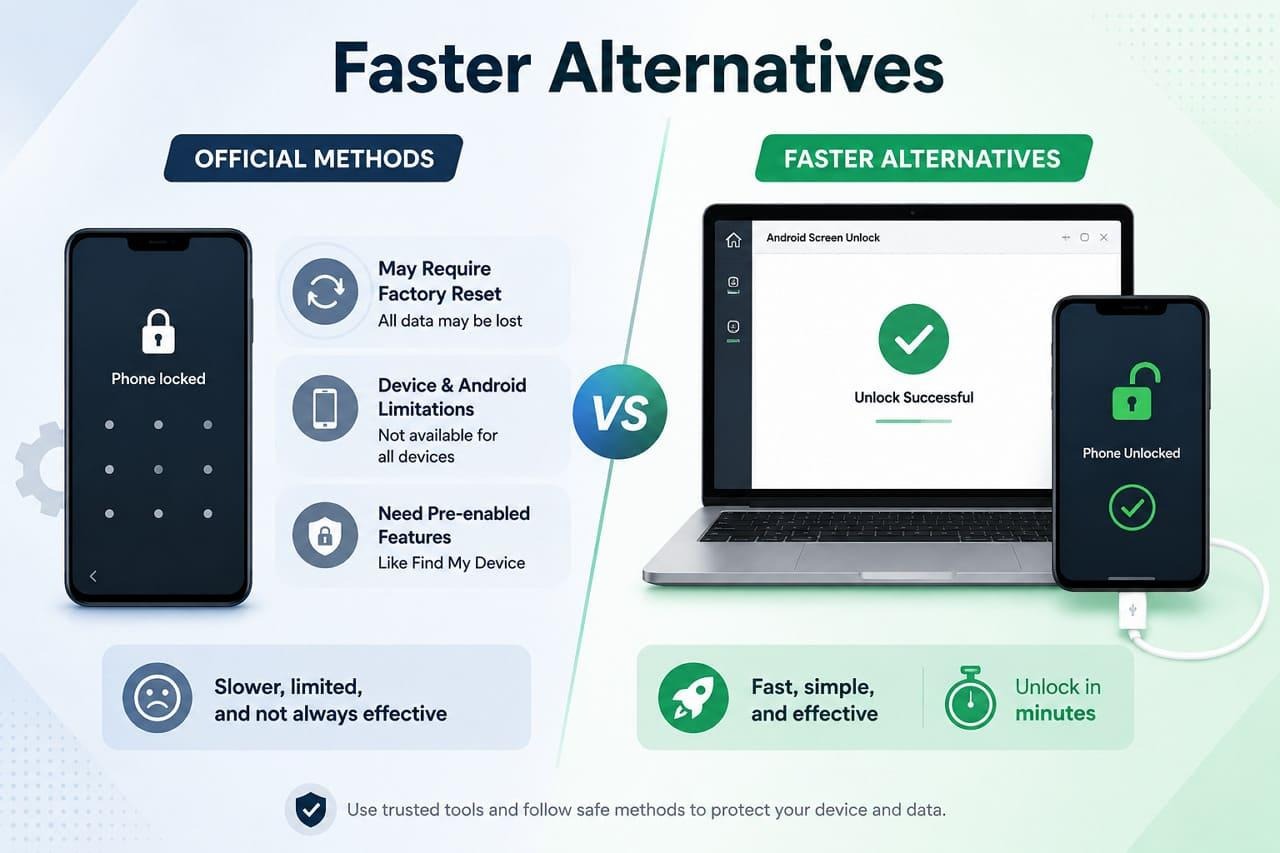
For those wondering how to unlock an Android phone, it’s important to understand the available options. Some official methods require a factory reset or have device and Android version limitations. Others only work if you previously enabled features such as Find My Device.

On the other hand, Android screen unlock software offers a faster alternative for many supported devices. Using a USB connection, they can remove supported screen locks in just a few minutes with step-by-step guidance, making the process easier for most users. 

Part 4. How to Unlock Your Android Phone with Dr.Fone

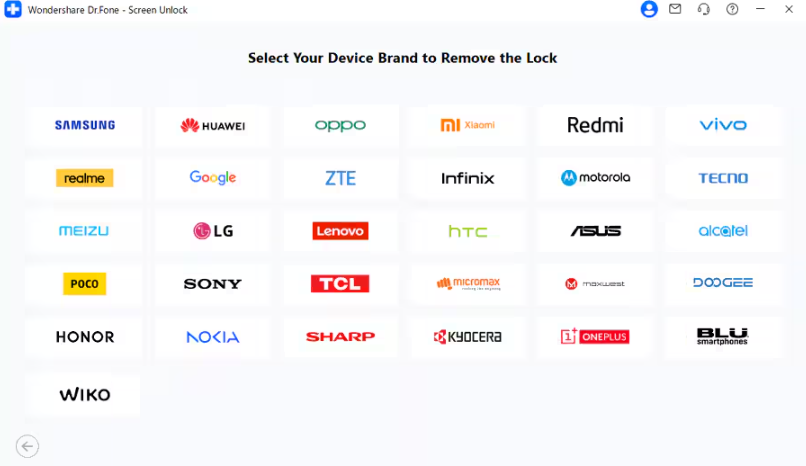
To unlock an Android Phone with software, use Dr.Fone – Screen Unlock (Android), which supports 29 brands for screen lock removal and 19 for FRP. It supports multiple Android screen lock types, and its AI-powered FRP removal feature is available for Samsung devices running Android 16, including the Galaxy S26 and S25 series. It is among the first tools to offer this capability for supported Samsung Android 16 devices. 

In addition to modern models, it also supports legacy phones, like TECNO, Infinix, and Itel, for FRP. With support for over 2000+ Android phones and tablets, Dr.Fone enables users to use a special mode on most Android models to unlock the device automatically. For all the locks and models, the guides are separate and detailed, and can be unlocked without any technical skills required. 

Key Features

  1. Weekly Updates: The tool receives weekly updates to improve compatibility with newer Android phones and tablets. Recent updates have added support for Samsung Android 12 screen unlock and Wiko devices. 
  2. Online FRP Bypass: Samsung Snapdragon device users can also remove the FRP online, and the simple interface makes navigation effortless. 
  3. Screen Unlock Without Data Loss: On Samsung and LG models, you can remove any screen lock without data loss; other tools are limited to Samsung only. 
  4. US Model and Chipset Support: The tool supports all the US Samsung models and chipsets, like MTK / Qualcomm / Exynos. 

Dr.Fone Screen Unlock Guide for Most Android Device Brands

For the Android mobile unlock, review this section and learn how this tool automates the process using Special Mode: 

Step 1. Consider the Unlock Android Screen Option 

In the Screen Unlock tool for Android, select the “Unlock Android Screen” option and choose the Android brand in the new interface. Following this, you need to click the “100% Remove Screen Lock” feature.

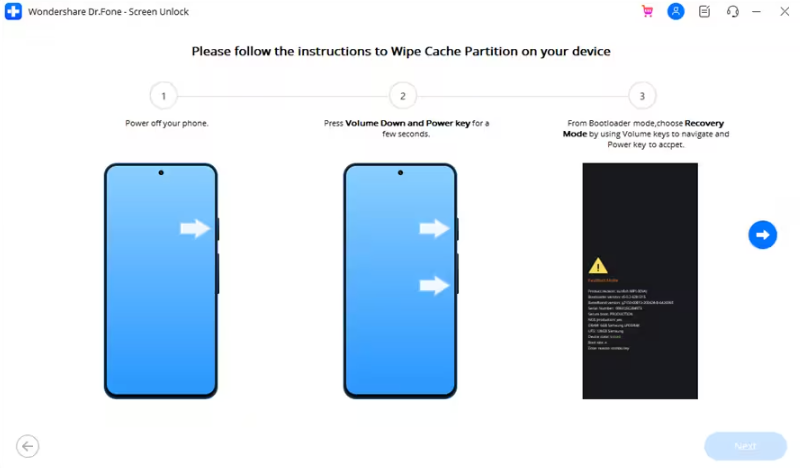
Step 2. Access Special Mode to Unlock with Dr.Fone 

After that, you will be automatically directed to activate the “Special Mode,” where Dr.Fone will unlock the device within 10 minutes, without any manual hassle. 

Device Unlocked — What to Do Next

To sum up, hardware chips and data encryption can cause regular unlock tricks to fail. As a result, you can use Dr.Fone – Screen Unlock (Android) to unlock an Android Phone in Special Mode. After the device is unlocked, log back into the primary Google account to restore the synced data. Finally, prevent future issues and set up a screen lock with easy, accessible PINs and biometrics. 

TVS Motor Enters Africa With Electric iQube Scooter in Kenya

0

TVS Motor Company is entering Africa’s electric two-wheeler market with the launch of its iQube electric scooter in Kenya, as the Indian manufacturer seeks to expand beyond its established markets and tap growing demand for lower-cost urban transport.

The company introduced the iQube in Nairobi on Aug. 6, making Kenya its first African market for the electric scooter. The model will be sold through Car & General, TVS Motor’s long-standing local partner, and supported by its nationwide sales and after-sales network.

The launch comes as Kenya’s two-wheeler market faces rising fuel costs and increasing interest in electric mobility. Car & General Chief Executive Officer Vijay Gidoomal estimates that Africa’s broader two-wheeler market could expand at an annual rate of about 7% to 10% through 2030, while electric two-wheelers could grow between 15% and 25% over the same period.

“EV penetration is still low relative to the size of the industry but the conditions are rife for its growth and the runway promises to be extremely long,” Gidoomal said.

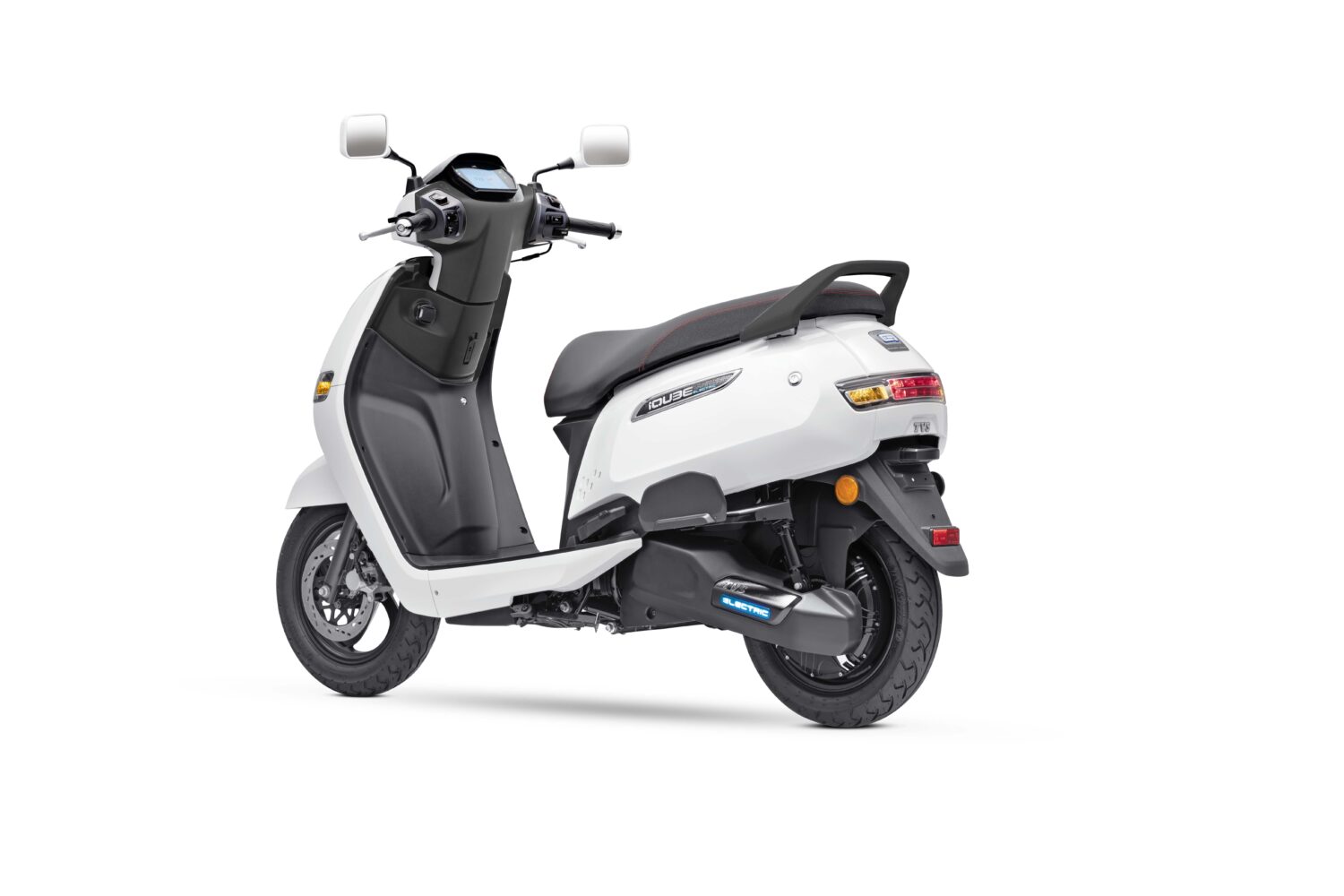
The iQube will be offered in two variants, the iQube 3.5 and iQube 2.2. The higher-capacity model has a 3.5-kilowatt-hour battery and a claimed real-world range of 115 kilometers, while the 2.2-kilowatt-hour version can travel about 75 kilometers on a charge.

Both models use a 4.6-kilowatt hub-mounted motor. The iQube 3.5 has a top speed of 82 kilometers per hour and can accelerate from zero to 40 kilometers per hour in 4.2 seconds. The 2.2 version has a top speed of 75 kilometers per hour.

The scooters can be charged using a portable charger connected to a standard household electrical outlet. The iQube 3.5 takes about two hours and 55 minutes to charge from zero to 80%, while the smaller battery takes about two hours.

TVS is also positioning the iQube as a connected vehicle rather than simply an electric replacement for a petrol scooter. Its SmartXonnect platform provides navigation, ride information and charging data, while additional features include geofencing, anti-theft protection and crash and fall alerts.

The scooters come with reverse and forward parking assistance, a five-inch digital display and up to 32 liters of under-seat storage. Both models use lithium-ion batteries with battery-management protection and IP67-rated water and dust resistance.

TVS said Kenyan riders could save about 47,000 shillings ($365) a year in energy and maintenance costs compared with a conventional 125cc petrol-powered scooter.

The company is also highlighting the scale of the iQube’s global rollout. More than one million customers have used the model worldwide, collectively covering more than 17.8 billion kilometers, according to TVS. The company estimates that the vehicles have helped avoid about 623,595 metric tons of carbon dioxide emissions.

For TVS Motor, the Kenya launch represents a broader push into electric mobility outside India. The company operates in about 90 countries and has manufacturing facilities in India and Indonesia.

“Driven by our vision to transform lives through exciting, responsible, and sustainable mobility, we are proud to introduce the TVS iQube in Kenya, marking our entry into the African market,” Peyman Kargar, president of international business at TVS Motor, said.

The iQube will be sold through Car & General dealerships in Kenya with a two-year or 30,000-kilometer warranty, whichever comes first. The company did not disclose pricing in the announcement.

Kenya has become one of Africa’s more active markets for electric two-wheelers, helped by relatively low operating costs and the suitability of motorcycles and scooters for urban transport and delivery services. TVS’s entry adds another established international manufacturer to a market increasingly attracting electric-mobility companies.

The company will be betting that the combination of lower running costs, charging from conventional household outlets and connected features can persuade urban Kenyan riders to switch from petrol-powered two-wheelers.

The TVS iQube will be available in 2 model variants – TVS iQube 3.5 and TVS iQube 2.2.

SpecificationsTVS iQube 3.5TVS iQube 2.2
Peak Power4.6 kW4.6 kW
No. of Batteries/TypeTwo / Lithium-IonOne / Lithium-Ion
Battery Capacity3.5 kWh2.2 kWh
Range Per ChargeReal world range of 115 kms.Real world range of 75 kms.
Top Speed 82 km/h75 km/h
Acceleration 0-40 km/h4.2 s4.2 s
Parking AssistReverse / ForwardReverse / Forward
Peak Torque140 Nm140 Nm
SafetyBMS-Controlled Protection System & IP67 WaterproofingBMS-Controlled Protection System & IP67 Waterproofing
Cluster5” Digital Cluster5” Digital Cluster
Charging Duration (0-80%)2 hours 55 minutes (950W portable charger)2 hours (950W portable charger)
Under seat storage32 litres30 litres

Beyond Antivirus: How AI, EDR and XDR Are Redefining Enterprise Cybersecurity

0

Why intelligent detection, automated response and unified security platforms are redefining enterprise cyber defence

Artificial intelligence (AI) has fundamentally changed the cybersecurity landscape. While organisations are harnessing AI to improve productivity, automate workflows and accelerate digital transformation, cybercriminals are using it for faster and highly targeted attacks. 

With AI, hackers are able to send more personalized and convincing phishing emails to unsuspecting users. Hackers are also using AI to create malware that can evade traditional detection methods. AI helps hackers to automate attacks and exploit vulnerabilities at unprecedented speed.

According to a report co-authored by Oxford University, Cambridge University, OpenAI, the Electronic Frontier Foundation and the Center for a New American Security, Artificial intelligence and machine learning (ML) are altering the landscape of security risks for citizens, organizations, and states. 

“Malicious use of AI could threaten digital security (e.g. through criminals training machines to hack or socially engineer victims at human or superhuman levels of performance), physical security (e.g. non-state actors weaponizing consumer drones), and political security (e.g. through privacy-eliminating surveillance, profiling, and repression, or through automated and targeted disinformation campaigns),” it reads.

The report, dubbed the Malicious Use of Artificial Intelligence: Forecasting, Prevention, and Mitigation, adds that as AI capabilities become more powerful and widespread, there will be expansion of existing threats, introduction of new threats, change to the typical character and intensity of threats.

“It is often the case that AI systems don’t merely reach human levels of performance but significantly surpass it. It is troubling, but necessary, to consider the implications of superhuman hacking, surveillance, persuasion, and physical target identification, as well as AI capabilities that are subhuman but nevertheless much more scalable than human labour,” said Miles Brundage, Research Fellow at Oxford University’s Future of Humanity Institute.

For enterprise security teams, this marks a turning point. Traditional security strategies built around prevention cannot keep pace with modern threats. With AI, cyberattackers are able to automate vulnerability discovery, launch sophisticated cyberattacks, improve target selection, evade detection, and creatively respond to changes in the target’s behavior. 

Despite the efficiency, scalability, and ease of diffusing AI technologies, the dual-use nature of AI means the same characteristics of AI that enable large-scale and low-cost attacks also allow for more scalable defenses. AI-enabled defenses such as spam filters and malware detection, as well as  others that are being developed and widely deployed. With AI, cybersecurity is shifting from simply blocking threats to continuously detecting, investigating and responding to suspicious activity. 

This evolution has placed Endpoint Detection and Response (EDR) and Extended Detection and Response (XDR) at the centre of modern enterprise security.

Why Traditional Antivirus Is No Longer Enough

Conventional antivirus solutions remain an important component of enterprise security, but they were designed for an era when most attacks relied on known malicious files. Today’s threat actors increasingly employ fileless attacks, credential theft, ransomware, insider abuse and “living-off-the-land” techniques that use legitimate operating system tools such as PowerShell and Windows Management Instrumentation (WMI) to carry out malicious activities.

Because these techniques often involve trusted applications rather than recognisable malware, signature-based detection alone is no longer sufficient. Security teams require visibility into how systems behave, not just whether malicious files exist.

This shift has made behavioural analytics one of the most important advances in modern cybersecurity. Instead of asking whether a file is malicious, AI-powered security platforms now monitor anomalies in the process, device or user behaviour. Using AI, cybersecurity analysts can track and purge unexpected privilege escalation, unusual PowerShell execution, abnormal data transfers or suspicious authentication attempts before ransomware is deployed or sensitive information is stolen.

How EDR Changes Endpoint Security

Using AI, Endpoint Detection and Response extends endpoint protection by continuously collecting telemetry from laptops, desktops, servers and virtual machines. It monitors, records and analyzes every significant event such as process execution, registry modification, network connection, user authentication and application activity to identify any malicious behavior.

Unlike traditional antivirus, EDR provides security teams with a detailed timeline of an attack. Analysts can trace where a compromise began, understand how an attacker moved through the environment and identify every affected endpoint.

An EDR platform detects the unusual activity, correlates it with outbound network connections and flags the behaviour as suspicious. Rather than generating isolated alerts, it reconstructs the attack chain, enabling analysts to isolate the endpoint, terminate malicious processes and prevent the attacker from moving deeper into the network.

This level of visibility dramatically reduces investigation time while improving incident response.

Why XDR Represents the Next Evolution

While EDR focuses on endpoints, modern attacks rarely remain confined to a single device. A compromised user account may access cloud applications, authenticate through identity platforms, communicate via corporate email and interact with multiple servers before security teams realize an attack is underway.

Extended Detection and Response (XDR) addresses this challenge by bringing together telemetry from endpoints, email systems, cloud workloads, identity providers, servers and network infrastructure.

Instead of forcing analysts to investigate separate alerts across multiple security products, XDR automatically correlates related events into a single incident.

A phishing email, suspicious Microsoft 365 login, abnormal endpoint behavior and unusual cloud activity may appear unrelated when viewed independently. XDR links these events together, providing analysts with a complete picture of the attack and enabling faster, more informed response decisions.

This ability to correlate events across the enterprise is becoming increasingly valuable as organizations adopt hybrid and multi-cloud environments where visibility is often fragmented.

As enterprise cyberattacks become faster and more sophisticated, organizations are looking beyond standalone security tools toward platforms that can consolidate prevention, detection, investigation and response. This is the philosophy behind  Kaspersky Next, the company’s flagship enterprise cybersecurity portfolio that combines enterprise-grade endpoint protection with EDR, XDR, cloud security and AI-assisted investigation in a single platform. Designed as a scalable solution, organizations can begin with advanced endpoint protection and progressively adopt more sophisticated EDR and XDR capabilities as their security maturity grows.

According to Kaspersky, one in three organizations plans to integrate EDR or XDR into their Security Operations Centres (SOCs) as businesses seek better visibility, faster investigations and more proactive defense against increasingly sophisticated attacks. Kaspersky Next also reflects a growing industry shift towards integrated security operations. 

Kaspersky uses predictive algorithms, machine learning, neural networks, clustering techniques and statistical modelling to improve threat detection accuracy, prioritize incidents and accelerate both Mean Time to Detect (MTTD) and Mean Time to Respond (MTTR). These AI capabilities help reduce alert fatigue by identifying the threats that require immediate attention while automating routine investigation tasks. 

Download this Whitepaper to find out how Kaspersky Next can help your organization to cut infrastructure resource requirements by up to 30% with Kaspersky Next EDR Expert deployments and by up to 60% with Kaspersky Next XDR Expert deployments. Kaspersky Next EDR Expert is trusted by more than 600 enterprise customers protecting over 2.5 million endpoints worldwide, while its detection engine is supported by more than 1,900 detection rules developed and continuously maintained by Kaspersky’s global Security Operations Centre. At the XDR level, the platform includes more than 2,700 preconfigured detection rules and over 300 integrations with third-party technologies.

Peach Cars Raises $4 Million to Expand Kenya Operations

0

Kenyan used-car marketplace Peach Cars has secured approximately Sh517 million (¥600 million/US$4 million) in debt financing from Japan Finance Corporation (JFC) and Shoko Chukin Bank, strengthening its balance sheet as it accelerates expansion across Kenya. The financing comes just over a year after the company raised an US$11 million Series A round led by Suzuki Global Ventures.

The fresh capital will be used to expand Peach Cars’ vehicle inspection network, improve access to auto financing, and scale its online marketplace. The company also plans to grow its branch footprint and invest further in its proprietary inspection technology, which is designed to bring greater transparency and trust to Kenya’s fragmented used-car market.

Peach Cars currently lists more than 1,500 vehicles and has built its business around comprehensive vehicle inspections, digital valuations, secure transactions, and financing services. The company says the latest funding will allow it to deepen these offerings while making car buying and selling more accessible for Kenyan consumers.

The lenders’ backing follows an on-the-ground assessment of Peach Cars’ operations in Nairobi. According to the company, executives from Shoko Chukin Bank visited its inspection facilities before approving the financing, citing confidence in the firm’s Japanese-quality inspection processes and locally built operating model.

The debt financing reflects growing interest from Japanese financial institutions in African mobility startups. Rather than raising additional equity, Peach Cars has opted for debt financing to fund its next phase of growth while limiting shareholder dilution, a strategy that could become more common among maturing African startups with proven business models.

Guinea Unveils NimbaPay, an Instant Payments Network, as Africa Expands Real-Time Digital Finance

0

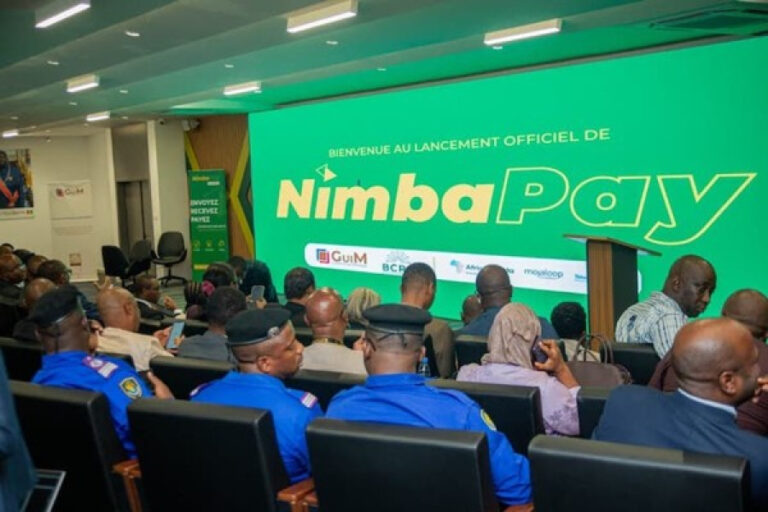
Guinea launched NimbaPay, its first national instant payment network, giving banks, mobile money providers and microfinance institutions a shared platform to process real-time transactions as the West African nation accelerates efforts to modernize its financial system.

The platform was developed by the Central Bank of the Republic of Guinea and implemented by Guinéenne de Monétique. It enables interoperable payments across participating financial institutions, allowing customers to transfer money instantly regardless of where their accounts are held.

The launch is aimed at reducing the country’s dependence on cash while widening access to affordable digital financial services. By replacing a fragmented payments landscape with a single national infrastructure, authorities expect the system to improve efficiency, lower transaction costs and support broader financial inclusion for consumers and businesses.

NimbaPay was built on the open-source Mojaloop platform with technical and strategic support from AfricaNenda Foundation, which has backed the rollout of instant payment systems across the continent. The foundation said Guinea joins Rwanda and Liberia among African countries that have deployed national interoperable payment infrastructure with its support.

The rollout also supports Guinea’s Simandou 2040 development strategy, which seeks to diversify the economy and strengthen digital public infrastructure alongside the development of the country’s vast iron ore resources. Future phases of the platform are expected to introduce government payments, public administration services and regional cross-border transaction capabilities.

“Each new instant payment system brings us closer to an Africa where individuals and businesses can transfer money instantly, safely and affordably,” Robert Ochola, managing director of AfricaNenda, said in a statement. “We are confident that NimbaPay will expand access to digital financial services, drive innovation and create new opportunities for individuals and businesses throughout Guinea.”

Guinea’s launch comes as governments and central banks across Africa accelerate investments in national instant payment infrastructure to improve financial inclusion and reduce the cost of digital transactions. Countries including Ghana, Nigeria, Tanzania, Kenya, South Africa, Ethiopia, Mauritius and Zambia have rolled out interoperable payment systems that connect banks and, in many cases, mobile money operators, enabling real-time transfers across different financial institutions.

Nigeria’s NIBSS Instant Payment (NIP) is among the continent’s largest real-time payment networks, while Ghana’s GhIPSS Instant Pay pioneered interoperability between banks and mobile money providers. Tanzania’s TIPS, Kenya’s PesaLink and South Africa’s PayShap have similarly expanded instant retail payments, reflecting a broader shift toward digital public infrastructure across Africa.

The continent is also moving beyond domestic interoperability. Regional initiatives such as the Pan-African Payment and Settlement System (PAPSS), backed by Afreximbank, are working to connect national payment networks, allowing businesses and consumers to make cross-border payments in local currencies without relying on correspondent banking networks. Guinea’s planned expansion of NimbaPay to support regional transactions aligns with that broader push toward an integrated African payments ecosystem.

PalmPay Eyes Hong Kong IPO as It Pursues Global Expansion

0

PalmPay, an Africa-focused fintech is reportedly preparing for a potential Hong Kong initial public offering (IPO), according to a Bloomberg report, as the fintech looks to raise fresh capital to support its international expansion and strengthen its position in emerging markets.

PalmPay is reportedly seeking to raise about $200 million at a more than $1 billlion valuation, joing the likes of African heavyweights Jumia, Flutterwave, Moniepoint among others. TechMoran has not established the details of the IPO as the plans are still under discussion, and details including the timing of the IPO and the banks involved have not been finalized.

Founded in 2019 in Nigeria, PalmPay offers payments, money transfers, savings, credit, insurance and merchant solutions to over 35 million registered users and about 1 million business customers. With operations in Nigeria, Tanzania, Ghana, South Africa and Bangladesh, PalmPay aims to become one of Africa’s fastest-growing digital financial services platforms.

PalmPay is a product of Transsion Holdings, the parent company of TECNO, Infinix and Itel and was launched with backing from Chinese technology investors. With an Original Equipment Manufacturer (OEM) as its parent firm, PalmPay has had the advantage of being preinstalled on millions of smartphones being sold in these markets. This has driven PalmPay’s adoption by leveraging on Transsion Holdings’ dominant smartphone market position in Africa. Other strategic investors include NetEase and MediaTek for scale across Africa and Asia.

With a population of over 200 million, Nigeria remains PalmPay’s largest and most important market where the company has built one of the country’s largest digital financial ecosystems through an extensive network of agents and merchants serving millions of consumers and small businesses. Beyond Nigeria, PalmPay has expanded its consumer business into Tanzania, while its merchant and business payment services are available in Ghana and South Africa as it broadens its footprint across Africa’s leading digital economies.

PalmPay’s planned IPO comes as competition intensifies among Africa’s largest fintech firms. Its biggest rival, OPay, also on the road to going public, entered the Nigerian market earlier and has grown into one of the continent’s largest digital financial platforms, reportedly serving more than 60 million users and achieving a valuation of about $2 billion in its last major funding round. While OPay remains the larger player, PalmPay has expanded rapidly by combining Transsion Holdings’ vast smartphone ecosystem with a growing portfolio of digital financial services, positioning itself as one of Africa’s leading fintech companies.

A Hong Kong listing would provide PalmPay with access to deeper pools of international capital while underscoring growing investor confidence in African fintech firms, which continue to attract global interest as digital financial services gain wider adoption across the continent.

Absa Cleared to Launch Two Global Multi-Asset Funds

0

Absa Bank Kenya‘s Absa Asset Management has received approval from Kenya’s Capital Markets Authority (CMA) to launch two global multi-asset special funds, expanding its investment products as demand for diversified wealth management solutions grows.

CMA regulator approved the Absa Global Multi-Asset Special Fund (USD) and the Absa Global Multi-Asset Special Fund (KES) as additional sub-funds under Absa’s existing Absa Unit Trust Scheme. The two new funds were regulated under the Capital Markets (Collective Investment Schemes) Regulations, 2023.

The funds will provide investors with exposure to global markets through professionally managed portfolios across multiple asset classes. They will complement Absa’s existing range of funds, including the Shilling Money Market Fund, Dollar Money Market Fund, Fixed Income Fund, Balanced Fund and Equity Fund.

“This approval is a strong endorsement of our commitment to developing investment solutions that respond to the changing needs of our clients,” Elizabeth Irungu, Head of Absa Asset Management Ltd., said. She added that while the new funds provide access to international markets, the Absa Equity Fund gained 15% in the first half of 2026, with local investment products remaining accessible from KSh1,000 and $100.

The approval comes as demand for specialised investment products continues to rise. Special Funds accounted for a record 23.9% of Kenya’s Collective Investment Schemes market, with assets under management reaching KSh203.5 billion as of March 2026, according to CMA data.

Absa said assets managed by its asset management business have grown 28% since inception, reflecting rising investor demand for diversified, professionally managed investment solutions.

Spotify Hits 777 Million Users Globally, Including 300 Million Paying Subscribers

Spotify has reached 777 million users worldwide, including 300 million paying subscribers, as the audio streaming company released its second-quarter 2026 results and continued expanding its global platform.

Spotify said its service now operates across 184 markets, offering users access to more than 100 million tracks, 7 million podcast titles and 500,000 audiobooks in select markets.

The company, listed on the New York Stock Exchange under the ticker SPOT, released its quarterly update on August 4, 2026, with executives set to discuss the results during a live question-and-answer session.

Subscriber Base

Spotify’s 300 million paying subscribers represent the company’s Premium customer base, which provides recurring subscription revenue. The platform also serves additional users through its free, advertising-supported service.

The company has built one of the largest global audiences in digital entertainment since launching in 2008, using its combination of subscription and advertising-supported offerings to reach listeners across markets worldwide.

Expanding Audio Platform

Spotify has expanded beyond music streaming into podcasts and audiobooks as it develops a broader audio ecosystem.

The company’s catalogue now includes millions of podcast titles and audiobooks in selected markets, giving users access to multiple forms of audio content through a single platform.

Global Competition

Spotify continues to compete in a crowded digital entertainment market where companies are seeking a larger share of consumer attention.

Its scale, global reach and large subscriber base remain central to its position in the audio streaming industry as it continues building its platform for listeners, creators and content partners.

The second-quarter update comes as Spotify maintains its position as the world’s largest audio streaming subscription service, serving 777 million users globally, including 300 million paying subscribers across 184 markets.

Nikita Bier Steps Down as X Product Lead, Transitions to Advisor Role

0

Nikita Bier has stepped down as head of product at X, transitioning to an advisory role after leading a major overhaul of the social media platform’s core experience.

In a post on X, Bier described leading product at the company as “the privilege of a lifetime,” but said the role had become a “24/7 job” and that it was time to “take a breather.”

During his tenure, Bier said X recorded unprecedented growth in new users and engagement, climbed 70 places in Apple’s App Store rankings over the past year, and rebuilt key parts of the platform, including the timeline, Android app, onboarding, notifications and chat.

He added that X launched nearly 30 new products over the last 400 days while introducing Country-of-Origin labels on user profiles and strengthening defenses against AI-powered bots.

Bier said product leadership responsibilities will now be shared by Benji Taylor, who will oversee design, Singhai, who will lead core product engineering, and Dinkin Flicka, who will head mobile engineering.

Before joining X, Bier had already established himself as one of Silicon Valley’s most successful consumer app founders. He created the viral social app TBH, which was acquired by Facebook in 2017, before launching Gas, an anonymous compliments app for teenagers that was acquired by Discord in 2023. His track record of building fast-growing social products made him one of the technology industry’s best-known product leaders before he joined X.

Bier thanked X owner Elon Musk and the company’s employees for the opportunity, saying he looks forward to remaining active on the platform as an advisor.

The leadership change comes as X continues to invest in product development and user growth amid intensifying competition in the social media market.

Nikita Bier holds degrees in Business Administration and Political Economy from the University of California, Berkeley, where he graduated with honors. He also completed study programs in Denmark and France, as well as a summer Russian language course at the University of Virginia.

Moove Raises $250M at $2.1B Valuation to Build Global Infrastructure for Autonomous Mobility

0

Moove, the mobility infrastructure startup, has raised $250 million in a Series C funding round, valuing the company at $2.1 billion, as it doubles down on building the infrastructure needed to power autonomous vehicle fleets around the world.

The round was led by Mubadala Investment Company and co-led by Woven Capital and Ion Pacific, with participation from BlueCrest Capital Management and Sona Capital. Existing backers include BlackRock, MUFG, Franklin Templeton, Uber, Left Lane Capital, and others.

The fresh capital will fund the expansion of Moove’s autonomous vehicle business, including ownership of autonomous fleets and the rollout of robotics-powered depots known as “Nests,” where self-driving vehicles are charged, serviced, maintained and dispatched around the clock. The company also plans to launch in new markets globally and increase its autonomous vehicle workforce from about 150 employees to roughly 500 by the end of 2026.

Founded in 2020, Moove initially built its business by financing and managing vehicles for ride-hailing drivers. In just five years, it has expanded from 76 vehicles in Lagos to operating approximately 42,000 vehicles across 29 cities in 13 countries, making it one of the world’s largest ride-hailing fleet operators. The company says it has also reached $420 million in annual recurring revenue (ARR).

Moove has accelerated its expansion through acquisitions, including Kovi in Brazil and Tokyo Taxi in Japan.

The company’s next growth phase centers on autonomous mobility through its partnership with Waymo, under which it manages autonomous vehicle fleets in Phoenix and Miami, with operations also planned for London. Rather than developing autonomous driving software itself, Moove is positioning itself as the operating infrastructure provider responsible for fleet financing, charging, maintenance, servicing, logistics and 24/7 operational management.

“Every major technology revolution becomes an infrastructure race,” said Moove Co-Founder and Co-CEO Ladi Delano. “The internet required data centres. AI required compute. Autonomy requires fleets, charging, maintenance, data systems and 24/7 operations in every city—and that is what Moove is building.”

For lead investor Mubadala, the investment aligns with the UAE’s ambition to become a global hub for advanced technologies and next-generation transport infrastructure. The sovereign investor said autonomous mobility will require scalable operational platforms capable of managing fleets, infrastructure and technology at city scale.

As autonomous vehicles move closer to mainstream deployment, Moove is betting that the winners in the sector will not only be companies building self-driving technology but also those providing the physical and operational infrastructure required to keep those vehicles running continuously. With fresh funding and a growing partnership with Waymo, the company is positioning itself as a key infrastructure provider for the emerging autonomous mobility economy.

IFC, 4G Capital Team Up to Unlock $144.4 Million in MSME Financing

0

Fintech lender 4G Capital has partnered with the International Finance Corporation (IFC) under a new risk-sharing initiative aimed at expanding access to financing for Kenya’s micro, small and medium-sized enterprises (MSMEs), particularly women-owned businesses.

The partnership is part of IFC’s first Catalytic First Loss Guarantee (CFLG) transactions in Africa. Alongside similar agreements with Equity Bank Kenya and KCB Bank Kenya, the three partnerships are expected to unlock approximately $144.4 million in local currency lending for microenterprises, women-owned businesses and climate-focused enterprises across Kenya.

Rather than a direct investment in 4G Capital, IFC is providing a first-loss guarantee, allowing participating lenders to extend more credit by reducing the risk associated with lending to underserved businesses. The initiative is delivered through IFC’s $4 billion MSME Platform and is supported by blended finance from the International Development Association’s (IDA) Private Sector Window (PSW).

Across the three transactions, IFC has committed $24.2 million, backed by $11 million from the IDA PSW. The programme is expected to mobilize approximately $120.2 million in additional lending to MSMEs, with every dollar of first-loss capital designed to unlock about $11 in financing for small businesses.

MSMEs account for approximately 90% of businesses in Kenya and employ more than 15 million people, yet many continue to struggle to access affordable financing. IFC estimates Kenya’s MSME financing gap at nearly 21% of GDP, limiting the ability of businesses to expand operations, create jobs and invest in productivity and climate resilience.

For 4G Capital, the agreement marks its first partnership with IFC and strengthens its ability to provide working capital to entrepreneurs who have traditionally been underserved by the formal financial sector.

“Small businesses are the backbone of Kenya’s economy, creating jobs, generating income, and driving innovation in communities across the country,” said Mary Porter Peschka, IFC Division Director for Eastern Africa. “Through these partnerships, IFC is helping expand access to finance for entrepreneurs who have traditionally been underserved by the financial system. By sharing risk through the Catalytic First Loss Guarantee Program, we are unlocking capital that can help businesses grow, strengthen their resilience, and contribute to more inclusive and sustainable economic growth.”

Julian Mitchell, CEO of 4G Capital, welcomed the partnership, saying access to working capital remains the biggest obstacle facing many small businesses, particularly those owned by women.

“The biggest challenge for micro and small businesses is access to working capital, particularly for women-owned enterprises. This facility provides us with the ability to reach and impact more underserved business owners and support their growth, which is vital to their local communities,” he said.

Beyond the financing, IFC said it will continue working with participating institutions to strengthen their ability to serve MSMEs and expand sustainable financing solutions that promote innovation, financial inclusion and inclusive private sector growth.

The initiative also builds on IFC’s long-standing relationships with KCB Group and Equity Group, extending nearly two decades of collaboration aimed at strengthening Kenya’s financial sector and improving access to finance for underserved businesses.

As digital lenders continue to play an increasingly important role in Kenya’s financial ecosystem, initiatives such as the CFLG programme are expected to help narrow the country’s financing gap while enabling more entrepreneurs to invest, grow and create jobs.

Samsung Brings WhatsApp Shopping to Kenya With New Online Store

0

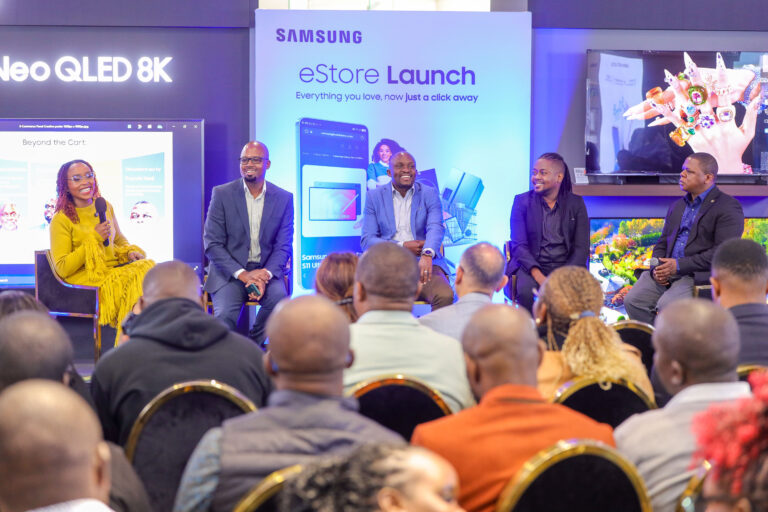
Samsung Electronics East Africa has launched its official direct-to-consumer online store in Kenya in partnership with Housewives Paradise, introducing WhatsApp Shopping as it expands its digital retail strategy in one of Africa’s fastest-growing e-commerce markets.

The Samsung Brand Store enables customers to buy smartphones, TVs, home appliances, wearables, and accessories directly from Samsung, with nationwide delivery and payment options including M-Pesa and major bank cards. The company said the platform complements its existing retail network while giving consumers access to online-exclusive products and offers.

A key feature of the platform is WhatsApp Shopping, allowing customers to connect with Samsung sales representatives for product recommendations, purchasing assistance, and order tracking directly through WhatsApp. Home appliance purchases also include Samsung’s Signature Service, offering certified installation and priority customer support.

Samsung has introduced similar WhatsApp-powered shopping experiences in markets including Brazil and Spain, where customers can browse products and interact with sales advisors through the messaging platform. The Kenyan rollout extends that strategy to East Africa by integrating WhatsApp Shopping into an official direct-to-consumer storefront.

Alongside the consumer platform, Samsung has launched a dedicated B2B portal for businesses, SACCOs, educational institutions, healthcare providers, and government agencies, supporting bulk procurement and enterprise device management through Samsung Knox.

The move gives Samsung a direct sales channel that allows it to strengthen customer relationships, offer exclusive products unavailable through traditional retailers, and gain greater control over the end-to-end shopping experience while collecting valuable customer insights.

“Today, we officially open the digital doors to the Samsung Brand Store, redefining the e-commerce landscape in East Africa,” said Francis Modi, E-Commerce Manager at Samsung Electronics East Africa.

The online store is operated by Kenyan retailer Housewives Paradise and is now available to customers nationwide.

NCBA Reports $95M H1 Profit as AI, Digital Lending Drive Growth

0

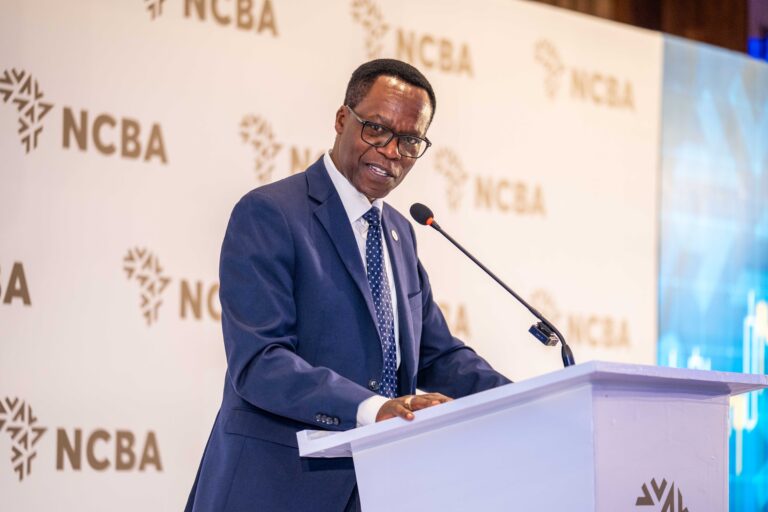
NCBA Group Plc reported a first-half profit of KES 12.4 billion ($95 million), up 12.2% from a year earlier, as East Africa’s largest bank by customer numbers benefited from stronger digital lending, higher customer deposits and continued investment in artificial intelligence despite a cautious economic environment.

The Nairobi-based lender said profit before tax rose 14.3% to KES 15.5 billion, while operating income increased 15.1% to KES 40.7 billion during the six months ended June. The board declared an interim dividend of KES 3.75 per share, up from KES 2.50 paid in the corresponding period last year.

Digital banking remained one of the biggest drivers of growth. Digital loan disbursements climbed 26.9% year-on-year to KES 819 billion, while customer deposits rose 11% to KES 551 billion. Total assets increased 11.5% to KES 739 billion, reflecting continued expansion in the bank’s lending and deposit franchises.

The earnings come as lenders across East Africa navigate slowing economic growth, tighter monetary policy and persistent credit risks. NCBA increased provisions for credit losses to KES 5.2 billion from KES 3.2 billion a year earlier, a move the bank said reflects current operating conditions while positioning it to absorb potential risks.

Kenya remained the group’s largest earnings market, with the local banking subsidiary increasing profitability by 24.3% to KES 13.7 billion. Regional subsidiaries in Uganda, Tanzania and Rwanda generated a combined KES 1.6 billion in profit, while the group’s non-banking businesses—including investment banking, leasing, insurance and bancassurance—posted KES 1.1 billion in profit, up 40% from a year earlier.

NCBA invested KES 2.4 billion in technology infrastructure during the period to accelerate AI adoption, strengthen cyber resilience and improve the resilience of its banking platforms. The bank said mobile banking accounted for 94% of transaction volumes, while system availability reached 99.68%, underscoring customers’ growing reliance on digital channels.

Outside its core banking operations, the lender expanded assets under management in its wealth business to KES 101 billion and grew its SME loan book 12% to KES 44.7 billion. It also strengthened its position in electric vehicle and solar asset financing, while its CarDuka digital marketplace facilitated vehicle sales worth KES 1.94 billion during the first half.

The bank said its proposed transaction involving Nedbank remains on track after the tender offer closed in July with shareholder subscriptions exceeding the targeted shares. Completion of the deal is subject to remaining regulatory approvals and other closing conditions.

Looking ahead, Chief Executive Officer John Gachora said NCBA expects continued growth opportunities supported by projected expansion in Kenya’s private sector credit market and regional investment activity, despite an uncertain global economic outlook.

INTERPOL Says AI Fuels 55% of Cybercrime Across Africa as Losses Reach $484 Million

0

Artificial intelligence is now linked to 55% of reported cybercrime across Africa, helping drive financial losses to $484 million, according to INTERPOL’s African Cyberthreat Assessment Report 2026.

The report shows that cybercrime losses have more than doubled from $192 million since 2024, with AI increasingly used to automate phishing attacks, impersonation scams, identity fraud and other digital crimes.

INTERPOL said the growing use of AI has transformed cybercrime from isolated incidents into a more industrialized and cross-border criminal ecosystem, making attacks faster, more scalable and harder for victims and platforms to detect.

The warning comes as Africa’s digital economy continues to expand rapidly. The continent recorded more than 1.1 billion mobile subscribers in 2025, creating a larger pool of potential targets for cybercriminals exploiting AI-powered tools.

Online scams remained the most reported cybercrime across Africa last year, with attackers using AI alongside mobile money platforms and social media to reach victims. According to the report, 72% of the 36 African member countries surveyed reported the presence of scam centres, with the highest concentration in Southern and West Africa.

East Africa emerged as a major hub for mobile money fraud and ransomware attacks targeting critical infrastructure, while Central and West Africa continued to experience high levels of business email compromise and romance scams. Southern Africa’s relatively high digital connectivity has also made the region an attractive target for international cybercriminal groups.

One of the report’s most significant findings is the rise of synthetic identities—AI-generated digital personas created by combining genuine personal information with fabricated data. INTERPOL said these identities have been used to open bank accounts, obtain mobile loans and register SIM cards under false names, sometimes bypassing biometric verification systems.

Business email compromise attacks have also become more sophisticated, with AI used to generate highly convincing corporate correspondence. Africa-based threat actors are increasingly targeting victims in Europe and North America while routing operations through infrastructure spread across multiple jurisdictions, complicating investigations.

INTERPOL warned that the lack of real-time information sharing between banks, telecommunications companies and law enforcement agencies remains a major vulnerability in the fight against financial fraud.

“Cybercrime has emerged as one of the most significant criminal threats to the region. AI is automating every stage of a cyberattack from reconnaissance and phishing to extortion and evasion,” said Neal Jetton, Director of INTERPOL’s Cybercrime Directorate.

Despite the growing threat, INTERPOL said coordinated international operations—including Operation Serengeti 2.0, Operation Contender 3.0, Operation Sentinel and Operation Red Card 2.0—resulted in more than 1,500 arrests, the seizure of hundreds of devices and the recovery of over $100 million in criminal proceeds.

The organization is calling for stronger digital forensic capabilities, greater investment in AI literacy for law enforcement officers, enhanced cross-border cooperation and deeper collaboration between governments and the private sector to combat increasingly sophisticated cyber threats across the continent.

KNEC Moves 15 Million Academic Records Onto Avalanche for Blockchain Certificate Verification

0

The Kenya National Examinations Council has moved 15 million academic records onto the Avalanche blockchain as it rolls out a blockchain-based certificate verification system aimed at reducing forgery and speeding up credential authentication.

The first phase covers examination records dating back to 1989, with the council planning to expand the platform to approximately 35 million academic credentials over time.

The new system allows institutions, employers, and other authorized parties to verify certificates digitally through a blockchain-backed registry, eliminating the need for lengthy manual confirmation processes. Because records stored on a blockchain are tamper-evident and time-stamped, KNEC says the platform is designed to provide a more secure and transparent method of confirming academic qualifications.

Certificate fraud has long been a challenge in Kenya’s education and employment sectors, where employers and universities often require direct verification from KNEC before recognizing examination results. The blockchain rollout is expected to reduce verification turnaround times while creating a permanent digital record that is significantly harder to alter or counterfeit.

Avalanche, a high-throughput blockchain network known for enterprise and government applications, will host the credential infrastructure underpinning the verification platform.

KNEC’s digitization initiative is part of a broader effort to modernize public records management and expand the use of secure digital identity and credential systems across government services. As additional historical and current examination records are added, the platform is expected to become one of the largest blockchain-based academic credential repositories in Africa.

Yellow Card Secures $40 Million to Expand into Latin America & Asia-Pacific

0

Yellow Card, the stablecoin infrastructure provider, has raised $40 million to scale Global USD Accounts, Yellow Card’s end-to-end dollar account for businesses, and expand its operations in Latin America and Asia-Pacific.

The strategic funding round was from SC Ventures by Standard Chartered, Sony Innovation Fund, Polychain Capital, Blockchain Capital, and additional strategic investors will help the firm expand . Today’s raise brings Yellow Card’s total financing to over $120 million in equity financing.

“This investment is a vote of confidence in what we’ve spent years building: the infrastructure that lets global businesses move money without a traditional correspondent banking. But the bigger opportunity now is connecting banks themselves to stablecoin rails,” said Chris Maurice, CEO and Co-Founder of Yellow Card.

The financing will help deliver Global USD Accounts to more businesses, giving them a single account to hold U.S. dollars, hold and swap stablecoins, manage treasury, and collect and disburse local currencies on domestic rails in over 50 countries. The accounts run on infrastructure Yellow Card has operated for years, and the new funding deepens the company’s presence in Latin America and Asia Pacific, and expands the local payment rails and currency coverage needed to scale globally. Global USD Accounts are already used and trusted by many of Yellow Card’s customers, including Visa and Western Union.

Yellow Card has facilitated over $10 billion in transactions across its network. The company supports more than 50 currencies, and holds relevant licenses, authorizations and registrations in 22 jurisdictions across North America, Europe, and Africa. Strategic partnerships with Visa, Mastercard, PayPal, and Coinbase have positioned the company as an infrastructure layer for global payments players.

The investment from Sony Innovation Fund reflects growing institutional interest in stablecoins for payments globally and will allow Yellow Card to deepen its reach in Asia-Pacific.

“By combining robust APIs, deep local fiat rails, institutional-grade security, and a strong regulatory-first approach, Yellow Card is making stablecoin-powered payments practical for banks, fintechs, and enterprises. As the company rapidly expands beyond Africa into broader emerging markets across LATAM, EMEA, and APAC, we look forward to supporting its vision of becoming a trusted bridge between traditional finance and the next generation of digital money,” said Austin Noronha, Managing Director, Sony Ventures-US.

Alex Manson, CEO of SC Ventures said Stablecoins are here to stay but adoption will depend on robust infrastructure and clear real-world utility. ”Yellow Card is building those rails for businesses across Africa, enabling them to access and move value efficiently across markets,” Manson said. ”We believe YC is well positioned to scale across Africa and beyond and look forward to supporting its next phase of growth.”

NCBA Launches AI-Powered PropertyDuka.com to Simplify Home Ownership

0

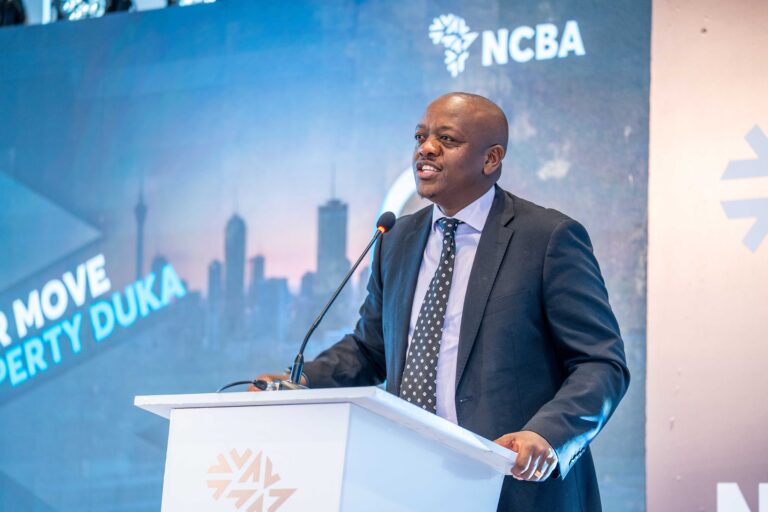
NCBA has launched PropertyDuka, which it says is East Africa’s first AI-native property ecosystem, bringing property search, financing, construction, furnishing and insurance services together on one digital platform.

The marketplace enables users to search for homes, receive AI-powered guidance through PropwizAI, assess mortgage affordability, access NCBA mortgages and construction financing, and connect with verified developers and property service providers.

The launch comes as Kenya’s property market, valued at over KES 1 trillion annually, continues to record low mortgage uptake, with only about 30,000 active mortgages despite nearly 79% of urban residents renting.

PropertyDuka joins CarDuka and AuctionsDuka under NCBA’s Duka Marketplaces platform, which has grown to nearly 7 million users and facilitated over KES 4 billion in transactions since 2025.

NCBA says the platform is part of its strategy to expand beyond traditional banking by embedding financial services into customers’ property journeys.

UAE-Based Web3 Startup Bundle Raises $5.5M Pre-Seed to Reinvent Customer Rewards

UAE-based Web3 startup Bundle has emerged from stealth with US$5.5 million (approximately KES 715 million) in pre-seed funding to build what it describes as the world’s first networked rewards platform, enabling businesses to pool their marketing budgets and offer significantly larger customer rewards while lowering customer acquisition costs.

The funding round was led by Ethereal Ventures, founded by Ethereum co-founder Joe Lubin, and Further Ventures, with participation from Nascent, GSR, Scenius Capital, Anchorage Digital, and Nuwa Capital.

Founded by Bader Al Kalooti and Mostafa Wanas, Bundle is rethinking traditional loyalty programmes by allowing brands to combine their incentive budgets into shared reward pools. Instead of relying on discounts and cashback campaigns that often erode margins and struggle to retain customers, the platform enables businesses of all sizes to offer consumers access to larger, more attractive rewards.

The company says its model addresses a growing challenge facing businesses as customer acquisition costs continue to rise while conventional promotional campaigns deliver diminishing returns.

“Bundle was built to level that playing field,” said Bader Al Kalooti, Co-Founder and CEO of Bundle.

“We believe every business, regardless of size, should be able to offer their customers the kind of rewards that genuinely excite them, rather than relying on discounting, which is a race to the bottom.”

Consumers earn Bundle tickets by completing everyday actions such as making purchases or referring friends. Those tickets provide entries into shared reward pools funded collectively by participating brands, giving customers access to prizes that would typically be beyond the reach of individual businesses.

For merchants, the platform simplifies campaign management by handling rewards infrastructure, regulatory compliance and cross-border operations through a single system.

Although built on blockchain technology, Bundle keeps the experience familiar for both brands and consumers. The platform uses stablecoins and blockchain payment rails behind the scenes to enable transparent, low-cost international reward payouts, while customers interact with a standard Web2 interface. Funds can be withdrawn through licensed payment service providers without requiring users to understand blockchain technology.

Bundle has already demonstrated early traction during pilot programmes conducted across five markets. The company distributed US$100,000 in rewards to more than 1,100 winners, including a US$50,000 grand prize. According to Bundle, participating brands achieved conversion rates of up to four times higher than those generated through traditional incentive campaigns.

Building on those results, Bundle plans to launch commercially in Singapore, Vietnam and the Philippines, where more than 50 founding brands have already joined the platform. The company intends to use its compliance-focused operating model as a foundation for expansion into additional global markets.

Investors say the startup illustrates how blockchain technology can solve real business problems without exposing users to the complexity often associated with Web3.

“The next wave of blockchain businesses like Bundle will drive mainstream consumer applications by feeling native to users and solving real problems,” said Min Teo, Managing Partner at Ethereal Ventures.

“It is a perfect example that uses shared rewards and blockchain rails to help brands drive loyalty and customer growth at scale.”

Robbie Nakarmi, Partner at Further Ventures, said the shared rewards model enables businesses of all sizes to compete more effectively by offering larger incentives at a fraction of the traditional cost.

“Through its innovative shared rewards network, Bundle now gives brands of all sizes access to larger rewards to drive higher conversions from their marketing campaigns at a fraction of the cost, creating a more effective way to engage customers,” he said.

The newly raised capital will be used to accelerate product development, strengthen strategic partnerships and support Bundle’s expansion across Asia before entering additional international markets.

As businesses worldwide search for more effective alternatives to traditional loyalty programmes, Bundle is betting that collaborative rewards powered by blockchain infrastructure can improve customer engagement while bringing practical Web3 applications to mainstream consumers without adding complexity.

How to Make Data Privacy Your Competitive Advantage

For years, data privacy was largely owned by legal teams, reviewed by leadership from time to time, and often seen by employees as another task that delayed progress. That traditional approach no longer meets the demands of modern business. 

Consumer data is of enormous value. It’s the power behind how you sell, build products, market, and hire. Nowadays, customers want to know how you handle their data, your business partners want proof of data protection, and regulators expect compliance with data privacy laws. 

When your business takes data privacy seriously, you will do more than just stay compliant. You will move with less friction, enhance your brand’s reputation, and earn business deals that depend on customer trust. Here are three ways you can make data privacy your competitive advantage. 

  1. Create a Clear and Transparent Data Privacy Policy

One of the best ways to build consumer trust is to create a privacy policy that is clear, straightforward, and easy to understand. A well-written policy should explain what information is collected, why it is collected, how it is used, who it is shared with, and how it is protected and retained. When you communicate these details in plain language, they make it easier for customers to understand and trust your data practices.

Don’t just set your privacy policy and forget it. Remind customers of your terms regularly, and spell out any changes clearly when they happen. This kind of transparency builds real trust over time. You should also keep in mind that best practices and regulatory guidance shift as time goes on, so your policy needs regular updates to stay current.

  1. Train Employees on How to Protect Customer Data

Data privacy isn’t just one department’s job. Everyone at your company has a hand in protecting the personal information in your database. That’s why a well-trained team matters so much when it comes to keeping that data safe. 

However you approach it, whether you build the training in-house, bring in a professional, or have employees work through eLearning courses, make sure it covers these topics:

  • Privacy laws
  • What counts as personal data
  • Security policies
  • How bad actors gain access to personal data
  • How to report a data breach

This helps to minimize the risk of a data breach, which can significantly hurt your company. You don’t want to find yourself with court cases or even exposed on consumer watchdog sites like companiesbehavingbadly.com. 

  1. Give a Clear Reason for Collecting Consumer Data

As data privacy laws continue to evolve, collecting data isn’t a one-way street anymore. It’s a two-way conversation with the consumer. Be clear and upfront about why you are asking for their data and exactly how you plan to use it.  

For instance, if your business has an app that requests location access when a customer is signing up, they are likely to trust you with their data if you give them a good reason. In this case, for example, you can explain that location tracking is used to send offers and discounts when a customer is close to your store. 

Customers want reassurance on two fronts: that their data is being used ethically, and that sharing it actually benefits them. Research from Experian found that 70% of consumers would hand over more data if they saw a clear payoff for doing so. Deliver real value in return for that data, while still respecting privacy, and you’ll put yourself ahead of competitors who don’t.

Endnote

The data privacy landscape is constantly evolving. You can make it your competitive advantage by having a straightforward data privacy policy, training your employees on data privacy, and giving clear reasons for collecting customer data. 

Baraza Media Lab CEO Maurice Otieno Steps Down After Expanding African Media Innovation Hub

0

Maurice Otieno is stepping down as Executive Director of Baraza Media Lab after overseeing the Kenyan media innovation organization’s expansion from a startup into one of Africa’s largest philanthropy-backed journalism support platforms.

Otieno, who joined Baraza’s founding team in 2019 and became Executive Director in April 2020, announced his departure on LinkedIn this week, saying he was “stepping aside” rather than leaving the sector. Governance and public finance specialist Eric Kinaga will succeed him.

The leadership transition comes after six years during which Baraza significantly expanded its funding, staffing and continental footprint despite launching shortly before the Covid-19 pandemic disrupted media organizations worldwide.

Otieno said Baraza secured about $20 million in philanthropic funding during his tenure and increased its reach from roughly 1,500 people to 12,000. His LinkedIn profile, however, cites more than $15 million raised over five years from over 300 donors. While the funding totals differ, both accounts point to the organization’s rapid growth from three employees to about 40 staff.

Baraza now operates on an annual budget of approximately $4 million and engages around 7,000 people every month through its journalism, innovation and civic engagement programmes, according to Otieno.

Under his leadership, the organization launched initiatives including the Data Storytelling Fellowship, She Leads Media, the FumbuaKE collective and a Media Innovation Incubator aimed at strengthening independent journalism and digital media innovation across Africa.

Otieno also founded the Africa Media Festival, which this year attracted more than 200 organizations from 31 countries, underscoring Baraza’s growing role as a continental convener for media leaders, startups and development partners.

Institutionally, he said Baraza established its first fiduciary board, implemented more than 40 organizational policies and introduced monitoring and evaluation systems to guide programme decisions while reducing staff turnover by 20%.

The organization faced its first major test within months of its launch as Kenya confirmed its first Covid-19 cases. Otieno said Baraza responded by diversifying its funding sources and expanding strategic partnerships, helping sustain growth during a period when many media organizations were cutting operations.

Kinaga inherits an organization that has become a prominent intermediary between philanthropic funders, newsrooms and media entrepreneurs across Africa.

Before joining Baraza, Kinaga spent nearly a decade working on public finance, governance and accountability, including roles at USAID Kenya and East Africa, the Institute for Social Accountability and Transparency International Kenya. He previously coordinated the Shule Yangu Alliance, an advocacy campaign focused on securing land rights for more than 30,000 public schools, before moving into budget governance and fiscal accountability.

He also publishes Letters to a Kinder Nation, a newsletter examining governance and public institutions.

“I’m interested in building public systems that are not only effective and accountable, but also worth believing in,” Kinaga said.

Neither Baraza nor Kinaga has announced changes to the organization’s funding priorities or programme strategy following the leadership transition.

Otieno said he plans to spend time with his family before taking on his next role, adding that he will continue supporting the media innovation ecosystem from outside the organization.

Airtel Money Appoints Michael Bonke Acting MD, Launches Bizna Wallet for Kenya’s SMEs

0

Airtel Money Kenya has appointed Michael Bonke as its Acting Managing Director, ushering in a new leadership chapter as the company unveiled Bizna Wallet, a dedicated digital wallet designed to help Kenya’s small businesses better manage their finances while accelerating digital financial inclusion.

Bonke assumes the leadership of Airtel Money Kenya with more than 15 years of experience in the telecommunications and fintech sectors, having spent nearly a decade at Airtel Money in leadership roles across sales, business development and marketing. During his tenure, he has helped drive customer growth, digital transformation and strategic partnerships as Airtel Money expands its footprint in Kenya’s competitive mobile money market.

His first major announcement as Acting Managing Director is the launch of Bizna Wallet, a solution aimed at micro, small and medium-sized enterprises (MSMEs) seeking a simpler and more secure way to manage business finances.

The launch comes as Kenya’s SMEs continue to embrace digital payments. According to the Mastercard SME Confidence Index, 95% of SMEs now accept mobile payments, highlighting growing demand for financial services that extend beyond simply receiving payments.

Speaking during the launch, Bonke said the new wallet addresses a longstanding challenge facing many entrepreneurs who use personal mobile money accounts to run their businesses.

“Small businesses are at the heart of Kenya’s economy, yet many entrepreneurs still rely on personal wallets to manage business finances. Airtel Money Bizna Wallet is designed for kiosk owners, market traders, boda boda riders, matatu operators and other micro-businesses to enable them to separate business income from personal finances, monitor their daily sales, access mini statements, receive payments across mobile money networks and protect business payments from unauthorized reversals, giving entrepreneurs greater visibility over their cash flow and more stable business operations. Our goal is to provide solutions that help businesses operate more efficiently while making digital financial services more accessible and rewarding,” said Bonke.

Bizna Wallet enables businesses to separate business income from personal finances, monitor daily sales, access mini statements and manage cash flow more efficiently. The wallet also allows merchants to receive payments across mobile money networks while introducing protection against unauthorized payment reversals, providing greater security for business transactions.

The solution is targeted at Kenya’s vast informal and SME sector, including kiosk owners, market traders, boda boda riders, matatu operators and other entrepreneurs who depend on mobile money to run their day-to-day operations.

Alongside the launch of Bizna Wallet, Airtel Money also expanded its Rudishiwa cashback programme to all Airtel Money customers.

Under the new offer, customers will receive 50% cashback on eligible transactions, including paybill payments, transfers to other mobile money networks, bank-to-wallet transfers and wallet-to-bank transfers. Unlike the company’s previous airtime rewards, the cashback is credited as real cash into a dedicated Cashback Wallet, allowing customers to transfer the rewards directly into their main Airtel Money wallet.

“As Kenya’s digital economy continues to grow, so do the needs of businesses and consumers. At Airtel Money, we are continuously investing in technology, expanding our reach and developing innovative solutions that make financial services simpler, more secure and more relevant for our customers. This is why we have introduced cashback rewards to Airtel Money users. Initially, we had airtime rewards, and now we have introduced real cash rewards that go into your cashback wallet for every eligible transaction. Customers can transfer the cash from the cashback wallet into the main Airtel Money wallet,” Bonke added.

The cashback programme is available to all registered Airtel Money customers in Kenya who complete qualifying transactions of KES 101 or more, with no opt-in required. Rewards are credited instantly and are accessible through both the My Airtel App and the *USSD 334# platform.

The appointment of Bonke and the launch of Bizna Wallet signal Airtel Money’s continued push to strengthen its position in Kenya’s digital financial services market. By combining dedicated financial tools for SMEs with cashback incentives for consumers, the company is seeking to deepen financial inclusion, expand merchant adoption and grow its digital payments ecosystem as Kenya’s cashless economy continues to evolve.

Women Founders Still Struggle for Venture Capital in Africa, Report Finds

0

Women are making steady gains in Africa’s technology startup ecosystem, but they continue to face significant challenges accessing venture capital, underscoring a persistent funding gap that threatens to slow progress toward a more inclusive innovation economy.

That is according to the third edition of “Diversity Dividend: Exploring Gender Equality in the African Tech Ecosystem“, the regular deep-dive into the state of gender diversity in the African startup and VC ecosystems released by Disrupt Africa in partnership with Madica, Thinkroom and Jumpstarter Crowdfunding. The report finds that while female representation among startup founders and chief executives has improved over the past two years, investment into women-led ventures has declined since 2023.

The study analyzed more than 3,000 African startups and combined ecosystem data with interviews of founders and investors to assess gender diversity, funding trends and opportunities across the continent.

Women co-founded 641 startups in the survey, accounting for 19.2% of the ecosystem in 2026, up from 17.3% in 2024 and 14.6% in 2023. Female leadership also improved, with women serving as chief executive officers at 12.1% of startups, compared with 11.1% two years ago and 9.6% in 2023.

Those gains, however, have not translated into better access to capital.

The report shows that only 18.5% of startups that secured funding in 2024 had at least one female founder, down sharply from 26.3% in 2023. The proportion of funded startups led by female chief executives also declined to 12.5% from 15.3% over the same period.

The trend continued in 2025, when just 16.9% of funded startups had a female co-founder and only 9.6% were led by women. Early figures for 2026 present a mixed picture. Of the 60 startups that raised funding during the first five months of the year, 11, or 18.3%, had a female co-founder, while only five, or 8.3%, were led by a woman chief executive.

The findings highlight a growing disconnect between improving representation and access to investment, suggesting that women entrepreneurs continue to encounter structural barriers even as the broader ecosystem becomes more diverse.

“This third edition of our pioneering research publication, Diversity Dividend, tracks small, yet significant, steps towards a more gender diverse African tech startup ecosystem,” said Gabriella Mulligan, co-founder of Disrupt Africa. “But much more needs to be done to ensure the sector moves more quickly towards the gender parity it needs to really scale and succeed, and the funding figures are certainly a concern. Diversity is not going to increase if diverse startups can’t access the funding they need to grow.”

Madica, an Africa-focused pre-seed investment program dedicated to supporting underrepresented founders, said improving gender equality requires more than increasing the number of women receiving investment.

“We’ve heard it before, and we’ll continue to hear it. Getting past representation and specifically gender equality requires much more than ‘choosing diversity’,” said Akinyi W. Ooko Ombaka, Head of Portfolio Success at Madica. “It necessitates creating a real environment for equitable opportunities to thrive.”

Ombaka said founders need sustained mentorship, strategic advisory support, access to global entrepreneurial networks and practical operational assistance alongside funding, adding that listening directly to women founders is essential to designing effective interventions.

Jumpstarter Crowdfunding, another partner in the report, said expanding access to community-based financing could help narrow the capital gap faced by women entrepreneurs.

“Data consistently proves that diversity is a powerful catalyst for economic resilience, yet female and underrepresented founders still face significant capital allocation gaps,” said Derek Whitehead, Chief Operations Director at Jumpstarter Crowdfunding. “Providing transparent, community-driven funding infrastructure and greater visibility is essential to turning Africa’s most impactful ideas into thriving businesses.”

The report concludes that although female participation in Africa’s startup ecosystem continues to improve, progress remains incremental. Without broader and more equitable access to venture capital, the continent risks slowing the growth of women-led businesses and limiting the innovation and economic benefits that greater diversity can deliver.

Safaricom Approves Record $621 Million Dividend as Ethiopia Nears Break-Even

0

Safaricom PLC shareholders approved a record KES 80.13 billion ($621 million) dividend at the company’s 18th Annual General Meeting, lifting the annual payout after three years of holding it steady while the telecom operator funded its expansion into Ethiopia.

The final dividend of KES 1.15 ($0.009) per share, approved on Friday, brings the total dividend for the financial year ended March 31, 2026, to KES 2.00 ($0.015) per share, following an interim dividend of KES 0.85 paid in March. It is the largest annual dividend distribution in the company’s history.

The higher payout follows Safaricom’s strongest financial performance to date and reflects improving confidence in its Ethiopian business, which the company expects to break even during the current financial year after years of heavy investment and currency-related headwinds.

“This has been a defining year for us. We marked 25 years of connecting and driving transformation through our services and community involvement. We did this while delivering our strongest financial performance yet,” Group Chief Executive Officer Dr. Peter Ndegwa said.

Safaricom maintained its dividend for three consecutive years as it absorbed the costs of entering Ethiopia and navigated the impact of the Ethiopian birr’s depreciation following foreign exchange reforms introduced in 2024. The expected turnaround in Ethiopia removes one of the biggest drags on group earnings as the company enters the first year of its Vision 2030 strategy.

Investor confidence has strengthened alongside the improving outlook. Safaricom’s shares rose 50.3% during the financial year, lifting its market capitalization to KES 1.10 trillion (about $8.5 billion) by March 31. The stock has continued to gain, pushing the company’s market value to approximately KES 1.44 trillion ($11.2 billion) ahead of the annual meeting.

The final dividend will be paid on or about September 4, 2026, to shareholders on the register at the close of business on August 4. Including this year’s distribution, Safaricom will have returned approximately KES 280 billion ($2.17 billion) to shareholders over the past five years.

As part of its Vision 2030 strategy, Safaricom is seeking to evolve beyond its traditional telecommunications business into a broader technology company, with investments in artificial intelligence, digital financial services, expanded broadband infrastructure, wider 4G and 5G coverage, and increased smartphone adoption across its markets.

Board Chairman Adil Khawaja said the company also completed a restructuring that increased Vodacom Group’s stake in Safaricom to 55% following the acquisition of an additional 15% interest from the Government of Kenya and an internal reorganization. The Government of Kenya now owns 20%, while public investors hold the remaining 25%.

Shareholders also re-elected Edward Okaro to the board, reappointed Ernst & Young as external auditors and approved resolutions required to formalize the revised ownership structure.

Safaricom serves more than 72 million customers across Kenya and Ethiopia and generated KES 414 billion ($3.21 billion) in service revenue during FY2026. Its M-PESA platform processed KES 41.68 trillion (about $323 billion) in transactions and generated KES 182.7 billion ($1.42 billion) in revenue, reinforcing its position as Africa’s largest mobile money platform and one of the continent’s biggest fintech businesses.

Amazon Deepens AI Bet With $50 Billion OpenAI Investment

0

Amazon has completed a $50 billion investment in OpenAI, becoming one of the company’s largest strategic shareholders with an estimated 5% equity stake. The move strengthens Amazon’s position in the intensifying race to dominate artificial intelligence infrastructure and foundation models.

The investment was originally structured in two phases. Amazon committed an initial $15 billion earlier this year, with an additional $35 billion tied to milestones such as OpenAI reaching a major AI breakthrough or pursuing a public listing. Those conditions had not yet been met, but Amazon proceeded with the remaining investment, underscoring its long-term confidence in OpenAI’s technology and commercial prospects.

The funding gives OpenAI additional capital to expand its computing infrastructure and train increasingly sophisticated AI models—an endeavor requiring billions of dollars in chips, data centers and energy. The company continues to compete with rivals including Anthropic, Google, and several fast-growing Chinese AI developers.

The deal also marks a significant shift in OpenAI’s cloud strategy. Following a renegotiation of its partnership with Microsoft, OpenAI gained greater flexibility to work with multiple cloud providers, allowing Amazon Web Services to provide computing infrastructure alongside Microsoft’s services. The revised arrangement reduces OpenAI’s reliance on a single cloud provider while giving Amazon a larger role in powering future AI development.

For Amazon, the investment complements its existing AI portfolio. The company has also committed tens of billions of dollars to Anthropic while promoting its proprietary Trainium AI chips as an alternative to NVIDIA’s dominant GPUs. By supporting multiple leading AI developers, Amazon is positioning AWS as a preferred destination for customers building and deploying advanced AI applications.

The investment also reinforces expectations that OpenAI is preparing for a future public listing, although no IPO timeline has been officially announced. If OpenAI eventually goes public at a higher valuation, Amazon’s stake could become one of the most valuable strategic investments in the company’s history.

The transaction highlights how the world’s largest technology companies are increasingly competing not only to develop AI models but also to secure ownership stakes in the firms shaping the next generation of artificial intelligence.

Fincart Raises $2.8 Million Seed Round to Scale AI E-Commerce Platform Across Africa and MENA

0

Egyptian e-commerce operations startup Fincart has raised $2.8 million in an oversubscribed seed funding round to accelerate the expansion of its AI-powered merchant platform across Africa and the Middle East.

The round was co-led by Launch Africa and Antler MENAP, with participation from Yango Ventures, Five35 Ventures, Bluestream Capital, Hi2 Global, Kalahari Venture Labs and other regional investors. The funding follows Fincart’s pre-seed round in January 2025, which was led by Plus VC.

Founded in 2023 by Mostafa Masry and Nihal Ali, Fincart has evolved from a logistics management platform into an AI-powered operating system that helps online merchants manage shipping, customer engagement and access working capital from a single interface. The platform integrates with more than 40 courier companies across Africa, creating one of the continent’s largest logistics integration networks.

The startup said it will use the new capital to strengthen its AI capabilities, expand its engineering and commercial teams, deepen strategic partnerships and prepare for regional expansion beginning in 2027.

Fincart says it now serves more than 450 merchants across sectors including fashion, cosmetics, electronics and accessories. The company has facilitated nearly EGP1 billion (about $20 million) in gross merchandise value through its platform while relying almost entirely on organic growth, with roughly 40% of new customers acquired through referrals and no spending on marketing over the past three years.

“Our investors’ confidence in our vision, product and long-term goals will enable us to accelerate our mission of transforming e-commerce operations across the region,” Chief Executive Officer Mostafa Masry said.

The company was founded after Masry and Chief Operating Officer Nihal Ali experienced the operational challenges facing online merchants, particularly around last-mile delivery and reconciling cash-on-delivery payments, which remain the dominant payment method across Egypt and much of Africa and the Middle East.

“Most merchants are juggling multiple disconnected tools for shipping, payments and customer engagement,” Ali said. “We built Fincart to replace all of that with a single control panel where merchants can sell more, deliver faster and manage their customers without the friction.”

Launch Africa said Egypt’s high-volume, cash-on-delivery e-commerce market presents a significant infrastructure opportunity, while Antler MENAP said the founders’ operational experience and execution positioned the company to build commerce infrastructure that can scale across Africa and the Middle East.

Kenya Launches Digital Piracy Crackdown Over $708 Million Annual Losses

0

Kenya has launched a nationwide crackdown on digital piracy after the government estimated that illegal streaming, software piracy and unauthorized content distribution strip $708 million (KES 92 billion) from the economy each year and deny the Treasury about USD 131 million (KES 17 billion) in tax revenue.

Information, Communications and the Digital Economy Cabinet Secretary William Kabogo Gitau unveiled the government’s response after receiving the National Steering Committee on Digital Piracy report, which outlines a new enforcement strategy to curb commercial-scale copyright infringement.

“Piracy is not a victimless crime. It drains Kenya’s economy, deprives our youth of jobs, exposes consumers to cyber risks, and discourages investment in local creativity and innovation,” Kabogo said.

The report estimates that piracy drains USD 1.94 million (KES 252 million) from the economy every day, slashes income for musicians, filmmakers, authors, journalists, software developers and sports broadcasters, and exposes consumers to malware, fraud and identity theft. It also links organized piracy networks to transnational crime.

The government will create an inter-agency enforcement framework bringing together the Kenya Copyright Board, the Communications Authority, the Media Council of Kenya and the Copyright Tribunal to speed up investigations and enforcement. Authorities will prioritize illegal streaming of live sports and premium digital content.

Kabogo said the recommendations would drive “coordinated enforcement efforts, public awareness campaigns, policy reforms, and stronger partnerships with the private sector and international stakeholders.”

The government will also develop Kenya’s first National Policy on Digital Piracy and align the proposals with the Copyright and Related Rights Bill, 2026.The ministry estimates that stronger enforcement could create or sustain more than 50,000 jobs across Kenya’s creative and technology sectors.

“We are committed to implementing these recommendations with urgency, transparency and respect for constitutional rights, including freedom of expression and due process,” Kabogo said, adding that the government will also work with industry to expand access to affordable legal content alongside stricter enforcement.

Africa Must Build AI Infrastructure or Risk Becoming a Digital Colony, BCG Warns

0

Africa risks becoming a supplier of raw data for artificial intelligence while paying foreign companies to access the technologies built from that data unless governments and businesses urgently invest in digital infrastructure, according to a new report by the Boston Consulting Group (BCG).

The report, Advancing Africa’s AI and Digital Economy, argues that while AI is expected to contribute $15.7 trillion to global GDP by 2030, Africa remains far behind in developing the infrastructure needed to participate meaningfully in the global AI economy.

Today, Africa’s digital economy contributes just 5% of the continent’s GDP, compared to a global average of 15%. Without significant intervention, BCG projects that figure will rise to only 8.5% by 2050, leaving the continent increasingly dependent on technologies developed elsewhere.

The report warns that Africa could repeat a familiar pattern of exporting valuable resources—this time in the form of data—instead of capturing value through locally built digital platforms, AI models and infrastructure.

“Africa’s core challenge is no longer about technology adoption; it is about tech production. We have the world’s youngest population and the fastest-growing cloud market, but we lack the foundational infrastructure to own our digital future. Winning requires capturing value from the technology stack itself—building, governing and retaining our data and talent locally,” said Hamid Maher, BCG Managing Director and Senior Partner and Head of BCG’s Tech Hub in Africa.

Africa’s AI Infrastructure Gap

Despite accounting for 18% of the world’s population, Africa has less than 1% of global data centre capacity, limiting its ability to develop and host AI systems domestically.

The continent also remains significantly underrepresented in generative AI. According to BCG, today’s large language models adequately support less than 2% of Africa’s estimated 2,000 languages, making many AI applications less relevant for local users.

The report also highlights an expanding imbalance in digital trade. Africa’s services trade coverage ratio with the United States stood at 51% in 2024, reflecting the dominance of North American digital platforms whose combined market values range between $1 trillion and $5 trillion.

Without stronger domestic capabilities, BCG warns African countries risk exporting healthcare, behavioural and environmental data to train proprietary AI models overseas before paying licensing fees to use those same technologies.

Three Barriers Slowing Africa’s AI Economy

BCG identifies three structural challenges preventing Africa from becoming a producer rather than a consumer of AI.

The first is fragmentation. Individually, Africa’s 54 economies remain too small to justify the massive investments required for hyperscale data centres, cloud infrastructure and AI computing.

The second is talent flight. Africa has roughly 62,000 AI specialists, representing about 5% of the global AI workforce, yet 38% work remotely for foreign companies, limiting the growth of local AI ecosystems.

The third challenge is dependence on imported technologies. African organisations often pay up to 35% more than global counterparts for proprietary software while remaining locked into foreign platforms that restrict flexibility and local innovation.

Three Priorities for Africa

To reverse the trend, BCG recommends three major interventions.

The first is expanding digital infrastructure through public-private partnerships, allowing governments to maintain strategic oversight while leveraging private sector expertise. Rwanda’s IremboGov platform, which provides citizens access to more than 100 government services and has processed over 51 million transactions, is cited as a successful model.

Secondly, BCG urges African governments to pool investments across borders through initiatives such as the African Continental Free Trade Area (AfCFTA) Digital Trade Protocol, enabling shared cloud infrastructure, cybersecurity systems and fraud detection platforms that would be too costly for individual countries.

Finally, the consultancy recommends wider adoption of open-source technologies to reduce licensing costs and strengthen local innovation. Morocco’s implementation of the open-source MOSIP digital identity platform is highlighted as an example of how countries can retain technical expertise while building national digital systems.

Agriculture Offers an Early Opportunity

The report points to agriculture as one of the sectors where locally developed AI and digital public infrastructure could have the greatest immediate impact.

According to Khalid Baddou, Chief Institutional Affairs Officer at UM6P, AI models trained on European agricultural data often fail to deliver accurate recommendations for African farmers because of differences in climate, soils, crop varieties and farming practices.

BCG argues that digital public infrastructure—including digital identity, satellite data and interoperable payment systems—could enable scalable innovations such as parametric insurance, allowing farmers to receive automatic payouts when droughts, floods or other climate indicators reach predefined thresholds without requiring expensive field inspections.

Race Against Time

BCG believes Africa still has an opportunity to build competitive AI ecosystems but warns that the window is narrowing as advanced AI and robotics begin disrupting sectors traditionally viewed as engines of economic development, including business process outsourcing and manufacturing.

“As agentic AI and advanced robotics begin to disrupt traditional developing pathways like call centres and manufacturing, establishing strong domestic tech ecosystems is becoming an economic imperative for Africa,” said Patrick Dupoux, BCG Managing Director and Senior Partner.

For Africa, the consultancy concludes, the challenge is no longer simply adopting artificial intelligence—but owning enough of the underlying infrastructure, talent and data to capture its economic value.