America’s best selling pickup truck the F-150 is getting a new more affordable variant, the Rattler. Ford so far already offers the Tremor and Raptor as off-road trim levels, but one costs $52,000 and the other retails for $68,675. Those prices are not within reach for all clients so Ford has unveiled a less costly off road version, the Rattler.
The Rattler is based on the entry-level F-150 XL but borrows off-roading options from the FX4 package. From the package the Rattler comes standard with skid plates, hill descent control, off-road tuned shocks, rear electronic locking differential, 18-inch wheels with all-terrain tires and dual exhaust, plus a black grille made of plastic since this is an entry level pick up truck.
To differentiate itself from the other F-150 variants, the Rattler comes with unique fender badges, rattlesnake-inspired graphics on the outside plus the inside where you will also find bronze accents and stitching.
Ford didn’t reveal the price for the Rattler. The 2022 F-150 XL it is based on the starts at $31,685 and if you add the full FX4 package to it, the total goes to around $40,000 including destination fee. However, since the Rattler doesn’t get the full FX4 package, you can expect it to start under the $40,000 mark. The new pickup truck will go on sale towards the end of this year as the 2023 Ford F-150 Rattler.
Xiaomi today announced the official launch of the Redmi Note 11 Pro+ 5G, complementing its popular Redmi Note 11 Series with more 5G power. Also announced today is Redmi 10 5G, which is also the first Redmi Series device to feature 5G, making next-gen connectivity accessible to more consumers.
With the launch of the Redmi Note 11 Pro+ 5G, Xiaomi is pushing the legacy of the Redmi Note Series one step further by delivering a performance that exceeds expectations. Featuring 120W Xiaomi HyperCharge and an ultra-clear 108MP camera, Redmi Note 11 Pro+ 5G sets a new standard in the segment by making exceptional performance available at a highly affordable price, making it a top-of-the-line contender in its bracket.
Redmi Note 11 Pro+ 5G: The Ultimate Redmi Note
As the first-ever Redmi smartphone equipped with 120W wired charging, Redmi Note 11 Pro+ 5G charges its 4,500mAh battery to 100% in merely 15 mins1.Built with industry-leading dual charge pumps to deliver the blazingly fast charging speed; the device also ensures charging safety and stability with more than 40 safety features, as well as attaining TÜV Rheinland’s Safe Fast-Charge System certification.
Raising the bar for a flagship camera experience, Redmi Note 11 Pro+ 5G again features a 108MP primary camera, complemented by an 8MP ultra-wide and a 2MP telemacro camera. The main camera features a Samsung HM2 sensor and dual native ISO, allowing you to capture every moment in high resolution and true-to-life details, even in low light conditions. The device also comes with a 6.67″ FHD+ AMOLED DotDisplay, with a 120Hz refresh rate and 360Hz touch sampling rate that makes scrolling and swiping a treat for your eyes.
Powered by an octa-core MediaTek Dimensity 920 processor, Redmi Note 11 Pro+ 5G takes your mobile performance to a whole new level thanks to its energy-efficient 6nm process.
Redmi Note 11 Pro+ 5G, 8GB+256GB now available in Kenya at Ksh. 45,999/-.
Redmi 10 5G: Level Up with 5G
5G is coming to Redmi Series for the first time with the debut of Redmi 10 5G. Powering up the device is a MediaTek Dimensity 700 processor, with an octa-core CPU of up to 2.2GHz and the support of a dual 5G SIM to deliver an efficient performance. It also features a 50MP main and a 2MP depth camera to capture the ideal shot, as well as a 6.58” FHD+ Dot Drop display with a 90Hz refresh rate for a smooth viewing experience. Its 5,000mAh battery also provides enough power for you to sail through your tasks with less time plugged in.
The device will be available in Kenya in May 2022.
Here are some quick specs
Redmi Note 11 Pro+ 5G
Redmi 10 5G
Processor
MediaTek Dimensity 920
Mediatek Dimensity 700
Display
6.67″ FHD+ AMOLED DotDisplay Up to 120Hz refresh rate Up to 360Hz touch sampling rateWide Color Gamut (supports DCI-P3) Sunlight display, Reading mode 3.0Resolution: 2400x1080Brightness: HBM 700 nits (typ), 1200 nits peak brightness (typ)
6.58″ FHD+ Dot Drop displayUp to 90Hz refresh rateSunlight display, Reading mode 3.0Resolution: 2408×1080
Rear Camera
108MP main camera 丨 8MP ultra-wide angle camera 丨 2MP macro camera
CredPal, one of Nigeria’s early adopters of buy now, pay later (BNPL), has concluded a $15 million gap round of equity and debt, with the latter accounting for a significant proportion of the funding, to expand its customer credit operations across the continent.
The funds will be used to expand into other African markets, including Kenya, Egypt, Ghana, and Cameroon.
According to CEO Fehintolu Olaogun, CredPal launched a point-of-sale consumer credit solution linked to e-commerce sites for lower-to-middle-income earners in 2018.
The notion of BNPL was new at the time, especially in Nigeria. CredPal experimented with a new credit giving via cards, which experienced an increase in utilization despite low uptake.
Customers can use CredPal’s BNPL services to shop for items ranging from electronics, particularly smartphones, to furniture and groceries at a member institution using one of two methods: a credit card or a mobile app.
Customers can get loans for amounts ranging from $5,000 ($10.00) to $500,000 ($1,000.00), which they must repay within 30 to 180 days after making a 30% down payment. The rate of interest varies between 4% and 9%.
Clients who pay off their debts before the two-month mark may avoid paying interest, which is paid by fees the firm acquires from merchants, according to Olaogun.
CredPal has 20,000 merchant subscribers, but it has only onboarded over 4,000, with only 600 of them being monthly active merchants. They have an 85,000-strong monthly active consumer base.
CredPal revealed that part of the new investment will go toward securing a relationship with telecom provider Airtel Nigeria to enable low to middle-income earners to buy smartphones in installments, as the firm seeks to extend both product-wise and regionally.
CredPal has a number of current supporters, including Greenhouse Capital, a fintech and embedded finance-focused venture capital firm.
CredPal participated in this equity bridge round two years after raising $1.5 million in seed capital for their credit card product launch.
New investors include Uncovered Fund, LongCommerce, First Circle Capital, and Adii Pienaar, co-founder and previous CEO of WooCommerce.
Porsche 911 is arguably the company’s most iconic car, however, the new electric Porsche Taycan has been surpassing it in sales in several markets. This turn of events might be the reason the company has seen it fit to produce a battery electric 911 within the decade.
Blume, Porsche CEO has previously shot down any chance of an electric 911 in the past but in a recent financial call, he revealed that the company delivered over 300,000 vehicles globally in 2021, and 41,296 of them were the all-electric Taycan which outsold the combustion version of the Porsche 911.
Things might be shifting based on an article from Manager Magazin out of Germany, that reported that Porsche is developing an electric version of the 911 that will be powered by at least some level of solid-state batteries from a company called Quantumscape.
Quantumscape is backed by Bill Gates and Porsche’s parent company Volkswagen, the automaker is the biggest shareholder having invested $100 million in 2018, followed by another $200 million in 2020.
Solid state batteries are seen as a next-gen technology that promises a lot of benefits over the current liquid lithium-ion batteries. The benefits include more capacity in the same space offering longer range in cars, they also charge much faster cutting waiting times of 5 to 80% full in half and finally they are safer since they are not flammable in high temperatures like the traditional liquid lithium-ion batteries.
Electric Vehicles have many advantages over the internal combustion engine cars, however, one area the latter still rules is the amount of time it takes to refill a full tank. A petroleum powered vehicle takes lesser time to fill up the tank than an electric vehicle takes to fully recharge.
Scientists from the Institute for Basic Science (IBS) in South Korea have come up with a solution that will drastically reduce the recharging time to mere seconds.
Currently, the fastest supercharging station take around 20 to 40 minutes to fully charge a battery from flat while home charging solutions take the whole night, however, the team from IBS state that their technology can do the same job in three minutes at home and just 9 seconds at charging stations.
This revolutionary technology is made possible by the laws of quantum physics to power all of a battery’s cells at once.
Dr Rosa, Co-author of the findings in the Physical Review Letters journal said: ‘This is particularly exciting as modern large-capacity batteries can contain numerous cells. Such collective charging is not possible in classical batteries, where the cells are charged in parallel independently of one another.’
Dr Dario Rosa said: ‘The consequences could be far-reaching and the implications of quantum charging could go well beyond electric cars and consumer electronics.’
The researchers found that a typical electric vehicle with a battery containing around 200 cells would recharge 200 times faster.
As ground breaking as this new system is, the researchers noted that quantum technology is still at its infancy but the findings would spark developments into that direction and eventually realise real life applications.
Co-author Dr Dominik Safránek said: “Of course, quantum technologies are still in their infancy and there is a long way to go before these methods can be implemented in practice.’
‘Research findings such as these, however, create a promising direction and can incentivise the funding agencies and businesses to further invest in these technologies.’
A super fast refilling system as this would make more people consider the jump to electric vehicles even in countries where charging infrastructure is scarce since lines at stations would move significantly faster.
Technology company Telkom, and PEACE Cable, an international submarine cable system operator company have successfully landed a new submarine cable in Mombasa.
The 15,000km long PEACE cable will give Kenya a strategic boost with respect to more flexible digital connection options, including high speeds of 200 Gbps per single wavelength with a total capacity of 192Tbps, as well as stable and secure data access possibilities. Further, the continued growth in consumer demand for connectivity and data will unlock new markets for co-location data centres, content development networks and Over-the-Top service providers in the country.
Fundamentally, this new cable will connect France to Pakistan via the Europe-Asia route, and Mombasa, Kenya, via an Indian Ocean route, providing the most direct connectivity route from Asia and East Africa to Europe, as well as reducing existing communication delays between the continents.
Telkom’s CEO, Mr. Mugo KIBATI says “The investment in submarine cables is of strategic importance to Telkom, where we view access to the Internet as a fundamental human right. Interest in this kind of delivery infrastructure is growing due to the sharp increase in the demand of Internet services including: cloud computing, streaming, gaming, connected devices, and also taking into account the customer’s demand for seamless service provision with no interruption. We are therefore proud to contribute to Kenya’s strategic evolution to become a digital economy, in line with the country’s Big 4 Agenda that relies on ICTs to enhance processes, improve efficiencies, and boost consistency in service delivery to Kenyans.”
“This ultra-high capacity Cable will assist Kenya and the region in meeting its current and future broadband capacity requirements, bolster redundancy, minimise transit time of our country’s connectivity to Asia and Europe, as well as assist carriers in providing affordable services to Kenyans. This is in line with our long-term goal of effectively addressing the digital transformation being witnessed in Kenya and the region, as we seek to become the technology partner of choice in these markets.”He added.
The PEACE Cable is the sixth submarine cable to land in Kenya, preceded by the Djibouti Africa Regional Express 1 (DARE 1), SEACOM, The East African Marine System (TEAMS), the Eastern Africa Submarine Cable System (EASSy) and the Lower Indian Ocean Network II (LION II).
PEACE’s second phase will see the cable extend to Singapore and Southern Africa, boosting bandwidth and connectivity from its current African landing point in Mombasa, all the way to South Africa, consequently opening new markets to cable partners in East Africa and the Southern African Development Community (SADC).
The PEACE Cable’s Chief Operating Officer, SUN Xiaohua said, “We are very proud to work with such an excellent partner as Telkom to jointly complete this successful landing in Kenya. PEACE will bring more diversified digital connection options and provide high-speed, large-capacity and stable data access opportunities to Kenya in the future. We will spare no efforts with PEACE to bring more business development to this region.”
StarTimes subscribers will tomorrow catch the live action on the World Football channel from 9:45 pm as the leading Pay TV operator will be airing the matches live. With a few World Cup final spots up for grabs during the European Qualifiers play-off finals, stakes are high as renowned football powerhouses seek to secure a place in the upcoming prestigious tournament in Qatar. Football fans throughout the world will be keen not to miss any of the action.
When the draw for the European World Cup qualifying play-offs was made, a showdown between European giants Portugal and Italy was on the cards, with only one of the two being able to make it to the finals in Qatar.
But when the next European tickets for the showpiece event of global football are handed out on Tuesday, Italy’s dream of adding to their Euro 2020 title has already evaporated.
Beaten at home by footballing minnows North Macedonia on Tuesday, the Italians will watch from afar as Portugal welcome Blagoja Milevski’s team with the winner making it to the finals.
For the Azzurri, who already missed out on Russia 2018, the defeat came as a huge shock. “It is a huge disappointment. It hurts, it hurts so much. We have always created and dominated matches but we have not been able to finish teams off. It is not to blame anyone in particular but it is the reality,” midfielder Jorginho said.
Portugal qualified for the show-down match courtesy of a 3-1 victory against Turkey on Thursday, but despite the scoreline being relatively clear, the home side was made to sweat for the victory, with Turkey missing a late penalty with the score 2-1.
Surprisingly, the stand-out player for A Seleção was unheralded Porto midfielder Otávio, who played only his third game for the national team, scoring the opening goal that set Portugal en route to the final of the play-offs.
For Portugal captain Cristiano Ronaldo Tuesday’s game could be the last opportunity to qualify for the finals of a major tournament. Aged 37 the striker, who has scored at least a goal in nine consecutive major international tournaments, is in the twilight of his career.
He said on social media that he was focused on the finals. “As always, I’m proud to represent Portugal. We know it won’t be easy. We have the maximum respect for the opponents that we will face and they have the same goals as us. But together we will fight to put Portugal where it deserves to be. Let’s do it,” he said.
Tuesday’s other game sees a showdown between two legendary strikers.
Poland, who received a bye in the final after Russia was excluded from the competition, have Robert Lewandowski, while Sweden has Zlatan Ibrahimović in their squad.
The 40-year-old missed Sweden’s extra-time victory against the Czech Republic, through suspension, but is available for the game in the Stadion Śląski in Chorzów.
Europe’s final spot in Qatar will be decided at a later stage between Wales and the winner of the match between Scotland and Ukraine
The ICT Authority in partnership with key ICT sector players beginning April 11th will host a four-day tech summit at Leisure Lodge Golf and Resort in Diani, Kwale County. The summit will unpack high-level discussions geared towards nurturing innovative ideas, investments and partnerships that spur the realization of Kenya’s development agenda leveraging on technology.
Under the theme – Of accelerating Digital Transformation, the summit will bring together 1000 regional and global ICT industry thought leaders, key policymakers, high profile industry champions, executives, financiers, and ICT innovators.
The summit will feature high-level discussions, a woman in Tech Stream, Waziri Golf Cup and Innovation Awards. There will also be an ICT expo featuring ICT innovations and life-changing ICT solutions from the public and private sectors that have made an impact on Kenyan lives.
Dr Kipronoh Ronoh, Acting Chief Executive Officer, ICT Authority: “The summit comes at an opportune time, especially in these Covid 19 times where all players have appreciated technology and how it can accelerate economic growth. We look forward to hosting top ICT partners in the region for some ICT discourse all this is in line with supporting the government to realize its digital transformation strategy that leverages on ICT to drive the Big Four Agenda and Vision 2030.”
“The summit will create an opportunity for us to reflect on the ICT gains we have made as a country, key bottlenecks that the sector experiences and what public-private partnerships can do to bolster economic growth in the country,” added Dr Ronoh.
Some of the notable key projects that the Connected Summit has birthed include – Huduma Centre, E-Citizen and add others.
Xpovi, a Robo-advisory startup, plans to scale-up autonomous financial and business planning services, after closing a USD300 Thousand Pre-Seed Round led by StrategicAngel Investors.
Xpovi, a recently founded startup, launched operations with the release of its “Automated BusinessPlanning” solution, which allows early-stage startups to build financial models and business plans with a few clicks using a web-based questionnaire.
Commenting on the funding round, Mohamed Marei, Xpovi’s CEO said: “We are grateful for our Investors’ early-on belief in Xpovi’s vision and founding team, and the support we received while venturing into a greenfield. The pre-seed round has enabled us to grow our team and launch the first Automated Business Planning web application.
Over the upcoming few months, we plan to upscaleXpovi’s data-automation, artificial intelligence, and user experience. In preparation to offer our services to.4.0 Million micro, small and medium enterprises operating in Egypt in a feasible and time-efficient manner”.“In today’s fast-paced world, and the empirical growth in the technology acceptance model. We seek to revolutionize financial and business advisory, to enable planning, monitoring, and decision-making supported by instant-based analysis and data-driven recommendations”.
Xpovi for Digital Solutions L.L.C (“Xpovi”), was founded in May 2021, as an Egypt-focused robotic advisory startup. Introducing business planning solutions through an interactive, and easy-to-answer questionnaire at www.xpovi.com. The product capitalizes on artificial intelligence, and machine learning to enable datasorting automation and financial models building.
In pursuit of merging the art and science of financial modeling with traditional business planning to democratize accessibility to bespoke advisory. Xpovi developed its in-house algorithm to transform a web-based questionnaire designed in Multiple-Choice Questions, Drop Lists and Check Lists, into a fully detailed
Business Plan deliverable same day. Xpovi business plans are designed in an excel format; the construction of which takes place robotically as users submit answers.
The business plan includes four detailed sheets 1) forecast financial statements, 2)assumptions sheet, 3) addressable clientele and 4) scenario analysis.
The deliverables include a User Manual, to guide and help users iterate, pivot, and change assumptions as their business circumstances change, effortlessly.
The business plan offers tailored data and insights on a 5-years forecast-basis in a multicurrency presentation, that includes:1) addressable clientele identification, 2) forecast funding surplus (deficit) by source, 3) forecast revenue and cost models, 4) automated marketing budget, media plan and customer acquisition costs, and 5) tailored employees hiring and compensation.
The 12th Orange Social Venture Prize in Africa and the Middle East kicked off on March 28. Candidates have until May 27 to submit their applications here.
POESAM was first launched in 2011. It has given roughly €555,000 to African business ventures with beneficial social and environmental consequences in diverse areas, including health, education, e-commerce, and farming, over the course of 11 previous editions.
The competition is categorized into two:
A national stage to gather applications, between March and late May at Orange’s 17 subsidiaries. When this stage is complete, a jury with representatives from Orange’s start-up ecosystem will meet in each subsidiary to choose 3 national winners (per subsidiary) who will qualify for the international stage;
An international stage, where the projects of the 3 winners from each subsidiary will be reviewed by an evaluation committee made up of group employees.
They will select 10 finalists following their evaluation. A final jury of African tech influencers will choose the 3 winners of the POESAM International Grand Prize in October. They will receive:
€25,000 for 1st place
€15,000 for 2nd place
€10,000 for 3rd place
As equal opportunities are a crucial aspect of Orange policy, the International Women’s Prize will be awarded for the 3rd year running.
Supported by Orange Group Diversity and Inclusion, this €20,000 prize will either go to a project managed by a woman, or to a project offering a technological solution to improve the living conditions of women (women’s independence, creating or maintaining jobs, data collection on gender, digital and financial inclusion, etc.).
The Africa’s Business Heroes competition, which annually awards ten outstanding entrepreneurs from around Africa with a share of a US$1.5 million grant, is now accepting applications for the fourth year.
The Africa’s Business Heroes (ABH) competition is the Jack Ma Foundation’s flagship philanthropy effort focused at helping and motivating the next generation of African entrepreneurs in all industries.
ABH will recognize 100 African entrepreneurs over the course of ten years and commit to providing grant funding, training programs, and other support for the building of a stronger entrepreneurial ecosystem.
Entrepreneurs from all 54 African countries, across every sector, age group, and gender are now able to submit their applications, in either French and English, for a chance to become one of the 10 finalists for the fourth edition of the challenge.
The official slogan of the competition, “It’s African Time”, is a bold call to action to all talented African entrepreneurs who are challenging stereotypes associated with “African time” – creating local impact and building a better, more inclusive future through their businesses.
At the grand finale later this year, 10 finalists will take the stage to present their businesses to a panel of business legends to win a share of the US$1.5 million grant. The journey to the final will also include access to a community of international leaders and innovators, industry experts, investors and accelerators, as well multi-disciplinary bootcamps and training sessions to help the finalists take their businesses to the next level.
“Entrepreneurship in Africa is experiencing a strong upward trajectory and it is so encouraging to see. But there are still so many entrepreneurs whose inspiring stories and impactful businesses need a spotlight, and who could benefit from additional support,” said Zahra Baitie, head of partnerships and programmes at ABH.
“We want to enable entrepreneurs that are not only building successful businesses, but who are also running mission driven organisations that generate growth for their local communities across Africa. If this sounds like you, join the Africa’s Business Heroes prize competition today. It’s African Time.”
The late 20th century (and early 21st century) saw the rapid development of technology and computer science. This was the time that the internet truly became an unavoidable part of everyone’s life. Nowadays, there is nary a household in the world that doesn’t have internet access, and that development began in the late 1990s and early 2000s.
The development of the internet has led to the simplification of quite a lot of things, including communications, employment, and of course, gambling. It was in the early 2000s that the first online gambling and betting sites saw the proverbial light of day. Nowadays, betting and gambling is done mostly online, as it is quite easier and more streamlined.
How Does Online Betting Work?
While it has been around for two decades now, online betting has only recently begun to gain traction in the mainstream, especially in developing countries like Kenya, India, South Africa, etc. Because of this recent rise in popularity, in this section of the article, we are going to explain how online betting works, and make some things about it clear.
Online betting sites are websites where prospective and seasoned punters alike can go, and follow the latest news on their favorite sport, while simultaneously being capable of putting a bet on their team/player of choice. One benefit that online betting sites have over land-based bookies, is the casino section of the website, which allows users to play their favorite gambling games against friends or strangers, from the comfort of their own home.
But just what is it that makes online sports betting so enticing? One of the biggest advantages of online betting sites is the fact that they offer free bets.
What Are Free Bets?
The offer of free bets is one of the main reasons that the popularity of online betting has seen a huge surge in recent years. In Kenya, especially, online betting sites have seen a massive increase in popularity recently, and many of these betting sites offer quite a lot of free bets at a frequent rate. But what is a free bet?
It is simple, a free bet is a type of bonus which is given to users of online betting websites. A Free Bet bonus lets the punter place a bet without wagering any money. There is no set value for free bets, and the amount varies depending on the website and situation. In essence, free bets let punters place a bet without taking a major risk.
The majority of betting sites available to Kenyans offer free bet bonuses to new users, as well as, to seasoned players and punters. This is one of the major reasons for the shift to online among Kenyans.
How Can You Get Free Bets?
A large number of the websites in Kenya offer free bet bonuses to new players. This means that all one has to do in order to get free bets, is simply register with a given website and collect their welcome bonus.
Many of those new to the idea of online betting and free bets may ask the question “So what is the catch?” As with anything that is “free” there is a bit of a catch. In order to gain access to the free bet bonuses offered by most betting sites, one must first make at least the minimum required deposit to the betting site. However, the free bet bonus more than makes up for this.
However, once registered with a website, a user will keep being awarded free bets on a regular basis, so that the website might entice them to keep using their services.
We have observed a significant march toward complete digitization of the world in recent years. The usage of and reliance on technology has expanded considerably since the start of the COVID-19 epidemic. Furthermore, technological advances have become increasingly vital to enterprises and a big section of the worldwide population’s daily lives.
As a result, cloud services are being used by organizations such as governments, companies, and small businesses to modernize and innovate. Without a doubt, the pandemic has shown that digitally fortified businesses are more adaptable, resilient, and capable of transforming when faced with a crisis.
Several technology developments are projected to influence the global tech sector and impact our lives throughout the year and beyond in the year 2022. The following are four examples of the numerous tech trends.
The so-called Metaverse is the first projected trend. More than at any other point in history, the year 2022 will make it easy for many of us to understand this concept because the year will witness significant developments in the trending tech feature.
The Metaverse, often known as “the digital twin of the universe,” is a digital environment that allows interconnected networks to communicate. It’s a three-dimensional virtual arena where people can build assets, gain enhanced virtual experience, and earn large sums of money using digital resources. Top companies from all over the world have stepped up their efforts to develop the meta world. Facebook, one of the first builders, renamed its social networking platform Facebook to Meta.
The acceleration of 5G technology is the second anticipated tech development, with the landscape likely to extend in the future to include 5G networks, 5G devices, and 5G services. Operators are expected to develop a growing number of 5G standalone networks to provide consumers with a better 5G experience. It will provide an unbroken network connection at extraordinary speeds while maintaining a high level of service quality.
The deployment of more drone technology is the third trend that has emerged. Drones have applications in practically every field of business, from transporting goods to aerial surveillance. Still, the autonomous technology has a lot of potential to be unveiled and put to use, resulting in a greater spectrum of unmanned services across industries.
In the coming year, it is also expected that cryptocurrencies will become a more viable legal tender for a larger portion of the population. What began as an alternative medium of exchange with considerable criticism and little acceptance is now dominating the mainstream with tremendous demand across the world. The digital currency has attracted many investors due to its potential for high profits, and this trend is expected to continue.
After reviewing these few technological trends, it’s important to note that the Cloud is at the centre of accelerating digital transformation and innovation. Businesses across a wide range of industries are rethinking their business models, growth engines, and digitization efforts to become nimbler. With the shift to a digital-first world, simulation, automation, and remote everything is becoming a reality. Fundamentally, we’re transitioning from a mobile and cloud era to one of ubiquitous computing and ambient intelligence, an era in which the next 10 years will see more digitalization than the previous four decades.
What does this mean for us in Africa, then? This means that we must begin preparing today in order to avoid being left behind. Within Microsoft and through the African Development Centre (ADC), we have been at the forefront of designing initiatives that are helping the continent prepare for this new digital era through our many mentorship and training programs.
Our Game of Learners (GOL) digital and coding competition for university students is one such example. It is now in its third year and is held in the form of a hackathon, involving students directly regardless of where they received their higher education. With the help of Microsoft volunteer mentors and Microsoft Student Partners, students acquire hands-on experience with computer science technology and methodologies while producing community-impacting solutions as part of this project. This year’s goal is to provide a solution based on the crucial issue of Climate Change that decreases or reverses gas emissions and footprints.
We organize these programs because we recognize their importance in the lives of students and the role, they play in preparing the future generation of tech professionals like coders and programmers for the African continent in the digital age. Overall, mentorship is important in a student’s life, and those who have it throughout their education frequently have an advantage over those who do not. Mentors provide not only support, encouragement, wisdom, and instruction, but also knowledge from their own experiences that students can learn from and apply in their studies and professional lives.
Through the ADC, Microsoft is without a doubt enabling digital transformation, bridging gaps in infrastructure, connectivity and capability while creating a sustained societal impact on the African continent. More of similar initiatives should be supported so that Africa does not fall behind in the global digitization agenda.
Jack Ngare is the Managing Director, African Development Centre
After three years of successful operation in Kenya, Microsoft’s premier engineering hub, the African Development Centre (ADC), is relocating to its own offices in Nairobi, demonstrating the company’s commitment to the continent.
The ADC will now be based at Dunhill Towers along Waiyaki Way in its new ultra-modern state-of-the-art facility, the first of its kind serving the East African region.
The facility will house the engineering, design, research, and innovation teams, as well as the Microsoft Garage, an incubation hub launched as part of the ongoing efforts to scale tech innovation in the continent. The facility was officially launched by H.E the president Uhuru Kenyatta, who was accompanied by Joe Mucheru, the Cabinet Secretary for ICT, Innovation and Youth Affair among other key guests.
Since its inception in Nairobi in 2019, the ADC has grown to over 450 full-time employees working in areas such as software engineering, machine learning, data science, market research, infrastructure, and much more.
Speaking at the offices’ opening, the ICT Cabinet Secretary praised the development, noting that it strengthens the country’s position as a leading regional digital innovation hub, putting Kenya on the path to achieving large-scale industrial technology status, as other countries such as China, India, and Israel.
“Our Vision 2030 recognizes the role of science, technology, and innovation in a modern economy, in which new knowledge plays a central role in wealth creation, social welfare and international competitiveness through effective exploitation of knowledge, innovation system and flourishing entrepreneurship, among others. As a Ministry, our strategy is to build capacity in tech innovation and utilization of knowledge to transform the economy of this country and therefore we welcome the work that the ADC and Microsoft are doing towards contributing to this agenda,” Mr. Mucheru said.
On his part, the ADC Managing Director, Jack Ngare said: “One of our proud achievements in developing this facility was during the construction phase when we hired over 100 builders, artisans, architects, artists, craftsmen, women groups, and other skilled and unskilled workers, all during the height of the COVID pandemic. In addition, most of the construction materials were locally sourced thus ploughing back into the economy. We anticipate more employment will be created in the future, both in the day-today running of the facility and to staff the various community engagements that will take place.”
The facility was built in a similar style to Microsoft’s global offices to optimize space utilization, air conditioning, and lighting adjustments as part of Microsoft’s global ambition to be net carbon negative by 2030. There will also be self-heating windows, a mini solar plant to power the facility, and a water treatment facility to recycle and purify the water, which are not yet available in other Microsoft offices but are available at the new ADC facility.
“The facility will continue our efforts towards training, equipping and hiring engineering talent in Kenya and Africa as whole to contribute to the development of Microsoft products that are in use by over 1 billion devices and empowering millions of users and organizations across the world to do more,” Ngare added. The Nairobi-based centre was launched days after the ADC Nigeria which serves the West African region.
Speaking about The Garage, Lydia Karanja, its lead for Kenya said: “The Garage in Kenya will help Microsoft employees, customers and developers tap into their creative prowess to come up with cutting edge technologies that will solve the problems we have in the world today. I can’t wait to see the next big thing coming out of Africa.’’
The Garage is structured as a freeform workspace where Microsoft employees, interns, schools, and community groups can find the tools and training they need to launch products and learn skills. “The Garage is meant to spread the values of openness and collaboration throughout the Microsoft ADC, where people come to The Garage to work with interdisciplinary teams on passion projects that sometimes make their way into Microsoft products – this should ultimately allow Microsoft ADC to become a more prominent shaper of Africa’s tech culture,” Karanja explained.
Projects born out of Garages around the world include an app that uses artificial intelligence to narrate what a smartphone camera is seeing to visually impaired users. Another project used AI to build a platform hospitals and doctors can use to communicate with patients, including automated symptom checkers and health plan information. The Garage has locations in Boston, Vancouver, Israel, India, and China.
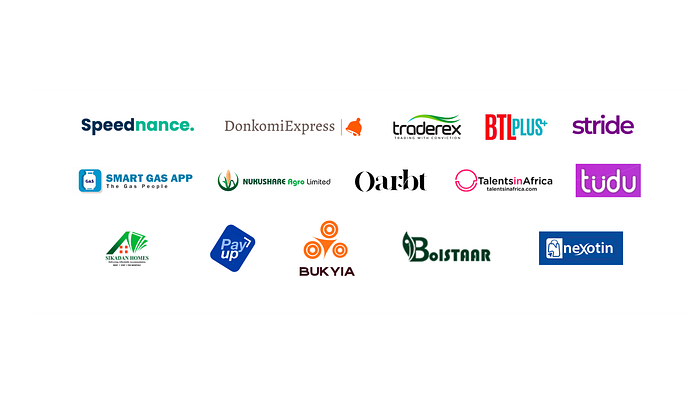
MEST Africa and the Mastercard Foundation have announced the first cohort of the 2022 MEST Express Accelerator program, an initiative that supports promising early and growth stage startups with training, access to sector specific mentorship, technical and product development advisory services, and legal guidance to help founders and their businesses grow their operations.
Fifteen startups have been selected for this cohort based on their innovative offering, investor readiness, and potential to scale and provide work opportunities for young Ghanaian women and men. The startups are from varied sectors, including fintech, proptech, software as a service (SaaS), agriculture, energy, logistics, human resources management, and ICT. Graduating startups have the opportunity to receive up to $20,000 in equity-free funding towards further accelerating their growth.
Since September 2020, the Accelerator has supported 12 promising Ghanaian startups with $100,000 in funding and all participating businesses are part of the growing MEST community — receiving continued support from MEST as they make progress in their entrepreneurial journeys.
“We are pleased to have the opportunity to work with the most diverse group of startups we have had to date. Ten industries are represented in this cohort, including our first ever hardware startup. We are also excited to see some of the startups in this cohort using contemporary technologies such as blockchains, cryptocurrencies, and web3 in the delivery of their services. This speaks to the growing awareness and adoption of these technologies within the startup ecosystem in Ghana and we are eager to support startups to build viable business models around these solutions and more. As we kickstart our first cohort this year, we also wish to celebrate the many successes from our previous cohorts, such as Swoove, who have gone on to receive investment from BFA Global’s Catalyst Fund, Tendo receiving backing from YCombinator, and Treepz, which is Ghana’s (formerly Stabus) acquisition by Plentywaka,” said Felix Darko, Program Manager for MEST Express.
The selected ventures join a roster of over 70 startups, including Wi-Flix, Bosea Micro Credit, BezoMoney, and Motito — all graduates of MEST Express. Over the next five months, these 15 companies will work towards ramping up sales and traction, increasing market share, scaling their products, sourcing talent, and creating job opportunities for increased business growth and greater impact.
“As a startup, access to funding opportunities and professional advice has been challenging. Joining the MEST Express Accelerator has given us priceless access to mentorship, networking, and funding opportunities. The experience so far has been very insightful with tremendous support from experts across different fields. We look forward to completing the program with much more knowledge and skills that will allow us to build a sustainable business,” said Benjamin Bice Asiedu, Co-founder and CEO of Traderex.
Bolstaar— a farm technologies aggregation platform that allows smallholder farmers to have on demand access to technologies, machineries, and implements.
BTL Plus — a marketing technology company serving brands and consumers with engaging apps and solutions.
Bukyia — a social food ordering app, with cloud kitchen components, that provides “eat now and pay later” financing options through their BukyiaPay service.
Donkomi Express — a web-based platform that connects sellers and buyers of clothing items through our website and social media.
Nexotin — an e-commerce marketplace, targeted at students, helping them buy items affordably and conveniently.
Nukushare — an agricultural technology service company that builds digital technologies and people systems to ensure African farmers have last-mile and timely access to quality improved seeds and fertilizers.
Oarbt — a SaaS solution for creators to sell web2 and web3 products in 3D showcases with data insights for user engagement and sales conversion.
Pay Up — facilitates payments from domestic accounts in Ghana and international accounts, allowing Ghanaians to make payments from a cedi account to a foreign currency denominated account.
Sikadan Home — uses facility management strategies and financial solutions to offer affordable housing for Ghana’s low-income population.
Smart Gas App — GasApp has developed an online platform for liquid petroleum gas (LPG) distribution, leakage detector, and level monitor which works through a mobile app and smart device.
Speednance a virtual currency exchange platform that facilitates the buying and selling of Bitcoin and USDT within minutes.
Stride an on-demand logistics startup that provides last mile delivery and fulfillment services to e-commerce merchants.
Talents in Africa — a marketplace platform that uses proprietary testing tools to predict young people’s performance at work and matches them to job opportunities. They help growing companies in Africa recruit, build, and retain talent.
Traderex — a commodity trading company focused on trading agro commodities physically in the open market as well as electronically on formalized exchanges.
Tudu Technologies — an ecommerce platform helping vendors easily list and sell items, connect with customers, and offers logistics and delivery support.
“Following the tremendous success of the previous cohort under this program, we are excited to support this group, and look forward to their sustained contribution to the thriving start-up ecosystem in Ghana, as they in turn, create more work opportunities for other young men and women,” said Chirag Shamdasani, Ghana Program Lead, Innovation, at the Mastercard Foundation.
The 11th edition Connected Kenya Summit, set to take place from 11th-14th April 2022 in Diani, Kwale will look into how ICT will support the different sectors of the economy and society through digital skills, digital infrastructure as well as ICT innovations as well as conversations around emerging technologies such as Blockchain, Internet of Things, big data and Artificial Intelligence, among others.
Themed “Accelerating Digital Transformation” Connected Kenya Summit, 2022, will shape how industry will provide viable ICT solutions to challenges facing the country especially after the COVID-19 pandemic negatively impacted the different sectors of the economy.
Started in 2009 by the ICT Authority, the Connected Kenya Summit attracts renowned ICT thought leaders and experts from overseas and the region and brings together ICT industry players, government, innovators and other stakeholders to network, share and exchange ideas on how ICT can continue to be a catalyst of service delivery to citizens and attain a knowledge economy.
This year’s Connected Kenya Summit will review growth in the ICT sector in the last decade; share knowledge and case studies to develop and recommend policy, regulatory and operational interventions to charter a future Kenya of economic prosperity using ICTs. Some of the great innovations birthed at Connected Kenya Summit include the Huduma Initiative, the e- citizen portal, Digital Literacy Program as well as the National ICT Master Plan.
Other notable achievements of the Connected Summit include the increased number of locally assembled devices at the JKUAT & Moi university assembly plants, which have both assembled the over one million digital learning devices that have been distributed to learners in all corners of the country under the Digital Literacy Program; digital infrastructure among health institutions countrywide and use of ICTs to enable farmers get value for their produce.
Blockchain technology is being implemented in a variety of industries, ranging from IT to banking. But what is it and how should it influence the gambling industry? Here are some of the upcoming changes in online casino games, sports betting, and other kinds of online gambling that we should expect.
Based on Bitcoin technology, blockchain offers a new age of provably fair gaming. It works like this on legal gambling sites: the game engine uses hashing to generate a random integer, and it allows players to potentially adjust the hash before the hand is given or the spin is played.
Even better, the game’s whole history will be recorded on the public blockchain. Because everyone can observe what’s going on, auditors will notice any unusual trends or cheating.
Improving Value of Gaming Items
The value of virtual things in 3D virtual reality video games can be boosted in three ways with blockchain technology. The first is the creative usage of virtual goods in virtual reality videos which can increase the functional worth of such digital assets.
Creating platforms in 3D virtual reality videos that allow players to sell their digital stuff for cash. Improving the social value of virtual reality videos’ digital assets by establishing networks that enable sharing, trading, purchasing, and gifting.
Secure Storage
Using ledgers based on blockchain technology to keep track of your digital assets and invest in virtual reality video games in 3D will ensure that digital items are stored safely and securely indefinitely. Blockchain technology is unbreakable, while game cryptography is extremely difficult to crack. Virtual items in virtual reality videos will stay intact in the gamer’s pocket in this manner.
Gaming Economic Regulation
The prohibition of trade in the gaming sector serves no purpose other than to generate unregulated illicit markets. This turns off the games’ ability to manipulate all trade parameters. As a result, the chance of being conned online has increased. Game makers will be able to trade digital objects with little to no chance of being scammed thanks to blockchain technology.
Payments with No Hassle
Online casinos and legal gambling sites rely on money to stay afloat. From sluggish payouts to missed payments, there is a slew of concerns that squander both operators’ and players’ time and resources. However, because Bitcoin is a peer-to-peer electronic cash system, there is no requirement for trusted third parties to validate transactions, meaning that nobody can prevent players from sending money for whatever reason they want. Cryptocurrencies are now at a point where they may be used to make payments with near-zero fees and immediate settlement.
Virtual Reality in the Future
Virtual reality’s future is now within reach. It will be employed in a variety of areas, including the internet, consumer technology, retail, eye-tracking technologies, education and behavioral data collection, among others. Furthermore, virtual reality is said to be combined with blockchain technology to introduce a new paradigm in massive data collection and behavioral designs.
These consequences are favorable for both players and online casino proprietors, as evidenced by the six key effects listed above.
Swvl, Inc, the Egyptian tech-enabled mass transit solutions firm, and Moove, a mobility lender have partnered to scale Moove’s revenue-based vehicle financing model across the MENAP (Middle East, North Africa, and Pakistan) region, as well as expand vehicle classes to include electric buses.
The partnership follows Moove’s recent $105 million Series A2 round.
Starting with an initial rollout of 500 buses, with the goal to scale up substantially, the partnership will enable mobility entrepreneurs on Swvl’s platform to access a range of brand-new buses. The $1 trillion global mass transit industry presents a sizeable opportunity for mobility entrepreneurs to own their vehicles and strengthen their earning potential. By paying a percentage of their weekly income, prospective drivers will have the ability to work towards owning their buses through Moove’s two product offerings: Drive-To-Own (DTO), which enables drivers to work towards ownership of their vehicles in 48 months, or Flexi-Rental, an entry-level weekly rental option for drivers who may not yet qualify for DTO.
Moove is committed to ensuring that at least 60% of the vehicles it finances are electric or hybrid. This commitment to tackling the climate crisis saw Moove being awarded the IFC’s 2021 Annual Corporate Award as one of the top 20 most impactful and transformational projects, applying an innovative and scalable solution towards a global problem.
Powered by cutting-edge technology, Swvl empowers underserved communities with transportation solutions that are reliable, convenient, safe and affordable. By leveraging Moove’s unique credit-scoring technology onto Swvl’s platform, both companies aim to add more drivers and vehicles to Swvl’s platform in order to enable more bus route creation and increase expected earnings for drivers.
Mostafa Kandil, Swvl Founder and CEO, said, “Moove’s unique approach to democratizing vehicle ownership by providing access to financing perfectly aligns with our mission at Swvl. Through this partnership, we areable to further our mission of empowering underserved communities with safe, efficient and cost-effective mobility solutions at scale.”
Ladi Delano, co-Founder and co-CEO of Moove, said, “Forming new partnerships with strategic partners has always been a key driver of growth for us, which is why we are thrilled to be Swvl’s preferred mega fleet partner in MENAP. Starting with Cairo, our seventh market, this is an exciting time for Moove as the MENAP region presents opportunities that remain untapped and, by virtue of this partnership, we have now expanded into urban transportation and the bus vehicle class. With 50% monthly growth since launch, the growth at Moove has been exponential and we are excited to expand our platform to serve more mobility entrepreneurs whilst leading the way in the electrification of mobility fleets in markets across the world.”
Youssef Salem, Swvl CFO, said, “Electrification is integral to Swvl’s mission of substantially reducing emissions via a combination of increasing ride sharing and vehicle efficiency. Today’s partnership with Moove, who shares our commitment to empower communities and care for our planet, enhances economic opportunities for thousands of captains while transitioning into lower emission fleets. This partnership serves as the latest example of executing on opportunities which enhance economics for our stakeholders, protect the environment and diversify and expand supply for our marketplace. We will continue to pursue further initiatives which are core to our sustainable mobility value proposition.”
Moove, launched in 2020 by serial entrepreneurs Ladi Delano and Jide Odunsi, is a mission-led company committed to providing mobility entrepreneurs access to affordable vehicle financing and ensuring that 50% of its customers are women. The company also aims to ensure that at least 60% of the vehicles it finances are electric or hybrid vehicles as part of its commitment to improving road safety and vehicle emissions on Africa’s roads. A leader in the mobility fintech space across Africa, Moove-financed vehicles have completed over 3 million rides covering more than 25 million kilometers across 6 markets, including Lagos, Accra, Johannesburg, Cape Town, Nairobi and Ibadan.
The most dramatic incident from last night’s Oscars is undoubtedly already familiar to you.
Unless, of course, you’ve been living under a rock (Pun intended-I was itching to drop that). Chris Rock, like many others across the world, is likely still processing.
No one anticipated actor Will Smith to jump onto the stage and give comedian Chris Rock a scorching slap. This was all sparked by a Chris Rock joke about Will’s Wife, which everyone appeared to enjoy except Jada Smith. Will Smith laughed at the joke a few seconds before he was slapped.
Here are some of the finest replies, tweets, and memes I’ve seen since then that I’m still giggling over.
The MPESA Super App now allows you to call a taxi.
Safaricom has announced partnerships with Little and Makao, allowing M-PESA customers to use both firms’ services through the M-PESA Super App rather than downloading separate applications.
Customers may use the Little M-PESA Mini App to hire cabs, bodabodas, and restaurants, among other things. The Makao M-PESA Mini App may also be used to book short-term lodging and holiday cottages anywhere in the country using the M-PESA App.
From the MPESA App, you can now call a taxi and book a vacation.
As part of the launch, customers who download the Little M-PESA Mini App will receive KSh. 300 off their first two trips for the following month. Customers who book lodgings for the next month using the Makao M-PESA Mini App will save 15%, and the first ten customers who book rentals in Mombasa will enjoy complimentary yacht rides.
The M-PESA Super App now contains a total of 25 apps with the inclusion of the two M-PESA Mini Apps. Among the M-PESA Mini Apps are the SGR Mini App, airline booking Mini App, NSSF Mini App, M-Tiba Mini App, and GiftPesa Mini App for supermarkets and other retail gift cards.
Safaricom hopes to partner with over a hundred businesses and organizations to provide their services and goods as M-PESA Super App apps. All county services across the country, other government agencies, eCitizen, stores, and restaurants are among them.
Peter Ndegwa, CEO – Safaricom said.
“For 15 years, M-PESA has connected millions of customers to opportunities through a wide range of financial services. Our next evolution focuses on enabling businesses to grow and scale through solutions such as the M-PESA Super App which empowers businesses to reach our more than 30 million customers through digital storefronts in the form of M-PESA Mini Apps.”
Since its launch in June 2021, the M-PESA Super App has been downloaded over 5 million times.
Eksab,a Cairo-based daily fantasy football platform, has secured a $3M Seed funding round, led by 4DX Ventures with participation from a number of strategic angel investors from the local and global sports and entertainment ecosystem, bringing the company’s total investment to date to $3.7M.
Eksab will deploy the capital to scale its user base across the MENA region and Africa, invest in product development, talent acquisition for engineering, product, and execute partnerships with a number of leading global football clubs.
According to Aly Mahmoud, Eksab Founder and CEO, “This is a phenomenally high growth period in our business as we look to take our platform to new audiences. We are also really excited to have some leading global investors and partners join this round. The fact that our previous investors are all doubling-down on Eksab highlights the great effort the team has put in over the last 12 months and the massive opportunity in the sector. With the growth of Web3 and play-to-earn gaming, we see Eksab as being at the forefront of the digital transformation of football, content, community and gaming across Africa and the Middle East.”
Launched in 2018 in Egypt to make football more exciting and interactive for every fan in the Middle East and Africa, through gaming and online community building. Eksab is the first and only licensed fantasy football platform in Egypt and plans to acquire additional licences to operate in three additional countries by mid-2022, in a bid to capture the lion’s share of the multi-billion dollar football ecosystem in the region, serving more than 500M football fans in the Middle East and Africa.
With over 700K registered users in Egypt participating in daily, weekly and monthly fantasy and predictions contests, with its user base making over a million ‘picks’ each month, Eksab players can choose free or premium competitions, make predictions and choose line-ups, with winners climbing the leaderboard and winning cash and prizes. Since the launch of its premium competitions in 2021, Eksab has grown its paying user base by an average of 60% month on month, partnered with over 10 top-tier Egyptian football players and content creators and Eksab is currently adding functionality to integrate with leading blockchain-based platforms to enable football fans to capitalise on Web 3.0’s increased speed and transparency.
With the new financing round, and with the 2022 FIFA World Cup taking place in the Middle East in November 2022, Eksab is positioning itself to dominate the growing football gaming market in the region, using tech to connect football fans and build gaming communities and secure exclusive partnerships with leading clubs in the Middle East & Africa.
“We have been consistently impressed by the growth Eksab has demonstrated over the past 12 months, powered by technology-backed innovation and unrivalled market knowledge, by Aly and his team. The football gaming market is enormous globally, but especially in MENA. Eksab has built a product and a community that has been rapidly growing in the MENA region but can easily scale across the continent – which fits 4DX’s investment ethos perfectly,” Dan Marlo, Managing Partner at 4DX added.
Morocco’s Al Mada Holding Group announced earlier this week the launch of a pan-African venture capital fund to invest in the continent’s fast-growing startups.
According to converging news reports, the Al Mada-backed venture fund aims to attract innovative investors and participate in the exponentially developing African startup ecosystem with a budget of MAD1.1 billion (€100 million).
The new venture capital aims to capitalize on the significant growth prospects of the African startup industry, which continues to set records year after year, growing 12-fold in the last five years while receiving only 1% of funding from global venture capital firms.
The venture capital fund aims to help promising technology-oriented firms focus on future areas such as financial services (fintech), health tech, logistics, education, and renewable energy expand and emerge.
In addition to providing direct funding, the Al Mada venture fund will equally offer startup access to the fund’s large network of partners.
Posing as a vertical accelerator venture capital, Al Mada aims to responsibly invest in the continent’s talents and future industries.
“Al Mada is delighted to bring its 100-year experience as a pan-African inverter to young innovative entrepreneurs who are building the Africa of tomorrow,” said the Moroccan company. “Startups will thus be able to rely on our solid expertise and that of our teams specializing in Venture Capital.”
African startups are continuing to thrive, supported by the exponential growth of fintech startups. In 2021, African startups raised a total of $4.65 billion. This year, startups across the continent have raised $1 billion in a record seven weeks, prompting experts to state that the African startup landscape may reach $7.3 billion at the end of 2022.
Egyptian health-tech startup Otida has raised $340,000 in a pre-seed round led by Lofty Inc., a Texas-based VC, with the participation of Flat6Labs Cairo, Afropreneurs, Jedar Capital, OQAL Angel Investors, UI Investments and some angel investors.
Otida is a diabetes app that serves as a nutritionist, fitness coach, and physician, among other things, for diabetic patients who struggle to go through their daily lives. This round will help in the productization of Otida’s activities as well as the expansion of distribution to reach more patients.
Ahmed Tawfic, founder and CEO of Otida: “Otida’s business model revolves around the needs of patients with diabetes. We believe that with the level of technology we are surrounded by today, it’s unacceptable to have patients with diabetes still struggling to find the right treatment program that fits each individual condition.”
Considering its unprecedented magnitude, diabetes has been recently declared as a global pandemic. In fact, more than one in every ten people around the world is currently living with diabetes; 90% of whom have type 2, which is often milder than type 1 but can also lead to deadly health issues such as heart diseases and strokes.
Moreover, it is estimated that every 30 seconds a lower limb or part of a lower limb is lost somewhere in the world as a consequence of diabetes. Ranked 9th in diabetic population, Egypt is plagued with a fast-growing health problem with a significant impact on morbidity, mortality, and health care resources. Kuwait is ranked 3rd with almost a 25% prevalence rate among adults.
The current care model for diabetes is ineffective, reactive to symptoms, lacks personalizations, depends solely on medications and adds the whole responsibility on doctors alone. This is an outdated approach that Otida aims to defy, because as it stands, the care model for diabetes is considered incompetent due to the poor quality of data gathered.
The blood tests taken only when the patient presents their case to a new physician are not representative enough to build effective treatment programs. That happens because the health care system doesn’t take into account the inconsistencies of each patient’s body; for example, their blood levels could be performing abnormally on the date the test was taken for any given reason.
Otida collects a minimum of 100 data points, per patient, per day, to tailor the best personalized care model for each user on the app. Otida’s solution is a care model that is rooted in technology, it adopts the most up-to-date guidelines to present the most effective care model. Once signed up for Otida, patients receive wearables to read blood sugar levels every 15 minutes and report back to the cloud without having to have the patients prick their fingers with an archaic blood sugar monitor.
That is in addition to the data collected from the patients, such as food consumed, the medication prescribed, and periodical lab tests. That way, and to return with the best fitting care model, the app learns a lot about the patient’s nutrition, glycemic responses to different food and medications, their lifestyle and behavior.
Each patient gets assigned a coach who is available around the clock. Otida also educates its patients about their individual conditions and how they can measure their insulin and blood levels and how they can use that data to improve their lifestyles.
Otida watched as this tech solution changed many lives. Thanks to smart technology and sharp data analytics, Otida was able to reverse diabetes for those diagnosed with type 2.
Mona AbdelMoteleb, Medical Director of Otida: “We have patients with type 2 diabetes who were insulin dependent, with Otida’s guidance they stopped taking it and stopped depending on medications altogether. We want to be a companion to help diabetic patients live a normal, happy life.”
Today, the Otida team is composed of eight members all working towards one mission: to make the life of each user with diabetes easier. To expand Otida’s footprint to a milestone of 5,000 patients this year, the company’s looking to hire devoted, experienced calibers to help make Otida’s mission a reality.
Otida’s team structure is divided as follows: a technology department that’s responsible for both development and product management; a nutrition department of nutritionists and dieticians studying each patient’s response to food and placing right plans that work with each correspondingly; a medical department armed with endocrinologists and other relevant specialties; customer support department with agents answering to the patients’ questions and requests; data analytics department to make use of the data collected within the app to present the users with a healthy, efficient solution.
Founded originally as instadiet, the app focused its methodology on the glycemic responses of its users. The app would measure how quickly each food item causes their users’ blood sugar levels to rise and put together a diet plan accordingly.
Due to this data-driven approach tailored for each individual, the app attracted a lot of users diagnosed with diabetes who found their methodology perfect for their day-to-day lives. The demand the app collected got the founders to rethink their strategy to be even more efficient to their diabetic user base and the 9 million people with diabetes in Egypt and 73 million in the whole region.
Bimaleo offers private and commercial drivers, real-time, personalised auto insurance policies. “Bimaleo ‘as needed’ and Bimaleo ‘by the mile’, instead of the industry-standard full-year premiums based on approximations and estimates that have historically made prices unfair.
With the pay-as-you-use/drive motor insurance model, drivers who use their cars infrequently, work and live local and drive safely can expect annual average savings of 50% over what they were paying their previous auto insurer.
Bimaleo was founded in 2020, by Shreyas Patel and George Richard during the Covid-19 pandemic had greatly affected various operations and businesses.
Mr. Patel, who is the Co-founder and company’s CEO said, “The idea came to us in 2020 when Covid-19 hit and numerous fleet owners had their vehicles grounded and subscribed to telematics services that could benefit from pay as you use/drive motor insurance, by allowing the data generated from the telematics units installed in the vehicle to pay for insurance only when using the vehicle.”
“We noted that corporate fleet owners were paying for an entire year of comprehensive premiums while using their vehicles for half the year thus the compelling reason to purchase insurance based on use came to mind.” he says
To use their services, a client can easily subscribe to their services by going to their site and creating an account. Once the account is activated, they will be taken through a simple KYC process, where they require details of the vehicle, like vehicle registration number, make, model, chassis number etc.
Once this information is provided, a tracking device is installed in the client’s vehicle and from the tracking device will allow the company speed up claims with underwriter partners when an accident occurs.
The company has partnered with trusted tracking providers in the market and if you have a device from one of the partners, the client can then proceed to purchase insurance for the day/days in question from a list of underwriters in the market.
“Purchase of the premium is made via M-Pesa and the policy note is emailed to the client. Clients can also purchase Third party insurance on the platform for the year as required by law. If they have a tracking device from a provider that is not on our partner list, they are free to contact us, and we shall advise them on how they can purchase insurance through the platform. As an added advantage, through Bimaleo, clients can purchase comprehensive premiums from the company while retaining their existing third-party insurance from any underwriter they currently subscribe to.
“Through the telematics data gathered from the tracking device installed in the vehicle, if a client accepts to receive benefits from our premiums discount package, we can evaluate how good a driver is on the road by taking into consideration data such as speeding, harsh braking, sever cornering etc. This translates to a daily score. If a client’s score is high based on good driving practices, the next premium purchase they make through the platform will have a reduction on the premium rate. This service is to encourage safe driving on the roads and promote cost savings,” Patel says.
Fidelity Shield Insurance was the first underwriter they worked with to actualise the service and KK Security (part of Garda World) as channel partners, that can offer the service to their existing tracking clients.
Onboarding further underwriters and channel partners is ongoing as well as plans to launch the services in the next six months across the region.
You can get your KCPE results by sending an SMS to 20076 with your Index Number. Alternatively, by visiting the KNEC website and entering your Index Number, you can view your KCPE results online. Candidates who took the KCPE examinations in 2022 will be unable to see their results until the platform is upgraded.
The Kenya National Examinations Council (KNEC) is in charge of administering and publishing the KCPE exams.
Students and parents used to have to go to their schools to get their results slips. KNEC has made it possible to view your KCPE results online or by SMS in previous years.
How to Check KCPE Results via SMS in 2022
In 2022, here’s how to verify your KCPE results through SMS:
Send an SMS containing your Index Number to 20076 for Safaricom, Airtel, networks to receive your KCPE results through SMS.
If your Index Number is 1234567890, for example, you would SMS the following message:
20076 to 1234567890
Within a few minutes, you should receive your KCPE results by SMS.
Before sending the SMS, make sure you have enough airtime.
On all networks, sending an SMS to check KCPE results costs Ksh. 25 per SMS.
How to Check KCPE Results Online in 2022
You can also see your KCPE results by going to the KNEC website and inputting your Index Number.
You can view your results in real time and print your KCPE result slip using this approach.
Follow these steps to check your KCPE results on the KNEC portal:
Log in using your candidate number and examination year as your username and password on the KNEC website (https://www.knec-portal.ac.ke/).
On the “ONLINE- RESULT-SLIP” tab, select “ONLINE- RESULT-SLIP.”
From the drop-down option, choose “KCPE.”
Click “Login” after entering your Index Number.
The results of your KCPE will be presented on the screen.
Candidates who took the KCPE examinations in 2022 are now unable to use this approach because the portal has not been updated.
Waspito, a Cameroonian e-health startup, has raised US$2.7 million in seed funding to grow its user base in Cameroon and Ivory Coast.
Waspito, founded in 2020 by Jean Lobe , connects users with doctors via instant video consultations from their smartphones. It also offers mobile laboratory services, in which a lab professional collects samples from a user’s home and sends the results to them digitally.
Waspito has served over 15,000 patients to date, and it plans to expand to ten countries in the next four years. It also includes a health-focused social network where users may engage anonymously with medical specialists who provide preventive care suggestions and answers to inquiries.
An oversubscribed US$2.7 million seed round led by Launch Africa Ventures, Newtown Partners via the Imperial Venture Fund, BLOC Smart Africa managed by Bamboo Capital Partners, Orange Ventures, Saviu Ventures, Plug and Play, and BringCom will fund the first stage of this expansion, which will see the company expand its coverage across Cameroon and launch in Ivory Coast.
Waspito will also increase its service offering as it works to connect Africa’s health ecosystem online in order to alleviate the continent’s medical doctor shortage and other health system difficulties.
“My incredible team has been making baby steps in the right direction and this additional funding will help accelerate execution,” said Lobe Lobe. “We are proud of the pool of investors we were able to get on this round. Their experience and network will add value to our team as we continue this journey to solving Africa’s health care accessibility and affordability problem.”
The general narrative is that every entrepreneur needs a business plan. As much as that somehow primes most entrepreneurs to come up with business plans (which is a good thing) it is not entirely true. There are obviously those who need business plans but there are also those who do not need them. To get rid of confusion we shall delineate this subject by laying out those two sets. We shall not only classify but we shall also explain i.e. why a particular set either needs or does not need a business plan.
Who Needs A Business Plan?
Startup Entrepreneurs
So many people actually think that business plans are solely meant for startup entrepreneurs. The reason it is like that is because business plans are mostly drafted by startup entrepreneurs. Startup entrepreneurs usually have great business ideas and yet lack sufficient funding. Thus they draft business plans that they will use to approach prospective investors or financiers. Though the landscape is evolving and some no longer require business plans in particular, most still require a well written business plan. If you happen to be an entrepreneur who is starting out or looking to start out you need a business plan. It is best to be prepared regardless of the fact that in some cases it might not be requested.
There is a risk factor in bankrolling any business idea. Startup entrepreneurs are subjected to rigorous assessments because of that risk factor. No wonder why the business plan is requested for in that it can be used as an avenue to ascertain the potency of a business idea.
Entrepreneurs Scaling Or Pivoting Their Businesses
We are in the thick of the industrial revolution – things are fast-paced and there is rapid change. It is because of such an operating environment that pivoting or scaling is commonplace. Scaling has to do with increasing production levels or product range – anything that constitutes an increase in business operations. Pivoting entails tweaking a business in a way that enhances it – it can be in terms of revenue, profits and the like. This can be done through various approaches depending on what is being leveraged on. Pivoting is often necessitated by developments in the operating environment or the business itself.
The ‘pivoting’ simply means you make adjustments but still ensuring you remain firmly positioned. For example, pivoting can involve introducing a new product or new products. When scaling or pivoting occur, certain things that initially held true from the onset might change. Both scenarios also would require capital injection in order to see the light of day. It is for that reason that entrepreneurs dealing with either scaling or pivoting might need a business plan. This is because they would want to seek funding from prospective investors or financiers. This would not be surprising because scaling or pivoting can be in essence seem like starting all over again.
Who Does Not Need A Business Plan?
Financially Self-sufficient Entrepreneurs
If ever there is someone who does not need a business plan, it is the financially self-sufficient entrepreneur. This stems from the fact that business plans are primarily meant for fund-seeking initiatives. Such an entrepreneur can draft a business if they want to – but it will not really be a need or necessity. A financially self-sufficient entrepreneur can come up with a business plan that they would use as a reference document. That seldom happens though because drafting a business plan is hectic as it is so not having to draft one is most welcome to many.
The One-Man Band Very Small Scale Entrepreneurs
There are entrepreneurs who start or run very small businesses. The businesses will be so small that the owner will literally be running the business solo. There are so many businesses like these all over the world. In most cases the entrepreneurs in question will not even be well-versed or even aware of the technical dynamics of running a business professionally. Such entrepreneurs are all over especially in countries that are experiencing economic challenges.
There are countries where the informal sector is most active than the formal sector. It is in countries like that where you will find most of these one-man band small businesses. Aside from some of the aspects we have mentioned, one other reason can be lack of access to business financing. This is for a number of reasons some which are lack of structure in the business, high risks involved and lack of collateral. Due to that lack of access to financing these types of entrepreneurs never get to a point where they need to draft a business plan.
One From Which None Is Requested
This might sound obvious but it is important to discuss some things on this. The general assumption most entrepreneurs make is that a business plan is a must-have. Such an assumption might be wholly wrong but the truth is there are times when a business plan is unnecessary. Since they can be unnecessary it would be good to know when it is not needed. This calls on entrepreneurs to ensure they check with the people or institutions they wish to approach. Supposing an entrepreneur has identified a prospective financier they think could fund them they must find out what they would want. They could be surprised to find them just wanting a one-minute pitch to make their decision. Due to this possibility it becomes apparent that there are times you might not be requested to present a business plan. It is good to know this beforehand so that you do not waste time preparing one.
Surveys have shown that there is broadly no significantly attributable difference between the success level of businesses based on whether or not they had or have business plans. You do well to have a well-written business plan; that is noble. However, you have to weigh the merits of your context since you might not even need one. That is why we did this article to guide you in noting who needs one and who does not.
Villgro Africa, an early-stage business incubator and impact investor, Innovate Now an Assistive Technology Accelerator and the Kenya National Innovation Agency (KeNIA) a State Corporation under the Ministry of Education, have partnered to support entrepreneurs with Assistive Technology hardware innovations.
Through a call for applications, innovators who are developing such solutions have been invited to apply. The partnership will see entrepreneurs with innovations that are rehabilitative, assistive and adaptive for people living with disabilities or the elderly receive funding of up-to USD 20,000, training and
mentorship on investor readiness, and get access to investor networks. The call is now LIVE at villgroafrica.org/call-for-applications-3
As part of this initiative, an innovation bootcamp will provide selected entrepreneurs with business skills to support commercially viable hardware technology and strengthen the capacity of Kenyan innovators with regards to scaling their enterprise and impact.
Who is eligible to apply?
This call shall be limited to Kenyan citizens who have the skills to actualize their hardware product.
How will you benefit?
Funding – Initial investment funding pool of $20,000.
Access to Networks – Access to development and investor networks from Innovate Now,
KeNIA and Villgro Africa.
Investment Readiness – Receive mentorship and training that will enable you to
communicate effectively with potential partners and investors.
Selection Criteria
Awareness of user needs – What work have you done to understand user needs and align
with them?
Potential for Impact – What is your assistive technology’s potential for social and/or
environmental impact?
Potential for scale – What is the potential size of the market for the assistive technology
hardware innovation
Maturity of assistive technology hardware product – How advanced is the product;
functional prototype stage or market ready? Is Design for Manufacture & Assembly done?
Team strength – Do you have a cross functional team e.g. comprising a doctor, engineer and
marketer, that has the experience to drive the business to success?
How to apply?
Applicants must first log in to their user account on VC4A to access the full application. If you
don’t have a user account on VC4A, you will be asked to sign up and complete 3 onboarding
questions, before you can start with your application.
All applications have to be submitted via the online application form. Application Deadline: 28th March 2022
We are in the information era. Data influences every second of our lives. Sport has not been bypassed by the technological revolution, and companies like Zebra Technologies are bringing an incredibly detailed level of insight into every NFL play.
Those looking atwww.sidelines.io sports odds will not necessarily be familiar with every rule change recommended or be aware of the remarkable amount of information that is available. Football, though, is changing at pace.
Alterations to improve player safety and prevent injuries hit the headlines. Tracking data is useful far beyond that, however, helping teams to understand what works on the field and to give the league an idea of where officiating can be improved.
Zebra attached a Radio Frequency Identification (RFID) chip to every football, player and referee in the 2021 season. This generated around 43,000 snaps to analyze. The NFL can rewatch every movement made on the field throughout the season from out-of-place officials to the hardest hits. Of course, the kickoff and punt return rules have been under the spotlight, but the sheer quantity of this data gives the NFL the opportunity to learn more about every facet of the game.
Kickoffs have been tweaked after Zebra’s data revealed considerable head trauma. The pitch-wide chaos of punt plays has drawn concern, too.
Officials Under Scrutiny
While safety is the biggest issue the league aims to address with Zebra’s tracking data, the referees are under the metaphorical microscope, too.
The game is played at a higher pace than ever, putting more onus on the officials to keep up. With each referee tagged with a chip, the NFL can see how well each official is moving to provide the best view of a given play.
Troy Vincent, the NFL’s executive vice president of football operations, spoke about the analysis of referees during Super Bowl week.
“One of the things we’re able to look at—because they are actually being tracked as well—is: ‘Where was he or she when they made the call? Were they in the right place?’ We’re talking, pre-snap, during snap and post-snap. Was someone properly aligned? Where were they during, say, the motion of the play, or in the middle of the play, and then where the play ended? Was he or she in the right place?’
“So this is just the evolution of technology…We’ve been [tracking referees] for a few years now. It’s important. One, to make sure we’re evaluating everything. Not just where they are, but their movement in between the play. Also, Zebra allows us to [track] distance. Distance [a ref] traveled as you look at future positions whereas you identify talent that will be coming. Man, we know that back judge or the side judge or the umpire or the ref, looking at their movement, tells us what future officiating should look like, based off where the game is.”
Injury Prevention
Away from aiming to prevent concussions, the NFL can also use tracking data to look at the causes of other injuries. Coming out of Super Bowl Sunday, artificial turf was a hot topic after Odell Beckham Jr tore his ACL.
Everything from underfoot conditions to the type of cleats are recorded for injuries like Beckham’s. The nature of the contact and force of it are obviously crucial to determining the root cause for such a devastating injury.
Vincent believes ACL, hamstring and groin injuries are preventable. He cites using data to do things ‘better, smarter, more efficiently’ for the benefit of the modern athlete. Hopefully we will see a marked reduction in NFL injuries in the coming seasons.
Tesla Auto Pilot and FSD (Full Self Driving) are the most popular driving assistant and autonomy technologies today, however, Mercedes-Benz Drive Pilot is at the fore front when it comes to government approval.
Drive Pilot has already been approved in Germany as a Level 3 autonomy system, it is usable on roads without traffic light stops, roundabouts or construction zones and it works at speeds up to 60 km/h. The technology is close to getting legal in Nevada and California. Mercedes is hoping to get certification in the US, making it the first brand to obtain it in that prime market. To get this Level 3 certification, the system needs to give the driver a 10 second warning to take control of the vehicle in case of a difficult road scenario. No other manufacturer has such a long warning period in place.
These certifications shows that authorities trust in the technology and Mercedes Benz is so confident in it such that it will take full legal responsibility if something happens with the Drive Pilot turned on.
Available on some S-Class and the electric EQS models, Drive Pilot, when activated, takes control of the steering wheel, speed and brakes. It uses a combination of advanced imagery system, LiDAR sensors, variety of GPS systems, microphones and standard cameras to collect data around it. The system is capable of handling situations like sudden traffic halting, detecting debris on the road or aggressive cut-ins.
In case Drive Pilot detects emergency lights on ambulances and fire trucks, it hands over control to the driver and disengages itself. Other scenarios the system will need the driver to intervene includes, if it detects subpar weather conditions, overhead obstructions, tunnels, or if it becomes too dark. Otherwise, it can steer the car to the destination without needing much input from the owner. In fact, drivers are legally allowed to use their smartphones with Drive Pilot is engaged.
The system is still a long way from Level 5 full automation, but with the continued development by automakers and government support, it could happen sooner rather than later.