back to top
Thursday, April 2, 2026
spot_imgspot_imgspot_imgspot_img
Home Blog Page 575

OPay launches tricycle hailing services OTrike in Nigeria

Opay, Opera’s Africa’s focused payments and everything platform has added OTrike, a tricycle hailing service to its portfolio, as it moves to become Africa’s biggest super-app.

Use cases for its payments platform and data collection

OTrike comes just a few months after Opay launched ORide in Nigeria in a move various analysts claim OPay’s strategy to build as many use cases for its payments platform as possible. The data is also important for its Opera browser, it’s loans service OKash and the many other services data can do.

OTrike in Abia State

OTrike, which has been launched in Aba this month will be expanded across the country after rigorous tests according to sources within the firm. Available to users in Aba such as Brass, Ariaria and Enyimba, the over 2m population is large enough to be a sample population for the firms pilot.

OTrike is not the end for Opay as there are buses and trucks on the menu and digital products like music and movies on the go. After moving consumers and services such as utility and peer-to-peer payments, OPay is expected to play big in moving commodities and it won’t be surprising for them to take on Kobo360 or Lori Systems in Nigeria.

Opay e-shop in the offing?

Opay is also not limited to just transport and services, there is a huge opportunity for it in ecommerce and we are likely to see an ecommerce platform run by OPay. Mostly an in-app shop using AI built on OPay user data. This is not far-fetched because DHL recently launched its pan-African eshop after years of running shipping and logistics for global firms and ecommerce platforms.

AI and data collection

Warehouses might be the next thing and before we know it, OPay will be playing big in the home delivery retail business after its online food delivery grows from just groceries to the entire shopping cart.

OPay now powers online food ordering, purchase airtime for family or friends from any network, payments for electricity bills, GOTV, DSTV and STARTIMES subscription, now hailing for ORides and OTrikes. The future is just limitless for Opera, the mother firm, which has both the resources and the technology to scale into more services. Money is not an issue as the firm has invested its own $100m into these and is willing to put in even more.

Golden Brick Capital

Another $100 million might be in the offing as Opera Software, the firm that owns OPay and ORide and now OTrike verticals is owned by Chinese firm Golden Brick Capital, a private equity fund which purchased Opera’s consumer business for $575 million three years ago.

“Africa is a very important market for Opera. Nine of the top 20 Opera Mini user countries are from Africa,” said Richard Monday, Vice President of Africa, Opera Software. “We aim to invest heavily in Africa, to build a local platform and grow with the local business partners. This platform will expand the user base for content providers, e-commerce businesses, operators, OEM’s and others to strengthen the African internet ecosystem.”

Your Canon DSLR camera is vulnerable to ransomware attacks

0

Canon DSLR Cameras which are renowned among professional photographers are said to be vulnerable to ransomware attacks over the air. Every other day more and more devices grow dependent on the internet connectivity to function and the threat of cyberattacks grow with it.

Digital cameras with built-in Wi-Fi let people quickly send images to other devices like laptops, but a vulnerability in the process could leave people’s cameras exposed.

Eyal Itkin at Israel-based firm Check Point found that the way cameras transfer information, the Picture Transfer Protocol (PTP), could be exploited.

Check Point Software Technologies released a report and video detailing how ransomware could be remotely installed onto a DSLR camera.

In the report, researcher Eyal Itkin found that a hacker can easily plant malware on a digital camera. He says that the standardized Picture Transfer Protocol is an ideal method for delivering malware because it’s unauthenticated and can be used with both Wi-Fi and USB.

The report notes that individuals with an infected Wi-Fi access point could extend it at a tourist destination to pull off an attack or infect a user’s PC.

Additionaly, in the video, Itkin shows off how he was able to exploit a Canon E0S 80D over Wi-Fi and encrypt the images on the SD card so that the user wouldn’t be able to access them.

He also reports that cameras could be a particularly juicy target for hackers. Why? They’re full of personal images that most people likely won’t want to walk away from.

A hacker, in a genuine ransomware attack, will typically demand a small amount of money in exchange for the key that will decrypt the files. This is usually a small amount that people would rather just pay to get rid of the inconvenience.

Check Point has known about this vulnerability for a couple of months now. After sharing about it with Canon back in March, the pair have been working together on a fix, with Canon issuing a warning to camera owners last week not to use unsecured WiFi networks.

The Japanese firm also advises owners to update and install the latest security patch.

Unfortunately Check Point did not reveal whether other manufacturers are also vulnerable, but in any case, all are adviced not to connect to unsecured WiFi networks regardless of what device you may be using.

Raino Tech4Impact raises $100K equity round from Samurai Incubate Africa

0

Raino Tech4Impact, a Kenyan Social enterprise startup you have probably never heard of has received $100,000 in equity investments after emerging the best startup at the recently held pitch event organized by Samurai Incubate Africa and Growth Africa.

Raino was among the 10 startups selected to pitch at the Samurai Incubate Africa pitch event as it seeks regional startups for its $3.4 million fund. TechMoran had earlier announced the pitch event as organized by Leapfrog Ventures but Samurai Incubate Africa and Growth Africa took the lead. The other startups included Bluewave, TalkLift, Uzapoint, Medbit, OZE, Ridesafe, Julla, Tovuti, Afrijob and Hoji.

Bluewave Insurance creates an innovative mass market microinsurance products accessible via mobile devices while Hoji is an automated research platform helping NGOs and research consultants automate their research and decision making process. Afrijob is a pan-African jobs platform connecting African talent in Africa and in the diaspora to opportunities at home while Julla is a point of sale financing platform enabling users to purchase items now and pay later.

Medbit, like its name is an online medical platform allowing patients the ability to book appointments and seek treatment online and via the mobile phone while OZE provides investment-readiness data to SMEs. Ridesafe offers real-time Emergency Response to motorbike riders and passengers in the event of an accident.

TalkLift is an AI platform for helping businesses manage conversations with their customers from different communication channels while Tovuti is a software solutions firm offering point of sale, card and mobile payments and retail solutions to its customers. Uzapoint is an ERP tool for SMEs.

It was surprising that the NGO-style Raino Tech4Impact won the hearts of the judges and raised equity funding and not the other conventional startups at the pitch event. However, the judges vindicate the social entreprise.

“The reason why I choose Raino Tech4Impact is because in Africa the population is growing very fast and the problem of food shortage and wastage is also growing and is now a very big problem and the point is how much of a difference. So I felt we can have more synergies between us and help grow this business and make it bigger,” Samurai Incubate Africa CEO Mr. Takuma Terakubo explained.

Founded in 2014, the social enterprise uses technology to build solutions in health, agriculture, sports, green energy and offer business support services in a move to champion Sustainable Development Goals (SDGs). It’s founder was also surprised on being the best startup at the pitch event.

“I am very surprised to have been selected as the winner, I honestly didn’t expect it because I was very late and I even used a boda boda to get here. I am very happy because this money will go towards helping those people who at the bottom of the pyramid to compete with a lot of fish imports. This money will give them a leverage to have an edge in competing power and be able to sell their fish more effectively and at the end of the day be able to grow and improve their livelihood,” said Francis Nderĩtũ, the Managing Director of Raino Tech4Impact.

Tech YouTuber MKBHD Launches ‘Waveform’ Podcast Alongside Studio71

0

Marques Brownlee who is otherwise known as MKBHD recently launched a podcast named Waveform with the help of friend and MKBHD producer Andrew Manganelli. Waveform, which is being produced in conjunction with the influencer agency Studio 71, marks one of the first major non-YouTube projects Brownlee has taken on.

Brownlee who has more than 9 million subscribers on his tech-focused channel MKBHD,  is one of the top, if not best technology YouTubers. From reviews of phones to an in-depth ‘Autofocus‘ car series, Marques covers a wide range of technology.

Apart from MKBHD, Brownlee additionally works with The Verge’s father or mother firm, Vox Media, on a YouTube sequence referred to as Retro Tech. In it, he spotlights one iconic piece of vintage tech in every episode alongside fellow YouTubers, educators, and inventors.

Waveform: The MKBHD Podcast will feature tech and product news, tips on running a YouTube channel, and exclusive interviews between Brownlee and tech industry heavyweights. The Podcast is available on AppleSpotify, and Google‘s podcast platforms. Unfortunately, Waveform is not available on YouTube.

In a statement, Brownlee commented, “Over the last ten years and one thousand plus videos, I’ve built one of the largest tech channels on YouTube. But even through all of that, I’ve realized I have more to share. I’m excited to launch Waveform, which will explore everything from tech news and new products to the videos that surround them. You can also expect some behind the scenes tips on running a tech channel and maybe even some unfiltered takes that don’t make it to YouTube.”

Waveform: The MKBHD Podcast, Episode 1

In the first episode, Marques and Andrew discuss the recently announced Samsung Galaxy Note 10, upcoming phones and what is expected to come in future episodes.

However, Marques isn’t the only Youtuber running a podcast, creators like Philip DeFrancoLogan Paul, and David Dobrik have all launched successful podcasts that get uploaded to secondary YouTube channels.

Most of these podcasts exist on traditional audio streaming platforms, like Spotify and Apple Podcasts, but many YouTubers also upload video versions to YouTube, a platform where they can easily make money with pre-roll and banner ads.

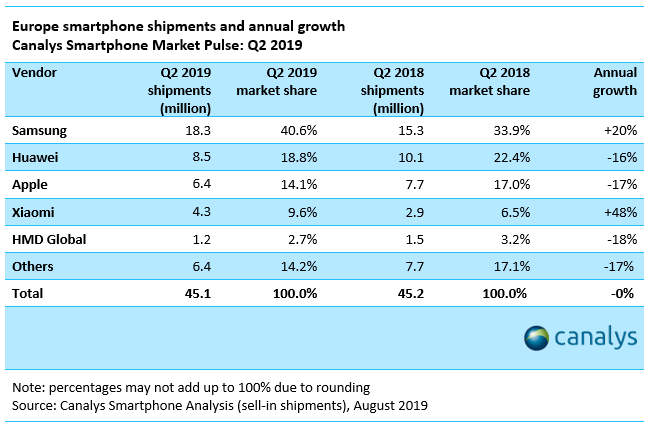
Samsung and Xiaomi surge in European smartphone market in Q2-report

Samsung rocketed to over a 40% market share in Europe in Q2, its highest for five years, as it shipped 18.3 million smartphones., according to a new report from research firm Canalys.

Samsung shipped over 12 million A series units and it shipped more A Series units than any other vendor in Europe managed with their entire range of smartphones.

Samsung Galaxy A Series which include the Galaxy A10, A20e, A40 and A50, have been launched in various markets globally.

Galaxy A Series

“Samsung obviously had enough of losing share in Europe,” said Canalys Senior Analyst Ben Stanton. “For years, a focus on operating profit has stifled its product strategy. But this year, the shackles are off, and winning back market share is its clear priority. But its success is not solely due to product strategy.”

Samsung’s shipments grew as its main rival Huawei suffered the impact of political restrictions in the United States, which saw its shipments fall 16% to 8.5 million units. While in Europe, Apple remained the third largest vendor, falling 17% to ship 6.4 million iPhones.

On the other hand, Xiaomi took advantage to gain further share in markets where it is strong, growing 48% to 4.3 million units while HMD Global completed the top five, down 18% to ship 1.2 million smartphones.

Samsung capitalized on Huawei’s US problems

According to Stanton. “Samsung has been quick to capitalize on Huawei’s US Entity List problems, working behind the scenes to position itself as a stable alternative in conversations with important retailers and operators.”

The analysts also added that a lack of brand loyalty among users of low-end and mid-range Android smartphones in Europe was a catalyst as Europe is one of the most brand-volatile smartphone markets in the world.

Xiaomi is now a major force in Europe

“Xiaomi is now a major force in Europe,” said Canalys Analyst Mo Jia. “Its core strength remains price-sensitive countries across Europe, in online and open market channels, but it is increasingly being trusted and ranged by important mobile operators.”

With a weakened Huawei, distributors, retailers and mobile operators are actively seeking alternative brands to fill the gap and reduce their dependence on Samsung which has become a force in Europe after the fall of Huawei.

Retailers are therefore turn to alternatives such as Xiaomi which has become attractive due to its early foray into 5G.

Trella joins YC to disrupt MENAs fragmented trucking industry

Trella​, the Cairo-based trucking marketplace, which recently raised $600k+ in a pre-seed funding led by Algebra Ventures, has joined ​Y Combinator​’s S19 batch, to disrupt the fragmented trucking industry in MENA.

Trella is in the right hands as YC has helped built companies including Airbnb, Dropbox, Stripe, Reddit, and Doordash and these development validates Trella’s commitment to digitizing trucking and offering a grade-A end-to-end solutions to both shippers and carriers in the trucking industry.

According to Trella, YC opens the door for invaluable opportunities for synergies and collaboration with fellow YC companies and alumni, as well as unparalleled access to YC’s network of investors, mentors, and partners.

‘We’re excited to be part of such a prestigious program,’ says Omar Hagrass, Trella’s CEO. ‘YC has already been super valuable and cemented our position with investors, partners, and stakeholders. We’re looking forward to building something really big.’

Founded in 2018, Trella is on a mission to optimize the trucking industry. using its b2b technology platform which connects shippers and carriers in real-time, using data to optimise drivers’ routes and increase the volume of backloads.

Trella empowers truckers who get significantly more value and a more consistent flow of business through the platform while also reducing costs for shippers by improving load utilisation and efficiency, and enabling shipment tracking in real-time.

Addressing an enormous pain-point in a deeply fragmented industry plagued by asset under-utilisation and a lack of transparency, consistency, and reliability, Trella’s tech platform has already piqued the interests of regional and global investors and businesses. The firm competes with Trukkin which is based in Saudi Arabia and the United Arab Emirates which recently raised over $3.5m in funding to bolster its long-haul trucking business in the MENA and GCC region and beyond.

Trella’s other competition include Lori Systems, Trukkin, Kobo360, a logistics marketplace which recently launched in Ghana, Kenya and Togo after $6 million backing from the IFC.

‘At YC, it’s our job to help talented founders from anywhere in the world to access the advice, network, and funding that Silicon Valley has to offer,’ says Michael Seibel, YC CEO and Partner. ‘With Trella, we saw extremely strong founders, tackling a huge problem, in a region of the world that needs more tech investment. It was an obvious fit.’

Huawei launches Honor brand’s first Smart TV with HarmonyOS

0

It’s the first HarmonyOS device.

Huawei launched the Honor brand’s first smart TV, which is also the first product powered by the Android alternative (HarmonyOS) that the company launched at its developer conference in Dongguan over the weekend.

HarmonyOS can be used in various products from home appliances and wearable technology to in-car devices, Huawei said.

The Honor Vision TV is the first product to feature its self-developed operating system, an alternative to those from Google and Apple. 

The new TV will become an “information and control center” in the living room, Huawei said, allowing users to make high-definition video calls, sync and project files and pictures between smartphone and TV, while search and control the device by smartphone. 

“It’s not only a TV but it represents the future of TV,” said Zhao Ming, Honor’s president.

Several reports confirmed that Huawei had been developing its own operating system for a while now in case time comes that it can’t use Android anymore.

Ever since Google suspended Huawei’s Android license back in May, the company has been open about its plans to develop an alternative operating system. The company did say that Harmony OS has been in development for over two years.

We can all now see that HarmonyOS is Huawei’s big attempt to decrease its reliance on Google’s Android operating system.

Considering that all other tech giants cut ties with the manufacturer recently due to the trade restrictions that the US government imposed upon it.

Honor Vision will be available in two versions, both of which are 55-inch screen with 4K HDR capability. They are the Honor Vision and Honor Vision Pro, which will go on sale in China this week, reports Gadgets360.

Honor’s new display is equipped with SoCs and chipsets from Huawei’s semiconductor company HiSilicon. Honor vision Tv owners will be able to use their phones or tablets to search for programs to watch. They can also sync what they’re typing out on their phones, and they can project files on the display. The Pro model has a 1080p pop-up camera for video calls with AI capabilities, including facial recognition, body tracking, and posture detection, as well.

Honor Vision Tv with Pop Up Camera

The Pro version has twice the storage (32GB) of the standard one and is priced at ¥4,799 (approximately $680) more expensive than its basic sibling which will run for ¥3,799 (approximately $540).

Pre-orders are now open in China and a wide release is expected on August 15th, but there’s no word yet on whether it’ll ever be available outside Huawei’s home country.

Companies that have traditionally been known for their smartphones are venturing into the smart TV business. Xiaomi who has been in this game for some time now is launching a marketing campaign for its products, including TVs, on August 16. On the other hand, OnePlus is also gearing up to launch its own smart screen product.

On Friday, a day before Huawei’s launch, Hisense, the top TV vendor in the domestic market, also released a new smart home ecosystem with interactive and Internet of Things features.

Its Hi Table features a new display, Internet of Things, AI and social functions. It can connect 45 million Hisense users and 120 kinds of smart devices “to define the future of TV,” according to Wang Wei, the company’s vice general manager. 

“We welcome the entry of Huawei. It will bring fresh air and innovation in the market,” Wang said.

Just recently, Skyworth also announced its upgraded smart TV strategy, which allows users to send emails and display PPT files on TV.

Seedstars Accra Awards NVOICA as Best Startup in Ghana

0

Ghana’s Nvoica by Growth Factor, which solves the problem of cash flow issues caused by late payments by enabling SMEs to get paid in 24hrs when dealing with credit clients, has been named by Seedstars as the “Best Startup in Ghana” for its innovative sustainable solution.

Nvoica won the Ghana round of Seedstars World 2019 and will potentially represent the country at the Seedstars Summit in Switzerland to compete for up to USD 500,000 in equity investment and other prizes.

Seedstars World, the largest seed-stage startup competition for emerging markets and fast-growing startup scenes, brought its Ghana round to a successful close during Seedstars Accra. The event took place this Thursday, at SBIncubator Ghana, and 9 selected startups were invited to present their companies in front of the local jury panel. 

“Winning Seedstars Accra means a lot to Nvoicia. It’s a win for the team and most importantly the Small Business Owners we developed Nvoicia for. We see this as a call to be better and to do better. It was quite an experience pitching alongside some of the best startups in Ghana. We look forward to the Regionals and ultimately the Global Summit.”, explains Kelvin Tyron, Founder at Nvoica. 

Besides representing Ghana at the Seedstars Africa  Summit, the winner will win an all-inclusive trip to the Seedstars Africa Summit and the chance to win a spot at the Seedstars Global Summit in Switzerland where the winner will take home a 500K USD investment prize In addition, the winner will receive 3 months access to the investment readiness program.

The 9 startups pitched in front of a prestigious jury, including Klenam Fiadzoe, Technology Entrepreneur,  Coiz Ltd; Adu Ampofo, MD Velia Consulting; Hamdiya Ismaila, General Manager, Venture Capital Trust Fund; Grace Safoa Buaka, Investment Manager, Oasis Capital Ghana; Nana Okyir Baidoo, Senior Associate Investment Banking, Fincap Securities; Baafour Otu-Boateng, Principal, Investisseurs & Partenaires; Fredrik Andersson, Investment Manager, Seedstars.

The event attracted interest from over 70  startups, and around 200 attendees.

Tech Shelta, an AgriTech company that helps greenhouse farmers maximize their efficiency in production and incomes, came second and Simundi Limited, with its product ‘KeepSales created to eliminate mismanagement of money and data of shop owners in Ghana with technology, grabbed the last spot in the top 3. The other startups invited to pitch were Codetrain, GasApp, Jumeni Technologies, Agripool, Nocofio, and Kwidex Technologies.

Claudia Makadristo, Regional Manager for Africa at Seedstars, said,‘’Accra shows year after year that is able to produce high-quality startups and so, of course, this year the competition was fierce yet again’’

Continuing on its world tour of fast-growing startup scenes in emerging markets, Seedstars World’s next stop is Zanzibar, Dar es Salaam and Dakar, to select the best startup in Tanzania and Senegal.

Startups are invited to apply here: https://www.seedstarsworld.com/

Samsung Galaxy Book S; Ultralight laptop with Snapdragon 8cx

0

The Galaxy Book S, a new ultralight laptop powered by Qualcomm’s Snapdragon 8cx processor was announced by Samsung just a few days ago at the Samsung Unpacked Event 2019.

The Galaxy Book S is a device that looks to promise the best of both worlds by marrying the battery life and LTE data of a smartphone with the power and feature set of a full Windows 10 laptop.

Samsung’s new always-connected PC features Microsoft’s Windows 10 OS and emphasizes that its Arm-powered computers compete against mainstream x86-based laptops in terms of performance and capabilities. Like other Snapdragon-based Windows machines, Samsung is aiming for long battery lifetimes here, with the new Galaxy Book S rated to work for up to 23 hours on a single charge.

The Samsung Galaxy Book S has a 13.3-inch Full-HD LCD featuring a 10-point multi-touch system and a 16:9 aspect ratio. This is different from last year’s Galaxy Book2 which used a 12-inch Super AMOLED display featuring a 2160×1440 resolution and a 3:2 aspect ratio. Unlike last year’s mobile PC, the new one is a laptop and not a convertible. Meaning it cannot be used as a tablet.

The 8cx is Qualcomm’s 7-nanometer chip designed for PCs, and Samsung says that this version of the Galaxy Book should have “40 percent greater CPU performance, 80 percent greater graphics performance, and added memory bandwidth” compared to the Galaxy Book 2.

When it comes to wireless connectivity, the Samsung Galaxy Book S includes Snapdragon X20 LTE modem (Cat 18, 5CA, 4×4 MIMO, depending on the market and operator), 802.11ac Wi-Fi, and Bluetooth 5.0. The PC’s wired connectivity department is limited to USB Type-C that is used for data and charging.

When it comes to imaging and multimedia capabilities, the Galaxy Book S has a 720p webcam, a built-in microphone as well as Dolby Atmos-badged stereo speakers co-designed with AKG. The laptop also has a Windows Hello-compatible fingerprint reader and is also fanless.

Interestingly, it features a traditional clamshell design, which is different from the 2-in-1 stylings of the Galaxy Book and Galaxy Book 2.

Samsung kept things pretty simple with the Galaxy Book S. There’s only a single USB-C port on the right edge, while another USB-C slot and a headphone jack are all you’ll find on the left. A SIM card slot that also has a spot for a microSD card is tucked under this pair of ports. This tray is where your SIM is connected to an LTE network, which is one of the best things about a Snapdragon-powered laptop.

The Book S supports Gigabit LTE and instant-wake and weighs just a little over two pounds. It comes with either 256GB or 512GB of storage, expandable up to 1TB.

It’ll be available starting at $999 this September in “select markets”, and will come in pink and gray.

Here are the basic specs of the Galaxy Book S:

Display: 13.3’’ FHD TFT (16:9) Touch: 10-point multi-touch screen
Dimensions: 305.2 x 203.2 x 6.2-11.8 mm, 0.96 kg
Processor: Qualcomm Snapdragon 8cx, 7nm 64-bit Octa-core processor (Max. 2.84 GHz + 1.8GHz)
RAM: Memory 8GB RAM (LPDDR4X), 
Storage: 256 / 512GB+ microSD slot (up to 1TB)
Camera: 720p HD
Battery: 42Wh, up to 23 hours video playback
Other features: Gigabit LTE, Bluetooth 5.0, fingerprint sensor, Dolby Atmos, Windows Hello support


Meet HarmonyOS; Huawei’s New Distributed Operating System

0

HarmonyOS will deliver an intelligent experience across all user scenarios

Huawei launched HarmonyOS at the Huawei Developer Conference today, whereby in China, the software will be known as HongmengOS. It is a new microkernel-based, distributed operating system designed to deliver a cohesive user experience across all devices and scenarios.

Richard Yu, CEO of Huawei’s Consumer Business Group, explained the company’s thoughts behind developing this new OS. “We’re entering a day and age where people expect a holistic intelligent experience across all devices and scenarios. To support this, we felt it was important to have an operating system with improved cross-platform capabilities. We needed an OS that supports all scenarios, that can be used across a broad range of devices and platforms, and that can meet consumer demand for low latency and strong security.”

“These were our goals with HarmonyOS,” he continued. “HarmonyOS is completely different from Android and iOS. It is a microkernel-based, distributed OS that delivers a smooth experience across all scenarios. It has a trustworthy and secure architecture, and it supports seamless collaboration across devices. You can develop your apps once, then flexibly deploy them across a range of different devices.”

There’s been a lot of speculation about Huawei’s in-house operating system ever since Google suspended the company’s Android license back in May, following the US government’s decision to put Huawei on the Entity List. Huawei had made it no secret of the fact that it’s been working on its own OS, but the extent to which it would be able to act as a substitute for Android still remained unclear.

The OS was rumored to launch in Q3 but later on, word came out that it isn’t an android alternative, and just recently we got the news that Huawei’s sub-brand Honor is set to launch a smart TV running on the HongMeng OS.

HarmonyOS is a lightweight, compact operating system with powerful functionality, and it will first be used for smart devices like smartwatches, smart screens, in-vehicle systems, and smart speakers. Through this implementation Huawei aims to establish an integrated and shared ecosystem across devices, create a secure and reliable runtime environment, and deliver a holistic intelligent experience across every interaction with every device.

An all-scenario, intelligent experience sets a high bar for connectivity, so HarmonyOS was designed with four distinct technical features to deliver on its promise to consumers.

1. Seamless: First-ever device OS with distributed architecture, delivering a seamless experience across devices

By adopting distributed architecture and distributed virtual bus technology, HarmonyOS offers a shared communications platform, distributed data management, distributed task scheduling, and virtual peripherals. With HarmonyOS, app developers won’t have to deal with the underlying technology for distributed apps, allowing them to focus on their own individual service logic. Developing distributed apps will be easier than ever before. Apps built on HarmonyOS can run on different devices while delivering a seamless, collaborative experience across all scenarios.

2. Smooth: Deterministic Latency Engine and high-performance IPC

HarmonyOS will address underperformance challenges with a Deterministic Latency Engine and high-performance Inter-Process Communication (IPC). The Deterministic Latency Engine sets task execution priorities and time limits for scheduling in advance. Resources will gravitate toward tasks with higher priorities, reducing the response latency of apps by 25.7%. The microkernel can make IPC performance up to five times more efficient than existing systems.

3. Secure: Microkernel architecture that reshapes security and trustworthiness from the ground up

HarmonyOS uses a brand-new microkernel design that features enhanced security and low latency. This microkernel was designed to simplify kernel functions, implement as many system services as possible in user mode outside the kernel, and add mutual security protection. The microkernel itself provides only the most basic services like thread scheduling and IPC.

Harmony OS’s microkernel design uses formal verification methods to reshape security and trustworthiness from the ground up in a Trusted Execution Environment (TEE). Formal verification methods are an effective mathematical approach to validate system correctness from the source, while traditional verification methods, such as functional verification and attack simulation, are confined to limited scenarios. Formal methods, by contrast, can use data models to verify all software running paths.

HarmonyOS is the first OS to use formal verification in device TEE, significantly improving security. In addition, because the HarmonyOS microkernel has much less code (roughly one-thousandth the amount of the Linux kernel), the probability of an attack is greatly reduced.

4. Unified: Multi-device IDE allows apps to be developed once and deployed across multiple devices

Powered by a multi-device IDE, multi-language unified compilation, and a distributed architecture kit, HarmonyOS can automatically adapt to different screen layout controls and interactions, and support both drag-and-drop control and preview-oriented visual programming. This allows developers to more efficiently build apps that run on multiple devices. With a multi-device IDE, developers can code their apps once and deploy them across multiple devices, creating a tightly integrated ecosystem across all user devices.

The HUAWEI ARK Compiler is the first static compiler that can perform on par with Android’s virtual machine, enabling developers to compile a broad range of advanced languages into machine code in a single, unified environment. By supporting unified compilation in multiple languages, the HUAWEI ARK Compiler will help developers greatly improve their productivity.

Developer plan and ecosystem development

At today’s conference, Huawei also announced the evolution roadmap for HarmonyOS and its kernel. HarmonyOS 1.0 will be first adopted in its smart screen products, which are due to launch later this year. Over the next three years, HarmonyOS will be optimized and gradually adopted across a broader range of smart devices, including wearables, HUAWEI Vision, and head units for your car.

The success of HarmonyOS will depend on a dynamic ecosystem of apps and developers. To encourage broader adoption, Huawei will release HarmonyOS as an open-source platform, worldwide. Huawei will also establish an open-source foundation and an open-source community to support more in-depth collaboration with developers.

China is home to a strong app ecosystem and a massive user base. Moving forward, Huawei will lay the foundations for HarmonyOS in the Chinese market, and then expand it further to the global ecosystem. With a focus on providing new and unique value, Huawei will open up and share its core capabilities in areas like connectivity, cameras, and AI. It will work closely with ecosystem partners to deliver apps and services that provide consumers with the best possible experience and bring new life to the industry.

HarmonyOS will bring incredible new benefits to consumers, equipment vendors, and developers. For consumers, it will bring a cohesive and powerful intelligent experience across all aspects of their lives. For equipment vendors, it will help them gain a first-mover advantage in the age of holistic intelligent experience, where 5G, AI, and IoT will see explosive growth. At the same time, HarmonyOS will enable developers to win over more users with less investment, and rapidly innovate services across all scenarios.

“We believe HarmonyOS will revitalize the industry and enrich the ecosystem,” said Richard Yu. “Our goal is to bring people a truly engaging and diverse experience. We want to invite developers from around the world to join us as we build out this new ecosystem. Together, we will deliver an intelligent experience for consumers in all scenarios.”

Nevertheless, it isn’t yet clear how much need Huawei will have for its own in-house operating system going forward. Ever since Huawei was placed on the Entity List, the Trump administration has since indicated that it’s willing to ease the restrictions on the company.

In July, senior officials said that the administration would grant licenses to deal with Huawei in instances where national security wouldn’t be impacted. Though, Bloomberg reported yesterday that the White House is delaying its decision about issuing these licenses in the wake of China’s decision to halt purchases of US farming goods.


Livescore football for every fan

Many fans rightly expect that the new season of the English Premier League will be one of the best in the history of the tournament. The previous time, everything was decided only in the final round, when Manchester City beat Liverpool by just 1 point. This once again proves how important it is to watch livescore football closely.

The upcoming season again promises to please the fans with the rivalry of these two clubs. The City managed to win all domestic trophies, but on the account of the Reds is triumph in the Champions League. The race promises to be very tense, because the previous season both teams almost did not make mistakes.

Both Liverpool and Manchester City were quite passive in the transfer market. True, the Citizens signed Rodri, but this doesn’t compare to their past acquisitions. Let’s see how their relative passivity will affect the livescores of football games.

Who will conquer Barclays Premier League?

If we try to make a long-term prediction, then Liverpool, probably, has the minimum advantage over others. The following factors should contribute to the Reds triumph:

  1. The ultimate motivation. The City has won two champion title in a row, while the last time Liverpool occupied the first position was in 1990.
  2. Great and balanced lineup. Not only Liverpool has a great attacking trio, but also, perhaps, the best defender and goalkeeper in the Barclays Premier League.
  3. Good teamwork.
  4. Klopp’s coaching ideas. The German finally managed to win the first trophy with Liverpool. One victory in the Champions League will clearly be not enough for him.
2665d6.jpeg

During the previous season, the Reds lacked a tiny bit of luck. After winning the Champions League, they can now focus on the Premier League. The minimum gap from the leader once again proves that in football any loss of points can cost much to the team, especially in the long run.

Both giants have high chances of winning Barclays Premier Leagues trophy, although one should not forget that any of the opponents can intervene at any moment. However, given the gap between Liverpool, City and their pursuers at the end of the previous season, we can hardly believe in it.

It is for such intense rivalry that the fans love the English Championship so much. Also, do not forget that there will surely be a real struggle for the places in the Champions League zone and for staying in the elite. You can always monitor how it develops on the website of sports statistics, where information is updated in real time.

Chelsea FC teams up with 1xBet

Chelsea Football Club today introduces 1xBet as their official Betting Partner for the next three seasons.

Founded in 2007, 1xBet is one of the leading online betting companies in Asia, Africa and Europe, with markets available on more than 1,000 daily events, including football, tennis and rugby.

The relationship with Chelsea will provide 1xBet with greater visibility worldwide, and particularly in the UK, as the betting company seeks to increase market share.

Chris Townsend OBE, Chelsea Commercial Director, said: ‘‘We are excited to welcome 1xBet to Chelsea Football Club as our new global betting partner. 1xBet are one of the most rapidly developing companies in the betting industry and we look forward to supporting them in their endeavor to increase brand awareness within the UK and around the world.’

Alex Sommers, spokesman of 1xBet, added: ‘It’s a big honour for us to become a partner of such a great football club as Chelsea. We guarantee that Chelsea fans will see a variety of interesting and engaging activities from the partnership over the next three years. And of course, we will fly our blue flag as high as possible!’

To celebrate the launch of the partnership, 1xBet will be running a ‘Guess the Score’ competition throughout the 2019/20 season. UK-based fans who correctly predict the outcome of Chelsea’s Premier League games, using a specially dedicated competition page on chelseafc.com, will be entered into a draw to win tickets to Chelsea matches, signed club merchandise and Stamford Bridge Megastore vouchers.

Samsung Galaxy Note 10 and Note 10+: Which one to choose

0

The Samsung Galaxy Note 10 and Note 10+ were launched yesterday along with other Samsung products at the Samsung Unpacked Event in New York.

This is actually the 10th Galaxy Note device if you count the Galaxy Note Edge. Considering that the Note family is the best-of-the-best when it comes to Samsung smartphones, many Note fans usually grab the most recent device whenever it lands without giving the matter much thought. But this year some choices will have to be made in regards to the comparison of the two Note phones.

By Samsung launching two Note devices for the first time, the company needed to downgrade some of the specs and features of the standard Samsung Galaxy Note 10 to better highlight the superiority of the Galaxy Note 10+.

This leaves many us to wonder which is the better deal: buying the Note 10 or buying the Note 10+.

The standard model has 6.3 inches display with roughly the same footprint as the Galaxy S10 Plus, and the Galaxy Note 10 Plus has an enormous 6.8-inch display. Notes have only gotten larger since the first model with its 5.3-inch display. 

Galaxy Note 10 displays

Both the Note 10 and Note 10+ feature what Samsung calls an “Infinity-O” display. It is an all-screen device with a small punchout circle to house the front camera. Samsung first tried this on the Galaxy S10 Series, but those devices had the hole on the top right of the screen. On the new Note Series, it sits in the center of the top edge. I feel like this is less prominent and doesn’t get in the way of indicators for WiFi, battery level and such.

Sadly, the Samsung Galaxy Note 10 series has no headphone jack (Boo!). This is a strange play from the company but it is probably meant to push people towards getting the Samsung Galaxy Buds. Although, Samsung did listen to its users and got rid of the dedicated Bixby button (hurray!)

Aside from the headphone jack, there is no microSD expansion on the Galaxy Note 10, but the Plus model still supports expandable storage. This is another odd thing for Samsung to eliminate the feature from one model and keep it in another, especially since the Note 10 only comes in a 256GB variant.

In terms of camera, it seems that the current Galaxy Note 10 and Galaxy Note 10+ don’t have much of an upgrade in that department when compared to the Galaxy S10 line that came out earlier this year.

Both the Galaxy Note 10 and Galaxy Note 10+ have a 12 MP main camera, a 12 MP telephoto camera, and a 16 MP ultra-wide-angle shooter. On the front, that tiny punch-hole hides a 10 MP selfie camera. The Note 10+ has an extra DepthVision Camera, which allows it to place virtual objects in Augmented Reality with higher accuracy, make full 3D scans of real-world objects, and likely provide improved edge detection for Live Focus features.

Galaxy Note 10+ camera

Though, the contrasts between the two handsets go far beyond size, considering that the Note 10 will set you back Kes.103,999/-, while the Note 10 Plus starts at Kes.119,999/-.

Let’s examine the specs and features of each device side-by-side to get a clear picture of which phone is right for you and your pocket.

Galaxy Note 10Galaxy Note 10+
PriceKes.103,999/- Kes.119,999/-
Display6.3-inch Dynamic
AMOLED (2280 x 1080)
6.8-inch Dynamic
AMOLED (3040 x 1440)
CPUSnapdragon 855 (US);
Exynos 9825 (WW)
Snapdragon 855 (US);
Exynos 9825 (WW)
RAM8GB12GB
Storage256GB256GB, 512GB
microSD SlotNoYes
Rear cameras16-MP ultra-wide (ƒ/2.2);
12-MP wide-angle (ƒ/1.5-f/2.4);
12-MP telephoto (ƒ/2.1)
16-MP ultra-wide (ƒ/2.2);
12-MP wide-angle (ƒ/1.5-f/2.4);
12-MP telephoto (ƒ/2.1);
time-of-flight VGA
Front cameras10-MP (ƒ/2.2)10-MP (ƒ/2.2)
Battery3,500 mAh4,300 mAh
Charging25W; 45W optional25W; 45W optional
OSAndroid 9 Pie with
Samsung OneUI
Android 9 Pie with
Samsung OneUI
ColorsAura Glow, Aura White,
Aura Black, Aura Blue
Aura Glow, Aura White,
Aura Black, Aura Blue
Size5.9 x 2.8 x .31 inches6.4 x 3.0 x .31 inches
Weight5.9 ounces6.9 ounces
Fingerprint SensorIn-ScreenIn-Screen
ConnectorUSB-CUSB-C
Headphone JackNoNo
Special featuresWireless PowerShare;
water-resistant (IP68);
S Pen stylus with Bluetooth connectivity and Air actions
Wireless PowerShare;
water-resistant (IP68);
S Pen stylus with Bluetooth connectivity and Air actions

For those of you who are hardcore Note fans and are already dying to get their hands on the new flagships, you can do so by just making a pre-order now.

The funny thing is, you won’t know how much you want a mini Note until you actually hold one, so for the rest of you who want to go check the phones out first before splurging that $1000, the devices will be in stores on August 23rd.

Cell C appoints Douglas Craigie Stevenson as CEO

0

The Cell C board has appointed Douglas Craigie Stevenson as Chief Executive Officer, effective immediately. Craigie Stevenson was appointed as interim CEO in March this year.

In a statement, Kuben Pillay, Chairman of the Cell C Board said, “In the past five months, Douglas and his team has led the company to improved financial stability, sound business ethics and good governance, better operational performance and has established a path to sustainability. His permanent appointment was unanimously approved by the board and we are fully behind his efforts to lead Cell C.”

Craigie Stevenson joined Cell C in October 2017, post the Blue Label recapitalisation, in the position of Chief Operating Officer. He was responsible for the critical operational divisions of the business including; property and procurement; technical operations, which comprises network operations and IT; and the regional retail operations.

He is an accomplished telecommunications executive with more than 20 years of experience, having served in various senior positions across Africa, including South Africa, Malawi, Tanzania and Mozambique. He is well versed in challenging markets and implementation at various organisational levels, with a strong focus on strategic leadership and performance.

Prior to joining Cell C, Craigie Stevenson was Chief Executive Officer of Telekom Networks Malawi Plc, where he was instrumental in the launch of its 4.5G network.

Previous positions include Chief Executive Officer of Telekom Networks Malawi plc, Managing Director: Vodacom Business Africa Group, Chief Financial Officer: Business Africa Group/ Enterprise Business Partner Vodacom South Africa, Financial Director: Vodacom Mozambique and Commercial Director and Financial Director at Vodacom Tanzania.

He holds a Master of Business Administration from the University of the Free State as well as a Bachelor of Accounting Science (Honours) from UNISA.

Samsung Galaxy Note10 & Note10+ Unveiled; Price, Availability & Specs

0

Samsung Electronics unveiled the Galaxy Note10 at the eagerly awaited Samsung Unpacked Event in New York just a few hours ago.

This is a new line of premium smartphones that combines elegant design with powerful performance and productivity tools to help users make the most of every moment.

Inspired by a generation that flows seamlessly between work and life, the Galaxy Note10 gives users the freedom to work the way they want and showcase their creative spirit, all on-the-go. The Galaxy Note10 is designed to help users do more of what they love.

“From the very beginning, the Galaxy Note has stood for the best-of-the-best technologies and features. The Galaxy Note10 re-imagines this promise for the modern Note fan who uses their smartphone to take their productivity and creativity to the next level, and who effortlessly flows between ideas and endeavors at a moment’s notice,” said DJ Koh, President, and CEO of IT & Mobile Communications Division, Samsung Electronics.

“Every element of the Galaxy Note10 was designed to help users achieve more. Whether they’re finishing a big project for work, capturing and editing a video, or playing their favorite mobile game, the Galaxy Note10 will help them do it faster and better.”

Galaxy Note10 Design

Galaxy Note users appreciate the power of sophisticated design—not just the look and feel of their device, but the experience it offers. Every element of the Galaxy Note10 is crafted to be sleek, slim and distraction-free, so users can devote their full attention to the ideas, projects, and content that matters most.

The Device offers:

  • Two Sizes: For the first time ever, the Galaxy Note10 comes in two sizes. A 6.3-inch Cinematic Infinity Display, the most compact Note yet; and the biggest Note display ever with a 6.8-inch Cinematic Infinity Display on a device that’s still easy to hold and easy to use.
  • Edge-to-edge Design: The Galaxy Note10’s edge-to-edge Cinematic Infinity Display is nearly bezel-less, while the in-display cut out for the front camera is small and centered for a balanced design. Samsung’s most immersive display creates a seamless experience between thought and action, viewing and creating.
  • Best Quality Display: The Galaxy Note10 features the award-winning Dynamic AMOLED display. With HDR10+ certification and Dynamic Tone Mapping. Photos and videos are brighter than previous Note devices and feature a stunning, wide color range. UL verified the Galaxy Note10 display for its 98% color and brightness uniformity. The Eye Comfort display reduces blue light without affecting color quality for comfortable viewing.

Galaxy Note10 Productivity

Note users put a premium on productivity, and they see their phone as essential to help them do and achieve more. To facilitate this, the Galaxy Note10 features new technologies, enhanced capabilities and powerful integrations all in service of giving users the freedom to work in a way that makes them the most productive.

The Device offers:

  • Handwriting to Text: Now, users can jot down notes, instantly convert their handwriting to digital text in Samsung Notes, and export it to a variety of different formats, including Microsoft Word. Users can now customize notes by shrinking, enlarging, or changing the color of the text.
  • Evolution of the S Pen: The Galaxy Note10 builds on the Bluetooth Low Energy-enabled S Pen capabilities introduced on the Galaxy Note9 by adding Air actions. This allows you to control certain aspects of the device using gestures with the S Pen. By opening up the Air actions SDK, developers can create customized controls that give users the ability to play games or use their favorite applications using gestures.
  • Samsung DeX for PC: The Galaxy Note10 extends Samsung DeX’s capabilities, making it easier for users to work between their phone and a PC or Mac. With a simple, compatible USB connection, users can drag and drop files between devices, and use their favorite mobile apps with a mouse and a keyboard, while keeping their data secure on their phone through Samsung Knox.
  • Link to Windows: The Galaxy Note10 integrates Link to Windows directly into the Quick Panel. With one click, users can connect to their Windows 10 PC. There, they can see notifications, send and receive messages, and review recent photos without pausing to look down at their phone.

Galaxy Note10 Camera

The Galaxy Note10 features a combination of advanced imaging technology and software like;

  • Premium Video Technology: The Galaxy Note10 enables users to capture pro-grade video without having to carry around any extra gear. Live focus video adds depth-of-field adjustments so you can blur the background to focus on your subject. Zoom-In Mic amplifies the audio in a frame and pushes background noise aside to help focus on the sounds that you want. And to remove the bumps and shakes that usually make an action shot blurry, new and improved Super steady stabilizes footage, and is now available in Hyperlapse mode for steady time-lapse videos.
  • Quick and Easy Video Editing: Once they’ve recorded their video, Galaxy Note10 users can edit-on-the-go instantly right from their phone. Video editor can be used with the S Pen, so instead of having to tap to select or edit a clip, users can choose the precise moment they want to trim. For creators who need even more control over their footage, Adobe Rush on the Galaxy Note10 provides a sophisticated suite of editing tools, now even more accurate with the S Pen.
  • Screen Recorder: For gamers who want to add some personality to their streams, or vloggers who want to enhance their tutorials, the Galaxy Note10 introduces Screen recorder. Easily capture what’s on the screen, use picture-in-picture to add reactions, and use the S Pen to annotate as they record for a more entertaining, engaging video.
  • AR Doodle and 3D Scanner: The Galaxy Note10 integrates bleeding-edge AR and 3D capabilities into the camera. Along with an Ultra-Wide camera, it opens up an entirely new medium for creators. With AR Doodle, one can use the S Pen to personalize photos with dynamic drawings, effects, and animations that track to the image. And with 3D Scanner, a groundbreaking first for the Note, the Galaxy Note10+’s DepthVision camera can take a scan of an object, and instantly turn it into a movable 3D rendering.
  • Night Mode: Night Mode, now available on the front camera, lets users capture striking selfies no matter how dim or dark the conditions.

Galaxy Note10 Performance

Note fans use their phones to do just about everything. From tackling everyday tasks, taking on big projects, running their business, editing video for their social media channels or creating beautiful illustrations with the S Pen.

To help them do it all, the Galaxy Note10 is engineered with top-tier hardware and next-level features like;

  • Super Fast Charging: With just 30 minutes of charge, the Galaxy Note10+ lasts through the day with up to 45W wired charging capability.
  • Wireless PowerShare: Users can wirelessly recharge their Galaxy Watch, Galaxy Buds, or another Qi-enabled device using the Galaxy Note10.
  • Gaming: As mobile games get more processing-heavy and graphics-rich, the best gaming experiences require top specs. The Galaxy Note10 features the world’s slimmest vapor chamber cooling system, which delivers optimal performance during gameplay while keeping the device slim and sleek. With the AI-based Game Booster, the Galaxy Note10 optimizes performance and power consumption depending on the game. And with the PlayGalaxy Link P2P streaming service, users can pick up where users left off on any PC game and enable them to continue playing on the move with no need for local storage.
  • Hyper-fast Speeds: With LTE and 5G-ready options, Note10 users can take full advantage of their carriers’ fastest speeds. The Galaxy Note10+ 5G harnesses the full power of the next-generation network for streaming high-resolution video, downloading content hyper-fast, and streaming graphics-heavy games in real-time.

Galaxy Note10 Availability & Price

The Galaxy Note10 and Galaxy Note10+ will be available in Aura Glow, Aura White, and Aura Black starting from August 23rd. Both retailing at a price of Kes. 103,999/- and Kes. 119,999/- respectively.

Galaxy Note10 & Note10+ Specifications

Galaxy Note10Galaxy Note10+
Display6.3-inch FHD+
Dynamic AMOLED Infinity-O Display,
2280 x 1080 (401ppi)
HDR10+ Certified
6.8-inch Quad HD+
Dynamic AMOLED Infinity-O Display
3040 × 1440 (498ppi)
HDR10+ Certified
CameraRear: Triple Camera
– Ultra Wide: 16MP F2.2 (123°)
– Wide-angle: 12MP 2PD AF F1.5/F2.4 OIS (77°)
– Telephoto: 12MP F2.1 OIS (45°)Front: 10MP 2PD AF F2.2 (80°)
Rear: Quad Camera
– Ultra Wide: 16MP F2.2 (123°)
– Wide-angle: 12MP 2PD AF F1.5/F2.4 OIS (77°)
– Telephoto: 12MP F2.1 OIS (45°)
– DepthVision Camera: VGAFront: 10MP 2PD AF F2.2 (80°)
Body71.8 x 151.0 x 7.9mm, 168g
(BLE S Pen: 5.8 × 4.35 × 105.08mm, 3.04g)
77.2 x 162.3 x 7.9mm, 196g
(BLE S Pen: 5.8 × 4.35 × 105.08mm, 3.04g)
* Galaxy Note10+ 5G mmWave model weighs 198g.
AP– 7nm 64-bit Octa-core processor (Max. 2.7 GHz + 2.4 GHz + 1.9 GHz)
– 7nm 64-bit Octa-core processor (Max. 2.8 GHz + 2.4 GHz + 1.7 GHz)
Memory– 8GB RAM with 256GB internal storage
(LTE model only)- 12GB RAM with 256GB internal storage
(5G model only)
– 12GB RAM with 256GB internal storage
– 12GB RAM with 512GB internal storage
SIM CardDual SIM: one Nano-SIM and one Nano SIM Dual SIM (Hybrid): one Nano-SIM and one Nano SIM or one MicroSD slot (up to 1TB)
5GSingle SIM: one Nano SIMSingle SIM: one Nano SIM and one MicroSD slot (up to 1TB)
Battery3,500mAh (typical)4,300mAh (typical)
OSAndroid 9.0 (Pie)

Samsung Unpacked 2019 Suprise Product

Samsung Electronics also introduced the Galaxy Book S. It’s a game-changing mobile computing device built for high-performing users who don’t want to be weighed down by excessive size and features of traditional laptops.

With Galaxy Book S, Samsung ushers in a new era of mobile computing with a device that harnesses the mobility and connectivity of a smartphone and the powerful productivity of a PC.

It’s a device that looks to promise the best of both worlds by marrying the battery life and LTE data of a smartphone with the power and feature set of a full Windows 10 laptop. Galaxy Book S’ main features are the new Qualcomm 8cx processor, and the 23-hour battery life Samsung is promising it will provide.

Stay tuned for more details on the Galaxy Book S.

Twitter is working on a snooze button to pause pesky notifications

Twitter is working on a snooze button that can pause notifications from flooding your phone, according to app researcher, Jane Manchun Wong.

For those of you who have a gift of creating tweets that go viral, you most likely enjoy your new-found fame for a few hours, before getting ticked-off with the endless stream of notifications.

Because of your settings, every retweet, reply, and like can cause your phone to vibrate or “make noise”. This can be strangely annoying throughout the day, particularly if you’re focused on something other than your mentions.

However, days of silencing your phone could soon come to an end according to this new leak.

This new snooze button would not get rid of notifications entirely, but it would significantly save those mentions for later. When you’re ready to return to Twitter, you can take the plunge without missing anything important.

On August 4, Wong, an app code miner for unreleased or upcoming features, first discovered the yet-to-be-released snooze button while looking at the Twitter Android apps’ code. Wong wrote in a blog post about her discovery that all indications suggest the Twitter team just started working on it recently.

The new feature which will appear as a crossed-out bell in the upper-right corner of the app’s notifications tab will give users an option to essentially mute their push notifications for 1, 3, or 12 hours.

On activating the snooze button you won’t receive any push notifications on Twitter, but should you want to see notifications, they can still be accessed on the Notifications tab.

Ms Wong explained: “I came across this new ‘Snooze’ button by looking into the code underneath Twitter’s mobile app for Android, and I am awaiting comment from Twitter about this feature.

A Twitter spokesperson could not confirm whether the snooze button is indeed coming to the social network’s apps or when it would roll out.

Wong further added that there’s always a chance that the snooze button may never make it to wide release. “Experimental features like this one could come and go, though I believe many of us would love it if Twitter releases this feature in the future,” she wrote.

We’ve seen the snooze functionality built into other apps in the past. Facebook has its own snooze button which was launched in 2017, but it works a bit differently. Rather than muting all notifications, Facebook allows you to mute individuals or pages for 30 days at a time.

WhatsApp, on the other hand, allows you to mute notifications on a chat-by-chat basis for either 8 hours, a week, or a year at a time.

This is a particularly great feature for those times when you want to remove distractions without stopping an app’s notifications indefinitely at the OS level.

Apple iOS 13 to restrict Facebook and WhatsApp background app access

0

Apple’s next operating system update has taken privacy to be a renewed focus. One new feature in iOS 13 that seems centered on user privacy could have sweeping consequences for messaging and online call apps. In iOS 13, Apple will restrict apps to run voice over Internet protocol (VoIP) in the background when the programs are not actively in use.

This change is slated to roll out when iOS 13 is released in September and many apps that offer VoIP services currently run in the background, which will need to be rewritten to adjust to Apple’s upcoming rules. Though, app developers will get a grace period of up until April 2020 to comply.

Apple has been putting privacy at the front and center of its business, especially as many tech companies make headlines for data breaches or misuse of personal information like we saw Facebook’s recent privacy issues.

iOS 13 will include multiple updates centered on giving users more control over how and when apps can get their information, such as one-time location sharing and a “Sign in with Apple” system. It will let users log in to apps and services without revealing an email address.

“Sign in with Apple” a direct competitor to the Sign in with Facebook button that has jumbled the web for years allowing Facebook to collect information on third-party services its users log into.

The feature guards the users by Apple’s Face ID 3D login system on iPhones and iPads.

“Data collection is limited to the user’s name and email address, and Apple’s private email relay lets users receive email even if they prefer to keep their address private. Apple will not track users as they interact with your app,” the company said.

“All accounts are protected with two-factor authentication for superior security, and Apple will not track users’ activity in your app or website,” said Apple.

When it is necessary for data to leave your device to be processed or stored in the cloud, Apple would let you know and give you the ability to control it.

Messaging apps that offer VoIP calling (Voice over Internet Protocol) typically utilize an ‘always-on’ behavior so that they can connect calls quickly. Yet they also collect information about what users are doing on their devices.

Thus restricting the programs that can simply be open at any time on apple’s mobile hardware, fits the narrative Apple is crafting about being a trusted place for customer privacy in an increasingly untrustworthy industry.

Undoubtedly this move will impact many apps to make some big changes. Possibly the most obvious apps impacted by the update will be Facebook’s Messenger and WhatsApp programs.

Both these apps give users the option to make calls, and they run in the background of a smartphone so that they can quickly connect calls.

The Information first reported on the story, and a representative from Facebook said that the company is in talks with Apple about this development.

The representative said, “The changes to the upcoming iOS releases are not insignificant, but we are in conversations with Apple on how best to address. To be clear, we are using the PushKit VoIP API to deliver a world-class, private messaging experience, not for the purpose of collecting data.”

It is not yet clear if Facebook’s reps think they can convince Apple to reverse their direction completely, or if they will be looking for a longer grace period to rework apps.

Facebook’s track record for privacy issues is not good, and it may not have data collection as the explicit purpose of its VoIP programs. However, that doesn’t mean the social network isn’t doing so.

Facebook got the scrutiny of the Federal Trade Commission, along with a $5 billion settlement and closer oversight, over charges surrounding misuse of user data.

The firm also stored email-address lists and collected email passwords from its users this spring. Furthermore, many people have the experience of seeing weirdly accurate or timely targeted ads when they use Facebook’s services.

The change, which Apple quietly announced at WWDC 2019, marks another punch in its ongoing feud with Facebook and other services that rely on data collection to make money.

In January, after a TechCrunch report, Apple took drastic action against Facebook by removing the social media giant’s certificate for its Enterprise Developer Program after it uncovered that Facebook was improperly using it to distribute apps that monitored user activity. Although that wasn’t Facebook’s first Apple breach.

iOS 13 Features

Apple is also working on new security features to safeguard your photos and videos from hacking or third-party apps from reading your information.

Apple CEO Tim Cook says, “iOS 13 is twice as faster than iOS 12. The idea is to give Apple users a more agile and secure experience.”

The changes will be implemented in the expected September rollout of iOS 13 and Apple is providing some leeway to app developers, giving them until April 2020 to comply. If they don’t, it might be safe to suppose that these apps could be excluded from the App Store.

AfriLabs partners African Union to train 1m African entrepreneurs by 2021

AfriLabs, a pan-African network of 158 technology and innovation centers in 45 African countries has partnered with the African Union Commission to host the 2019 AfriLabs Annual Gathering.

The Annual Gathering brings together tech and innovation hubs within its network to connect and share knowledge with startup entrepreneurs, corporates, investors, academia and developmental agencies to convene, network and share knowledge.

Themed ‘Connect: Towards an Integrated Innovation Ecosystem’ this year’s conference will hold on the 28th – 30th of October 2019 to launch a deeper engagement between the African Innovation and Entrepreneurship Ecosystem, AU member states, Economic Communities and other organisations working with the African Union.

“We are calling on other partners and ecosystem stakeholders interested in contributing to the social and economic development of our continent to work with us and our community of innovation hubs across the continent to achieve a successful Annual Gathering 2019 and ultimately our vision for Africa,” said Anna Ekeledo Executive Director, AfriLabs.

The 1 Million by 2021 Initiative, launched by the Chairperson of the African Union Commission, H.E. Moussa Faki Mahamat, aims to remodel Education, Employment, Entrepreneurship and Engagement in Africa and aims to reach at least 1 million youth by 2021 through these key areas.

The two will co-host the AfriLabs Annual Gathering 2019 and other relevant events. Collaborate on deploying digital skills training to African youth by curating training content, deploying through virtual and physical spaces including AfriLabs members hubs and labs.

The 1 Million by 2021 Initiative aims to galvanize political action and commitment from development partners. The initiative targets 1 million young people through direct investments and essential game-changing interventions while also responding to fundamental questions on new approaches to solving existing problems targeted towards African realities. Through coordinated and focused implementation, the overarching goal is that the direct and accumulated impact on the lives of young people should reverberate across the continent.

“We remain grateful to these partners who are as invested as us in ensuring that the potential of youth on the continent is realised by tapping into these areas which recognise the importance of digital skills as an avenue to achieve sustainable economic development,” said H.E Prof. Sarah Anyang Agbor, Commissioner of Human Resources, Science and Technology.

Countdown to Samsung Galaxy Unpacked 2019 & What to Expect

0

The countdown to the Samsung Galaxy Unpacked 2019 is just hours away, which means the newest additions to the Galaxy family are ready to make their big debut.

The event comes just a couple weeks after the company announced that the Galaxy Fold would go on sale in September (more than four months from its original launch date) after the phone had been strengthened.

Samsung’s Unpacked event for the Galaxy Note 10 and a slew of new wearables, including the refreshed Galaxy Buds takes place today, August 7 at 11 p.m. (Kenyan time)/4 p.m. EDT /1 p.m. PT, at the Barclays Center in Brooklyn. This is the same place that they launched the Galaxy Note 9 last year.

If you won’t be able to make it to New York City for the event, don’t fuss! You can still follow the action unfold live on or via any of the links below.

To Tune in via;

Customarily, Samsung introduces more than just one product at Unpacked, but it’s already gotten the jump on its own press event by launching both a new tablet and a smartwatch within the past week. Nevertheless, lead analyst for Techsponential, Avi Greengart says the Aug. 7 could still offer a surprise.

According to earlier reports, Samsung’s newest flagship will have two variants being the Galaxy Note 10 (6.43″) and the bigger Galaxy Note 10+ (6.8″) – compared with the Note 9’s 6.4-inch screen. Both smartphones will have ‘Infinity-o’ hole-punched displays.

These phones will be powered by Qualcomm’s flagship-grade Snapdragon 855 chip. The Note 10 will reportedly house a 3,500mAh battery while its bigger variant will house a 4,300mAh. Unfortunately for headphone jack lovers, Samsung has killed the headphone jack this time around.

Samsung Galaxy Note 10 Series

Recent rumors about Galaxy Note 10 also point to the S Pen having its own camera and that the phone could have four rear cameras. Other rumors suggest the Note 10 will have physical buttons for power and volume.

Samsung believes that the Note devices are used by power users. These users not only use their phones to chat or browse social media, but also to create content or work. Keeping this context in mind, Samsung may add a couple of new features to Note 10 and Note 10 Plus that will help content creators as well as those who work on the go.

For now, there are no specific details of the Kenyan launch of the Note 10 series. But chances are the Note 10 and the Note 10 Plus will be launched in Kenya in a week or two acknowledging that Samsung brings its top phones to Kenya within days after the global launch.

We’ll bring you all the updates from the event; stay tuned to TechMoran for more.

https://youtu.be/7TzMnJhgwww

Vivendi Group to invest $40 million in an E-gaming lab & film recording studio in Rwanda

0

Vivendi Group, a subsidiary of French Bolloré Holdings is set to invest $40 million in Rwanda, after a partnership with the Rwanda Development Board (RDB).

The deal will see Vivendi Group develop and occupy the Kigali Cultural Village (KCV) in a bid to diversify Rwanda’s tourism offering by opening up new cultural entertainment avenues.

According to Clare Akamanzi, the RDB Chief Executive Officer: “RDB welcomes this new investment as we seek to diversify Rwanda’s tourism offerings and increase annual receipts to US$ 800 million by 2024. This investment is a good step forward for the country’s MICE (Meetings, Incentives, Conferences and Events) strategy that has been growing remarkably over the years.”

The deal is expected to see thousands of Rwandans get jobs in the arts industry and gain skills that they will be able to earn sustainably from and even export to the region.

Vivendi Group, will, under the 20-year lease agreement spend between US$ 3-4 million in Phase 1 of the project to build a 300-seat modern cinema hall, a 15,000-people open concert area, a food court and a children’s gaming area. The facility will run on sustainable energy in the first six months.

Sitting on 30.1 hectares, Vivendi Group and the KCV will develop facilities intended to showcase Rwanda’s traditional and contemporary arts, nature, biodiversity, traditional lifestyle and history.

The facilities will host 19 movie sessions a week, live concerts, cultural and artistic festivals, seminars and conferences.

Phase two will be initiated on completion of phase one and will include Universal recording studios, Escape games, Gameloft E-gaming laboratory and testing factory, a children’s playground, bars and restaurants and the Canal Factory.

Vivendi Group companies

The Canal Factory, a modern, compact TV, cinema and music recording studio will be dedicated to Rwandan talents and students desiring to be trained in the fields of cinematography.

Vivendi Group owns the French TV channel and movie producer Canal+ Group, as well as music world leader Universal Music Group, book publisher Editis, communication company Havas, video games company Gameloft, and video hosting service Dailymotion.

The decision to invest in Rwanda came after French investors, among them President of Bolloré Holdings Cyrille Bolloré, visited the country in January 2018. In a meeting with RDB, investment opportunities in different sectors including tourism were highlighted.

“We are glad this investment will be Vivendi’s first in East Africa. I am confident that Rwanda will not only become a regional entertainment and cultural hub, we shall soon be developing and exporting entertainment and cultural industry talent in the coming years,” concluded Akamanzi.

The KCV project, which is located on Rebero Hill in Kicukiro Sector. According to the FT, Vivendi has entered into preliminary negotiations with Tencent for a strategic investment totaling 10% of the share capital of Universal Music Group (UMG) at a preliminary equity valuation of €30 billion for 100% of UMG. In addition, Tencent would have a one-year call option to acquire an additional 10% at the same price and terms.

Vivendi and Tencent are also concurrently considering areas of strategic commercial cooperation. In this context, Vivendi is keen to explore enhanced cooperation which could help UMG capture growth opportunities offered by the digitalization and the opening of new markets. The deal is expected to improve the promotion of UMG’s artists, with whom UMG has created the greatest catalogue of recordings and songs ever, as well as identify and promote new talents in new markets.

Recently, Vivendi’s CANAL+ Group acquired Lagos-based ROK, an IROKO+ incubated African film studio and international TV network as it looks to strengthen its content production reach in Nigeria and across Africa. 

ROK will produce thousands more hours of Nollywood content to deliver movies and original TV series for CANAL+ Group’s audiences in FSA while CANAL+ Group will continue to collaborate with IROKO Ltd, with non-exclusive content distribution of ROK content via the IROKOtv SVOD app. 

Launched in 2013, ROK Studios is a top African film and television studio and production house based in Lagos, Nigeria. ROK owns one of the largest content libraries in Nigeria, with blockbuster films and series, as well as an Animation Studio called ROK Animations Studios.

In Africa alone, ROK has produced over 540 movies and 25 original TV series, making ROK one of the most prolific production houses in Nollywood.

Three powerful technique to execute quality trades

0

Without having the proper preparation you can’t win any battle. Trading is more like participating in the battlefield against your strongest enemy. You have to train yourself and understand the nature of this market. Things might seem extremely easy but in reality, it’s very hard. Majority of the retail traders are losing money since they don’t know the perfect way to find great trades. If you trade the market with gut feelings be prepare to blow your trading account. You need to understand the importance of proper logic in currency trading profession. Some of you might think the pro traders have secret ingredients to make money online but if you dig deep, you will find one thing in common. All the professional traders follow three powerful technique to filter out the best trades. Let’s learn more about this technique.

Stay tuned with the market

The outcome of any trade is completely random. Whether you follow the technical data or fundamental factors, it doesn’t matter. But the smart traders at Rakuten prefer to trade the market based on three major forms of market analysis. You might think trading is more like finding the perfect trades in the higher time frame but it’s more than that. Even after getting a powerful trading technique, you might not be able to find great trades in this market. You must keep yourself updated with the latest market news. For instance, if you execute any trade during the FOMC meeting minute, you are bound to lose money. Always keep yourself informed so that you can find the best trades at any market condition.

Stop following the right plan

Following the rigid plan is not going to make you a successful trader. At times you need to improvise your trading plan and take the proper decision. To learn the proper way to improvise your trading plan you must find the best Forex demo account Australia. Smart traders prefer to trade the market with elite brokers Rakuten since they offer premium demo trading account to their clients. You can use the free demo account and backtest a trading strategy and bring necessary change to your trading system. The more you will trade the better you will understand this market. But always keep things in order. Never start to trade the market randomly since it will significantly increase the risk factors in trading. Focus on simple logic and become a student of this market.

Master trade management skills

Becoming a successful trader is a very challenging task. You must master the art of trade management skills or else it will be impossible to make a profit in the long run. Things might seem a little bit easy at the initial stage but if you focus on the long term goals you will understand the complex nature of this market. Start learning with the trailing stops of this market since it will protect your trading capital. Try to trade the market with a simple 2% risk of money management since it will make you a better trader. Ignore the lower time frame trade setups since you will not find a high-risk-reward ratio. The losing trades must be smaller than the winners or else it will be very tough to make some real progress in this market.

Conclusion

Finding the best trades in the Forex market is not so hard provided that you follow the above-mentioned rules. Regardless of the size of your trading account, you should never trade the market with any amount which you can’t afford to lose. Focus on the long term goals and trade the market with proper discipline. At times take a small break from your trading career since it will refresh your mind. Consider this profession as your business and prepare to learn new things regularly.

JUMO appoints new Africa CEO to support its expansion into new markets

JUMO, a fintech platform helping firms to offer savings, lending and insurance products to entrepreneurs in emerging markets, has appointed Buhle Goslar as Africa CEO as part of a new organisational structure to support its expansion into new markets in Africa.

JUMO has operational hubs in Cape Town, Delhi, London, Mumbai, Nairobi
Porto, Singapore and is active in Ghana, Kenya, Pakistan, Tanzania, Uganda, and Zambia. The firm is expanding to Bangladesh, Côte d’Ivoire, and Nigeria as well as expand across India.

Goslar, who previously held the role of Chief Customer and Sustainability Officer at JUMO, will oversee the company’s business in its African markets including Ghana, Kenya, Tanzania, Uganda and Zambia. Based out of the Cape Town operational hub, she will also focus on strategic partnerships in new markets on the continent.

Prior to joining JUMO Goslar worked as Head of Product at Woolworths Financial Services and held senior marketing roles at Barclays and Investec.

“I look forward to building on the solid base we have achieved in five African countries, and not only widening our reach geographically, but also deepening our services for entrepreneurs and MSMEs. To do this, we’ll continue our close relationships with new and existing partners and other stakeholders, united around the ambition to drive financial inclusion and boost economic growth where it matters,” said Goslar.

The firm also announced it had appointed Ashish Desai as India CEO in a newly created role to support its expansion in India. JUMO opened two new offices in Mumbai and Delhi earlier this year.

Desai is a former director at Cedar Consulting, and General Manager: Mobile Financial Services for Mahindra Comviva (then Bhartitelesot). Most recently he was the Joint President and Business Head at Aditya Birla Idea Payments Bank where he managed partnerships and alliances and spearheaded thought leadership on fintech regulation and policy.

“India is at a pivotal moment to harness the collective forces driving financial inclusion in the country and unlock them with JUMO’s proven technology. Using AI and big data to create value from people’s digital footprints and behavioral data, we can match financial services with individuals’ needs and help them achieve their aspirations for themselves, their families and their communities,” said Desai.

Brian Tait has been appointed as Interim CEO for Asia (excluding India) as JUMO recruits for the new role. The new regional CEOs will report to JUMO founder Andrew Watkins-Ball as Group CEO.

“As our business grows into new markets, we have the ability to scale our technology and data analytics capability to reach even more entrepreneurs and enable greater access to financial services across the world. I’m proud to have this calibre of leadership driving the next chapter in our journey to become a truly global technology company for building and running financial services,” said Watkins-Ball.

Nigeria’s Rubi Health & Ghana’s Developers in Vogue selected into Vodafone Institute’s F-LANE accelerator

0

Nigeria’s Rubi Health & Ghana’s Developers in Vogue have been selected into Vodafone Institute’s F-LANE accelerator beating 280 start-ups from 62 countries that applied.

The two from Africa are among the five most innovative startups selected to participate in this year’s F-LANE accelerator which selected startups by and for women.

Others include startups and social ventures from India, the UK and Germany.  The five will be part of a seven-week support program in Berlin, which includes mentorship, training, networking and financial start-up assistance. The majority of the start-ups in the past F-LANE rounds had received investments following the programme – in some cases even up to 4.5 million euros.

The accelerator programme will start on 4 October with a seven-week support programme in Berlin. The highlight will be the Demo Day of the five finalists on 21 November 2019 in front of investors and decision-makers from business, media and politics.

“Prejudices against women in the tech sector are still persistent, and the figures about their disadvantage are alarming. Programmes like F-LANE are needed to put this issue on the agenda and show that there is a variety of outstanding business models and diverse inspiring start-up teams,” said Alice Deißner, Director of the Vodafone Institute for Society and Communication.

F-LANE Start-ups 2019 include:

Ghana’s Developers in Vogue aims to close the gender gap in the tech industry in Africa via an AI-based platform. The organization offers training in usually male-dominated technical areas, such as software engineering or programming then matches its participants to potential employers. More than half of the graduates have already accepted job offers from partners such as Microsoft or Vodafone. In addition, Developers in Vogue sees itself primarily as a community of technology-oriented African women who work together to create a better future for all.

Nigeria’s Rubi Health offers psychotherapeutic care to expectant mothers in rural hospitals in Nigeria who are confronted with new anxieties during or after pregnancy and suffer from depression or anxiety.

The mothers book therapy hours at affordable prices via video chat in rooms provided by the hospitals. In this way, therapists can be connected from anywhere and the shortage of medical personnel can be overcome on site. In addition, Rubi Health organizes regular “health camps” where thousands of women can have their mental health examined for the first time.

Other include the following;

Together for Her (India)

India has one of the highest maternal mortality rates in the world, which Together for Her wants to change with a new data based platform. Mothers can evaluate visited hospitals according to their “Quality of care” (QoC) using 9 WHO-based indicators. These ratings are freely accessible to (expectant) mothers who are looking for contact points and want to find out more about their health in general. The hospital ratings are also evaluated after registration on the website, which has so far shown a significant increase in their QoC. In addition, Together for Her offers bundled services to pregnant women to help them monitor prenatal health, which can be offered more cost-effectively due to the economies of scale of the website.

Safe & the City (UK)

Safe & the City has made it its mission to make cities smarter and safer with an app. To this end, they create personalized navigation algorithms that can help avoid danger zones and find help in emergency situations. This service focuses particularly on women, as sexual harassment is still part of their everyday lives. An extensive analysis of the anonymized data collected is used to suggest safe routes through the city to users. In addition, they also work on-site and train companies that are displayed as secure contact points in the app. Safe & the City already works closely with the Metropolitan Police, the City of London and UN Women UK and plans to expand into other major cities within the next two years.

Boost Thyroid (GER)

Hashimoto is one of the most common autoimmune diseases. Worldwide, 350 million people are affected, mainly women. However, awareness is extremely low and there are few opportunities for patients looking for information and digital solutions to manage their health. This is where Boost Thyroid comes in. The app supports the diagnosis and offers information about Hashimoto as well as a personalized tracking tool that collects the examination data of the users. This anonymous data is used to support studies by research institutes, the results of which can, in turn, lead to an improved quality of life for patients.

WhatsApp to soon be used on Multiple Devices Simultaneously

0

Just a few days ago, what started as an exciting rumor has now been confirmed: WhatsApp was reportedly working on a new multi-platform feature, meaning users will soon be able to access the popular messaging app on multiple devices simultaneously.

Believed to have been first reported by well-known WhatsApp tipster WABetaInfo who said in a statement that it’s “no longer a rumor, it’s confirmed”.

We will be able to use our WhatsApp account across multiple devices. 

The WhatsApp tipster added: “It includes WhatsApp for Windows (UWP, when available), so you can use WhatsApp on your PC if your phone has no connection. iPhone/Android and iPadOS included.”

An earlier tweet from the same tipster revealed that WhatsApp is also working on a new desktop client based on the Universal Windows Platform (UWP). As per the report, the new software will allow one to use the messaging service even when their phone’s not connected to the internet. but that’s not immediately clear when the UWP app will be rolled out to users.

Nevertheless, the multi-platform feature already has been confirmed and, will start rolling out sooner rather than later.

Right now your WhatsApp account is linked to your phone number, and in order to sign into WhatsApp on a device, you need to be logged out on all or any other devices.

It has always been unclear why WhatsApp has continued to restrict users from using multiple devices considering that Telegram allows it and still manages to deliver messages securely using end-to-end-encryption on both devices.

Facebook’s other apps, Instagram and Messenger are both able to run on multiple devices simultaneously.

What makes even less sense is when you consider that the company makes an exception to the rule by allowing users to run WhatsApp Web from a browser while still logged in on their phones.

WhatsApp’s web version of its popular messaging app was released back in 2015, but in order to use it, one needs to have their phone connected to the Internet. Users also have to authenticate their accounts on computers by scanning a QR code on the web client through the built-in camera functionality within the WhatsApp application on their phone.

However, that is now seemingly a thing of the past with this new update. Allowing users to make use of the app on multiple devices simultaneously does seem like the next logical step.

There doesn’t seem to be a technical reason why it can’t be done, as more and more users are making use of multiple devices in their daily workflow. It only makes sense for users to be able to access WhatsApp on their Phones, Phablets, Tablets and PCs without having to rely on a browser-based solution.

WhatsApp will certainly make life a lot easier for millions of its users once it incorporates the multi-platform feature into its service.

Apart from the multi-platform feature and the UWP app, WhatsApp is also separately working on several other features such as WhatsApp Payment which possibly could be one of the biggest features of the Facebook-owned messaging platform. This feature will enable users to perform payment transactions within the app. 

Another feature getting tested as well is the Quick Edit Media Shortcut, which would allow users to edit media files that have been shared on the messaging app. It can be used to edit media files quickly that are shared on both individual and group chats.

The Facebook-owned app is additionally set to launch a voice message preview feature for iOS according to reports. How will it work; WhatsApp will send push notifications for voice messages along with a preview tool. This means that iPhone users can open the voice message directly from the notification panel. At present, users on iPhones and Android devices need to open the chat to listen to the voice messages.

WhatsApp also recently started rolling out the ‘Frequently Forwarded’ feature in a move to curb down fake news on its platform. The new feature marks messages that are sent multiple times as “forwarded many times.”

Bittrex & Rain partner to simplify buying & selling of Cryptocurrency in the MENA region

Bittrex, a digital asset trading platform and cryptocurrency platform Rain, has launched a digital asset trading platform for users in the Middle East and North Africa (MENA) region.

The deal gives Rain access to all cryptocurrencies and digital tokens available on both the Bittrex and Bittrex International platforms and will offer MENA customers a vast choice of digital assets in the world to trade in.

According to Bittrex CEO Bill Shihara, “Our global partner network is key to driving blockchain awareness and adoption. Launching the first fully licensed platform in the region is an outstanding accomplishment by the Rain team and we are very proud to partner with them as they bring blockchain to an underserved marketplace with great potential. I could not think of a better way for Bittrex to enter the MENA region and continue to expand our global footprint.”

The new platform offers multiple Middle Eastern currency/BTC pairs including BHD/BTC, SAR/BTC, AED/BTC and KWD/BTC.

Rain, a licensed digital asset trading platform in the Middle East, has been working with regulators in the region for the past three years to help drive adoption of blockchain innovation in Bahrain and the broader MENA region.

The platform previously took part in the Bahrain Central Bank’s blockchain sandbox initiative and now operates within the Crypto-Asset (CRA) legal framework established by the Central Bank of Bahrain (CBB).

“Rain could not be more excited to establish a partnership with one of the most liquid and trusted cryptocurrency exchanges in the world, Bittrex,” said the Rain executive team in a joint statement. “Together, Rain and Bittrex can help bring international standards to the MENA region in terms of pricing, fees, and selection of cryptocurrencies. Rain’s mission is to build a top cryptocurrency exchange headquartered in the Middle East, and Bittrex is now fully committed to helping us fulfill this mission.”

AIIM raises $320m to invest in power, transport & energy ventures in Africa

African Infrastructure Investment Managers (AIIM), an infrastructure-focused private equity fund manager, has raised $320 million from investors from Africa, Europe and Asia for big-ticket power, transport & energy projects in Africa.

AIIM recently invested in BBOXX New Generation Utility in Kenya and are shortlisted on the Nairobi-Nakuru Highway PPP. It’s latest raise, African infrastructure fund, AIIF3, makes the cumulative commitments to $2.2 billion over 7 funds and executed more than 56 transactions in target pan-African markets.

According to Jurie Swart, CEO of AIIM: “We are delighted that our investors share our vision for the African infrastructure opportunity and we are grateful to them for placing their trust in our proposition.”

The Fund focuses on mid-market opportunities in these sectors, a space which is less competitive and carries less execution risk than the larger marque deals; gaining exposure to opportunities in countries with high growth prospects but lacking the scale to support mega deals.

AIIM has already made investments across the thermal power, renewable energy, ports & logistics and airports sectors across 12 African countries.

AIIM has closed a number of successful exits from previous funds including the Azura-Edo Power Plant in Nigeria and Kipeto Energy Limited in Kenya. The exit represents the largest exit by a private equity fund in the Nigerian power sector to date.

“We continue to believe that the energy sector in Nigeria holds great potential, and this is evidenced by our recent growth equity investment into Starsight Power Utility, and our commitment to invest in the Uquo Integrated Gas project,” said Olusola Lawson, Head of West Africa at AIIM.

Lawson added that the successful sale of its shareholding in Azura-Edo to existing shareholders also indicates their confidence in the country’s prospects and the future of the power sector and it creates a marker for successful exits to both domestic and international investors in the nascent Nigerian power sector.

This fund epitomises AIIM’s broader investment thesis of building out domestic infrastructure in Africa and driving sustainable economic growth across the region. AIIM’s 2,100MW renewable energy portfolio generated a total of 1,795GWh of clean power last year, offsetting nearly 1 million tonnes of Co2 equivalents and at full generation, AIIM projects will generate around 10% of Nigeria’s on-grid generation, 27% of Mali’s on-grid generation and 17% of Ghana’s on-grid capacity.

AIIM has also announced the appointment of Wanjiku Mugane as a Senior Advisor in Kenya. Based in Nairobi, Wanjiku will be working closely with the AIIM investment team, delivering market insights and supporting the deal pipeline.

Wanjiku Mugane

Wanjiku is co-founder and Executive Director of Eagle Africa Capital Partners Ltd, a corporate finance advisory and patient capital investing firm. Prior to this, Wanjiku was the East Africa CEO of Standard Chartered Securities and co-founder of First Africa Group, providing cross-border corporate finance advisory.

“Her impressive background paired with her deep understanding of the investment landscape in Kenya, makes her a terrific addition to AIIM as we seek to broaden our capabilities in the region. We are thrilled to welcome her to the team,” added Swart.

Finserve Africa’s Jack Ngare appointed MD for Microsoft’s Africa Development Centre

0

Jack Ngare, MD Finserve Africa, an independent commercial fintech arm of Equity Bank Group, has been appointed MD Microsoft’s Africa Development Centre in Nairobi, Kenya.

Launched in May 2019, the ADC works with engineers on key issues for Kenya, Africa and the rest of the world. The ADC gives Kenyan talent the opportunity to work on cutting-edge technology, creating solutions for local and global impact, while reinforcing the countries’ position as a leading digital innovation hub. Microsoft engineers in Kenya will able to do meaningful work from their home country, while still being part of a global engineering and development organisation.

The ADC aims to help Microsoft to better listen to its customers, develop locally and scale for global impact. It’s also an opportunity to engage further with partners, academia, governments and developers – driving impact in sectors important to the continent, such as FinTech, AgriTech and OffGrid energy.

“The ADC is unlike any other existing investment on the continent, helping us better listen to our customers, develop locally and scale for global impact,” says Mike Fortin, corporate vice president at Microsoft and the leader who established the first ADC engineering team in Nairobi. “We’ve been adding to our team of engineers aggressively, and to have Jack leading this talented group is fantastic.”

With more than 15 years of experience in various business functions, Ngare brings a wealth of in-depth knowledge around topics like management, telecommunications, financial services and emerging technology. Prior to his work at Finserve Africa, Ngare held position at Stanbic Bank, NIC Bank, as well as spending seven years at British Telecom with assignments in the UK, Saudi Arabia, Peru and Japan.

He holds a Master’s degree in management from Harvard University, a Master’s degree in advanced computer science and a Bachelor’s degree in computer science from the University of Leicester.

“This is such an incredible opportunity, to join an organisation that is truly empowering people globally, and in Africa, to achieve more. I can’t wait to start my new journey as managing director and proud to lead such a talented team in Nairobi. I also look forward to welcoming many more talented engineers to the centre as we all embark on this wonderful digital transformation journey,” concludes Ngare.

Ngare saw Finserve Africa launch mKey, a keyboard app that allows users to save, borrow and connect with their friends and follow news and trends in one place.

Targeted at Kenya’s increasingly digital population, mKey users can perform daily tasks such as accessing local and international news, getting aggregated local content, sharing on social media, applying for and paying mobile loans, paying for goods and services, sending and receiving money as well as a chama and group accounts that work like social chat groups, straight from their mKey keyboard.

Ngare also announced that Finserve Africa was set to work with over 2000 SMEs from East and Central Africa to use its application programming interface (APIs) to craft innovative products and services that meet current consumer taste and preferences therefore boosting their businesses.

As the MD Finserve Africa, Mr. Jack Ngare said they were happy to note that entrepreneurs, many of them start-ups and SMEs, have taken advantage of the firm’s open APIs, to design innovative products and services that are now boosting businesses across the region. Its such experience that led to Ngare’s appointment to run Microsofts ADC.

Launched in September 2017, Finserve’s APIs have supported many developers including those managing airtime sales, logistics, payments, cash management services among others.

Ngare was MD Finserve Africa when it introduced the Jenga Payment Gateway to allow firms to online and mobile payments from a host of payment channels such as American Express, Visa, MasterCard, Diners, JCB, Union Pay and other card associations from 180 countries, and from mobile wallets from 7 countries across East & Central Africa such as Alipay and Wechat.

“We have simplified integration for businesses with an online presence, be they large or small, allowing the companies to concentrate on their core business activities. Jenga Payment Gateway offers the widest payment options coupled with seamless integration, allowing customers to pay for goods using their preferred method, whether its debit or credit cards, mobile money or electronic wallets” said Finserve Managing Director, Jack Ngare. 

Instagram & WhatsApp to be renamed by Facebook

Instagram and WhatsApp are about to be renamed as Facebook tries to be clearer about its ownership of the two services.

The two services will be renamed “Instagram from Facebook” and “WhatsApp from Facebook”.

These new titles are to appear on Facebook’s internal branding, and also in the title for both apps on Apple’s App Store and Android’s Google Play store.

On a device’s home screen, the app titles will stay the same for now, but it’s likely that the new name will appear when you open it. Although the renaming will not affect how either app operates.

“We want to be clearer about the products and services that are part of Facebook,” Bertie Thomson, a Facebook spokeswoman stated.

Nevertheless, Facebook has not yet said when the name change will take effect.

Earlier this year, a New York Times report said Facebook wants to integrate the messaging services of WhatsApp, Instagram, and Facebook Messenger in order to keep up engagement within Facebook’s network of users. As part of these new changes, staff working on Instagram’s messaging feature Direct, will now report to the team behind Facebook’s separate Messenger app. 

But right now the move is part of a broader change towards linking the three apps together and bringing them under the Facebook banner, according to The Information, which first reported the change.

However, the move is proving controversial, with The Information noting that it was “met with surprise and confusion internally”.

The new name will make clear to anyone using them that the apps are linked, which is clearly a good thing for them but Zuckerberg is reportedly annoyed that Facebook doesn’t get credit for the growth of Instagram and WhatsApp.

According to a survey carried out by web browser DuckDuckGo last year, 56 percent of Americans didn’t know Facebook owns Instagram, and 45 percent didn’t know that Google owns YouTube; which it has done since 2006 if you were also clueless on this.

Considering how much time we spend on social media, an average of 136 minutes per day globally, this being over two hours, it is worrying that people aren’t aware of who owns the platforms they are regularly using to share information about themselves.

Although we must point out that this name change is a clear sign that Facebook is trying to take greater control of these social apps and billionaire boss Mark Zuckerberg is also trying to put his stamp on both apps.

After Facebook bought Instagram back in 2012 for $1 billion and followed up with a purchase of WhatsApp in 2014 for $19 billion, it has largely left the apps to run separately and on their own. This perhaps helped them sidestep the recent privacy scandals that affected Facebook.

If you need some light shed on what the Facebook privacy scandals were, check out The Great Hack trailer below.

The Great Hack available on Netflix

HMD Globals slashes Nokia 1 Plus prices to increase sales

0

HMD Global, the home of Nokia phones, has slashed the price of Nokia 1 Plus in Kenya in a move expected to increase its sales in the entry-level segment.

The phone was first announced early this year and was retailing for around Ksh 9,300. There are new brands launching in the market every day and the recent was Vivo, a sister company to OPPO and One Plus which recently launched its Y series smartphones in a number of markets including Nigeria, Kenya and Egypt.

Vivo, the world’s top 5 smartphone maker is competing TECNO, Infinix, iTel whose mojo in Africa has gradually fallen due to renewed competition from players such as Huawei, Samsung, Nokia and OPPO entering the mid-range market consumer segment.

According to Gopher Ogembo Senior Business Manager – HMD East Africa, ‘’We are happy to announce today that more Nokia smartphone fans looking to upgrade their entry-level phones that they can get the Nokia 1 Plus at a reduced price. Nokia 1 Plus combines a big display, solid imaging, and aspirational design with a unique nano-pattern finish laced with the latest Android 9 Pie (Go Edition).”

Nokia 1 plus was launched in the Kenyan market early 2019 and has brought value and quality in the entry level smartphones space in the market.  Making it a phone to consider when seeking an option in the entry level smartphones.  Signalling good news for Android 9 (Go edition) smartphone fans

The Nokia 1 plus which comes with no bloatware, skins or UI changes and no unnecessary pre-installed apps or hidden processes using up battery life. You can get the phone at dealer outlets countrywide from KES. 8300.

Pure, secure and up-to-date and Android 9 Pie (Go edition)

Nokia 1 Plus runs on the latest Android 9 Pie (Go edition), optimised to deliver a smooth and responsive experience that gets better over time. You also get even more space for your photos and videos with free unlimited high-quality photo storage with Google Photos. Android 9 Pie (Go edition) apps are designed to run faster and consume less data.

Modern design and quality combined with a big, bright screen

The Nokia 1 Plus has a cutting-edge design to the value segment. It has a gorgeous textured nano-pattern at the back that cups the Nokia 1 Plus all the way to the display. Its polycarbonate shell is inherently coloured rather than painted (colour runs through so doesn’t show white when nicked or scratched), providing a unique texture for a sophisticated look and feel.

Next Einstein Forum announces new cohort of 25 Fellows

The Next Einstein Forum (NEF) today announced its third Class of 25 scientists contributing to solve Africa’s and the world’s most pressing challenges. 

In a statement, Thierry Zomahoun, Founder and Chair of the Next Einstein Forum and President and CEO of the African Institute for Mathematical Sciences (AIMS), “The selected Fellows are doing cutting-edge research in renewable energy, nanomaterials and nanotechnology, food security, precision medicine, health systems, climate science and urban planning. We strongly believe their current and future discoveries will solve global challenges and we are excited to introduce you to them.”

An initiative of the African Institute for Mathematical Sciences (AIMS), the NEF will award the fellows in Nairobi, Kenya on 10 March 2020.

NEF Fellows are selected by an International Scientific Program Committee, using a rigorous process that comprises academic and scientific merit, a strong publication record, patents, awards and a track record of funds independently raised for research. Fellows are also required to demonstrate the relevance of their research or innovations to humanity’s grand challenges, as well as a passion for raising Africa’s scientific profile and inspiring the next generation of scientific leaders.

The 2019-2021 NEF Fellows include:

Dr. Badre Abdselam (Morocco) seeks to contribute in the design and implementation of regional policies on young scientists’ intentional mobility within Africa to optimize brain circulation. 

Dr. Ademola Adenle (Nigeria) is leading research in science and technology policy in addressing sustainable development challenges such as climate change, food insecurity, energy and health innovation in Africa. 

Dr. Fanelwa Ajayi (South Africa) seeks to develop various nanoparticles particularly with the use of edible substances, such as fruits and vegetables, and finding additional applications for them.

Dr. Daniel Akinyele (Nigeria) is immersed in unveiling deeper insights into planning, developing and managing new electrification systems for energy-poor communities using the social-technical-economic-environmental-policy, or STEEP.

Dr. Zaheer Allam (Mauritius) investigates the dynamics shaping urban life in the Anthropocene to better build policies enhancing both livability and economic levels in future cities, set to host the majority of humans on earth.

Dr. Ibrahim Cissé (Niger) is interested in developing high resolution methods of microscopy that go directly inside living cells, and single bio-molecules which could decode human genome from DNA into RNA.

Dr. Menattallah Elserafy (Egypt) studies DNA repair mechanisms, working to understand cellular processes which deciphered will change diagnostics and pave roads for personalized therapies. 

Dr. Obidimma Ezezika (Nigeria) is studying processes that help contribute to developing new industrial models for effectively taking health interventions to scale in sub-Saharan Africa. 

Dr. Jesse Gitaka (Kenya) works on malaria elimination, prompt diagnosis and management of sub-clinical maternal bacterial infections that eliminate still births, prematurity, maternal and newborn sepsis and mortality.

Dr. Alpha Keita (Guinea) hopes to develop, together with his team in the Guinea and France, the reservoirs of viruses to better understand the natural history of Ebola virus spread.

Dr. Agnes Kiragga (Uganda) hopes to merge data science and machine learning methods to available “large data” and existing health records to predict and prevent HIV among high-risk groups in Africa. 

Dr. Eric Lontchi (Cameroon) investigates ways of combating the burgeoning epidemic of obesity and diabetes, hoping to uncover new insights into the pathogenesis of, and potential treatments for diabetes.

Dr. Salome Maswime (South Africa) leads a research initiative to scale up the implementation of the perinatal problem identification program model to four other healthcare systems in Africa.

Dr. Blesssing Mbabie (Nigeria) seeks to cover the real-time status of antimicrobial resistance and social factors that drive it, discovering natural drugs with high potential inhibitors of antimicrobial resistance mechanism.

Dr. Ebele Mogo (Nigeria) is involved in research that aims to transform societal systems that recognizes African contextual realities when designing healthy communities and preventing non-communicable diseases. 

Dr. Vidushi Neergheen-Bhujun (Mauritius) is determined to connect the dots between the role of functional food and cancer prevention.

Dr. Marian Nkansah (Ghana) focuses on developing public knowledge on toxic chemicals from unusual places, and the associated risk on local communities, strengthening the intersection of scientific evidence and policy.

Dr. Eucharia Nwaichi (Nigeria) leads research projects that aim to find sustainable and safe sanitation strategies for the remediation of petroleum-impacted environments in the Niger Delta.

Dr. Cecil Ouma (Kenya) leverages current research on energy materials and associated technologies, with hope to innovate cheap and small-scale off-grid technologies for rural and peri-urban settlements in Africa.

Dr. Dyllon Randall (South Africa) hopes to change our modern sanitation systems to focus on resource recovery rather than mere treatment, moving communities to rethink “waste” as valuable resources.

Dr. Samson Rwahwire (Uganda) is using his knowledge of material science and nanotechnology to modify bitumen for road construction utilizing green nanoscience as a crosslinker for plastic waste. 

Dr. Cheikh Sarr (Senegal) is interested in developing a prototype of a self-driven vehicle, equipped by a lot of sensors networks in order to facilitate the mobility of people with disabilities.

Dr. Geoffrey Siwo (Kenya) hopes to combine artificial intelligence with genetic data and scientific knowledge as a means of accelerating the discovery of fundamental principles that could enable equitable development of precision medicine. 

Dr. Sara Suliman (Sudan), co-inventor of a four-gene biomarker, investigates why genes involved in electrolyte regulation across mammalian cell membranes might confer susceptibility to the world’s deadliest pathogen: Mycobacterium tuberculosis.

Dr. Jessica Thorn (Namibia) uses social-ecological system modelling and participatory scenario planning to investigate and measure the impact of development corridors in land use, livelihoods, ecosystem, and social coherence. 

Download their complete profiles here.