

back to top
Wednesday, April 29, 2026
spot_imgspot_imgspot_imgspot_img
Home Blog Page 19

How AI Is Helping Journalists Turn Video Interviews into Publishable Stories Faster

0

Every journalist knows the frustration: you’ve just wrapped up a compelling video interview, but before you can write a single word, you’re facing hours of tedious transcription work. A one-hour interview can take 4-6 hours to transcribe manually, turning what should be quick turnaround stories into day-long projects. For independent journalists and smaller newsrooms working on tight budgets and tighter deadlines, this bottleneck can be the difference between breaking a story and missing it entirely.

Artificial intelligence is fundamentally changing this equation. AI-powered transcription tools are transforming video interviews into publishable text in minutes rather than hours, making professional-grade content production accessible to journalists regardless of their resources or location.

The Traditional Pain Points

The old workflow for processing video interviews has remained largely unchanged for decades. After recording, journalists face a grinding process: rewinding, pausing, typing, repeating. Professional transcription services offer an alternative, but at $1-3 per minute of audio, costs quickly become prohibitive for freelancers and small outlets.

Beyond transcription itself, journalists struggle with quote extraction—combing through pages of text to find the perfect soundbite. Creating subtitles for social media clips adds another layer of work. These tasks consume time that could be spent on actual reporting and storytelling.

For journalists in emerging markets, these challenges hit even harder. Limited budgets mean doing everything yourself, and slow internet connections make uploading large video files to transcription services frustrating or impossible. The result? Important stories go untold or lose their timeliness simply because the logistics are too cumbersome.

How AI Transforms the Workflow

Automated Transcription That Actually Works

Modern AI transcription tools have crossed a critical threshold: they’re accurate enough to trust. The best systems now achieve 95%+ accuracy rates, even handling different accents, technical terminology, and multiple speakers. Upload an MP4 file, and within minutes you have a complete transcript ready for editing.

The speed difference is dramatic. That one-hour interview that would take you all afternoon? An AI tool processes it in 5-10 minutes. You can conduct a morning interview and have the story published by lunch—a timeline that was simply impossible with manual transcription.

Multi-language support means journalists can now easily work with interviews conducted in languages they don’t speak fluently, opening up cross-cultural storytelling opportunities that were previously accessible only to large organizations with translation budgets.

Smart Content Features

But AI does more than just transcribe. Advanced tools can automatically identify and highlight key quotes, saving journalists from reading through entire transcripts hunting for the perfect pull quote. Some systems even tag different speakers, making it easy to attribute quotes correctly—a critical feature for maintaining journalistic accuracy.

Subtitle generation happens automatically in multiple formats (SRT, VTT, plain text), ready to drop into social media videos or publish as standalone content. For journalists trying to maximize reach across platforms, this alone saves hours of work each week.

The format flexibility matters too. Need a clean transcript for your article? A timestamped version for fact-checking? Subtitles for your Instagram Reel? Modern AI tools generate all of these from a single upload.

Real-World Application: MP4 to Text Tools

Tools like SoundWise.ai‘s which is a free MP4 to text converter exemplify this new generation of journalism technology. Simply upload your video file—whether it’s a formal sit-down interview, a field recording from a smartphone, or B-roll with voiceover—and receive a formatted transcript optimized for editorial use.
The cost comparison is striking. Traditional transcription services charge $60-180 for a one-hour interview. AI-powered solutions typically cost a fraction of that, often with unlimited or subscription-based pricing that makes budgeting predictable. For freelancers and small newsrooms, this shifts video storytelling from a luxury to standard practice.

Integration with existing workflows is seamless. Most tools export in standard formats that drop easily into your content management system, Google Docs, or preferred writing environment. No specialized training required—if you can upload a file, you can use these tools.

Global Impact

This technology is genuinely democratizing journalism. In Kenya, a freelance journalist can now compete with international outlets on turnaround time. In Brazil, a small investigative team can process dozens of interview hours for a deep-dive story without hiring transcriptionists. In India, regional language journalists can create multilingual content for broader audiences.

Mobile-first solutions mean journalists can upload video directly from their phones in the field, receive transcripts on the go, and file stories from anywhere. The traditional advantage of large newsrooms with dedicated support staff is shrinking.

Consider breaking news scenarios: a journalist covering a protest or event can record video interviews, get instant transcripts, and publish within an hour. For investigative work, managing dozens of source interviews becomes logistically feasible even for solo reporters. The technology doesn’t change what makes good journalism—it just removes barriers that prevented good journalists from doing their best work.

Best Practices & The Future

As powerful as AI tools are, they’re assistants, not replacements for editorial judgment. Smart journalists verify quotes against the original audio, especially for controversial or sensitive stories. AI transcription is impressively accurate, but it’s not perfect—names, technical terms, and unclear audio can still produce errors that need human correction.

Transparency matters too. While there’s no need to disclose every tool in your production workflow, maintaining journalistic integrity means ensuring AI enhances rather than replaces your reporting process. The story still requires a journalist’s insight, context, and verification—AI just handles the mechanical parts.

Looking ahead, the technology continues improving rapidly. Real-time translation is becoming standard, allowing journalists to interview sources in one language and immediately work with transcripts in another. Automated fact-checking integration is emerging, flagging claims that need verification. Some experimental tools can even generate draft story frameworks from video content, though human writing and editorial judgment remain essential.

The trajectory is clear: within a few years, the idea of manually transcribing video will seem as outdated as typing on a typewriter. The question isn’t whether to adopt these tools, but how quickly you can integrate them into your workflow.

Conclusion

AI-powered video transcription tools are giving journalists something increasingly precious: time. Time to conduct more interviews, develop deeper sources, craft better stories, and beat deadlines that once seemed impossible.

The technology is here, it’s affordable, and it works. From solo freelancers to established newsrooms, journalists who embrace these tools are finding they can produce more content, of higher quality, in less time. The mechanics of transcription no longer need to be a bottleneck.

Most importantly, this shift allows journalists to focus on what they do best: finding stories that matter, asking tough questions, and connecting audiences with information they need. The transcription? Let AI handle that. You’ve got stories to tell.

Ready to transform your video interview workflow? Explore AI-powered tools to transcribe mp4 to text and reclaim hours of your day for actual journalism.


Kenyan Court Quashes Popote’s $8.5 Million Claim Against Safaricom Over Invalid Contract

0

The High Court in Nairobi has overturned an arbitral award that had exposed Safaricom PLC to more than $8.5 million in potential damages, ruling that the claim was founded on an unsigned partnership agreement and speculative revenue projections.

Justice Peter Mulwa of the Milimani Commercial and Tax Division found that the 2018 agreement relied on by Popote Innovations Ltd. was never executed by Safaricom and therefore could not generate a binding arbitration clause or any enforceable commercial obligations.

Popote had accused Safaricom of abandoning a co-developed digital payments platform known as Popote Pay before later launching the M-Pesa Super App and M-Pesa Business App, which it argued contained features derived from their joint concept. The company initially sought $358,000 in compensation before escalating its demand to include a monthly revenue share of roughly $357,000, calculated over a fifteen-month period. That claim totalled about $5.4 million.

During arbitration, however, the sole arbitrator expanded the revenue period to twenty-four months—a figure Popote had not pleaded—implying projected losses of more than $8.5 million.

He later issued what he called a “conservative” award equivalent to one year of projected revenue, which based on Popote’s own assumptions would still have exceeded $4.2 million. The court said the arbitrator’s approach not only exceeded the scope of reference but was grounded in speculative financial forecasts unsupported by expert testimony.

Justice Mulwa said the case failed as there was no valid agreement between the two firms as Safaricom had never signed the partnership contract. Under Kenya’s Arbitration Act, he noted, consent to arbitrate must be in writing, and a draft agreement cannot create jurisdiction merely through conduct or inference. “Without mutual assent, there can be no valid arbitration agreement,” he said, concluding that the entire arbitral process was a nullity.

The judge also described the damages model used in the award as inconsistent and based on hypothetical revenue streams rather than verifiable losses.

The court set aside the arbitral award in full and dismissed Popote’s bid to have it recognized as a judgment of the court. Each party was directed to bear its own costs. The ruling, delivered virtually, eliminates what would have been one of the largest arbitration-based payouts ever imposed on Kenya’s biggest telecommunications company.

CEO Weekends: Byron Osiro The Sales Leader Turning Relationships into Revenue and Setbacks into Purpose

On most weekends, corporate Kenya slows down. Boardrooms fall silent, inboxes pause, and professionals exhale after a long Nairobi week. But for Byron Osiro, weekends are a time of reflection, a moment to look back at the journey that shaped him into one of East Africas most authentic voices in sales, digital transformation, and relational leadership.

Osiro, known for his strong presence at Oracle, his mentorship of young professionals, and now his new book From Red to Green, is not your typical suit and tie sales executive. His story is rich, marked by grit, betrayal, reinvention, and finally, purpose. And it is this blend of pain and wisdom that is now inspiring Kenyas corporate and entrepreneurial circles.

From Silent Struggles to Boardroom Wins

Before the book, before the speaking engagements, and before the growing public recognition, Byron Osiro was a young sales professional navigating a brutal industry.

Sales can be unforgiving. Deals fall through at the last minute, relationships shift overnight, and people change when money appears on the table. Osiro encountered all of it.

He speaks openly about the emotional red seasons of his career:
• losing major accounts after months of work
• the sting of professional betrayal
• the pressure of quarterly targets
• the moments when confidence shrank and hope felt thin

But instead of quitting, he studied the pain. He dissected every lesson. He built a philosophy that would eventually become the backbone of his growth:
Success comes from relationships, not transactions.

It is this belief that transformed his sales approach at Oracle and shaped his mentorship work across East Africa.

A Voice Rising in Kenyas Digital Transformation Space

During his seven year journey at Oracle, Osiro contributed significantly to the digital transformation of enterprise customers in the financial services industry and the public sector.

He built a reputation for:
• strong customer relationships
• an ability to simplify complex technology for decision makers
• a leadership style grounded in empathy rather than pressure

In an industry often driven by numbers, Byron brings something rare: humanity.
He maintains that technology decisions still hinge on trust, and trust grows from meaningful connections.

From Red to Green A Book Rooted in Real Life

When he launched From Red to Green, it was not merely another business book entering the Kenyan market. It was a personal manifesto.

The book blends:
• real stories from the trenches of sales
• the emotional cost of becoming a leader
• the central role of relationships in personal growth
• practical strategies for turning failures into momentum

Its message resonates because it is not polished corporate jargon. It is raw, relatable, and deeply African.
The transition from red to green is familiar to anyone who has faced lifes volatility, when finances dry up, when confidence drops, when friends disappear, when opportunities collapse.

Osiro argues that these seasons are not dead ends. They are turning points.

A Launch Night Filled with Purpose

The book launch held at Romo House, Capital M Building in Westlands, brought together corporate dignitaries, entrepreneurs, professionals, and emerging leaders.

Njeri Jomo, CEO of Jubilee Health, served as the chief guest, a testament to Osiros influence across sectors. She praised the book as “a timely reminder that resilience and relationships still matter in a digital age.”

The conversations throughout the evening echoed a common truth:
Kenya is hungry for leaders who are relatable, honest, and vulnerable, leaders who inspire without pretending perfection.

Osiros story filled that gap.

A Mentor for a New Generation of Sales Leaders

Beyond Oracle and the book tour, Byron invests heavily in mentorship.
Young sales professionals and entrepreneurs often seek him out for guidance on:

• building confidence
• navigating complex clients
• closing deals ethically
• managing the emotional roller coaster of the industry

What separates him from many corporate leaders is his candor.
He does not mentor from a pedestal. He mentors from lived experience.

The Future of Byron Osiro

With From Red to Green now in the market, Osiro is emerging as a new kind of business influencer, one who blends faith, emotional intelligence, and corporate excellence.

His next phase appears to include:
• deeper mentorship programs
• speaking engagements
• sales leadership consulting
• broader participation in Africas digital transformation conversations

If the launch night was any indication, Byron Osiro is stepping into a season of influence shaped not by corporate titles, but by authenticity and service.

Why His Story Matters to Kenyas Workforce

At a time when many young professionals feel burnt out, undervalued, or stuck, Osiros message lands with refreshing clarity:

You can rebuild.
You can restart.
You can rise again.

From job seekers to CEOs, his story serves as a powerful reminder that relationships fuel resilience and resilience fuels success.

And in the spirit of CEO Weekends, Byrons journey encourages every reader to slow down this weekend and ask the deeper questions:

• Who am I becoming
• What am I learning from my red seasons
• How can I cultivate relationships that push me toward my green

Because growth begins with reflection and no one models that better than Byron Osiro.


Spotify Messages to Allow Users in Kenya Share Tracks, Artists & Podcasts

0

Spotify has launched its Messages feature in Kenya, a simple in-app chat for swapping songs and  podcasts with the people who shape your taste.

According to Business Tech Kenya, the feature is rolling out this week to Free and Premium listeners, helping users recommend songs, artists and podcasts to their friends.

Messages works simply. Users can tap Share on what’s Playing, choose a friend they’ve interacted with on Spotify, and send.

“Messages are one-to-one conversations where you can react with emojis and add text, keeping the chat where listening happens,” announced Spotify. Users find Messages by tapping their profile photo in the top left corner. The Spotify will suggest people to message based on who they’ve previously shared with, joined Jams or Blends with, built collaborative playlists with, or who’s on their Family or Duo plan.

“In Kenya, recommendations are social currency. Messages brings that local energy into Spotify so the right track, pod, or chapter gets to the right person faster,” said Head of Music Sub-Saharan Africa, Phiona Okumu.

Spotify says the feature is big for artists and  podcasters too as it makes it easier for them to be discovered. Messages also allow users to share via WhatsApp, Instagram, TikTok, Snapchat, and Facebook and act as a complement.

TechMoran had reported the launch of Spotfiy Messages in August, to allow friends and family share their favorite music, podcasts, audiobooks with one another.

The firm added that recommendations have always been at the heart of the Spotify experience because word of mouth is one of the most powerful ways for people to discover their next favorite track.

“Our goal is to give users what they want and make those moments of connection more seamless and streamlined in the Spotify app,”announced the firm. “That’s why, beginning this week, Messages will start rolling out to Free and Premium users aged 16 years and older in select markets on mobile devices.”
For privacy, users control who to accept or ignore message requests from. They also can block users, report content, or opt out entirely in Settings. The firm says conversations are protected with industry-standard encryption in transit and at rest. In line with platform best practices, Spotify uses proactive detection to identify certain unlawful or harmful content, and our moderators review reports—helping keep sharing safer while respecting privacy.

Safaricom Calls for Industry Collaboration to Tackle Cybersecurity

0

Safaricom is calling on organizations to work together to safeguard data, protect customer trust, and support Kenya’s digital growth agenda, reinforcing its position as a key driver of secure digital progress in the region.

Speaking at the Safaricom Cybersecurity Summit 2025 held today in Nairobi, Peter Ndegwa, Safaricom CEO said, “Cybercrime is a challenge that no single institution can solve alone.  As more Kenyans embrace digital tools, the responsibility to keep them safe becomes greater. This summit provides a platform for government, private sector, and civil society to collaborate and ensure that Kenya’s digital growth is anchored on trust and resilience.”

The forum, themed “Powering Progress. Securing Growth,” brought together business leaders, government representatives, regulators and technology experts to explore how Kenya can strengthen its defences against an escalating wave of cyber threats.

In the first quarter of 2025 alone, Kenya detected over 2.5 billion cyber threat events, according to the National Kenya Computer Incident Response Team Coordination Centre (National KE-CIRT/CC). The event gave leaders, IT professionals and entrepreneurs practical insights into keeping their systems safe while also highlighting the importance of inclusion and accessibility in digital security to help solve phishing scams, ransomware and large-scale system disruptions which continue to target sectors including finance, healthcare, energy and government services.

Safaricom called for collaboration to position Kenya as a regional leader in addressing digital security challenges through collaboration, innovation, and public awareness. Individually, Safaricom has invested in stronger data protection and cybersecurity systems to keep customers safe online. Beyond defending its network from threats, the company has strengthened privacy practices and earned ISO 27701 certification, an international standard that recognises responsible management of customer data and information security.

Safaricom’s Chief Corporate Security Officer, Nicholas Mulila, agreed on the importance of shared responsibility for a secure digital environment.

“Cybersecurity is not just a corporate concern—it’s a national security priority,” said Mulila, underscoring the need for cross-sector collaboration between government agencies, private firms, and consumers to build a safer digital economy.

Now in its second year, the Safaricom Cybersecurity Summit has quickly become a leading forum for shaping Kenya’s digital resilience, aligning with the company’s broader mission to foster secure innovation and sustainable digital transformation across the continent.

Pesapal & KCB Partner to Digitize Fuel Station Operations in East Africa

0
Pesapal, a financial services and business solutions provider, has partnered with KCB Bank Kenya to transform fuel station operations across East Africa.
The collaboration will see the two entities roll-out the Pesapal advanced Forecourt Management Solution to over 10,000 fuel dealers in the region.
The Forecourt Management Solution provides an integrated digital platform that streamlines fuel dispensing, sales monitoring, inventory tracking, payment processing and financial reconciliation.
The technology addresses critical pain points that have long constrained the industry, from manual errors and inventory shrinkage to limited access to working capital.
“Pesapal has spent years developing deep expertise in fuel industry digitization, working closely with oil marketing companies, fleet operators, and dealers to understand their unique challenges,” said Pesapal Founder, Agosta Liko.
“Combined with KCB’s nationwide reach and innovative financing, our technology will enable dealers to modernize operations, eliminate revenue leakage, achieve regulatory compliance, and, for the first time, access growth capital based on verified performance,” he added.
By leveraging the real-time performance data generated through Pesapal’s platform, KCB will be able to accurately assess creditworthiness and offer stock financing and working capital solutions to fuel dealers.
This data-driven approach to lending represents a fundamental shift in how financial institutions in partnership with Fintechs can support businesses in Africa’s petroleum sector.
“The rollout of this framework is a clear demonstration of our commitment to utilizing technology and innovation to provide holistic solutions to our customers in the oil and gas sector,” said KCB Bank Kenya Managing Director, Mrs. Annastacia Kimtai.
“We are going beyond financing to support operational efficiency, sustainability, and growth across the entire oil and gas value chain,” she added.
The adoption of the system will address urgent needs in East Africa’s petroleum sector, which is undergoing rapid transformation driven by evolving regulatory requirements, increasing consumer expectations for digital services, and growing pressure for operational transparency.

Apple introduces Digital ID for Age & Identity Verification Online & Offline

0

Apple has introduced its Digital ID, a new way to create and present an ID in Apple Wallet using information from their U.S. passport, and present their ID with iPhone or Apple Watch

The Digital ID is rolling out first in beta at TSA checkpoints at more than 250 airports in the U.S. for in-person identity verification during domestic travel, with additional Digital ID acceptance use cases to come in the future.

“With the launch of Digital ID, we’re excited to expand the ways users can store and present their identity,” said Jennifer Bailey, VP Apple Pay and Apple Wallet. “Since introducing the ability to add a driver’s license or state ID to Apple Wallet in 2022, we’ve seen how much users love having their ID right on their devices. Digital IDs brings this secure and convenient option to even more users across the country, as they can now add an ID to Wallet using information from their U.S. passport.”

The launch follows the capability for users to add an eligible driver’s license and state ID to Apple Wallet. If users do not have a U.S. passport to create their Digital ID, they can still add an eligible driver’s license.

Digital ID gives more people a way to create and present an ID even if they do not have a REAL ID-compliant driver’s license or state ID. Digital ID is not a replacement for a physical passport, and cannot be used for international travel and border crossing in lieu of a U.S. passport.

Adding Digital ID to Apple Wallet

Users can easily create and add a Digital ID to Apple Wallet using a U.S. passport then add driver’s license or state ID to the account.  The Digital ID takes advantage of the privacy and security features already built into iPhone and Apple Watch to help protect against tampering and theft. Digital ID data is encrypted.

The Wallet feature is live in 12 states and Puerto Rico. In the past six months alone, the feature has come to Montana, North Dakota, and West Virginia, and launched internationally for the first time in Japan with My Number Card on iPhone.


Google launches Gemini Pro Plan in Kenya to Give Students AI Tools

0

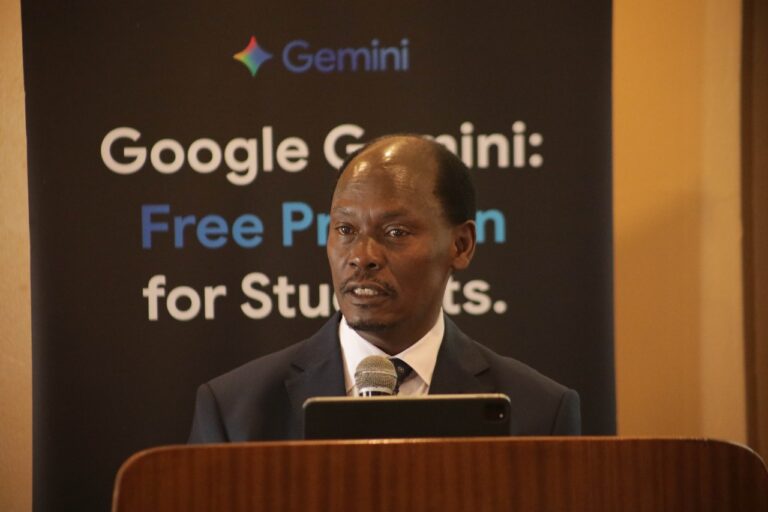
Google has launched its Gemini Pro Plan in Kenya to give university and college students access to 12 months of complimentary access to it’s most advanced artificial intelligence tools, Google Gemini Pro Plan (Google AI Pro), to foster digital transformation and foster AI literacy.

Registrations for the free offer closes on December 9, 2025.

Cabinet Secretary for the Ministry of Information, Communications and the Digital Economy in Kenya, Hon. William Kabogo said: “This initiative by Google is a pivotal step that aligns perfectly with Kenya’s strategic vision, as outlined in the Kenya AI Strategy 2025-2030, to harness the transformative power of AI for sustainable development, economic growth, and the well-being of our citizens.”

Kabogo believes the AI tools will equip the next generation with foundational AI skills needed to thrive in the classroom and prepare for the future workforce.

Through the Gemini Pro Plan, students will gain access to Gemini 2.5 Pro, a powerful AI model designed to act as a personal tutor and academic companion. Key features include unlimited photo uploads to scan lecture notes or textbook exercises for instant explanations, exam preparation tools that convert study materials into custom practice questions and flashcards, Deep Research for generating comprehensive reports with citations, and Veo 3.1 Fast for creating dynamic videos with sound from text and images.

Students will also benefit from NotebookLM – Google’s AI-powered research and writing assistant that helps users summarize, analyze and organize information from uploaded sources like documents, videos and websites –  and 2TB of Google Drive storage, enabling guided learning, study guides, and interactive quizzes. The initiative equips the next generation with foundational AI skills, preparing them to thrive both in the classroom and in the future workforce.

By bridging the AI skills gap and embedding AI literacy into higher education, the Gemini Pro Plan demonstrates the power of Public-Private Partnerships in advancing talent development and innovation.

In addition to the Gemini Pro Plan, Google is offering a free training course, “AI for Higher Education,” through the Gemini Academy. Open to both students and lecturers, the 90-minute course certifies participants on the ethical and effective use of AI in learning, with graduates receiving an official Google Gemini Certificate. Applications can be made via this link: www.rb.gy/cjvce7. The redemption window for the free student offer runs from October 7 to December 9, 2025, and students can sign up through dedicated channels at https://gemini.google/students/

Verto Named Among UK’s Fastest-Growing Tech Firms

0

Verto, a Nigerian fintech revolutionizing cross-border payments for businesses, has been recognized as one of the 50 fastest-growing tech companies in the United Kingdom in the prestigious Deloitte Technology Fast 50 UK 2025 list.

This honor underscores Verto’s rapid growth trajectory and its expanding influence on Africa’s digital economy, particularly in Kenya, where fintech innovation plays a pivotal role in driving trade and financial inclusion.

“We are incredibly honored to be named by Deloitte as one of the fastest-growing tech companies in the UK,” says Ola Oyetayo, CEO and Co-Founder of Verto. “This recognition reflects our ongoing commitment to solving the challenges of cross-border payments for businesses in emerging markets. Kenya, in particular, remains a cornerstone of our African operations, and we are dedicated to supporting Kenyan SMEs, exporters, and fintechs as they scale across borders.”

Verto’s platform offers businesses a seamless way to send, receive, and exchange money globally, facilitating cross-border trade across Africa and beyond. In Kenya, the fintech company enables businesses to connect to over 200 international markets, access multi-currency accounts, and execute international transactions with ease, transparency, and efficiency. This support is essential for African enterprises looking to expand and compete in the global market, with the company supporting over $25 billion in annual transactions.

Oyetayo added that Verto’s growth is driven by the company’s mission to make international payments more frictionless, inclusive, and affordable for all businesses, particularly in Africa. “Africa’s economic potential lies in its ability to engage in seamless trade, both within the continent and globally,” he adds. “By simplifying global payments, we are unlocking that potential, starting with countries like Kenya, where innovation and entrepreneurship are flourishing.”

Verto works closely with banks, fintechs, and large corporations to simplify foreign exchange and international transfers, helping businesses navigate the complexities of cross-border transactions. Additionally, the company is exploring new partnerships in Kenya, reinforcing its role as a UK-born fintech with a strong focus on the African market.

Recently the firm launched its annual Verto Awards to recognize and support high-impact, early-stage startups transforming cross-border payments, foreign exchange, and digital commerce across Africa. The 2025 Verto Awards will culminate in a high-profile gala event in Nairobi on November 27, 2025, where top innovators from across the continent will be celebrated. The awards are a key component of Verto’s long-term mission to accelerate Africa’s digital economy by removing cross-border financial friction and supporting scalable, sustainable innovation.

“Through the Verto Awards, we are equipping the next generation of African entrepreneurs with global visibility and tangible resources to scale,” notes Oyetayo.

How M-PESA in Kenya is Different From M-PESA in Ethiopia

0

M-PESA is now 18 years old since it was launched in Kenya in 2007 to solve one of the country’s biggest challenge at the time, peer-to-peer, money transfer.

In Ethiopia, however, the story is different, even though the two countries share geographical proximity and cultural ties.

1. Inclusion vs. Digitization

In Kenya, M-PESA evolved out of a deep-rooted societal problem, quick and safe person-to-person money transfer in a largely unbanked economy. At the time of launch, only 27% of Kenyans had access to formal banking. Safaricom”s M-PESA revolutionized financial inclusion enabling millions of users in Kenya to send, save, and borrow money through their phones.

18 years after launch, Kenya’s banked population stands at over 85%, and M-PESA has grown into a full-fledged financial ecosystem powering payments, loans, insurance, and e-commerce.

In Ethiopia, however, the problem is not financial access but cash dependence. The country’s banking network is already well developed, with more than 30 banks and 8,000+ branches and ATMs serving its 125 million citizens. What Ethiopia lacks is digital efficiency unlike Kenya which needed financial inclusion at that time.

“We are not solving the money transfer problem,” says Wim Vanhelleputte, CEO of Safaricom Ethiopia. “What we are solving in Ethiopia with M-PESA is the digital payment problem is replacing cash payments with digital ones.”

2. Maturity vs. Modernization

Kenya: A Homegrown, Cloud-Native Fintech Powerhouse

Over the 18-year period, M-PESA’s technology has evolved steadily from a simple USSD-based money transfer service to a robust fintech infrastructures dubbed now fintech 2.0.

  • Fintech 2.0 Platform: Safaricom has upgraded M-PESA to a cloud-native, microservices architecture, allowing for faster innovation and scalability.
  • Active-Active Data Centers: The system runs simultaneously across multiple data centers with failover recovery in under four minutes.
  • Massive Scalability: The platform handles thousands of transactions per second (TPS) and targets 6,000 TPS by 2026.
  • Containerization & AI: Technologies like Red Hat OpenShift and AI-driven monitoring enable real-time fraud detection and API-based integration for merchants and fintechs.

This deep technology stack has made M-PESA Kenya not just a mobile money service, but a national financial backbone integrated with banks, government services, and global payment partners.

Ethiopia: Ready-Made Platform

Ethiopia’s M-PESA, on the other hand, benefits from a ready-built system. Safaricom Ethiopia did not have to reinvent the technology, it deployed Kenya’s mature platform and customized it for Ethiopia’s digital payment needs.

Unlike in Kenya, where features like Lipa na M-PESA were tested in supermarkets before scaling, Ethiopia can roll out the complete suite with merchant payments, transfers, airtime purchases, and more from day one.

Ethiopia ten benefits from a more robust and mature platform with easier integration and adoption rather than product development from scratch. With a largely banked population and increasing smartphone use, M-PESA Ethiopia is positioned to digitize transactions faster than Kenya did in its early years.

3. Mature Tariffs vs. Market Entry Flexibility

Kenya: Transparent, Tiered, and Mature

Kenya’s M-PESA pricing model is the result of years of refinement and regulatory alignment. The tariffs are public, predictable, and tiered according to transaction value.

Transaction Type Amount (KES) Typical Fee (KES)
Person-to-person (P2P) 1 – 100 Free
P2P 101 – 500 7
P2P 501 – 1,000 13
P2P 1,001 – 2,500 23
Withdrawal 50 – 100 11
Withdrawal 10,001 – 50,000 150 – 300
Daily Limit Up to 500,000

These tariffs make small transfers accessible while maintaining revenue from higher-value transactions. The system is supported by a vast agent network and interoperable APIs, enabling businesses to integrate payments with ease.

Ethiopia: Early-Stage Pricing and Regulatory Influence

M-PESA Ethiopia, launched officially in 2023, is still shaping its tariff structure. While official transaction fees are yet to be widely publicized, Ethiopia’s market operates under a tightly regulated framework that influences pricing strategy.

The government’s investment protection fee of USD 150 million for foreign mobile money operators has raised entry costs, potentially affecting long-term pricing flexibility.

However, given Ethiopia’s competitive landscape and cash-heavy economy, Safaricom Ethiopia adopted a low-fee, high-volume pricing model to encourage early adoption and build transaction trust among users.

“If you want to be successful with a new product, you need to be relevant,” Wim emphasizes. “You need to solve a real problem or a customer pain point and that’s what we’re doing through digital payments.”

4. Different Paths, One Vision

Aspect M-PESA Kenya M-PESA Ethiopia
Primary Goal Financial inclusion Digital payments
Technology Base Cloud-native, AI-integrated, high TPS Customised deployment of Kenya’s mature system
Development Path Built and evolved over 18 years Leapfrogs with a ready platform
Pricing Tiered, transparent, regulated Early-stage, adoption-focused
Market Maturity Deeply entrenched financial ecosystem Early-stage digital payments economy
Key Advantage Scale and ecosystem depth Speed of rollout and customization


Kenya’s M-PESA story is one of financial access helping connect millions who were excluded from the banking system. Ethiopia’s, in contrast, is a story of digital modernization replacing bulky cash with sleek, fast, and secure transactions.

From a technology perspective, Safaricom Ethiopia is launching on the shoulders of a proven fintech giant. From a pricing standpoint, it is entering with flexibility balancing both affordability and growth.

The result? Two distinct markets, two strategies, one vision for Safaricom Group, to power Africa’s next phase of digital financial transformation.


Jetour Enters Kenyan Market with Four New SUVs

0

Jetour Kenya, a global automotive brand under the Chery Group, has entered the Kenyan market with four sport utility vehicles (SUVs), the Jetour T2, Dashing, X70 Plus, and T1.

Jetour has officially entered the Kenyan market with the launch of four new SUVs, the T2, Dashing, X70 Plus, and T1 and announced plans to begin local assembly of its vehicles for the Kenyan and East African market.

According to Ali Zubedi, Executive Managing Director, Global Motors Centre Limited, “Jetour is more than a car brand — it’s a commitment to progress. As we begin local assembly, we’re creating jobs, building skills, and strengthening Kenya’s automotive ecosystem. Our mission is to make world-class SUVs accessible to every Kenyan household.”

Jetour Kenya assembly line is expected to create new jobs and build technical skills, strengthen Kenya’s automotive manufacturing ecosystem, and support the government’s Vision 2030 industrialisation and sustainable mobility agenda.

Each SUV targets a distinct lifestyle segment, from rugged off-road performance (T2) to urban tech-luxury (Dashing), family comfort (X70 Plus), and first-time SUV owners (T1).

The Jetour T2 stands out as the ultimate off-road companion, powered by a 2.0L turbocharged engine, BorgWarner 4WD, and a 700mm wading depth, making it perfect for conquering Kenya’s rough terrain. The Jetour Dashing brings a futuristic edge to city driving with its aerodynamic design, AI-enhanced driving assistance, and digital cockpit, catering to tech-savvy professionals.

The Jetour X70 Plus, a global bestseller, offers seven-seat comfort and smart connectivity for families seeking space, safety, and sophistication. The Jetour T1 combines compact design, high ground clearance, and advanced connectivity, catering to young urban drivers and first-time SUV owners.

“Kenya is a strategic market for Jetour in Africa. Its vibrant economy, innovation, and youthful population make it the perfect hub for our long-term growth and for advancing our goals on sustainable mobility,” said Andy Yuan, Vice President, Jetour International.

The plan by Jetour to set up a local assembly operation will not only create hundreds of jobs, enhance skills transfer, and support Kenya’s Vision 2030 industrialisation but will also provide clean mobility goals directly aligned with government efforts to promote sustainable transport and local value addition.

Kenya is ready for vehicles that combine elegance, reliability, and innovation,”said Farooq Sheikh, Managing Director, Jetour Kenya. “Jetour brings a modern mobility experience that matches our local landscape and lifestyle — from rugged terrains to urban commutes.”

YC-Backed Moni Rebrands as Rank, Acquires AjoMoney & Zazzau MFB

0

Moni, a Y Combinator-backed fintech that leverages community and social trust to provide financial services for Africans, has acquired AjoMoney, a group savings solutions firm, and Zazzau MFB, a licensed microfinance bank and rebranded as rebranded as Rank, to deliver a wider range of financial services for communities.

As part of the acquisition, Zazzau Microfinance Bank will now be called Rank Microfinance Bank.

According to Femi Iromini, CEO of Rank, said, “Rebranding from Moni to Rank marks a new chapter in our mission to make prosperity common. Rank is about rising together – building a financial system powered by community, trust, and shared progress. The acquisitions of AjoMoney and Zazzau Microfinance Bank are pivotal steps in this journey.”

Iromini added that AjoMoney strengthens the firm’s roots in community savings, while Zazzau Microfinance Bank gives the firm a regulatory foundation to accept deposits, connect to NIBSS, and offer a full suite of financial services.

Moni, now Rank, is rolling out its community-powered financial ecosystem in Nigeria then expand across the continent. Moni will start a group savings solution designed to transform saving, investing and financial progress from a solo struggle into a shared community journey.

The integration of AjoMoney and Rank Microfinance Bank provides immediate scale and regulatory depth. AjoMoney brings deep expertise in delivering group savings solutions, which will be integrated into Rank’s core product suite. Rank Microfinance Bank also provides a robust regulatory foundation and licensed access to offer regulated banking services across key Nigerian markets.

“AjoMoney was built to make access to finance simple, fair and powered by community. We modernized one of Africa’s oldest financial traditions – rotating savings and credit associations – and brought it into the digital era,” said Mr Ibrahim Adepoju, CEO of AjoMoney. “Passing this vision to the Rank team is a natural next step. With their deep experience in digital banking and community finance, Rank is well-positioned to scale this mission to millions across Africa, making financial services affordable without burden or barriers.”

The leadership and key members of both acquired entities will be integrated into Rank, bringing their expertise in grassroot finance, compliance and product innovation to support the delivery of a money app for communities. In the short term, customers can expect smoother onboarding, broader savings options, and improved security and compliance. In the long term, they’ll benefit from a fully integrated ecosystem, where they can save, borrow, invest and grow their money within their trusted communities. 

Dr. Mohammed Usman, Director at Zazzau Microfinance Bank, said “the vision of a money app for communities is something that really excites us and we are happy to be part of this vision. The partnership is a natural fit and we are looking forward to this journey and contributing significantly to enabling more financial access for Africans and ultimately delivering enhanced value for individuals and businesses.”

Huawei Cloud Named Carrier Hybrid Cloud Leader in Sub-Saharan Africa

0

Huawei Cloud has been named leader in the Carrier Hybrid Cloud category in Sub-Saharan Africa at the AfricaCom event held on November 11.

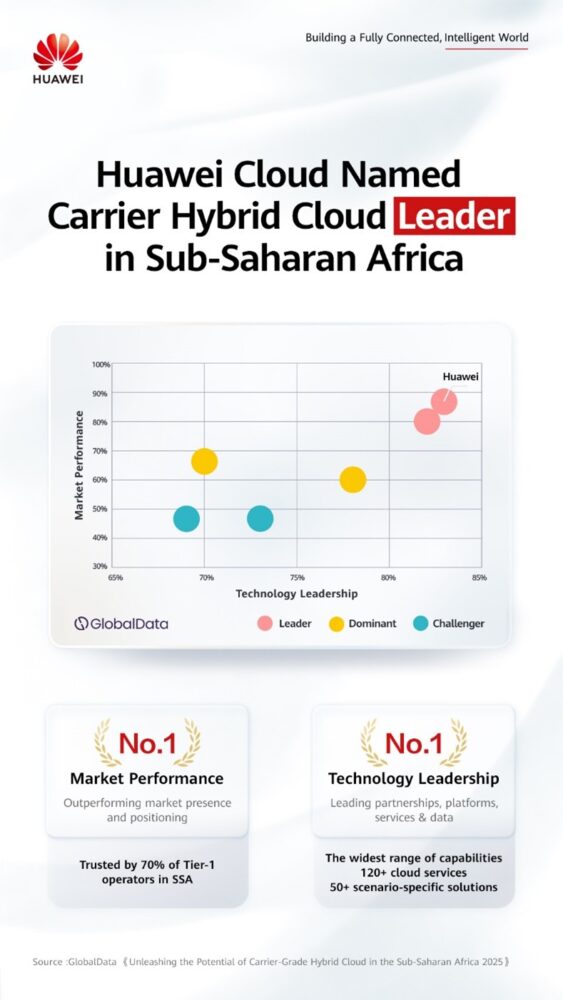
In the latest industry GlobalData white paper named “Unleashing the Potential of Carrier-Grade Hybrid Cloud in Sub-Saharan Africa 2025” highlighting key insights into the region’s evolving hybrid cloud landscape, Huawei Cloud came out at the top after a comprehensive research across 13 Sub-Saharan countries and interviews with 25 leading telecom carriers.

The report named Huawei Cloud as the Carrier Hybrid Cloud Leader in Sub-Saharan Africa, recognizing its leadership in technological innovation and solid market performance.

Huawei Cloud Ranked No.1 in Sub-Saharan Carrier Hybrid Cloud

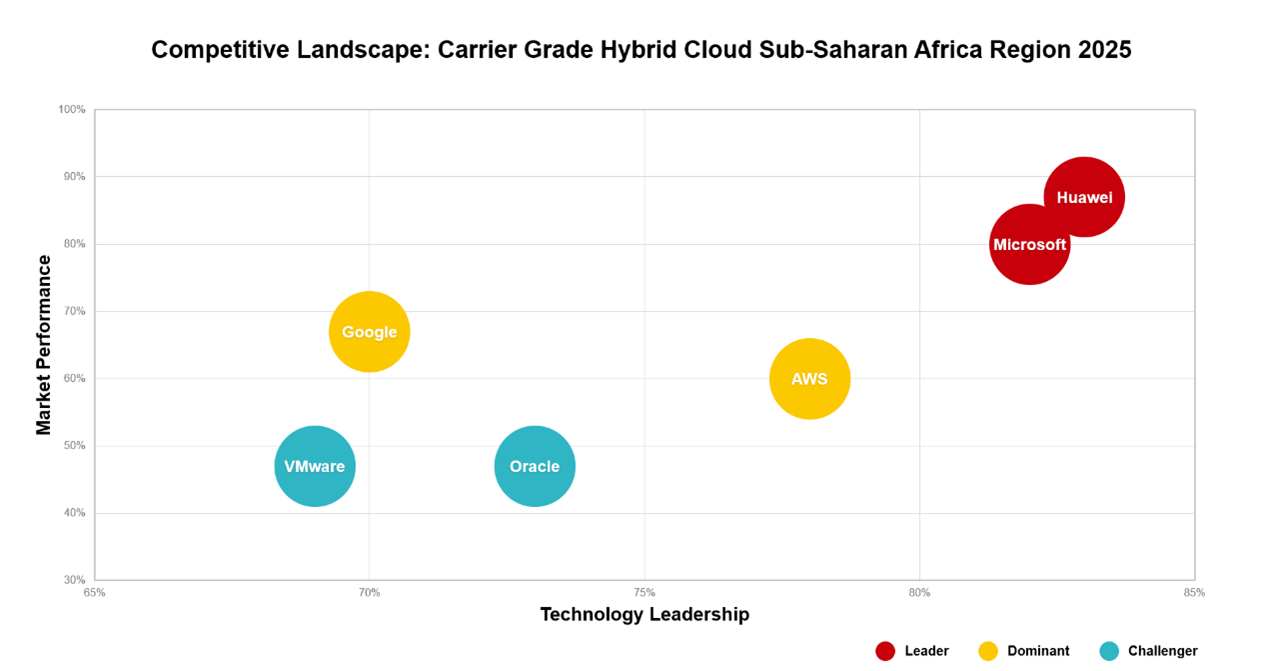
Based on GlobalData’s research, assessing both technology leadership and market performance metrics, Huawei Cloud secured the top position among carrier-grade hybrid cloud vendors in the region.

Microsoft was positioned second and also recognized as a Leader, followed by AWS and Google as Dominant players. VMware and Oracle were considered Challengers.

Competitive Landscape: Carrier Grade Hybrid Cloud Sub Saharan Africa Region 2025

From a Market Performance perspective, Huawei Cloud achieved the highest rating for expanding market presence, supported by its extensive solution offerings and deep telco expertise. The study evaluated vendors against three key metrics: Market Presence, Market Differentiation, and Telco Expertise. Huawei demonstrated a stronger market push than its competitors, with Microsoft ranked second, followed by Google, AWS, VMware, and Oracle.

Market Performance: Carrier Grade Hybrid Cloud Sub Saharan Region 2025

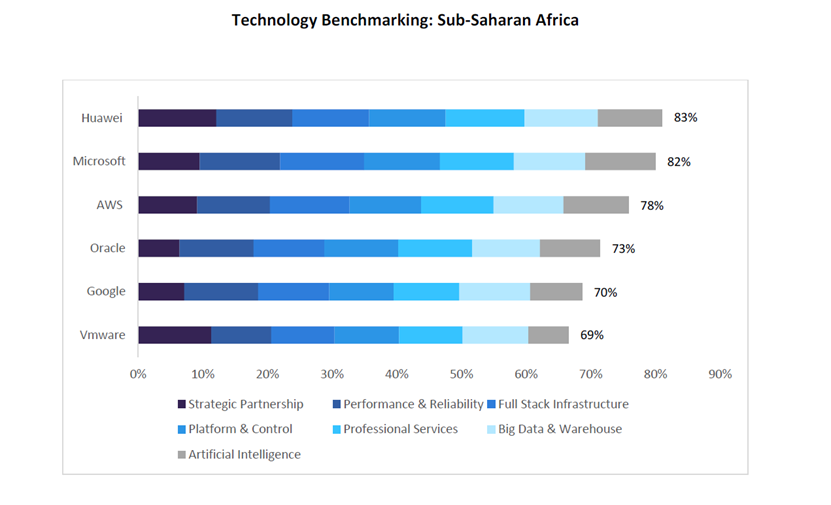
In terms of Technology Leadership, Huawei Cloud achieved the number one aggregate score across seven major categories: Strategic Partnership, Performance and Reliability, Full Stack Infrastructure, Platform and Control, Professional Services, Big Data and Warehouse, and Artificial Intelligence. Huawei Cloud outperformed competitors in Strategic Partnership, Platform and Control, Professional Services, and Big Data & Warehouse, demonstrating a coherent and comprehensive capability across its carrier hybrid cloud portfolio.

Technology Benchmarking: Sub-Saharan Africa

Outlook for Carrier Hybrid Cloud in Africa


As Africa’s telecom industry accelerates digital transformation, hybrid cloud is becoming the cornerstone for innovation. With rapid growth in mobile data, expanding fiber networks, and rising adoption of AI and fintech services, carrier-grade hybrid cloud will empower carriers to deliver secure, intelligent, and scalable services that drive the continent’s next wave of digital growth. Huawei Cloud is committed to supporting this evolution, providing leading hybrid cloud solutions and deep telco expertise to help carriers succeed in the region.


Click the link to view the full report.(LINK)


Solar Saver Raises $10 Million to Expand Access to Clean Energy in Southern Africa

0

Solar Saver has raised $10 million from Swedfund to expand access to affordable and reliable solar power for small and mediumsized businesses in Southern Africa.

Solar Saver will use the funds to scale-up of distributed solar and battery energy systems in South Africa, Namibia, Botswana and Zambia, in a move that will bolster access to stable electricity for small and medium-sized enterprises.

According to Jonas Kolijn, Senior Investment Manager for Energy & Climate at Swedfund, “Access to dependable and affordable energy is essential for private sector growth, job creation and climate resilience. Through this investment, we help strengthen energy security and support fossil-free economic growth in one of Africa’s key economic regions.”

Swedfund’s investment is part of a USD 60 million equity round led by Inspired Evolution’s Evolution III Fund alongside FMO, the Dutch development bank. The investment contributes to reduced greenhouse gas emissions, a more reliable electricity supply and improved competitiveness for small and medium local enterprises.

Solar Saver develops, owns and operates small-scale solar and battery systems that supply power directly to businesses. The company installs and operates systems on client premises, selling electricity through power purchase and rent-to-own contracts that require no upfront investment from the customer. It currently operates more than 700 installations with a combined capacity of circa 140 MW across Southern Africa.

Solar Saver offers clients a rent-to-own model hence they don’t require expensive capital or financial guarantees, making Solar Saver the largest fleet of self-financed C&I solar installations in Southern Africa.

The Solar Saver portfolio includes over 700 systems operated by Solar Saver under long-term rent-to-own and PPA contracts across South Africa, Namibia and Botswana. 


.

Bolt’s Driver Verification Feature Lauded for Improving App Safety

0

Bolt’s driver verification feature is being recognized as a key factor in enhancing ride-hailing safety in Kenya, according to a new Safety Index report by Ipsos.

Commissioned by Bolt, the study shows that ride-hailing users now increasingly trust technology-driven mobility solutions over conventional transport options.

According to Dimmy Kanyankole, Senior General Manager at Bolt, “Safety is at the core of our service. Driver verification ensures that every ride starts with trust. Coupled with real-time GPS tracking and emergency tools, it gives our users control and peace of mind. This report confirms that safety isn’t just an expectation—it’s the foundation of trust between Bolt and our riders.”

The report, which surveyed 250 active ride-hailing users across Nairobi, Mombasa, Kisumu, and Nakuru, found that 79% of respondents consider Bolt’s driver verification feature the most valuable safety tool on the platform. Users cited it as critical in boosting confidence when traveling, particularly for women and young adults, who form a large share of the ride-hailing market.

Sometime back, Bolt permanently blocked over 6,000 drivers from its platform due to non-compliance and safety-related matters. Announced in its South African region, the firm said the move was part of it’s ongoing commitment to providing safety for its ride-hailing and online ordering sectors. The purge, which affected both drivers and riders reported for misconduct and non-compliance, took over six months.

After that, launching safety features gives both the passengers and drivers the confidence to patronize the service hence the study.

The study further revealed that 94% of ride-hailing users feel safer using the app than other transport modes while 97% said integrated safety features, including driver verification and the SOS button, significantly enhance their sense of security. From the report, 94% feel particularly secure when traveling at night, thanks to real-time location tracking and verified driver identities.

The report also highlighted the wider impact of ride-hailing on responsible mobility in Kenya. Approximately 79% of users believe the service has helped reduce drunk driving, and 64% have booked rides for friends or family members in situations where safe transport was essential.

As ride-hailing adoption grows across Kenya, Bolt’s verified driver system continues to set the benchmark for safety standards in the industry, reinforcing technology’s role in fostering safer and more responsible transport choices.

“Bolt’s focus on verified drivers and integrated safety features reflects a broader shift in urban mobility. Users increasingly value services that provide reliability, comfort, and safety, particularly during nighttime travel,” said Soyinka Witness, Strategy Director at Ipsos Sub-Saharan Africa.


Roam Crowdfunding Millions of Dollars to Scale Electric Mobility Across Africa

0

Roam, a Nairobi-based electric vehicle firm, is crowdfunding millions of dollars to accelerate the growth of electric mobility in Africa.

The raise is being conducted on Crowdcube, Europe’s largest and the world’s frst equity crowdfunding platform.

Roam is making available a limited allocation of its upcoming Pre-Series B fundraising round on a first-come, first-served basis.

“We’ve proven that electric mobility is possible, affordable, and scalable in Africa,” said Filip Lövström, CEO and Co-Founder, Roam. “This crowdfunding campaign is about inclusion. We want anyone within our community, and supporters of our mission, to now be able to join us on our continued journey as a shareholder.”

The campaign targets the African motorcycle market, one of the world’s largest and fastest-growing mobility sectors, valued at over $15 billion annually. Investors have the opportunity to be part of a defning clean technology shift, helping to reduce emissions, cut fuel dependency, and empower millions of entrepreneurs across Africa. The journey continues by scaling Roam’s fagship motorcycle and expanding its charging network.

Roam has built a solid growth path, supported by global partners like Bolt, Hitachi, DHL, TotalEnergies, Wells Fargo, and M-KOPA. The company operates from Roam Park in Nairobi, which has an annual production capacity of over 50,000 motorcycles and is powered by Kenya’s 80% renewable energy grid. The company’s momentum is fueled by partners like M-KOPA, Africa’s largest Pay-As-You-Go fnancier, which makes the Roam electric motorcycle accessible through daily micro-payments.

Roam motorcycles are also being used for ride-hailing by drivers for Bolt and Uber, offering a sustainable alternative for urban transport. To support its vehicles, Roam is building a solar-powered charging infrastructure supported by TotalEnergies and European grants. This network already spans across Kenya, with the capacity to serve thousands of riders daily, and is ready to scale across borders.


Gozem Launches in Brazzaville in Francophone Africa Expansion Drive

0

Gozem, a Pan-African super app, has officially launched operations in Brazzaville, expanding its footprint across Francophone Africa. Already active in Togo, Benin, Gabon, and Cameroon, the company seeks to digitize urban transport in the Congolese capital.

Users can book geo-localized “green” taxis, premium air-conditioned rides, and hourly rentals through the app. Partner drivers, branded “Champions,” gain access to digital tools for geolocation, trip traceability, and cashless payments, creating new revenue opportunities.

Gozem is backed by a $30 million Series B round, combining equity and debt, led by SAS Shipping Agencies Services Sàrl (MSC Group subsidiary) and Al Mada Ventures, which will support fleet expansion and fintech integration.

The company enters a region where regulatory oversight is increasing. In neighboring Kinshasa, DRC, authorities recently banned seven ride-hailing firms after a compliance review, leaving Yango as the only authorized platform in the capital. The move followed earlier efforts to identify legitimate drivers, enhance passenger safety, and enforce tax compliance—highlighting the importance of regulation in shaping urban mobility markets.

Gozem aims to differentiate itself through driver empowerment, reliable service, and digital payments, potentially formalizing informal transport networks in Brazzaville. The expansion aligns with the company’s broader vision of evolving into an “African Super App”, eventually integrating delivery, mobile payments, and fintech services, while contributing to the region’s digital and economic ecosystem.

IFC Invests $6M into First Circle Capital to Fuel Growth of Fintech Startups in Africa

0

IFC has invested $6 million into First Circle Capital, an early-stage venture fund based in Africa, to invest into high-potential fintech startups across Africa.

IFC invested $6 million including $2 million from the Women Entrepreneurs Finance Initiative (We-Fi) into the fund whose targeted fund size was $30 million.

The African banking sector remains one of the most proftable globally, yet incumbents have been slow to adapt to the continent’s dynamic and fast-growing consumer base. This has created a substantial market gap that fntech startups are well-positioned to fll. According to a 2023 report by BCG and QED Investors, Africa’s fntech revenues are projected to grow 13-fold by 2030, the fastest pace of any region worldwide.

Founded and led by former M-Pesa executive and fintech investor Selma Ribica and former emerging markets entrepreneur Agnes Aistleitner Kisuule, First Circle Capital has backed a number of early‑stage African fintech companies including Power, TurnStay, Opareta, Scale, E‑Doc Online, Orca, Credify, MNZL, Pumpkn, Terminal, Balad, Oola adding to 15 investments across 8 African markets, with 30% of companies led or cofounded by women and 50% operating in multiple countries.

First Circle Capital’s Power, is an earned-wage access solution that allows workers to access their salaries before payday, improving financial flexibility. TurnStay is a travel-tech startup providing fintech solutions that streamline cross-border payments, catering specifically to the travel industry. Opareta builds digital infrastructure for mobile-money agent networks, strengthening the foundation for African fintech ecosystems.

First Circle Capital has also invested in Scale, a card-issuing platform that enables fintechs to issue cards more efficiently, and E-Doc Online, which focuses on financial data infrastructure to improve access and management of financial information. Orca is a fraud orchestration platform dedicated to fraud detection and prevention, while Credify works to digitize logistics and trade finance for SMEs. MNZL provides asset-backed financing solutions, and Pumpkn supports agribusiness SMEs through specialized financing.
First Circle Capital also backs in Terminal, which offers logistics and cross-border shipping solutions across Africa, and Balad, which builds infrastructure for remittance services. In the insurance sector, Oola and WiASSUR focus on digitizing insurance products and brokering services for car, health, home, and travel insurance. For micro-retail payments, WafR provides infrastructure that simplifies transactions at small-scale retail points. Finally, CredRails builds open-banking infrastructure to strengthen the financial ecosystem and enable seamless integration for fintech services.
Overall, First Circle Capital’s portfolio shows its focus on fintechs, payment’s infrastructure, and financial inclusion across Africa, hence investing in startups that address critical gaps in payments, lending, insurance, and logistics. First Circle Capital builds a stronger Series A pipeline not just for First Circle, but for the broader investor ecosystem. The fund’s ability to prepare companies for institutional follow-on capital is already refected in the cross-border scale and commercial traction of its early portfolio.


After Building a Digitally Integrated Clinic Network, Rivia Now Wants to Scale “Health Access”

0

Rivia launched in Ghana in 2024 with a simple goal: make healthcare accessible, enjoyable, and patient-centered.

To do that, the company partnered with existing clinics, upgraded their physical infrastructure, trained their staff, and embedded Rivia’s own clinic management software (RiviaOS) into daily operations. Within eight months of joining the network, the average Rivia clinic triples its patient visits, according to the company.

That’s not hard to believe because initial partner clinics received an essential upgrade — which included better infrastructure, new software, trained staff and well-stocked medical consumables. Add Rivia’s growing brand reputation and you start to see why people prefer “Rivia Clinics” across Ghana.

But the real magic lies under the hood. All clinics on Rivia’s platform are digitally integrated, meaning patients can move seamlessly from one provider to another without re-registering or repeating their medical history. It’s a unified health record that travels with you, saving time and reducing errors.

Today, Rivia has built a digitally integrated network spanning 52 providers, impacting the lives of over 50,000 patients. Rivia raised an undisclosed pre-seed round in 2024 from investors such as Kaleo Ventures, Fast Forward Ventures, Chanzo Capital, Taurus Venture Capital and a host of other angels, including Meta and Microsoft employees.

Rivia’s New Bet: The “Health Access” Model

For most people, the go-to way to get healthcare coverage is through traditional insurance schemes. But this model is a nightmare of complexities, technicalities, and medical jargon that has either complicated the process or scared people away completely.

In Ghana, fewer than 600,000 people—out of a population of 35 million—have private health insurance.

In Nigeria, where out-of-pocket spending makes up nearly 75% of total healthcare expenditure, only about 5% of the population is covered by any form of health insurance.

In Kenya, just 3–4% of citizens are enrolled in private health plans, while the Social Health Insurance Fund (SHIF) struggles with low coverage and inefficiency.

Even in South Africa, the most developed market on the continent, only about 16% of the population—roughly 9 million people—are covered by private medical aid schemes, leaving the majority dependent on overstretched public hospitals.

In short, despite decades of effort, traditional insurance models have failed to scale across Africa. The result is a fragmented system where most people still pay cash for care, and millions delay or avoid treatment entirely.

“The system still runs on legacy business models and somehow expects different results,” says Isidore Kpotufe, Rivia’s co-founder and CEO.

Rivia is taking a different approach. Instead of trying to fix insurance, it’s building something new—a model it calls “Health Access.”

“There are two markets,” Isidore says. “Health Insurance and Health Access. Rivia belongs to Health Access.”

The idea borrows lessons from companies like Netflix, Amazon, and Uber—simple, user-friendly platforms that give people instant access without the usual complexity.

How the Rivia Health Access Model Works

Here’s how it works in practice:

Members pay an upfront yearly fee, say $50, which unlocks $200 worth of healthcare services within Rivia’s network of clinics.

Unlike traditional insurance, there are no restrictions, exclusions, co-pays, or deductibles. Members can use their full balance for any service available in the Rivia network—from consultations to lab tests and prescriptions. Rivia’s model is primarily targeted at primary care, where 60% to 80% of healthcare happens, depending on the region.

Behind the scenes, Rivia has pre-agreed partnerships with clinics that guarantee service availability for members. This flips the traditional model on its head: instead of insurers underwriting care, the clinics themselves do, backed by Rivia’s platform.

“The market is full of point solutions—a telemedicine app here, a clinic management software there,” says Isidore. “None of them solve the real problem: fragmentation. We spent the last year building the underlying infrastructure. Now, our network of clinics doesn’t just share a brand; they share a central nervous system. This is the launchpad for everything we do next.”

He adds, “Think of it as Netflix for healthcare. You pay a simple subscription and get direct access to a world of care—no fine print, no restrictions. Our integrated network, AI-powered platform, and provider agreements make that possible.”

User-Centered, Tech-Enabled Experience

Members have access to AI-supported, doctor-led virtual care for free, and most in-person visits start with a virtual consultation.

“About seven out of ten clinic visits begin as virtual consults,” says Isidore. “That’s how people prefer to engage now.”

Members can view prescriptions, lab reports, and diagnoses directly from their Rivia account, which is also integrated on WhatsApp—no new app needed. From booking appointments to receiving prescriptions, everything happens inside the familiar messaging platform.

“Our digital approach is market-aware,” Isidore explains. “We’re not forcing users onto a random new app. We’re meeting them where they already are.”

Rivia offers both free and paid plans. Its paid plans are targeted mainly at small, medium and growing businesses (SMBs) that have been excluded from traditional health insurance. However, its free tier is available to individuals, families, and smaller firms that want to test the system before committing.

“Eighty percent of our focus today is on SMB partnerships,” Isidore notes. But Rivia is also attracting attention from larger companies. Ghana’s Trasacco Group, one of the country’s largest real estate and construction firms, has already onboarded the staff of Ibis Styles Hotel in Accra onto the platform. The Food and Drugs Authority has also shortlisted Rivia to provide health access for over 1,000 employees. 

Looking Ahead

Rivia is now raising a seed round to scale its platform across Ghana and expand into Nigeria, Côte d’Ivoire, and Kenya in the near term.

With Ghana’s healthcare expenditure estimated at $3–4 billion annually, and more than 2.5 million formal sector employees, the opportunity is massive. Rivia’s approach—bridging care, technology, and transparent financing—could redefine how Africans experience healthcare.

In a market long weighed down by complexity and exclusion, Rivia’s focus on simplicity and access could finally offer the breakthrough that healthcare in Africa has been waiting for.


Safaricom Tests Ziidi Trader, an M-PESA Stock Trading Feature

0

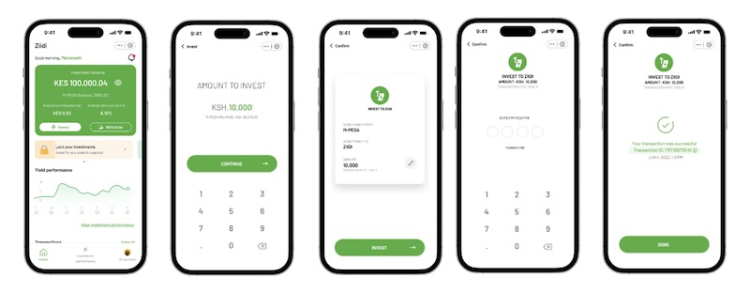
Safaricom Plc is piloting a new feature on its M-PESA mobile money platform that will allow users to buy and sell shares listed on the Nairobi Securities Exchange, expanding its footprint in Kenya’s financial services industry.

The service, dubbed Ziidi Trader, is designed to let millions of M-PESA users access stock trading directly from their phones, in what could mark a major shift in retail participation in the country’s capital markets. The feature will include real-time price feeds, watchlists, and portfolio tracking tools, similar to those offered by global trading apps.

The move is part of Safaricom’s broader strategy to transform M-PESA from a payments service into a full-fledged digital finance platform, combining money transfers, savings, credit, and investments under one ecosystem.

Kenya has about 1.4 million registered investors on the NSE, yet only around 61,000 actively trade, according to exchange data. High transaction costs, complex onboarding, and the need to use licensed brokers have limited wider market access. Embedding trading within M-PESA — which counts over 32 million active users — could help democratize investing and inject new liquidity into the local market.

Ziidi Trader follows the launch of Ziidi Money Market Fund in January 2025, which has attracted more than 450,000 users and KES 7.5 billion ($48 million) in assets under management. That fund replaced Safaricom’s earlier collaboration with Genghis Capital, known as Mali, which ended over control issues.

With payments, savings, and trading increasingly interconnected, Safaricom is positioning M-PESA as East Africa’s dominant financial super app. If successful, Ziidi Trader could deepen retail engagement with Kenya’s capital markets and further entrench Safaricom’s role in the region’s digital economy.


ServiceNow, NTT DATA to Accelerate Enterprises AI-led Transformation

0

 ServiceNow, an AI platform for business transformation, and NTT DATA, a digital business and technology services firm have expanded their partnership to accelerate AI-led transformation for enterprises.

The two will expand access to AI-powered automation across industries and geographies. ServiceNow and NTT DATA will co-develop and co-sell AI-powered solutions to drive productivity, efficiency, and customer experience improvements.

According to Amit Zavery, president, chief operating officer, and chief product officer at ServiceNow,”Together, we’re transforming how the world’s leading enterprises operate, making work simpler, smarter, and more resilient with the ServiceNow AI Platform.”

NTT DATA will also act as a strategic AI delivery partner to help customers deploy AI-powered automation and achieve operational efficiency at scale.

 Leveraging the power of the ServiceNow AI Platform, NTT DATA will help more organizations realize faster time to value through strategic advisory services, platform implementation and expansion, and ongoing managed and lifecycle services. 

“Expanding our partnership with ServiceNow is a key milestone in our mission to build the world’s leading AI-native services company.” said Abhijit Dubey, president, CEO, and chief AI officer at NTT DATA, Inc.

NTT DATA will become a strategic AI delivery partner for ServiceNow across industries and global regions and the two will collaborate to deploy AI-powered automation for customers in enterprise, commercial, and mid-market segments.

The two will also collaborate to advance new AI deployment models, including through the Now Next AI program, which embeds AI engineering expertise directly into enterprise transformation projects with customers.

By combining ServiceNow’s agentic AI platform with NTT DATA’s global delivery scale and industry expertise, we’re enabling enterprises to accelerate innovation, enhance productivity, and achieve sustainable growth.”

 NTT DATA expects to begin ramping and expanding delivery of ServiceNow AI solutions to customers across industries and regions, including ServiceNow AI Agents and Global Business Services, among other solutions, with broader deployment expected to follow.

How Victor Osimhen’s Hat-Trick Revived Nigeria’s World Cup Dream

0

Nigeria – Benin match 10/14/2025

The CAF, meaning the Confederation of African Football, runs Africa’s World Cup qualifying process and regional tournaments; its formats decide which national teams advance to intercontinental playoffs or direct slots for the 2026 FIFA World Cup. CAF is the umbrella body for 54 member associations and organises qualifiers that have produced intense, decisive final-day drama across 2025. Throughout the campaign, fans closely followed the action and placed their bets on Linebet, making every match even more exciting.

How the match unfolded

The World Cup qualification chances of Nigeria remained alive after they defeated Benin 4-0 at Godswill Akpabio Stadium in Uyo on October 14th 2025. Victor Osimhen scored two goals in the first half before he finished his hat-trick with a precise second-half goal while Frank Onyeka scored a late volley to seal the 4-0 victory. The Nigerian team gained better chances for playoff qualification while Benin experienced a decline in their group standings.

The bookmakers predicted Nigeria would win the match with odds between 1.30 and 1.40, while Benin received odds between 7.0 and 8.5 because of their respective strengths and home field advantage. Multiple sports analysts selected Osimhen as their top pick for anytime scorer during the match.

Advantages of live bets on Linebet

For Kenyan bettors, the Benin vs Nigeria match was a good example of where in-play markets add value. Linebet in Kenya offers: fast live odds updates, streaming for selected events, one-click cashout, and a wide range of micro-markets (next-goal, goal windows, corners). Using the Linebet app or online interface lets users react to momentum swings — for example, backing Osimhen after 60 minutes when he looked freshest, or taking short cashout when Benin pressed. Always check local regulations and gamble responsibly.

Bottom line

The 4–0 Nigeria win on 14 Oct 2025 underscored how a star striker (Victor Osimhen) can change a campaign in a single night, why CAF qualifiers remain fiercely competitive, and why live betting—via services such as Linebet—has become central to modern football wagering.


Fastagger and Microsoft Bring Edge AI to Africa’s $1.7 Trillion Mobile Money Market

0

Africa stands at a turning point. The continent, home to the world’s youngest population, has the opportunity to reshape its economic trajectory by becoming an active player in the global digital economy. Yet persistent gaps in connectivity, hardware costs, and infrastructure threaten to widen the divide between Africa and the G20 economies.

While artificial intelligence is revolutionizing industries across the world, many African nations are still constrained by unreliable internet, high data costs, and widespread use of 2G and 3G devices. Most AI models rely on powerful cloud servers and constant connectivity—conditions far from reality in rural Africa.

That’s where Fastagger, a Nairobi-based deep tech company, steps in.

Fastagger has developed technology that allows AI models to run directly on low-power devices—including affordable smartphones—without relying on cloud infrastructure or constant internet access. The company’s software brings machine learning to the “edge,” allowing AI to function offline in bandwidth-constrained environments.

Doctors in remote clinics can now access diagnostic tools without an internet connection; teachers in rural schools can deploy AI-powered learning aids offline; farmers can get predictive insights and smart agriculture advice directly from their phones.

“Africa has the opportunity to reshape its economic future by becoming an active participant in the global digital economy,” said Microsoft in a statement. “Technology is the key to unlocking this digital future.”

Recognizing Fastagger’s potential, Microsoft’s Africa Transformation Office (ATO) included the startup in its flagship cohort, providing end-to-end technical and strategic support. Through Azure AI, IoT, and GitHub platforms, Microsoft has helped Fastagger accelerate product development and deployment.

The initiative is further strengthened by partnerships with Technvest, Cloudmania, and NVIDIA, which contributed to the system’s optimization for mobile environments and scalability across African markets.

“Microsoft’s tools and the ATO team’s support have been game changers for us,” said Fastagger CEO Mutembei Kariuki. “From Azure AI to GitHub, the ecosystem gave us everything we needed to move from concept to deployment quickly.”

Small and medium-sized businesses (SMBs) form the backbone of Africa’s economy, many of them powered by mobile money. In 2024, Africa accounted for 53% of the global mobile money market, valued at $1.7 trillion, with 1.1 billion registered accounts. Sub-Saharan Africa alone contributed $190 billion to regional GDP.

Yet many small businesses still rely on manual record-keeping and basic spreadsheets, limiting their ability to analyze customer data or build loyalty programs. Fastagger’s AUNI AI business assistant, developed with Microsoft and NVIDIA, is changing that.

Available for as little as $1–$5 per month, the AI assistant helps merchants automate customer engagement, track sales, and run loyalty programs using mobile-based AI. Embedded within Safaricom’s M-PESA Business App, the tool already serves more than 2,500 micro and small enterprises across Kenya.

The system reduces complex payment reconciliation steps from eight to two, automatically analyzing customer data and issuing digital coupons. It also helps merchants build credit profiles through loyalty transactions—creating a bridge between informal retail and formal finance.

According to Bain & Company, just a 5% increase in customer retention can raise profitability by 25–95%. For Africa’s small enterprises, that could mean survival or collapse.

“Using the AUNI system has allowed us to effectively manage and track customer interactions, streamline our marketing efforts, and gain valuable insights into customer behaviour,” said Sharon Njoroge of Mandevu, an SME using the system. “It’s a game-changer for how we make data-driven decisions.”

Fastagger’s integration into the NVIDIA GenAI Accelerator and Microsoft’s startup ecosystem has opened new pathways for growth, making its technology globally deployable. Through Microsoft Azure, enterprises worldwide can now access Fastagger’s on-device AI infrastructure, expanding the startup’s reach beyond Africa.

“Fastagger’s model shows that the future of AI in Africa isn’t about catching up,” said a spokesperson from Microsoft’s Africa Transformation Office. “It’s about building solutions that work locally—and scale globally.”

With Africa projected to reach 1.4 billion mobile connections by 2030, Fastagger’s edge AI approach could redefine how digital inclusion is achieved. By enabling offline AI, Microsoft and Fastagger are transforming Africa’s connectivity challenges into innovation opportunities—and empowering millions of entrepreneurs to thrive in the digital economy.


Ventures Platform Secures $64M to Deepen its Investment Scope Across Africa

0

Ventures Platform, a Nigerian-based seed-stage fund, has announced the $64 million first close of its $75 million second fund, VP Pan-African fund II, aimed at deepening seed investments, catalysing Series A rounds.

New and returning investors include the first-of-its-kind participation from the Nigeria Investment in Digital and Creative Enterprises (iDICE) program, alongside, IFC, Standard Bank (South Africa), BII, Proparco, Micro, Small & Medium Enterprises Development Agency and AfricaGrow.

The fund also attracted strong participation from leading European family offices, including Alder Tree Investment, as well as a consortium of prominent global investors including  Michael Seibel.

In a statement to TechMoran, Kola Aina, Founding Partner at Ventures Platform, said, “With VP PAF II, we are broadening our reach and deepening our focus on discovering and empowering innovators that will solve chronic non-consumption across the continent. We believe Africa’s challenges are its greatest opportunities. By supporting resilient founders, we’re catalysing sustainable, market-creating innovations that will shape the future of the continent and plug gaps for the next billion.”

Ventures Platform’s PAF II will strategically deepen its investment scope across Africa. In addition to its foundational pre-seed and seed rounds, the fund will now lead and catalyse Series A investments, effectively de-risking high-potential ventures and enhancing value creation. Simultaneously, it will consolidate the firm’s activities in Francophone Africa and accelerate pan-African expansion into North Africa.

The fund says it will prioritise ventures building essential “painkiller” solutions that solve for non-consumption and plug infrastructural gaps in Fintech, Healthtech, Agritech, Edtech, AI, amongst other sectors.

Since its inception in 2016, Ventures Platform has funded over 90 startups, including OmniRetail, Thrive Agric, and Moniepoint, Raenest, Remedial, and SeamlessHR, as well as LemFi among others.

With VP PAF II, the VC is positioned to further empower Africa’s most promising innovators, driving sustainable economic evolution and solidifying the continent’s position as a global leader in innovation while delivering on its mission of democratising prosperity.

 “By channeling venture capital into Africa’s tech ecosystem, we’re unlocking the potential of entrepreneurs to drive resilient growth and expand opportunities for small businesses and young people across the continent,” Farid Fezoua, IFC Global Director for Disruptive Technologies, Services and Funds said.

Safaricom Profit Jumps 52% to KES 42.8 Billion on Kenya, Ethiopia Growth

0

Safaricom Plc, East Africa’s biggest telecommunications operator, posted a 52.1% jump in group net income to KES 42.8 billion ($277 million) for the six months ended September 30, 2025, buoyed by stronger performance in Kenya and narrowing losses in Ethiopia.

Revenue rose 11.1% year-on-year to KES 199.9 billion, supported by solid growth in mobile data, M-PESA transactions, and fixed services. Group EBITDA climbed to KES 101.3 billion, while CAPEX reached KES 43.7 billion as the company continued expanding its regional infrastructure footprint.

“We remain focused on executing our strategy through segment-led execution and integrated solutions,” said Peter Ndegwa, Safaricom Group CEO. “It has been 25 years of transforming lives through innovation and community empowerment.”

Safaricom’s Kenyan unit delivered a 22.6% rise in net income to KES 58.2 billion, fueled by sustained demand for connectivity and digital financial services.

  • Service revenue: KES 194.0 billion (+9.3%)
  • EBIT: KES 89.5 billion (+13.1%)
  • CAPEX: KES 34.2 billion

Revenue composition:

  • Mobile & Voice Services: KES 96.2 billion
  • M-PESA: KES 88.1 billion
  • Fixed & IoT Services: KES 9.8 billion

In Ethiopia, operating losses declined 20.1% year-on-year to KES 15.5 billion, aided by rising customer adoption despite pricing and currency headwinds.

The unit generated KES 6.2 billion in service revenue, including KES 4.1 billion from data and KES 1.4 billion from voice, with M-PESA contributing KES 8.7 million. Subscriber numbers surged 83.7% to 11.1 million, signaling early traction in Africa’s second most populous market.

Safaricom’s focus on regional integration, fintech innovation, and connectivity expansion positions it to capture long-term growth across East Africa. The company’s performance in Ethiopia will remain key to sustaining its momentum and diversifying income streams beyond its mature Kenyan market.


How We Went From the Casino Halls to Our Pocket Screens

0

If you ever walked into an old casino, you remember the noise first. Coins dropping, cards sliding, a hundred voices mixing into something that sounded like electricity. You didn’t go there just to gamble, since all the experience made you go because it felt alive. The room had its own pulse.

Now, that same feeling lives behind a screen. It’s strange when you think about it. A place that used to need marble floors and bright lights can now fit inside a phone and play online slots. The change didn’t happen overnight, but it happened fast enough that most people barely noticed.

The first online casinos were plain. Slow reels, simple buttons, no real personality. Still, people played. Maybe because it was easy. No dress codes, no long drives, no one watching your face when you lost. Just you, your mouse, and the sound of a digital spin. It felt private and maybe, maybe even a little rebellious.

Then technology caught up. Internet speeds improved, games started to move like they were breathing. Slots had themes now where you are in jungles, surrounded by gods or movie heroes. Poker rooms had live chat so you could bluff across continents. Roulette wheels spun in real time, streamed from small studios with dealers who smiled straight through the camera.

That’s when everything changed. The casino stopped being a destination. It became something you carried around. When smartphones took over, so did the apps. You didn’t need to plan a night out; you just needed a signal. People started betting during lunch breaks, waiting rooms, train rides. Platforms like Betway made sure the experience felt smooth and easy with quick to open, quick to close, and built for the rhythm of real life.

The big question was trust. In a real casino, you can see the cards, hear the dice, watch the dealer’s hands. Online, it’s code. You can’t see fairness, you have to believe it. That’s where modern operators learned to talk in transparency. Licenses on every page, real-time payout stats, secure deposits, and withdrawals that hit faster than a slot spin. Slowly, people stopped worrying about what they couldn’t see.

But something was lost too. The noise. The people. The glance from a stranger when both of you watch the same wheel slow to a stop. That human buzz is hard to replace. Some of it returned with live dealer games which are real humans dealing real cards over a camera, but it’s not the same. It’s quieter now, more personal.

And maybe that’s the point. Old casinos were about spectacle; online ones are about access. You don’t chase glamour anymore. You chase time as you have a few minutes here, one hand there. The thrill fits between everything else you do.

From the smell of smoke and felt to the glow of a touchscreen, the casino didn’t vanish. It just learned to move. It left the halls, slipped into the web, and found a new home inside your pocket. Same heartbeat. Different sound.

Angola’s Anda Secures $3.2 Million Seed Round in Landmark Venture Funding Deal

0

Anda, an Angolan mobility startup has raised $3.2 million in seed funding, in a landmark deal for Africa’s tech and mobility sectors.

The $3.2 million was co-led by France’s Breega and Austria’s Speedinvest, alongside U.S., Japanese, and other European investors and marks the first time an operational Angolan startup has secured international venture financing from a diversified syndicate.

Founded by Sérgio Tati and Jörg Nührmann, Anda is building an integrated platform to formalize Africa’s sprawling informal motorcycle-taxi economy. The startup combines asset financing, driver training, licensing, and ride-hailing into one system providing motorcycles, smartphones, GPS, insurance, and legal compliance so drivers can focus on service while Anda handles operations.

Its “drive-to-own” model enables riders to buy their motorcycles over time, transitioning from rental to ownership. Anda plans to roll out electric motorcycles and charging stations, signaling a shift toward greener, sustainable urban mobility across Africa.

“This investment positions Anda as the first Angolan startup to raise venture capital from such a diverse global consortium,” the company said in a statement. “It represents global recognition of Angola’s innovative potential and the growing strength of Africa’s technology ecosystem.”

With over 600,000 informal motorcycle-taxi drivers in Luanda and 1.2 million nationwide, Anda’s market opportunity is massive. By bundling credit, training, and compliance, the startup aims to expand financial inclusion and local job creation in a market long constrained by currency volatility and limited smartphone access.

Breega CEO and Co-founder Ben Marrel said the investment underscores a widening investor appetite beyond Africa’s dominant tech hubs:

“Africa is vast, but too often the spotlight stays on its five main ecosystems. We’re backing founders from day one, from anywhere on the continent—now including Angola.”

In Angola—where venture activity remains nascent—the Anda round is a rare signal of international investor confidence. The startup was previously recognized at the 13th Annual Investment Congress (AIM Congress) in Abu Dhabi for its inclusive business model.

For Africa’s next generation of founders, Anda’s success reinforces a clear message: local insight, scalable models, and strong execution still drive global capital interest. Innovation, once concentrated in Lagos, Nairobi, and Cape Town, is now expanding rapidly to new frontiers from Luanda to Maputo, Kampala, and Abidjan.


Uber, Bolt Face Constitutional Petition in Kenya as Drivers’ Strike Enters Day 3

0

Kenya’s Transport Workers Union (TAWU-Kenya) has joined a nationwide strike by Uber and Bolt drivers and announced plans to file a constitutional petition against the two ride-hailing firms and key government regulators over what it calls exploitative digital labor practices.

TechMoran had earlier reported about the planned strike but a Bolt spokesperson downplayed the plans.

The union said it has issued a formal notice of intention to sue Uber B.V., Bolt Operations OÜ, their Kenyan subsidiaries, and state agencies including the Ministry of Labour, NTSA, Competition Authority of Kenya, and the Office of the Data Protection Commissioner. The case is expected to be filed at the Employment and Labour Relations Court.

“Drivers are not slaves of the algorithm. They deserve dignity, fair compensation, and protection under Kenya’s labour laws,” said Nicholas Ogolla, General Secretary of TAWU-Kenya, in a statement.

The planned petition accuses Uber and Bolt of deducting commissions above the 18% cap set by the Digital Hailing Regulations, 2022, unilaterally controlling pricing, arbitrarily deactivating driver accounts, and processing driver data without transparency, actions the union says violate the Data Protection Act, 2019.

Ogolla added that despite being labeled independent contractors, drivers “operate under full platform control of pricing, penalties, and deactivation which amounts to disguised employment and digital exploitation.”

The union said it is working with driver associations and civil society groups to compile evidence and affidavits ahead of filing, citing violations of Articles 41, 46, and 47 of Kenya’s Constitution, which guarantee fair labour practices, consumer rights, and fair administrative action.

TAWU-Kenya has given the respondents 14 days to address the grievances before the petition is lodged.

Uber and Bolt representatives in Kenya did not immediately respond to requests for comment.


How Mobile-based Tools Are Helping to Build a Saving Culture in Kenya

0
One of the things that can really kill the mood of a special occasion like a birthday or a holiday is the lack of enough resources to shop for gifts or other items that may be needed to make the event memorable.
Unfortunately, over the last five years, the high cost of living has been presenting a real challenge for Kenyan households, many of which are struggling to make ends meet, let alone celebrate special occasions.
As the festive season approaches, saving beforehand can be an excellent strategy for households to manage the high cost of living in an environment where disposable incomes are shrinking.
Early planning can help households to avoid financial stress, prevent debt accumulation and allow for a more enjoyable and memorable celebration focused on loved ones rather than expenses.
It can help one stay within budget, take advantage of sales and ensure that they have sufficient funds not only for gifts, travel and other festive activities, but also for school fees after the holidays are over.
But how can one go about planning in advance for future activities, in an environment where resources seem to be getting scarcer?
According to Samuel Njuguna, the founder of Chumz app, one of the most effective ways to save for a special occasion such as the Christmas holidays, amongst other occasions, is to automate savings.
“One can automate their savings by putting them in mobile based savings applications, designed to help users save money through goal-based and behavioral nudges,” says Njuguna.
Applications such as the Chumz app, licensed in 2022 by the Capital Markets Authority, allow users to start saving with as low as five shillings.
The platform allows users to create a specific goal in the app, for instance “Christmas 2025” and set a target amount and date (e.g., Sh30,000 by December 20, 2025).
“Chumz utilizes behavioral psychology, gamification and customizable tools to help you track and save gradually toward your target,” said Njuguna.
Users can link their M-Pesa and set up automated savings triggers like saving a small amount daily or weekly (e.g., Sh100 every Monday), saving a percentage every time they receive money in M-Pesa, as well as rounding up transactions and saving the spare change.
Chumz sends its users nudges and reminders when they spend money, encouraging them to save instead of spending impulsively. This can be especially useful during the December shopping rush.
“Users can also lock the Christmas goal so that they don’t withdraw the money until December, preventing premature spending,” said Njuguna.
After spending heavily over the Christmas holidays, one of the issues that many Kenyans struggle with is paying for school fees during the January back to school season.
Just like for Christmas, the Chumz app allows users to create a goal for January school fees, for example, “Term 1 Fees – 2026” with a set amount and deadline.
Saving a small amount weekly or biweekly reduces the pressure when the term starts. For example, if you save Sh500 every Friday for three months, that comes to a total of more than Sh6,000, plus interest.
 “We partner with regulated financial institutions, so your savings will earn some interest while they sit in your wallet,” stated Njuguna.
If you happen to be part of a chama or family saving group, the Chumz app has a group feature that allows multiple people to contribute toward one school fees fund.

Kenya’s Farm to Feed Raises $1.5M to Build a Climate-Resilient and Equitable Food System

0

Farm to Feed, a Kenyan Agtech startup, has closed a $1.5 million seed funding round, to scale impact across agricultural value chains.

The round included $1.27 million in equity and $230,000 in non-dilutive funding from DEG’s DeveloPPP Ventures program.  The $1.27 million equity round was led by Delta40 Venture Studio, with participation from DRK Foundation, Catalyst Fund, Holocene, Marula Square, , 54Co, Levare Ventures and Mercy Corps Ventures, among others.

“This funding allows us to expand our reach, connecting more farmers to a market that is increasingly demanding sustainably produced food,” said Claire Van Enk, CEO and Founder of Farm to Feed.

Founded in 2021 by CEO Claire Van Enk, and co-founders Anouk Boertien and Zara Benosa, Farm to Feed wants to feed Africa, whose population set to double by 2050. Farm to Feed is turning food loss into opportunity, increasing farmer incomes, and delivering nutritious, sustainable food to growing local and global markets.

Farm to Feed aggregates the full harvest – including “imperfect” and surplus produce – directly from smallholder farmers and supplies it to businesses such as restaurants, caterers, and food processors. This model boosts farmer incomes, strengthens climate resilience, and reduces methane emissions. To date, Farm to Feed has grown 100% YOY, onboarding 6500 farmers onto the platform, selling over 2.1 million kgs of produce and avoiding 247 tons of CO2e.

Having previously raised $1 million in pre-seed equity and grant funding, the firm will use the new capital to scale operations across Kenya and into regional markets, strengthen its digital platform, and expand its new semi-processed product line to unlock higher-value markets for African farmers. This will open new local and global markets.

“Farm to Feed embodies the kind of innovative venture we are dedicated to supporting at Delta40,” said Lyndsay Holley Handler, Co-Founder and Managing Partner of Delta40 Venture Studio. “We love that Farm to Feed maximizes farmer incomes by purchasing the full harvest while ensuring that every gram of produce creates value.”

The firm is creating a true win-win-win for farmers, businesses, and the planet. As a women-led venture with deep on the ground experience and international expertise, they have the leadership and vision to scale, deliver strong revenue and EBITDA, and achieve meaningful exits.