African Movie Channel UK Ltd, a limited company incorporated in the United Kingdom, on the 28th of February, 2005 is set to launch in Africa.
Botswana is in the process of meeting the 2013 SADC and 2015 world deadlines for the television broadcasting digital migrations, as the Vice President Dr. Ponatshego Kedikilwe last week introduced the beginning of digital broadcasting migration in Botswana.
Dr. Kedikilwe said the inauguration of terrestrial television in Botswana included the founding of a joint task force between Japan and Botswana as they facilitate the transition from analogue to digital television broadcasting.
“Government is very much alive to the fact that technological transformation of this magnitude will not come without significant initial cost and potentially on-going development costs over time,” he said.
The Vice President held that the government was ready to facilitate public private partnerships for the implementation of digital television and related industries in the areas of manufacturing, content generation and human resource development.
Now, the Vice President stated that the government has invested an excess of P160 million (USD18.7million) to aid in the expansion of radio and television transmission network alone.
Minister for Presidential and Public Administration, Mokgweetsi Masisi said that the country had
The Minister for Presidential Affairs and Public Administration, Mokgweetsi Masisi, said Botswana selected the Integrated Services Digital Broadcasting Terrestrial (ISDB-T) standard, developed in Japan after directing thorough tests and trials to determine the most appropriate and beneficial mode for Botswana.
“Botswana remained conscious of the need to derive maximum technological, economic and social benefits for our population, with any of the various digital broadcasting standards,” he stressed.
The Japanese vice minister for Internal Affairs and Communications, Tachibana Keiichiro said his country and Botswana have, through mutual agreement, committed to the Joint Task Force for cooperation in digital broadcasting hence they will assist Botswana with human resources to transfer technology to Botswana.
Botswana’s Minister of Transport and Communications Mr Nonofo Molefhi said in SADC’s some member states proposed the referral of migration dates, something, which he said, signified that the investment was not a small task as it required collaboration, education and partnerships
Global internet corporation, Yahoo Inc. has acquired Rockmelt, a social Web browser. Rockmelt has been struggling for quite some time now and this move will reveal technology and engineering talent that could boost its mobile and social networking efforts.
Yahoo did not reveal the terms and conditions accompanied by the contract, but there has been speculations that the price was between USD 50 million and USD80 million.
The corporation will shut down the existing Rockmelt product within 30 days and assimilate the technology into Yahoo’s media platform to “deliver content in new ways,” said a yahoo spokeswoman.
In line with the acquisition, Yahoo will also acquire thirty tow Rockmelt employees as part of the deal. this also includes the CEO Eric Visharia who will become the vice president of products for Yahoo’s media properties and RockMelt CTO Tim Howes, who will become vice president of engineering for Yahoo’s mobile products, according to the source.
Launched in 2010, Rockmelt’s Web browser integrated social networking features directly within the browser, allowing users to send Facebook messages and browse Twitter postings. It however never grew enough of a following to challenge the larger Web browsers such as Google Inc’s Chrome and Microsoft Corp’s Internet Explorer.
For a year now, Rockmelt shifted its determinations to focus strictly on the mobile version of its product.
This new deal represents the 21st acquisition by Yahoo chief executive Marissa Mayer. Most of the deals have been smaller transactions to acquire engineering talent. Yahoo’s biggest deal was the USD 1.1 billion acquisition of blogging service Tumblr in May.
US president, Barak Obama, has used his power of veto over the US ITC to avoid an import ban on some older Apple iPhones and iPads.
The ban had been ordered by the US ITC after finding out that the Apple products had trespassed on the copyrights of Samsung.
The sanction could have applied to older iPhone 4 and iPad 2 3G models that run on networks operated by AT&T and T-Mobile, as well as two regional networks in Texas and Alaska.
Micheal Froman, White house official, outlined the decision in a letter to overrule the US ITC’s decision. The main argument the main argument is that the copyrights cited by Samsung in the dispute are also considered to be “standards essential” and are supposed to be licensed on fair terms.
Although Samsung won the legal argument, the White House can reject that decision if it feels it would cause determinate damage to the US economy or consumers.
“We are disappointed that the U.S. trade representative has decided to set aside the exclusion order issued by the U.S. International Trade Commission. The ITC’s decision correctly recognized that Samsung has been negotiating in good faith and that Apple remains unwilling to take a license,” said Samsung, responding to the decision.
Apple was pleased and said that Samsung was wrong to abuse that patent system in that way. However, Samsung can still pursue other legal remedies against Apple, other than seeking an import ban.
The last time a US ITC decision was overturned in this way was back in 1987.
Google has made it official that it is working on a new website that will allow users to locate their lost Android Smartphone.
They intend to make the Android Device Manager (ADM) accessible late this month. The ADM will either track a mobile phone’s location on a mapping service or cause the phone to ring loudly if you lost it in your own home.
The service will be available on devices running Android 2.2 or above and in order to use it, users also will need to be signed into their Google Account.
There will also be an Android app to allow users to easily find and manage their devices including the ability to remotely wipe handset data if the phone is stolen.
Apple and Windows Phone based devices have had a similar “location” facility for lost and stolen phones, and that has often lead to news articles about thieves being arrested after the iPhone was tracked to their home.
NYSE-listed telecom group with operations in Russia, Italy, and other markets, VimpelCom, is selling two of its sub-Saharan assets and making an allowance for purchasing a Pakistani mobile operator.
The telecom group is believed to have sold its units in Burundi and the Central African Republic for USD 100 million to an African investor running Neil Telecom, Laurent Foucher. The units are currently part of Telecel Global, a VimpelCom possession.
VimpelCom revealed its plans to do away with noncore markets last year in October. Its recent sell-offs in South Asia included Vietnam in April 2012 and Cambodia this past April. These sales represent necessary steps for a re-focusing on the group’s seven priority markets in Eurasia and North Africa.
Russia is one of the priority markets, and the telecom group is one of the three largest operators in the country. Pakistan is another priority, so VimpelCom is currently negotiating with Abu Dhabi Group over the potential acquisition of Warid Telecom.
The Pakistani operator, which may cost VimpelCom as much as USD 1 billion, could become the telecom group’s second asset and represent the group’s second USD 1 billion investment in this Asian country. In December 2012, the company invested the same amount in Pakistan’s Mobilnik.
The Abraaj Group announced the successful withdrawal of its investments in Ghana based HFC Bank. The group sold its stake in HFC to an independent Caribbean bank, Republic Bank Limited, popularly known as RepBank.
The Abraaj Group is a leading investor operating in the growth markets of Asia, MENA, Turkey and Central Asia, Sub-Saharan Africa and Latin America. In 2012 it completed the merger of Aureos Capital, thereby creating the deepest bench of private equity experience across growth markets.
Commenting on the exit, Jacob Kholi, Partner, The Abraaj Group, said: “Our investment in HFC was well timed as we capitalized on the rapid growth in the banking sector in Ghana. With the support of the other stakeholders, the Bank executed a successful strategy which has attracted a lot of strategic interest. This created the opportunity for our successful exit. We believe that the new partnership being forged with RepBank will propel HFC to the next level of its growth.”
Through its funds, the group acquired its initial stake in HFC in 2010 and made an addition investment in 2012. It is through this investment that HFC has become one of the leading domestic banks in Ghana and remained strongly capitalized, allowing it to increase its branch network.
The bank currently has twenty seven branches across Ghana, and working to open even more hence expanding its reach. With The Abraaj Group’s support, lending to businesses and consumers and deposits has grown significantly, with loans and advances to customers increasing to more than 100 per cent from GHS160 million (USD 77.39)to GHS330 million (USD 159.61), and deposits from customers growing to more than 150 per cent from GHS123 million(USD 59.49) to GHS312 million (USD 150.91).
Mr. Asare Akuffo, Managing Director of HFC, commented: “The investment by Abraaj has enabled HFC to lay the foundations that will facilitate the next phase of our growth and expansion.”
HFC Bank was formed in 1990, listing on the Ghana Stock Exchange in 1995. The Bank existed as an independent mortgage finance institution until 2003, when it expanded into universal banking, providing a wide variety of financial services.
Estee Lauder is set to introduce Clinique, its second biggest brand, in Nigeria this year and also in Mozambique in the near future. Clinique has sales over one Billion USD.
The company had launched MAC makeup in Lagos Nigeria in February this year after being “overwhelmed” with requests and will be opening another store there within weeks said Sue Fox, Estee Lauder’s managing director for sub-Saharan Africa, told Reuters in an interview.
“There’s massive interest from the consumers there in international brands,” she said. “We’re very excited about the potential of MAC in Nigeria. That’s led us to pursue a strategy with MAC that will ensure that we’re able to bring the brand to consumers in other markets,” she said.
Estee Lauder has reserved a second new market for MAC which is its third biggest brand, this year and another two or three in 2014, adding to new partner stores in Botswana and Zambia.
The cosmetic company is also about the enter Cote d’Ivoire for the first time with fragrances which is currently its biggest category in Africa. Estee Lauder’s partners in designer fragrances include Tom Ford, Michael Kors Holdings Ltd (KORS.N) and Coach Inc (COH.N).
“The potential of Africa, we believe, is extremely positive and we wouldn’t be entering unless we believe that there was long term sustainable growth,” said the managing director. “Our target consumer is the emerging middle class, the established middle class and that affluent African consumer who’s probably extremely well-traveled and very brand savvy.”
The biggest problem affecting the company’s growth is the lack of retail infrastructure outside South Africa.
Estee Lauder manager said that the company is focusing on cities with the biggest growth potential and has recognized key locations such as Lagos, Abuja and Port Harcourt in Nigeria, as well as the capitals of Ghana, Kenya, Tanzania, Mozambique and Angola.
Ghana’s Origgin, a startup firm developing mobile apps founded in 2010 by 25-year-old Kane Mani wants to develop mobile apps for the world.
According to Mani, the firm aims “to put a mobile device in the hands of every person in the world running Origgin apps.”
“We’re Origgin-ators. We’re a team of young, insanely creative business artists and technologists whose are passionate about solving great problems by building great innovative products through marrying art and technology,” He added.
To show they are not joking, Origgin has developed TVNOTES, a social TV content subscription app that allows anyone to watch theri favorite TV shows anywhere, anytime with people who matter in their lives and WAAKYE LOCATOR, a social location-based app that allows users to find the coolest Waakye food joint around them and review with friends.
The team also runs APPLIFY, a technology TV show that discusses mobile apps, mobile trends, and smartphone and consumer interactions in Ghana and a A DAY IN TECH, a monthly technology development seminar that focuses on fostering technology education, adoption and consumption in Ghana and Africa.
Origgin also designs and develops cross-platform mobile apps for individuals, professional and business on all platforms and also provide mobile apps as a service to people who can’t afford to develop and maintain an app. They also provide tools for app developers and businesses to get the best of the mobile technology.
They also offer online content creation through video production, live streaming, guerilla marketing for clients in tech, government agencies and mainstream businesses and as well providing training for them. Some of their clients include Samsumg and Vodafone.
Waakye Locator is a popular Ghanian traditional meal made by boiling rice and beans together. Waakye Locator helps hungry Ghanians locate where it is sold and then review it with their network of friends.
Mani founded Origgin in 2010 after quitting film directing studies at the National Film and Television Institute (NAFTI) with an aim to use technology to solve Africa’s problems. The firm designs and develops mobile apps for smartphones and tablets on Android, iOS, Windows and Blackberry platforms.
“We’re a mobile company focused on building the best mobile applications to solve the toughest problems in our society and beyond,” Mani said and added, “However, we seek to build Africa and change the world through technology.”
The firm is also using tech education and tech media to bring intimacy between technology, individuals and businesses thereby expanding the practice of using and adopting technology to disrupt traditional ways of doing things.
Rocket Internet has today launched Jovago.com, an online hotel booking company in Lagos Nigeria in a move that will cause stiff competition in the market and end Nigeria’s leading hotel booking service Hotels.ng and Kenya’s SleepOut.com market dominance.
Jovago has over 140 000 hotels, 200 in Nigeria offers worldwide service but focusing on Africa and starting in Lagos, Nigeria. The site allows one to search, compare and find the best location with no booking fees. Users pay at the hotel or use secure online payment for a safer and more convenient travel experience. Jovago will be run by Rocket Internet‘s Africa arm, Africa Internet Holding.
According to Jeremy Hodara, co-CEO Africa Internet Holding and co-founder and CEO Jovago: “Jovago provides the easiest way to make travel arrangements. This will help business people and travelers find reliable accommodation everywhere. We are about to fundamentally change the hotel booking market in Nigeria by creating the safest and most convenient experience. Jovago is the best place to find a hotel in Africa”
Rocket Internet is set to expand the hotel booking service in Africa but started from Lagos due to its high population of over 162 million, over 21 million in Lagos and impressive internet population of over 50 million users.
The Jovago team includes co-founder & CEO Jeremy Hodara, co-founder & CEO Sacha Poignonnec, Managing Director Nigeria, Marek Zmyslowski and CTO, Christian von Hardenberg.
Teach2Teach, a Section 21 not-for-profit organisation has partnered with FOXit, a specialist independent software provider to help simplify learning and manage resources for staff at Ditshego Preschool in Mooiplaas, Gauteng.
The partnership has also given Teach2Teach the financial resources it needs to help learning institutions and has helped it demonstrate the value of on-site skills development in the form of teacher training, as well as effective
FOXit is a Centurion-based company and official partner of Teach2Teach. Its affiliation forms part of a focused, strategic Broad-based Black Economic Empowerment (BBBEE) and corporate social responsibility programme.
The organisation assists institutions to solicit the resources they require and also provides services, specifically in-classroom training free of charge, to under-resourced education institutions -particularly within previously disadvantaged areas, to ensure that education environments are well-organised and sustainable.
However, this service and the sustainability of the organisation are dependent on the buy-in and reliable support of businesses.
For the Mooiplaas community – and the Ditshego Preschool in particular – the organisation’s involvement and attention has been instrumental in restoring an environment conducive to learning.
Wendy Watson-van Tonder, spokesperson for the initiative, together with volunteer Nicky Herbst from Westview Methodist Church, explain that there was a definite need at the Preschool for guidance and advice to reorganise resources, apply a more stream-lined approach and instil a sense of order in terms of classrooms and overall management.
“We were approached by a volunteer and requested to assist. Since we continue to push education in previously disadvantaged areas and help to bring about some upliftment in future generations, Mooiplaas fits our ‘mission’,” explains Watson-van Tonder.
She adds that whilst teachers were initially sceptical, having been let down on numerous occasions by would-be helpers, this scepticism turned to enthusiasm after there was a realisation Teach2Teach was there to stay to get the job done.
Isabel Nel, Managing Director of Ditshego Preschool, expressed the gratitude of all staff and pupils from the school for the work done by Teach2Teach.
In a letter to the organisation, Nel wrote: “In 2012 Ditshego Preschool was a safe place for 140 children in the Mooiplaas Informal Settlement. Six of the seven teachers only had informal training to conduct a daily program for the children. This is not enough to ensure a better future.
Since January 2013 Teach2Teach has trained teachers and we provide education as well. Parents and volunteers have seen the difference. In very difficult circumstances Teach2Teach persevered and the children are the beneficiaries … You made a difference in so many children’s lives.”
Researchers from Rice University in the United States have come up with two prototype solar sterilizers that will enable medical institution in remote areas sterilize medical equipment.
The new devices consist of a vessel containing water and gold nanoparticles that is placed in sunshine collected using a solar dish. The nanoparticles absorb the sunlight and this heat produces steam.
The usual method of sterilizing medical equipment includes steam, which consumes power and water. Some of the medical facilities in rural Africa are not connected to the national power grid and this might not be favorable.
“Although steam-based sterilization is the primary method of choice for the processing of medical waste in the developed world, the large energy requirement for operation is the fundamental limitation for its adoption in developing countries, with limited or nonexistent access to sources of electricity sufficient to power such systems,” the study says.
The temperatures of the two prototypes are between 115 and 132 degrees Celsius for the time period sufficient to sterilize the contents of a 14.2 liter volume. This is in accordance with the US Food and Drug Administration sterilization guidelines.
“Some consideration should be given to a method of ensuring the items to be sterilised stay at or above the required temperature for the required time without having to watch the process,” Tony Collins, managing director of UK-based autoclave manufacturer Priorclave said.
The use of the gold nanoparticles have raised question of the possible price of the items and if poor communities can afford the technology. The prototypes have not yet been field tested and as soon as they are, it will be clear what value they would add to rural medical institutions.
Refugee body, UNHCR has adopted a new barcode technology to aid it in distributing food in their camps, cutting distribution time from 10 days to 4 days.
This new barcode technology will be embedded in a card given to all the families in the camp and they can have it scanned as they receive their food rations.
“Previously, staff had to refer to a printed list of all families living in the camp, a lengthy process and one which inevitably led to mistakes, at the Yida settlement in northern South Sudan, which is home to more than 70,000 refugees,” the body said.
The technology helps generate valuable data on how many people are receiving the rations. Other data captured include their gender and their biometrics.
“If a card is determined to be invalid, its owner has the opportunity to argue his or her case at a desk set up to arbitrate disputes within the distribution centre,” UNHCR said.
“The simple technology that we are using allows us to make the monthly distribution of rations easier for the refugees and for UNHCR and our partners. It saves time and manpower and allows us to reduce fraud resulting from lost or stolen ration cards,” Tunzaw Oo, an Associate Registration Officer with the UN refugee agency.
Samaritan Purse another aid organization is also using the same barcode technology to distribute food and get information on malnutrition in camps.
The UNHCR team in Yida is also examining the possibility of installing wireless internet technology in the camp that would link two distributions sites and allow data to be entered and accessed from different locations.
Nigeria’s first online community for students by students, Yada, Hebrew for learning and sharing has appointed Nelson Sombodi as its ambassador in a move that will see it become the preferred platform for students in Nigeria.
Sombodi is an events manager, editor, publicist and a successful entrepreneur. The co-founder of E-101 Magazine, a youth entertainment and lifestyle magazine said he was honoured on the appointment.
‘I fell in love with the name, the brand, and concept of creating an interactive platform that is controlled and managed by the users, who are students from Nigerian campuses. Even though an enormous task and responsibilities are before me, I felt honoured as the first Yada Ambassador from the South,’ he said in a statement.
His appointment as brand ambassador for Yada.ng was made official August 1, 2013.
Yada.ng is run by Ringier Media Nigeria, a part of the 1833 founded Ringier International, a Swiss multinational integrated media company.
African gaming company, Kuluya Games seems to be riding on steriods, the Nigerian startup has launched a cute t-shirt line dubbed Kuluya Gear.
Founded in 1997, with over 43,000 students in over 21 countries in Africa, African Virtual University last week launched a multinational eLearning project at Egerton University in Kenya.
According to AVU, the project is part of the activities to implement the multinational project funded by the African Development Bank (AfDB) in a move to strengthen the AVU and its network of institutions to deliver and manage quality ICT integrated education and training opportunities.
The Egerton University launch follows the successful completion of the Policy Harmonization and Curriculum Conceptualization Workshop which was held from 9th to 12th July, 2012 in Nairobi Kenya where Vice Chancellors of 26 African Universities developed an implementation framework for the Multinational Project II and agreed to work with the AVU to collaboratively implement the project.
The eLearning project launched at Egerton University will enhance the use of open educational resources, and implementation of programs such as the teacher education, computer science and peace and conflict resolution, as well as capacity enhancement of university academics in developing, managing and implementing their own program using eLearning programs.
Through the project, the AVU will also work to reduce gender disparity in science disciplines by awarding scholarships to female students and provide technical assistance to countries and universities in Africa.
Speaking on behalf of the AVU Rector, Dr. Bakary Diallo, the AVU Head of Academic programs, Dr. Atieno Adala, said: “Various studies have demonstrated that the current mode of delivery has been unable to meet either current or projected demand”. Dr. Adala added that now is the time for African Universities to make the use ICTs an integral part of our teaching and learning.
The Deputy Vice Chancellor, Finance and Administration, Egerton University, Prof. John Njenga Munene, who represented the Vice Chancellor said: “Distance education is the future but it also calls for rigorous quality assurance from university academics”. He said the AVU Multinational project II offer Egerton University the necessary support to ensure that the university offers eLearning programs.
The AVU has its headquarters in Nairobi, Kenya with a regional office in Dakar, Senegal.
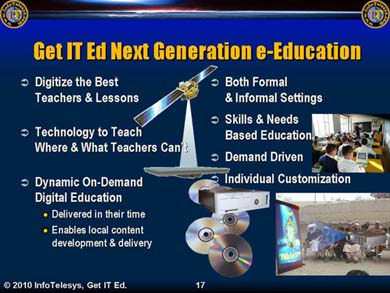
Founded in 1997, InfoTelesys is set to bring Advanced next-generation education utilizing technology to deliver what teachers at most schools can not. Get iT Ed provides advanced InfoTelesys computer technology to schools and educators at cost.Who are the founders?
The principal Founder is Clive Boustred: Born in South Africa; Honors in Physics England; @ the heart of Silicon Valley California since 1989.
Many other leading experts have been involved, such as CIO’s from Sun Microsystems, Motorola, Goldman Sacs, etc.
What inspired them to launch it?
InfoTelesys’ Founder was fortunate to have grown up in the computer era from the days of punch-cards through the astonishing accelerated growth of Silicon Valley where he worked at the forefront of the top companies (See strategize.com/team/clive_
Get iT Ed was going to follow behind profitable InfoTelesys divisions, however, following the outrageous assaults on the Founder by criminals in government in the US, the Founder was forced to study what is going on in politics and in general on and off this planet. Education, he realized, is crucial in fixing the problems and in creating a bright future on the planet, and Get iT Ed was moved to the forefront of InfoTelesys’ projects.
How is business generally in South Africa, do you face any regulations?
We are an international organization having established branches in the US, Canada, Russia, China, Japan, England and South Africa. One of our trademarks perhaps encapsulates the best answer to this question: “InfoTelesys, The Next Internet™”. Business is Internet. In regard to commerce, customs, resources, governments and taxation, we could write a paper on this subject alone.
We implement and utilize the worlds most advanced organizational structure developed out of the experiences of rapid growth Silicon Valley organizations. In South Africa, we have a subordinate Section 21 Registered organization representing InfoTelesys’ Get iT Ed not-for-profit education division here. Incidentally, our advanced organizational structure will be shared through another not-for-profit group implementing global solutions for governance, society, education, banking and courts, knowns as The Earth Plan.
How much capital did you raise to start?
Many, many millions of dollars have been invested in the project. Our Russian satellite division for example, consisted of over 1,000 individuals, however, following assaults from the US government, we were forced to put the Russian team on hold. InfoTelesys has been ahead of competitors who have burned a billion dollars. Our organizational structure which leverages Silicon Vally concepts of ownership and stock options, has allowed us to grow the organization beyond the limitations of traditional investments.
Any direct competition in the country you operate in? How unique are you?
We hope to have many competitors in the educational field. Education is what will change the world. We do not know of any competing organizations that understand the important technological issues needed to succeed in this domain yet.
From an educational perspective, it is important to note that InfoTelesys provides the worlds most advanced technology for significantly less than half the price competitors like Apple and Samsung charge. However, the huge difference is that while InfoTelesys has superior product, InfoTelesys does not lock their customers into proprietary designs and from a technology perspective, clearly knows how to do iT.
How much did you raise from the business so far? What are you doing with the cash?
InfoTelesys’ assets value is not disclosed, however, to put in perspective, the acquisition of Rostelesat involved more than ten billion dollars worth of ITU wireless spectrum alone. The lawsuit InfoTelesys filed against the US Government amounted to 1.45 trillion dollars, which InfoTelesys won, however, the US Government is not a law abiding government, and whether InfoTelesys can ever recover damages is questionable.
In regard to Get iT Ed, however, we are passionate about getting education going. We believe this is the only way we will solve the crisis the world faces as a consequence of out of control governments and the bankers who make money out of nothing.
InfoTelesys contributes around half the amount donated to any school against the retail cost of hardware. Not only does the cash donated to schools Get iT Ed iT Set’s go directly to learners hardware, it effectively is multiplied by two. The educational advantages however, provide multiplier factors many times that. Furthermore, we are working on structure to eliminate the 14% VAT SARS charges schools.
How is delivery in the city where you are headquartered? Do you use your own delivery system or you have outsourced?
We outsource delivery, however, we manage delivery ourselves, utilizing multiple best of breed and most economical service providers.
Any plans to cover other regions and beyond, if you are not already doing that?
Absolutely, however, we are focusing on establishing our first successful schools in the Western Province amongst some of the most impoverished regions on the planet. We have, for example, been approached by representatives of China’s largest educational group.
Criminals in the US government and the publics failure to demand their politicians, prosecutors and judges obey and follow the law. The underlying cause of this problem is the simple fact that the Central Banks are privately owned by criminal cartels who literally make US Dollars (and South African Rand), out of nothing. Naturally, with the money they make out of nothing, they also own all the mainstream media and education.
Clearly computer illiterate adults are a significant challenge. Couple the fact that most of the senior decision makers in education are older, and thus unfortunately generally not computer literate, and we see generations of learners leaving school with the same incompetence since the administrators are not implementing technology at schools.
We cannot fail to observe how “uneducated” children have no problem using computers, however, “educated” adults from the very same families, are often completely incompetent when it comes to computers. The dichotomy is so extraordinary, we are raising the question as to whether our existing education systems do not cause the problem.
We have many successes, foremost has been our consistent leadership in the fields we operate. Our latest press release mentioned above, provides a reference point in this regard. There are many technologies and products we have, which we have not yet announced.
What has been your failure? We would suggest that up to this point, helping adults who administer education comprehend the astonishing advantages we bring education when we equip each learner with their own computer, has not been successful yet. We hope this is only a temporary failure.
Founded this year by Constant Asabia and Deji Adejuyigbe, Eco-Innovation Hub is the first Innovation Hub in Ondo State, Nigeria.
The hub is an open space for the technologists, investors, tech companies and hackers in the area and focuses on young designers, researchers and entrepreneurs building web and mobile phone applications.
According to the founders, the hub is part open community workspace, part vector for investors and Venture Capitalists and part incubator with high-speed internet connectivity and stable power supply, has mini conference rooms for presentations, business meetings, developer sessions and mini Hackatons.
Riding on the wave that Africa is being recognized as the world’s new fastest growing hub both in infrastructural and technology, with several top class innovations by Africans such as HopSpot, the founders expect the hub will help the youth develop societally relevant solutions not only for Ondo State but the whole country and continent and even globally.
To them, ““If it works in Ondo State, then it can work anywhere else in the world!”
HarassMap is a volunteer-based initiative mapping sexual harassment in Egypt to end it. The independent initiative uses SMS and web platforms to reach the country’s population to fight sexual harassment.
Founded in 2005 by Rebecca Chiao with an MA in International Development and International Economics from Johns Hopkins School of Advanced International Studies (SAIS), Engy Ghozlan, a graduate of Cairo University, Amel Fahmy with an MA in Anthropology at the American University in Cairo and the London School of Economics and Sawsan Gad with an MA in Demographic and Social Analysis from University of California, Irvine in 2008 and her BA in Commerce from Ain Shams University in 2005, HarassMap wants to harness online and mobile technology to support a huge offline on-the-ground mobilization effort to encourage everyone to be watchful against harassment and to take action by speaking up against it before and when it happens.
The team says they are re-establishing consequences for harassers and making sexual harassment socially unacceptable and believe they can change the environment in their streets that tolerate harassment to put a stop to it.
They said, “We have one thing in common: the drive to put an end to sexual harassment and to make Egypt a safer environment for everyone. Passion, rather than hierarchy, is our main tool for organizing and carrying out our work.”
The team has been organizing campaigns and protests on sexual harassment, conducting research, and raising awareness and initiating dialogue on the issue in Egypt since 2005.
According to the founders sexual harassment will stop only when harassers stop harassing but that will only happen when everyone stops making excuses for harassers, ignoring harassment, and tolerating their behavior. The platform is therefore founded to encourage bystanders to speak up against harassers and have a zero-tolerance attitude towards harassment.
The team decided to start this campaigns as there was no political will to address sexual harassment in Egypt. Not wanting to wait for the for the government to act, the co-founders, volunteers and partners have vowed to make sexual harassment completely socially unacceptable and are mobilizing the country to see it as crime.
They team works simply.
They use online and mobile technology to mobilize the community and encourage them to speak up against sexual harassment by use of community volunteers who go out in all over Egypt convincing the people on the streets to intervene against sexual harassment.
Users can also report and document harassment online or by SMS then the online maps generated are used by volunteers to target hotspots to teach awareness about sexual harassment. The team also does research and monitors the state of sexual harrasment in Egypt.
Running on Ushahidi and FrontlineSMS platform’s, the HarassMap map is used by victims and witnesses in Egypt to anonymously report and share their experiences of harassment.
This is it, we all want deals especially when buying a phone, laptop or just any electronic.
Now, Nigeria’s online shopping mall, Konga.com has responded.
The online mall has today launched a bonanza to reward new and loyal customers with best prices in town on electronics. You will never get these, anywhere online in Nigeria.
Dubbed the Konga.com “Price Match Guarantee” the offer ensures that in addition to fast delivery, pay on delivery, best quality of goods and other benefits of shopping on Konga.com, customers will always get the lowest prices for electronics anywhere in Nigeria.
If a customer buys a qualifying item on Konga.com and finds an identical item on another retailer’s website for a lower price within 48 hours, Konga.com will match that price and refund the the difference.
Get the full details of the price match guarantee can be found here: http://bit.ly/_lowestprices
Konga.com is also giving out different freebies in the “Samsung Electronics Bonanza”. Simply buy select Samsung electronics at the lowest prices on Konga.com and get different freebies ranging from DVD players to microwaves, to home theatres. The products can be found here: http://bit.ly/_freebies
For our friends fasting, Nokia and Microsoft have today launched a line of apps to help them going this Ramadan.
The apps are on the Windows 8 platform and can be downloaded directly from the Windows Phone Store on the Nokia Lumia range of smartphones.
The apps feature packed Ramadan Kareem, Quran Mojawed, Muslim Prayers and Essential Duas.
According to Nokia’s head of developer engagement, innovation and corporate relations East Africa, Moses Sitati, there has been an increase in the number of apps being developed specifically on religion. This trend is reflecting in both the Nokia Store and Windows Store.
“Apps are a key part of how people personalize their smartphones and help them to connect to what matters most. As religion is an integral part of many people’s lives, we are seeing a significant increase in this category, and we are pleased to announce the availability of some of the most innovative applications to see our Muslim consumers through the remaining part of the Ramadan season,” said Sitati.
Commenting on the availability of new Ramadan apps, Michael Mansour, developer platform and technology lead at Microsoft Gulf highlighted the continued commitment to building the Windows Phone ecosystem.
“This Ramadan, Nokia Lumia users will now have easy access to many of the cherished experiences for Muslims during the holy month of Ramadan. We have added various Islamic apps that help users celebrate this Ramadan with renewed religious fervour and offer Ramadan-specific activities with greater ease and conviction,” he said.
Some of the latest Islam and Ramadan apps available on the store include the following:
a. Ramadan Kareem:
This app is the perfect companion for all Muslims observing the fast. The app gives the time and countdown for both the next prayer and for Iftar. It also covers the prayer times for the entire day, selecting the location manually or through GPS and using one of the multiple calculation methods one can choose under settings. It also offers very useful tools such as Mosque locator, a Qibla Finder as well as a Quran calculator, to determine the number of pages to be read to achieve one’s reading goal at the end of the Holy month. What is unique about Ramadan Kareem, is the free TV and Radio streams the user can access, a selection of Fatwa and holy reading and not to mention the special Ramadan recipes and non-Muslim section, explaining to do’s and don’ts of Ramadan.
b. Quran Mojawed
Quran Mojawed offers the complete Quran in Arabic calligraphy with the possibility to listen to each surah from a different reciter. In addition, the Quran Mojawed offers complete Tajweed guidelines, as well as bookmarks. Quran Mojawed is developed by veterans ASGATech, who have established themselves as one of the leaders of Islamic apps.
c. Muslim Prayers
Muslim Prayers stands out of the crowd with its highly customizable options. Every feature, such as prayer times, Qibla or Mosque Locator can be “pinned to the start” and accessed straight from the home screen. Its Mosque Locator is directly integrated with Nokia HERE Drive and allows users to make use of the voice guided navigation with one click. In addition, the app makes beautiful use of live tiles, allowing the user to see the prayer times flickering on the tiles on his/her home screen.
d. Essential Duas
Essential Duas compiles a plethora of Islamic Duas for Muslims in a neat, clear interface, following the philosophy of Windows Phone design language, and granting the user a simple, yet elegant way to recite supplications on-the-go. Essential Duas also includes transliterations, as well as translations for each supplication, to help users who are not well acquainted with the Arabic language understand and learn the Duas better. Lastly, the app makes it possible to share Duas with friends and family, via SMS, email,
Nokia Lumia users can download these apps directly from the Windows Phone Store on their smartphone.
Howard Izundu, an 18 year-old developer has launched Yolpe.com, an online recruitment platform for members only, that he say will change the way firms hire in Nigeria and Africa.
Izundu told TechMoran, “Some times last year, we started development on a platform that we hoped would transform the future of the job industry and the lives of so many people. We created after months of work what I feel would impact the lives of lots of people.”
Izundu added, “Our service makes finding an employee dead easy and simple for employers/recruiting managers. When utilized, it effectively eliminates job ads, applicant tracking systems, company recruitment portals and the system of applying for jobs by emailing resumes (all which are normally the biggest banes to Hiring), thereby speeding up the employment process. Probably, if you have ever worked as a hiring
manager you would immediately see the glaring need/use of this service.”
He says, traditionally, the recruitment process takes from 3 weeks to more than 2 months before completion but with Yolpe, it can effectively be done in at most 2 weeks depending on volume, finding and sourcing already taken care of, by them.
Yolpe is a medium people where job seekers sign up to connect to firm with job openings or get referrals based on their qualifications, relevance, specialization, company fit and talents. Users get access to job openings anytime, anywhere. He says that because most jobs are not advertised traditionally and most employed job seekers do not apply for jobs, Yolpe will help employers recruit the best talent in the market.
“I became interested in recruitment when my dad lost his job. For the past one year, I have had a roller-coaster ride testing out different platforms e.g. an internet job marketing site (hirepuss.com), social networks for employees to discuss, service for employees to complain about their jobs and warn off prospective companies e.t.c,” said Izundu.
“Then at my internet job marketing site I discovered something. As incredible as this may sound, Job seekers were hardly applying at recruitment portals of small companies nor sent quality resumes. This showed that job seekers were hardly interested in small S.M.Es who were my major clients. In contrast, bigger organizations usually had a surplus on every single job opening which they hate and an interesting number are
usually under-qualified. So there is a surplus on one side and a deficit on the other,” he added.
“Another issue is that you would publish a job opening on The Guardian or on job boards without knowing if you would even get a response or if your application qualified. That’s why if you look closely, you would see companies doing re-runs of their ads especially on
newspaper.”
He then said he discovered that firms did not usually have multiple positions open at once so they usually hire one or two persons to fill the vacancy immediately and mostly through referrals. That’s why he thought Yolpe can help connect users to jobs just as friends do at the work place.
Yolpe.com aspires to solve this problem with a simple solution. Connect job seekers with employers, remove all the middlemen and create pent up demands on both ends and sell it to both sides of the table. Easily.
“At its core, it’s kind of like a dating site (marketplace) for employers and those looking for work, having a noble mission: “To make Job seekers’ information easily accessible Online, enabling employers find them faster, speeding up the Employment process”. The difference with LinkedIn.com is that LinkedIn is for professional networking but Nigerians need jobs fast not networking,” he said.
He says he is ready to take on his competitors who include TheLadders.com, Bizreach.com, RegionUP.com and all Job-boards in Nigeria and LinkedIn in general.

Top European men’s fashion brand, SuitSupply, is set to launch in Africa. The firm will run as Africa.supply.com, on the continent in September.

The Amsterdam-based firm has reported record-high sales following its expansion into the United States with stores popping out nation-wide in major cities, and is now set to take on Africa with the launch of its website as a Pan-African multi-channel roll-out.
“There is a growing interest and need for high-quality fashion in Africa. It’s a market that is as equally challenging as it is exciting for any player in the industry,” said Fokke de Jong, CEO and founder of the company. “The launching of africa.suitsupply.com will be our gateway to bringing our signature high-quality tailoring, impeccable style and revolutionary men’s fashion concept to Africa.”
After the website launch which is scheduled for mid-September, the company plans to get on a store roll-out and is currently assessing South Africa, Nigeria, Morocco, Kenya and Angola as their next retail locations.
The Suitsupply concept has over the years been very well accepted by many diverse markets, fueling the company in the rapid global expansion undertaken in the last years.
In the US, SuitSupply recently open stores in Atlanta and Philadelphia, Hamburg in Germany.The company also plans to open stores in Hong-Kong, Shanghai, Dallas, Denver, Seattle, Mexico City and a second New-York location within the next months.
MTV Staying Alive Foundation and Nigerian publisher Kachifo are inviting young Nigerian artists and illustrators between the ages of 16-34 to hand in their designs for a comic book based on the Shuga TV series.
The designers have the task of developing storylines and characters from the youth, sex, health and relationships drama. This exciting opportunity will give a matchless platform for showcasing the best illustration and graphic design talent in Nigeria.
SO MTV says that if you think you have what it takes to turn this MTV Base TV series into a hot new comic book, email a full colour comic book sample (six pages maximum in Jpeg or PDF format), drawn to the downloadable script, omitting no part of the story, to comic@kachifo.com. File size must be 2MB or less. The submission must clearly state the name/s of entrant, current address, telephone number/s, and email address. Submissions may be made by single individuals or teams. A team should consist of no more than three persons. The deadline for submission is midnight on Tuesday, 13 August 2013. No entries submitted after this date will be considered.
The Shuga Comic Book will be published by Kachifo in January 2014.
Bozza’s digital platform aims to take talent from the slum or township and allow it to connect with potential audiences.
Late in 2012, Bozza closed its second round of funding with investment from Omidyar, Hasso Plattner Ventures Africa and an individually wealthy investor.
For Emma Kaye, the company’s CEO this provided the runway to start exploring the business models and to “build out the business.”
The CEO is quite clear that she is not going to be one of now very numerous content platforms that have exploded on the continent with the arrival of better.
“Nearly all these content platforms are working with the top layer of celebrities who are already famous. Bozza is about enabling individuals in the creative industries to have a voice. But content is about the talent and Bozza will be digging down deep into that to create new talent. It’s about breaking the glass ceiling that exists for township or slum talent” she continued.
Despite having got a considerable source of self-generated local content and people potentially interested in it, Bozza has been tackling how it can best make a business model out of these assets.
So Bozza has gone into the market with its third version of its platforms and is now focused on three ways to monetize; one will be to operate a similar fermium model to LinkedIn. This means offering things like local music talent opportunities.
The other way is attracting sponsorship and advertising from brands who want access to the green artists’ audiences and it will see whether it is possible to scale this as the artist’s audience size grows.
Lastly it will, organize content from the platform to operators and handset manufacturers, offering dynamic and new content.
Bozza is currently in South Africa, Nigeria and Kenya but also from across the continent and with a stippling of users from Europe. The platform is available on Android, Blackberry, Java and Nokia Express. The platform has grown steadily and reached 300,000 users without marketing.
In making its Pan-African expansion, it has worked with local partners who have got a strong understanding of things like poetry, music and video and know how to get new talent to market.
The internet will accelerate building of audience both local and internationally as well as build the artist profile, this will assist in the rising of talents.
In the past two years innovation hubs, incubators and accelerators have created support networks to give ICT entrepreneurs a better chance of survival.
iSpace came out of a conversation between Ghanaian developers for the need for a space to meet and the lack of reliable internet connectivity and decided to set up iSpace.
It is run as a social enterprise that offers developers, entrepreneurs and those in creative industries connections, resources and training. According to Oxford Street in Accraís Osu district and covering a floor, it gives a visible public presence to all three of these commonly overlapping communities
The idea of having creative industries alongside was that the media are not very familiar always with ICT and the developer community is currently largely but not completely invisible.
iSpace has attracted 6 start-ups and has a co-working space that can accommodate 60 people. It has enticed funding from the Indigo Trust and ATTI is part of the Google partnership for entrepreneurs. It also wants to be able to set up its own UX Lab to assist providence in research for developers before they start writing apps.
The OS and handset market is incredibly fragmented, making all but the development of SMS apps tough. Transaction processes remain in the hands of the mobile operators.
Diverse communities such as developers, entrepreneurs, creative industries, articulate what they need and argue for it. Funding fashions change and a lot of hubs will disappear unless they start tackling the fundamentals of building the ecosystem.
Gartner Inc. predicts that the public cloud services market in India will grow by 36 percent in 2013 to total USD 443 million from USD 326 million in 2012.
Infrastructure as a service (IaaS), including cloud compute, storage and print services continues as the fastest-growing segment of the market in India. It is increasing from 22.7 percent in 2012 to USD 43.1 million, and a growth of 39.6 percent in 2013 to USD 60.2 million IS expected.
The largest segment of cloud services market in India, Software as a service (SaaS) continues to dominate as is comprises 36 percent of the 2012 market. Gartner predicts that through 2013 to 2017, USD 4.2 billion will be spent on cloud services, of which USD 1.6 billion will be sent on SaaS.
“The continued growth of the cloud services market will result from the adoption of cloud services for production systems and workloads, in addition to the development and testing scenarios that have led as the most prominent use case for public cloud services to date,” said Ed Anderson, research director at Gartner. “Evidence of this growth is found in the increasing demand for cloud services from end-user organizations, met by an increased supply of cloud services from suppliers.”
The cloud business process services segment (BPaaS) is the second-largest market segment after SaaS, comprising 23 percent of the total market in 2012 in India, followed by SaaS at 13 percent, cloud advertising services at 12 percent, cloud management and security services at 11 percent, and cloud application infrastructure services (PaaS) at 5 percent.
Market dynamics differ significantly when considering the cloud services market size and market growth across the different regions of the world. Generally, the emerging markets in Asia/Pacific, Latin America, Eastern Europe, the Middle East and North Africa show the highest growth rates, while representing the smallest overall markets.
China is the exception, being both a large and growing market. Likewise, the mature markets of North America, Western Europe, Japan and the mature Asia/Pacific countries constitute the larger, but slower-growth, markets.
“IT services providers, particularly those focused on delivering cloud services offerings or related services, must consider these disproportionately large mature markets if they want to play a leading role in cloud services growth worldwide,” Mr. Anderson said. “Similarly, markets in Emerging Asia/Pacific, Greater China and Latin America should also be important considerations for IT services providers that want to capitalize on the high growth of these regions, particularly Latin America and Greater China.”
Countries ranked in top five positions in 2018 would account for 51 percent of worldwide smartphone shipments even though the BRIC countries would account for 33 percent of smartphone shipments says a prediction by ABI
The BRIC countries, which are Brazil, Russia, India and China, will take their places among the top seven smartphone markets in 2018, according to ABI Research.
The report says that China will displace the US as the largest smartphone market in 2013, while Brazil and India are also forecasted to be in the top four countries for smartphone shipments by 2018.
Russia on the other hand taking the eleventh position of being the largest smartphone market in 2013 and will get an upgrade to 7th in 2018, said ABI Research analysts.
“With room to grow, the emerging BRIC nations are displacing established markets such as the US and Japan as market leaders in terms of smartphone shipments,” stated senior analyst, Michael Morgan from ABI Research.
The research further said that the top five countries in 2018 would account for 51 percent of worldwide smartphone shipments while the BRIC countries would account for 33 percent of smartphone shipments.
By 2018, Western Europe and North Americas’ share of smartphone shipments would be 33 percent down from 39 percent in 2013.
The predication further said that the growth of smartphone market in the coming five years will depend on operators depend on operators and handset OEMs delivering enhanced and price appropriate solutions to the BRIC consumers.
In terms of total handset shipments, the BRIC countries are already in the top five, but have trailed behind in their global smartphone share.
In a span of two years, Android pairing with low cost hardware has opened the door to increasingly lower average selling price for smartphones noted the research report.
“When you look at operating system share in emerging markets, you tend to find that Android has been busy fulfilling its mission to bring the Internet to consumers who can’t afford a traditional PC or laptop,” added ABI Research senior practice director Jeff Orr.
Healthcart.co.za, an online retail store for over-the-counter medicines, vitamins, supplements, sports nutrition, personal care and much more with thousands of products available for delivery day or night has today introduced 10% discounts on items for all Absa card holders.

Launched June this year in South Africa by Paul Cook, a PhD in physics from the California Institute of Technology and co-author the McKinsey Global Institute report Africa at Work: Job Creation and Inclusive Growth and co-founder Thornhill Associates, an online leadership development and feedback provider, Healthcart.co.za, is South Africa’s first independent online store offering a full range of non-prescription pharmacy products.
The incredible 10% off deal on over 4000 products to every Absa credit cardholder is valid from 1 August to the 30th September 2013 and restricted to Absa credit cardholders only.

According to Healthcart CEO Paul Cook, “Healthcart is bringing consumers the future of online shopping and this fantastic deal from Absa means even greater savings on essential healthcare items.”
The state-of-the-art portal retails essential healthcare items from multi-vitamins and supplements, razors, soap and foam bath to sports nutrition and cough, cold and flu fighters and has made medical shopping hassle-free.
Users can log on and access vital healthcare items in diverse categories from personal care and sexual health to fitness supplements and infant care with free delivery on orders over R500.
Rocket Internet one of the most aggressive online investors in Africa and the world, are planning to launch a new site that will deal with hotel bookings, according to Techloy.
The site aptly named Jovago hopes to rope in major hotel chains in Africa and give consumers a new platform to obtain timely hotel bookings.
The new e-commerce venture is expected to launch in August and is being lead by managing directors, Jeremy Hodara and Sacha Poignonnec. The Jovago team will work from offices located in Berlin, Paris, Porto and Lagos with a total staff base of about 50.
The company is also looking to go into countries such as Kenya, Nigeria and Ivory Coast to expand its business offering.
Rocket Internet recently received funding to a tune of 35 million Euros to drive their expansion in the continent.