
back to top
Thursday, April 2, 2026
spot_imgspot_imgspot_imgspot_img
Home Blog Page 567

Breaking Down The Best Eco-Friendly Mobile Apps And Computer Services

0

Have you decided to change your life to ensure that you’re going to protect the environment? Remember that the world is not going to last forever. If you do not take steps to protect the environment, there is a good chance that problems are going to happen sooner rather than later. Therefore, you need to make sure that you’re doing everything in your power to protect Mother Nature. Believe it or not, there has a lot to do with the apps you’re using. You’ll also have to consider the computer services that you enjoy. If you’re not taking advantage of eco-friendly services, you can guarantee that things are going to go awry and you’ll be damaging the environment.

Below, you’re going to learn a lot more about eco-friendly mobile apps and computer services.

Online Casino Apps

First and foremost, you should think about making the switch to online casinos. If you’re serious about protecting the environment, you’ll want to stop going to your local casino. Think about your actions for a few seconds. When you drive to a casino, you’re going to be spending money on gas and your car will release a lot of emissions into the atmosphere. Therefore, you need to avoid this mistake. If you want to protect the environment, you should start playing at gambling websites. If you’re interested in betting on sports, you’ll want to check out UFABet and other similar websites.

They’ll make it possible to gamble online without leaving home. Therefore, you won’t waste gas or money. Simultaneously, you’ll be able to protect the environment since your vehicle will remain at home. This is one of the best ways to reduce your emissions.

Use Carpooling

While you’re at it, you’ll want to consider taking advantage of Carma Carpooling and other similar apps. These apps help you find people in your area who are offering carpooling services. You do not want to drive your vehicle too frequently. If you do, you’re going to releasing a lot of chemicals into the atmosphere and this can create major problems. With that being said, you should rely on others. Carma Carpooling and other apps can help. By using these apps, you’ll be able to cut your emissions in half. This ensures that you do not have to drive your car so often. 

Good Guide

If you’re looking for good eco-friendly apps, you’ll want to consider using GoodGuide. This app is free and you can use it as much as you want. It will provide you with access to various information including nutritional details. There is a good chance that you have trouble finding out which apps are eco-friendly and which ones should be avoided. Well, this mobile app can make a difference. It’ll tell you what these products contain. 

RecycleNation

Finally, you should think about using RecycleNation. This mobile app has become one of the most popular during the past few years. It is very beneficial for people who are interested in recycling. By using this app, you’ll be able to find recycling centers in your area. The app is free and it offers a wealth of information regarding recycling centers in the United States. It is pertinent to begin taking advantage of this app so you can recycle your items easily!

Seedstars Lusaka set to hold on November 7th

0

Seedstars World, is coming to Zambia for the first time. With the support of the local host Bongo Hive, Seedstars will be holding a dynamic pitch event on the 7th of November, 2019 , at 4 pm. 

The companies invited to the training session and to privately pitch at the Seedstars Lusaka event must have raised less than USD 500k in funding and built a minimum viable product, ideally with existing traction. The Seedstars team is searching for one additional criterion: potential for regional and global scalability. 

Besides representing Zambia at the Seedstars Regional Summit, the winner will get a chance to win an all-inclusive trip to Switzerland, to compete at the Seedstars Summit for the title of Seedstars Global Winner and up to USD 500,000 in equity investments and other prizes.

The applications are open until 28th October 2019 and startups are invited to apply at https://www.seedstarsworld.com/event/seedstars-lusaka-2019 After careful screening, the Seedstars team will shortlist around ten of the best seed-stage startups to participate in training and 1:1 meetings with investors on 7th of November, 2019

DOEN partnered with Seedstars to launch the DOEN Land Restoration Prize, in order to find and award the best tech(-enabled) solutions in the land restoration and land degradation space on the continent.

Also AFDB has joined forces with Seedstars as a main partner for the  “Job Creation Track” which aims to train, support, promote and award startups that show potential for creating sustainable jobs in Africa. The bank will support all local bootcamps, including a two-day dedicated bootcamp at the regional summit.

“This year, Seedstars is partnering with SAIS – Southern Africa Innovation Support to bring you this local event in Maputo. Selected startups will have an opportunity to participate in three months Seedstars Investment Readiness Program supported by SAIS and get seed funding for their businesses” 

Seedstars Maputo to hold on November 1st

0

Seedstars World, is coming to Mozambique for the fifth time with the support of the local host Standard Bank Incubator.

Seedstars will be holding a dynamic pitching event on the 1st of November, 2019 at 4pm. 

The companies invited to the training session and to pitch at the Seedstars Maputo event must have raised less than USD 500k in funding and built a minimum viable product, ideally with existing traction. The Seedstars team is searching for one additional criterion: potential for regional and global scalability. 

Besides representing Maputo at the Seedstars Regional Summit, the winner will get a chance to win an all-inclusive trip to Switzerland, to compete at the Seedstars Summit for the title of Seedstars Global Winner and up to USD 500,000 in  equity investments and other prizes.

After careful screening, the Seedstars team will shortlist around ten of the best seed-stage startups to participate in training and pitching event on the 1st of November 2019. Event information and attendee registration can be found here: https://www.seedstarsworld.com/event/seedstars-maputo-2019

Mozambique was previously represented by WenaData with their innovative solution that aims to make it easier to collect statistical data in Mozambique by rewarding survey and poll participants through a points and rewards system.
In order to provide local entrepreneurs with this opportunity and aiming to deliver the best possible event, Seedstars is closely working with Standard Bank Incubator and MozDevz  who is representing the initiative throughout the year.

Standard Bank are the main sponsors of the event. Further support is provided by GIZ and SAIS.

Seedstars, SAFEEM and GIZ aim have joined forces to increase women participation across all levels to achieve an improved gender balance. The project aims to increase and catalyse investments for women-led startups in Sub-Saharan Africa, drive more inclusive training opportunities for women-led startups across the continent, highlight more women entrepreneurs and   to create a tool kit of best practices that aim at achieving an improved gender balance.

Additionally, DOEN partnered with Seedstars to launch the DOEN Land Restoration Prize, in order to find and award the best tech(-enabled) solutions in the land restoration and land degradation space on the continent.

Also AFDB has joined forces with Seedstars as a main partner for the  “Job Creation Track” which aims to train, support, promote and award startups that show potential for creating sustainable jobs in Africa. The bank will support all local bootcamps, including a two-day dedicated bootcamp at the regional summit.

Seedstars is partnering with SAIS – Southern Africa Innovation Support to bring you this local event in Maputo. Selected startups will have an opportunity to participate in three months Seedstars Investment Readiness Program supported by SAIS and get seed funding for their businesses.

Seedstars holding a dynamic pitch event on 7th of November in Bamako, Mali

0

Seedstars World, the largest early-stage startup competition for emerging markets and fast-growing startup scenes, is coming to Mali for the fourth time. With the support of the local host Impact Hub Bamako, Seedstars will be holding a dynamic pitch event on 7th of November, 2019 at 4 pm.

The companies invited to the training session and to privately pitch at the Seedstars Bamako event must have raised less than USD 500k in funding and built a minimum viable product, ideally with existing traction. The Seedstars team is searching for one additional criterion: potential for regional and global scalability. 

Besides representing Mali at the Seedstars Regional Summit, the winner will get a chance to win an all-inclusive trip to Switzerland, to compete at the Seedstars Summit for the title of Seedstars Global Winner and up to USD 500,000 in equity investments and other prizes.

The applications are open until 28th of October 2019 and startups are invited to apply at https://www.seedstarsworld.com/event/seedstars-bamako-2019. After careful screening, the Seedstars team will shortlist around ten of the best seed-stage startups to participate in training and 1:1 meetings with investors on 7th of November 2019.

Mali was previously represented by ESène with their on-board system that collects soil moisture to provide water and fertilizer for crops.

In order to provide local entrepreneurs with this opportunity and aiming to deliver the best possible event, Seedstars is closely working with Mohamed Keita, who is representing the initiative throughout the year. 

“Seedstars offers a unique opportunity for technology companies to access a network and funding, at Impact Hub Bamako we are proud of our collaboration with this great organization that has allowed the hatching and development of many startups whose products have a huge impact on the lives of millions of Africans.” explains Mohamed Keita, Founder and CEO  at Impact Hub Bamako.

Seedstars, SAFEEM and GIZ aim have joined forces to increase women participation across all levels to achieve an improved gender balance. The project aims to increase and catalyse investments for women-led startups in Sub-Saharan Africa, drive more inclusive training opportunities for women-led startups across the continent, highlight more women entrepreneurs and   to create a tool kit of best practices that aim at achieving an improved gender balance.

Additionally, DOEN partnered with Seedstars to launch the DOEN Land Restoration Prize, in order to find and award the best tech(-enabled) solutions in the land restoration and land degradation space on the continent.

Also AFDB has joined forces with Seedstars as a main partner for the  “Job Creation Track” which aims to train, support, promote and award startups that show potential for creating sustainable jobs in Africa. The bank will support all local bootcamps, including a two-day dedicated bootcamp at the regional summit.

Women Enterprise Fund collaborating with KEBS to support women-led SMEs

0

Women Enterprise Fund (WEF) is collaborating with Kenya Bureau of Standards (KEBS) and other organizations to provide support for women running small and medium-sized business to standardize and improve the quality of their products.

The partnerships has seen 13,500 beneficiaries trained by WEF receive technical guidance to improve their products ensuring they meet industry standards.

Once the products are standardized the women are eligible to apply for certification, which the Fund pays a subsidized rate of Kshs.5,800. As a result their products will qualify for the KEBS Diamond mark of quality which allows them to access local and international markets.

“A key mandate for WEF is to provide business support services including linkages for the women entrepreneurs to improve on the quality of their products and access markets. This was one of several strategic partnerships we have entered into to support our beneficiaries,” said Eng. Charles Mwirigi, CEO Women Enterprise Fund.

 “Over the last 5 years, our beneficiaries have benefited from this partnership which has enabled them to improve their products to industry standards. This includes handling, product quality, packaging and preservation,” added Eng Mwirigi.

As a result of the partnership the agency has disbursed over Kshs.150 million to fund beneficiary businesses in the manufacturing and processing sector since the Fund was set up in 2012. A number expected to increase significantly as the number of SME’s venturing into manufacturing continues to grow.

The funding cuts across numerous ventures including vegetable oil processing, soap and detergents making, water purification and bottling, yoghurt processing, aquarium making for sale, honey processing, making of hides and skins products, processing of horticultural produce, making of construction materials e.g. tiles and bricks making, ventilation blocks, milk processing and welding.

Since 2012, the agency has also partnered with other organizations including Jomo Kenyatta University of Agriculture to support the women enterprises and start-ups with the guidance needed to develop and grow their businesses.

The revelations comes as data from Kenya National Bureau of Statistics indicate that women and youth comprise over 70% of our Kenya’s population but despite this, they have continued to face enormous and varied challenges in their pursuit for social economic empowerment.

Through these capacity building partnerships, WEF is not only increasing their chances of accessing credit for starting or expanding their businesses as well as building their capacity to run their businesses in order to increase their chances for success.

Earlier in the year, WEF and Coca-Cola Central, East and West Africa Limited (CEWA Ltd) announced that a further 285,000 Kenyan women will be empowered in their joint economic empowerment program. Participants in the program receive business skills training, financial services, as well as access to peer networks through a business club for mentoring and ideas sharing. In 2018, the initiative empowered 161,000 Kenyan women.

Huawei Band 4 & Huawei VR Glass officially launched in China

0

Huawei Band 4 has, a similar design to the Honor Band 5i, colour display & plugs into USB for charging

Currently organizing its 5G conference in Shenzhen China and after the official launch of its Mate X foldable phone, Huawei took the wraps off Huawei Band 4 and Huawei VR Glass, its much-awaited VR product.

The Huawei Band 4 is an upgrade over the company’s older fitness trackers. While the Huawei VR Glass, which as the name itself suggests, is a virtual reality headset, the newest addition to its portfolio and will be driven by 5G connectivity down the road.

Huawei Band 4

Huawei‘s fourth-gen band doesn’t look so different from the previous ones as it features almost the same design to bring you a 0.96-inch TFT colour display (same as its predecessor) with 80×160 pixels resolution and 2.5D curved glass protection.

Under the hood, the fitness band has an Apollo 3 SoC and carries a series of sensors that include a three-axis accelerometer, infrared sensor, and an optical heart rate sensor. These sensors power features such as Huawei TruSeen 3.5 to monitor heart rate and Huawei TruSleep 2.0 to recognise the four phases of your heart rate during the sleep and analyse the sleep quality.

Tracking of various fitness activities which include outdoor and indoor run, walk, cycle, elliptical, and free training, are offered on the band. The band also provides notifications of new messages and phone calls directly from the connected smartphone and delivers features such as Find My Phone and Remote Shutter. There is also a Huawei Watch Face Store from where you can get watch faces of different styles.

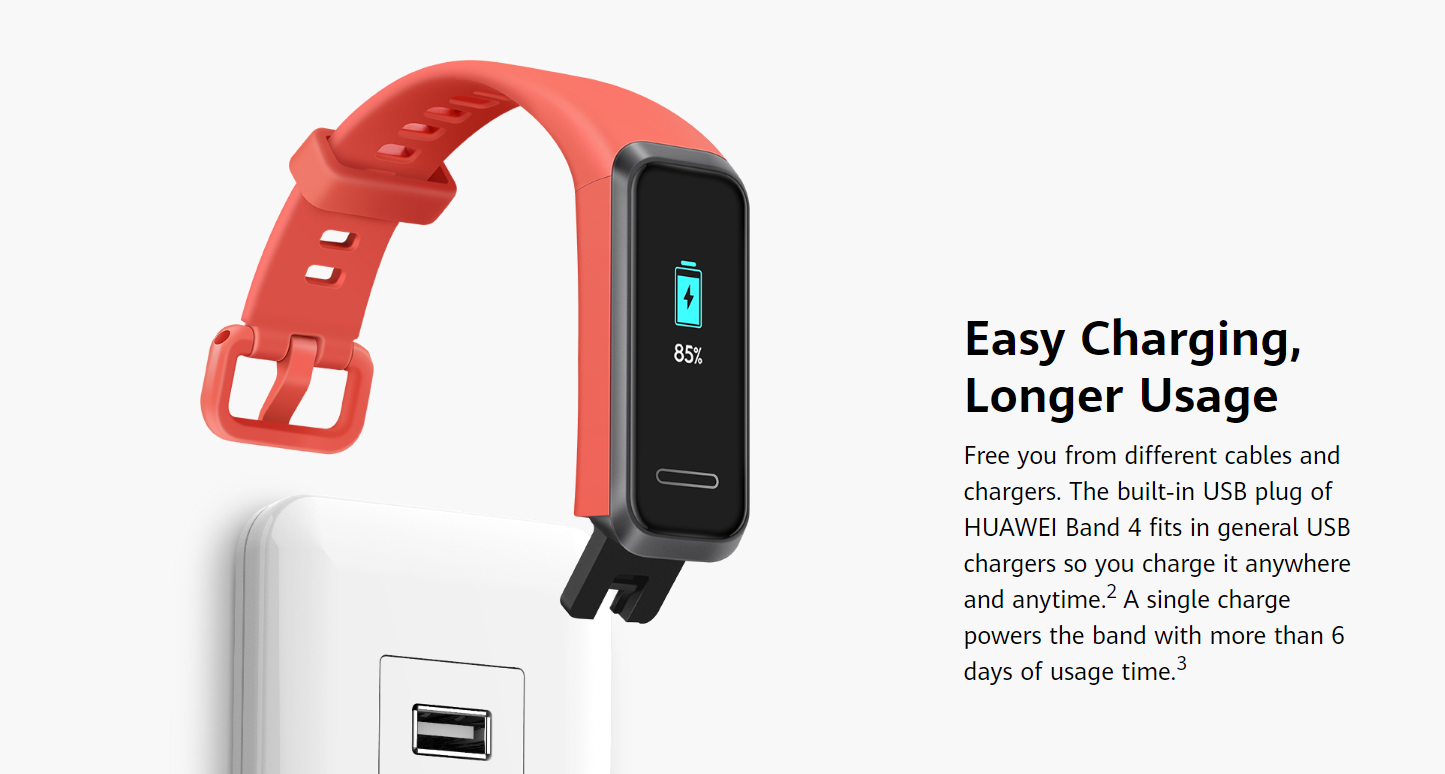
Unlike many other smart fitness bands and wearables, the Huawei Band 4 comes integrated with a USB Type-C charger that lets you charge the device without requiring a specific cable or charger. You simply need to pull out the strap on one end and plug the band into a charging port. The company also claims that the 91mAh battery of the Band 4 delivers up to nine days of power on a single charge, although it’s smaller than both Mi Band 4 and Honor Band 5.

Huawei Band 4 Charging
Huawei Band 4 – Charging

The Huawei Band 4 is compatible with devices running at least Android 4.4 or iOS 9.0. It weighs 24 grams (including the wristband) and measures at 56mmx18.5×12.5mm.

The Huawei Band 4 price is set at CNY 199 ($30/€25 ) in China, and it will go on sale in the country from November 1. However, the band is already available for purchase in Indonesia and Thailand for IDR449,000 ($32/€30) and THB999 ($35/€30), respectively. It comes in Sakura Pink, Amber Sunrise, and Graphite Black colour options.

Global launch details of the Huawei Band 4 are yet to be revealed. Nevertheless, the company is likely to bring it to markets like India and Africa in the coming future.

Huawei VR Glass

Huawei also launched the first-ever VR Glass headset in its home country alongside its fitness tracker, that is priced at $424 and will be available on sale from December this year in China.

Huawei VR Glass
Huawei VR Glass

Huawei’s newly launched VR Glass has lens barrel thickness of 26.6mm which is almost one-third of that of Oculus Quest and HTC Vivo Pro, meaning it’s more comfortable to wear on your face. It weighs around 166 grams and the temples come with a foldable design.

As for the specifications, this VR headset provides 3200×1600 pixels screen resolution with up to 1058PPI (pixels-per-inch) pixel density and a 90-degree field-of-view. Huawei also offers IMAX screen-like experience, 3D stereo sound effects, and access to around 30,000 hours of VR content, 3 live VR broadcast platforms, and hundreds of VR games.

Huawei says that the glasses can be adjusted in the range of 0-degree to 700-degree myopia, they are 55mm to 71mm distance adaptive, and a breathable sunshade mask comes on them. The company also says that the device is ergonomically designed to fit the face. It uses protein leather material which is soft and comfortable, the elastic mask magnetic suction is removable and the myopic groups do not need to wear additional glasses.

The mirror leg of Huawei VR Glass comes with dual speakers that offer a wide sound field, built-in dual SmartPA, and supports 3D sound stereo. It can also be connected with Bluetooth headphones.

Huawei being new to the VR headset segment, which has been dominated by Oculus, HTC, Sony and others to date, only get those who get their hands on this Huawei VR headset will fully understand its performance and display quality.

Google Messages 5.2 will now let you set chat reminders

0

Google has slowly but surely been refreshing its Messages experience. The last addition to the app in v5.0 was a dark theme that syncs with the system mode on Android 10, but the latest Google Messages beta, version 5.2, brings reminders so that you don’t forget to message your loved ones back.

Many at times we receive messages that we check immediately but need to act on later, and when the notification is gone, you can’t snooze it to be nudged later. Often the recourse is to set a separate task or reminder in another app to jog your memory, which you may also forget about until your contact pings you again.

Once you get Google Messages 5.2, new message notifications now have an additional option. Next to “Mark as read” and “Reply,” you’ll now find a third button suggesting “Set Reminder.” From this, you can set a reminder for one hour, the next morning, noon, or night, or pick a specific date and time on when to action your chats. Once the reminder is set, an alarm clock icon shows up on the right of the chat, and the reminder can further be edited or removed by opening that conversation.

Left and Middle: Set a message reminder. Right: Reminder is already set.

Once your time set is here, you’ll get a new notification with the last message received in the chat. Even at this stage, users can still snooze the reminder for another hour by tapping to open it.

Left: Update or delete a set reminder. Middle & Right: Reminder notification.

This feature will come with Messages 5.2 which is currently slowly rolling out on the Play Store. But in the meantime, you can sign up for Beta updates to Google Messages either directly from the Play Store listing or on the web.

BitPesa raises $15m, forms new holding company dubbed AZA Group

0

BitPesa, a Nairobi-based Cryptocurrency liquidity platform has raised $16 million and formed a new holding company AZA Group, to run its brands BitPesa, TransferZero and BFX.

The debt financing was raised from the Development Bank of Southern Africa (DBSA) and makes AZA Group, one of the leading provider of currency trading solutions across Africa, Europe and the Middle East where BitPesa, TransferZero and BFX operate.

According to Elizabeth Rossiello, founder and CEO of AZA . “We’re here to be an integral part of how Africa is accelerating its growth. The potential for frontier markets continues to increase and becomes more globally relevant. We’re solving a continent-wide challenge of a lack of financial infrastructure available for growing businesses – and we are doing it using a unique combination of financial and technological tools with a modern operational approach.”

With the financing, AZA will expand into new markets in the Middle East, Northern, and Southern Africa, as well as reinvent the frontier currency industry in the markets it already operates.

Since inception of its first company BitPesa in 2013, AZA Group has seen $1 Billion volume transacted in, out, and across Africa. With the acquisition of TransferZero and launch of its B2B product BFX, transaction growth spurred 300%. AZA Group is the only non-bank provider of both wholesale FX and distribution across the African Region, and has gained on geography through increased bank accounts, mobile money, and other payment options.

With a team of over 100 people, AZA has regional HQ offices in Lagos, London, and Nairobi with growing satellite teams in Dakar, Madrid, Accra, Kampala and soon Johannesburg.

AZA’s independent Board Director, Linda Fayne Levinson, was the first female partner ever at McKinsey Group and currently is Chair of the Board of Hertz, Independent Lead Director of Jacobs Engineering Group and a Director of Ingram Micro, and NCR.

“The DBSA in its desire to support the development of African economies supports innovative concepts and technology to enhance Africa’s competitiveness and reduce the cost of trade to its people.” said Paul Currie, DBSA’s Chief Investment Officer

Selena Gomez’s Latest Music Video was Shot on iPhone 11 Pro

0

“Shot on iPhone” is one marketing machine that often irritates a number of photo and videographers, and the latest entry to the campaign series is a music video. Popstar Selena Gomez yesterday released a new song and video entitled “Lose You to Love Me,” and the entire video was shot in black and white using an iPhone 11 Pro. As noted by Billboard, the video was shot by well-known music video director Sophie Muller.

https://youtu.be/zgJMrgDABAY

As part of its ongoing “Shot on iPhone” series, Apple released a one-minute clip of the video but the full video is available on Gomez’s YouTube channel.

However, it’s worth noting that this is hardly the first time a professional music video, ad or even a feature film has been shot entirely on an iPhone. Previously there was this music video done by Olivia Wilde for Edward Sharpe & the Magnetic Zeroes, shot on iPhone 6S:

There was also a Bentley ad shot on iPhone 5s:

In its “Shot on iPhone” series, Apple has released various types of photos and videos including stills, sports-themed videos, and short films. And it’s just recently that Apple expanded the campaign to include musicians and bands on tour.

Considering that they’re far out of reach for the majority of iPhone users, these “Shot on iPhone” creations are usually criticized. We saw Marques Brownlee (MKBHD) explain back in 2017 that these videos are typically shot on iPhone rigs that include cinema lenses, gimbal stabilizers and other extremely expensive cinema gear that no “typical” iPhone user has at their disposal. They look too good to be true because, in a sense, they are.

Although unlike many of the previous “Shot on iPhone” ads and music videos we’ve seen, director Sophie Muller decided to keep Gomez’s shoot very simple.

As you can see behind the scenes in a video below by Hunter Simmons, the video seems to be captured on an iPhone 11 Pro with no additional lensing. Plus as much as the phone is undoubtedly sitting under some very expensive cinema lighting, definitely a fluid head and fancy stabilizer arm, the setup and the results are far from the iPhone-on-a-gimbal-with-a-cinema-lens-hanging-out-of-a-car shots as seen in the Bentley ad.

The camera moves in the video are mostly limited to moving in and out, but some post-processing has been done to layer other shots onto the original. Despite coming from a well-known music video director, the results have come out as simple and straight-forward enough that someone could recreate with their own phone at home… which may have been the whole point to it.

For a long time now, the iPhone has been hailed as the smartphone for shooting videos and the iPhone 11 Pro’s camera was one of the major upgrades to this year’s lineup. The new triple-lens camera has a new night mode that allows for better images in low light, plus it can now take 4K video with “extended dynamic range and cinematic video stabilization” at up to 60 frames per second. Apple also added advanced video editing tools to it.

As we can see the ability to shoot 4K/60 from all of the cameras, and capture footage with multiple cameras at once, seems to be why the iPhone is hailed as the smartphone for shooting videos. Though many may still disagree on whether or not this video helps to prove that.

Still, at least this Shot on iPhone video feels a bit more honest, giving users a more realistic understanding of the kind of results they could potentially get at home, given a little bit of ingenuity and artistic vision.

AfriLabs, a Pan-African Tech Hub Network, Admits 20 New Hubs into Its Network

0

AfriLabs, the pan-African network of tech and innovation hubs has admitted 20 new hubs to its network, expanding its membership to 174 hubs in 45 countries across Africa.

“AfriLabs is excited to admit such innovative members who are eager to contribute to the thriving African tech and innovative ecosystem. We strongly believe in the ability of African hubs to steer innovation on the continent that will stimulate socio-economic development in Africa. Welcome to the Network!’’ Anna Ekeledo, Executive Director, AfriLabs, said.

In West Africa, AfriLabs grew its community in Nigeria with Box Office Hub, MusterPoint Coworking Space, Exponential Hub, RAD5 Tech Hub, Cedar Hive, Capital Square and Cavic Hub.

Other new West African members include Tarkwa Entrepreneurship Development Hub in Ghana, Seme City in the Republic of Benin, OVillage in Cote d’Ivoire and Suguba in Mali.

New members in East Africa include GearBox in Kenya, blueMoon and Startup Factory in Ethiopia, IdeiaLab in Mozambique and Ennovate Hub in Tanzania, while Dream Factory Innovation in Botswana is the new member from Southern Africa. Those from Northern Africa are Junub Open Space in South Sudan and LaFactory by Screendy in Morocco.

AfriLabs also welcomed Afrobytes in France as a part of its diaspora members.

With over $170m war chest, Nigeria’s Cars45 launches in Kenya

0

Cars45, a Nigerian automotive trading platform operated by Frontier Car Group, which raised $22m from EchoVC in 2017, $58m in May 2018 and $89m in the same month from Naspers, has launched in Kenya.

The firm is promising Kenyans the fastest way to buy, sell or swap their cars at an affordable budget.

Frontier Car Group announced the launch of Cars45 in Ghana and Kenya last year. Frontier Car Group targeted South Africa’s Johannesburg, Cape Town and Pretoria with “car inspection lots” for its premium services.

The firm’s Premium Inspection Service allows Cars45 to reach individuals who are unable to visit any of its inspection centers but would still like to use its service to sell their cars. The premium inspection service attracts an upfront payment to allow the firm to send an inspector to the seller’s preferred location to inspect, provide a valuation report and purchase the car.

Cars45 is a consumer-first and value-driven business as such we are always seeking new and innovative ways to make the car trading process as seamless as possible for consumers. With this premium inspection service, we are enabling convenience and offering consumers best-in-class experience,” said Vice President, Consumer-to-Business services, Mayokun Fadeyibi on the launch of the Premium Inspection Service in Lagos.

Cars45 also provides fleet liquidation, vehicle auctions, concierge services and vehicle financing which it does in partnership with financial institutions. TechMoran is yet to find out the Cars45 partners in Kenya but will update the article with more information.

The car marketplace for used vehicles is expected to create delightful consumer experiences in Kenya and take on Ringier One Africa Media’s Cheki which has been the biggest and most preferred platform in the market. Cars45 will also grapple with the number of growing secondhand car dealers using Facebook, auctioneers and several other players in Kenya.

Cars45 recently launched car importation to allow its users to easily import their cars via its online platform without the hassle of doing all the paperwork and tracking on their own.

Apple’s AR glasses with game-changing capabilities may arrive in the first half of 2020

0

Just like everyone else with major resolutions, Apple‘s got big plans for 2020. The company is set to introduce major new augmented reality initiatives next year with new 3D rear sensors for the iPhone and the likely debut of Apple’s long-rumoured AR headset product; Apple AR Glasses.

These glasses are expected to synchronize with a wearer’s iPhone to display things such as texts, emails, maps, and games over the user’s field of vision. Apple AR Glasses may even come with a separate app store, which could make sense given how Apple uses different digital storefronts to dispense apps for macOS, tvOS and watchOS. Bloomberg’s Mark Gurman, a reliable reporter on Apple leaks these tidbits.

Gurman even claims that the Apple AR Glasses will hopefully be, “if all goes perfectly, an eventual successor to the iPhone.” But Apple first needs to find a reason to make its glasses seem like a necessity, nailing down the killer app that offers more than marginal convenience over a smartphone or smartwatch.

Bloomberg says that Apple aims to launch the headset in 2020, featuring holographic displays in the lenses. Although the exact form factor and use cases for the headset is still unclear. Considering that Apple analyst Ming-Chi Kuo previously said Apple would release an AR headset in mid-2020 with a “third-party brand collaboration.”

2020 is also expected to be a big year for the iPhone with a new external design, the addition of 5G networking, and new time-of-flight 3D sensors for the rear camera that will help with augmented reality applications. The new 2020 iPhones are also expected to feature OLED displays in new sizes: 5.4-inch, 6.1-inch, and 6.7-inch models.

Someone may ask what’s the difference between VR and AR headsets?

Many get AR and VR confused; VR (Virtual Reality) headsets are mounted on the head in a similar way to snorkelling goggles, but completely block your view of the outside world. The VR headset tracks your head movement, and the 3D image displayed inside the headset moves accordingly. This makes it appear as if you’re wholly inside a 3D ‘virtual’ world.

image credits; iDropNews.

On the other hand, when it comes to AR (Augmented reality) headsets, the glasses are see-through and you can still see the world around you, but an image is displayed in front of your eyes.

In recent years AR hit the headlines first, thanks to Google Glass (which displays 2D images) and more recently with a headset developed by Microsoft called HoloLens that embeds 3D images in the world around you.

Microsoft’s HoloLens glasses are already available for developers; although anyone can buy one. It, however, costs a crazy price of $3,000, or $5,000 for the Commercial Suite which includes enterprise features. There’s now also a HoloLens 2 with upgraded features, but it’s still business-focused.

As for Google Glass, development of the consumer-focused product was halted back in 2015, but Google revealed a new-and-improved Google Glass Enterprise Edition 2 in 2019.

Apple’s AR eyewear seems to succeed where Google swung and missed with Glass, syncing with iPhones, and presenting data; including messages, maps and games, right in front of your eyes.

Huawei’s Mate X is ready and making its way to China first

0

The Mate X, Huawei’s much-delayed folding phone, is finally going on sale next month. This news was announced by the company at a launch event today in Shenzhen attended and reported on by Sina Digital.

Unfortunately for anyone eager to be among its early adopters, Huawei’s Mate X won’t be available outside of China. At least, for now. 

Initially, Huawei showed off the Mate X back in February at the Mobile World Congress in Barcelona. This is where the foldable phone became an instant challenger to Samsung’s Galaxy Fold.

However, Huawei has taken a different approach as compared to Samsung in designing its foldable phone. Rather than the device opening like a book to reveal a larger screen on the inside, the Mate X has a wraparound outside display that’s accessible even when the phone is closed.

This should make it more usable as a conventional phone than the Galaxy Fold, but the plastic-covered screen faces an even greater durability challenge since it’s constantly exposed.

Huawei Mate X
Photo credits; The Verge

The Mate X is also a 5G phone with Huawei’s Kirin 980 processor and Barong 5000 modem and has a dual-cell 4,500mAh battery that can reportedly be filled to 85% in half an hour, with 55W fast charging. The screen is 8 inches diagonal when unfolded, while when folded, it’s like having a 6.6-inch screen phone on the front and a 6.38-inch panel on the back.

The Mate X will be available from Nov. 15 from 16,999 yuan ($2,400, £1,860) which gets you a model with 8GB of RAM and 512GB of storage.

“Our strategy is based on carriers’ 5G roll out in different regions,” said a spokesman for Huawei. “So far, Huawei has made the Huawei Mate X available in the China market on Nov. 15. A global launch plan is under review.”

For global consumers who really want a Mate X, a little patience could pay off in the long run. The initial version of the phone will pack Huawei’s Kirin 980 chip, but a subsequent model, the Mate Xs, coming in 2020 will feature specs more akin to the recently released Mate 30, including the updated Kirin 990 chip, which Huawei only announced back in September.

This limited launch is consistent with the weird state of foldable phones this year as we saw Samsung forced to pull back the launch date of the Galaxy Fold when some early review units broke or saw their displays fail. Huawei on the other hand also delayed the release of the Mate X after initially targeting a summer launch. Motorola likewise delayed the release of its rumoured foldable Razr phone

For those who had been holding off buying a Galaxy Fold in favour of the Mate X, you might be frustrated at having to wait a little longer. Although we need to consider that the Mate X is a whole new style of phone, hence why Huawei is keen to see how the phone is received within China before it puts it out into the wider world.

Another thing to consider if you’re waiting to get the device is that just as with the Huawei Mate 30, the Mate X will be running an open-source version of Android and won’t offer the full range of Google apps and services you might be used to. This is all as a result of being placed on a US watchlist due to national security concerns.

At today’s event, Huawei also announced that it had shipped 200 million phones so far this year, having reached that milestone 64 days earlier than it did last year. This is real proof of the company’s resilience, but more is to be proven once we have year-on-year results that factor in Google-less phones like the Mate 30 Pro.

Is dark mode coming soon to WhatsApp?

0

Dark mode is a feature that WhatsApp users have been crying for, and have been patiently waiting for the chat app to add support for it since September last year.

In the year-long wait, dark modes have become more and more popular.

Recently, pretty much every single app out there is introducing some kind of dark mode to the equation. The main reason behind this is that users tend to demand it because the logic behind dark mode has to do with the impact that the light of your smartphone can potentially end up making it difficult for you to sleep at night. After which you might not wake up feeling all so fresh when you finally do sleep. This is something that can have a pretty serious impact on your health if it continues for an extended period of time.

Apple improved its operating system in iOS 13 to include a system-wide dark mode, Google launched Android 10 which supports it, and just recently we saw that Google is also rolling out dark mode for its Gmail app on iOS and Android.

Additionally, Instagram which just like WhatsApp is a Facebook-owned app, recently got a dark mode makeover. WhatsApp has lagged behind a lot of other platforms on the internet when it comes to dark mode.

Undoubtedly, WhatsApp will eventually end up offering its users a dark mode, but so far the platform has failed to provide its users with the kind of experience they have been asking for.

However, it seems like the wait might finally be coming to an end. According to WABetaInfo, which specializes in analysing WhatsApp beta releases, the app’s developers are currently working on a dark mode for its iOS and Android apps and optimizing the new design before its release.

A recent development has revealed that WhatsApp’s sticker and emoji menus have been updated with dark backgrounds, and developers have been hard at work adapting the app’s signature message bubbles to suit the new look.

It also looks like the new colour scheme will be mainly dark blue rather than black or grey, and will be activated automatically if you’ve selected your phone’s system-wide dark mode.

The Whatsapp team is also working on a dark splash screen. With the Splash Screen feature, the app’s splash screen is also expected to be darkened, which will avoid the problem some apps have where a person using the dark theme is startled by an unexpected burst of white light. This will be available on Android and iOS platforms.

While, in another update the Facebook-owned app is also testing an improved UI for Date and Event Bubbles, making them suitable for dark theme!

It is currently unknown why WhatsApp is taking so long to provide users with a feature that they have been requesting for quite a long period of time,

We all thought that dark mode would come with the next update, but considering that even self-destructing messages haven’t made it to our apps yet, a feature that was announced before dark mode; it is probably not wrong to think that it’s going to be quite some time before we are able to use such a mode on WhatsApp. Although, once the feature is introduced it is likely to be highly well received by the various people that have been eagerly anticipating it all this time.

Your TikTok Account might just be your Ticket to Business Success, and You Don’t know it yet

What is the first thing that pops up in your head when you think of TikTok? A funny (and sometimes cringy) short video, maybe? Well, considering that’s what the actual platform offers, you wouldn’t be faulted for thinking that.

However, there is a more pragmatic and potential marketing aspect of this quirky social media app that most people seem to be ignorant of (or at least are too oblivious) to make productive use out of it.    

Tik-Tok, at present, has over one Billion active users, which may not necessarily project an astounding figure when compared to other social media giants such as Facebook, Instagram, or even Twitter. However, considering that Tik-Tok is barely a 4-year old video sharing platform, the potential growth is too huge and perplexing to avoid. 

With the incredible number of users this unconventional social media platform continues to gain every year, its marketing potential also witnesses a significant magnification. In fact, while the majority of the users continue to utilize the platform solely for creating short videos and sharing it amongst the community, some have already started exploring its massive marketing/ advertisement potential side. 

So, if you’re someone looking for an ideal way of promoting your product or services to literally billions of potential customers, Tik-Tok could be your perfect solution. Due to its massive user base around the world and the significant growth it continues to witness, its marketing potential is probably the best amongst the many other existing social media platforms. 

The crucial factor:

 With the ever-increasing figure, Tiktok continues to generate; it is not hard to see how you can utilize this platform and harness its optimum marketing potential. However, the one crucial factor you need to consider before jumping in on the Tiktok marketing bandwagon is its internal structure and how the “community” functions. 

You cannot simply make a promotional video and expect the other billion users to view it and get instant success on your venture. Like any other traditional social media platforms, Tiktok functions primarily on the number of friends or fans (in this case) you have on your account. Hence, your content will only get as much exposure as your virtual fan base on the app. This, obviously, means you need more fans to achieve the extent of recognition you’re aiming to obtain from such a venture.  

So, it is rather obvious that you first need to establish a generous fan number before you can proceed to create content advertisements and ensure it produces a productive outcome.

Now, there are two logical ways of achieving this: you can either approach it the conventional way, which is a tiresome and a rather time-consuming process. After all, you will have to post/ create good quality videos on a regular and hope other users follow your account. This can take up to years of creating content and gaining more fans as you progress, which is not an ideal option if your primary priority is to create advertisement ads for your products eventually.

However, there is one more method of achieving the desired number of fans at a much lesser (almost negligible) time duration. Thanks to the recent developments, you can actually buy tiktok likes through some genuine “sellers” online. This gives your content advertisements a much-needed boost and enables your marketing content to spread more effectively and quickly. Also, as opposed to what most fear – your account does not get suspended due to such transactions – at least, if you buy it from a genuine online merchant. 

There are certain benefits of buying tiktok fans instead of trying to generate fans in a conventional way:

  • Time-efficient 

If you don’t want to waste your time trying to gain more fans by having to invest a considerable amount of your resourceful time, purchasing actual tiktok fans online is your ideal method. The fans are added as soon as you complete the transaction, reducing the time factor even further. This also reduces the number of resources you would have to invest in trying to think of something creative to post every day, diverting your mind from your actual priority.

Purchasing tiktok fans provides the easiest and ensures a hassle-free procedure to promote your product without having to actually gain fans. 

  • Cost-friendly 

A vast majority of the people have this misconception that they would have to write out a generous cheque in order to obtain fans in such a short span of time. However, it costs much lesser than what you might actually think. There are also various packages you can choose from depending on how much fans you want to purchase. The price can start from as low as $2.99 for 100 fans to $59.99 for up to 5000 fans depending on the number of fans and also different merchants as well.

Considering what these number of fans on your account can do for your business marketing strategy on tiktok, it’s more than safe to assume you’re getting your money’s worth.

Gmail’s Dark Theme is finally here for Android and iOS

0

Dark mode on different applications has become very popular in recent years, thanks to its ability to blacken interfaces, thus reducing the strain on your eyes and simultaneously saving your device’s battery life. Because of this, companies like Google and Apple began to release system-wide dark modes across their operating systems, whereby even app developers are updating their apps with their own dark mode takes.

Google announced that a new dark mode was coming to Gmail late last month, at the moment, the search engine giant is finally rolling out dark mode for its Gmail app on Android and iOS devices.

Here’s how to get Gmail’s new dark mode, also known as “dark theme”

For those who are already using Android 10 or iOS 13 and have dark mode turned on at the system level, the Gmail app will auto-adjust to dark mode. However, you can also turn it on separately in the Gmail mobile app. Here’s how.

Android users
  1. Go to the Gmail app on your phone and tap on the hamburger menu in the top corner.
  2. Scroll to the bottom and tap Settings.
  3. Tap General settings.
  4. At the top, tap Theme.
  5. Tap Dark (or, if you’ve already set the dark theme as your system default, tap System default).
Gmail dark theme
iPhone users
  1. Go to the Gmail app, tap the hamburger menu in the top corner.
  2. Scroll to the bottom and tap Settings.
  3. Tap Theme.
  4. Tap Dark.
When will Gmail’s dark mode be available?

Google dark mode is releasing over an “extended rollout” period:

  • Android: The rollout started on 24 September and should be available for everyone to try by end of October 2019.
  • iOS: The rollout started on 24 September and should be available for everyone to try by end of October 2019.

Usually, when Google introduces a new feature, it takes a few weeks for it to reach the masses. While both Android 10 and iOS 13 introduced system-wide dark mode, developers still have to update apps to be compatible. That was the case with Gmail, which wasn’t dark mode compatible when Android 10 first launched.

Dark mode or theme, as Google wants to call it, is everywhere these days. Aside from Gmail, you can also find it on YouTubeFacebook Messenger and Instagram. Apparently, it helps extend battery life on phones with OLED screens and anecdotally, people also say that it helps reduce eye strain and migraines. Whether that’s actually true is up for debate.

Benefits of Remote Teams Using Time Tracking Software

0

Keeping track of remote workers is a challenge. Not only do you have to manage employees in different time zones, but you also face the challenge of having so much physical distance between you and your workers. These factors can make it feel impossible to properly lead and manage your workforce.

As a manager or business owner, you want peace of mind that your remote workers are working when they should be. You also want to know that everyone on the team is most efficiently using their time. But let’s face it, remote work does have its pitfalls. Working from home or while on-the-go opens the door for all sorts of distractions and work/life balance issues, which can impact time management.

The good news is that time tracking software can be used to keep everyone on track and working towards completing all of their daily tasks. Here’s what you need to know about these apps, so you can track your time wisely while also keeping tabs on your workers.

Benefits for Remote Workers

Remote workers need a dependable and streamlined way to accurately log all of their tasks, to include the amount of time they spend working on certain things throughout the day.

By giving remote workers access to a quality time tracking app, you can ensure that they are accurately invoicing for all of the work that is completed each day. This way you can ensure that clients are being billed correctly, based on the actual hours worked.

These apps are also beneficial in that they can help workers to better estimate the time that they will need to complete certain tasks. Many time tracker apps can calculate the average time spent completing certain tasks, which makes it much easier to project timelines.

Remote workers can also benefit from a time tracking tool as they:

  • Make it easy to share information and task updates with teammates
  • Enable effective scheduling to prevent under and over-working
  • Allow for absences to be easily communicated

Most importantly, these tools enable workers to identify problem areas in regards to their time management skills. When remote workers are able to see exactly how they’re spending their work hours, they can work on streamlining their processes or spend less time being idle or distracted.

Benefits for Managers

Time tracking apps are also greatly beneficial for managers. A quality time tracker gives managers the transparency that’s needed to effectively manage remote workers. One of the biggest benefits for managers is that they’re able to track and analyze key performance indicators in a single location. 

For example, using a time tracker app a manager can make sure that workers are working tasks by highest priority and that workers have an equal workload. Being able to track these indicators ensures that your remote team is efficient and that the workload is balanced so that no one is over- or under-working.

Want a clear-cut way to be able to see what your remote team has completed by close of business each day? Most time tracker apps offer this functionality. Daily reports are extremely helpful in ensuring your team is on track.

Managers can even use this software to determine which workers are top performers. This data can then be used to determine which workers deserve a promotion or some sort of recognition. On the flip side, the data can also be used to pinpoint which workers may need more guidance or training to improve their efficiency.

Choosing the Right Time Tracking Software

In order to get the most benefit from time tracking software, you’ll want to take the time to research your options. There are dozens of different software to choose from, including mobile apps, desktop apps, and browser extensions.

There are many general factors you’ll want to consider when choosing the best time tracking software for your remote team. For example, you’ll want to determine your workflow as well as supported devices and platforms. 

You’ll also want to determine which capabilities are most important to you and your team. Time tracking software offers all sorts of features including:

  • Automatic time tracking
  • Billing and invoicing
  • Integration with project management software
  • To-do lists
  • Metrics and analytics

Knowing what capabilities the software must offer makes it much easier to narrow down your options. Features and functionality are some of the most important details to consider.

You’ll also want to determine how user-friendly the software is as well as the cost to deploy and use it. Obviously you don’t want to go over budget, but at the same time, you don’t want to go the cheap route and invest in a sub-par app that doesn’t meet your needs.

Conclusion

It’s much easier to manage a remote team when you have access to top-notch time tracking software. Keep these benefits in mind when determining which time tracker app is worth investing in so that you can more efficiently manage your remote team.

How The Emergence of IoT is Changing the Landscape of PCB Designs

0

The advent of IoT is no news, and its expansion only seems to be advancing over time. It is also influencing several industries, as its application and use are unlimited. 
One of the industries IoT devices are highly influencing is the PCB industry, PCBs are critical components to the manufacturing of IoT devices, hence, the rise of changes in PCB designs.

IoT packages are very unconventional and traditional PCBs won’t appeal to these devices. Hence, the need for high functionality and minimalistic designs is a great concern. PCB designers are left with the critical work of making these difficult designs a possibility — that involves cramming advanced functionality into miniaturized devices that keep shrinking moving forward.

IoT devices are the technology behind wearables, smart offices, remote monitoring, and control, therefore  PCB designers are going to face the challenges of PCB layout, space, and weight whilst embedding an exceptional level of functionality.

It is no brainer that IoT devices are surely changing the landscape of PCB designs. Below are 4 ways PCB designs are not going to be the same.

1. Miniaturization

This is the most impactful change IoT will have on PCBs. The designs of IoT devices are extremely minimal and at the same time require a great deal of effective functionality. PCB designers will be tasked with embedding several components in tiny layout spaces. 

The major example of these are wearables. These are gadgets that need to be almost invisible as they are carried on the body at all times and to the extent of being ingested. These wearables are worn on body parts like the earlobes and wrists, hence the need for miniaturization of its components, majorly the PCB.

The major focus while manufacturing IoT devices is miniaturization. Even designers and OEMs attest to this since miniature components are of great essence when creating IoT devices.

Flex and HDI PCBs will be major factors in making this technology a successful possibility, with HDI enabling the use of the blind, buried, and micro vias to reduce layout space. Also, the flexibility and bendability of flex PCBs will make the fitting of PCBs into IoT packaging seamless.

2. Newer Packaging Technologies

As earlier mentioned, the packaging technologies of IoT devices are a whole lot of different from the traditional modes of making PCBs. Plated-through-hole and surface mount components will become history.

Packaging technologies that are of use to IoT devices are more advanced and capable of shrinking devices, like Three-Dimensional ICs (3D-IC), Multi-Chip Modules (MCM) and System-in-Package (SiP).

These packaging technologies make it easier to integrate lots of components on a single chip, and also aid in keeping form factors thin through the connection of multiple integrated circuits on a single die.

The  3D-IC gives room for the vertical stacking of multiple silicon dies acting as a single device, and further provide a reduction in the consumption of power, together with a smaller footprint.

These will be the packaging technologies that will be more appropriate for IoT designs, while former traditional approaches will be dumped.

3. Advanced New Materials

Since the making of IoT devices requires an upgrade in PCB designs, that will inadvertently lead to an advancement in the materials. The IoT era will lead the PCB industry to do away with certain substrate materials like the traditional FR4 and rigid PCBs, due to the nature of IoT devices.

These devices need elastic and flexible circuitry and they also need materials that won’t be harmful to the human body as IoT devices are huge in the medical industry. Therefore, materials that would be used need to match all these requirements.

Materials like flex boards, flex-rigid copper, HDI PCBs, and mesh will be the norm for IoT designs. The use of 3D printers will also be prioritized in the PCB industry for rapid prototyping, also making room for PCB designers to be more creative.

There’s also the likelihood of embedding circuits within other objects which will be highly possible in 3D printing. This will definitely require a high degree of specialty and continuous development in the PCB manufacturing and designing industry.

4.  PCB and Mechanical Designers Collaboration

PCB designers and mechanical designers will have to spend a great amount of time together to design PCBs for IoT designs.

They both have to be fully engaged in the process, considering the dynamics of IoT designs. Assembly lines will become a thing of the past, as mechanical designers will be involved in every stage of producing these designs.

Whatever changes need to be done to both mechanical assembly, and circuit board won’t be delayed, instead, it will be done a short span as both PCB and mechanical designers work closely.

The whole thing of importing and exporting designs to simply share component models and board outlines for modifications and basic interference checks will be laid to rest.

The verification of the effectiveness of design throughout the product development workflow, and maintaining alignment is of dire importance for successful PCB and IoT designs, hence the need for collaboration.

Embracing The Transformative Change

The PCB design landscape is witnessing a holistic change in the design process because there are some serious advancements in the tech scene that the PCB industry has to level up to.

With all these changes and developments in sight, the PCB industry has to reprioritize its priorities and PCB designers have to acknowledge the current difficult task at hand. They have to unlearn, re-learn, and be ready to design and be as creative as never before.

Nigeria’s Carbon opens its financial services API to businesses across Africa

0

Carbon, Nigeria’s digital financial services firm, has opened up its API, to provide technology and services to startups, SMEs and FinTechs to help them build and scale their businesses.

According to Chijioke Dozie, “As part of our goal of connecting businesses with the funds and services that will enable them to thrive and expand, we are aiming to provide robust infrastructure and a suite of services that will transform their processes.”

Dubbed Carbon for Business, the API will see customers access uncollateralized credit, secure online payments, reliable funds transfer and fast KYC (know your customer) compliance obligations on the go.

Other services include identity verification via CarbonIVS to enable businesses perform KYC and anti-money laundering services on prospective staff or other parties.

Carbon IVS is integrated with all major identity databases including passport, Bank Verification Number (BVN), driver’s license and voters registration.

The API will also give users access to fund transfers and overdraft -including Optimus, an affordable and reliable funds transfer platform that provides low cost transfers and overdraft facilities.

The API will also give startups and SME access to online payments from Visa, Verve and Mastercard in over 40 currencies. All transactions are PCI DSS compliant, 3D Secure enabled, and processed through an SSL encrypted channel.

Carbon is also promising SME business loans of up to ₦20 million uncollateralized flexible repayment loans.

Launched in 2016, Carbon has amassed more than 1 million users, initially providing consumers with access to credit, simple payments solutions, high-yield investment opportunities and easy-to-use tools for personal financial management.

The company has disbursed more than $35.6 million in loans and in 2018 alone achieved revenues of $10.4 million. This expansion into business-focussed users represents the next step on the journey of becoming the most versatile digital finance platform, anywhere. 

The Carbon for Business platform is also part of Carbon’s advocacy efforts in pushing the Nigerian banking and financial services industry towards adopting Open API standards, as signalled by their recent partnership with Open Banking Nigeria.

Seedstars Harare set for October 25th at Impact Hub

0

Seedstars World, is coming to Zimbabwe for the fourth time with the support of the local host Impact Hub Harare on the 25th of October, 2019 at 4pm.

Seedstars says companies invited to the training session and to privately pitch at the Seedstars Harare event must have raised less than USD 500k in funding and built a minimum viable product and have the potential for regional and global scalability. 

Besides representing Harare at the Seedstars Regional Summit, the winner will get a chance to win an all-inclusive trip to Switzerland, to compete at the Seedstars Summit for the title of Seedstars Global Winner and up to USD 500,000 in  equity investments and other prizes.

After careful screening, the Seedstars team will shortlist around ten of the best seed-stage startups to participate in training and pitching event on the 25th of October here.

Zimbabwe was previously represented by Rera Online Farm an online platform that provides an opportunity for retail consumers to farm their own poultry produce. 

UNDP Zimbabwe  are the main sponsors of the event. Seedstars and ABAN also joined forces to train local business angels through Heritage Angel Investors. Additionally, DOEN partnered with Seedstars to launch the DOEN Land Restoration Prize, in order to find and award the best tech(-enabled) solutions in the land restoration and land degradation space on the continent.

Also AFDB has joined forces with Seedstars as a main partner for the  “Job Creation Track” which aims to train, support, promote and award startups that show potential for creating sustainable jobs in Africa.

Seedstars is partnering with SAIS – Southern Africa Innovation Support to bring you this local event in Harare. Selected startups will have an opportunity to participate in three months Seedstars Investment Readiness Program supported by SAIS and get seed funding for their businesses”

WhatsApp new feature will allow you to choose who can add you to group chats

0

WhatsApp Rolling Out Feature That Allows You To Choose Who Can Add You In Groups Globally

Nobody ever wants to be added on to random group chats without their permission, be it a wedding committee or a funeral fundraising group, we all like being accorded the courtesy of saying yes to being part of the group. However, this is a common feature in a number of messaging services.

In April this year, WhatsApp started rolling out a much-anticipated feature; the ability to choose who can and cannot add you to groups. Unfortunately for most of us the feature was rolled out to Indian users only.

Months later, WhatsApp has finally decided that this feature is good enough to start rolling out globally, which means beta users all over the world are finally getting the feature which debuted back in April as reported by WABetaInfo. WhatsApp’s Group Privacy feature will give users more control over who can add them to group chats.

Questionably, WhatsApp has never explained why it takes so much time to roll out features but the release cycle for many features seems to take forever, for example, night mode being another feature leaked over a year ago but still not available.

WhatsApp users now have one of 3 options for who can add then to a group: “Nobody”, “My Contacts”, or “Everyone”.

“Nobody” simply means that you’ll have to approve joining every group to which you’re invited, and “My Contacts” means that only users you have in your address book can add you to groups.

What will happen when someone tries to add you to a group without asking and you have these options set on your app is, the person adding you to a group will be prompted to send a private invite through an individual chat. There will also be a blacklist option allowing you to specify who cannot add you in groups if you want to do that on a contact by contact basis. This will definitely give you the choice of joining the group, which is what we all expect, right?!

Plus, you’ll have three days to accept the invite before it expires.

The feature requires WhatsApp Build 2.19.110.20 for iOS and is also available for Android.

WhatsApp says the feature will be found under Settings > Account > Privacy > Groups and will begin rolling out today. It should be available to everyone in a few weeks.

CarePay awarded for its M-TIBA healthcare fintech platform

0

CarePay, the M-TIBA parent firm, has been awarded the 2019 Duke’s Choice Award for its M-TIBA platform which was launched commercially in Kenya in 2016.

CarePay uses the Java programming language to build technology modules for the M-TIBA platform and applications for a range of mobile devices.

The Duke’s Choice Award has been running for 17 years and is given to innovators who have used Oracle’s Java technologies in a uniquely innovative manner. M-TIBA was first developed in Kenya and is being used by over 4.5 million people across Africa who have registered on M-TIBA for savings and insurance schemes. It also processes payments to over 2,000 healthcare providers who are contracted on the platform.

CarePay digitally connects health payers (e.g. insurers), beneficiaries and healthcare providers on to one platform. The technology gives health scheme administrators a detailed view of how healthcare is being utilised and paid for. It informs decision-making on investments, epidemic responses, and quality of care.

In January 2019 Agence Française de Développement (AFD) – as part of a US$1.5 million grant – funded a range of new technology modules on the M-TIBA platform. These include biometric registration, enhanced integration with insurance IT systems and new patient data and privacy units.

PharmAccess Foundation deployed M-TIBA for registrations on universal health coverage pilots for three of four pilot counties in Kenya (Kisumu, Nyeri and Machakos). CarePay has been selected by Lagos State Health Management Agency to run registrations and scheme administration for its health insurance scheme in Lagos, Nigeria. This month AAR Insurance Kenya announced a new service that enables city customers to manage medical expenses using their mobile phones on M-TIBA.

On 23 September 2019 at the UN High-Level Meeting on Universal Health Coverage, World Bank Group President, David Malpass, cited M-TIBA in Kenya as one of the new models for health financing and delivery, being supported by the World Bank and IFC.

The CarePay software engineering team has expanded from its Nairobi origins and now comprises of 45 developers based in Kenya and the Netherlands.

Kenneth Kimani, Director of Software Development, CarePay Kenya says, “CarePay has grown a world class Java capability. We are building and managing a massively robust health payments platform that can be used in a distributed environment and on a range of devices. This award recognises CarePay’s commitment to giving the people the power to care. It shows that technology can be used to make a positive change in achieving universal health coverage. And it shows that the skills to develop this technology are sitting right here in CarePay.”

Barry Lagerweij, IT Director, CarePay International said, “The award gives a boost to our developers as it shows that our solution is bringing positive changes in seemingly traditional health sectors. It gives people the power to make informed decisions on healthcare savings and access.”

Used by over 4.5 million people across Africa, M-TIBA processes savings and insurance schemes and works with over 2,000 healthcare providers across its areas of operation.

Google to fix Google Photos loophole that gave iPhones original-unlimited storage

0

iPhone Has Free Unlimited Original Quality Storage on Google Photos while the Pixel 4 Doesn’t

Google Pixel 4 ‘s announcement was made but it came with some surprising news, it was revealed that it would be the first Pixel phone to not provide all users with free unlimited original-quality backups on Google Photos. However, in a strange twist, there’s a “loophole” that thankfully enables owners of newer iPhone models to get free unlimited original-quality storage in the Google cloud.

How?

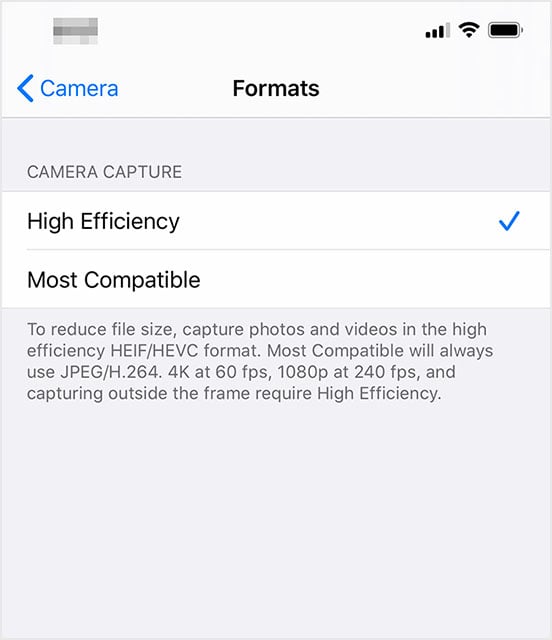
It all has to do with the HEIC file format that newer iPhones running iOS 11 started shooting instead of JPEG since 2017.

“Because iPhones shoot photos in HEIC format and not JPG, you get free unlimited original quality backups to Google Photos due to HEIC being smaller and more efficient than JPG so Google doesn’t touch the files,” Redditor stephenvsawyer explains. iPhones, therefore, get free unlimited original quality backups simply because it would cost Google both storage space (because if Google tried to compress iPhone’s HEIC photos they would actually become larger) and computing power (because Google doesn’t need to compress and process all of the billions of photos iPhones backup.)

“So Apple is literally saving Google millions of dollars by shooting their photos in HEIC and it benefits iPhone users as well because we get free original quality backups.”

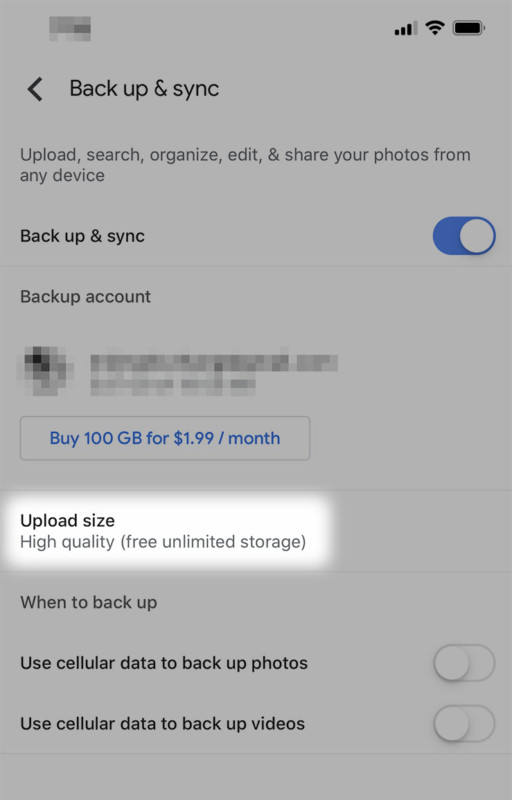
Google Photos’ unlimited “high quality” free storage does compressed backups of photos up to 16 megapixels, while the paid “original quality” storage does uncompressed backups of any resolution.

The Google Pixel 4 website advertises “high quality” backups rather than “original quality”, a first for Pixel phones.

Considering that the top-of-the-line iPhone 11 Pro Max tops out at 12 megapixels per photo, the HEIC photos being backed up by Google Photos are both uncompressed and full resolution, meaning that you’re actually getting “original quality” storage even though in your settings you’ve chosen “high quality.”

If you would like to take advantage of this “loophole” on Google Photos, just go to Settings→Camera→Formats and make sure High Efficiency is selected.

The HEIC image format is supported in Android starting in version 10, although Google is yet to implement it in Pixel phones running the latest OS. When or if it does, Pixel 4 phones should be able to take advantage of this free unlimited original quality backup benefit as well.

Although, the search giant didn’t elaborate on what this fix would entail. Is it that they will simply block iPhones from gaining unlimited storage at original quality, or will it be a case of bringing the feature to compatible Android phones? After all, the Galaxy S10 series supports the HEIF/HEIC format too, while Android PieAndroid 10, and the Snapdragon 855 all offer support.

A good guess would be that the former path is the fix in question, as Google will be missing out on revenue if they open up unlimited original-quality storage to all phones with HEIF support. Plus it’s inevitable that the number of phones with the feature will only increase as time goes by.

The Environment of Africa’s Gaming Development

0

The iGaming industry on the African continent continues to rise each year and this can be seen in more developed African countries such as Kenya. Countries such as these have been very accepting of the iGaming industry, keeping an open mind about the possibilities that games can provide. Kenya stands out as being a major adopter of mobile phones and this adoption is being done at a very rapid pace and a prediction made by the PricewaterhouseCoopers’ 7th annual Entertainment and Media Outlook said that there will be a massive growth in the usage of mobile devices and browsers to play casual and social games, with more and more people in Africa having access to the internet through their phones.

The Need for Game Developers

There has been a growing desire for Kenyas for digital experiences and much focus is being put on game development with many of the developers themselves being self-thought by using available resources online, like social platforms such as YouTube and Skillshare. There is a noticeable gap in this particular area in Kenya and around the continent as well. Many classes are being created and dedicated to providing high-learning classes and courses for game development.

A great focus is being put on developing other areas of the games where there is a lack of the needed talents, such as animation, world-building, sound, and special effects. Many companies located in Africa expressed concerns regarding the lack of skill present in the gaming development areas, especially in animation work. Also, the lack of creativity has been flagged as an issue. Access to training and experience in the industry is a key factor that would help improve the overall South African gaming and animation industry. Raising awareness of these needed skills is also essential to ensure that there will be a growing interest in regards to gaming development in Africa.

The Growing Trend of Mobile Gaming in Africa

Africa is no stranger to games in general, having a long history with board games. Digital games are a new thing in Africa and game design has not been though in schools until recently, explains Dutrieux, a game developer that was part of a five-person team called QCF Design. Many people ended up as game developers unintentionally through their skills as programmers and graphic designers coming together to make an idea a reality.

People with technical skills such as programmers and digital artists are plentyfull, however in the case of programmers, other sectors of the workforce such as corporate and finance where more appealing as a future-proof career. Mobile gaming, in general, has been steadily growing in Africa, with more people having access to phones and over 10 years the number of people subscribed to a mobile service is in the millions. When it was first made known to the world, online gaming was a trend adopted mostly by tech-savvy and those with access to access and the know-how to operate them. Since the launch of 3G broadband network, mobile phones and mobile gaming quickly became popular amongst the crowds and, over time, there have been many innovations to make online gambling available to a wider audience that owns a mobile device.

The growing use of mobile devices proves to be very beneficial for the gaming industry, especially iGaming. Kenya is one of the countries in Africa that has the most people connected to an internet service and more people are able to have access to online casino games such as slots, poker and of course betting sites. Africa’s market is very complex and continues to develop each year, connecting more people across the continent, and so far, the future looks promising for casino companies and the iGaming industry.

Final Thoughts

Because tech enthusiasts are opting for other business areas, there is a lack of technical skills in the game development sector, where many programmers sometimes shift their attention to animation work. To ensure the future of proper game development resources and expertise, more emphasis is being put on education and support for technical training. Gaming is used to develop and research other things such as artificial intelligence. A group in Africa called “Serious About Games” or SAG, is promoting online games with the goal of testing and researching artificial intelligence which will be later used in other and more serious areas such as business and social areas.

Startups: Protect Your Data without Breaking the Bank

0

Just because your startup has a limited budget to work with, doesn’t mean that you don’t have the same security and privacy needs as any other brand. In an era where your reputation can be built or broken by the threats that gain access to your data centers, it’s important that you have a way to keep your information protected. Fortunately for today’s smaller businesses, you don’t necessarily have to spend a fortune on the latest security service to keep your data under wraps. The following three steps will help you to manage your infrastructure, without breaking the bank. 

Create a Security Policy

The first step in any data management strategy is creating a data security policy. How are you going to identify the assets that you need to save and store, and the ones that you need to remove from your systems? How long are you going to hold onto your assets, and who will be responsible for checking that they’re up to date? What are your plans for Java logging, storing your data logs, and addressing the constant issue of GDPR when it comes to data analytics?

To create a comprehensive security policy, write down as many questions as you can about how you’re going to gather, store and use data, then look for ways to answer those questions with your security plan. For instance, if you’re worried about GDPR, you can put a system in place to avoid collecting any personal data without the approval of a customer. 

Invest in Employee Training

Once you have a basic security policy to work with, you can begin to share it with your employees and colleagues in a comprehensive training plan. The policy that you have in place will let you know what kind of training your team members need. For instance, should they be aware of how to spot a phishing attack in their email, or do they need to know when to delete a file instead of storing it? 

Training employees on the do’s and don’ts of managing and logging data can go a long way towards protecting your assets, your business, and reputation. Consider training options for everything from scam identification, to learning how to create a secure password. 

Test Your System Regularly

Finally, the only way to be sure that your security system works is to put it to the test. Invest in regular vulnerability testing to help your team find the gaps in your strategy and consider working with third-party auditors too. Although paying someone to try and break through your security protections might seem counterintuitive at first, it’s much better to find out that something isn’t working this way, than it is to try and recover from an attack later. 

Remember that at least you’ll be able to recover from an attack without losing any critical data or dealing with costly downtime. Regularly putting your security systems and employees to the test will make sure that you’re prepared for anything in this age of growing and ever-evolving cyber security threats.

Microsoft partners SheHacks to help women thrive in tech

0

Microsoft, through the Cloud and AI Security Engineering team has partnered with SheHacks, women STEM-focused annual festival, to encourage more women in tech.

Microsoft says the partnership is due to its commitment to supporting developing, sponsoring and advocating for women with an interest in Security Engineering. 

Hayden Hainsworth, General Manager for Cybersecurity Engineering at Microsoft, said  “My mission is geared towards empowering our customers and partners to get and stay secure on their journey to cloud while inspiring the next generation of cybersecurity engineers”. 

“We are really delighted to be partnering with SheHacks for this year’s Hackathon, with a focus to prepare women to thrive in the technology industry. We want to make it easy for anyone to take their next step forward in technology,” Hainsworth added.  

Kenya has one of the highest number of internet users with over 46 million people having access to the service, according to internet world statistics. But with the acceleration of digitalisation comes insecure consumer habits. This coupled with inadequate cybersecurity measures in key sectors and eventually turning Kenya into a lucrative target for cyber criminals. Microsoft’s collaboration with SheHacks provides a great opportunity to empower more youth with the right skills – most urgent cybersecurity skills to accelerate digital success in the region. 

SheHacks Founders Evelyn Kilel and Laura Tich agree to the fact that there is need for tech support for women.

“Since we founded this initiative, we have seen tremendous growth in the number of women and young people who want to take part. This year alone, we are hosting close to 300 young ladies from Kenya to equip and empower them with the required technical know-how to combat cyber-crime”, they said.  

The Future of Work – Are Robots the key to reducing unemployment?

0

With the rise of robots, machine learning (ML) and artificial intelligence (AI), the employees of today are in panic mode about the state of their future career prospects. Will they have a job in 20 years’ time… 10 years’ time… or even next year?

New technology continues to burst out daily to change the way we work, and on the surface, this automation of processes previously done by human hands would seem to present companies with the opportunity to downsize. The spectre of an apocalyptic, dwindling future workforce is naturally terrifying for most people, especially in Africa, which is traditionally manpower-centric.  But, the reality is that these super-intelligent machines and robots might well be doing humankind a massive favour.

“Machine learning will enable technology to replace the work of hands and the workplace of the future will probably include much more head-work, so it doesn’t necessarily mean that machines will reduce the number of jobs available,  they will change the way we work and the definition of what ‘work’ is,” says Deseré Orrill, Chairman, OLE!CONNECT, a company that is a pioneer in the field of personalised, data-led marketing.

Orrill is a successful global entrepreneur who is currently completing her MBA in Design Thinking, and it’s fitting that she will deliver the welcome address and Chair, the Future of Work session at AfricaCom 2019 at the CTICC on Wednesday 13 November 2019.

Orrill will also moderate the discussion on Creating a Culture of Lifelong Learning, a topic, which big hitters Simon Rey (Ecobank), Yumna Tayob (FNB Bank) and Hendrik Malan (Frost & Sullivan) will all weigh in on. It’s an issue that is crucial to Africa’s harnessing of its human potential, and the panel will share their insights into how education and reskilling are key to Africa making the most of its human capital, as well as the importance of ensuring effective lifelong learning in the modern economy.

Future of Work @ AfricaCom 2019 will seek to unpack a wide range of issues at the top of the agenda for business owners and industry leaders. In the African context this includes coming to grips with digital literacy for the modern workforce, building a solid talent pipeline and succession planning through reskilling, as well as strategic workforce planning to harness AI in order to improve organisations, as well as their employees.

However, it’s not just employees who face challenges in the new workplace frontier, as employers have to get a handle on issues such as, understanding what the future of work means for employees AND themselves, how to achieve executive support for new workplace initiatives, and how technology can play a game-defining role in human resources.

The battle between old school and new school has plenty of spark points in the modern work environment. Business leaders will benefit from the discussion about harnessing workplace technologies, as well as using design thinking to create an integrated digital workplace. Discussions and presentations will include Leveraging New Ways of Working to Create Sustained Results in Africa, as well as a discussion on Closing the Skills Gap: Preparing for an Uncertain Future, moderated by Mooketsi Bennedict Tekere, CEO, Ngwana Enterprises withDevaan Parbhoo, Manager, Learning Design & Learning Development at Santam.

Humans in the workplace complete tasks with hands and heads but, also with heart.  Orrill highlights the fact that AI and ML cannot replicate human creativity, sensitivity and sensibility, which are essential ingredients in all creative and caring professions, along with those where human intuition and the fabled ‘6th sense’ play a role. 

“These functions and skills just can’t be replaced by machines, although machines and AI can certainly offer incredible support to the humans involved in these professions.  We also believe robots and automation will contribute to the creation of positive, dynamic and fluid workplaces of the future,” says Orrill. “In fact, in advanced economies where greater use of robotics, automation and AI is prevalent, unemployment today is at the lowest it has been in decades. So, the future of work is not a gloomy wasteland… on the contrary, it’s a bright and promising place.”

To share in this vision for a optimistic new working world, and to keep on trend with workplace best practice, and cutting edge insights, take your place at Future of Work @ AfricaCom 2019 at the CTICC on Wednesday 13 November 2019.

AfricArena working with Facebook and Amazon Web Services to Empower African Entrepreneurs

0

AfricArena has joined forces with Facebook and Amazon Web Services (AWS), to empower the next generation of top tech entrepreneurs that are on a trajectory to build a better Africa.

AfricArena Founder, Christophe Viarnaud, in a statement said: “While Africa is growing substantially, it still faces problems in ICT infrastructure and systems to keep up with population and market demands. This is why the continent is looking to the innovations of startups and entrepreneurs to address the problems of today, whilst simultaneously designing a prosperous and sustainable future. “

AfricArena aims to work with notable corporates and institutions to help African startups access bigger markets and raise more capital. The partnership with AWS and Facebook will enable it to do so on an even bigger scale.

Support for startups

Through its startup programme, Amazon Web Services provides startups with the low cost, easy-to-use infrastructure needed to scale and grow. With the AWS Activate programme, startups get access to resources to quickly get started on AWS – including credits, training, and support.  Additionally, the new AWS Africa Region, set to open in Cape Town in 2020, will enable organisations to leverage advanced technologies such as Artificial Intelligence, Machine Learning, Internet of Things (IoT), mobile services and more, to drive innovation.

Facebook runs several programmes across the continent designed to empower startups to build and grow their businesses. For developers, Facebook supports Developer Circles, a community-driven initiative that members join for free – allowing them to connect, share ideas, learn, and collaborate. There are now approximately 45 Developer Circles across 17 countries in Sub-Saharan Africa (the most in any region globally) with over 52,000 members in cities such as Johannesburg, Accra, Lagos, Kinshasa, Dakar and Nairobi.

Celebrating the stars of the AfricArena Summit

As part of its collaboration with AfricArena, AWS will be supplying prizes valued at over $200,000 at the upcoming AfricArena Summit, taking place on Monday, the 11th and Tuesday, the 12th of November 2019, where the most game changing startups from each of the major capitals on the continent will be showcasing their solutions on ‘the stage for Africa’s tech future’.

First place winners taking part in each of the 46 pitch battles will walk away with $10,000 in AWS Promotional Credit (valid for two years); one year (or up to $5,000) of AWS Business Support and 80 credits to use at their Self-Paced Labs (valued at $80).  The runners up will receive $3,000 in AWS Promotional Credit (valid for two years); one year (or up to $5,000) of AWS Business Support and 80 credits to use at their Self-Paced Labs (valued at $80).  In addition, each participating startup will take home $2,000 in AWS Promotional Credit (valid for two years); one year (or up to $5,000) of AWS Business Support and 80 credits to use at their Self-Paced Labs (valued at $80).  Over and above these, the startups will receive useful resources with their AWS Activate account, including Tutorials and Projects; AWS Developer Tools and SDKs; AWS Overview Whitepaper (PDF); AWS Well-Architected Framework; and AWS CloudFormation Templates.

Facebook will deliver a keynote address and participate in a panel discussion (which will include three South African startups) on how Facebook developer tools can be leveraged for business growth.

“The support from and presence of Facebook and AWS at the Summit all contribute towards uplifting the next generation of technological innovators in Africa,” concludes Viarnaud.

5 Best Trello Software Alternatives for Project Management

0

The best part of technology is their omnipresence in the whole corporate, and the education sector throughout the world. Therefore, project management has become THE word. There is plenty of software to choose from, but one needs to choose the best for his/her company. 

One of the popular ones in the market includes Trello, which is a software that is used to organize and group your work with the help of boards, lists, cards. It can be used by both individuals and groups. 

However, even Trello has a flip-side, and many are not satisfied with the simple approach of Trello. There are many features, such as task dependency, cost-tracking, time-tracking, and sub-tasks, that aren’t present in Trello. 

 But if you think of other alternatives, you should consider the following 6 best Trello software alternatives in 2019 (especially when it comes to project planning, task and file management, team collaboration):

  • ProWorkflow:

You get to check your workload, collaborate with your colleagues and clients while there will be an in-built timeline and timesheet which will keep track of your projects and track your time better than you do, no kidding! 

It comes with special features like file sharing, in-built messaging with easy and secure storage of your data. For creating reports and all, there are multiple templates to choose from. They also have add-ons like Adobe Extension App etc.

According to users, your experience only gets better with ProWorkflow. Their excellent customer support is equally comparable to their quality services.

Did you know about their widgets that manage your tasks and contacts just in time!

  • Proofhub: 

| ProofHub offers a single platform for all your projects and team members. Another Kanban based alternative tool to Trello, ProofHub, offers a single platform for all your projects and team members. For example, when it comes to task management, you can create, assign tasks, subtasks to individuals or groups. You can create multiple tasks, as well.

When it comes to kanban boards, you can attach files and merge workflows, thereby adding flexibility and ease to the whole process. The Gantt chart records your progress statistically, highlighting the ones requiring immediate attention, your rate of efficiency in planning it.

You can have group discussions and chat with your colleagues, having a real-time discussion. They also provide an in-built project calendar, along with providing regular reports depicting a clear summary of your progress. Online proofreading is another prominent feature. 

  • Jira

| Jira is a beast, and it makes project management look like a walk through a park.

There are various project management tools available online. There are a bunch of simple ones like Trello. However, if you want a solid and power-packed tool, there is no tool better than Jira. Mainly made for software development, Jira is an agile project management tool that is used for bug tracking, planning and releasing projects, issue handling, and project management. Jira is listed among the top 3 Trello software alternatives, and it has already gained a massive following in the software development industry.

Fun fact: Did you know that the word “JIRA” was derived from the word “Gojira,” which is Japanese for “Godzilla.”

If you are a beginner and want to use Jira, it can be pretty intimidating when you see what it is capable of. Jira is a beast, and it makes project management look like a walk through the park. Jira also helps users to generate reports, which in turn helps in improving teams and the creation of individual workflows. The one thing that sets Jira apart from other tools is that each and every member of the team can use the tool to plan and release new software. 

  • Teamwork: 

| Teamwork has a visually comforting interface, and it is so neat that it beats other tools in terms of user-interface |

Now that we have talked about some complex project management tools let’s talk about the simplest tool out there; Teamwork. Teamwork is a cloud-based project management software that helps to boost your team’s performance and manages various project operations.

But why should one use Teamwork instead of Trello?

Teamwork has a visually comforting interface, and it is so neat that it beats other tools in terms of user-interface. The Gantt Charts are not only powerful but can also be printable. Moreover, Teamwork can manage all sizes of projects- from simple and short ones to complex ones.

It also monitors each and every member’s progress and checks their availability. On top of all this, the solution provides the Task-dependency feature which is missing from Trello. The client billing feature which enables the client to generate invoices and

the document sharing feature sets Teamwork apart in this cut-throat market.

  • Office Timeline: 

| Create amazing project timeline visuals in a jiffy without getting into the fuss of installing yet another management software |

Office Timeline provides a simple yet efficient timeline maker that enables businesses to create professional-looking visual project timelines and Gantt charts swiftly. It is a common fact that project plans are variable and are subject to change. However, when it comes to presenting only milestones and timelines, traditional project management tools are difficult to work with. On the other hand, although excel sheets are pretty easy to use, it wouldn’t be the right choice for creating a visual project timeline. So, if you’re into social media or influencer marketing field, this might be helpful for cold pitching. 

Don’t mistake Office Timeline as another project management tool. It is a solution created by Microsoft, which is provided as a simple add-on in Microsoft PowerPoint. Now you can create amazing project timeline visuals in a jiffy without getting into the fuss of installing yet another management software.

YouTube Partners With Merchbar to Help Artists Push Tour Merch Under Videos

0
YouTube has partnered with Merchbar to allow artists with an Official Artist Channel to ‘surface’ their official merchandise and vinyl alongside their videos.

Merchbar is one of the largest music merchandise aggregator providers globally, carrying over 1 million items from 35,000 artists, and YouTube is rolling out another feature for musicians with ‘Official Artist Channels’ on its platform.

YouTube has signed a deal with Merchbar which will see artists able to surface their official merchandise and vinyl alongside their videos.

Official Artist Channels will display a shelf with the artist’s own branded merchandise, which can then be bought after clicking through to Merchbar’s website.

“Fans watching videos from their favourite artists on their YouTube Official Artist Channels can now see a shelf with the artist’s own branded merchandise and, with a simple click, access the artist’s merchandise on Merchbar’s website”.

To celebrate the launch, superstar DJ and producer Marshmello is one of the first to take advantage of this, having created a soccer jersey that will be exclusive to Merchbar and his YouTube channel.

“We’ll be rolling out this feature in the US first and are working to expand internationally in the near future,” explained YouTube.

YouTube noted in a blog post that in order to launch a MerchBar shelf on their platform, artists must operate an Official Artist Channel and a Merchbar store with U.S. fulfilment enabled. The feature, which can be enabled on YouTube Studio, is initially launching in the U.S. but will expand internationally “in the near future,” YouTube said.

Although, this isn’t the first time YouTube has worked with merchandise, nonetheless: the merch shelf is already a feature used by its non-music creators, but in that case, it also supports merch firms like Teespring, Fanjoy, Crowdmade and DFTBA.

“Merchandise drops have become an integral part of artists’ album campaigns and with this partnership, YouTube is giving fans direct access to their most favourite merch.

With placement below the videos on both mobile and desktop, the merch shelf is a tremendous opportunity for artists to drive awareness and get their latest gear in the hands of fans ”

YouTube.

Spotify also partnered with Merchbar to integrate its retail listings into the streaming platform in 2016. Although the move with YouTube now gives artists with Official Artist Channels the ability surface and sell both concert listings and tickets and merch directly under music videos, making it easier for fans to find the latest details about their favorite artist from a single source.