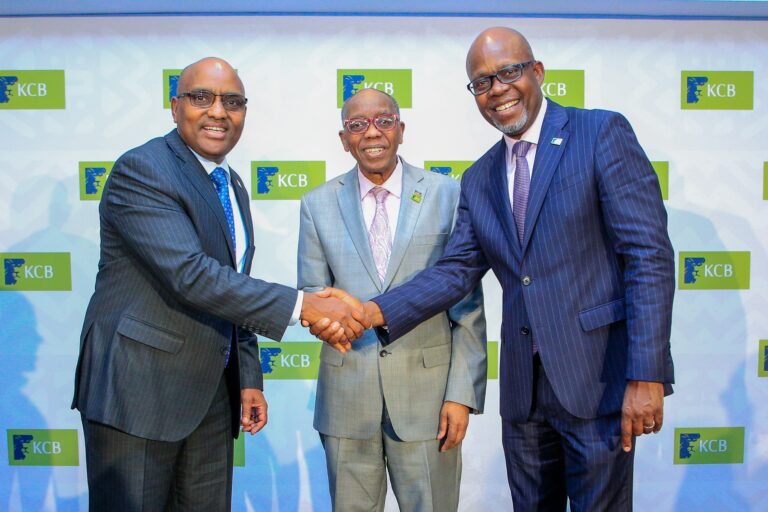
Kenya Commercial Bank (KCB Group Plc) has today reported a 20.8% increase in its first-half profit before tax to KSh49.3 billion, or about $382 million, due to higher lending, deposit growth and stronger non-funded income supporting earnings growth.
KCB Group’s total assets expanded 16.8% to KSh2.3 trillion, or about $17.8 billion, while customer deposits rose 15.1% to KSh1.7 trillion, equivalent to roughly $13.2 billion. Gross loans increased 14.2% to KSh1.3 trillion, or about $10.1 billion, driven by lending to retail, small and medium-sized businesses and corporate customers.
“Our strong half-year performance reflects the resilience of KCB Group’s diversified business model, the strength of our regional footprint, and the confidence our customers continue to place in us,” said KCB Group CEO Paul Russo.
The Group’s total income rose 9.5% to KSh108.1 billion, about $838 million while its non-funded income increased 15.4% to KSh34.1 billion, or approximately $264 million, while funded income grew 7% to KSh74 billion, equivalent to about $574 million.
Asset quality also improved. The Group’s Gross non-performing loans fell by KSh17.3 billion to KSh203.8 billion, or about $1.58 billion, from KSh221.1 billion a year earlier. The non-performing loan ratio declined to 15.1% from 18.7%, which KCB attributed to recoveries, rehabilitation of distressed facilities and tighter credit-risk management.
Regional operations accounted for 27.7% of the group’s profit before tax and 31.1% of its balance sheet. KCB Investment Bank recorded a 226.6% increase in profit before tax to KSh503.2 million, or about $3.9 million, supported by advisory mandates and capital-markets transactions.
KCB’s loan-to-deposit ratio improved to 78.8% from 79.5%, while return on equity stood at 21.1%. Equity attributable to shareholders increased 16.3% to KSh357 billion, or roughly $2.77 billion.
The board declared an interim dividend of KSh3 per share, up 50% from KSh2 a year earlier, resulting in a payout of KSh9.64 billion, or about $75 million.
KCB maintained strong capital buffers, with its core capital-to-risk-weighted-assets ratio at 18.6%, well above the 10.5% statutory minimum. The total capital ratio stood at 21.6%, also above the 14.5% regulatory threshold.
The results underscore the growing contribution of KCB’s diversified regional franchise as the lender continues investing in digital banking, financial inclusion and sustainable finance across East Africa. KCB operates in Kenya, Tanzania, South Sudan, Uganda, Rwanda, Burundi and the Democratic Republic of Congo. The group has 460 branches, 1,247 ATMs and more than 1.4 million merchants and agents across the region.
“The performance reflects the effectiveness of our governance framework, and the disciplined execution of our long-term strategy,” said KCB Group Chairman Joseph Kinyua.
Moment, a Cape Town-based fintech, has closed $22 million to deepen its network, enhance its platform and accelerate expansion across Africa.
The Series A funding round was led by AlphaCode Venture Partners, with follow on investment from General Catalyst, MultiChoice, and participation from Canal+. This raise adds Moment’s sum total raised to $55 million to help it build its payment infrastructure businesses across Africa.
“Africa’s payment complexity has long been a hidden tax on commerce on every business trying to grow here, and on every household trying to participate in the digital economy. Moment is dismantling that barrier in a way we haven’t seen before: at continental scale, compliantly, and with a product that the market’s largest enterprises have already validated,” said Dominique Collett, General Partner at AlphaCode Venture Partners. “We’re backing Joel Yarbrough, Moment’s CEO and his team as they build a defining piece of Africa’s financial infrastructure.”
Offering both payment collection and revenue retention solutions to corporate and enterprise merchants, Moment offers billers and merchants such as insurers and subscription platforms an unrivalled suite of collection tools including recurring payments, customer outreach tools, failed payment recoveries across digital and in-person channels, and the ability to directly link Moment to their enterprise billing systems.
Africa’s payment landscape is notoriously fragmented. In South Africa, over two-thirds of payments are still made in person at retail locations despite high bank penetration. In Nigeria, instant bank transfers dominate, with strong competition from cash, cards, and digital wallets. In other markets, mobile money platforms have thrived due to low bank penetration, but are fragmented across dozens of operators, with no single provider able to offer merchants unified collections across all channels.
Moment lets their customers pay with any locally preferred payment method, spanning cards, mobile money, real-time bank transfers, eWallets, recurring bank debits, and in-person payments.
“Within three years of launch, we are processing for 10 million people a month across some of Africa’s leading brands. We support the full spectrum of locally preferred digital payment methods as well as an in-person acceptance network spanning over two million physical locations,” said Moment CEO Joel Yarbrough. “Our platform is highly resilient and we process 600,000 transactions a day despite power and connectivity problems that plague the market. We’ve built a platform that can deliver on the particular challenges of the African market and help businesses get paid faster and at lower cost.”
By optimising subscription and instalment payments, adding new locally preferred collection methods across Africa, and integrating intelligence into its reconciliation and back-office clearing capabilities, Moment ensures merchants can confidently collect anywhere while getting their money faster than ever before.
Spotify will begin labeling AI-generated artist identities with an AI Persona badge from mid-September, as the streaming platform moves to give listeners greater transparency about who is behind the music.
The badge will appear on artist profiles, search results and track rows in playlists. Artists can disclose their AI identity through Spotify for Artists, while Spotify will also review profiles that appear to use photorealistic AI-generated personas.
Spotify said music from AI Personas will not be included by default in editorial or personalized recommendations. Users can still discover the music if they follow an AI Persona or seek it out directly.
The company will notify artists whose profiles are flagged by its review team, giving them an opportunity to self-disclose or appeal the decision. Spotify will initially focus its reviews on artists that meet defined audience thresholds.
The policy is separate from the use of AI in music production. Spotify’s AI Credits allow artists to disclose how AI was used to create individual tracks, while SongDNA provides additional information about artists and contributors.
The AI Persona initiative is part of Spotify’s broader push to strengthen artist identity and transparency. The company has also introduced Verified by Spotify, Artist Profile Protection and Artist Details as it seeks to distinguish authentic artists from synthetic identities and low-effort content.
Spotify’s move reflects a growing challenge for streaming platforms as generative AI makes it easier to create not only songs, but entire fictional artists with AI-generated voices, images and identities.
Small Foundation is backing a new investment vehicle established by AgDevCo to provide patient financing to early-stage agribusinesses across East Africa, targeting companies that often fall between microfinance and conventional commercial lending.
AgDevCo Ventures will invest in businesses involved in agricultural input supply, production, aggregation and processing, while providing technical assistance in areas including financial management, agronomy and environmental and social practices.
The vehicle is designed to address a financing gap facing young agribusinesses whose capital requirements can exceed microfinance limits but are considered too small, early-stage or exposed to agricultural risks by commercial lenders.
Seasonal revenues, long production cycles and climate-related disruptions can make conventional debt difficult for agricultural businesses to service, limiting their ability to expand and create jobs in rural communities.
AgDevCo, an impact investor focused exclusively on African agriculture, will manage the vehicle through a dedicated team based in Nairobi. The portfolio will draw on the firm’s broader agricultural investment and operating experience.
Small Foundation, which was an early backer of AgDevCo, said its latest support forms part of a broader blended-finance structure intended to offer more flexible financing to businesses at an early stage of development.
“Small Foundation was one of AgDevCo’s earliest backers and has been just as catalytic in getting AgDevCo Ventures off the ground,” AgDevCo Chief Executive Officer Daniel Hulls said. Hulls also chairs AgDevCo Ventures.
The partnership will also test whether patient capital combined with technical support can help early-stage companies strengthen their operations, deepen relationships with smallholder farmers and become better positioned to attract follow-on investment.
For investors and development-finance institutions, the initiative reflects a broader effort to direct capital toward commercially viable rural businesses that remain underserved by traditional financing models.
AgDevCo Ventures’ focus on early-stage companies could also provide a pipeline of businesses capable of scaling across East Africa’s agricultural value chains, where access to capital remains a constraint on private-sector growth.
British International Investment, the UK’s development finance institution, is investing $20 million in an Africa50 fund as it seeks to attract more private capital to infrastructure projects across the continent.
The investment in the Africa50 Infrastructure Acceleration Fund was announced alongside a new agreement between BII and Africa50 to expand cooperation on infrastructure financing, co-investment and project development.
The commitment takes the fund to a fourth close of about $330 million, with investors including the African Development Bank, International Finance Corp. and more than 20 African institutional investors.
The fund targets infrastructure projects in power and energy, water and sanitation, transport and logistics, and digital and social infrastructure.
The investment comes as African governments struggle to finance the infrastructure needed to support faster economic growth. Limited public funding has increased the importance of development-finance institutions, pension funds, insurers and other long-term investors in funding large projects.
Under a memorandum of understanding signed at the Infra for Africa Forum in Tanzania, BII and Africa50 will identify opportunities for co-financing and co-investment while working to expand the pipeline of projects that can attract institutional capital.
“Africa’s infrastructure financing gap remains one of the biggest barriers to sustainable growth and development across the continent,” BII Chief Executive Officer Leslie Maasdorp said.
Africa50 Chief Executive Officer Alain Ebobissé said the continent’s infrastructure needs could not be met by public capital alone.
The partnership is designed to use BII and Africa50’s capital and networks to bring more investors into infrastructure projects, potentially allowing projects to reach financial close and construction faster.
For BII, the investment also supports a strategy of using development capital to mobilize additional funding from private and institutional investors. Africa50 specializes in developing, financing and investing in infrastructure projects across Africa.
The fund’s latest close brings together capital from international development institutions and African investors, reflecting growing efforts to finance the continent’s infrastructure through a combination of public and private capital.
Technology is playing an increasingly important role in helping 13 Starehe Boys Centre students complete a 1,100-kilometre charity cycling challenge from Busia to Mombasa, combining endurance, digital coordination and safety support in a journey designed to raise KSh10 million for the school’s education fund.
The riders resumed the final leg of the challenge from Nairobi on Wednesday after arriving in the capital on Monday and taking Tuesday to rest and recover. They are expected to reach Mombasa on Sunday, August 16.
The challenge, known as the Dr. Geoffrey Griffin Memorial Charity Bikeathon, requires the students to cycle roughly 100 kilometres each day, making preparation, route coordination, communication and safety critical to completing the journey.
For the riders and their support teams, technology is helping turn what would otherwise be a physically demanding road journey into a coordinated long-distance operation. Route planning, communication between riders and support teams, and access to emergency assistance are central to keeping the group moving together across multiple counties.
The riders have also spent months preparing physically and mentally for the challenge, undertaking long-distance training to condition themselves for repeated 100-kilometre rides.
“You cannot just wake up and ride 1,100 kilometres,” said Ian Hicho, Technical Director and Team Coach and an Old Starehian. “The preparation started months ago, with physical training, long-distance rides and mental preparation.”
The challenge illustrates how technology and modern training methods are becoming increasingly important in endurance sports, where performance depends not only on physical fitness but also on planning, communication, monitoring and logistics.
Safety is another major part of the operation. St John Ambulance emergency response teams are supporting the riders along the route, providing medical and safety assistance as the students travel through different road and weather conditions.
The riders are also supported by Vivo Energy Kenya, whose Shell service station network has provided stopover points, refreshments and logistical assistance along the route.
For team captain Ian Stanley, the challenge has provided lessons in leadership and coordination that extend beyond the classroom.
“Being team captain means making sure everyone is where they are supposed to be, that the bikes are in order and that the team moves together,” he said.
The technology and logistics supporting the Bikeathon are particularly important because the riders are travelling as a team rather than competing individually. Maintaining communication, ensuring the bicycles remain operational and coordinating support along the route all become increasingly difficult as distance and fatigue accumulate.
The fundraising campaign is targeting KSh10 million for the Starehe Boys Centre education fund, giving the technology-enabled journey a broader social purpose: using a highly coordinated physical challenge to mobilise support for education.
Fidel Alfred Odhiambo, a Form Three student and returning Bikeathon participant, said the experience has reinforced the importance of resilience.
“There are moments when you feel like giving up, especially when climbing the hills, but you remember why you started and you keep going,” he said.
The Bikeathon honours the legacy of the late Geoffrey Griffin, founder of Starehe Boys Centre, and is intended to develop resilience, teamwork, leadership and a sense of service among the students.
At the heart of the challenge, however, is a simple objective: getting all 13 riders safely to Mombasa while raising money to support future Starehe students.
The team is now entering the final stretch of its 1,100-kilometre journey, with technology, logistics and teamwork helping keep the riders on course as they head towards Mombasa.
Liquid Intelligent Technologies is using high-speed wireless optical technology from Taara to connect large enterprises in Lagos to data center capacity without relying entirely on fiber, offering a faster way to expand connectivity in Nigeria’s largest commercial hub.
Over the past two years, Liquid has deployed nearly a dozen Taara links across Lagos, connecting internet service providers, banks, hotels and a utility company to high-capacity network infrastructure.
The technology is designed for locations where laying fiber is expensive, slow or technically difficult. It can also provide an alternative route when fiber networks are disrupted by cuts, which can leave businesses without connectivity while repairs are carried out.
Taara, a graduate of X, Google’s Moonshot Factory, uses narrow beams of invisible light to transmit data through the air. Its Lightbridge platform can deliver up to 20 Gbps of capacity across distances of up to 20 kilometers.
Unlike conventional fiber deployments, the system does not require trenching, spectrum licensing or extensive civil works. Taara says links can be installed and activated within hours in some deployments, compared with the weeks that traditional infrastructure projects can require.
For Liquid, the technology provides another way to distribute bandwidth from its points of presence at Africa Data Centres and other leading data centers to enterprises that may be beyond the immediate reach of fiber.
That could become increasingly important as demand for cloud services, digital payments, artificial intelligence, enterprise applications and data-intensive services grows across Africa.
Lagos presents a particular infrastructure challenge. As Nigeria’s largest commercial center, the city has a dense concentration of businesses and growing demand for reliable connectivity, while expanding physical network infrastructure in congested urban environments can be expensive and operationally difficult.
Fiber remains the backbone of modern communications networks, but operators increasingly need additional technologies to extend capacity and create redundancy.
Liquid is using Taara links as a complement to its existing fiber infrastructure rather than as a replacement for it. The company can use the wireless optical connections to reach customers more quickly, connect locations where fiber deployment is difficult and establish alternative network routes.
“For Liquid, deployment speed has been one of the most significant advantages,” Eugene Uka, acting chief executive officer of Liquid Intelligent Technologies Nigeria, said.
“Traditional fiber deployments aren’t always a possibility, especially across difficult terrains. Taara links can often be installed and activated within hours,” he said.
The technology could also help address one of the persistent weaknesses of fiber-dependent networks: physical cuts.
Fiber cables can be damaged during road construction, excavation and other civil works. Restoring connections can take days depending on the location and extent of the damage. A wireless optical link can provide an alternative connection between network points without requiring another physical cable to be laid.
“As demand for connectivity continues to grow, operators need more flexibility in how they expand and reinforce their networks,” said Bhavesh Mistry, regional lead for Taara in Africa.
“Fiber remains an essential part of modern communications infrastructure, and will for some time, but there are many situations where deploying fiber quickly or cost-effectively can be difficult,” Mistry said.
Taara’s technology uses highly focused beams of light to transmit data between two points. Because the system operates through the air, operators can establish high-capacity connections without digging trenches or acquiring additional radio-frequency spectrum.
The company says Lightbridge can provide up to 20 Gbps over distances of as much as 20 kilometers, positioning it between conventional fiber and traditional radio-frequency wireless systems.
Liquid has now begun exploring opportunities to expand the technology beyond Lagos, with Abuja, Ibadan and Kano among the Nigerian cities being considered for future deployments.
The expansion could give Liquid another tool for serving enterprises in areas where the economics or physical challenges of fiber deployment make conventional infrastructure less attractive.
Taara Lightbridge is currently deployed in more than 20 countries, with operators including T-Mobile, Airtel, Digicel, Liquid and SoftBank.
For Africa’s rapidly expanding digital economy, the significance of the technology may extend beyond simply providing a faster alternative to fiber. Wireless optical links could allow network operators to add capacity, connect new customers and build backup routes without waiting for lengthy civil works.
In markets where demand for connectivity is growing faster than physical infrastructure can be deployed, getting data from a data center to a business may increasingly depend not only on what is buried underground, but also on what can be transmitted through the air.
Mastercard has appointed Yasemin Bedir as its Eastern Europe, Middle East and Africa (EEMEA) region president, effective 1 September running its 81 country business in the region.
Bedir, a nearly 20-year veteran of Mastercard, also joins the company’s Management Committee. She succeeds Dimitrios Dosis, who was recently named Chief Commercial Payments Officer, leading Commercial & New Payment Flows.
Based in the UAE, Bedir will oversee the strategy, direction and overall success of all aspects of Mastercard’s operations across the region through its partnerships with retailers, fintechs, financial institutions, governments and businesses.
“Yasemin is a leader who finds the best in her teams to help them deliver the greatest impact for our customers and to fuel local economies,” said Sachin Mehra, Chief Business Officer, Mastercard. “This is a vast and complex region that demands creative thinking, proven results and strong relationships. Yasemin has delivered that throughout her career. Working with our customers and partners across the EEMEA region, we have a true opportunity to shape and redefine how people and businesses move money, exchange value and enable commerce for years to come.”
Most recently, Bedir served as Division President for Eastern Europe for four years, guiding the team through a complex geopolitical and regulatory environment to strengthen Mastercard’s leadership position across these markets. She is a passionate advocate for talent development and has fostered a culture grounded in accountability and collaboration.
Bedir joined Mastercard in 2007. During her tenure, she gained experience and insights from working in markets across the globe, including serving as General Manager of the company’s Turkey and Azerbaijan activities before overseeing community institution and processor relationships in North America for nearly five years.
“I’ve been inspired by the teams here at Mastercard,” said Bedir. “Their resilience, innovative spirit and relentless dedication to meet and exceed customer needs is what powers our impact every day. Together, we will build on the strong foundation the regional team has created under Dimi’s leadership over the past five years.”
Earlier in her career, Bedir worked at HSBC, Garanti Bank and Yapı Kredi in Turkey. She is among the Founders of the Professional Women Network (PWN) and leads many projects to help SMEs grow.
Tanzania has introduced a new requirement for people conducting business through social media to publicly display their tax identification details, bringing online sellers and other digital businesses under a more visible layer of tax enforcement.
The Tax Administration (General) (Amendment) Regulations, 2026, issued through Government Notice No. 158G, require a person conducting business on social media to display a Tax Identification Number (TIN), Tax Clearance Certificate or the applicable tax certificate on their social media profile or account in a manner that is easily visible.
The regulations were signed by Finance Minister Khamis Mussa Omar in Dodoma on June 30 and took effect July 1, 2026. They amend Regulation 58 of the Tax Administration (General) Regulations, 2016, made under the Tax Administration Act, Cap. 438.
The change effectively makes a social-media account part of a business’s tax compliance footprint.
For online merchants, creators and other entrepreneurs using platforms such as Instagram, Facebook and other social networks to sell goods or services, tax credentials will now have to be visible on the account used for that business.
The regulation says the information must be displayed for the purposes of “inspection and enforcement,” giving Tanzania’s tax authorities a direct way to identify businesses operating through social media.
The measure comes as governments across Africa look for ways to capture economic activity moving from traditional shops and marketplaces to digital platforms.
Tanzania has already introduced tax rules covering parts of the digital economy, including registration requirements for certain non-resident electronic service providers. The latest amendment takes a different approach by targeting the visibility of businesses operating directly through social media.
For Tanzania’s growing base of small online businesses, the requirement could turn tax compliance into something customers can see before making a purchase.
A seller’s social-media page may no longer simply be a storefront carrying a product catalogue, phone number and payment details. It will also need to carry evidence of the seller’s tax status.
The rule could also make it easier for authorities to identify businesses that operate exclusively online and previously had little physical presence through which they could be identified.
The amendment does not specify a particular social-media platform in Regulation 58, meaning the requirement is framed around conducting business on social media, rather than being limited to Instagram, Facebook, TikTok or another named service.
For Tanzania’s digital merchants, the change marks a broader shift in the relationship between social media and government regulation: the platform where a business sells is increasingly becoming part of the system through which that business is identified, monitored and taxed.
YouTube is raising the bar for creators seeking to earn money from its platform, while introducing new revenue opportunities tied to subscriptions, shopping and brand deals.
The company said Monday that it will overhaul parts of the YouTube Partner Program from Feb. 1, 2027, marking its first major changes to the program since 2018. The changes come as YouTube tries to direct more money toward creators who consistently generate views and engagement.
The YouTube Partner Program has more than 3 million creators, according to the company. YouTube said it expects to pay creators more in 2027 than it did in 2026.
The biggest change affects Shorts, YouTube’s short-form video product.
Starting Feb. 1, 2027, creators will need at least 10 million qualified Shorts views over a 90-day period to remain eligible for advertising and subscription revenue sharing from Shorts.
Creators who fall below that threshold will not be removed from the Partner Program. They will continue to earn from eligible long-form videos, while Shorts revenue sharing will resume if they again reach 10 million qualified views in 90 days.
The move could put pressure on creators whose businesses depend heavily on viral Shorts, particularly smaller channels that generate large numbers of views but have inconsistent traffic.
YouTube is also promising alternative ways for those creators to make money. The company said it plans incentives tied to YouTube Shopping, brand deals and the ability to start or grow trends on the platform.
Details of those programs will be announced later.
YouTube expands Premium revenue
YouTube is also expanding Premium Lite to every country where YouTube Premium is available.
Premium Lite offers users largely uninterrupted viewing, as well as offline and background playback for most content. YouTube will distribute a portion of subscription revenue to creators based on member watch time and views.
For YouTube Premium, 30% of net subscription revenue is allocated to the creator pool, while Premium Lite allocates 60%. From those pools, creators receive a 55% share for long-form videos and 45% for Shorts.
YouTube said creators can, on average, earn more from a Premium subscriber than from the same user viewing advertisements.
The expansion gives creators another source of income that is less directly dependent on advertising demand.
Higher hurdle for new creators
YouTube is also increasing the requirements for new creators who want access to advertising and Premium revenue sharing.
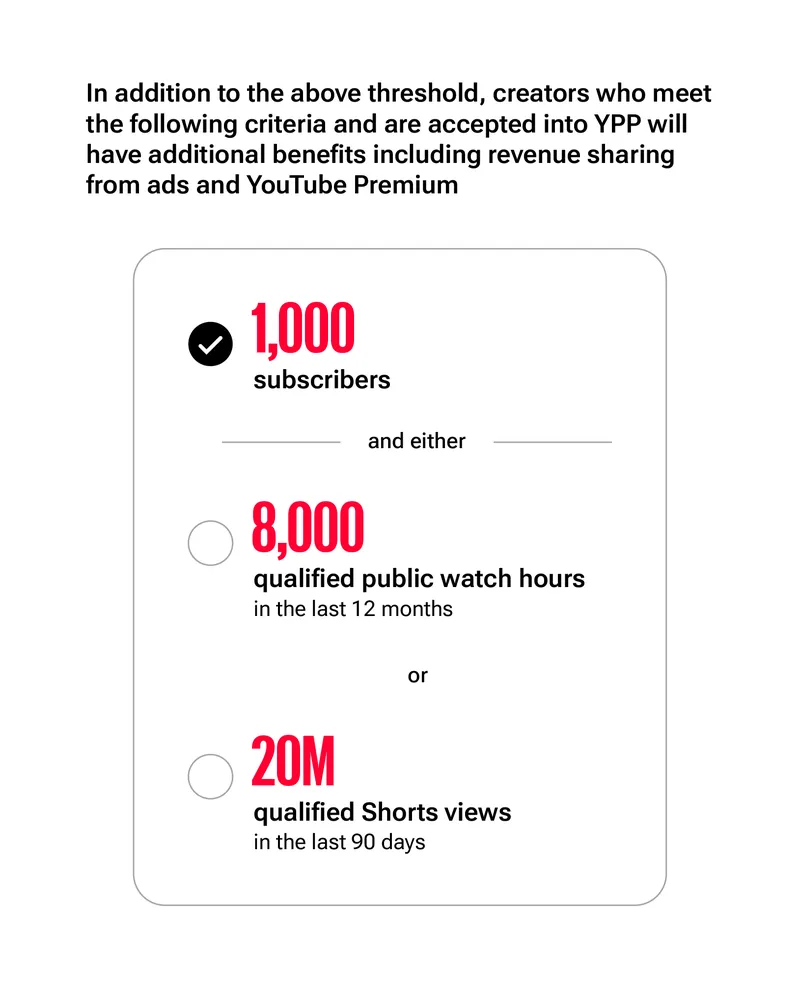
From Feb. 1, 2027, new applicants will need either 8,000 qualified public watch hours during the previous 365 days or 20 million qualified Shorts views during the previous 90 days.
The company said the thresholds for fan-funding and shopping products will remain unchanged. Existing YPP members will not be affected by the new entry requirements.
YouTube said the changes reflect the scale of the platform, which now generates more than 200 billion Shorts views a day and more than 1 billion hours of daily viewing on television. For creators, the message is increasingly clear: YouTube is moving away from a model where sheer view volume is enough to drive monetization.
The platform is putting greater emphasis on sustained engagement, audience loyalty and commercial activity while giving creators more ways to earn beyond advertising. Creators will be able to review and accept the new Partner Program terms in YouTube Studio before the changes take effect on Feb. 1, 2027.
Intel is raising $20 billion through a new stock offering, giving the US chipmaker a major injection of fresh capital as it continues to invest in its business.
Intel said Monday it priced 210,526,315 shares of common stock at $95 per share. The offering was increased from the previously announced $15 billion.
The company expects to receive approximately $19.7 billion in net proceeds, assuming the underwriters do not exercise an option to purchase additional shares. The amount reflects deductions for underwriting discounts and commissions as well as estimated offering expenses. The underwriters have a 30-day option to purchase up to 31,578,947 additional Intel shares at the $95 offering price, less underwriting discounts.
The offering is expected to close on Aug. 12, subject to customary closing conditions.
Intel said it plans to use the proceeds for general corporate purposes, which may include capital expenditures and working capital. The company did not provide a detailed breakdown of how the money will be allocated. The new funding gives Intel additional cash to support its operations and investment plans at a time when semiconductor companies are committing billions of dollars to advanced manufacturing and computing infrastructure.
The stock sale will increase the number of Intel shares in circulation, meaning existing shareholders will own a smaller percentage of the company once the new shares are issued. That dilution could increase if the underwriters exercise their option to purchase the additional 31.58 million shares.
J.P. Morgan, Goldman Sachs & Co. LLC, Morgan Stanley and Citigroup are acting as joint book-running managers for the offering.
Barclays, BofA Securities, BNP Paribas, Credit Agricole CIB, Deutsche Bank Securities, Mizuho, RBC Capital Markets, TD Securities, Wells Fargo Securities and Cantor are among the other banks acting as book-running managers. Intel has filed a registration statement on Form S-3 with the US Securities and Exchange Commission for the offering.
Intel, which trades on the Nasdaq under the ticker INTC, designs and manufactures semiconductors used in computers, data centers and other technology products. The $20 billion fundraising gives the company additional financial resources for capital spending, working capital and other corporate purposes.
From August 14, cyber cafés must register customers and maintain session records, creating a three-year trail of who used which computer and when as Kenya tightens its fight against cybercrime.
Kenya is about to make anonymous internet access harder as the Communications Authority of Kenya introduces new licensing requirements requiring cyber cafés to identify customers and keep records of their sessions.
From August 14, 2026, cyber cafés operating as Public Communications Access Centres (PCACs) will be required to establish a mechanism for registering customers and maintain basic service-use logs. The requirements include the terminal ID and the start and end time of a customer’s session, while expressly excluding personal browsing history from the required session log. Operators must retain records relevant to compliance for at least three years.
The requirements are contained in the Communications Authority’s PCAC Class Licence, issued under the Kenya Information and Communications Act, Cap. 411A. The move puts Kenya’s cyber cafés at the centre of a growing debate over the balance between digital security and personal privacy.
The law behind Kenya’s new cyber café rules
The legal basis for the requirements is important. The Kenya Information and Communications Act, Cap. 411A, provides the statutory framework under which the Communications Authority regulates and licenses communications services. Under Section 24(1) of the Kenya Information and Communications Act, a person may not operate a telecommunications system or provide telecommunications services except in accordance with a valid licence granted under the Act.
It is through this licensing framework that the CA has imposed the new operational requirements on Public Communications Access Centres. The specific customer-registration requirement is contained in Clause 3.1 of the PCAC Class Licence, which requires licensees to put in place a mechanism for registering customers.
Under Clause 3.2, operators must maintain a customer session log containing the terminal ID and session start and end time. Crucially, the licence states that the required log excludes personal browsing history. Clause 3.3 requires licensees to retain records relevant to compliance with the licence for a minimum of three years, while Clause 3.4 requires operators to submit reports to the Authority when requested.
The Authority’s oversight powers are also spelled out in the licence.
Under Clause 5, authorised officers may access a licensee’s premises, systems, records and equipment for purposes including inspection, audit and investigation. Clause 7 provides further inspection and enforcement powers, including action where a licensee breaches the conditions of the licence.
This means the three-year cyber café record-keeping requirement is not a new provision of the Computer Misuse and Cybercrimes Act. It is a condition of the PCAC Class Licence issued by the Communications Authority under the Kenya Information and Communications Act. That distinction matters because it identifies exactly where the requirement comes from and what the Authority is regulating.
From anonymous browsing to identifiable users
Cyber cafés have traditionally offered Kenyans relatively easy access to computers and the internet without requiring them to own a computer or maintain a permanent broadband connection. That role remains important even as smartphone ownership and mobile internet access have expanded. Customers continue to use cyber cafés to file tax returns, access government services, print documents, apply for jobs, scan paperwork and complete online applications.
Under the new requirements, however, visiting a cyber café will leave behind a formal record. Operators must register customers and maintain session information showing which terminal was used and when the session started and ended. That could provide investigators with an additional trail when a computer or public internet connection is linked to suspected criminal activity.
Why the government is tightening the rules
The new requirements arrive as Kenya faces a growing cybercrime problem. Cybercriminals increasingly exploit digital channels for mobile-money theft, identity fraud, SIM-swap attacks, phishing, malware and other forms of online crime.
The Communications Authority’s cybersecurity monitoring system has recorded billions of cyber threat events, reflecting the growing scale of attacks against Kenya’s digital infrastructure. Cyber cafés can present a particular challenge for investigators because shared computers and public internet connections can make it harder to establish who was using a particular terminal at a particular time. The CA’s new requirements are designed to close some of that attribution gap.
But who gets access to the data?
That is where the policy becomes more controversial. A cyber café registration record can contain a person’s name and identification details alongside information showing when they accessed a particular terminal. The three-year retention requirement means operators will be responsible for safeguarding this information long after the customer has left the premises.
The question therefore shifts from simply whether the information should be collected to who can access it, under what circumstances and how securely it will be stored. This is particularly important because cyber cafés range from relatively sophisticated digital service businesses to small neighbourhood shops with limited technical resources. A database created to help investigators trace criminals could itself become a target if operators fail to secure it properly.
The privacy test
Kenya’s legal framework already places obligations on organisations handling personal information. The Kenya Information and Communications Act requires licensees, where applicable, to take necessary steps to secure personal data under their possession or control through appropriate technical and organisational measures.
The cyber café debate is therefore not simply about the CA’s power to impose licensing conditions. It is also about whether operators can collect, retain and protect customer information in a manner consistent with Kenya’s broader data-protection requirements.
The CA’s rules are also narrower than a system that records users’ entire internet activity. Under Clause 3.2 of the PCAC Class Licence, the required session log is limited to information such as the terminal ID and session start and end times and does not include personal browsing history. That distinction will be important in determining how intrusive the new regime ultimately becomes.
Will tracking users actually stop cybercrime?
There is also a practical question over whether the rules will significantly reduce cybercrime. A customer registration system can make it easier to identify the person associated with a particular cyber-café terminal. But criminals can use other channels, including personal smartphones, public Wi-Fi, compromised accounts and stolen identities.
A registered name and ID number therefore do not automatically prove that the individual whose details appear in a cyber-café log was the person who committed an offence. The value of the system will depend partly on the accuracy of the registration process and the ability of investigators to combine cyber-café records with other digital evidence.
A new compliance burden for cyber cafés
The new requirements also add another layer of compliance for cyber café operators. In addition to registering customers and maintaining session records, operators must retain relevant compliance records for at least three years and provide reports to the Authority when required.
For businesses already operating in a market disrupted by smartphones and cheaper mobile data, the additional administrative and data-security obligations could increase operating costs. The new licensing regime is consequently not only a cybersecurity measure. It is also a change to how public internet businesses in Kenya must operate.
Kenya’s new digital trade-off
The government is betting that greater traceability will make cybercrime harder to commit anonymously. Privacy advocates and ordinary internet users, meanwhile, will want assurances that the information collected under the new rules will not become a tool for unnecessary surveillance or expose legitimate users to new data-security risks.
The CA’s decision to exclude personal browsing history from the required session log provides an important boundary.
But the three-year retention requirement still means cyber cafés will become custodians of identifiable customer records for a significant period. For Kenya, the real test will be whether the new system can give investigators a stronger trail to follow without turning every visit to a cyber café into an unnecessarily intrusive record of an individual’s digital life.
5 Key Takeaways
The rules take effect August 14: Cyber cafés operating as Public Communications Access Centres will have to comply with the new PCAC Class Licence requirements.
The legal basis is KICA: The PCAC Class Licence is issued under the Kenya Information and Communications Act, Cap. 411A, with Section 24(1) providing the licensing framework.
Customers must be registered: Clause 3.1 requires operators to establish a mechanism for registering customers, while Clause 3.2 requires basic session logs.
The logs are limited but retained for three years: Clause 3.2 covers terminal ID and session start/end times and excludes personal browsing history, while Clause 3.3 requires relevant records to be retained for at least three years.
The CA has inspection powers: Clauses 5 and 7 provide the Authority with powers relating to access, inspection, audits, investigations and enforcement of the licence conditions.
Samsung Electronics East Africa is training young Kenyans in mobile photography and digital content creation as more people turn social media and digital platforms into channels for business, employment and income.
The company brought together aspiring photographers, videographers, digital creators and storytellers in Nairobi for the Samsung Street Photography Challenge, combining practical training with a street photography session in the city’s Central Business District.
Participants used Samsung’s Galaxy A27, Galaxy A37 and Galaxy A57 smartphones to learn how to produce high-quality visual content using mobile devices.
The training was led by mobile photographer Edwin Waweru, who introduced participants to the fundamentals of mobile photography, including composition, lighting, framing and visual storytelling. The hands-on sessions focused on capturing compelling images in everyday environments and turning ordinary scenes into stories.
Content creator and Iko Nini Podcast host Mwafreeka also shared insights into the business of content creation, discussing how smartphones have lowered the barriers to becoming a creator and how young people can build audiences, maintain consistency and turn digital creativity into career opportunities.
Samsung used the event to showcase photography and video capabilities available on its Galaxy A Series, including Nightography for low-light photography, AI-powered editing features such as Object Eraser and Optical Image Stabilization for smoother video.
The features are increasingly relevant as creators look for tools that can help them produce professional-looking content without relying on expensive cameras and complex production equipment.
“Technology should do more than connect,” said Brenda Nakhulo, Head of Marketing, Mobile eXperience, Samsung Electronics East Africa. “The creator economy is opening new doors for young people across Kenya, and we want to ensure they have access to the skills, knowledge and innovation needed to succeed.”
The Street Photography Challenge is part of Samsung’s broader efforts to promote digital skills and creativity among young people. The company says such initiatives are designed not only to improve technical skills but also to encourage innovation and create pathways for young people to participate in the creator economy.
For Kenya’s growing community of digital creators, the shift toward mobile-first content production is lowering the cost of entry into photography, video and online entrepreneurship. A smartphone can now serve as a camera, editing suite, publishing platform and, increasingly, a business tool.
Samsung is positioning its Galaxy A Series within that shift, combining mobile imaging technology with training intended to help young creators make greater use of the devices already in their hands.
Cape Town-based AI software startup Tennsa has raised pre-seed funding from Oakvale Invest to scale its platform and accelerate its push to help businesses move from fragmented legacy workflows to agentic intelligence.
The investment makes Tennsa the first company in Oakvale’s portfolio. Oakvale describes itself as Africa’s first AI-focused pre-seed fund.
Founded by Rivar Maharaj, Tennsa develops secure, bespoke AI software designed to help enterprises integrate artificial intelligence into their existing operations, rather than forcing businesses to replace the systems they already use.
The company is tackling what it sees as a growing problem among businesses: not a lack of data, but a lack of coherence.
Accounting information may sit in one system, inventory in another, customer relationships in a third, while critical communications are spread across email and chat. Each system provides part of the picture, leaving operators to reconcile information manually and determine which issues require attention.
Tennsa’s platform is designed to connect those systems and interpret them as a single operating picture.
Its Tennsa OS acts as an always-on intelligence layer across business systems including accounting, inventory, CRM, email, calendars and banking. Every morning, the platform produces a briefing highlighting what changed, what is at risk and what requires action.
Users can then investigate specific issues through conversations grounded in the underlying business data.
The company says its AI is designed to avoid fabricating information when the relevant data is unavailable, instead grounding its responses in the actual invoices, orders, communications and other records connected to the platform.
Tennsa also takes a different approach to traditional data projects by integrating with business systems at source rather than requiring companies to first consolidate their information into a central data warehouse.
That approach is intended to shorten deployment times and allow businesses to begin using the platform within days of connecting their systems.
Tennsa is initially focused on the South African market and has built integrations for local and widely used business platforms including IQ Retail, Sage, Xero, PayFast and Yoco. The company also says its technology is designed around South African regulatory requirements, including the Protection of Personal Information Act and data-sovereignty considerations.
Beyond Tennsa OS, the company provides AI strategy and guidance, custom AI development and integration, and AI training.
The startup is also backed by Google for Startups.
The investment comes as enterprises increasingly move beyond experimenting with standalone generative AI tools and begin looking at ways to embed AI into core business processes.
For Oakvale, Tennsa represents the first investment in a portfolio being built around artificial intelligence at the earliest stages of company formation. For Maharaj and his team, the capital provides an opportunity to scale Tennsa’s technology and its vision of turning the software businesses already use into a coherent source of intelligence.
The broader ambition is to make AI less of an additional tool for businesses to manage and more of an intelligence layer operating across the systems they already depend on.
Twenty-six projects backed by Microsoft, Gates Foundation, Google.org and Masakhane will build African-language AI for healthcare, agriculture, education, justice and digital inclusion.
Africa’s AI revolution is expanding beyond the languages that have traditionally dominated the technology.
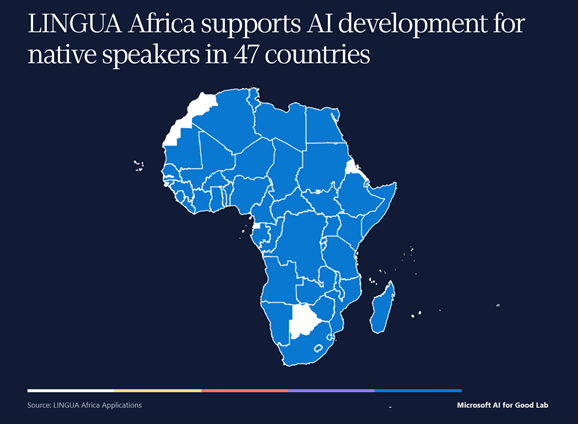
Twenty-six projects have been selected under LINGUA Africa, an initiative aimed at strengthening the language data, models and tools needed to make artificial intelligence more accessible to African communities. Together, the projects cover more than 50 African languages, dialects and sign languages spoken by more than 500 million people across 47 countries.
The initiative brings together the Microsoft AI for Good Lab, Gates Foundation, Masakhane African Languages Hub and Google.org, which are providing support designed to help African researchers, startups, universities, nonprofits and community-led organisations build language resources and practical AI applications.
The selected languages range from widely spoken languages such as Kiswahili, Hausa, Amharic, Wolof and Luganda to less digitally represented languages including Awngi, Tjwao, Doma, Medumba and Ghomala’. The projects are focused on areas where language can determine whether people can actually access and use digital services.
Healthcare, agriculture and education
Healthcare is one of the biggest areas of focus.
The World Health Organization’s Kenya-based AFYA-LINGUA project will build a community-grounded African-language layer for health covering Kiswahili, Hausa, Yorùbá, Lingala, Amharic, isiZulu, Chichewa, Wolof, Kinyarwanda and Crioulo.
At Makerere University in Uganda, researchers will build what the initiative describes as a maternal and child health speech dataset covering Luganda, Acholi, Dholuo, Dinka and Juba Arabic.
Crails will develop an open Luganda medical speech corpus and foundational models for clinical AI, while projects in Sierra Leone and Rwanda will explore AI-powered telemedicine and tools for community health workers.
Agriculture is another major focus. The Mohamed bin Zayed University of Artificial Intelligence will develop a multimodal vision-language AI system for agricultural advisory services across 10 African languages, including Hausa, Yoruba, Igbo, Twi, Wolof, Kiswahili, Amharic, Afaan Oromo, Luganda and Kinyarwanda.
In Kenya, AntuGrow will develop SemaShambani, a voice-first agricultural advisory and credit-literacy platform covering Kiswahili, Gĩkũyũ, Kikamba, Dholuo, Luhya and Kalenjin. The Alliance for a Green Revolution in Africa will also develop MlimiVoice Malawi, an AI platform designed to support smallholder farmers in Chichewa and Tumbuka.
Kenya emerges as a key participant
Kenya has several projects among the 26 selected initiatives. Besides the WHO and AntuGrow projects, Algedi Intelligence Labs has been selected for RADA, a project covering Kiswahili, Gĩkũyũ, Kamba, Dholuo, Maa, Kalenjin and Somali.
Ushahidi will work on open language resources for health and education in Tonga, Tjwao and Doma. The Kenyan projects reflect the broader objective of LINGUA Africa: creating AI resources that can work with languages people actually use in their communities rather than relying predominantly on English and other globally dominant languages.
The data problem behind Africa’s AI gap
One of the biggest barriers to developing effective AI for African languages is the lack of high-quality digital data. Many languages have limited collections of speech recordings, written material and other datasets needed to train modern AI systems. LINGUA Africa is therefore putting significant emphasis on creating open speech, text, multimodal and sign-language datasets, alongside automatic speech recognition and text-to-speech technologies.
HausaNLP, for example, will develop DialectBridge, focusing on Hausa dialects spoken in Kano, Sokoto, Zaria and Katsina. The Bantu Language Initiative will develop open voice infrastructure covering Lingala, Kituba and Kikongo in the Congo Basin. In Tanzania, Arusha Technical College will build TSL-Open, an open, community-led resource for Tanzanian Sign Language.
Other projects will develop resources for languages that have received relatively little attention from mainstream AI development, including Awngi in Ethiopia and Ghomala’, Medumba and Fe’efe’e in Cameroon.
Building AI around African realities
The 26 awardees include universities, startups, nonprofits, international organisations, research institutions and community-led initiatives.
Their projects span healthcare, agriculture, education, justice, journalism, public services and cultural preservation. That diversity points to a broader shift in African AI development: the focus is moving from simply adopting AI technologies to building the underlying infrastructure needed to make those technologies relevant to African users.
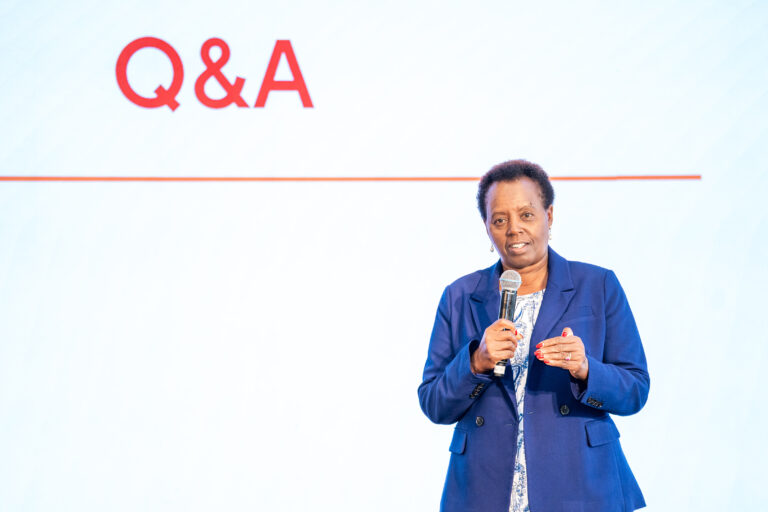
“AI only delivers value when people can actually use it, and language is the bridge,” said Inbal Becker-Reshef, Managing Director of the AI for Good Lab.
The same principle applies across sectors. An agricultural recommendation delivered in a language a farmer does not understand may never become useful advice. A health service that cannot communicate effectively with patients faces a similar limitation.
A bigger opportunity for African AI
The LINGUA Africa programme comes as governments, businesses and technology companies across the continent increase investment in artificial intelligence. But Africa’s AI opportunity is not only about building larger models or deploying more sophisticated applications.
It is also about ensuring those systems can understand the languages, cultures and contexts of the people they are designed to serve. The 26 projects selected by LINGUA Africa could help create that foundation by making more African-language data openly available and turning it into practical tools for healthcare workers, farmers, students, journalists, legal practitioners and communities.
With 50+ languages representing more than 500 million people, the initiative is targeting one of the most fundamental gaps in Africa’s AI ecosystem: making sure the continent’s linguistic diversity is represented in the technology shaping its digital future.
Before his engagement to Charlene Ruto put him in Kenya’s spotlight, Isaya Yunge had already built a career spanning youth advocacy, scholarship technology, smart-home solutions and entrepreneurship across Africa.
From speaking at the G8 at 17 to building technology ventures
Isaya Yunge is entering a new chapter in the public spotlight, but his story did not begin with his recent engagement to Charlene Ruto. It began much earlier with a teenager speaking on a global stage, a youth advocate working with UNICEF and an entrepreneur betting on technology to expand access to opportunity for Africa’s young people.
At 17, Yunge spoke at the G8 Summit in Germany, an unusually early entry into international policy and leadership circles. His appointment as a UNICEF Africa Youth Ambassador further positioned him among a generation of young Africans pushing education, entrepreneurship and youth development onto the global agenda.
Years later, he would take that experience into technology.
Turning scholarships into a technology problem
One of Yunge’s most notable ventures was SomaApp, a digital platform designed to connect students with scholarship opportunities in Tanzania and beyond.
As CEO of SOMAAPPS Technologies between 2016 and 2019, Yunge helped build a technology business around a problem familiar to millions of African students: finding and accessing educational opportunities.
The startup’s work earned continental recognition in 2017 when SomaApp won the GSMA Mobile Money Africa Hackathon award for Best Startup in Africa. For Yunge, the significance of technology went beyond building another app. It was about using digital platforms to reduce information barriers and connect young people to opportunities.
Building beyond one startup
Yunge’s entrepreneurial journey did not stop with SomaApp. He went on to co-found Smart Kaya, a technology venture focused on smart-home solutions, adding connected technology to his growing portfolio. He later became Director and CEO of SPEKI Technologies, serving from January 2022 to July 2023, where his work focused on business growth, innovation and organisational transformation.
Since 2019, he has also served as Chief Entrepreneur at GOODSAM Technologies, working across business and product development. The different ventures point to a career that has increasingly moved from youth advocacy into building and scaling technology businesses.
Keeping young people at the centre
Education and youth opportunity have remained a thread running through Yunge’s career. Since 2020, he has chaired the SOMAPP Foundation, which focuses on expanding access to education through scholarships and skills-based online resources.
That work extends the original idea behind SomaApp: technology can be used not simply to digitise existing systems, but to connect people with opportunities they may otherwise struggle to find. His career has therefore developed across three overlapping areas—technology, entrepreneurship and youth empowerment.
Recognition from Africa’s innovation ecosystem
Yunge’s work has earned recognition from both technology and leadership circles. Forbes Africa named him among its 30 Under 30, while in 2019 he was included among Tanzania’s 50 Most Influential Young Tanzanians. Those accolades came as his career was evolving from youth advocacy into technology entrepreneurship.
His trajectory reflects a wider African technology story, a generation of entrepreneurs moving between startups, social impact, digital products and business leadership while attempting to solve practical problems in their communities.
The Charlene Ruto chapter
Yunge is now attracting a new level of attention following his engagement to Charlene Ruto, daughter of President William Ruto. The couple held their engagement ceremony on Saturday, August 8, 2026, bringing his personal life into Kenya’s public spotlight. But beneath the celebrity headlines is a technology and entrepreneurship career that began years before the engagement.
From addressing global leaders at 17 to developing scholarship technology and leading technology ventures, Yunge has built a profile around a consistent theme: creating opportunities through technology and entrepreneurship. His engagement may have introduced him to a much wider Kenyan audience. His technology journey, however, was already well underway.
NTT DATA is targeting insurers looking to automate increasingly complex operations with the launch of an AI platform designed to turn underwriting, claims and customer-service workflows into governed, repeatable AI-delivered services.
The company’s new NTT DATA AI for Insurance combines configurable AI agents, insurance-specific data models and workflow orchestration through its AIVista platform, while maintaining human oversight, auditability and regulatory controls.
The move comes as Kenya’s insurance industry expands and insurers face growing pressure to improve efficiency, strengthen fraud detection and manage risk.
According to the Insurance Regulatory Authority, long-term insurance premiums increased 36.3% in the first quarter of 2026, while industry assets surpassed KES 1.1 trillion. Industry assets have also been reported to have grown 22.4% to KES 1.15 trillion, highlighting the scale of capital and operations that insurers increasingly need to manage digitally.
For insurers, the appeal of agentic AI is moving beyond chatbots and isolated automation. NTT DATA is positioning its platform as an operating layer capable of coordinating AI agents, employees, enterprise systems and business processes across core insurance functions.
“Insurance is built on human judgment that understands risk, prices fairly and stands behind promises when it matters most,” said Bruno Abril, Global Lead, Insurance Industry at NTT DATA. “AI strengthens the ability of insurers to meet that responsibility.”
The company said its platform can support underwriting, claims processing, customer service and other workflows while allowing insurers to configure the technology around their own products, processes and regulatory requirements.
It is also designed to integrate with existing carrier systems, potentially allowing insurers to introduce AI without replacing their core technology infrastructure. NTT DATA said its model-routing capabilities can similarly reduce dependence on a single foundation-model provider.
AI moves into the insurance back office
The shift is significant because insurance companies have traditionally had to balance automation with stringent requirements around risk, compliance and accountability.
NTT DATA’s 2026 Global AI Report found that 86% of insurers support AI use in back- and mid-office workflows, while two-thirds want to use AI in front-office interactions. Yet the company says most insurers have not fully industrialized agentic AI across their core operations.
NTT DATA AI for Insurance is designed to address that gap through specialized models and agents, embedded governance controls and an insurance-specific knowledge base.
The platform includes an insurance data genome intended to provide AI agents with context from submissions, policies, claims and regulatory requirements. NTT DATA also says its prebuilt and configurable agents can enable deployment into insurance workflows up to three times faster.
The company is betting that this combination of automation and control will be particularly relevant in markets such as Kenya, where insurers are simultaneously pursuing digital transformation, managing growing volumes of data and responding to rising customer expectations.
“As the East Africa market expands and customer expectations evolve, insurers are increasingly turning to artificial intelligence to enhance underwriting, accelerate claims processing, strengthen fraud detection and deliver more personalized customer experiences,” said Richard Hechle, Managing Director of NTT DATA East Africa.
“AI is no longer a future capability; it is becoming a strategic imperative for insurers looking to drive growth, efficiency and customer trust in a rapidly changing market.”
From AI tools to AI operations
NTT DATA’s strategy reflects a broader change in enterprise AI adoption: companies are increasingly looking beyond standalone AI tools toward systems that can execute multi-step business processes under defined rules and oversight.
For insurers, that could mean using AI to identify potentially high-risk claims, assist underwriters with large volumes of information or automate parts of customer-service processes, while keeping humans involved in decisions that require judgment or accountability.
Prashant Hinge, Chief Information Officer at MSIG USA, said AI could help insurers identify high-risk claims earlier, improve consistency and give claims professionals better information for decision-making.
NTT DATA said it currently serves 10 of the world’s 25 largest insurers and employs more than 12,000 insurance specialists globally.
The company has also been recognized as a leader in the HFS Horizons: Agentic Services 2026 research and the ISG Provider Lens Insurance Services 2025 report for generative-AI development and deployment services.
For Kenya’s insurers, the emergence of platforms such as NTT DATA AI for Insurance signals a shift in how artificial intelligence could be deployed across the industry — from experimental applications to governed systems embedded directly into the processes that determine how insurers assess risk, handle claims and serve customers.
OpenAI is bringing the team behind AI presentation startup NextSlide into the company, in a move that could expand ChatGPT’s capabilities beyond text and into visual communication.
NextSlide founder Ahmed Beshry announced that the startup’s team is joining OpenAI, where they will work on building ChatGPT.
Founded a little over a year ago, NextSlide developed a presentation-generation platform designed to turn prompts, notes, documents and research into polished, editable presentations.
The company positioned its technology around a broader problem than simply saving users time when creating slides: making visual communication accessible to people without professional design skills.
“Presentations help ideas move through the world,” Beshry said in announcing the move, noting that they are used to teach, persuade, share research and advance important work.
NextSlide’s approach allowed users to start with existing information rather than build presentations from scratch, potentially reducing the time and expertise required to turn research or ideas into presentation-ready material.
The team will now bring that experience to OpenAI as the company continues expanding ChatGPT into a broader productivity platform.
The move could be particularly significant for professionals, businesses, educators and researchers who increasingly use ChatGPT to transform information into usable work products.
Rather than stopping at generating written content, AI assistants are increasingly being used to create documents, analyze information, develop visual assets and support presentations.
For OpenAI, adding the NextSlide team could strengthen this broader vision for ChatGPT as a tool that helps users move from an idea to a finished piece of work.
Beshry said the NextSlide team was attracted to the opportunity to continue pursuing its original mission at a much larger scale.
“We’re excited to continue pursuing that same mission: building AI products that help people create, communicate, and turn their ideas into meaningful work,” he said.
NextSlide’s standalone journey was relatively short, having launched just over a year ago. Its integration into OpenAI demonstrates how quickly the AI industry is consolidating around products that can automate traditionally specialized creative and knowledge-work tasks.
The move also highlights the growing competition among AI companies to make their assistants useful across entire workflows rather than for isolated tasks.
For ChatGPT users, the longer-term implication could be a more seamless path from research and instructions to presentation-ready output—without having to move between multiple applications.
OpenAI has not disclosed financial terms for the deal or provided details on when NextSlide’s presentation capabilities will become available inside ChatGPT.
For NextSlide, however, the transition marks the end of its independent chapter and the beginning of a new one inside one of the world’s leading AI companies.
Beshry thanked users and supporters who helped shape the product, saying the team was “excited for what comes next.”
Kenya’s digital economy is creating new opportunities for consumers and businesses, but it is also creating more channels for fraud.
The latest consumer complaints data from the Communications Authority of Kenya shows that fraud is no longer confined to suspicious calls and text messages. It is increasingly appearing across mobile money, digital financial services, social media, personal data and other digital platforms.
Between April and June 2026, the Authority received 110 complaints relating to Digital Financial Services and Mobile Money. Of these, 86 involved fraud and scams.
At the same time, the Authority recorded 75 complaints concerning cybercrime and criminal use of ICT infrastructure. Social media generated 43 complaints, while data breaches accounted for 19. There were also 10 complaints involving confidentiality and privacy breaches and another 10 concerning unauthorized sharing of personal information.
The numbers point to an increasingly interconnected fraud environment.
According to the Authority, fraud schemes reported during the quarter included phishing, impersonation, social engineering, fraudulent mobile money transactions and online marketplace scams.
This means the communications infrastructure itself is becoming an important part of the fraud equation.
The Authority notes that fraudulent voice and data communications, cyber-enabled misuse of ICT infrastructure and online abuse demonstrate how communications networks can be exploited as conduits for financial and cyber-enabled fraud.
The response is consequently moving beyond individual consumer awareness.
The Authority says combating digital fraud requires cooperation between telecommunications operators, financial-sector regulators, financial institutions, law enforcement agencies, cybersecurity stakeholders and technology platforms. It is also pushing for stronger fraud detection, monitoring and early-warning mechanisms.
That approach reflects the changing nature of Kenya’s digital economy.
A scam can begin with a message, exploit a social-media account, manipulate a consumer into revealing information and ultimately target a mobile-money or financial account. The different systems may be operated by different companies, but the consumer experiences them as one connected digital environment.
The Authority says it is using complaint data and market intelligence to identify systemic risks, strengthen regulatory responses and inform consumer protection initiatives.
The latest numbers therefore point to a broader challenge for Kenya: as digital services become more interconnected, protecting consumers increasingly requires an equally interconnected approach to fraud prevention.
The fight is no longer simply against the scammer sending the fraudulent message. It is about securing the digital ecosystem through which that message can eventually reach a consumer’s money, identity or personal information.
East African Breweries reports one of its strongest recent performances, with net revenue rising 13% to KSh146 billion and total debt falling by KSh4.8 billion as the brewer increases shareholder returns.
East African Breweries Plc posted a sharp increase in full-year earnings, with profit after tax jumping 49% to KSh18.2 billion as revenue growth, tighter cost management and lower financing expenses lifted the brewer’s performance.
Net revenue rose 13% year-on-year to KSh146 billion for the year ended June 30, according to the company’s financial results. The increase was supported by volume growth across its beer and spirits businesses, alongside productivity initiatives and disciplined cost management.
The earnings growth significantly outpaced revenue growth, pointing to an improvement in the company’s profitability as EABL benefited from lower financing costs and continued efforts to improve productivity.
Total debt declined by KSh4.8 billion during the financial year, strengthening the group’s balance sheet and reducing its exposure to financing costs.
The results come as consumer-facing companies across East Africa continue to contend with affordability pressures, elevated household expenses and changing consumption patterns.
EABL said the macroeconomic and operating environment across East Africa remained broadly stable during the year, with relatively steady currencies, contained inflation and a more favourable interest-rate environment.
“We delivered one of our strongest performances in recent years, achieving net revenue growth of 13% to Kshs. 146 billion. Profit After Tax increased by 49% to Kshs. 18.2 billion, supported by volume growth, effective cost management, and lower financing costs, while total debt reduced by Kshs. 4.8 billion, further strengthening our balance sheet,” Group Managing Director and Chief Executive Officer Jane Karuku said.
Debt reduction gives EABL more room
The KSh4.8 billion reduction in debt is an important part of EABL’s financial performance, coming alongside the sharp increase in profit.
Lower debt and financing costs can provide the brewer with greater flexibility to invest in its brands and operations while improving the resilience of its balance sheet.
EABL said its performance was driven by the breadth of its portfolio, market reach and disciplined execution across the business.
The company’s portfolio spans beer and spirits, giving it exposure to multiple segments of the alcoholic beverages market across East Africa.
Dividend rises 59%
The stronger earnings are also translating into higher returns for shareholders.
EABL’s share price increased 43% during the financial year, closing at KSh269 on June 30. The board recommended a final dividend of KSh8.7 per share, subject to withholding tax.
That takes the total dividend for the year to KSh12.70 per share, representing a 59% increase from the previous financial year.
The higher payout underscores the improvement in EABL’s earnings while giving investors a larger return following a year of strong financial performance.
Affordability remains a challenge
Despite the strong results, EABL continues to operate in an environment where consumers face pressure on disposable incomes.
The company said inflationary pressures eased toward the end of the year, although energy and food costs remained elevated.
EABL also highlighted growing concerns around illicit alcohol consumption, reinforcing the need for continued collaboration between governments, regulators and industry players.
The issue presents both a regulatory and commercial challenge for established alcohol manufacturers, which compete against products outside the formal and regulated market.
Regional portfolio supports growth
EABL’s business is concentrated in three core markets — Kenya, Uganda and Tanzania — while its products are sold in more than 10 countries across Africa and beyond.
Its portfolio includes Tusker, Guinness, Bell Lager, Serengeti, Kenya Cane, Chrome, Johnnie Walker, Captain Morgan and Smirnoff.
The breadth of the portfolio gives EABL exposure to both mainstream and premium segments of the market and allows the company to pursue growth across different consumer categories.
The brewer said its performance ambition remains focused on being one of Africa’s best-performing and most trusted consumer products companies.
Outlook
EABL remains optimistic about its prospects but expects consumer affordability pressures and fiscal challenges to remain factors in the operating environment.
The company said it remains confident in its strategy and ability to capture growth opportunities across the region.
“We remain well positioned to deliver sustainable growth through our diversified portfolio, market-leading brands and talented teams,” Karuku said. “As we continue to invest in our business and our communities, we are confident in our ability to create long-term value for shareholders while contributing positively to the socio-economic development of East Africa.”
For investors, EABL enters the new financial year with a combination of stronger earnings, higher shareholder distributions and a lower debt burden.
The 49% increase in profit, against 13% revenue growth, also signals that the brewer’s cost and productivity measures are beginning to translate into stronger bottom-line performance.
Africa’s creator economy is growing rapidly, but for many creators, turning influence and expertise into sustainable income remains difficult. Global platforms were largely built around payment systems such as PayPal and Stripe that do not work reliably across much of the continent, leaving creators to depend on fragmented tools to connect with paying audiences.
It is this gap that Andrew Kibe, a technology leader with experience building digital and financial infrastructure across Africa, is seeking to address with Inner Circle, a platform designed to help creators monetise their expertise through paid sessions, subscriptions, priority messages and group experiences.
Founded in May 2026 and already serving creators across eight African markets, Inner Circle is betting that the next chapter of Africa’s creator economy will be built on infrastructure designed for Africa from the start.
TechMoran caught up with Kibe and this is what he told us.
When was Inner Circle founded and what inspired you to do this?
Inner Circle was founded in May 2026 by Andrew Kibe and a small founding team based in Nairobi, Kenya. I am a seasoned technology leader and engineer with over two decades of experience shaping Africa’s digital and financial ecosystems. As Group CTO at 4G Capital, a leading African neobank, I steered the company’s technology vision and infrastructure, contributing to its growth and successful fundraising of over $23.1 million.
Previously, I was instrumental in the rise of TopUp Mama, driving its tech strategy and execution as the company scaled rapidly to $4.8 million in sales within 18 months and raised over $2.7 million in funding. Most recently, as CTO at Lemonade, one of Kenya’s mobile payment platforms, I led engineering for cross-border payment rails across multiple African markets. My career reflects a rare blend of technical depth, strategic leadership, and a proven track record of building scalable systems that power real impact across Africa’s emerging markets.
The inspiration for Inner Circle came from a simple observation: Africa has an enormous creator economy comprised of musicians, coaches, entrepreneurs, doctors, lawyers, fitness experts but almost none of the monetisation infrastructure that exists in the West works reliably for them. Platforms like Patreon and Cameo require PayPal or Stripe, both of which are either unavailable or unreliable across most of Africa.
African creators were giving away their expertise for free on Instagram and TikTok with no way to convert it to income. Inner Circle was built to fix that.
Is the company bootstrapped or venture capital funded?
Inner Circle is currently bootstrapped and founder-funded. We made a deliberate decision to build and validate the model with real creators and real revenue before raising external capital. The platform is live, processing real transactions, and growing organically. We are open to strategic conversations with investors who understand the African creator economy and the payments infrastructure required to serve it.
How many registered users so far?
Inner Circle has 109 active vetted creators on the platform across Kenya, Nigeria, Ghana, Uganda, Tanzania, Zambia, Senegal and Benin, with over 2,000 registered fans. We are selective, every creator is reviewed and approved personally. We are not a marketplace where anyone can sign up. This keeps quality high and protects fans from wasting money on creators who are not serious about their time. So far, more than 600 sessions have been handled through the platform, giving people the opportunity to have direct, paid conversations with experts they already follow or want to learn from.
How does the revenue-sharing model work between Inner Circle and creators?
Creators keep 90% of every transaction, sessions, subscriptions, priority DMs, paid questions, and group rooms. Inner Circle takes 10%. This is the best split in the industry. Cameo takes 25%. Patreon takes up to 12% plus payment processing fees that can push the effective take to 20%+ in practice. Intro.co takes 20% on every booking. Passes.com takes between 15–20% depending on the creator’s tier. On Inner Circle, a creator charging KES 1,500 for a session receives KES 1,350 directly to their mobile wallet, same day. There are no monthly fees, no setup costs, and no minimum earnings threshold to receive a payout.
Which countries are officially supported?
Inner Circle currently supports Kenya (KES), Nigeria (NGN), Ghana (GHS), Uganda (UGX), Tanzania (TZS), Zambia (ZMW), Senegal (XOF) and Benin (XOF), 8 markets across East, West and Southern Africa. Payments are processed via mobile money and bank in each market. We are actively expanding and have the infrastructure to add new African markets rapidly.
What differentiates Inner Circle from similar platforms? Why should African creators choose it over these existing alternatives?
Most platforms serving African creators are either global tools that barely work in Africa such as Patreon, Cameo, Calendly + PayPal or local solutions that solve one problem booking or payments but not both together.
Inner Circle is the only platform built end-to-end for African creators that combines:
1. Native mobile money & bank payments — M-Pesa, MTN MoMo, Airtel Money and others, with no card required
2. Multiple income streams in one place — 1-on-1 sessions, subscriptions, priority DMs, paid questions, and live group rooms
3. Same-day payouts — directly to mobile money, and bank account
4. Built-in video — sessions happen on Inner Circle, not a third-party tool the creator has to manage separately
5. Multi-market from day one — a Kenyan creator can receive a booking from a fan in Nigeria, Ghana or Uganda and get paid in their local currency
The closest local comparison would be assembling Calendly + M-Pesa PayBill + Zoom + WhatsApp Business but Inner Circle replaces all of that with one link.
What safeguards are in place to protect creators and users against fraud, abuse or chargebacks?
Several layers of protection are built into the platform:
● Creator vetting — every creator is manually reviewed and approved before going live.
Fans know they are booking a real person, not a ghost account.
● No-show protection — if a creator misses a session without notice, the fan isautomatically refunded in full. If the fan misses, the creator is still paid.
● Payments via regulated infrastructure — all payments go through LemonadePayments,a crossborder payments platform. Funds are not held on our platform.
● Session recording consent — sessions happen on our inhouse powered videoinfrastructure with clear consent flows.
● Dispute resolution — fans can flag sessions and our team reviews attendance datafrom the video platform to resolve disputes objectively.
● Refund channels — every market has a configured refund channel. Refunds areprocessed back to the original payment channel within 24 hours.
What is the roadmap for Inner Circle over the next 12 months?
Our priorities over the next 12 months:
1. Market expansion — South Africa (ZAR) and Egypt (EGP) are next. We are in conversations with payment partners for both markets.
2. Strategic Partnerships — working with talent management agencies, media houses, and creator networks across Africa to bring established talent onto Inner Circle with managed profiles, dedicated booking support, and co-marketing. This includes partnerships with platforms like Aktivate to tap into their existing roster of verified African creators and give them a direct monetisation channel.
3. Fan communities — giving creators a space to host their subscribers beyond individual sessions.
4. Creator storefront — enabling creators to sell digital products directly through their Inner Circle profile — templates, guides, presets, courses, and downloadable content — giving fans a way to buy from their favourite creators without booking a live session, and giving creators a passive income stream alongside their session earnings.
5. Creator discovery — improving how fans find the right creator through intent-based search and category browsing.
6. Group rooms at scale — enabling creators to host paid live sessions with up to 1,000 participants.
7. Referral and gifting — letting fans gift sessions to others, and rewarding fans who bring new creators or fans to the platform.
8. Low-bandwidth mode — optimising the video experience for users on 3G connections across Africa.
9. Mobile apps — native iOS and Android apps for both creators and fans.
10.Creator Analytics Dashboard — giving creators deeper insight into their earnings, fan behaviour, session completion rates, and subscription churn so they can make smarter decisions about their content and pricing.
11.Verified creator programme — a structured tier system that rewards top-performing creators with higher visibility, lower platform fees, and promotional support from Inner Circle.
12.Localised content and onboarding — onboarding flows, support, and creator resources in Swahili, Yoruba, Twi and French to serve our expanding francophone West African markets (Senegal, Benin, and Côte d’Ivoire).
13.Brand partnerships — enabling brands to sponsor creators directly through the platform, opening a new revenue stream for creators beyond fan payments.
Payments are broken in Africa despite thousands of fintech platforms. How do you aim to fix this?
This is the core problem Inner Circle was built to solve, and it shaped every infrastructure decision we made from day one. Let’s be clear about what is actually broken. The problem is that global platforms were never designed for African payment infrastructure. They assume Stripe, PayPal, or a Visa card, none of which work reliably across most of Africa. When PayPal cuts off users or Stripe declines African cards, creators lose access to their income overnight. That is not a payment problem. That is a dependency problem.
Inner Circle was built to eliminate that dependency entirely. Our entire payment infrastructure runs on African mobile money and bank rails through Lemonade, a payments platform operating across more than 8 African markets. We have no Stripe integration. No PayPal dependency. No exposure to the decisions of Western payment companies.
Our approach in practice:
● Same-day payouts — creators receive their earnings directly to M-Pesa, MTN MoMo,Airtel Money, or a bank account on the same day a session completes. No 3–5 day delays, no minimum balance to unlock a withdrawal.
● Transparent, low fees — 1.5% collection fee on KES transactions with a flat KES 20payout fee. No hidden charges, no percentage taken on withdrawals.
● True multi-currency — a creator in Nairobi can receive a booking from a fan in Lagos,Accra, or Kampala. Each party pays and gets paid in their local currency. No manual conversion, no wire transfers, no friction.
The broader challenge across Africa is infrastructure fragmentation — every country has different rails, different regulators, and different mobile money operators. Most platforms treat this as a reason not to expand. We treat it as The Opportunity. By building on Lemonade’s unified infrastructure, we can add a new African market in days, not months. A creator on Inner Circle today has access to fans across 8 countries. Within 12 months, that number will be significantly higher.
The payments problem in Africa is not unsolvable. It just requires building with Africa in mind from the start, not retrofitting a Western product for a market it was never designed for. That is exactly what we did.
Three Kenyan startups are among 16 ventures selected as regional finalists for the 2026 American Society of Mechanical Engineers Innovation Showcase (ASME ISHOW), putting Kenya at the centre of a global cohort of hardware startups developing solutions for agriculture, healthcare, mobility, food storage and environmental challenges.
Ecomobilus Technologies Limited, KilimoChills Solution and Orienta, all based in Nairobi, are among eight African ventures and eight ventures from the Americas selected for the accelerator following online pitches and design and engineering reviews conducted between July 6 and August 6.
The 16 finalists will compete for six places in the 2026 global ISHOW cohort. Those selected will receive a share of grant funding, technical support, design services and access to ASME’s international network of engineering and industry experts.
The finalists will be announced during a virtual awards ceremony on August 11, with Jit Bhattacharya of Kenyan electric-mobility company BasiGo scheduled as the guest speaker.
Ecomobilus Technologies is taking to the accelerator its e-Mkoko, a solar-powered electric handcart designed for last-mile logistics. The technology targets informal traders who rely on manual transportation to move goods, potentially reducing physical labour while improving the efficiency of small-scale commerce.
KilimoChills is addressing a different infrastructure problem: food spoilage. Its solar-powered cold storage room is designed as a modular solution for small-scale food vendors, providing refrigeration without relying entirely on conventional electricity infrastructure.
Orienta’s technology focuses on accessibility. Its HVAD smart glasses are designed to help visually impaired people navigate streets, identify people and access information through an offline, hands-free platform.
Together, the three Kenyan ventures reflect a broader shift in the country’s technology ecosystem toward physical products designed around specific infrastructure and social challenges.
The African finalists also include BMTA&C Energy from Morocco, which has developed a solar-powered refrigeration system combining thermal storage and intelligent energy management; Kumva Insights from Rwanda, whose Farm Smarter Platform uses sensors and IoT technology to help farmers and agribusinesses monitor environmental and operational conditions; Team CannaSave from Uganda, which has developed a monitoring system to detect neonatal nasal cannula displacement; and Yaaka Investment Limited from Zambia, which is developing an e-waste recycling plant.
AISHA, based in Pennsylvania, is the eighth African-region finalist despite being headquartered in the United States. Its technology uses an AI-powered voice assistant deployed on low-cost hardware to provide healthcare information to patients and healthcare workers in underserved communities.
The Americas finalists span a similarly broad range of technologies.
Aetheria, based in the Netherlands, has developed MonoFoam, a mobile system designed to capture gases from end-of-life insulation foam while recovering materials for reuse and recycling. Amel Energyv in Massachusetts is developing PFAS-free materials intended as alternatives to conventional binders and solvents used in lithium-ion battery manufacturing.
H2O Now is working on a solar-powered portable water generator designed to produce potable and agricultural water in water-scarce environments. Kinnections in Texas has developed a wearable glove using controlled fingertip vibrations for people living with Parkinson’s disease.
Other finalists include NeoTex, which has developed a sensor-equipped infant garment for monitoring vital signs; Ocean Made, whose biodegradable Kelp Pots are designed to reduce plastic use in plant production; Tap Energy, which is developing an in-pipe micro-hydroelectric turbine for industrial water systems; and Canada’s WeavAir, an environmental and infrastructure monitoring platform designed to support asset management and climate-risk monitoring.
The final six ventures will become part of ASME’s 2026 global ISHOW cohort and will participate in the organisation’s annual ISHOW Bootcamp during the winter.
The bootcamp will provide customised design and engineering reviews aimed at helping the ventures move from prototypes and early-stage products toward commercial scale. Participants will also receive design services and become members of the ISHOW alumni network.
For Kenyan startups, the programme offers a route into an international hardware ecosystem at a time when the country’s technology sector is increasingly moving beyond software and mobile applications.
The three selected companies operate in markets where hardware remains critical to solving problems that cannot be addressed through digital platforms alone: moving goods, preserving food and improving independent mobility for people with visual impairments.
ASME will hold the third regional ISHOW event in Chennai, India, on September 3–4 alongside the ASME International Mechanical Engineering Congress and Exposition. Ventures selected across the Africa, Americas and India regional events will form the 2026 global cohort.
The awards ceremony for the Africa and Americas finalists will take place virtually on August 11 at noon Eastern Daylight Time.
Clea, a Nigerian cross-border payments startup has launched Vendor Payments, a new feature designed to help businesses pay international suppliers, vehicle auction platforms and shipping companies directly through its platform, as it expands beyond foreign exchange and cross-border transfers into broader trade finance infrastructure.
The launch comes as the company reports strong early growth. Clea says it processed more than $20 million in transaction volume within six months of emerging from stealth in December 2025. The new Vendor Payments feature has already been adopted by more than 50 businesses during its pilot phase, highlighting demand for simpler ways to settle overseas supplier invoices.
The feature enables businesses to pay supported vendors, including U.S. vehicle auction platforms Copart and IAA, directly from their Clea accounts. Customers select a vendor, enter payment references such as buyer numbers, lot numbers or invoice details, and authorize the transaction. Because vendor details are preconfigured within the platform, payments can be completed without manually entering beneficiary banking information. Clea said it plans to add more suppliers and payment destinations over time.
The company said the launch reflects its strategy of building a single platform for African businesses managing international trade. By integrating supplier payments alongside cross-border transfers, Clea aims to reduce the operational complexity businesses face when sourcing goods from overseas markets.
“African businesses are increasingly trading across borders, but managing international supplier payments remains unnecessarily fragmented,” said Sheriff Adedokun, Founder and CEO of Clea. “We’re building more than a payments platform. We’re building the financial infrastructure businesses need to trade globally with confidence.”
Initially, Vendor Payments is available to eligible verified Clea business customers making U.S. dollar payments to selected suppliers in the United States. Businesses can fund their Clea accounts in Nigerian naira, convert funds into foreign currency within the platform and complete international payments through a single workflow.
The launch places Clea among a growing group of African fintech firms expanding beyond remittances and foreign exchange into integrated business banking and trade infrastructure. As cross-border commerce continues to grow, platforms are increasingly competing to offer businesses end-to-end services ranging from payments and foreign exchange to invoice management and supplier financing.
Clea said future updates will expand its global vendor network, allowing businesses to discover approved suppliers, manage invoices, build trusted vendor relationships and automate recurring international payments through a unified platform.
You might forget your Android unlock pattern after not using it for a while. You can also become locked out by entering the wrong PIN too many times. As a result, you may be locked out of your device and unable to access your apps, files, or personal data.
In such situations, if you wonder how to unlock an Android phone, this practical guide will help you out. Learn what the lockout means and how Dr.Fone – Screen Unlock (Android) outshines traditional unlock methods.
Part 1. Android Lock Mechanisms: What You’re Up Against
Android phones use PINs, patterns, passwords, and biometrics to protect your device. However, forgetting your screen lock credentials can leave you locked out. Your PIN, pattern, or password helps protect encrypted data, making it inaccessible without the correct credentials. Biometrics provide convenient access but still require your primary screen lock after a restart or certain security events.
These lock options are protected by Android’s built-in security features, including hardware-backed protection on supported devices. Hence, the basic tricks cannot bypass any Android screen lock.
Part 2. Will Your Data Survive the Unlock Process?
When an Android mobile unlock attempt is made, your local data will be removed right away. This is because modern Android devices automatically encrypt your storage via lock credentials. So, when you bypass biometric or PIN protection with a factory reset, it deletes the encryption keys and wipes the device.
That means any local files, photos, or app data that weren’t backed up will be permanently lost. Nonetheless, your contacts, emails, and photos associated with your Google Account will remain safe on Google’s remote servers. Once synced to your Google account, you can download them again as you log in after the reset, according to Google.
Part 3. Comparing Solutions — Official Routes vs Faster Alternatives
For those wondering how to unlock an Android phone, it’s important to understand the available options. Some official methods require a factory reset or have device and Android version limitations. Others only work if you previously enabled features such as Find My Device.
On the other hand, Android screen unlock software offers a faster alternative for many supported devices. Using a USB connection, they can remove supported screen locks in just a few minutes with step-by-step guidance, making the process easier for most users.
Part 4. How to Unlock Your Android Phone with Dr.Fone
To unlock an Android Phone with software, useDr.Fone – Screen Unlock (Android), which supports 29 brands for screen lock removal and 19 for FRP. It supports multiple Android screen lock types, and its AI-powered FRP removal feature is available for Samsung devices running Android 16, including the Galaxy S26 and S25 series. It is among the first tools to offer this capability for supported Samsung Android 16 devices.
In addition to modern models, it also supports legacy phones, like TECNO, Infinix, and Itel, for FRP. With support for over 2000+ Android phones and tablets, Dr.Fone enables users to use a special mode on most Android models to unlock the device automatically. For all the locks and models, the guides are separate and detailed, and can be unlocked without any technical skills required.
Key Features
Weekly Updates: The tool receives weekly updates to improve compatibility with newer Android phones and tablets. Recent updates have added support for Samsung Android 12 screen unlock and Wiko devices.
Online FRP Bypass: Samsung Snapdragon device users can also remove the FRP online, and the simple interface makes navigation effortless.
Screen Unlock Without Data Loss: On Samsung and LG models, you can remove any screen lock without data loss; other tools are limited to Samsung only.
US Model and Chipset Support: The tool supports all the US Samsung models and chipsets, like MTK / Qualcomm / Exynos.
Dr.Fone Screen Unlock Guide for Most Android Device Brands
For the Android mobile unlock, review this section and learn how this tool automates the process using Special Mode:
Step 1. Consider the Unlock Android Screen Option
In the Screen Unlock tool for Android, select the “Unlock Android Screen” option and choose the Android brand in the new interface. Following this, you need to click the “100% Remove Screen Lock” feature.
Step 2. Access Special Mode to Unlock with Dr.Fone
After that, you will be automatically directed to activate the “Special Mode,” where Dr.Fone will unlock the device within 10 minutes, without any manual hassle.
Device Unlocked — What to Do Next
To sum up, hardware chips and data encryption can cause regular unlock tricks to fail. As a result, you can use Dr.Fone – Screen Unlock (Android) to unlock an Android Phone in Special Mode. After the device is unlocked, log back into the primary Google account to restore the synced data. Finally, prevent future issues and set up a screen lock with easy, accessible PINs and biometrics.
TVS Motor Company is entering Africa’s electric two-wheeler market with the launch of its iQube electric scooter in Kenya, as the Indian manufacturer seeks to expand beyond its established markets and tap growing demand for lower-cost urban transport.
The company introduced the iQube in Nairobi on Aug. 6, making Kenya its first African market for the electric scooter. The model will be sold through Car & General, TVS Motor’s long-standing local partner, and supported by its nationwide sales and after-sales network.
The launch comes as Kenya’s two-wheeler market faces rising fuel costs and increasing interest in electric mobility. Car & General Chief Executive Officer Vijay Gidoomal estimates that Africa’s broader two-wheeler market could expand at an annual rate of about 7% to 10% through 2030, while electric two-wheelers could grow between 15% and 25% over the same period.
“EV penetration is still low relative to the size of the industry but the conditions are rife for its growth and the runway promises to be extremely long,” Gidoomal said.
The iQube will be offered in two variants, the iQube 3.5 and iQube 2.2. The higher-capacity model has a 3.5-kilowatt-hour battery and a claimed real-world range of 115 kilometers, while the 2.2-kilowatt-hour version can travel about 75 kilometers on a charge.
Both models use a 4.6-kilowatt hub-mounted motor. The iQube 3.5 has a top speed of 82 kilometers per hour and can accelerate from zero to 40 kilometers per hour in 4.2 seconds. The 2.2 version has a top speed of 75 kilometers per hour.
The scooters can be charged using a portable charger connected to a standard household electrical outlet. The iQube 3.5 takes about two hours and 55 minutes to charge from zero to 80%, while the smaller battery takes about two hours.
TVS is also positioning the iQube as a connected vehicle rather than simply an electric replacement for a petrol scooter. Its SmartXonnect platform provides navigation, ride information and charging data, while additional features include geofencing, anti-theft protection and crash and fall alerts.
The scooters come with reverse and forward parking assistance, a five-inch digital display and up to 32 liters of under-seat storage. Both models use lithium-ion batteries with battery-management protection and IP67-rated water and dust resistance.
TVS said Kenyan riders could save about 47,000 shillings ($365) a year in energy and maintenance costs compared with a conventional 125cc petrol-powered scooter.
The company is also highlighting the scale of the iQube’s global rollout. More than one million customers have used the model worldwide, collectively covering more than 17.8 billion kilometers, according to TVS. The company estimates that the vehicles have helped avoid about 623,595 metric tons of carbon dioxide emissions.
For TVS Motor, the Kenya launch represents a broader push into electric mobility outside India. The company operates in about 90 countries and has manufacturing facilities in India and Indonesia.
“Driven by our vision to transform lives through exciting, responsible, and sustainable mobility, we are proud to introduce the TVS iQube in Kenya, marking our entry into the African market,” Peyman Kargar, president of international business at TVS Motor, said.
The iQube will be sold through Car & General dealerships in Kenya with a two-year or 30,000-kilometer warranty, whichever comes first. The company did not disclose pricing in the announcement.
Kenya has become one of Africa’s more active markets for electric two-wheelers, helped by relatively low operating costs and the suitability of motorcycles and scooters for urban transport and delivery services. TVS’s entry adds another established international manufacturer to a market increasingly attracting electric-mobility companies.
The company will be betting that the combination of lower running costs, charging from conventional household outlets and connected features can persuade urban Kenyan riders to switch from petrol-powered two-wheelers.
The TVS iQube will be available in 2 model variants – TVS iQube 3.5 and TVS iQube 2.2.
Specifications
TVS iQube 3.5
TVS iQube 2.2
Peak Power
4.6 kW
4.6 kW
No. of Batteries/Type
Two / Lithium-Ion
One / Lithium-Ion
Battery Capacity
3.5 kWh
2.2 kWh
Range Per Charge
Real world range of 115 kms.
Real world range of 75 kms.
Top Speed
82 km/h
75 km/h
Acceleration 0-40 km/h
4.2 s
4.2 s
Parking Assist
Reverse / Forward
Reverse / Forward
Peak Torque
140 Nm
140 Nm
Safety
BMS-Controlled Protection System & IP67 Waterproofing
BMS-Controlled Protection System & IP67 Waterproofing
Why intelligent detection, automated response and unified security platforms are redefining enterprise cyber defence
Artificial intelligence (AI) has fundamentally changed the cybersecurity landscape. While organisations are harnessing AI to improve productivity, automate workflows and accelerate digital transformation, cybercriminals are using it for faster and highly targeted attacks.
With AI, hackers are able to send more personalized and convincing phishing emails to unsuspecting users. Hackers are also using AI to create malware that can evade traditional detection methods. AI helps hackers to automate attacks and exploit vulnerabilities at unprecedented speed.
According to a report co-authored by Oxford University, Cambridge University, OpenAI, the Electronic Frontier Foundation and the Center for a New American Security, Artificial intelligence and machine learning (ML) are altering the landscape of security risks for citizens, organizations, and states.
“Malicious use of AI could threaten digital security (e.g. through criminals training machines to hack or socially engineer victims at human or superhuman levels of performance), physical security (e.g. non-state actors weaponizing consumer drones), and political security (e.g. through privacy-eliminating surveillance, profiling, and repression, or through automated and targeted disinformation campaigns),” it reads.
“It is often the case that AI systems don’t merely reach human levels of performance but significantly surpass it. It is troubling, but necessary, to consider the implications of superhuman hacking, surveillance, persuasion, and physical target identification, as well as AI capabilities that are subhuman but nevertheless much more scalable than human labour,” said Miles Brundage, Research Fellow at Oxford University’s Future of Humanity Institute.
For enterprise security teams, this marks a turning point. Traditional security strategies built around prevention cannot keep pace with modern threats. With AI, cyberattackers are able to automate vulnerability discovery, launch sophisticated cyberattacks, improve target selection, evade detection, and creatively respond to changes in the target’s behavior.
Despite the efficiency, scalability, and ease of diffusing AI technologies, the dual-use nature of AI means the same characteristics of AI that enable large-scale and low-cost attacks also allow for more scalable defenses. AI-enabled defenses such as spam filters and malware detection, as well as others that are being developed and widely deployed. With AI, cybersecurity is shifting from simply blocking threats to continuously detecting, investigating and responding to suspicious activity.
This evolution has placed Endpoint Detection and Response (EDR) and Extended Detection and Response (XDR) at the centre of modern enterprise security.
Why Traditional Antivirus Is No Longer Enough
Conventional antivirus solutions remain an important component of enterprise security, but they were designed for an era when most attacks relied on known malicious files. Today’s threat actors increasingly employ fileless attacks, credential theft, ransomware, insider abuse and “living-off-the-land” techniques that use legitimate operating system tools such as PowerShell and Windows Management Instrumentation (WMI) to carry out malicious activities.
Because these techniques often involve trusted applications rather than recognisable malware, signature-based detection alone is no longer sufficient. Security teams require visibility into how systems behave, not just whether malicious files exist.
This shift has made behavioural analytics one of the most important advances in modern cybersecurity. Instead of asking whether a file is malicious, AI-powered security platforms now monitor anomalies in the process, device or user behaviour. Using AI, cybersecurity analysts can track and purge unexpected privilege escalation, unusual PowerShell execution, abnormal data transfers or suspicious authentication attempts before ransomware is deployed or sensitive information is stolen.
How EDR Changes Endpoint Security
Using AI, Endpoint Detection and Response extends endpoint protection by continuously collecting telemetry from laptops, desktops, servers and virtual machines. It monitors, records and analyzes every significant event such as process execution, registry modification, network connection, user authentication and application activity to identify any malicious behavior.
Unlike traditional antivirus, EDR provides security teams with a detailed timeline of an attack. Analysts can trace where a compromise began, understand how an attacker moved through the environment and identify every affected endpoint.
An EDR platform detects the unusual activity, correlates it with outbound network connections and flags the behaviour as suspicious. Rather than generating isolated alerts, it reconstructs the attack chain, enabling analysts to isolate the endpoint, terminate malicious processes and prevent the attacker from moving deeper into the network.
This level of visibility dramatically reduces investigation time while improving incident response.
Why XDR Represents the Next Evolution
While EDR focuses on endpoints, modern attacks rarely remain confined to a single device. A compromised user account may access cloud applications, authenticate through identity platforms, communicate via corporate email and interact with multiple servers before security teams realize an attack is underway.
Extended Detection and Response (XDR) addresses this challenge by bringing together telemetry from endpoints, email systems, cloud workloads, identity providers, servers and network infrastructure.
Instead of forcing analysts to investigate separate alerts across multiple security products, XDR automatically correlates related events into a single incident.
A phishing email, suspicious Microsoft 365 login, abnormal endpoint behavior and unusual cloud activity may appear unrelated when viewed independently. XDR links these events together, providing analysts with a complete picture of the attack and enabling faster, more informed response decisions.
This ability to correlate events across the enterprise is becoming increasingly valuable as organizations adopt hybrid and multi-cloud environments where visibility is often fragmented.
As enterprise cyberattacks become faster and more sophisticated, organizations are looking beyond standalone security tools toward platforms that can consolidate prevention, detection, investigation and response. This is the philosophy behind Kaspersky Next, the company’s flagship enterprise cybersecurity portfolio that combines enterprise-grade endpoint protection with EDR, XDR, cloud security and AI-assisted investigation in a single platform. Designed as a scalable solution, organizations can begin with advanced endpoint protection and progressively adopt more sophisticated EDR and XDR capabilities as their security maturity grows.
According to Kaspersky, one in three organizations plans to integrate EDR or XDR into their Security Operations Centres (SOCs) as businesses seek better visibility, faster investigations and more proactive defense against increasingly sophisticated attacks. Kaspersky Next also reflects a growing industry shift towards integrated security operations.
Kaspersky uses predictive algorithms, machine learning, neural networks, clustering techniques and statistical modelling to improve threat detection accuracy, prioritize incidents and accelerate both Mean Time to Detect (MTTD) and Mean Time to Respond (MTTR). These AI capabilities help reduce alert fatigue by identifying the threats that require immediate attention while automating routine investigation tasks.
Download this Whitepaper to find out how Kaspersky Next can help your organization to cut infrastructure resource requirements by up to 30% with Kaspersky Next EDR Expert deployments and by up to 60% with Kaspersky Next XDR Expert deployments. Kaspersky Next EDR Expert is trusted by more than 600 enterprise customers protecting over 2.5 million endpoints worldwide, while its detection engine is supported by more than 1,900 detection rules developed and continuously maintained by Kaspersky’s global Security Operations Centre. At the XDR level, the platform includes more than 2,700 preconfigured detection rules and over 300 integrations with third-party technologies.
Kenyan used-car marketplace Peach Cars has secured approximately Sh517 million (¥600 million/US$4 million) in debt financing from Japan Finance Corporation (JFC) and Shoko Chukin Bank, strengthening its balance sheet as it accelerates expansion across Kenya. The financing comes just over a year after the company raised an US$11 million Series A round led by Suzuki Global Ventures.
The fresh capital will be used to expand Peach Cars’ vehicle inspection network, improve access to auto financing, and scale its online marketplace. The company also plans to grow its branch footprint and invest further in its proprietary inspection technology, which is designed to bring greater transparency and trust to Kenya’s fragmented used-car market.
Peach Cars currently lists more than 1,500 vehicles and has built its business around comprehensive vehicle inspections, digital valuations, secure transactions, and financing services. The company says the latest funding will allow it to deepen these offerings while making car buying and selling more accessible for Kenyan consumers.
The lenders’ backing follows an on-the-ground assessment of Peach Cars’ operations in Nairobi. According to the company, executives from Shoko Chukin Bank visited its inspection facilities before approving the financing, citing confidence in the firm’s Japanese-quality inspection processes and locally built operating model.
The debt financing reflects growing interest from Japanese financial institutions in African mobility startups. Rather than raising additional equity, Peach Cars has opted for debt financing to fund its next phase of growth while limiting shareholder dilution, a strategy that could become more common among maturing African startups with proven business models.
Guinea launched NimbaPay, its first national instant payment network, giving banks, mobile money providers and microfinance institutions a shared platform to process real-time transactions as the West African nation accelerates efforts to modernize its financial system.
The platform was developed by the Central Bank of the Republic of Guinea and implemented by Guinéenne de Monétique. It enables interoperable payments across participating financial institutions, allowing customers to transfer money instantly regardless of where their accounts are held.
The launch is aimed at reducing the country’s dependence on cash while widening access to affordable digital financial services. By replacing a fragmented payments landscape with a single national infrastructure, authorities expect the system to improve efficiency, lower transaction costs and support broader financial inclusion for consumers and businesses.
NimbaPay was built on the open-source Mojaloop platform with technical and strategic support from AfricaNenda Foundation, which has backed the rollout of instant payment systems across the continent. The foundation said Guinea joins Rwanda and Liberia among African countries that have deployed national interoperable payment infrastructure with its support.
The rollout also supports Guinea’s Simandou 2040 development strategy, which seeks to diversify the economy and strengthen digital public infrastructure alongside the development of the country’s vast iron ore resources. Future phases of the platform are expected to introduce government payments, public administration services and regional cross-border transaction capabilities.
“Each new instant payment system brings us closer to an Africa where individuals and businesses can transfer money instantly, safely and affordably,” Robert Ochola, managing director of AfricaNenda, said in a statement. “We are confident that NimbaPay will expand access to digital financial services, drive innovation and create new opportunities for individuals and businesses throughout Guinea.”
Guinea’s launch comes as governments and central banks across Africa accelerate investments in national instant payment infrastructure to improve financial inclusion and reduce the cost of digital transactions. Countries including Ghana, Nigeria, Tanzania, Kenya, South Africa, Ethiopia, Mauritius and Zambia have rolled out interoperable payment systems that connect banks and, in many cases, mobile money operators, enabling real-time transfers across different financial institutions.
Nigeria’s NIBSS Instant Payment (NIP) is among the continent’s largest real-time payment networks, while Ghana’s GhIPSS Instant Pay pioneered interoperability between banks and mobile money providers. Tanzania’s TIPS, Kenya’s PesaLink and South Africa’s PayShap have similarly expanded instant retail payments, reflecting a broader shift toward digital public infrastructure across Africa.
The continent is also moving beyond domestic interoperability. Regional initiatives such as the Pan-African Payment and Settlement System (PAPSS), backed by Afreximbank, are working to connect national payment networks, allowing businesses and consumers to make cross-border payments in local currencies without relying on correspondent banking networks. Guinea’s planned expansion of NimbaPay to support regional transactions aligns with that broader push toward an integrated African payments ecosystem.
PalmPay, an Africa-focused fintech is reportedly preparing for a potential Hong Kong initial public offering (IPO), according to a Bloomberg report, as the fintech looks to raise fresh capital to support its international expansion and strengthen its position in emerging markets.
PalmPay is reportedly seeking to raise about $200 million at a more than $1 billlion valuation, joing the likes of African heavyweights Jumia, Flutterwave, Moniepoint among others. TechMoran has not established the details of the IPO as the plans are still under discussion, and details including the timing of the IPO and the banks involved have not been finalized.
Founded in 2019 in Nigeria, PalmPay offers payments, money transfers, savings, credit, insurance and merchant solutions to over 35 million registered users and about 1 million business customers. With operations in Nigeria, Tanzania, Ghana, South Africa and Bangladesh, PalmPay aims to become one of Africa’s fastest-growing digital financial services platforms.
PalmPay is a product of Transsion Holdings, the parent company of TECNO, Infinix and Itel and was launched with backing from Chinese technology investors. With an Original Equipment Manufacturer (OEM) as its parent firm, PalmPay has had the advantage of being preinstalled on millions of smartphones being sold in these markets. This has driven PalmPay’s adoption by leveraging on Transsion Holdings’ dominant smartphone market position in Africa. Other strategic investors include NetEase and MediaTek for scale across Africa and Asia.
With a population of over 200 million, Nigeria remains PalmPay’s largest and most important market where the company has built one of the country’s largest digital financial ecosystems through an extensive network of agents and merchants serving millions of consumers and small businesses. Beyond Nigeria, PalmPay has expanded its consumer business into Tanzania, while its merchant and business payment services are available in Ghana and South Africa as it broadens its footprint across Africa’s leading digital economies.
PalmPay’s planned IPO comes as competition intensifies among Africa’s largest fintech firms. Its biggest rival, OPay, also on the road to going public, entered the Nigerian market earlier and has grown into one of the continent’s largest digital financial platforms, reportedly serving more than 60 million users and achieving a valuation of about $2 billion in its last major funding round. While OPay remains the larger player, PalmPay has expanded rapidly by combining Transsion Holdings’ vast smartphone ecosystem with a growing portfolio of digital financial services, positioning itself as one of Africa’s leading fintech companies.
A Hong Kong listing would provide PalmPay with access to deeper pools of international capital while underscoring growing investor confidence in African fintech firms, which continue to attract global interest as digital financial services gain wider adoption across the continent.
Absa Bank Kenya‘s Absa Asset Management has received approval from Kenya’s Capital Markets Authority (CMA) to launch two global multi-asset special funds, expanding its investment products as demand for diversified wealth management solutions grows.
CMA regulator approved the Absa Global Multi-Asset Special Fund (USD) and the Absa Global Multi-Asset Special Fund (KES) as additional sub-funds under Absa’s existing Absa Unit Trust Scheme. The two new funds were regulated under the Capital Markets (Collective Investment Schemes) Regulations, 2023.
The funds will provide investors with exposure to global markets through professionally managed portfolios across multiple asset classes. They will complement Absa’s existing range of funds, including the Shilling Money Market Fund, Dollar Money Market Fund, Fixed Income Fund, Balanced Fund and Equity Fund.
“This approval is a strong endorsement of our commitment to developing investment solutions that respond to the changing needs of our clients,” Elizabeth Irungu, Head of Absa Asset Management Ltd., said. She added that while the new funds provide access to international markets, the Absa Equity Fund gained 15% in the first half of 2026, with local investment products remaining accessible from KSh1,000 and $100.
The approval comes as demand for specialised investment products continues to rise. Special Funds accounted for a record 23.9% of Kenya’s Collective Investment Schemes market, with assets under management reaching KSh203.5 billion as of March 2026, according to CMA data.
Absa said assets managed by its asset management business have grown 28% since inception, reflecting rising investor demand for diversified, professionally managed investment solutions.