The Council of Governors, a body that brings together the 47 county governors in Kenya has launched a new site where they will be entailing how funds are used in the various counties.
The site named, Council of Governors has been given the official government domain extension, .go.ke.
After the promulgation of the constitution in August 2010, various counties began their own websites to entail what they needed
This new one will entail what the governors are doing to serve the people of Kenya. According to the new constitution of Kenya, the governor becomes the chief executive officer for the county and administers funds for various projects.
The site will also have news and events on what the governors are doing in their way to implement the spirit of devolution.
The site has been launched today. Stay here for more information.
Teachers in Kenya will have a new platform that will assist them to prepare, organize and publish multimedia educational material, bringing a new elearning platform to the country.
This new platform named Shakili will enable information to be shared across various devices, helping users to access information from wherever they are.
“We’ve re-thought everything — from the user interface to the underlying technology — to create the product that you want to use to share educational content, learn exciting new things, access knowledge and connect to teachers and local experts around you and what you enjoy learning,” the company said.
The company that is founded by Muthuri Kinyamu will add on to the ongoing efforts by various players to bring education more online than offline.
“I foresee a bright future for digital learning in Africa where it inspires increased student interest in their education and development of skills,” Kinyamu told TechMoran.
Other functions that the product
Easily share files Easily reach out and share files and links with your friends.
Variety of curated material Find a whole range of material that is relevant to you and your needs.
Connect: Learn: Discover More Bringing you closer to experts whose teachings will expand your perspective.
Access it from any device Access the content you care about directly from your phone, desktop or tablet.
With all the initiatives to digitize learning in Kenya, it is a wait and see if all the players will back the move and adopt online learning. This would include retraining teachers on the various platforms available to them.
The startup is currently signing up the very first members to experience the platform before its launch.
AccessKenya is not new in Mombasa, the corporate ISP and solutions provider owns and operates a 450-kilometre Carrier Ethernet Fiber Optic Network in Nairobi and Mombasa which connects over 550 commercial buildings.
The firm is also connecting Kenya’s 47 counties to its fiber and wireless networks, a project it says will take it two years. It recently said it will invest over Sh35 million to connect ten counties to its national network this year.
Just why did Access Kenya launch a data centre in Mombasa Kenya’s AccessKenya Group Monday?
Increasing demand
According to AccessKenya’s Chief Technology Officer, Raymond Macharia, the pre-existing facility had undergone an upgrade in response to increased demand, with the firm investing an initial sum of Sh8 million to deploy new equipment and additional space.
The total project cost is envisaged at more than Sh25 million to complete phase two of the upgrade, through to 2014.
“We are looking at opportunities in the provision of collocation services to our Mombasa clients as well as satisfying both our own business continuity needs and those of our Nairobi based clientele”, he said. Countrywide expansion
The firm’s new Data Center in Mombasa will bolster AccessKenya’s enhanced expansion of its firm’s metropolitan and fiber optic network across the country.
It will also help AccessKenya to offer more high availability services such as replication of critical applications for customers from multiple locations.
Offsite backup
According to the firm, clients will thus benefit from the continuity of service from a secondary site that would take over seamlessly in the event of a failure of the primary site meaning that they would not experience any outage.
Group Managing Director, Jonathan Somen disclosed that the company’s focus would remain selling internet to corporate and enterprise clients, “while also layering on IT solutions, Cloud, data backup and MPLS services”, he said.
Just two days after it emerged that the Nigerian Government had ordered 53 Gold-Plated iPhones, the country’s presidency has come out to deny the allegations terming them as “part of attempts by political opponents to discredit the Jonathan administration”.
This was said through a statement by Special Adviser to the President on Media and Publicity, Dr Reuben Abati. The statement reads: “We consider the reports in a section of the media claiming that the Nigerian government had ordered customized gold iPhones from a Dubai-based company to mark the country’s 53rd independence anniversary in October as not only false and misleading, but utterly mischievous.”
“It is instructive that despite the refutation of the story by the company, which ought to have laid the mischief to rest, a number of politically-minded news media continue to insist on promoting the blatant falsehood. We deplore their antics as yet another attempt to use any trick or means possible to discredit President Jonathan’s well-meaning, hardworking and focused administration.”
The statement went ahead to defend President Jonathan Goodluck’s administration, saying that it has been its priority to avoid extravagant expenses on “purchasing and distributing partygifts”, but instead focuses on providing “responsible, committed, and result-oriented leadership.”
The statement also clarified that the said 53 Gold-Plated iPhones had been ordered by an individual and not the Nigerian government, urging the Dubai-based supplying company to reveal the identity of the individual.
Nigerians are therefore left unsure who to believe, as the Dubai based company is yet to come out and deny the earlier media reports that caused a majoruproar among the citizens in the West African country.
Agriculture in Africa employs the bulk of the population. Farmers have been having it hard trying to integrate technology in their processes.
The Technical Centre for Agricultural and Rural Cooperation (CTA) has organized for regional hubs to conduct competitions to come up with innovations that can be incorporated in Agriculture.
Over 30 regional hubs had applied to be part of the AgriHack competition and they were narrowed down to 9 hubs which will conduct their own mini-hacks before sending the top two finalist to the regional finals.
The selected labs are: kLab from Rwanda; KINU and Buni Hub from Tanzania; Ice Addis from Ethiopia; Hive Colab and Outbox from Uganda; C4DLab (Computing for Development Lab) and iBizAfrica in Kenya; and Habaka Madagascar Innovation Hub from Madagascar.
The labs were chosen due to some qualification they possessed. According to the organizers of the competition, m:Lab East Africa, the hubs possessed:
Profile of the institution and the existence of a form of business incubation program;
Existence of an entrepreneur/developer community;
Existence of a business coach or advisor to provide mentorship and/or coaching
Ability to organize one selection event/hackathon to nominate a team to the finals;
Existence of a physical space to host winning national teams for incubation/coaching throughout the post competition incubation period
The competition which is being organized in the backdrop of ICT4Ag conference to be held in Kigali, Rwanda from November 4 to 8 this year, will see winners receive seed money to push their ideas.
The winners will receive EUR 5,000, EUR 4,000 and EUR 3,000 for the first, second and third overall positions respectively.
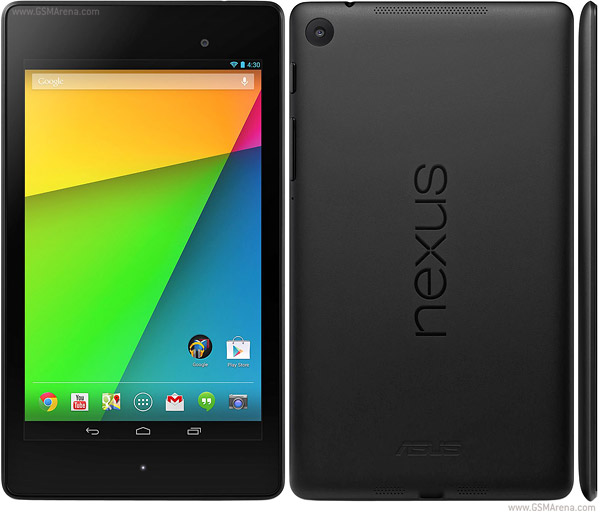
It might look like any other notepad that has flooded the market but the Nexus 7 by Google released in 2013 is really a nifty gadget to own, not only by the rave reviews but by its functionality.
After releasing the original Google Nexus 7 last year in August, the company decided to do an improved version of the tablet on the popular reviews the original device got in the market.
The best of it is its sleek and slender demeanor that makes it easy to carry around. The tablet which is fitted with near field communication capability runs on Android 4.3 Jelly Bean making it easy for users to download and enjoy apps from Google Play.
The gadget is part phone, part tablet with an option of using a microSim card or opting to use a wireless connection or even using both to the maximum features out of it.
Nexus 7 makes for a good gadget to read and to play games on. The 7.0 inch gadget has easy adaptation to 2G, 3G and 4G networks and runs on Quad-core 1.5 GHz Krait CPU making it faster in performance, compacted by a 2GB RAM.
The device is fitted with an LED-backlit IPS LCD capacitive touchscreen, 16M colors and measures 1200 x 1920 pixels protected by the corning gorilla glass technology laying aside fears of breakage and scratches.
Taking a picture with this device will not make you look weird as is with a normal 11 inch tab. Its 5MP camera enables you to take great shots with the screen allowing for focusing.
If you are an ardent Android user, using this device will be easy. All you need is either a microSim or a wireless network that will give you access. You will have to use your Gmail account if you have one to access all of the Google service on the device.
The need to have a microSIM might be a hindrance in the continent as many users still have the standard SIM size. Lumia phones are also facing this challenge but it might be a marketing gimmick (once you go MicroSIM you can’t go back).
The best use of this tablet is probably what all avid tech users would prefer: Good for reading and gaming. Thanks to its light weight, users can read or game for hours without feeling discomfort.
Key features include:
– HDMI port
– 2GB RAM
– 16/32 GB internal memory
– MP4/H.264 player
– MP3/WAV/eAAC+/WMA player
– Organizer
– Image/video editor
– Document viewer
– Google Search, Maps, Gmail, YouTube, Calendar, Google Talk, Picasa
– Voice memo
– Predictive text input (Swype)
Nigeria’s mobile app Afrinolly is partnering with Buni TV to help promote its second Short Film Competition to East African filmmakers. The winners will see their films distributed on both Afrinolly and Buni TV.
“Buni TV and Afrinolly share a strong commitment to support new African film talents,” said Buni TV CEO Marie Lora-Mungai. “We would like to encourage filmmakers from across the continent, and especially from Kenya and East Africa, to take advantage of this great opportunity to showcase their work.”
This partnership follows Afrinolly’s outstanding success of its first edition.
Afrinolly Short Film Competition was launched in November 2012 and has recorded over 500 entries worldwide with eventual winners in the short film and documentary categories receiving prizes totaling $100,000.
Submission of entries for the second Afrinolly Short Film Competition opened online on Sunday, September 1st 2013 and closes on Saturday, November 30th 2013 on http://afrinollyshortfilmcompetition.com/. Potential submissions should not exceed 15 minutes and all films not in English are encouraged to have English subtitles.
As occurred with the first edition, third place winners in both Short film and Documentary film categories will be rewarded with $5,000 each, second place takes $10,000 while the first prize winners will each receive $25,000.
Joining this year’s panel of judges are South African film and TV producer Steven Markowitz (Pumzi, Viva Riva!), Ghanaian journalist Komla Dumor of the BBC and Cameroon’s Tambay Obenson, editor of film blog Shadow and Act.
Dumor, Markowitz and Obenson join last year’s jury members such as veteran documentary maker Femi Odugbemi, renowned filmmakers Tunde Kelani and Obi Emelonye, Hollywood writer/producer and curator of The Black List Franklin Leonard, TV Content producer Bongiwe Selane, filmmaker Akin Omotosho, Mahen Bonetti of the New York African Film Festival and Nmachi Jidenma blogger and founder of Celebrating Progress Africa (CP-Africa).
The Afrinolly Short Film Competition is organized by Afrinolly, developers of the Afrinolly mobile app. Since its creation in 2011, the app has been downloaded by over 3 million users worldwide. Afrinolly remains at the forefront of maximizing technology and mobile options for viewing and distributing Africa-generated entertainment.
Top three global Notebook vendor, Asus will from 14th September to 13th October 2013 run an intensive marketing campaign in a move to deepen its market penetration in Kenya.
Asus expects the one month roadshow to raise awareness on its innovative products in the country. The firm says the roadshow will give consumers a firsthand experience to its products.
According to Asus product manager, Mr Chris Wen,“We at Asus believe that every idea starts with people and we turn our imagination into myriad revolutionary innovations. Through the roadshow, we hope to showcase among other products, the W8 touch notebook and the Intel powered Fonepad-which offer differentiated solutions.”
Asus has partnered with Orange and its channel partners across the country like Textbooks Centre, Technology House, BJ’s Electronics and Bright technologies in the road show.
It will also work with the partners to ensure its products reach other parts of the country like Mombasa and Kisumu.
Mr Wen added, “Asus understands the channel’s role in business and it is for this reason that we have invested heavily through our channel partners. Through this event and our partners, we hope to showcase Asus as a world 1st tier IT vendor determined to penetrate the market.”
However, questions abound as to how the firm will turn the numbers who attend the event into buyers and how the roadshow will have an impact on users who are used to mid-priced notebooks. A number still asked how the roadshow will reach corporate client’s who have set annual procurement budgets and timelines.
Libyana and Al Madar, state-owned telecommunication companies will soon have another competitor, as Libya is expected to issues a third operation with a three to six months.
The Libyan government wants to decrease its presence on the telecommunications in order to involve the private sector be it local or foreign.
Discussions between the economy ministry and its associated investment authority want to make the license more appealing to the telecommunications candidate.
Efforts by United Arab Emirates telecoms firm Etisalat to bid $825 million to get the third license in 2009 was went rock-bottom as the previous government revoked the tender.
The new government took back the stakes in the state-owned networks which had been controlled by the former dictator Colonel Gaddafi’s family following his death.
A research report from BuddeComm firm says that Libya’s telecoms market as well as the country’s economy and the telecommunications sector was crippled and disrupted by the civil war in 2011 but it is slowly recovering.
Ericsson, a global provider of telecoms infrastructure and services wants greater collaboration between the continent’s telecoms industry regulators and infrastructure providers to enhance provision of more cost-efficient services to the end-users.
Erik Ekudden, Ericsson’s Chief Technology Officer (CTO), speaking in Nairobi during the firm’s Networked Society roundtable said,
“There is a strong interest from regulators in Africa to use opportunities provided to work together with infrastructure providers as well as device vendors. Mobile network operators are greatly supported when regulators harmonise rules and policies on various key industry issues.”
Mr Ekudden also noted the need to relocate low frequency spectrum to mobile network operators for use in providing mobile broadband services.
According to Ericsson’s Mobility Report released in June 2013, the number of mobile subscriptions worldwide has grown approximately 8 percent year-on-year during Q1 2013 with the mobile broadband subscriptions growing by 45 per cent year-on-year to reach around 1.7 billion. The total amount of mobile data traffic doubled between the first quarter of 2012 and first quarter of 2013.
Mr Ekudden emphasized that it is still important to focus on harmonized solutions, noting that “Africa’s IT sector is too fragmented”.
“We’re too fragmented and there is no harmonization of policies which has led to high costs of deployment for service providers. This consequently translates to high costs for consumers,” he said.
The meeting – which was attended by various industry stakeholders including representatives from mobile operators as well as the industry regulator Communications Commission of Kenya (CCK) – discussed issues relating to IT industry transformation, role of MNOs in the transforming world, revenue growth, enabling cost efficient operations as well as high performing networks.
Kenya’s laptop project worth Ksh. 9.7 billion is on a predicament as all of the nine bidders had their quotes higher than the budget.
It happened that one vendor placed a double bid which consequently saw the lowest bidder quoting 28.7 billion, this is actually three times the amount of money the budget holds.
This may force the ministry responsible to fluctuate its budget in order to continue with the project as planned. The initial budget of the project was 17.5 billion including infrastructure, security, content and training.
Kenya’s ministry of Education had officiated the tender to obtain 1.3 laptops this week on Tuesday.
So far the lowest bidder is HP who quoted Ksh.28.7 billion with a unit price of Ksh. 20,639 and the highest bidder being Huwawei who quoted Ksh.60 billion. Other bidders include Samsung electronics with Ksh 39.1 billion, Symphony Technologies with Ksh. 38 billion, Haier Technologies with KSh. 34 billion, ZTE Corporation with KSh.33 billion and Telcom Kenya with KSh32 billion.
Mastec EA Ltd placed two bids quoting Sh32.6 billion in one and Sh31.3 billion in another while Shen Zhen Auto Digital quoted Sh30.3 billion.
Education Permanent Secretary Belio Kipsang’ said he was waiting for the final tender committee report.
The PS, however, dismissed fears that the project could fail because of the vendor quotations. In any case why would critics think so because according to the budget, Sh9.8 billion is for buying the laptops, Sh800 million for training, Sh500 million for digital content and Sh5.8 billion for setting up computer laboratories in 10 primary schools in each of the country’s 290 constituencies.
To add to that the 20,637 printers and the same number of projectors are to be provided in the schools across the country.
The ministry had set high standards for the vendors after placing a Sh228 million bid bond for the laptop tender, locking out many potential bidders from the process.
Bidders were also required to place Sh14 million for the printers tender security bond and another Sh20.4 million bond for the projectors tender
Airtel Kenya in partnership with Gecko Landmarks Ltd.has today launched a text based location service dubbed mLocator to enable customers to locate friends and family using an SMS short code.
Using landmarks that are locally well-known, such as buildings, parks, bridges and farms to deliver accurate location information, users simply send the word ‘find’ as a text message with the Airtel phone number they would wish to locate to 30100.
mLocator will be available to its Airtel customers FREE of charge from now until 30th September 2013.
According to Airtel Kenya Managing Director, Shivan Bhargava, “This innovative and unique service that enables our customers to locate their friends, family and loved ones through SMS from their Airtel SIM card is yet another demonstration of our commitment to improving the lives of our Customers through convenient and relevant mobile solutions.”
mLocator, currently in use in South Africa and Benin and has protected user privacy as one has to give consent to activate the location service request from the originator of the message request to locate them. Customers subscribing to this service will receive regular updates on who they have enabled to locate them.
Osmo Korri, Chief Commercial Officer at Gecko Landmarks said, “We are proud to partner with Airtel to offer this important service that will greatly benefit customers’ safety and well-being.
A few users praise Airtel for the service, which is a first in the country, but say its user private policy requiring one to allow others to locate him is disadvantageous. “How would you locate a friend who is kidnapped and barred from enabling the feature?”
India’s Zensar Technologies Ltd has become the first Indian IT firm to close an agreement with majority black owned investment business Kapela Fund 1 (Kapela) and The Tomorrow Trust to set up a new Broad Based Black Economic Empowered company in South Africa.
The deal will see Zensar become the majority shareholder of the Broad Based Black Economic Empowered Company and will also expand Zensar’s presence in South Africa.
According to Dr Ganesh Natarajan, Vice-Chairman and CEO of Zensar Technologies the new Company reiterates their commitment to South Africa and its transformational agenda will help consolidate their leadership in the region.
“We have had an extraordinarily successful decade of operations in South Africa and established leadership in providing technology solutions to the Banking, Insurance, Retail, Manufacturing and Mining sector,” Natarajan said. “This venture will help us expand our footprint into Government contracts and also enhance our standing in the Broad Based Black Economic Empowerment (BBBEE) code of the Government.”
Israel Skosana, Executive Chairman of Kapela Holdings is delighted to partner with one of India’s IT leaders to establish a trailblazing venture in South Africa and promised to work with them.
Kim Feinberg, CEO of The Tomorrow Trust said they are ensuring that we have youth who are educated up in order to be proactive participants in South Africa’s economy and society.
“For business to succeed we have to make sure that education is a priority in our country. Zensar has acknowledged and has committed to this fact and therefore has partnered with us to make sure that this indeed happens. Our synergies with bursaries and leadership will be highlighted and developed, creating sustainable impact. The Tomorrow Trust Board of Trustees and I are all very excited about this deal,” Feinberg said.
Earlier on, Zensar launched its Learnership Development Program (LDP) and has been identifying local students from the PDI community in South Africa and training them in both South Africa and India. Harish Lala, Vice President and Africa Region Head, Zensar said, “In line with Broad Based Black Economic Empowerment (BBBEE) framework, We are pleased that over eighty of them have already joined the workforce. The new Company will widen and deepen these partnerships for community development and reinforce our ‘Proudly South African’ vision for the country.”
The Learnership Development Program primarily equips students with crucial IT skills, such as software development and testing to ensure they are eligible for quality jobs. Sarvesh Batta who heads the initiative said, “Our aim is to home grow skills to service local Zensar clients in South Africa and also across Africa and increase our global capacity. By building a globally competent IT workforce, we can be part of the development of a world-class IT industry in South Africa.”
The South Africa program is part of Zensar’s Centre of Excellence (COE) initiatives around the world focused on training local students to join the workforce.
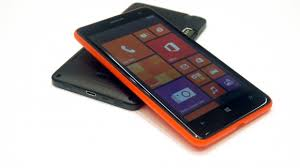
Nokia has given the people of East Africa high speed connectivity and a leading entertainment experiences and it comes with a big 4.7´inch screen, the Nokia Lumia 625.
Available currently in East Africa, the Lumia 625 comes in in a range of colours and it is available in East Africa and the recommended prices are; in Kenya it retails at KES 28,900, in Tanzania it retails at TZS 525,000 and retails at UGX 839,000 in Uganda.
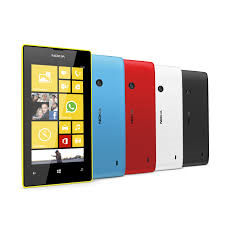
With the design of the award winning Nokia Lumia, this phone offers the choice of semi-transparent changeable shells which are available in white, black and yellow which add to the Live Tile personalisation brought by Windows Phone 8.
With a lower price, Nokia Lumia 625 brings an opulent selection of exclusive high end innovations, including a range of integrated camera applications like Nokia Smart Camera, which allows users to capture the perfect shot every time, and Nokia Cinemagraph, which transforms pictures into living memories.
The Nokia Lumia 625 is 4G/LTE ready smartphone, capable of offering up to 10x faster video streaming and internet surfing (well, depending on availability of 4G/LTE network service). Content like games, apps, and free navigation with HERE Maps and Drive are also easier to follow on its big screen. It offers access to over 165,000 apps and leading Nokia services out of the box.
The battery life of this smartphone is at 2000mAh and has processing speed of 1.2GHz, Dual Core. How about the camera, 5MP Autofocus, LED,1080p@30fps, VGA front facing camera. As for the 4.7 inch WVGA screen; the brightness mode is high, is readable even in the sun has colour enhancement and a super sensitive touch
“The Nokia Lumia 625 combines high end innovation and experiences with a stunning 4.7” screen and high speed connectivity, to bring entertainment to new audiences on a budget,” said Bruce Howe, general manager for Nokia East Africa. “This is a great addition to our Lumia portfolio in the region and shows our commitment to constantly bringing innovation at every price point”.
Running Windows Phone 8, the Nokia Lumia 625 provides leading personalisation with changeable Live Tiles that update direct to the home screen, whilst the People Hub makes it easy to stay connected with friends and family. There’s also Xbox Live, Microsoft Office integration and 7GB of online SkyDrive storage that add to the 8GB of in built memory, and SD memory card support of up to 64GB.
Nokia in partnership with Airtel Nigeria have introduced the Lumia 520 into the Nigerian market hoping to increase the smart phone penetration in the West African country as well as boost services and overall customer satisfaction.
“Airtel Nigeria and Nokia have tied up to launch the Lumia 520 in the country. Customers can part-exchange functioning old handsets of any brand at Airtel shops, paying NGN 23,990 to upgrade to the Lumia 520,” expressed the companies in a statement.
This launch comes at a time when the country’s telecommunication companies are struggling a regulator criticism since last year over call rates and subscription packages.
The Lumia 520 is currently retailing at NGN 28,000. Customers will also get six month’s free airtime for on-net calls and data worth NGN 6,000.
This air time is believed to give the promotion and new phone introduction some momentum, with Nigeria angling for the latest technology available on the market without having to face ridiculous fees and connection rates
TomTom speed cameras are now available for incorporation into the third party connected navigation solutions.
This means that vehicle, hardware and software manufacturers will be able to enhance their own navigation offerings with the speed camera service.
The service provides both fixed and mobile alerts to help drivers stay safe and relaxed, and avoid costly speeding fines.
The TomTom Speed cameras Service uses OpenLR technology which enables it to work flawlessly on maps from different manufacturers.
The service is designed to be easily integrated into connected in-dash navigation devices and mobile navigation applications. TomTom will deliver the service directly as a hosted service, or via a bulk feed.
“By incorporating the TomTom Speed Cameras service into their navigation devices, manufacturers can enrich the products they offer to their consumers,” says Charles Cautley, Managing Director for the TomTom AEG division. “Making the service available to more drivers worldwide will have a collective effect too; the bigger our community, the better the service will become for all our subscribers in the long term.”
The service is fully acquiescent with local transport regulation, including French Danger and Risk Zones. It offers broad geographic coverage and uses a wealth of reliable data sources to offer fresh and accurate updates to users. With reliable alerts for fixed and mobile speed camera locations, drivers can enjoy safer, more relaxed driving and avoid fines.
The TomTom Speed Cameras service is currently available to manufacturers for testing in all 40 countries where the service is functional. To learn more, visit Hall 4.1, Stand D-28 at the IAA Frankfurt Motor Show.
The TomTom Speed Camera service is based on governmental sources, news feeds, field surveys, and third-party sources in selected countries. It’s also based on community input from more than 3.5 million TomTom users around the world. Camera reports, confirmations and removals are processed automatically by our sophisticated Fusion Engine, which runs 24/7, every day of the year.
After the sale of its Verizon stake, Vodafone is eying to buy a majority stake in Maroc Telecom from France’s Vivendi which has been in talks with Etisalat.
Etisalat had put up a bid for Maroc Telecom’s 53% stake at $5.4 billion. Other bidders had pulled out of the deal as one who buys the majority shareholder has to buy out the minority shareholders too, leaving it Etisalat as the only telco interested. One of the shareholders is the Moroccan government which owns 30% of Maroc Telecom.
Vodafone recently sold its 45 per cent stake in US-based Verizon Wireless for $130billion and is now eying Maroc Telecom and France’s SFR. The Morocco based Maroc Telecom is one of the largest telecom operators in North Africa.
Vodafone is not new to Vivendi. In 2011, it sold its 44 per cent stake in SFR to Vivendi for $10.7 billion. Vodafone also has a strong presence in Africa with a 65 per cent stake in Vodacom with operations in Egypt, Tanzania, South Africa, Lesotho, Mozambique, and DRC.
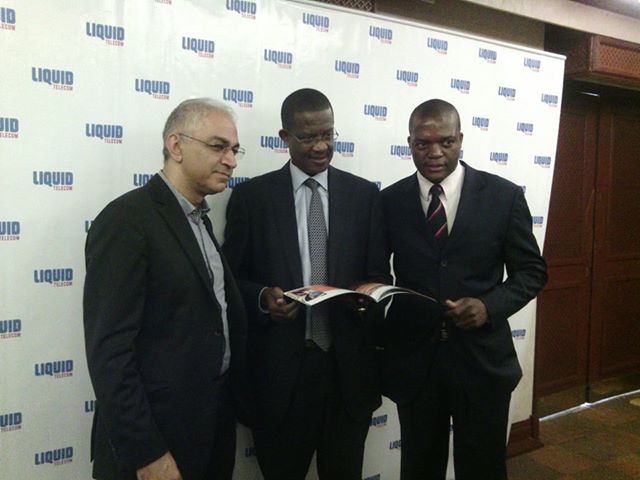
Mr. Shahab Meshki, CEO of Liquid Telecom Kenya (Left) with two executives from Rwanda and Zimbabwe respectively at the rebrand function.
Kenya Data Network has now fully rebranded to its new parent company Liquid Telecom today and adopted its corporate colors and identity.
The latest shift would enable the troubled KDN brand to finally get a home where it would grow financially. KDN has been juggled from Sameer group to Altech South Africa, and was dumped due to financial constraints before it was picked up by Liquid Telecom in March this year.
The chief executive officer of Liquid Telecom Kenya, Shahab Meshki said that the company has not only taken over the Kenyan market but has inculcated eleven brands across Africa in their bigger plan to be multinational across the continent.
“We are delighted to be part of the Liquid Telecom Group as such an exciting time for communications in Africa. As Liquid Telecom Kenya we’re perfectly placed to connect our customers to the potential growth in telecommunications throughout the African continent and beyond,” Meshki said.
The company has branches in Botswana, DRC, Lesotho, Mauritius, Nigeria, Rwanda, South Africa, Uganda, Zambia, Zimbabwe and the UK.
Meshki told Techmoran that the company would manage the Kenyan subsidiary differently from its Altech ‘handlers’, in a bid to make profit by taking advantage of being in a larger network.
We were wondering if Fibre-optic cable company, SEACOM‘s move to hire Safaricom’s former Senior Manager Joseph Muriithi as its Country Manager for Kenya will help save it.
Mr. Muriithi, the firms former Network Operations Manager is now the most senior person in the company and will run the firm’s Nairobi and Mombasa offices. The firm is not hiring a new Network Operations Manager (NOP), as Mr Muriithi will retain his current duties as the firm’s NOP running around to ensure network is on in Africa, Europe and Asia.
The father of two has a Master of Science in Information Systems from the University of Sunderland (UK) and has received extensive professional training in undersea technology, telecommunications systems, fibre optics terminal systems and mobile telephony.
The ‘Engineer of the Year Award’ 2004 has a 20-year experience in the telecommunications industry and has worked for the likes of Safariocm and as a Telecommunications Engineer at the Kenya Posts and Telecommunications Company.
Commenting on his appointment, Mark Simpson, SEACOM’s CEO, said: “SEACOM has changed the African ICT landscape, and it is now time for us to continue this transformation by driving new services and capabilities into Africa’s service provider market. Joseph’s wealth of experience in the telecommunication industry will be very valuable in enabling SEACOM’s continuing investment in the development of the Kenyan, and by extension Africa’s, Internet landscape”.
SEACOM doesn’t need saving, according to Mr. Muriithi, “As an open access cable system, SEACOM is primed as an ICT enabler to governments, education and private sector enterprises. The east and central Africa region can be effectively and adequately served through the Kenyan entry point. We look forward to an exciting time as the region opens up through this ICT transport superhighway”.
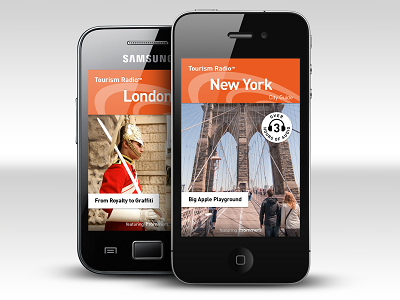
South Africa based travel app, Tourism Radio has scooped a slot at the at Africa App Quest 2013, a travel application competition held in conjunction with the 6th Annual E-Tourism Africa Summit.
The competition saw over 70 applications from across Africa and only 6 were ushered as the finalists of the challenge.
Tourims Radio was selected due to their “use innovative thinking and technology to produce creative, dynamic opportunities to increase and improve tourism in Africa”.
Tourism Radio CEO Mark Allewell says, “We’re delighted just to have been given the opportunity to take part in this year’s Africa App Quest and are more than happy to claim the title as one of the top apps on the continent.
“As a Cape Town-based developer, we’re constantly looking for ways to showcase South African apps on a global scale, and we’re sure Wildlife Africa Live will be able to hold the torch high. We look forward to improving our offerings in preparation for next year’s competition.”
Allewell maintains the company looks at apps not only from the mobile phone perspective, “We’ve produced location-aware travel technology for eight years now, and have firmly set our sights on wearable computer platforms like Google Glass. That is the future of travel, and the next evolutionary step for Tourism Radio.”
Judges included representatives from E-Tourism Frontiers, South African Tourism, VISA, the Kenya Tourist Board, and TripAdvisor.
A report by Pyramid Research suggests that the great broadband service and local content is the reason for the increase of over the top video (OTT).
Broadband penetration in the Arab world has seen services such as ICFLIX which has grown its market from MENA region to the US, a huge success.
“OTT video is a revitalizer that will create additional revenue sources while improving customer loyalty and lifetime value,” says Houda Bostanji, Analyst at Pyramid Research. Arab markets are seeing new initiatives from content providers, local aggregators and telcos.
In July 2013, Google announced the launch of a dedicated content hub on YouTube that is tailored to the Middle East and North Africa, bringing together over 500 Arabic TV shows. OSN, the MENA region’s leading pay-TV provider, was the first in the region to introduce video on demand on smartphones in July 2013. A tailored MENA strategy combined to actions differentiating from competitors will drive success for market participants, she notes.
West Africa has seen also different local content services such as Iroking music service and Iroko TV for Nigerian movies.
According to a new report by The Independent the government of Nigeria has orderd 53 gold-plated iPhones going for £3,000(about $5,000) from a Bristol-born businessman based in Dubai.
The businessman who runs Gold and Co, a firm that plates phones with Gold for its luxury clientele from royal families, governments, and rich customers from Russia, China and the Middle East,
The 42-year-old entrepreneur told The Independent:” Basic models in gold or rose gold cost from £3,000. Ali says he is fulfilling an order from the Nigerian government for 53 gold iPhones to mark the country’s 53rd year of independence from Britain next month.
“We will engrave them with the coat of arms, a shield and two horses,” he told the British paper.
The firm strips down the normal pieces then plates them in copper, nickel and then pure gold and has at the moment limited units ordered from different regions. He expects a huge demand with the announcement of two new iPhones. His customers range from the Saudi Royal family, which once ordered a gold iPhone at £50,000.
A new report says Vancouver-based firm is set to install a Bitcoin ATM next month, and by early December install the remaining four ATMs installed across the country.
The firm, Bitcoiniacs, a physical exchange for bitcoin has already shipped the five bitcoin ATMs at $18,500 each from Robocoin, a Las Vegas-based firm. By october, Vancouver’s bitcoin ATM will be operational then followed by Montréal, Ottawa, Toronto, and Calgary.
Founder Mitchell Demeter, who started a physical bitcoin exchange in June said he will install the first bitcoin ATM near Waves, a downtown coffee shop in Vancouver.
He said his offline method will see more people access the bitcoin, He also hopes to charge some 3% commission from the ATM machines and help users exchange bitcoins for dollars or dollars for bitcoins. The ATMs are supported by Calgary-based bitcoin exchange Virtex.
Transactions move to Robocoin’s servers to check if one has sufficient dollars or bitcoins to exchange, then converts before giving out one’s required currency via the ATM. Demeter says Canada’s financial regulator, FINTRAC, is not after the bitcoin yet,thereofre he expects no tough regulations but he will be limiting transactions to under $3,000 as require by law.
Robocoin, the firm behind the bitcoin ATMs, in Auguts received over 100 pre-orders from countries like Kenya, Zimbabwe, Australia, Sweden, and Argentina.
The RoboCoin ATMs were first on display at the Bitcoin 2013 Conference in San Jose, they are integrated with Mt. Gox or Bitstamp delivers dynamic Bitcoin inventory: trades are placed in real time and have a dashboard for easy administration, accounting, and email/text alert-configuration.
Nigeria Police is set to digitize the country’s motor registration system in a move to curb rampant crime especially in its cities. Set to begin September 16, all vehicles and motorcycles are required to move from the old analogue CMR to new digital BCMR system.
According to Police PR officer Frank Mba, the new system will reposition the police force to effectively combat terrorism, prevent crimes, apprehend and prosecute offenders.
Mba said: “The decision informing the introduction of the BCMR comes against the backdrop of contemporary security challenges bordering on terrorism, high incidence of car theft, carjacking, kidnappings and other acts of crimes and criminalities in our society. Unlike our hitherto analogue based procedures, the BCMR operates on smart-cards and portable hand-held receiver and is a specially developed technological means of attaching automobile owner’s unique traits and personal data to their vehicles for proper identification and protection purposes.”
The shift from the Central Motor Registry (CMR) to the digital Biometric Central Motor Registration (BCMR) system will be done online, at police commands countrywide and at designated banks. It will cost motorists $21 while cyclists will only pay $9.16.
The BCMR system will help the force tighten its grip against terrorism, kidnapping and car jacking among other crimes. The system can capture and match over20 million fingerprints per second which can then be verified against fingerprints stored at registration.
BCMR could also grab still images from CCTV cameras being installed in cities in the country and the footage could be used to apprehend suspected criminals.
Aalto in Africa is an expedition organized by students from Finland’s Alto University with plans to to take 50 students, staff members and other partners from Aalto University through the Zambian wilderness all the way to Cape Town, South Africa to learn from and co-create with local communities in Africa.
With a mission to build bridges between people and continents, Aalto in Africa is a Student-driven innovation project scheduled to take place September 22 to October 16 2013.
Speaking to TechMoran, Asta Länsimies, the Chief Organizer said “We found out that a lot is happening in Africa and especially in Cape Town for the World Design Capital 2014 and decided that since Africa is not very well known by European people, it would certainly open minds and build bridges for the future by bringing the Aalto community to southern Africa”
“There are many interesting start-ups and innovations coming from Africa, and these could be better known in Finland. In our country, the news and discussions often concentrate on poverty and development aid, and people as well as businesses do not realize the great potential of Africa,” she added.
Länsimies says she has already learned a great deal during the last year while organizing this project but she is expecting to learn a lot from the local culture, not only the traditional one but also how business works in Africa.
“It will be interesting to see how innovation and entrepreneurship is approached in comparison to Finland. I would be beyond happy if I learned something from the locals and take it back to Finland,” she added.
The team says it’s expecting to learn about everything it comes across during the journey and embracing new things with open arms. The students want to get to know other students from different disciplines and cultures and work together. Länsimies added that most students will participate in projects that are both multi-disciplinary and, personally it’s a unique chance to challenge oneself to see the world and yourself from a new perspective.
The 55 participants will be led by Lansimies, as the Chief Organizer, and in charge of project management and ensuring that overall things are running smoothly. Mari Terrio and Anna Vavilova are the team’s Program Coordinators. Vesa Luusua is leading the Communications team, and managing their website and different channels. Anthony Jones and Inka Wellman are Fundraising team leads. Iida Myllymäki is taking care of practicalities of our travel and Emilia Rantala is managing the finances.
Lansimies’s inspiration to come to Africa is just a dream. She said that during her studies, she has been active in student associations and been to many inspiring places in the world.
In 2010, she was part of a group of 80 Aalto University students that took a train to Shanghai China. The 80 were representing all disciplines within her university. The trip dubbed Aalto on Tracks, saw participants design their own learning – by organizing workshops, courses and even holding exams on the train. The project united the students and gave them a unique, multidisciplinary learning experience. In 2011, Aalto on Waves took 100 students and staff members to Brazil by ship with the same goal of creating a unique learning experience.
“We gathered a team to find the most interesting destination for 2013. Since southern Africa appeared to be an interesting area, still quite unknown for Finnish people, we decided to arrange the next project there,” Lansimies said.
According to Länsimies, “Part of the travel cost is paid by participants themselves. Most of the budget is covered by company sponsors and partners, as well as foundations. In addition to visibility, we offer our partners workshops, market research and other forms of collaboration that benefits both parties.”
Recently, there have been major innovation tours into Africa consisting of people coming to see what it is Africa is building. Innovation is becoming Africa biggest centre of attraction apart from its wild.
Kenya’s March 4th elections has caused the country a 7.4 percent drop in tourism, that is a total of Ksh 96 billion in just one year, financial year of 2012/2013; opposed to the 103.9 billion which was harvested in the previous financial year.
East African Affairs, Commerce and Tourism secretary Phyllis Kandie said: “Incidents which contributed to the non-resumption of charters, the uncertainty surrounding the March 4 election and the Euro zone crisis led to a drop in growth.”
The elections however was not entirely to blame, she added, part of the reason of the drop was because of the weakening of the Kenyan shilling.
At the time of scrutiny a total of 1.16 million tourist (this being 112,573 less than the previous year) visited the country by air and sea. The Mombasa international airport had a decline on arrivals for up to 13 percent while Jomo Kenyatta international airport had a 8.1 percent decline.
The coast seems to have lost its chartered flights to Zanzibar, Mauritius and Seychelles in the past few months, the reason attached to it is that it is a mass market and that it lacks uniqueness.
Kenya’s main tourism markets include UK, USA, Italy and Germany, but have recorded a decline in growth that was accredited to the financial crisis and travel advisories issued prior to the general election over perceived insecurity.
In the first half of 2013, Kenya received 495,978 tourists by air and sea with the largest drop being witnessed in February and March.
“We have registered upward growth in arrivals from the month of May and we believe this is an indication that the sector is on track. The current high season has also recorded impressive bookings in or accommodation facilities,” Ms Kandie said.
She said the product would be diversified by marketing targeted cultural events along with pitching for high profile conferences.
Founded by Bilikiss Adebiyi, Jonathan Kola and Oluwatobi Aworinde, Nigeria’s Wecyclers wants communities to clean their environment by recycling matter and earning from it. Wecyclers gives incentives to those who recycle waste in their communities.
Wecyclers receive used plastic bags and bottles, aluminum cans and just any waste and give out redeemable points to collectors as an incentive. The startup believes the incentives will encourage the low-income communities in Africa and other developing countries to have a reason to clean up their neighborhoods.
Wecyclers works simply.
When you collect and recycle one kilogram of matter, they give you redeemable points over your mobile phone in return. These points can be redeemed for food items, airtime, appliances and electronics. The team sends updates and reminders to participating recyclers mobile phones and they then send the materials to local recycling processors in the city.
The team uses low-cost cargo bicycles for convenient household recycling services and their SMS-based incentive program. They sell the collected matter to local recycling processors and help ensure a consistent supply recyclable materials.
According to Wecyclers, Lagos faces a waste crisis which is worsening with the continuing increase in the population, now estimated to be over 20 million. Wecyclers say the municipal government only collects 40 percent of the city’s garbage, leaving the rest to pile up and be a health hazard. Just a mere 13 percent of recyclable materials are salvaged from landfills.
This uncollected piles later become breeding grounds for diseases to people living in slums especially after floods. Ironically, recycling plants in the city face a supply constraint and operate at just 50 percent capacity or less. The team therefore believes it might help end this menace.
South Africa’s Network platforms, an IT solutions provider for internal IT managed services, as well as managed connectivity and cloud services is celebrating its 10th year of operation and offering clients in Johannesburg and Cape Town free rack space in Teraco.
The offer is subject to purchasing of bandwidth.
According to Bradley Love, CEO of Network Platforms, the offer is designed to support companies and ISPs wanting to move or test the many benefits of moving into the Teraco environment. Network Platforms provides anything from 1U rack space for the smaller clients and SME market to full racks for the larger clients.
“Hosting with us will enable our customers to start reaping the benefits of being in our racks at Teraco with our breakout bandwidth and peering connections to NAPAfrica/JINX/CINX without having to commit to a full rack.”
Love added: “Network Platforms offers a premium 1:1 uncontended and a contended service depending on the client’s requirement with local and international access. Our international routers have full failover as we utilise, SAT3, WACS, Seacom and EASSy.”
Network platforms also said that together with this offer, it will waive the installation fee on fibre and diginet for last mile connectivity for orders placed in the month of September and October. It is also giving away an opportunity for clients to win rugby tickets to enjoy the trimmings of a hosted box and watch an All Blacks vs Springboks match!
Every ‘like’ on its Facebook page gets one an entry into the draw, here http://lnkd.in/PYWFPB
The government of Tanzania in conjunction the Bank of Tanzania (BoT) as well as other stake holders are in the process of preparing law against cyber-crimes in the country which have never been in existence.
The team is striving to bring forth three bills of legislation which will provide the country with legitimate support for electronic financial transactions which will translate to new cybercrime laws and legislation.
“It is difficult to prosecute cyber-crimes because there is no law for that. We have no statutes to address the problems of criminal activities that take place over the Internet. The envisaged laws would also help to address legal issue in electronic financial transactions in Tanzania as currently there were no cyber-crime laws,” said George Sije from BoT Legal Counsel.
When the manage to come up with the cyber-crime laws, the Data Protection and Piracy Act will become the central piece of legislation, with the Computer and System Act, and Electronic Transaction Act to follow.
“This will be the main piece of legislation to govern personal data protection. Whenever you open a bank account, use ATMs, join a social networking website or book a flight online, you hand over vital personal information. Some crooks get unauthorised access to this kind of data, but we do not have the statutes to deal with them,” said Sije.
With the rise of the creative technologist and the increasing influence of digital on the marketing mix it is important for ad agencies, marketers and other creatives to pick the right digital production partner. TechMoran caught up with Nick Durrant, Managing Director of Bluegrass Digital, discusses the four points agencies need to look for when picking a digital production agency.
Bluegrass Digital was established in 1996 and has offices in London and Cape Town. The firm is a provider of cost-effective web solutions and online marketing services to a wide range of global clients.
As the creative marketing world ebbs and flows around the new impetus brought about by the increasing influence of digital on the marketing mix, creative technologists are emerging to service client requirements Durrant takes a look at how advertising agencies, marketers and other creatives should go about choosing their digital production partner.
What is a digital production agency?
Think of a digital production agency as the equivalent of the video production agency you would call on to implement TV advertisements as part of an above-the-line campaign. They have a range of specialist technical skills encompassing all things digital, including web, social media, mobile and underlying management technologies.
As with video production agencies, there are many ways to skin a cat. You might have some, or all of these skills in-house, and need to bring in extra capacity or specialist experience now and again. Or, you might prefer to outsource digital production to a specialist agency lock, stock and barrel.
As the digital star rises and clients become more confident about the role digital can play in their promotions we’re seeing an increasing shift from pure tactical implementation to increased strategic involvement from the outset.
Introducing the creative technologist
This brings the creative technologist into the spotlight. The industry at large and creative technologists themselves might still be debating the exact definition of this role, which is not surprising in such a nascent field. Creative technologists are playing a crucial role in digital production, irrespective of whether they are a techie that understands and can participate in the creative strategic process, or a creative strategist that can actually code.
The creative technologist is vital in matching the correct digital technologies with expected creative outcomes, and then making sure the implementation actually achieves that.
Choosing a digital production agency
It could be easy to think that all digital production agencies are on the same footing skills and experience wise. After all, it’s a relatively new field, especially in South Africa. But when choosing a digital production agency, marketers and creative agencies shouldn’t overlook experience, in order to ensure they team up with the best partner for their, and their clients’, needs.
1. Experience
There is no amount of resource, qualification, talk, mumbo jumbo that can replace the, late nights, difficult situations, client demands, changing briefs than experience. International experience is particular advantageous, especially if you’re pitching for a cross-border account. Suddenly you have the resources and international experience from a production point of view.
2. Project Management
Servicing a client abroad requires a strong focus not only on customer service, but also project management. It is important to ensure digital projects are delivered on time and to brief.
3. Technical skills
Accreditation across a range of technologies, and experience in working on the gamut of platforms, from iPhones, to Facebook, to the regular desktop web is essential when looking for a partner. Web content management expertise should include key web platforms such as Umbraco, EPiServer and SharePoint. Mobile development experience is also key.
4. Knowledge
Finally, seeking out an experienced digital production agency gives you access to a bit of magic that only comes with spending time in the trenches. With tight deadlines and even tighter budgets, rabbits need to be pulled out of hats more often than not, and this is where a partner that has been around the block once or twice has access to a depth of knowledge to draw on.
As the digital sun rises, choosing a digital production partner is going to be as important as choosing a video production company has been for ad agencies over the past few decades. The good news is, despite the relative newness of the field, pockets of experience do exist.












 Afrinolly is partnering with Buni TV to help promote its second Short Film Competition to East African filmmakers. The winners will see their films distributed on both Afrinolly and Buni TV.