back to top
Tuesday, April 21, 2026
spot_imgspot_imgspot_imgspot_img
Home Blog Page 13

Sanivation Raises $3.3M to Scale Waste-to-energy Plant in Kenya

Sanivation has raised $3.3 million to finance the expansion of its waste-to-energy operations, the group said on Tuesday.

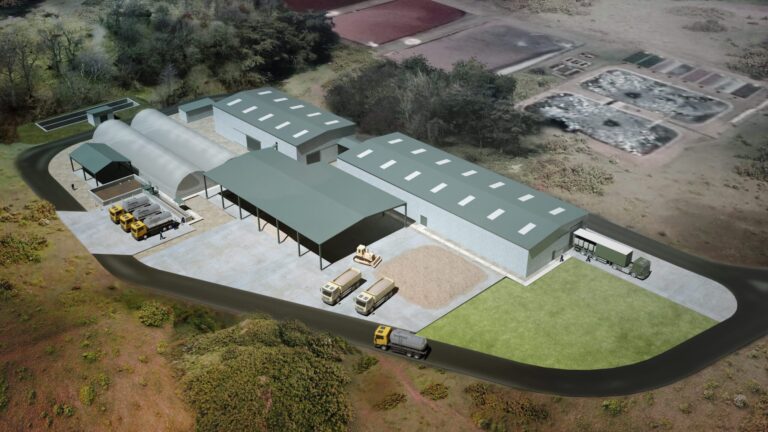
The equity investment, made through PIDG’s project development arm InfraCo, will support the expansion of Sanivation’s Naivasha Treatment Plant, increasing its capacity to convert human waste into solid fuel briquettes for industrial use. PIDG has also provided an additional $500,000 grant through its technical assistance facility.

Sanivation, which partnered with the Nakuru County government to establish a pilot facility in 2018, produces fuel briquettes by treating faecal sludge and blending it with waste from sawmills and agricultural processors. The briquettes burn longer and more efficiently than firewood and can reduce energy costs for industrial customers by between 10% and 30%, the company says.

The expanded facility is expected to treat waste equivalent to that generated by 100,000 to 130,000 households, easing pressure on existing wastewater infrastructure and helping to curb pollution around Lake Naivasha.

“This investment marks a turning point, not just for Sanivation, but for how sanitation infrastructure can be delivered across Kenya and the region,” said Sanivation CEO and co-founder Emily Woods. She added that the project demonstrates how waste can be transformed into clean energy while improving environmental outcomes and supporting community livelihoods.

PIDG said the project reflects its focus on circular economy solutions and climate-aligned infrastructure development in emerging markets.

“By reducing costs for industrial customers while decreasing pollution of the local environment, Sanivation aligns strongly with our strategy,” said Omar Jabri, PIDG’s head of business development for Africa at InfraCo.

Operations at the expanded Naivasha Treatment Plant are expected to begin in 2027.


Spotify Announces New Price Hikes for 2026 Amidst Royalty and Recruitment Controversies

0

Following a pattern established in recent years, streaming leader Spotify has confirmed it is increasing the cost of its premium subscription plans by $1 to $2 across all tiers.

This adjustment, which mirrors the company’s previous price hike in 2024, is set to take effect this February.

Global Impact and Billing Updates

Subscribers located in the US, Estonia, and Latvia will soon receive email notifications detailing these updated rates.

These changes are scheduled to apply immediately to their February billing cycle.

To help users navigate the new monthly costs, the updated pricing structure is broken down as follows:

Plan Type New Monthly Rate Previous Rate
Individual Plan $13 $12
Student Plan $7 $6
Duo Plan $19 $17
Family Plan $22 $20

Consequently, any subscribers who find these rates unsustainable and wish to cancel their plans are encouraged to follow Spotify’s official cancellation guide.

Justifying the Increase: Experience vs. Royalties

In defense of the move, the streaming giant explained that periodic price adjustments are necessary to “reflect the value Spotify delivers,” ensure the “best possible experience,” and support artists.

However, despite these claims of support, the company remains embroiled in a debate over fair compensation.

While Spotify reported paying out $10 billion to music rights holders in 2024, controversy persists within the creative community.

For instance, several Grammy-nominated songwriters boycotted a Spotify-hosted awards event last year, protesting what they claim are declining royalties from streams.

Addressing Recruitment Ad Backlash

In addition to the financial updates, the company has recently faced criticism for running recruitment ads for U.S. Immigration and Customs Enforcement (ICE).

In response to the public outcry, Spotify clarified that these ads were part of a broader government campaign that also ran on platforms like Meta and Google.

Furthermore, the company confirmed that the campaign has ended and no ICE ads are currently active on its service.

A Quarter Century of Knowledge: Wikipedia Welcomes Tech Giants into Content Ecosystem for 25th Anniversary

0

SAN FRANCISCO – On 15 January 2026, Wikipedia celebrated 25 years of making trustworthy, human-created knowledge accessible worldwide.

While the milestone marks two and a half decades of volunteer-led information sharing, it also signals a massive shift in how the world’s most powerful technology companies consume and sustain that data.

The New Guardians of Human-Curated Data

To mark this historic occasion, the Wikimedia Foundation is highlighting the rapid expansion of the Wikimedia Enterprise ecosystem.

In a significant move for the industry, the organization is announcing Amazon, Meta, Microsoft, Mistral AI, and Perplexity for the first time as they join an elite roster of partners.

These tech titans join existing members—including Google, Ecosia, Nomic, Pleias, ProRata, and Reef Media—in a formalized effort to support the infrastructure they rely on.

Consequently, these organizations are now utilizing Wikimedia Enterprise to integrate human-governed knowledge into their platforms at a global scale.

By doing so, they help ensure that the work of the global volunteer community reaches billions of people with the accuracy and transparency that Wikipedia represents.

Sustaining Truth in the Age of AI

In the current AI era, Wikipedia’s human-created and curated knowledge has never been more valuable.

Despite the rise of machine-generated content, Wikipedia remains among the top-ten most-visited global websites and holds the distinction of being the only one operated by a nonprofit.

The statistics surrounding the platform’s reach remain staggering:

  • Global audiences view more than 65 million articles.

  • Content is available in over 300 languages.

  • The site receives nearly 15 billion views every month.

Furthermore, this vast repository serves as the backbone for the modern digital experience, powering generative AI chatbots, search engines, and voice assistants.

Because of its rigorous community standards, Wikipedia remains one of the highest-quality datasets for training Large Language Models (LLMs).

High-Speed Infrastructure for Modern Tech

As the demand for real-time information grows, the Wikimedia Foundation is emphasizing that tech companies relying on this content must use it responsibly.

To facilitate this, Wikimedia Enterprise was developed as a commercial product for large-scale reusers.

The service provides reliable, high-throughput API access through three primary channels:

  1. The On-demand API: Returns the most recent version for a specific article request.

  2. The Snapshot API: Provides Wikipedia as a downloadable file for every language, updated every hour.

  3. The Realtime API: Streams updates as they happen.

Looking Ahead: Closing the Knowledge Gap

As knowledge on Wikipedia continues to grow to close knowledge gaps and include more languages, its value as a dataset for a broad spectrum of use cases also increases.

Beyond general searches, the Enterprise APIs provide access to other Wikimedia projects that complement the main encyclopedia.

This diversification makes the ecosystem valuable for specialized applications, such as knowledge graphs with travel data or Retrieval-Augmented Generation (RAG) models trained on educational material.

For those interested in these collaborations, the Wikimedia Enterprise blog serves as a resource for understanding these partnerships, featuring in-depth articles about the challenges these companies aim to solve.

As the community looks toward the next 25 years, the message to the tech industry is clear: the vast, multilingual, human knowledge repository built by volunteers is available for those who wish to ensure high-speed, reliable access to the world’s most trusted source of knowledge.

Best eSIM for Kenya 2026

0


In Nairobi, Malindi, Mombasa, and other major cities, mobile signals range from 5G, with 4G in coastal locations like Diani Beach, supported by 3G in rural regions. When signal quality varies that much, choosing the best eSIM for Kenya goes beyond reviewing mobile coverage and requires researching pricing, available activation options, hotspot support, and device compatibility.

For travelers, roaming costs are often high and charged by day, and the need to look for local SIM sellers is time-consuming and stressful, which is why digital SIMs have become a practical solution. Travel data apps – including Ohayu Kenya eSIM – connect users to local networks without the need to get a physical card or pay roaming fees. Other providers reviewed in this article are Holafly (unlimited data for $9.90/day), Airalo (3 GB plans for $20.00), GigSky, and Global YO.

Why eSIMs are changing connectivity in Kenya

Embedded SIM is changing the way mobile networks are used in Kenya. Unlike regular cards, which require physical handling, Kenya eSIM operates digitally. It can be quickly activated without visiting a carrier store – the process usually takes a few minutes and works well for travelers and short-term visitors who need mobile data right away.

Adoption among locals is developing slower, and travelers remain the main users of eSIMs. People arriving in Nairobi, Mombasa, or other regional centres often choose eSIMs to avoid standing in lines at vendors’ shops, registering, and dealing with verification processes. The main benefits of choosing digital options include:

  • Quick activation without paperwork or local verification requirements.
  • Predictable data costs compared to international roaming.
  • Simple plan management with the mobile app.
  • No need to remove and change the physical SIM cards.

The value comes from convenience, transparent pricing, and fast setup across the country’s main urban and tourist areas.

How to choose the best eSIM for Kenya

First, consider the area you are planning to visit. In rural and remote regions, expect mostly 2G or 3G coverage, while 4G LTE and 5G are widely available in major urban hubs such as Nairobi, Mombasa, Kisumu, and Nakuru.

Other points to keep in mind:

  • For the most consistent coverage, focus on plans that connect to well-established local mobile networks such as Airtel, Safaricom, or Telkom.
  • Confirm device compatibility on the eSIM provider’s website by selecting your exact smartphone model (for example, iPhone, Samsung Galaxy, Google Pixel).
  • Make sure your device is unlocked. Phones locked to a specific carrier will not connect to other networks.

For this specific location, coverage quality matters more than any advanced features. A reliable network partner, stable speeds outside cities, and reasonable pricing will have a bigger impact on your experience than plan extras.
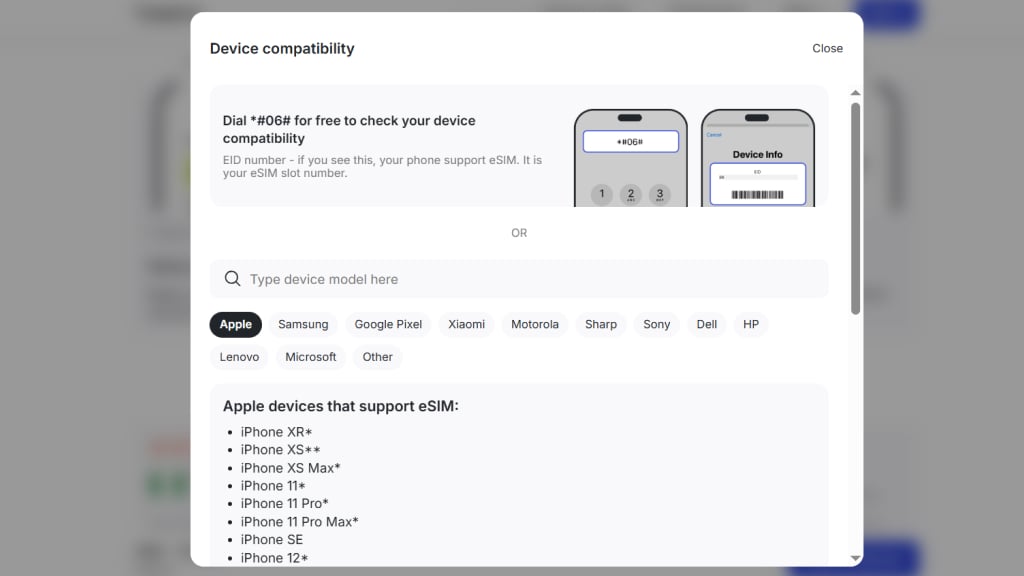
Source: https://ohayu.com/esim-compatible-devices/

  • Review the restrictions on transferring unused data based on the local or travel plan.
  • Determine whether you need calls and texts, which are mostly offered by local carriers, while most travel options are data-only.


You should also consider the plan activation options: this can be done before the trip or upon arrival. Activation can be completed using a QR code, manual code entry, or app-based setup.

Some key steps are:


  • For iOS: Settings → Cellular → Add embedded SIM;
  • For Android (Samsung, Pixel, Motorola, Oppo, etc.): Network & Internet → SIMs → Add embedded SIM.

Best global providers of eSIM for Kenya – plans comparison

We reviewed and compared the top global Kenya eSIM providers: Ohayu, Airalo, Global YO, GigSky, and Holafly, based on the most relevant criteria to travelers. Here are the detailed results:


Provider Data included Validity Price
Ohayu 3 GB 14 days $21.99
Airalo 3 GB 7 days $20.00
Global YO 3 GB 15 days $26.99
GigSky 3 GB 15 days $26.49
Holafly Unlimited 14 days $58.91
Ohayu global 2 GB 30 days $9.99

Most temporary data plans for Kenya have prices within a similar range, and vary by data limits and validity periods, so the choice between them depends more on the data needs than cost.
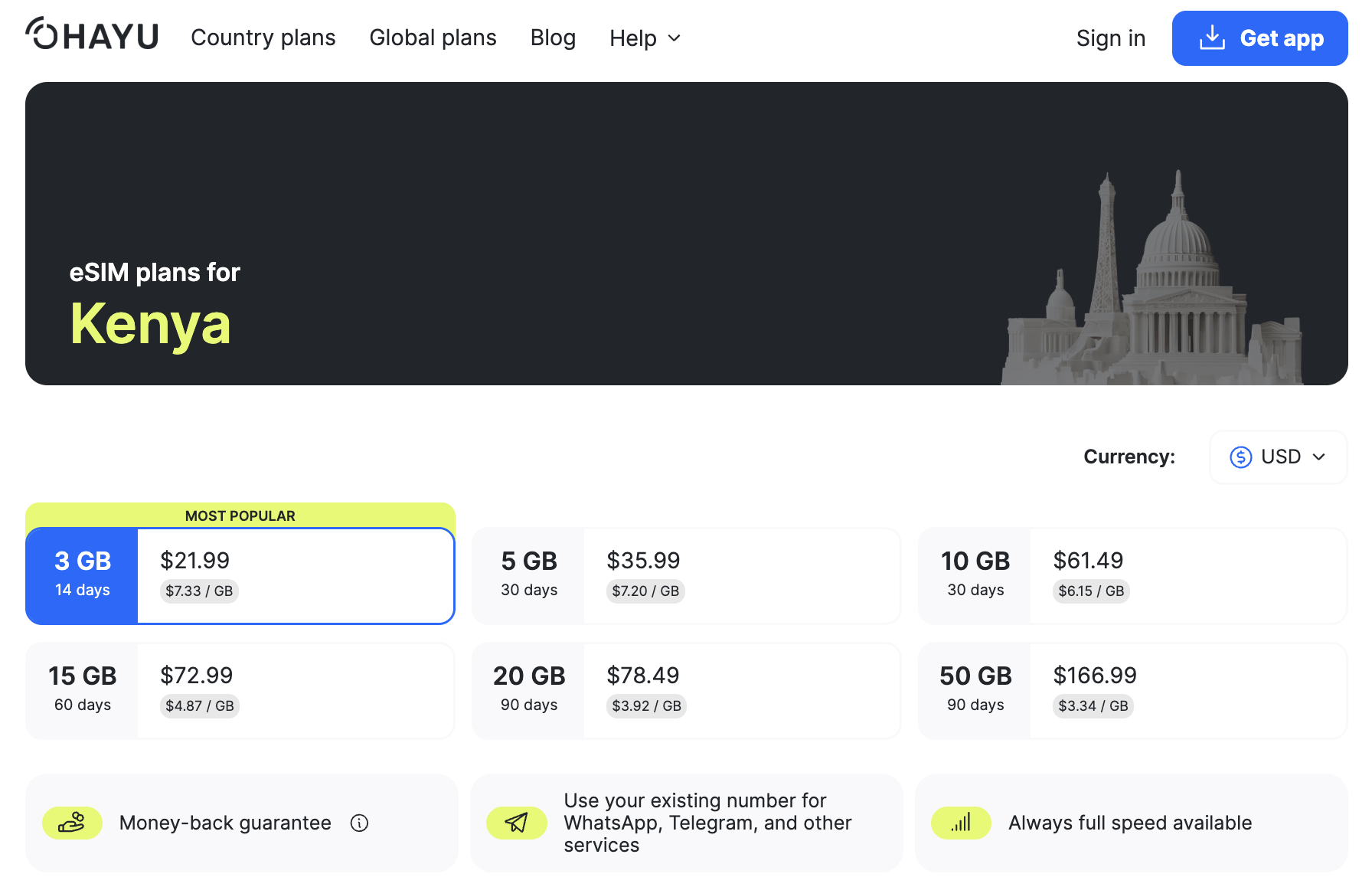
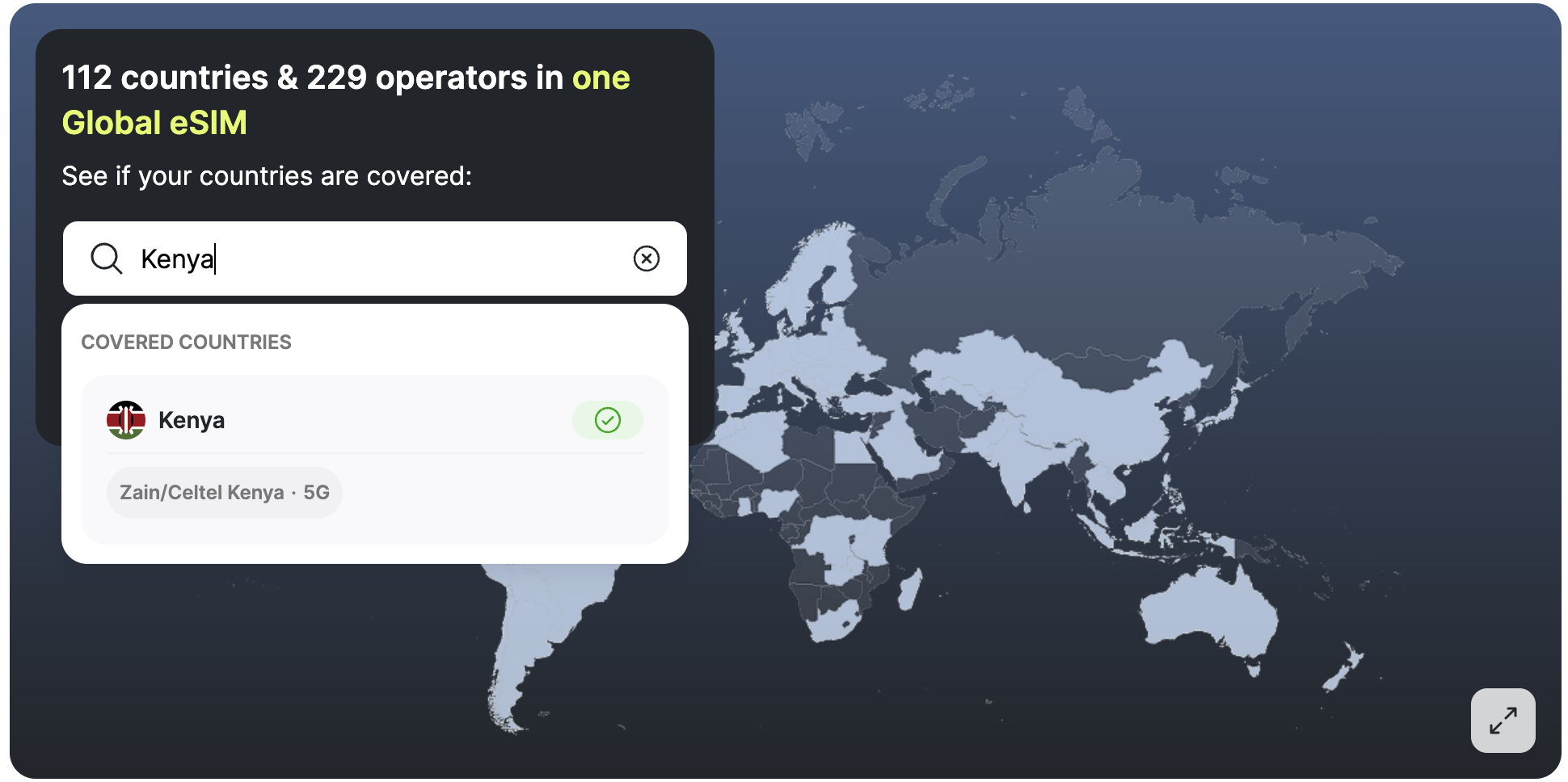
Kenya is also included in the Ohayu global plan, which starts at $9.99 for 2 GB of data per month and covers over 110 destinations. This option can be more cost-efficient for light data use or multi-country travel.
Use cases & network performance

Traveling to major cities. eSIMs generally perform well in Kenya’s main urban areas thanks to dense 4G coverage and 5G signal availability. Nairobi offers the smoothest performance, especially in districts such as Westlands, Upper Hill, Kilimani, and the central area. Mombasa and Kisumu are also covered by 4G in central zones and along main tourist locations. This coverage is more than enough for navigation, ride-hailing apps, video calls, and streaming.

Driving to remote areas. Outside major cities, connectivity depends on the location: in national parks, rural regions, and less populated counties, 3G remains common, and data speeds vary. During long road trips between towns or when going to safari destinations such asthe  Maasai Mara or Amboseli, coverage gaps might occur. In these cases, downloading offline navigation maps, translation apps, and other tools is strongly recommended.

Business travel. In business hubs, including Nairobi’s Westlands and Upper Hill areas or commercial districts in Mombasa,  the most stable connections are available. These locations have strong 4G infrastructure with 5G signals present, suitable for video conferencing, cloud-based work, and large file exchange with minimal interruptions during working hours.

What to avoid when choosing an eSIM

Avoid these mistakes when looking for the best eSIM for Kenya:

  • Trusting little-known providers;
  • Buying a plan before checking device compatibility;
  • Choosing a plan that doesn’t fit your needs;
  • Selecting an operator without checking the coverage;
  • Leaving roaming enabled for the main SIM card;
  • Choosing a provider without technical support.

Final thoughts

Choosing the best eSIM for Kenya is easier when your needs are clearly defined. Providers like Holafly are often selected for larger data allowances, while Airalo appeals to travelers looking for budget-friendly options. The right choice depends on the length of stay, data consumption, and exact destination – whether it is urban or rural regions.

For trips that include cities, tourist areas, and occasional travel outside major hubs, Ohayu is a reasonable choice because of its balance between simple setup, clear pricing, and predictable performance. The service automatically detects compatible devices and offers Android and iOS apps that help with plan selection, data usage tracking, and access to basic user guides, which reduces friction before and during the trip.

Kenya eSIM FAQs

How to get an eSIM for Kenya?

First, you need to select a provider and plan according to your needs. Activate the package before or after arrival using QR code, app-based setup, or with manual code entry.

Do embedded SIMs work outside Kenyan cities?

Yes, but coverage outside urban areas is usually more limited. In rural regions and smaller towns, including parts of Laikipia, Samburu County, and areas outside Nakuru or Eldoret, the primary signal is 3G, with some 4G coverage available depending on the local infrastructure.

Can one eSIM work in multiple countries?

Yes, the carriers we analyzed offer this option. Check the global or regional plans for traveling to different countries without the need to switch physical cards or data plans.

How does eSIM work in national parks and remote spots?

Connectivity can be unstable in remote locations and national parks like the Maasai Mara, Amboseli National Park, or Tsavo East and West. In these areas, data speeds are lower and might be patchy; limited coverage is common.

What if I’m out of data or need to extend the validity period?

Some providers have the option to extend the validity period for an additional price, while others offer to purchase a new package.


Tesla Cybertruck Makes Historic Debut in Kenya During Global Record Attempt

0

NAIROBI, KENYA — For residents in Nairobi and Utawala, the morning commute took a surreal turn earlier this week.

The familiar sights of the Eastern Bypass were briefly eclipsed by the sharp, glinting angles of a Tesla Cybertruck.

Consequently, onlookers and tech enthusiasts quickly flooded social media with clips of the “stainless-steel beast” as it navigated the bypass, drawing a massive crowd of excited Utawala residents who were eager to document the first-ever sighting of the vehicle in the capital.

Notably, this follows a similarly viral scene in Mombasa, where the truck was spotted charging at City Mall in Nyali and also in Nairobi Kenyatta International Convention Centre (KICC) where fans shared pictures widely on the socials.

As fascinated coastal residents snapped photos, the video went viral across Kenya, subsequently sparking intense speculation about how this armored electric pickup reached Kenyan shores.

The CyberLocos: A Guinness World Record in the Making

Furthermore, it has been revealed that the vehicle is not a local purchase but the primary transport for Berni and Alex, the adventurers behind the global expedition team CyberLocos.

On January 13, 2026, the duo confirmed they are using the Cybertruck to set a Guinness World Record for the most continents crossed in an electric pickup.

The Expedition Thus Far:

  • United States: The journey began with a cross-country trek.

  • South America: In addition to North America, they navigated the Andes and the Amazon.

  • Europe & Central Asia: Testing high-speed infrastructure and rugged steppes.

  • The Middle East: Moreover, they spent time conquering desert dunes.

  • Africa (The Current Stage): Ultimately, Kenya marks the official entry point for their African crossing.

Engineering “For Any Planet”

As specified by Tesla CEO Elon Musk, the Cybertruck is “a vehicle built for any planet,” largely because it is engineered from ultra-hard 30X cold-rolled stainless steel—the same material found in SpaceX’s Starship rockets.

“We want everyone to see that clean energy is powerful enough to take you around the world,” the CyberLocos stated.

In particular, their goal is to prove that electric vehicles can conquer Africa’s most challenging landscapes, from the deserts of northern Kenya to the highlands.

Tech Specs: Powering the African Crossing

While the Cybertruck is a bold design statement, it is simultaneously a high-performance machine designed for extreme endurance.

Feature Specification
Engine Output 845-horsepower
Acceleration 0–100 km/h in 2.6 seconds
Towing Capacity Over 4.9 tonnes
Range Up to 550 kilometres per charge
Material Bulletproof, cold-rolled stainless steel
Price Point Ksh 9.8 million to Ksh 16 million

Demonstrating Clean Energy’s Capability

Beyond the record-breaking attempt, the CyberLocos are using their three-ton pickup to demonstrate bi-directional charging, which allows the vehicle’s battery to power homes or other EVs directly.

As a result, as they head out of Nairobi, the team is inviting the public to “see it, touch it, and take photos” to normalize the presence of high-performance electric vehicles in the African savannah.

Background Information About Cybertrucks

The Tesla Cybertruck is the flagship electric pickup from Tesla, Inc., the American automotive and clean energy giant led by CEO Elon Musk.

Since its serial production began at Gigafactory Texas in late 2023, the vehicle has transitioned from a polarizing prototype to a multi-award-winning powerhouse in the EV sector.

As of early 2026, Tesla has further refined the lineup, centering its offerings on high-performance dual and tri-motor variants that define the “Foundation Series” currently seen in global expeditions.

Global Market Pricing (2025–2026)

While early reservations in 2019 teased a $39,900 entry point, the current global economic landscape and high demand for the truck’s unique “exoskeleton” have shifted prices significantly.

Model Variant Estimated Price (USD) Estimated Price (KES)
Long Range (RWD) ~$72,235 ~Ksh 9.4 Million
All-Wheel Drive (AWD) ~$82,235 ~Ksh 10.7 Million
Cyberbeast (Tri-Motor) ~$114,990 to $117,235 ~Ksh 15 – 16 Million

Note: These prices represent the base MSRP in the United States. Import duties, shipping, and local taxes can drive the “landed” cost in Kenya to well over Ksh 20 million for private owners.

Global Awards and Critical Accolades

Initially met with skepticism regarding its safety and utility, the Cybertruck has recently secured several prestigious industry honors:

  • IIHS Top Safety Pick+ (December 2025): In a major upset, the Cybertruck was named the safest pickup truck by the Insurance Institute for Highway Safety, outperforming the Ford F-150.

  • Tesla achieved this by updating the front underbody and footwell structures for units built after April 2025.

  • MotorTrend’s “Best Tech” Award (2025): Recognized for its revolutionary steer-by-wire system, which replaces mechanical steering columns with digital sensors and motors—a first for mass-market consumer vehicles.

  • American-Made Index Leader: The Cybertruck has been ranked as one of the most “American-made” pickups, with over 65% of its parts sourced from the US and Canada, a testament to Tesla’s vertical integration.

    Beyond hardware, the truck serves as a mobile power plant. Its Powershare technology (bi-directional charging) won praise for its ability to provide up to 9.6 kW of power—enough to run a job site or keep a home functioning during a blackout.

Uber Terminates Visa Payment in Kenya, Citing Global Payment Processing Costs

0

NAIROBI, KENYA — In a major shift that redefines the digital payments landscape for East Africa’s largest ride-hailing market, Uber has officially stopped accepting Visa card payments in Kenya.

The tech giant confirmed that the decision, which took effect in January 2026, follows an intensive review of global transaction economics.

Scaling Back Amid Rising Processing Fees

Uber said the move is a strategic response to the increasing financial burden of cross-border payment processing.

By narrowing its payment stack, the firm said it aims to mitigate the impact of rising interchange fees and scheme charges that typically accompany international card networks.

The New Payment Stack: Mobile Money Takes the Lead

While Visa cardholders are now required to add alternative methods, Uber’s platform remains accessible through several other high-traffic channels.

Supported Payment Methods include:

  • Mobile Money: M-Pesa (Safaricom) and Airtel Money.

  • Other Card Schemes: Mastercard and American Express.

  • Traditional Options: Cash and PayPal.

  • Corporate Vouchers: Uber Gift Cards.

Notably, mobile money remains the dominant force in Kenya. According to Central Bank of Kenya (CBK) data, Kenyans moved KES 636.2 billion ($4.93 billion) through mobile wallets in the 12 months to February 2025.

Uber’s integration with these local rails allows for near-instant driver payouts and reduces the friction of chargeback disputes common with international credit cards.

Impact on the Business and Expatriate Segments

The suspension of Visa—the current leader in Kenya’s card market—marks a significant reversal from Uber’s early strategy in Nairobi, where card adoption was touted as a hallmark of safety.

Industry analysts suggest that while local commuters are unlikely to be deterred due to high M-Pesa penetration, the change creates a “friction point” for:

  • Business Travelers: Who rely on corporate credit cards for expense claims and rewards.

  • Expatriates: Whose primary financial accounts are often tied to international Visa schemes.

  • Local Banks: Lenders such as KCB and Equity have spent years positioning Visa as the primary gateway for digital services.

Future Outlook for Digital Platforms in Africa

The move highlights a broader trend where global tech platforms are prioritizing local payment rails that clear instantly and avoid foreign exchange spreads.

While Visa confirmed they are “in touch with the Uber team” to resolve the issue, no timeline has been set for a potential return.

As of today, the app continues to operate normally, nudging users toward the more cost-effective local “Super-App” ecosystems that now define the Kenyan digital economy.

Safaricom’s Karen Basiye Honored by Schwab Foundation for Sustainability

0

Safaricom’s Karen Basiye has been honored as a Schwab Foundation Corporate Social Innovator of the Year, joining a select group of 21 global leaders recognized for their transformative work in social and environmental impact.

Karen, Director of Sustainable Business, Social Impact, and Foundations at Safaricom PLC, has been at the forefront of initiatives that integrate Digital Inclusion, Climate Action, and sustainable business practices into the company’s operations, ensuring that technology not only connects people but truly transforms lives across Kenya and Africa.

Karen believes that business thrives when society thrives and this mantra has led her to champion digital programs that bring connectivity to underserved communities, and implemented climate-focused initiatives that reduce the company’s environmental footprint.

She has consistently demonstrated how corporate leadership can create lasting social impact.

Under her guidance, Safaricom has launched programs such as M-Pesa Financial Literacy Outreach, Green Energy Initiatives, and community-based tech hubs, reaching millions of Kenyans with access not only to technology, but to opportunity. Young entrepreneurs in rural towns are using Safaricom platforms to start businesses, students are learning coding and digital skills in community hubs, and women previously excluded from financial systems are building sustainable livelihoods. These are the tangible outcomes of Karen’s vision, showing that profit and purpose can grow together.

“This year’s awardees highlight the extraordinary resilience and ingenuity at the heart of our social innovator and entrepreneur community,” said Hilde Schwab, Co-Founder and Chairperson of the Schwab Foundation for Social Entrepreneurship. “Leaders like Karen Basiye are not only transforming industries they are building a more inclusive and sustainable future for all.”

Being named a Schwab Foundation Corporate Social Innovator is not only a personal accolade for Karen is a recognition of Safaricom’s pioneering role in demonstrating how African companies can lead on responsible, impact-driven business at a global scale.

The recognition aligns with insights from the Schwab Foundation’s 2026 Built to Last report, which highlights that social innovators collectively mobilized nearly $1 billion in financial and in-kind resources despite widespread operational disruptions, shrinking resources, and other challenges.

For Karen, the award is a call to continue pushing boundaries. “Every initiative, every program, every connection we create is a chance to make life better for someone, somewhere,” she says. “When business and society grow together, we create lasting change that extends far beyond technology.”

As Karen Basiye joins the Schwab Foundation’s global network of social innovators, she carries not only Safaricom’s vision but Africa’s potential to lead the world in inclusive, transformative innovation. Through her work, she demonstrates that technology, combined with purpose and vision, can do more than connect—it can change lives, uplift communities, and shape the future.

Msossi, Kenya’s First App to Fight Food Waste, Set for January Launch

0

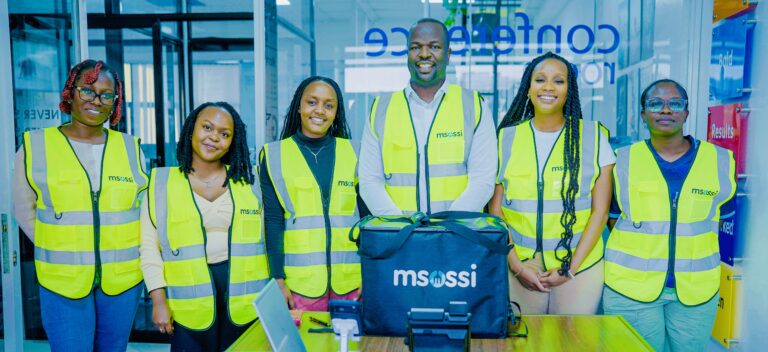
Msossi, Kenya’s first innovative food app designed to reduce food waste and losses, is set to launch this month. The platform connects supermarkets, restaurants, and hotels with consumers to sell surplus and near-expiry food items at discounted prices.

The app allows food businesses to list excess stock for quick sale, helping reduce the millions of tonnes of food wasted annually while offering consumers affordable options and minimizing financial losses.

Kenya faces a major food waste challenge, with an estimated 30–40% of all food produced lost to spoilage and expiry each year. This results in billions of shillings in economic losses, worsens food insecurity, and adds environmental pressure. Msossi addresses this through a digital marketplace for discounted food packs, promoting sustainability while delivering cost savings for both consumers and retailers.

“With Kenya losing up to 40% of all food produced to wastage, worth billions of shillings every year, Msossi offers a timely solution to turn potential losses into opportunities for savings and sustainability,” said Kevin Otiende, Msossi co-founder and CEO.

The app targets individual consumers seeking affordable and eco-conscious food choices, as well as businesses looking to reduce losses linked to food waste. By offering deep discounts, it encourages fast turnover of surplus items and helps build a more efficient food ecosystem.

“Over the past year, we’ve studied supermarket and restaurant operations and found that supermarkets lose between 5–12% of fresh food to wastage, while restaurants lose up to 30%,” Otiende added. “Our platform enables businesses to sell surplus food quickly at attractive prices, helping consumers access affordable nutrition while tackling serious environmental and economic challenges.”

Msossi will roll out nationwide, with features designed for easy listing and purchasing that suit local market needs. The platform also provides measurable impact data, including the amount of food saved, carbon emissions reduced, and meals rescued—insights that can support ESG and CSR reporting and demonstrate a commitment to circular economy and zero-waste practices.


Spacecoin Secures Kenya License to Challenge Starlink’s Satellite Dominance

0

Spacecoin,  a U.S.-based startup has officially been granted a transmission license by the Communications Authority of Kenya (CA) to operate in Kenya, in a major development for East Africa’s “Silicon Savannah.”

The approval allows the firm to deploy satellite internet and Internet of Things (IoT) monitoring services, positioning it as the first decentralized competitor to Elon Musk’s Starlink in the region.

The license specifically authorizes Spacecoin to conduct pilot programs and test its blockchain-based satellite network, targeting rural and underserved regions where traditional fiber and mobile infrastructure are economically unfeasible.

Decentralized Architecture vs. Centralized Scale

While Starlink dominates the current market with a vertically integrated system of over 8,000 satellites, Spacecoin is introducing a “permissionless” model. Unlike Starlink’s centralized control, Spacecoin utilizes a decentralized physical infrastructure network (DePIN) running on the Creditcoin blockchain.

Users access the network via tokenized payments, potentially bypassing traditional banking hurdles. The company promises a “no kill switch” architecture, designed to operate independently of centralized ground-based control and it has a “Starmesh” virtual network to provide structurally private browsing and decentralized web services.

Spacecoin has been rapidly validating its tech stack throughout the past two years.

In early 2024, the company successfully transmitted encrypted blockchain data across 7,000 km (from Chile to Portugal), proving that data integrity can be maintained entirely in space.

In November 28, 2025, the firm successfully launched three CTC-1 satellites from Vandenberg Space Force Base, California. In Q1 2026: Secured transmission licenses in Kenya and is pursuing similar Proof of Concept in Nigeria, Indonesia, and Cambodia.

The Battle for Kenya’s High-Growth Market

Kenya is a strategic battleground. According to CA and KNBS data, satellite subscriptions in Kenya grew twenty-six-fold between 2022 and 2024, largely driven by Starlink’s entry.

As of September 2025, Starlink reported 19,470 users in the country, maintaining a 0.8% market share of the fixed internet segment.

“Regulatory bodies in key regions are recognizing that decentralized satellite technology can deliver scalability and affordability that traditional infrastructure cannot,” stated Spacecoin founder Tae Oh.

Moreover, Spacecoin is not initially chasing mass-market rooftop dishes. Its Kenyan license emphasizes IoT monitoring, suggesting an early focus on institutional, industrial, and agricultural sectors.

Competitive Headwinds

Despite Spacecoin’s innovation, the gap remains substantial. Starlink is already operational in 26 African countries and benefits from SpaceX’s internal launch capabilities and manufacturing scale.

Spacecoin, by contrast, is betting on a partnership-driven model where local entities handle ground operations and user support.

As Africa’s digital moment accelerates, Spacecoin is banking on the idea that in markets where internet freedom and local collaboration matter most, a decentralized alternative will find its footing.

Global Expansion and Local Partnerships

Spacecoin is betting on a partnership-driven model. While the company provides the satellite and network stack, local partners manage ground operations and user support.

On Wednesday, January 14, 2026, the firm reached a pivotal milestone by announcing the launch of strategic connectivity pilots in four key countries: Kenya, Nigeria, Indonesia, and Cambodia.

This initiative transitions the company from theoretical development to practical, real-world deployment.

Under this partnership-driven model, Spacecoin maintains its role as the primary technology provider, supplying the core satellite infrastructure and decentralized network stack.

Meanwhile, local partners in each nation will take the lead on the ground, managing day-to-day operations, navigating regional regulatory landscapes, and providing direct support to local users.

  .  Nigeria: Building on an existing Nigerian Communications Commission (NCC) license to bring high-speed connectivity to rural communities.

  • Cambodia: Partnering with local ISP MekongNet to extend market reach.

  • Indonesia: Collaborating with government agencies to deliver access across the country’s fragmented archipelago.

By focusing on regions where internet freedom and affordability are paramount, Spacecoin aims to prove that decentralized satellite technology is “a real movement with momentum that will unlock permissionless connectivity.”

Acumen Reaches $250 mln Target for Hardest-to-reach Energy Initiative

Impact investor Acumen said on Tuesday its Hardest-to-Reach Initiative (H2R) has secured $250 million in blended capital to expand clean energy access across sub-Saharan Africa, meeting its fundraising target.

The milestone follows the final close of H2R Amplify, the initiative’s scale-focused debt fund, at $180 million. The close was supported by a $7.8 million commitment from the Swiss Agency for Development and Cooperation (SDC), alongside $18 million in grant capital to provide impact-based incentives to borrowers, Acumen said.

Launched at COP28 and anchored by the Green Climate Fund, H2R is Acumen’s largest energy initiative to date. It aims to reach nearly 70 million people, including about 50 million first-time energy users, in underserved and fragile markets where traditional financing has been limited.

H2R combines a market-building facility, Catalyze, with the Amplify debt fund to finance distributed clean energy solutions for households and small businesses across 17 countries, including Malawi, Zambia and Somalia.

“The full close of Amplify marks a shift from announced ambition to fully committed capital,” said Jiwoo Choi, Acumen’s chief of strategic initiatives and head of H2R.

SDC said its participation reflects its focus on expanding access to affordable and reliable energy while strengthening resilience and local development in vulnerable regions.

Amplify’s investors include the Green Climate Fund, International Finance Corporation, British International Investment, Shinhan Bank, Soros Economic Development Fund, Nordic Development Fund, Signify Foundation and ImpactAssets. Catalyze is supported by partners such as Norad, the Global Energy Alliance for People and Planet, the UK government’s Transforming Energy Access platform and several philanthropic foundations.

Acumen said H2R was recently named the 2025 Deal of the Year by the African Solar Industry Association.

Security Guard Becomes Latest Millionaire in Safaricom Shangwe @ 25 Promotion

0
Geoffrey Kipkoech, a 49-year-old security guard from Gachie, is the latest KES 1 million winner in Safaricom’s ongoing nationwide Shangwe @25 promotion.
Kipkoech, a father of five who works at Rosslyn Estate in Nairobi, received the life changing news while attending a training session. After missing several calls, he was finally reached by Safaricom and informed of the win, news that left him shocked and overwhelmed.
“I have been a security guard for the past fifteen years, struggling to take care of my family on a modest income. This win is truly life changing for me and my family. I sincerely thank Safaricom for this wonderful gift. I will use the money to support my family, pay school fees for my children, and buy more dairy cows to grow my small dairy and tea farm back at home,” said Kipkoech.
Mr. Kipkoech became a winner after purchasing airtime through M-PESA. A regular user of the service, he relies on it for his daily transactions, making it an essential tool in managing his responsibilities and supporting his family.
Beyond his security role, Kipkoech is also a small-scale farmer. He keeps cattle in his village and owns a tea farm in Nandi, which helps supplement his family’s income.
He plans to invest part of his prize money in building rental houses in his hometown of Nandi to create a stable, long-term source of income for his family. He also intends to expand his dairy farming activities by purchasing additional cows to further strengthen his household’s livelihood.
Driven by gratitude and a strong desire to give back, Kipkoech has chosen to support Kipsiori Catholic Church in Nandi and to build a small house for a vulnerable family in his village as part of his community initiative. He also plans to donate chairs to the church to enhance comfort and support community development.
“With the community project, I want to support my local church in Nandi by purchasing chairs and also build a small house for a vulnerable family in my village,” said Kipkoech.
Since its launch, Shangwe @25 has been rewarding customers daily and weekly with cash prizes, data bundles, devices, and business support tools. Each week, more than 50,000 customers win KES 10,000, KES 50,000, or KES 100,000. Over the course of the promotion, more than five million customers are expected to win prizes worth KES 250 million, with 25 customers set to become millionaires by the end of the campaign.
The promotion also supports businesses of all sizes. Micro and small enterprises are rewarded with tuk-tuk pickups to enhance logistics such as stock transportation and deliveries, while selected businesses receive stock worth KES 250,000 to accelerate growth. Medium and large enterprises receive KES 500,000 to support corporate social responsibility (CSR) projects of their choice.
The Shangwe @25 campaign forms part of Safaricom’s 25th anniversary celebrations a nationwide initiative to thank customers, uplift communities, and celebrate 25 years of connection, innovation, and impact. To access M-PESA services, dial *334#.

Treasury CS Defends Strategic Divestiture: Sh204 Billion Safaricom Tech Deal Under Scrutiny

0

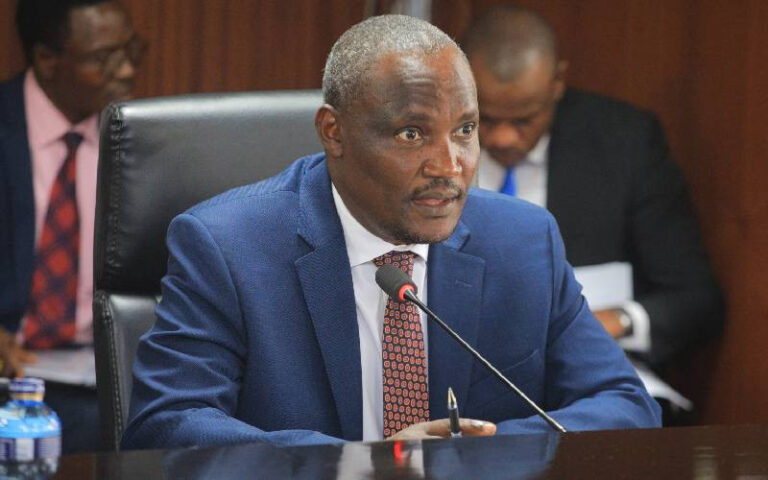
 Treasury Cabinet Secretary John Mbadi appeared before a joint parliamentary committee on Tuesday to defend a high-stakes partial divestiture of the government’s stake in Safaricom PLC.

This comes as the state intends to offload 15 per cent of its 35 per cent controlling interest to South Africa-based tech giant Vodacom.

The transaction, structured as a strategic sale rather than a retail offer, is expected to generate approximately $1.576 billion (Sh204.3 billion).

According to an instant analysis, this represents a 19 per cent premium over the current market price of roughly Sh28.5 per share.

Financing Infrastructure through Tech Capital

Lawmakers, including Daniel Manduku (Nyaribari Masaba) and David Mboni (Kitui Rural), challenged the CS on the security of the proceeds.

Consequently, Mbadi assured the Finance and National Planning and Public Debt and Privatization committees that the Sh204 billion would be strictly ring-fenced as “seed capital” for commercially viable projects.

“The money is not to fill our fiscal deficit, it will be used to set seed capital for commercially viable infrastructure projects,” Mbadi stated. “Kenyans objected to any more taxes and borrowing; therefore, we have to think of innovative steps of raising revenues.”

The CS confirmed that these funds will not support the 2025-26 budget but will instead prioritize:

  • Energy and Water infrastructure.

  • Roads and Airports.

Protecting the Safaricom Workforce and Local Identity

A major point of contention during the joint sitting, chaired by Kuria Kimani and Shurie Abdi, involved the potential for tech-sector layoffs.

In response, the Treasury CS revealed that the agreement with Vodacom includes specific safeguards for Safaricom’s workforce.

Key Labor and Governance Commitments:

  • Job Security: A moratorium on acquisition-related redundancies for three years post-transaction.

  • National Identity: Requirements that the Chairman and independent directors remain Kenyan.

  • Social Impact: Continued support for the Safaricom Foundation.

However, Kitui MP Irene Kasalu criticized the three-year window as “too short,” noting the difficulty of the current job market.

Strategic Rationale: Why Vodacom and Not an IPO?

Lawmakers questioned why the government settled on Vodacom without a competitive bidding process or a local retail offer.

Mbadi defended the “Economics 101” behind the decision, arguing that a mass retail dump of shares would have crashed the stock price.

Moreover, the CS highlighted several strategic advantages:

  1. Market Stability: Avoiding a price distortion caused by a sudden increase in share supply.

  2. Foreign Currency: Attracting significant inflows of US dollars.

  3. Efficiency: Avoiding the underwriting costs of a retail offer, which would have coincided with the planned divestiture of the Kenya Pipeline Company.

Independent Valuation and Transaction Costs

To ensure transparency, the National Treasury engaged KCB Capital as a transaction adviser for an independent valuation.

The government incurred Sh3 billion in transaction costs, representing 1.36 per cent of the total deal value.

Mbadi noted that this was well within the 1.8 per cent legal limit allowed for such transactions.

By opting for a strategic partner with a long history in the telecommunications industry, the CS argued that the state is maximizing value for money while reducing the long-term debt burden on taxpayers.

How NCBA’s Digital Onboarding Is Turning Kenya’s Mobile Users into Bankable Citizens

0

For years, financial inclusion in Africa was framed as a problem of access. More branches, more agents, more paperwork. In Kenya—home to one of the world’s most vibrant mobile money ecosystems—that problem has largely been solved. Today, formal financial access among adults in Kenya sits at a record high of about 85 per cent, driven largely by digital channels that reach far beyond physical branches.

Yet access alone doesn’t guarantee inclusion. Millions save, transact, and borrow each day without ever building a formal financial identity that banks can measure and leverage. That’s where NCBA’s digital onboarding ecosystem—anchored by products like M-Shwari, Loop, and NCBA Now—is reshaping the landscape. Instead of merely opening accounts, these platforms turn everyday mobile behaviour into verifiable financial profiles—laying the groundwork for credit, protection, and investment opportunities.

From Cash to M-PESA

Kenya’s rise as a global fintech leader began with mobile money, led by M-Pesa. In 2007, only about 23 per cent of adults were banked; by the early 2020s the figure had risen sharply, substantially driven by the adoption of mobile wallets. Today, more than half of Kenyans use mobile money daily, a key foundation for digital onboarding platforms to engage customers.

Yet formal banking participation still doesn’t guarantee meaningful financial inclusion. According to Kenya’s latest FinAccess survey, only about 18 % of adults are considered financially healthy, signaling that many banked individuals still lack deep engagement with savings, credit, or investment instruments.

Onboarding That Converts Activity into Identity

In this context, NCBA’s onboarding ecosystem does more than register accounts—it formalises behaviour.

M-Shwari remains the best-known entry point for many. Born from a landmark partnership between NCBA and Safaricom, M-Shwari lets users open savings and loan accounts directly through their phones, with no branch visit required. Over the years, tens of millions of Kenyans have used M-Shwari, turning everyday mobile money usage into a track record that banks can recognise.

For customers seeking broader functionality, Loop offers a fully digital microbanking experience. With instant onboarding, customers can open accounts, access debit cards, and transact without ever entering a branch—making full-service banking as accessible as messaging apps on a smartphone.

Meanwhile, NCBA Now acts as a gateway to the bank’s wider digital ecosystem. Its tiered onboarding allows users to start with minimal information and unlock richer services as they transact more. This progressive approach is especially important in markets where formal identification and digital literacy vary widely.

Onboarding as an Ongoing Process

Traditional banking treats onboarding as a one-time compliance step. NCBA treats it as a dynamic journey.

Each deposit, withdrawal, or loan repayment feeds into an evolving profile. Over time, this behavioural data enables NCBA to adjust credit limits, tailor offers, and introduce customers to protection and investment products that make sense for their financial lives. It’s the difference between simply being “banked” and being bankable.

Digital Loan Growth Reflects Inclusion in Action

The numbers show this strategy working at scale. NCBA’s digital lending infrastructure—spanning M-Shwari, Loop, Fuliza, and related offerings—has disbursed hundreds of billions of Kenyan shillings in loans annually, underlining the depth of engagement across demographics.

These platforms are not fringe products; they are central to how Kenyans manage liquidity, smooth income volatility, and meet everyday financial needs—turning mobile phones into on-ramps to credit and savings.

Why This Matters for Kenya and East Africa

NCBA’s digital onboarding story is also a story about Kenya’s digital economy. With over 90 per cent mobile phone ownership and high uptake of digital payments, the country leads Sub-Saharan Africa in account ownership and mobile financial engagement. Neighboring markets like Uganda and Tanzania are following similar trends, with fintech innovation lowering barriers to entry and deepening inclusion.

For policymakers and development actors, Kenya’s experience offers a test case: digital channels can dramatically expand financial visibility—but only if the onboarding journey creates real, usable financial identities that institutions can understand and serve.

Visibility as the New Currency

In Kenya’s digital economy, simply having an account is no longer enough. The real leap occurs when everyday actions—saving a little in M-Shwari, repaying a Loop loan, or moving money in NCBA Now—translate into measurable financial behaviour.

NCBA’s digital onboarding turns mobile phones into engines of inclusion, transforming invisible savers into data-driven economic participants. Convenience may draw customers in, but visibility is what unlocks opportunity—credit access, protection against risk, and the possibility of long-term investment.

For a country that once struggled with financial exclusion, this shift marks a new chapter in how banking can serve the many, not just the few.


Outliers Venture Capital Launches Fellowship Program to Develop MENA Tech Talent

0

Outliers Venture Capital has unveiled the Outliers Fellowship Program 2026, its flagship initiative aimed at identifying and developing the next generation of entrepreneurial leaders, operators, and builders across Saudi Arabia and the wider MENA region.

The program will be delivered in exclusive partnership with the Saudi Venture Capital Company (SVC), marking the first formal backing by a regional fund-of-funds for a dedicated talent pipeline for high-growth technology companies.

Building on last year’s inaugural cohort, which attracted applicants from 14 countries and included students from institutions such as UC Berkeley, Purdue University, King’s College London, and KFUPM, the Fellowship combines hands-on internships with leading tech companies, one-on-one mentorship, and structured in-person programming. More than 40% of Fellows in the previous cohort secured extended or follow-on roles, demonstrating the program’s effectiveness in developing high-performing talent.

The Fellowship addresses a critical need in the region: the shortage of experienced operators, limited early exposure to company-building, and retention of top talent within MENA. Fellows are embedded in high-growth technology companies such as Lean, Strataphy, Stream, Lendo, Penny, Soum, Ejari, and Stitch, receiving training and mentorship designed to accelerate their careers.

H.E. Dr. Nabeel Koshak, CEO of SVC, said the partnership “represents a practical model for developing talent that can operate at global standards and support the Kingdom’s economic transformation.”

Applications for the 2026 program open on January 26 and close on February 27. More information is available at https://fellowship.outliers.vc.


NCBA, Inchcape Team Up to Offer 95% Tractor Financing to Kenyan Farmers

0

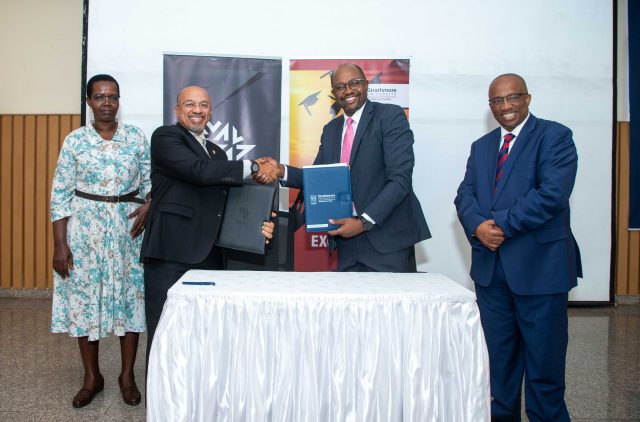
NCBA Group, one of Kenya’s largest banks, has partnered with machinery distributor Inchcape to provide farmers with up to 95% financing for New Holland tractors, a move aimed at accelerating mechanisation in the country’s agriculture sector.

The partnership, announced on Wednesday, includes support for up to two farm implements and access to KES 500,000 ($3,200) in working capital for business customers. Repayment plans are designed to align with harvest cycles, and farmers on monthly plans can defer their first payment by 60 days.

“By matching repayment schedules to the realities of farming and offering up to 95% financing, we are removing barriers that have historically held back the sector,” said Lennox Mugambi, Group Director of NCBA Asset Finance and Business Solutions.

Kenya’s agriculture sector contributes about 21% of GDP but remains heavily reliant on manual labour, limiting productivity. NCBA’s initiative also involves collaboration with development finance institutions and NGOs to make credit more affordable and sustainable.

Inchcape, which has a dealer network in Nakuru, Nairobi, Eldoret and Kisumu, said it would expand services to Mombasa, Nanyuki, and Meru. “Our network and factory-trained technicians ensure farmers get long-term value from their investment,” said the company’s managing director.

All financed tractors will be insured through NCBA Bancassurance Intermediary Limited. Farmers and agribusinesses interested in the programme can contact NCBA branches or authorised Inchcape dealers.

Here are the 12 ventures Showcasing at Africa Tech Summit Nairobi 2026

0

Africa Tech Summit holding on 11th and 12th, 2026, at the Sarit Expo Centre has selected companies, spanning payments, Web3, EdTech, climatetech, healthtech, and more, represent the next wave of African ventures ready to attract investors and global partners.

According to Mark Mugenwa, Business Development Manager at Africa Tech Summit, “Driving investment is the core goal of the Africa Tech Summit. This year’s selected cohort features ventures that are solving Africa’s challenges with sustainable, scalable impact models. These companies have demonstrated incredible traction and we look forward to hosting them and the wider ecosystem in Nairobi next month.”

The 2026 investor-ready ventures include:

Bekia (Egypt) is tackling inefficient waste collection and low recycling rates across Africa by offering a digital platform that streamlines disposal and helps businesses reduce environmental impact.

Bosso Africa Inc (Zambia) is streamlining Africa’s fragmented, slow, and inefficient process of sourcing construction materials. Bosso’s AI-powered platform delivers instant sourcing, price comparisons, and reliable logistics.

Chefaa (Egypt) is addressing unsustainable access to recurring prescriptions that undermine patient compliance and adherence in fragmented pharmacy markets.

Hizo (Africa) is revolutionizing intra-African payments. Hizo is solving Africa’s fragmented financial systems by enabling users to seamlessly spend, send, and receive money across the continent using their local currency and card payments.

Innobid (Kenya) leverages AI to democratise access to procurement opportunities for marginalized entrepreneurs in Kenya.

Niteon(Nigeria) is bridging the gap for millions of African manufacturers and farmers who remain unseen, underpaid, and disconnected from global opportunity.

Pretium (Kenya) is bridging the existing payment rails with the blockchain ecosystem.

Timart (Nigeria) is tackling Nigerian SMEs’ inventory challenges: manual tracking losses, staff fraud, scattered debt records, and offline tool failures that leak revenue and cripple cash flow.

TIBU Health (Kenya) is revolutionizing primary and chronic care access in Kenya’s underserved communities. TIBU brings clinic-grade care, AI-powered tools, and seamless care directly into high-traffic pharmacies, making healthcare faster, cheaper, and more reliable for low-income households.

Vepay (Nigeria) enables fast and secure cross-border payments, facilitating global transactions for individuals and businesses.

Winich Farms (Nigeria) is connecting smallholder farmers directly to markets and financial services

Zerobionic (Kenya) is a disability-led African startup that transforms plastic waste into AI-powered humanoid robots that translate speech into real-time sign language with 92% accuracy. Zerobionic empowers deaf learners to thrive in STEM education.

The Investment Showcase remains a core feature of the Summit, giving startups opportunities to secure funding, form strategic partnerships, and gain the visibility they need to scale.  The session features a Q&A from a host of experts from across the ecosystem who are keen to provide constructive feedback and support founders on their growth journey.

Startups under three years can benefit from the Early Bird Pro Startup Pass, which provides full access to the Africa Tech Summit experience. This includes an invitation to the exclusive ATS Welcome Reception on February 10th, priority access to early networking sessions for deal-making, inclusion in the official Deal Book shared with investors and partners, and more opportunities throughout the event. Register for final passes here

Uganda Communications Authority Orders Pre-Election Internet Blackout

0

KAMPALA, UGANDA — In a major disruption to the nation’s digital infrastructure, the Uganda Communications Commission (UCC) has issued a formal directive to all service providers to suspend internet access.

The order issued comes just ahead of the high-stakes general election scheduled for tomorrow, January 15, 2026.

Technical Suspension and Scope

According to reports by BBC, the UCC’s technical directive specifies that the suspension of services was to commence at 18:00 local time (15:00 GMT) on Tuesday.

While a specific restoration date has not been provided, the following service impacts have been observed:

  • Mobile Data: Standard users report a total loss of connectivity.

  • WLAN/Fixed Lines: Some large business facilities, including major hotels, reportedly maintain wireless access.

  • Critical Services: Voice calls and basic SMS functionality are expected to remain operational throughout the period.

Justification and Security Protocol

The regulator cited a “strong recommendation” from the Inter-Agency Security Committee, which includes the army and police, as the primary driver for the move.

Furthermore, the UCC justified the intervention as a measure to safeguard national stability.

“This temporary suspension is a precautionary intervention to ensure peace, protect national stability and prevent the misuse of communication platforms during a sensitive national exercise,” the commission stated in its letter to operators.

Moreover, the authority argued that the blackout is necessary to prevent “online misinformation, disinformation [and] electoral fraud… as well as preventing [the] incitement of violence.”

This marks a significant pivot from earlier this month, when the UCC dismissed reports of an impending blackout as “mere rumours,” asserting its role was to “guarantee uninterrupted connectivity nationwide.”

Digital Resilience and Opposition Response

The 2026 election features a rematch between 81-year-old President Yoweri Museveni, who is seeking a seventh term after four decades in power, and 43-year-old Robert Kyagulanyi (popularly known as Bobi Wine).

In response to the digital crackdown, the opposition leader utilized X (formerly Twitter) to share the leaked UCC directive.

Consequently, he urged his supporters to adopt decentralized communication methods.

  • Alternative Tech: Supporters were encouraged to download apps that utilize Bluetooth technology to bypass centralized network requirements.

  • Counter-Measures: However, the UCC has issued a technical warning, stating it possesses the capability to restrict such applications from operating.

Historical Context of Digital Shutdowns

This move echoes the events of the 2021 election, where a similar internet cut lasted for at least a week amid widespread protests.

Essentially, the government remains focused on its campaign message of “Protecting the Gains,” while the opposition mobilizes one of the world’s youngest electorates under the slogan “Protest Vote.”

Reacting to the technological restrictions, Bobi Wine described the architects of the communication suspension as “cowards.”

Continent’s Review on Internet Shutdowns

As of January 2026, internet blackouts and digital repression in Africa have reached critical levels, transitioning from temporary measures to more permanent legislative and technical control.

The year 2025 set a record for shutdowns, with the momentum carrying into early 2026 as several countries face pivotal elections and transitions.

Key Highlights of 2026 Digital Restrictions

Uganda’s Pre-Election Blackout (January 2026): Ahead of the general election scheduled for January 15, 2026, the Uganda Communications Commission (UCC) reportedly issued a directive to suspend internet and mobile money services. Although officials later described specific notices as “fake news,” rights groups have noted an escalating crackdown on VPN users and journalists.

The Rise of “Quiet Repression”: Beyond total blackouts, governments in Kenya(Computer Misuse and Cybercrimes (Amendment) Act, 2025) and Zambia (Cyber Security Act, 2025 (CSA) and Cyber Crimes Act, 2025 (CCA)),have entered 2026 with new cybersecurity laws passed in 2025.

These allow for continuous monitoring and “throttling” of networks, which are harder to challenge legally than a total shutdown.

Uganda: Facebook has remained blocked for five consecutive years (since 2021).

Nigeria: Meta (Facebook/Instagram) faces a potential service shutdown in early 2026 due to unresolved regulatory fines totaling nearly $290 million.

Economic and Human Impact in 2026

Metric Estimated Impact (Sub-Saharan Africa)
Economic Loss (2025) $1.11 Billion (Sub-Saharan Africa alone)
Duration of Disruptions Over 24,000 hours of recorded regional downtime in 2025
Top Economic Loser Tanzania ($889.8 Million lost due to 2025 election-day outages)
Users Affected Approximately 116 million users in the region

2026 Critical Zones

1. Ethiopia and Sudan: The Permanent Blackouts

Ethiopia remains the country with the most extensive history of blackouts (30 instances since 2016).In 2026, regions in Sudan and eastern DRC continue to face intermittent “conflict-related” shutdowns that cripple humanitarian aid and cross-border remittances.

2. West Africa and Legal Pushback

Following a landmark ruling by the Economic Community of West African States (ECOWAS) Court of Justice in May 2025—which declared Senegal’s previous shutdowns unlawful—governments in the region are facing increased legal scrutiny.

However, Senegal and Zimbabwe have countered by restricting “unlicensed” satellite services like Starlink to maintain control over the digital gateways.

BAKE Awards 2026 Opens Submissions for 10th Edition Celebrating Kenya’s KSh 1.27 Trillion Creator Economy

0

NAIROBI, KENYA — The Bloggers Association of Kenya (BAKE) has officially launched the milestone 10th edition of the BAKE Awards, spotlighting a digital industry that has matured into a massive economic powerhouse.

New data released on January 12, 2026, reveals that Kenya’s content sector is now valued at approximately Ksh 1.27 trillion (USD 9.8 billion).

According to collaborative research by the Kenya National Bureau of Statistics (KNBS), Baraza Media Lab, PwC, and UNESCO, this valuation places digital creators as primary economic drivers on par with the country’s most established traditional industries.

Theme: Turning Content into Capital

Celebrating its first decade, the 2026 competition is anchored by the theme: “The Creator Economy: Turning Content Into Capital.”

The focus this year is the professionalization of the craft, shifting the narrative from hobby-based creation to sustainable, vision-led entrepreneurship.

“We’re no longer looking at digital media only as a pastime. It is an industry that’s creating jobs, driving innovation, and establishing Kenya as a continental leader in digital entrepreneurship,” stated Kennedy Kachwanya, Chairperson of BAKE. “By returning to our traditional calendar and focusing on the theme of ‘Turning Content into Capital,’ we are emphasizing that digital content creation is a viable and powerful economic driver.”

Return to Traditional Calendar

After a late-season schedule in 2025, the awards are returning to their legacy January–June cycle.

This shift provides a predictable annual rhythm for creators across platforms like TikTok, YouTube, Spotify, and podcasting, alongside traditional blogging.

Key Dates for the 2026 Competition:

  • Submissions Open: January 12 – March 2, 2026

  • Judging Phase: March 3 – April 3, 2026

  • Public Voting: April 6 – May 29, 2026

  • Winners Gala Event: June 6, 2026

Reflections on a Historic 2025 Season

The launch follows a highly competitive 2025 season that concluded on December 13.

That edition saw a historic first: a tie for the “Creator of the Year” title between The JoyRide Podcast and Sarah Njoroge, a result that BAKE organizers say illustrates the escalating quality of Kenyan digital production.

Partners in Growth

The 10th anniversary is supported by a coalition of partners committed to the digital ecosystem, including:

  • Absa Bank Kenya

  • UNESCO

  • KICTANet

  • Baraza Media Lab

  • Media Council of Kenya (MCK)

Digital storytellers and fans are invited to submit their favorite creators here.

Safaricom Targets 5,000 Solar-powered Sites by 2030

0


Safaricom PLC said it plans to have 5,000 of its sites running on solar power by 2030 as part of efforts to cut reliance on fossil fuels and lower emissions across its network.

The Kenyan telecoms operator said 95% of its network is expected to be powered by green energy by the end of the decade.

Safaricom said it has already solarised 1,432 base transceiver stations, reducing the use of diesel-powered generators at network sites.

The company said improved digital tools have strengthened its ability to track and forecast greenhouse gas emissions. New emissions data management systems and artificial intelligence dashboards have improved data quality and supported more accurate reporting.

Safaricom was recently named to CDP’s climate change “A-List” for the second consecutive year, placing it among a small group of companies globally recognised for environmental disclosure. CDP said only about 4% of reporting companies achieved A-List status in 2025.

Safaricom said its climate disclosures align with the International Financial Reporting Standards (IFRS) S1 and S2 and the Taskforce on Climate-related Financial Disclosures (TCFD) frameworks.

“We introduced an internal carbon pricing mechanism and continue our reforestation programme, having planted more than 2.3 million trees to help offset residual emissions,” Chief Executive Officer Peter Ndegwa said in a statement. He added that the company’s sustainability-linked loan supports its environmental, social and governance goals, including a target to reach net-zero emissions by 2050.

The company also plans to plant 5 million trees across more than 5,000 hectares and reduce emissions across its supply chain by working with lower-carbon suppliers.


YouTube Updates Search Filters to Streamline Content Discovery

0

In response to ongoing user feedback, YouTube has officially announced a significant update to its search infrastructure.

The platform is rolling out a series of “more effective advanced search tools” designed to help users locate specific content more efficiently.

According to a statement from Hank (TeamYouTube), the primary objective is to “equip you with more effective advanced search tools, ensuring you can consistently and efficiently locate the content you love.”

Expanded Control with New Filtering Options

A major focus of this update is providing viewers with greater control over video formats. To address this, YouTube has introduced a dedicated Shorts filter within the ‘Type’ menu.

This addition allows users to explicitly choose between Shorts or VODs (long-form videos) in their results, regardless of the format.

Furthermore, the platform has rebranded several existing tools to better align with user expectations:

  • ‘Prioritize’ Menu: The former ‘Sort By’ menu has been renamed to ‘Prioritize’ to maximize its utility for users.

  • ‘Popularity’ Filter: Previously known as ‘View count,’ this filter now assesses both view counts and other “relevance signals,” such as watch time, to determine the most popular videos for a specific query.

Streamlining the Search Experience

As part of an effort to make the interface more intuitive, TeamYouTube is simplifying the filter menu. This reorganization involves removing specific features that were underperforming or contributing to user complaints.

Notably, the following two filters have been removed:

  1. ‘Upload Date – Last Hour’

  2. ‘Sort by Rating’

Despite these removals, YouTube clarified that users can still access the most recent content through the existing ‘Upload Date’ filters and identify top-performing content using the new ‘Popularity’ tool.

Commitment to User Feedback

The platform noted that these enhancements were driven by a desire to resolve inconsistencies in the search experience.

“We’ve heard your feedback and are enhancing the search experience by updating our filters to make them more effective and intuitive for everyone,” the statement read.

Users are encouraged to explore the new updates and provide further feedback as the rollout continues. Detailed guides on these changes have also been made available in the YouTube Help Center.

Microsoft Kenya Country Manager Phyllis Migwi Exits After Three-and-a-Half-Year Tenure

0

NAIROBI, KENYAMicrosoft has officially begun a formal search for its next Kenya Country Manager following the announcement that Phyllis Migwi will be stepping down in February.

After a three-and-a-half-year tenure, Migwi revealed her departure in a LinkedIn post on Tuesday, characterizing her time at the tech giant as “enriching.”

A Legacy of AI Innovation and Strategic Investment

During her leadership, Microsoft significantly elevated its influence within the Kenyan tech ecosystem. Key milestones from Migwi’s tenure include:

  • Global AI Leadership: In March 2025, the company facilitated the arrival of the largest Global AI Tour conference in Africa to Nairobi.

  • Infrastructure & Connectivity: She oversaw the expansion of rural broadband through the Airband initiative and pushed for AI adoption in the finance, healthcare, and retail sectors.

  • The $1 Billion Deal: Most notably, Microsoft announced a landmark $1 billion digital investment package for Kenya. This partnership with UAE-based G42 is anchored by a green data center that will house the new East Africa Azure cloud region.

“The work we are doing in Kenya and the region is critical,” Migwi wrote. “From strengthening government relations to empowering local businesses and communities, the ‘why’ behind our work has never been clearer. There is still so much potential to amplify this impact, and we need someone who is vision-led to continue that momentum.”

Strategic Shift: From Planning to Live Operations

The incoming leader will join at a pivotal moment as Microsoft transitions from announcing major investments to managing live infrastructure.

The primary focus for the new Country Manager will include:

  1. Cloud Infrastructure: Bringing the East Africa Azure cloud region and local data center online.

  2. SME Growth: Continuing to target startups and small businesses with specialized AI and data tools.

  3. Digital Skilling: Scaling employability programs aimed at young Africans.

Changing Workplace Dynamics

The leadership transition coincides with a significant shift in Microsoft’s global corporate culture.

The company is moving toward a mandatory three-day-in-office model, a policy being rolled out across major hubs and expected to reach international sites through 2026.

This move away from post-pandemic remote flexibility will be a key operational change for the Kenya team.

Microsoft has already advertised the Country Manager position on LinkedIn, seeking a leader to navigate these structural shifts while maintaining the current momentum.

YouTube Star IShowSpeed Shatters Records, Gains 360,000 Subscribers During Magical Kenya Tour

0

NAIROBI, KENYA — American popular streamer, Darren Jason Watkins Jr, famously known as IShowSpeed, has transformed his arrival in Kenya into a historic digital phenomenon.

Within just 24 hours of landing in Nairobi, the 20-year-old streamer turned the city into the focal point of the global internet, breaking multiple personal and regional records.

Unprecedented Digital Growth and Engagement

Speed’s presence in Kenya triggered a massive surge in his digital footprint. During his first day alone, his YouTube channel achieved the following milestones:

  • Subscriber Growth: Gained over 360,000 new followers in a single day, pushing his total past 48 million.

  • Live Peak: Reached more than 200,000 concurrent viewers, setting a record for one of the largest live audiences for a single creator.

  • Viral Reach: His Nairobi “In Real Life” (IRL) stream accumulated 8.8 million views, officially becoming the most-watched stop of his entire tour.

During an emotional live celebration, Speed told his fans:”I love you all so much. We gained 360,000 subscribers and reached 48 million. Kenya, we will never forget you. Kenya is number one right now.”

The “Speed Does Africa” Itinerary

Kenya marks a pivotal stop in Speed’s ambitious 28-day “Speed Does Africa” tour. Prior to arriving in Nairobi, he visited South Africa, Angola, Botswana, Eswatini, Rwanda, Zambia, Zimbabwe, and Mozambique.

Notably, his first day in the Kenyan capital was a whirlwind of cultural immersion and high-octane activities. He visited several iconic locations, including:

  • Educational & Housing Sites: Upper Hill High School and the Mukuru affordable housing project.

  • Public Landmarks: Uhuru Park, KICC, and Kenyatta Market.

  • Adventure: Nairobi National Park and a helicopter tour over the city skyline.

Viral Highlights and Cultural Diplomacy

Speed’s “unscripted energy” allowed him to connect deeply with Kenyan culture. Viral moments from the stream included:

  • Testing his nerves in a safari rally car.

  • Engaging with Nairobi’s world-famous matatu culture.

  • Attempting to cook traditional staples like ugali and chapati.

  • Meeting with legendary Olympic javelin champion Julius Yego.

High-Level Endorsements

The visit drew praise from the highest levels of the Kenyan government. President William Ruto issued a personal welcome to the creator, stating:“Kenya is not just another country. Kenya is a pulse, a feeling. Kenya is home. This is Magical Kenya, the Origin of Wonders.”

Tourism Cabinet Secretary Rebecca Miano further highlighted the strategic importance of the visit, noting that Speed is “helping us tell African stories beyond stereotypes” by turning the Kenyan experience into a real-time global event.

What’s Next for the Tour?

As his African journey continues, the streamer is scheduled to visit Nigeria and Senegal. His tour is being hailed not just as entertainment, but as a significant boost for digital tourism and cultural diplomacy across the continent.

How NCBA is Using AI and Data to Unlock Financial Inclusion in Kenya


In Kenya’s digital economy, innovation isn’t just a buzzword — it’s a competitive necessity. With nearly every adult linked to some form of digital financial service, the frontier of inclusion has moved beyond account opening to making finance smarter, tailored, and outcome‑driven. Amid this shift, NCBA’s approach to integrating artificial intelligence (AI) and data analytics stands out as a practical model for the future of banking in Africa.

AI and data are transforming how banks understand customers. In the Kenyan context, institutions increasingly rely on machine learning and analytics to tailor credit scoring, detect fraud, and personalize user experiences. According to a Central Bank of Kenya survey, credit scoring and personalized engagement are among the top applications of AI across local banks, though challenges in governance and capacity remain.

NCBA’s commitment to digital innovation has begun to pay dividends. The bank has invested heavily in digital infrastructure including a next‑generation core banking system developed with partners like Huawei and MuRong Technology enabling more agile product delivery and seamless customer experiences.

One of the most visible benefits of data‑driven banking is in credit access. In 2024 alone, NCBA disbursed more than KES 1 trillion in digital loans, a record figure reflecting a 23 percent year‑on‑year increase. Products like Fuliza, the mobile overdraft facility embedded in M‑PESA, accounted for a large share of this volume, with more than KES 906 billion lent to users for everyday needs such as stock purchases and school fees. Meanwhile, its M‑Shwari savings and loan product continues to play a critical role in fostering financial discipline and opening credit access for previously unbanked or underbanked segments.

These digital services rely on sophisticated behaviour‑based scoring models that review transaction patterns and mobile usage to determine creditworthiness. For many small traders, freelancers, and students, this means access to credit without the need for formal collateral — a conventional barrier that has historically locked out millions from productive finance.

But it’s not just about credit. Analytics also drives personalized savings nudges and goal‑based product features in digital apps like Loop, which doubled its loan disbursements in recent years as young professionals and entrepreneurs use it to manage both personal and business finances.

On the risk side, AI helps NCBA monitor emerging threats in near real‑time, improving fraud detection and enhancing resilience against scams or misuse — a significant advantage in a market where digital transactions occur daily in the tens of millions.

The broader implication is clear: as traditional banks tighten credit to SMEs and low‑income households in response to rising defaults and economic pressures, NCBA’s data‑optimized lending fills an important gap, enabling financial services to adapt to real customer behaviour rather than outdated risk proxies.

Looking ahead, this marriage of AI and financial inclusion may well define the competitive edge for banks across Kenya and East Africa. As regulators sharpen guidance on AI governance and risk management, institutions like NCBA that have already embedded data and machine learning into their products will be better positioned to deliver efficient, inclusive banking that meets the needs of a rapidly evolving customer base.


Former ICT Cabinet Secretary Eliud Owalo Joins 2027 Presidential Race

0

In a major political shift, Eliud Owalo, has officially announced his bid for the presidency in the 2027 General Election and consequently resigned from his current position as the Deputy Chief of Staff in charge of Delivery and Government Efficiency.

Mr Owalo, who previously served as the Cabinet Secretary for Information, Communications, and the Digital Economy, made the declaration yesterday, January 11, 2026, during a significant family and religious gathering in Nyanza.

A Platform of Performance and Risk-Taking

Speaking at the headquarters of the Nomiya Church in Oboch, Kisumu County, Owalo linked his ambition to his professional reputation, stating, “Come 2027, I will submit myself as a candidate for the presidency of the Republic of Kenya.”

He emphasized that his campaign would be defined by his identity as “a performer, a results-oriented person and a risk-taker.”

The Development Blueprint for Nyanza and Kenya

Central to his presidential vision is a robust economic and infrastructural agenda. Owalo outlined several priority projects aimed at regional and national transformation:

  • Water and Energy: Expanding infrastructure like the Koru–Soin dams to mitigate flooding, generate power, and ensure last-mile water connectivity for food security.

  • Trade and Logistics: Completing the Lake Victoria Ring Road to connect Busia and Migori, fostering trade with Uganda and Tanzania. He also called for upgrading Kisumu International Airport to a full cargo hub for direct international exports of fish and produce.

  • Industrialization: Establishing local processing factories for livestock, hides, avocados, tea, coffee, and soapstone to ensure value addition remains within the region.

  • Sector Revitalization: Prioritizing the recovery of the sugar, rice, and cotton industries, alongside mining reforms to benefit local communities.

The annual January 11 service served as a bridge between Owalo’s family legacy and his future aspirations, as he seeks to translate his administrative experience into the nation’s highest office.

Highlights of achievements during his tenure as  ICT Minister

During his tenure as the ICT CS, Mr Owalo implemented a comprehensive “Digital Superhighway” agenda.

Upon his exit in July 2024, he released a scorecard highlighting the following key achievements:

Infrastructure & Connectivity

  • Fibre Optic Expansion: Successfully rolled out 10,219 kilometers of fibre-optic cable, utilizing Kenya Power’s electric transmission lines to improve efficiency.

  • Public Wi-Fi: Established 1,360 free public Wi-Fi hotspots across all 47 counties to enhance internet accessibility.

  • Local Manufacturing: Facilitated the local assembly of 1.5 million affordable, smart-enabled phones, retailing from Sh7,500.

Digital Economy & Job Creation

  • Digital Hubs: Established 274 digital hubs in wards across the country and distributed 16,804 digital devices to these centers.

  • Employment: Reported the creation of 152,711 digital jobs through various ICT interventions.

  • Youth Training: Successfully trained 516,505 youth in digital skills to prepare them for the global digital marketplace.

Government Digitalization

  • Service Automation: Led the digitalization of 17,668 government services, significantly exceeding the initial target of 5,000 services.

  • Digital Cabinet: Operationalized 92 video conferencing facilities to automate the business of the Cabinet and state departments.

  • Postal Reform: Commenced the re-engineering of the Postal Corporation of Kenya into an e-commerce and logistics hub.

Education & Strategic Growth

  • Open University of Kenya: Established this institution at Konza Technopolis in October 2023 to facilitate virtual learning, admitting over 3,200 students.

  • Konza Technopolis: Advanced the “Silicon Savannah” by bringing on board 94 ICT providers and innovators to co-create solutions through the Konza cloud.

  • Anti-Corruption: Noted that under his leadership, the Ministry was ranked by the EACC as the least corrupt government ministry.

Genetec to Reveal Unified Security Innovations at Intersec Dubai 2026

0

DUBAI, UAE — As the landscape of physical security transforms into a strategic pillar for regional growth, Genetec Inc., a world’s leading provider of enterprise physical security software, is set to headline Intersec 2026.

The event will run from today, January 12 to 14, 2026, at the Dubai World Trade Centre (DWTC).

Driving Smart City and Infrastructure Resilience

According to the firm’s latest released the 2026 State of Physical Security Report, Africa and the Middle East, organizations are scaling operations within urban, commercial, and critical infrastructure sectors.

In response, Genetec noted it is positioning its latest suite of innovations to support this rapid expansion, specifically targeting:

  • Urban Mega Projects and Smart City initiatives.

  • Critical Assets, including oil and gas facilities.

  • Tourism Hubs requiring high-level security integration.

Consequentluy, by shifting physical security from a basic utility to a strategic function, Genetec said it aims to foster better collaboration and more informed decision-making for regional stakeholders.

Spotlight on Hybrid Cloud and Intrusion Management

In addition to these regional goals, a major highlight of the showcase will be the debut of the Genetec Cloudlink™ 210 appliance and the latest evolution of Security Center SaaS.

Notably, key features to be demonstrated include:

  • Integrated Intrusion Management: Now natively supported within the SaaS platform.

  • Flexible Deployment: Solutions designed to allow organizations to transition to cloud, on-premises, or hybrid models at their own pace.

  • Operational Agility: Tailored to meet specific workload and policy requirements.

AI-Powered Intelligence and Security Center 5.13

Beyond cloud solutions, Genetec is also set to unveil Security Center 5.13, which introduces significant enhancements in AI-powered analytics and advanced vehicle intelligence.

Essentially, these tools are engineered to speed up investigations and strengthen operational awareness in high-demand, complex environments.

“Intersec is a key platform for connecting with the region’s decision makers and partners, and for leading the conversation on building safer and smarter cities,” said Firas Jadalla, Regional Director, Middle East, Turkey and Africa, Genetec Inc. “As the industry shifts toward greater intelligence, integration and resilience, we remain focused on delivering unified solutions that help organizations modernize with confidence, whether they choose cloud, on premises, or hybrid deployments, and realize practical value from innovation such as AI.”

Finally, attendees can experience these technologies firsthand at the DWTC – Sheikh Saeed Hall, stand S1-D18.

How the 52-Week Challenge Can Boost Your New Year’s Savings Goals

0

Whenever we welcome a new year, it is a common tradition for people to set annual financial goals, specifically aiming to save a certain amount of money so as to achieve certain objectives, by the time the year ends.

However, given the prevailing economic conditions, characterized by diminishing disposable incomes and an escalating cost of living, achieving these financial objectives has become a challenge for many.

In addition, the high initial deposit requirements and complex financial jargon that most saving and investing platforms come with, do not make it any easier for people to save for their financial objectives.

Samuel Njuguna, the founder of Chumz, a mobile app that allows people to invest with as low as five shillings, observes that gamifying the investment process through challenges such as the 52-week challenge, can help to enhance the saving culture in Kenya.

“The 52-week money challenge is a fun way to push people to save money,” explains Njuguna.

“It works by setting aside a small amount of money one week at a time, increasing the amount saved every week, until the year comes to a close,” he adds.

People could start the challenge at the beginning of the year as one of their New Year money resolutions. By starting small and gradually increasing what they save, they can end up with a significant amount of money for their needs, at the end of the year.

The Chumz app has a 52-Week Challenge, which allows users to either save an incremental amount of money every week for one year, or start with a large amount and reduce it every week.

For example, someone could start with Sh50 in week one, Sh100 week two, Sh150 week three, by the time they get to week 52, they will be saving Sh2600, bringing the total amount of money saved in a year to Sh68,900, excluding interest.

Alternatively, if they have a lump sum at the beginning of the year, they could start with Sh2600 and reduce it every week, until they reach their objective.

The base amount could be any amount starting from five shillings. This solves the “I’ll start next month” problem by making the first deposit very tiny.

The app tracks which week you are on and exactly how much is due, sending timely reminders to deposit funds.

“Completing the 52-week money challenge can help you build confidence in your ability to save consistently,” said Njuguna.

“At the end of the challenge, use your momentum to start another challenge or automatically save a portion of each paycheck,” he added.

One can do the 52-week challenge alone, but challenging a friend or joining a group can make the challenge more fun. Plus, you’ll be less tempted to bail if you’ve committed to saving with a team.

Chumz also has other gamified saving options including Mia Kwa Mia, which allows users to save any amount between Sh100 and Sh900 for 100 days, as well as the Vault Challenge which encourages users to lock their funds for a longer period.

The platform is regulated by the Capital Markets Authority (CMA) in Kenya, meaning funds are held by a licensed custodian and managed by professional fund managers.


Nigerian Defence Tech Startup Terra Industries Raises $11.75 Million Funding

0

Nigerian defence technology startup Terra Industries has raised $11.75 million in a funding round led by U.S. venture capital firm 8VC, as it seeks to expand manufacturing and deploy autonomous security systems across Africa, the company announced.

The round included participation from Valor Equity Partners, Lux Capital, SV Angel, Leblon Capital, Silent Ventures and Nova Global, as well as angel investors including Micky Malka. Alex Moore, a defence partner at 8VC and board director at Palantir, has joined Terra Industries’ board, the company said.

Founded in 2024 by Nathan Nwachuku, 22, and Maxwell Maduka, 24, Terra Industries designs and manufactures autonomous defence systems used to secure critical infrastructure such as power plants, mines and industrial facilities.

The company said the new funding will be used to expand its manufacturing capacity, grow its engineering and software teams, and accelerate deployments across allied African countries.

“Africa is industrialising rapidly, but insecurity and terrorism continue to undermine that progress,” Nwachuku, Terra’s co-founder and chief executive, said in a statement. “Our mission is to give the continent the technological edge to protect its industrial future.”

Terra Industries said its technology is already deployed across multiple African countries, securing infrastructure assets valued at roughly $11 billion. Current deployments include power plants in southern and northern Nigeria, as well as gold and lithium mining operations in Nigeria and Ghana. In June, it won a $1.2 million contract to secure two hydropower plants, edging out a consortium led by an Israeli defense technology firm.

Africa holds about 30% of the world’s critical mineral reserves and invests close to $100 billion annually in infrastructure, but many projects are located in remote or unstable regions, particularly in Sub-Saharan Africa and the Sahel, where security challenges remain acute.

To address these challenges, Terra Industries is developing a vertically integrated platform of autonomous defence systems, including drones, unmanned ground vehicles, autonomous sentry towers and maritime surveillance systems. These systems are coordinated through ArtemisOS, the company’s proprietary software platform, which enables real-time threat detection and autonomous mission planning.

While its current contracts focus on infrastructure security, Terra said it is expanding into border security and counterterrorism as regional instability increases.

The company operates a 15,000-square-foot manufacturing facility in Abuja and said it plans to expand its engineering and business development presence in San Francisco and London.

Maduka, Terra’s co-founder and chief technology officer, said the company designs and manufactures its systems on the continent using predominantly African engineering talent, aiming to reduce reliance on foreign defence suppliers and retain intellectual property locally.

“Nathan and Maxwell have assembled a strong team to tackle a critical problem,” said Alex Moore of 8VC. “We are excited to support their mission.”


Chat Generative AI or Conversational AI in 2026: A Comprehensive Analysis

0


Chat Generative AI, also called conversational AI, is a branch of generative artificial intelligence that focuses on producing human-like dialogue. Unlike traditional chatbots that rely on pre-programmed rules, Chat AI uses large language models (LLMs) and multimodal generative techniques to understand context, maintain conversation history, and respond dynamically.

By 2026, chat AI has become ubiquitous, integrated in education, healthcare, business, and everyday personal productivity. It is no longer limited to answering questions but can generate essays, code, visual content, summaries, and even assist in decision-making.

2. Mechanisms Behind Chat Generative AI

2.1 Understanding Input

  • Chat AI begins with Natural Language Understanding (NLU), which interprets the user’s text for intent, context, sentiment, and entities.
  • Modern systems also accept multimodal input: images, audio clips, and videos for richer conversations.

2.2 Contextual Response Generation

  • Uses Large Language Models (LLMs) such as GPT-5, Claude 3, or Mistral.
  • Transformers allow chat AI to maintain long-term context across multiple turns in a conversation.

2.3 Reinforcement and Human Feedback

  • Reinforcement Learning from Human Feedback (RLHF) is used to improve response alignment with user expectations and ethical norms.
  • The AI continuously learns from corrections and user interactions.

2.4 Memory and Personalization

  • Advanced chat AI can store user preferences, prior conversations, and content styles, providing highly personalized responses over time.
  • Example: Remembering a student’s learning progress for tutoring purposes.

3. Examples of Chat Generative AI Tools (2026)

Tool Capabilities Use Case
ChatGPT (GPT-5) Text generation, coding, summarization General-purpose conversation, research assistance
Claude 3 (Anthropic) Long-form reasoning, ethical alignment Enterprise AI, safety-critical conversations
Bard (Google AI) Real-time web-connected answers Live Q&A, dynamic content
Perplexity AI Summarization and QA Academic research, information retrieval
Microsoft Copilot Chat Productivity, document summarization Office 365 integration for business
Character.ai Roleplay, personas Interactive storytelling, simulations
Replika AI Companionship, wellness Personal AI companion

4. Applications of Chat Generative AI

4.1 Business

  • Customer Support: AI handles inquiries, troubleshooting, and escalations.
  • Sales & Marketing: Generates personalized pitches, emails, and social media content.
  • Enterprise Productivity: Drafts reports, creates meeting summaries, and organizes workflows.

4.2 Education

  • Tutoring: Offers interactive lessons, explanations, and personalized learning paths.
  • Research Assistance: Generates summaries, literature reviews, and answers complex academic questions.

4.3 Healthcare

  • Patient Communication: Explains medical instructions in simple language.
  • Mental Health Support: Provides guided wellness exercises, stress management, and social companionship.

4.4 Personal Life

  • Productivity: Drafts emails, organizes calendars, and provides reminders.
  • Entertainment: Engages in storytelling, interactive roleplay, or conversational games.
  • Accessibility: Converts text to speech, explains visual content, or acts as a learning aid.

4.5 Gaming and Interactive Media

  • Dynamic NPCs (Non-Player Characters): AI can simulate realistic dialogue in games.
  • Story Generation: Produces branching narratives and interactive adventures.

5. Emerging Trends in Chat AI (2026)

  1. Multimodal Chat Systems
    • Integration of text, audio, images, and video in a single conversational interface.
    • Example: GPT-4V interpreting an image and generating descriptive or instructional responses.
  2. Long-Term Memory
    • Retains context from past interactions for continuity and personalization.
    • Example: A student AI tutor remembering prior lessons to customize new exercises.
  3. Voice and Speech Integration
    • Conversational AI now produces human-like speech with emotion and intonation.
  4. Real-Time Assistance
    • Embedded in live streaming, conferencing platforms, and productivity software for instant guidance.
  5. Ethical Alignment
    • Safety protocols to reduce bias, misinformation, and harmful outputs.
    • Example: Claude 3 emphasizes ethical reasoning in sensitive topics.

6. Technical Architecture Overview

  1. Input Layer
    • Accepts user text, images, or audio.
    • Applies tokenization for text or feature extraction for images/audio.
  2. Encoder Layer
    • Converts input into a mathematical representation the AI can process.
  3. Transformer/Attention Mechanism
    • Maintains context and relevance across multiple conversation turns.
  4. Decoder Layer
    • Generates the output text or content, integrating multimodal cues.
  5. Post-Processing & Feedback Loop
    • Ensures output quality, ethical alignment, and personalization.

(Optional diagram could visually map this flow: Input → Encoder → Transformer → Decoder → Output)

7. Challenges and Limitations

  • Hallucination: Produces plausible but incorrect information.
  • Bias: Reflects societal or dataset biases.
  • Privacy Risks: Sensitive information could be misused if AI retains user data improperly.
  • Over-Reliance: Users may depend too heavily on AI for decision-making.
  • Resource Intensive: Requires significant computational power for training and real-time operation.

8. Future Outlook

By 2030, chat generative AI will likely:

  • Combine text, voice, image, and video for fully immersive conversations.
  • Serve as personalized assistants in work, healthcare, learning, and entertainment.
  • Assist in research, business analytics, and creative industries, becoming a co-creator rather than a simple assistant.
  • Integrate with AR/VR environments, IoT devices, and smart cities for ubiquitous AI-driven interaction.

9. Conclusion

Chat Generative AI has evolved from rule-based systems to intelligent, multimodal, context-aware conversational agents by 2026. It is revolutionizing business, education, healthcare, and personal life, offering efficiency, personalization, and creative support. While challenges like hallucination, bias, and privacy exist, the technology’s potential continues to expand, positioning Chat AI as a central pillar of modern generative AI applications.


Generative Artificial Intelligence (Gen AI) in 2026

0

Generative Artificial Intelligence (Gen AI) is a transformative subset of artificial intelligence focused on creating novel content rather than merely analyzing or predicting data. Unlike conventional AI models that classify images, detect fraud, or recommend products, generative AI produces original outputs that can mimic human creativity.

From writing essays and coding software to generating photorealistic images, music, and even immersive 3D worlds, Gen AI has become a cornerstone of technological innovation in 2026, influencing industries such as healthcare, education, entertainment, business, and scientific research.

2. Core Principles of Generative AI

Generative AI leverages advanced machine learning techniques, particularly deep learning, to synthesize new data. Its operation can be understood in stages:

2.1 Data Acquisition

  • Massive datasets are essential to teach AI patterns and context.
  • Examples:
    • Text: Wikipedia, news archives, literature databases.
    • Images: ImageNet, Shutterstock libraries.
    • Audio: Music libraries, speech datasets.
    • Video: YouTube, Vimeo archives for motion and visual patterns.
  • High-quality, diverse datasets reduce bias and improve output variety.

2.2 Pattern Learning

  • Generative AI uses neural networks to identify statistical relationships in the data.
  • Transformers are dominant for text and multimodal generation; they model long-range dependencies between inputs.
  • Diffusion models are commonly used for images, progressively transforming noise into coherent visual outputs.

2.3 Content Generation

  • The AI predicts outputs based on user input prompts and learned patterns.
  • Examples:
    • LLMs (e.g., GPT-5) predict the next word in a sentence.
    • Diffusion models (e.g., Stable Diffusion XL) convert random noise into images following a text description.

2.4 Feedback and Refinement

  • Modern AI systems incorporate Reinforcement Learning from Human Feedback (RLHF) to align outputs with human preferences and ethical guidelines.
  • Example: ChatGPT’s alignment training reduces harmful or nonsensical responses.

3. Types of Generative AI and Tools (2026)

Type Description Popular Tools/Platforms
Text Generation Generates essays, chat responses, scripts, code GPT-5, Claude 3, Mistral, ChatGPT Enterprise, Perplexity AI
Image Generation Converts text prompts into realistic or stylized images DALL·E 3, MidJourney v6, Stable Diffusion XL, Leonardo AI
Audio & Music Produces music, speech, and sound effects MusicLM, AudioGen, Jukebox, Soundful
Video & Animation Creates video clips and animations from text or images Synthesia, Runway Gen-Video, Kaiber
3D & AR/VR Content Generates 3D models, virtual environments, game assets DreamFusion, Kaedim3D, NVIDIA Omniverse
Multimodal AI Handles text, image, audio, and video together GPT-4V, Gemini 2, LLaVA, MosaicML
Code & Automation Writes scripts, automates processes, and generates pipelines GitHub Copilot, CodeGeeX, Tabnine

4. Mechanisms Behind Generative AI

4.1 Large Language Models (LLMs)

  • Transformer-based models trained on billions of parameters.
  • Can generate text, answer questions, and assist in coding.
  • Example: GPT-5 produces coherent essays, stories, and professional reports; integrated into chatbots, research assistants, and enterprise applications.

4.2 Diffusion Models

  • Start with random noise and iteratively refine it into coherent images or audio.
  • Example: Stable Diffusion XL generates ultra-high-resolution images based on text prompts.

4.3 Reinforcement Learning

  • Aligns AI outputs with human preferences.
  • Reduces biases, hallucinations, and inappropriate content.
  • Example: ChatGPT uses RLHF to ensure helpful, safe, and contextually relevant answers.

4.4 Multimodal Integration

  • AI now handles text, images, audio, and video simultaneously.
  • Example: GPT-4V and Gemini 2 can analyze an image, explain it in words, and generate related content.

5. Applications Across Industries

5.1 Business and Enterprise

  • Content Marketing: Automated ad creatives, social media posts, newsletters.
    • Tools: Jasper AI, Writesonic, Copy.ai
  • Customer Engagement: Conversational AI for chatbots and support.
    • Tools: ChatGPT Enterprise, Anthropic Claude
  • Data Analysis: AI generates insights, visualizations, and business reports.

5.2 Healthcare

  • Drug Discovery: AI generates new molecular compounds for experimental drugs.
    • Example: Insilico Medicine, Exscientia
  • Diagnostics & Communication: AI summarizes patient data and generates health instructions.

5.3 Creative Industries

  • Art & Design: AI generates illustrations, digital art, logos, and advertising material.
    • Tools: DALL·E 3, MidJourney v6, Adobe Firefly
  • Music & Film: AI-generated music, soundtracks, and videos.
    • Tools: MusicLM, Jukebox, Synthesia
  • Fashion & Architecture: AI produces design prototypes and virtual models.

5.4 Education

  • Personalized Learning: AI tutors generate exercises and provide tailored feedback.
    • Example: Khan Academy AI tutor, Socratic AI
  • Research Assistance: Literature reviews, summarizing papers, and hypothesis generation.

5.5 Gaming and Virtual Worlds

  • Storytelling & Quests: AI generates complex narratives and quests.
    • Tools: AI Dungeon, procedural content generators
  • 3D Environments: AI creates immersive AR/VR worlds.
    • Tools: DreamFusion, NVIDIA Omniverse

5.6 Everyday Life

  • Personal Assistants: AI drafts emails, schedules, and summaries.
  • Entertainment: Personalized stories, music, and interactive experiences.
  • Accessibility: AI converts text to speech, summarizes video content, or generates sign language avatars.

6. Emerging Trends (2026)

  1. Real-Time Generative AI
    • AI integrated into video calls, AR, VR, and live streaming.
    • Example: Real-time AI avatars in virtual conferences.
  2. Hyper-Personalization
    • Content tailored to individual users, e.g., personalized advertisements, learning modules, or healthcare advice.
  3. Ethics, Safety, and Regulation
    • Policies to ensure responsible AI usage.
    • Examples: EU AI Act, US AI regulatory frameworks.
  4. AI in Scientific Research
    • Generating hypotheses, simulating experiments, and designing molecules.
    • Tools: AlphaFold (protein folding), Insilico Medicine.
  5. Integration Across Platforms
    • Generative AI embedded in productivity tools, design software, and enterprise systems.
    • Example: Microsoft Copilot integrated with Office 365, Adobe Firefly in Creative Cloud.

7. Challenges

  1. Accuracy and Hallucinations
    • AI can produce plausible but false information.
  2. Bias and Ethical Issues
    • AI may replicate societal biases present in training data.
  3. Copyright & Intellectual Property
    • Legal ownership of AI-generated works remains complex.
  4. Resource Intensity
    • Training models requires high computational power and energy.
  5. Security Risks
    • AI can be misused for deepfakes, misinformation, or automated cyberattacks.

8. Future Prospects

By 2030, generative AI is expected to:

  • Be fully multimodal, capable of understanding and producing any form of media.
  • Transform creative industries, reducing production costs and timelines.
  • Enable personalized medicine, education, and financial planning at scale.
  • Expand the concept of AI-assisted science, accelerating research and discovery.

9. Conclusion

Generative AI represents a paradigm shift in how humans interact with technology. It is no longer just a tool for automation but a co-creator, enabling innovations across creative, business, healthcare, and scientific domains. While adoption grows rapidly, challenges such as ethics, accuracy, and resource consumption must be addressed to ensure responsible, safe, and equitable AI use in 2026 and beyond.

Additional References and Tools for Research

  • Text/Language: GPT-5, Claude 3, Mistral
  • Images/Art: DALL·E 3, MidJourney v6, Stable Diffusion XL
  • Audio/Music: MusicLM, AudioGen, Jukebox
  • Video/Animation: Synthesia, Runway, Kaiber
  • 3D/AR/VR: DreamFusion, Kaedim3D, NVIDIA Omniverse
  • Enterprise AI: ChatGPT Enterprise, Copilot, Jasper AI

Web Summit Qatar to Attract More than 30,000 Attendees

0

Web Summit Qatar is expected to draw more than 30,000 attendees from over 120 countries to its 2026 edition in Doha, organisers said on Sunday.

The event will bring together entrepreneurs, investors, policymakers, and technology leaders, including more than 1,600 startups from around the world. Organisers also anticipate the presence of over 700 investors and 600 members of the international media.

The conference will showcase Qatar’s growing role as a regional technology hub, driven by smart-city initiatives, digital transformation, and economic diversification beyond oil. The event floor is at full capacity, with leading global companies including IBM, TikTok, Microsoft, Huawei, Qatar Airways, and Snapchat confirmed as partners.

Discussions at the summit will focus on how technology can address global challenges such as financial inequality, healthcare gaps, and climate change. Artificial intelligence is expected to feature prominently, with sessions examining its impact across industries including healthcare, energy, finance, media, and sports, alongside debates on regulation, funding, and governance.

Other areas of focus include quantum computing, fintech innovation, clean energy, government technology, health, and advanced manufacturing. Organisers said Web Summit Qatar aims to connect attendees through a mix of keynotes, panels, and personalised meetups powered by its Summit Engine platform.

Confirmed speakers include Canva co-founder and COO Cliff Obrecht, Omnicom Group CEO John Wren, Invest Qatar CEO Sheikh Ali Alwaleed Al-Thani, Pentagram partner Natasha Jen, and Morocco’s Minister of Digital Transition Amal El Fallah Seghrouchni, among others.

“Web Summit Qatar 2026 will bring together the people shaping the next decade of technology and innovation,” a spokesperson said. “The high level of participation reflects the event’s growing influence and Qatar’s strategic role in the regional tech ecosystem.”

Web Summit, which originated in Dublin and later expanded to Lisbon, Vancouver, and Rio de Janeiro, describes itself as the world’s largest technology and innovation event series.