

back to top
Tuesday, April 7, 2026
spot_imgspot_imgspot_imgspot_img
Home Blog Page 300

2022 iPhone SE vs. iPhone 11

0

Apple offers two iPhones with prices starting at under $500: The $499 iPhone 11 (which is now two generations old) and the $429 third-generation iPhone SE, which was just released. You may be enticed to purchase the new iPhone SE… It’s newer, less expensive, and has a faster processor, after all.

  • Size Differences Between iPhone SE and iPhone 11

Although the iPhone 11 is a larger phone, it isn’t what most people would consider “big” by today’s standards. The iPhone SE has a smaller body and is easier to hold, but the display is much smaller due to the large bezels above and below it.

The iPhone 11 is a half-inch taller and a third of an inch wider than the iPhone SE, but the display is 6.1 inches rather than 4.7 inches on the iPhone SE. There is a significant difference in screen size. It’s a matter of personal preference whether you prefer a small phone with a small screen, but you should look at them both in person to help you decide.

Both displays are LCDs with similar specifications.

  • Colors on the iPhone SE vs. the iPhone 11

White (“Starlight”), black (“Midnight”), and ProductRED are the three colors available for the iPhone SE, while the iPhone 11 is available in six colors: white, black, ProductRED, purple, yellow, and green.

All of the colors are the same as the iPhone SE, plus three more. There’s only one winner here if you like variety.

  • Processor and Specs Comparison: iPhone SE vs iPhone 11

Hands down, the iPhone SE has a superior processor. The A15 is extremely fast…far faster than you’ll ever need. The A13 processor in the iPhone 11 is still very good…as good as most premium Android phones’ processors. Both phones have 4GB of RAM, a Lightning port for charging, Wi-Fi 6, and Bluetooth 5.0, among other features.

In day-to-day use, you’re unlikely to notice much of a difference between them for a budget phone. However, you may discover that the A15 is still supported by the latest iOS updates while the A13 is not in three or four years.

  • Touch ID vs. Face ID: iPhone SE vs. Phone 11

Touch ID is preferred by some, while Face ID is preferred by others. If you live in a climate where you’ll be wearing gloves frequently, Face ID is unquestionably more convenient. After a short period of adjustment, most users prefer Face ID (or are content with it), but there are Touch ID aficionados who refuse to own an iPhone without it.

The iPhone SE is the last iPhone with Touch ID and a physical Home button, and the only one to buy if you want it.

  • Cameras on the iPhone SE vs. the Phone 11

The iPhone SE’s newer processor means better computational photography features (like Deep Fusion and Photographic Styles), but it still has a 12-megapixel rear camera and a 7-megapixel front camera from the iPhone 8. Portraits and 4K video can be captured.

The iPhone 11 features a much newer dual-camera system that combines a 12MP wide lens with a 12MP Ultra-Wide lens with 2x optical zoom out, as well as a vastly superior 12MP front camera that can record 4K video. It also has Apple’s fantastic Night mode, which the iPhone SE lacks. If you take a lot of photos, the decision is obvious.

  • Battery Life of iPhone SE vs. Phone 11

Although we don’t yet have final battery life test results for the new iPhone SE, we are confident that the iPhone 11 will last significantly longer. Apple concurs: It claims that the iPhone 11 will last 17 hours of video playback and the iPhone SE will last 15 hours.

The iPhone 11 lasted 333 minutes in our battery rundown tests, which is about 5.5 hours. The iPhone SE’s second generation lasted only 217 minutes, or 3.6 hours. Even if the third-generation iPhone SE lasts 20% longer than the one it replaces, it won’t come close to the battery life of the iPhone 11.

  • Cellular connectivity on the iPhone SE vs. the Phone 11

Simply put, the new iPhone SE has 5G connectivity, whereas the iPhone 11 does not. However, there is a catch! Those super-fast mmWave bands you’ve seen advertised (Verizon calls them Ultra Wideband) that can deliver speeds of over a gigabit per second? It only supports the sub-6GHz bands used by LTE networks, so those aren’t supported.

You’ll get better performance with 5G using those sub-6GHz frequencies, but LTE on the iPhone 11 won’t be far behind.

  • Other features of the iPhone SE vs. the Phone 11

With a 20W power adapter, both phones support Qi wireless charging up to 7.5 watts and fast charging up to 50% in 30 minutes. Neither phone supports MagSafe, which allows users to attach magnetically attached accessories and charge faster wirelessly.

The iPhone 11 is compatible with Dolby Atmos audio, whereas the iPhone 8 is not. It also has an U1 Ultra Wideband chip, which allows it to locate AirTags with pinpoint accuracy and recognize when it’s close to a HomePod mini. It’s also slightly more water resistant: IP68 (submerged up to 2 meters for 30 minutes) vs. IP67 (submerged up to 2 meters for 30 minutes) (submerged up to 1 meter for 30 minutes).

iPhone SE vs. Phone 11: Which Should You Buy?

Although the iPhone SE has a faster processor, you won’t notice much of a difference in everyday use. If you want a small phone, it’s also a bit smaller, and it has Touch ID if you can’t stand Face ID. It supports 5G but not the mmWave bands, which allow for insanely fast speeds.

The iPhone 11 has a much larger display, Face ID if you prefer it, better cameras (especially on the front), longer battery life, and a few other minor upgrades such as the U1 chip and more color options.

With the iPhone SE starting at $429, the price difference between it and the $499 iPhone 11 isn’t as wide as it once was, and we believe most people would be happier with the slightly more expensive, albeit older model.

Egyptian fintech startup Nexta secures $2.2 million pre-Seed round for expansion.

0

Nexta, an Egypt-based fintech and next-generation banking platform, is scheduled to debut with $2.2 million in investment after successfully meeting all CBE regulations and requirements. Disruptech was in charge of the pre-Seed round, which included significant international backers.

Nexta, the fintech disruptor, wants to reinvent the definition of user experience for all Egyptian digital natives and their households. Nexta, which has launched “next-generation banking,” offers Egyptians a better everyday life by delivering “lifestyle banking.”

This is accompanied with an unrivaled digital experience. A Nexta card will combine a user’s existing payment cards, allowing for quick and secure money transfers, as well as a slew of additional benefits.

Founded by Ibrahim Farag and Ahmed Hisham in 2021, with a seasoned team and visionary BOD, Nexta is expected to rise quickly in the Egyptian Fintech scene and create a unique experience for the Egyptian population, a “next-generation banking” experience.

 Ibrahim Farag, Nexta’s CEO, remarks: “We are proud to secure the trust of the CBE and Visa, and this is only the beginning. This is shaping up to be a highly competitive market. We await the formal announcement of the EKYC and Digital Banking Guidelines to be one of the early applicants. This is a vast market, and we are leading the wave.” 

After locking a solid partnership with Visa, the world leader in digital payments, and securing a partnership with one of the largest state-owned banks in Egypt and Africa.

The Egypt-based fintech aspires to lead the wave of what will be a competitive and healthy market. Ahmed Hisham, Nexta’s Managing Director, comments: “We at Nexta believe that our competitive edge is further highlighted through the mere fact that we have created a strong team, empowered through its diversity in expertise, backgrounds, and exposure. ” 

Nexta pledges to provide a new and wholesome banking experience for numerous market segments and contribute as a significant player to the creation of the Egyptian era of digitisation. Our partnership with Visa allows for exchanging expertise and penetrating an upcoming market.” Malak ElBaba, Egypt Country Manager at Visa, added “We are delighted with such partnership as it aligns with our strategy to backing Fintech as the enablers for financial inclusion. Nexta needed a partner that was committed to supporting their breakthrough into the market and delivering something truly distinctive. That’s where Visa is able to support with its global network capabilities and cross-market expertise. ” 

Nexta will be able to utilise its newly acquired funds to launch its much anticipated digital banking solutions, as well as support its effort in expanding its market and continuing its strategic partnerships.

Mohamed Okasha, Managing Partner at Disruptech concluded, “We believe that Egypt is witnessing a complete phase of digital transformation, thanks to the unprecedented support from the CBE. We are confident that Nexta’s strong team is well-positioned to pave the way in innovation with its disruptive offerings.”

Conti Gang Encrypts Karma’s Extortion Notes in Dual Ransomware Attack, Sophos Research Reveals

0

Sophos today released findings of a dual ransomware attack where extortion notes left by Karma ransomware operators were encrypted 24 hours later by Conti, another ransomware gang that was in the target’s network at the same time. Sophos details the dual attacks in the article, “Conti and Karma Actors Attack Healthcare Provider at Same Time Through ProxyShell Exploits,” explaining how both operators gained access to the network through an unpatched Microsoft Exchange Server, but then used different tactics to implement their attacks.

“To be hit by a dual ransomware attack is a nightmare scenario for any organization. Across the estimated timeline there was a period of around four days when the Conti and Karma attackers were simultaneously active in the target’s network, moving around each other, downloading and running scripts, installing Cobalt Strike beacons, collecting and exfiltrating data, and more,” said Sean Gallagher, senior threat researcher, Sophos. “Karma deployed the final stage of its attack first, dropping an extortion notice on computers demanding a bitcoin payment in exchange for not publishing stolen data. Then Conti struck, encrypting the target’s data in a more traditional ransomware attack. In a strange twist, the Conti ransomware encrypted Karma’s extortion notes.

“We have seen several cases recently where ransomware affiliates, including affiliates of Conti, used ProxyShell exploits to penetrate targets’ networks. We have also seen examples of multiple actors exploiting the same vulnerability to gain access to a victim. However, very few of those cases involved two ransomware groups simultaneously attacking a target and it shows, literally, how crowded and competitive the ransomware landscape has become.”

The Dual Attack

Sophos believes that the first incident started on Aug. 10, 2021, when attackers, possibly Initial Access Brokers, used a ProxyShell exploit to gain access to the network and establish a foothold on the compromised server. The Sophos investigation showed that almost four months passed before Karma appeared on Nov. 30, 2021, and exfiltrated more than 52 gigabytes of data to the cloud.

On Dec. 3, 2021, three things happened:

  • The Karma attackers dropped an extortion note on 20 computers, demanding a ransom and explaining that they did not encrypt the data because the target was a healthcare provider
  • Conti was quietly operating in the background also exfiltrating data
  • The target started onboarding Sophos’ incident response team to help with Karma

While Sophos was onboarding, Conti deployed its ransomware on Dec. 4, 2021. Sophos subsequently tracked the start of the Conti attack to another ProxyShell exploit leveraged on Nov. 25, 2021.

“Whether the initial access broker sold access to two different ransomware affiliates, or whether the vulnerable Exchange server was just an unlucky target for multiple ransomware operators, the fact that a dual attack was possible is a powerful reminder to patch widely known, internet-facing vulnerabilities at the earliest opportunity,” said Gallagher. “Defense-in-depth is vital for identifying and blocking attackers at any stage of the attack chain, while proactive, human-led threat hunting should investigate all potentially suspicious behavior, such as unexpected remote access service logins or the use of legitimate tools outside the normal pattern, as these could be early warning signs of an imminent ransomware attack.”

Sophos endpoint products, such as Intercept X, protect users by detecting the actions and behaviors of ransomware and other attacks, such as those described in this Sophos research.

For further information read the article, “Conti and Karma Actors Attack Healthcare Provider at Same Time Through ProxyShell Exploits.”

Linkypage is a must-have tool for social media management.

0

Connect all of your social media accounts to one central location, allowing you to reach a larger audience with more easily accessible content. Linkypage: Pro Lifetime Subscription is an easy-to-use tool for managing all of your social media accounts from a single page, and it’s currently on sale for $39.99 (regularly $600).

If you’re serious about building a social media presence, you’ll need a way to keep everything organized and connected. Linkypage gives you and your audience one-page access to all of your social media accounts. Create a one-of-a-kind link that connects your followers to all of your social media accounts and share it with everyone. Put it in your site bio, and anyone who clicks on it will be able to find your entire online presence. You can even print a QR code that links to your Linkypage!

Linkypage: Pro Lifetime Subscription is currently available for $39.99 (regularly $600).

How to Protect Your Wi-Fi from Your Neighbors

0

It’s time to stop your neighbors from siphoning off your bandwidth—possibly putting you in legal jeopardy as well—by giving out your Wi-Fi password or hosting an open Wi-Fi access point. Here’s how to do it.

If you suspect someone is using your Wi-Fi network without permission but aren’t sure, you can usually check a list of connected devices by logging into your router’s interface. The specifics of how to log in and check will vary depending on the device manufacturer, so check the documentation for your router.

  • For the time being, unplug your router or modem.

Locate your router and unplug it from its power source if you need someone to stop using your Wi-Fi immediately—as in right now. It will shut down and no one will be able to access it.

You could leave your router plugged in but unplug your cable or DSL modem if you want to configure your router while temporarily preventing internet access (if you have one). You can plug the modem back in after making the changes we’ve recommended below, and the bandwidth thieves will be locked out.

  • Open Wi-Fi Access should be turned off.

It might be time to reconsider hosting an open Wi-Fi access point that allows people to connect without a password. It could cause you problems or compromise your data security if someone using your internet connection does something illegal online.

To fix this, go to your router’s configuration interface and enable encryption (WPA2 Personal or, better yet, WPA3 Personal, if available) as well as a connection password. Don’t reveal your strong Wi-Fi connection password to your neighbors after you’ve set it up. You’ll need to type it in on each device you want to connect.

  • Make Use of a Current Encryption Standard

WEP, WPA1, and WPA2-TKIP are examples of older Wi-Fi encryption methods that are considered insecure. Using brute force methods, WEP is particularly easy to crack. If you’re still using one of these, it’s time to upgrade to a safer encryption method. WPA2-Personal (or WPA3-Personal if it’s available) is the best option.

Using a good, modern encryption standard will keep out potential nearby hackers and prevent your internet activities from being eavesdropped on by your neighbors. Disable WPS (Wi-Fi Protected Setup) as well, as it is insecure and could provide a point of entry for a hacker-savvy neighbor.

If your router doesn’t support the latest encryption methods, it’s time to replace it.

  • Disable the Guest Account on Your Router

Many Wi-Fi routers allow you to create guest accounts that are separate from your main LAN, have a different password, and are subject to other restrictions.

If a neighbor is stealing your Wi-Fi by using a guest account, you’ll need to disable it in your router’s configuration interface.

Even if your neighbors don’t use a guest account, you should probably disable it if you don’t use it. They are frequently insecure.

  • Change your Wi-Fi password if you haven’t already.

It’s time to change your Wi-Fi password if this becomes a problem. You’ll need to log into your router’s interface to do so. Look for a setting called “Wi-Fi Setup” or something similar. You’ll see a space to enter a new password somewhere near the SSID. Select a strong password and make the necessary changes to your router, including rebooting it if necessary.

You’ll need to enter this new password into the computers and devices that connect via Wi-Fi at your location once the router is back online. Smartphones, tablets, game consoles, televisions, smart home devices, and other electronic devices may fall into this category. Keep this new password private to prevent unauthorized access to your Wi-Fi.

  • Managing the Social Ramifications

If you previously shared your Wi-Fi password with a neighbor and then change it, they may ask for it again later. If you have a good relationship with your family, you could tell them you’ve decided to limit internet access to family members only from now on. There is no need for further explanation.

If you pay for your internet service, you have the right to control who uses it without having to justify it.

Ghanian Fintech Startup Dash Raises $32.8 Million in its Seed Round for Expansion Across Africa

0

Dash, a unified and accessible payments app has raised $32.8 million in an oversubscribed seed round led by New York-based global private equity and venture capital firm Insight Venture Partners, with participation from Global Founders Capital and 4DX Ventures.

Other investors in the round include ASK Capital, Techstars, Guillaume Pousaz’s Zinal Growth Partners, Jitendra Gupta of Jupiter Money, Amrish Rau, CEO of Pine Labs, the founders of Moss, executives from ProcessOut (acquired by Checkout.com), and the founders of PennyLane.

Dash aims to utilise the funds to expand to new markets such as Tanzania and South Africa, as well as get the licenses necessary to operate there, build out its team, invest in technology, and launch new features.

Dash was founded by Prince Boakye Boampong with a bid to create a unified payments app to increase efficiency and accessibility for the estimated 1.3 billion Africans currently transacting via digital payments. In 2014, Mr. Boampong was in Kenya and witnessed the way most unbanked Kenyans were sending money and paying bills with M-pesa.

First launching in 2020, Dash has created a unique alternative payment network that brings together mobile money and traditional banks, to facilitate the processing of transactions for consumers and businesses.

Prince Boakye Boampong, Founder, Dash said, “Once I saw that mobile money was more accessible to the average Kenyan, and allowed for faster transactions, without the need for traditional banking, I knew that it was forever going to change the financial landscape in Africa, however, I also recognized that interoperability would immediately pose a challenge.”

“We’re building this interoperability so a Kenyan traveling to Ghana or Ghanaian traveling to Kenya would be able to pay for stuff without having to change currencies or setting up accounts when they touch the ground .We’re taking a page from AliPay and PayTm by building features that will make the lives of our users easier without having to switch from different providers.” Prince added.

Deven Parekh, Managing Director, Insight Partners, said “Dash stands out against competitors with its consumer-friendly, highly flexible wallet offerings to meet the needs of African consumers. Dash’s platform acts as infrastructure for the large percentage of Africans that are unbanked, removing the barriers associated with daily transactions and cash utilization. We look forward to working with Prince and the Dash team as they continue to grow and scale up.”

Dash’s 1 million+ customers have processed over $1 billion since its launch in 2020, showing exponential month-over-month growth. Currently ,the company is operating in Kenya, Ghana, and Nigeria, in January 2022 alone, Dash reported a Total Processed Volume (TPV) of over $300 million, up 3X on a monthly basis from Q4 2021.

Dash closed first closed its seed round in October. It was reopened as investors’ interest in the startup rocketed, with an $8 million seed fund and 200,000 users said to have executed transactions worth $250 million

Launch Africa Ventures invests in Africa’s First On-Demand Expertise Platform

0

Thursday, March 10, 2022—Nairobi, Kenya— Homecoming Revolution’s new on-demand expertise platform, Insights by Experts, has received funding from Africa’s leading venture capital firm, Launch Africa.

At a colorful stakeholder ceremony held at the Sankara Hotel in Nairobi, Homecoming Revolution, a pan-African executive search firm, unveiled their new platform. The platform, dubbed “Insights By Experts,” allows global investors and companies to access on-demand independent talent from a vetted community of experienced African experts from a variety of African countries and sectors.

 “Over the past two decades, Homecoming Revolution has built deep relationships across the continent with some of the leading corporates and sector specialists, and are now bringing it all together on the Insights By Experts platform,” says Janade du Plessis, Fund Manager at Launch Africa.

The launch has been spurred by a soaring number of investors and companies who want to scale in Africa but are constrained by a lack of quick and relevant “on the ground” knowledge. Insights by Experts offers a rich repository of African experts curated by Homecoming Revolution, which has been in operation since 2003.

“Congratulations to the Insights by Experts team for creating such an amazing platform of so many different specialties”, said Stephen Mburu, CEO Phillips Pharmaceuticals Kenya.

The senior and experienced African experts can offer up-to-date, on-the-ground insights, advice, and opinions. The experts can be engaged for a range of needs including one-on-one chats, contracts or projects, coaching and mentoring, introductions, board positions, and more.

“It is a real privilege to create a platform that shares deep African expertise with the world. We hope that it will foster significant economic growth on the continent. Thank you to our incredible team, experts, and investors who have made this idea come to life”, said Angel Jones, CEO, Homecoming Revolution.

The experts will be useful during value identification (deal origination) and value validation (due diligence) which includes customer perception, founder references, competitor snapshots, technical assessments, customer problems and needs, market perceptions, and high-level risks. 

The experts’ services also come in handy during value acceleration (performance improvement), which includes governance, pricing validation, human resources consulting, go-to-market intelligence, partnerships & distributors’ procurement, as well as obvious quick wins. 

“It has been great working with the Homecoming Revolution team and I congratulate them on their new expertise platform, Insights by Experts. Now it will be easy to pick the brains of a vast number of different experts across Africa”, said Leonard Kimutai Tonui, Strategy Director at Coca Cola Beverages Africa in Kenya.

Value integration (aggressive growth), which includes the exploration of new business lines, acquisition considerations, regulatory risks of regional growth, technical endorsements, and Board seats, is a key process that requires significant input from experts. Finally, experts will be required for market value optimization before exit, which will include independent business plan validation, long-term improvement plans, and sale price maximization.

“For the PE and VC industry, we are continually in search of talent to work with for market insights as we grow our companies, or for senior team members for our portfolio companies. I think this platform is unique and could be of enormous help to our members”, said Eva Warigia, Executive Director of the East Africa Private Equity & Venture Capital Association.

The platform can be accessed through self-service or with the help of the company. The self-service process consists of six steps that begin with a search that spans many countries, industries, and disciplines. The client then submits a consultation request to the expert, along with key questions and suggested meeting dates. The client receives the expert’s response and confirms the consultation date, which is followed by a calendar invite from the expert that includes a video link. The client then converses with the expert and gains access to confidential information. Eventually, the client rates the expert and the experience.

If the customer requires additional assistance, the platform allows the customer to directly brief the recruitment team. These expert packages can be customized based on budget, delivery time, and outputs, and can include one-time chats or a longer engagement.

Hundreds of experts have been loaded onto the platform so far, with thousands more in Homecoming Revolution’s unique database.

Jandade du Plessis, Fund Manager at Launch Africa Ventures, continues, “We look forward to using the platform in our own business, for our portfolio companies, and our corporate partners.”

BasiGo Unveils a Sh5 million Passenger Electric Bus for PSV Operators in Nairobi

0

BasiGo, a Kenyan electric vehicle startup has launched a Sh5 million passenger electric bus targeting PSV operators. The 25-seat, electric bus is designed by BYD Automotive, the world’s leading manufacturer of electric buses has 250 Km of range and a recharge time of less than 4 hours.

BasiGo’s Electric Buses will offer long range, improved reliability, and lower operating costs than diesel buses. The electric buses are recharged each night thus, enabling a dramatic impact on air pollution and climate emissions.

With BasiGo’s unique Pay-As-You-Drive financing solution, the K6 Electric bus is made affordable to all owners who are eager to transition to clean, electric drive.

The unveiling comes a month after the company secured a $ 4.3 million seed funding round led by Novastar Ventures with participation from several Silicon Valley investors including: Moxxie Ventures, Nimble Partners, Spring Ventures, Climate Capital, and Third Derivative.

The pilot programme will be done in partnership with two PSV operators in Nairobi. Citi Hoppa will deploy the buses between the city centre and Jomo Kenyatta International Airport, while East Shuttle will operate along Eastlands routes.

BasiGo chief executive and founder Jit Bhattacharya said. “Today marks an important step towards a cleaner and brighter future for public transit in Kenya. We are thrilled to be partnering with two pioneering public service vehicle (PSV) operators Citi Hoppa and East Shuttle to give Kenyans their first chance to ride in an electric bus.”

According to East Shuttle Director of Finance John Moses Kamau. “With the possibility of less maintenance and avoiding the cost of diesel fuel, these buses address many of the hassles our owners face and should be better for our business overall.”

Buyers will be subjected to pay a daily subscription fee of Sh20 per kilometre to cover the cost of leasing the battery, nightly charging at a BasiGo depot as well as service and maintenance for the buses.

 Deliveries of first locally-assembled K6 electric buses will begin in the second half of 2022. Customers can reserve the K6 electric bus with no deposit and no cancellation penalty.

Kenya Power says it is ready to work with electric mobility firms by supplying electricity for charging the batteries. Acting kenya Power CEO Rosemary Oduor said,“to support the growth of electrified motorization in the country, Kenya Power has established a liaison office which will act as our one-stop shop to champion the company’s e-mobility business,” and She added that the company will support the identification of sites for potential charging stations, as well as requisite geo-mapping software to enable users locate the nearest charging station.

Telecommunications Services Provider, Phase3 Telecom Upgrades to enable Digital Connectivity

0

Phase3 Teleco, Africa’s leading independent aerial fiber optic network infrastructure and telecommunications services provider is upgrading to enable advanced digital connectivity, improved performance and enhanced network security for enterprise.

 This drive is targeted at cost efficient and unified network endpoint management for businesses in Nigeria and the West African sub-region.

This development is also designed to amplify Phase3 enterprise value active network deployments for MSMEs, large scale corporates and institutions.

According to the company’s executive chairman – Stanley Jegede, “this expansive service optimization is targeted at improved coverage on Phase3 network routes through Africa as well as to assure solutions that help businesses transform and scale seamlessly.

He says, “Phase3 current network upgrades is an ongoing exercise and will cover security features, performance enhancements, agile update capacity, and quality delivery mechanisms for enterprise segments. Especially in the areas of productive work-from-anywhere or do-business-from-anywhere and digitized remote connectivity solutions”.

In addition to the company’s focus to increase enterprise-based networks data handling capacity and their capability to access data within dissimilar sources faster vis-a-vis smarter, as today’s global clime demands.

Jegede, in his concluding statement says, “Phase3 layered digital capabilities will both enhance Phase3 network architecture and compliment legacy connectivity service experience in remote locations with significant Phase3 presence and network access points.

In Google Docs, here’s how to make a blockquote.

0

When writing an essay, research paper, or article with a long quotation, it’s critical to format it correctly. We’ll show you how to make a block quote in Google Docs in three different ways.

A block quote in your document is a quotation that is indented and starts on its line to set it apart from the rest of the text. This draws attention to the quote and sets it apart from the rest of the document.

Quotes in Blocks for Different Writing Styles

  • The requirements for block quotes are similar in the MLA and APA writing styles. The Chicago style, on the other hand, has its own set of rules.
  • More than four lines of prose or three lines of verse, indented 0.5 inch from the left margin, no quotation marks, and double-spaced
  • APA style requires 40 words or more, indented 0.5 inches from the left margin, no quotation marks, double-spacing, and no line spaces above or below the quote.
  • Five or more lines or 100 or more words should be indented from the left margin, with no quotation marks and single-spacing.

Check other requirements for block quotes or your paper in general if you’re required to use one of these writing styles. Consult your professor or the Purdue Online Writing Lab for assistance (OWL).

Make sure to select the text before using one of the methods below to create your block quote. This quotation should begin on its own line, and any subsequent text should begin on a new line as well.

Option 1 is to use a block quote. How to Use an Indent

You can use a built-in tool in Google Docs to indent paragraphs for your block quote.

Increase indent by clicking the Increase Indent button in the toolbar or selecting Format > Align & Indent > Increase Indent from the menu while the text is selected.

Create a Block Quote as a second option. Making Use of the Ruler

If you use Google Docs’ Ruler for things like adjusting margins, you can also use it to indent your block quote. Go to View > Show Ruler from the menu to see the Ruler.

On the left side of the ruler, select the Left Indent indicator. The triangle below the rectangle is this. To get to 0.5 inches, drag the indicator to the right. As you drag, you’ll notice this. When you’ve arrived at that point, let go.

Option 3: Use the Tab Key to Insert a Block Quote

You can use the Tab key to indent your quote if you’re using Google Docs’ default tab stops or have one set up for 0.5 inches from the margin.

Once again, select the entire block of quote text, then press Tab.

Not every aspect of your document’s formatting is a major undertaking. If you need to insert a block quote in Google Docs, make sure it’s formatted correctly. Using these methods only takes a few seconds.

Egyptian Home Renovation Startup Shatablee raises $1.2 million for its interior design platform.

0

Shatablee, a digital interior design and build platform tackling a variety of finishing issues in the Egyptian market, has raised $1.2 million in funding to expand operations and fully digitize the interior finishing journey.

Shatablee, which was founded in 2021, aims to digitally transform the traditional home finishing process by providing unprecedented solutions that allow all homeowners in gated communities to have access to a faster, easier, and more cost-effective journey by combining a variety of financial solutions on a single digital platform.

Shatablee allows users to choose their unit type within their home compound and then browse through a gallery of multiple design packages ranging from premium to exclusive to luxury.

Users can then customize the designs for each space within their unit to their own preference, choosing from a variety of financing plans and submitting their order. Once order is confirmed, Shatablee starts the build phase and completes the entire process in the span of 90 days.

“The sheer size and fragmentation of the market play to our advantage. We believe that Shatablee is best suited to address the asymmetries faced by customers as well as professionals in the market, be it the lack of financing, the prolonged time to deliver that may take up to 12 months, the limited price transparency or the inadequate quality of houses created across many segments, especially within gated communities” said Mostafa Amer, founder and CEO of Shatablee.

According to the founder, the capital raised will be used to empower the company’s ambitious growth strategy and the implementation of its expansion plans in its home market.

Kenyan Smart Addressing Startup OkHi Secures $1.5M Seed Extension for expansion.

0

Address verification are one of the most difficult jobs that individuals who work from home must complete in order to establish the legitimacy of their address.

Companies benefit from smart address technology because it reduces verification time and improves the accuracy of information based on data gathered from numerous sources.

OkHi is employing this technology to address these difficulties in Nigeria, and the company has secured a $1.5 million seed funding to help it expand. The current round brings the total seed funding raised by the company to $3 million.

Flutterwave’s founder and executives, Chapel Hill Denham, and EXFI, a syndicate of ex-Googlers, are among the investors in the round.

Timbo Drayson founded the company in 2014 in Nairobi, Kenya. Its technologies allow banks, fintechs, and businesses to collect and verify customer addresses using their cellphones, removing the need for utility bills and in-person interactions. It is the world’s only smart address verification service with smartphone functionality, according to the company.

OkHi’s service connects to a mobile banking or fintech app, allowing them to collect and verify their customers’ accurate addresses digitally.

Drayson claims that the business is in talks with 15 other banks and fintech companies, with plans to expand in the coming months. He also stated that OkHi would offer its address verification and collection services to industries such as last-mile deliveries, e-commerce, food delivery, and emergency services in order to diversify its customer base.

Customers are billed on a transaction-by-transaction basis by OkHi. When a business validates a customer’s address correctly, it is charged N500, or roughly $1. OkHi claims to have “hundreds of thousands” of users.

Companies from all over the world, including Egypt, India, South America, and Southeast Asia, are showing interest in Drayson’s company, he said.

However, despite having provided addresses in 54 countries to yet, the company is disregarding requests to formally grow in those areas in order to focus on Nigeria, where it wants to reach 1 million members in the next six months.

OkHi wants to hire quickly across engineering, sales, products, and engineering to accelerate customer and B2B development, and the investment will be critical to accomplishing that goal. OkHi is expanding its primarily remote team, with employees in Nigeria, Ethiopia, Kenya, and London.

Nigerian buy now pay later startup Klump raises $780k pre-seed funding for expansion.

0

Klump, a buy now pay later (BNPL) startup based in Lagos, has raised a pre-seed funding round of $780,000 to help it launch its flagship “Pay with Klump” product with select partners, providing BNPL solutions to customers and businesses.

Klump was founded in 2021 by Celestine Omin and Olufunbi Falayi, who have developed on products like Konga, DealDay, Paystack, Andela, Amazon, and H-E-B. Klump offers users to buy and receive their purchases right away, with payments spread out over four equal installments.

Klump can make an informed credit decision on a consumer in less than three minutes using its proprietary credit eligibility and fraud detection engine, with the goal of reducing the decision time to less than a minute.

The US$780,000 pre-seed funding round was led by London-based investment firm Seedcamp, with participation from MAGIC Fund, Voltron Capital, Yellowwood, Kickoff Africa, Hoaq Capital, Kesho VC, Assembly Investors, as well as several angel investors and founders, including Olugbenga “GB” Agboola, CEO of Flutterwave; Will Neale, founder of Grabyo; Michael Pennington, founder of Gumtree; Richmond Bassey, CEO of Bamboo; Babs Ogundeyi, CEO of Kuda Bank; Abdul Hassan, CEO of Mono; Opeyemi Awoyemi; and Selma Ribica.

The funds will be used to improve Klump’s credit decision and checkout engine, as well as to expand the company’s personnel, grow merchant partnerships, and provide clients with affordable financing options.

“Our BNPL offering is a natural next step in the development of the African e-commerce sector, and we intend to be at the forefront by developing the capability to make credit decisions on customers in real-time and offer flexible payments to help reduce the economic pressure of one-time payment which has grown astronomically since the emergence of COVID-19. At the same time, we want to help merchants achieve commercial prosperity by providing the tools to offer their customers the option to pay in small installments,” Omin said.

Falayi said Klump can quickly make sound credit eligibility decisions, facilitate transactions to approved customers, make disbursements to merchants, and effectively drive collections from customers with a flexible and efficient collections system.  

“We are keeping mechanisms in place to ensure we promote responsible lending and reduce the risk of customers taking loans they cannot pay back,” he said.

Felix Martinez, investor at Seedcamp, said he was thrilled to be backing Klump as it laid the backbone in democratising new payment methods across a hugely under-served African market. 

“It was clear to us from our first meeting that their respective experiences scaling some of Africa’s largest startup successes and implementing best-in-class payment solutions for large e-commerce merchants makes them the perfect team to become the responsible BNPL category leader on the continent,” he said.

Klump has also partnered with AltSchool, an alternative technology educational institution, to provide laptop financing to its students, as well as Betastore, a B2B retail platform, to provide inventory financing to its retail customers.

Over the coming few weeks, Klump will launch additional large-scale partnerships, with an initial focus on marketplaces with higher-margin, discretionary-spend categories like clothes and footwear, fitness, accessories, and beauty. Klump will also concentrate on the verticals of education, travels, and healthcare.

 Global Index Insurance Facility announces winners of the Africa AgTech & Inclusive Insurance Challenge 2022 in Africa 

0

 The Global Index Insurance Facility (GIIF), a World Bank Group program, announced the three top winners of the Africa AgTech & Inclusive Insurance Challenge, a competition for technology-led enterprises in Africa to offer innovative solutions for agriculture and inclusive insurance. 

The 1st place Winner was Omishtu-Joy from Ethiopia, an agritech startup that develops hardware that measures soil PH, NPK, moisture, humidity, and temperature level, supported by an AI system that matches crops to farmlands. The startup will obtain financial support of US$ 25,000

The 2nd place Winner was Rural Farmers Hub from Nigeria which collects and analyzes primary and secondary data from farmer groups and uses that data in e-extension and consulting services for smallholder farmers, showing how data can impact the agriculture sector significantly.The company will obtain financial support of US$ 15,000

The 3rd place Winner was Agrotech+ from Kenya. Their digital platform LendIt enables small-holder farmers access digital services such mobile money payments for commodities sold, micro-lending/input financing, crop insurance and pension scheme for the informal sector. The company will obtain financial support of US$ 10,000. 

Each of the 3 winners help solve complex social challenges through cutting edge innovations and high potential entrepreneurship, and each of them have shown ability to scale, disrupt and transform the sectors with their promising ideas.

“The role of technology and innovation will be critical to driving growth in underpenetrated financial and insurance sectors across Africa, where a young and growing pool of tech talent and a dramatic increase in digital connectivity will directly boost Africa’s economic value,” said James Smouse, Global Head of Insurance in IFC’s Financial Institutions Group. “We are very excited to support Africa’s young entrepreneurs through the Africa AgTech & Inclusive Insurance Challenge.”

“This was a great opportunity for start-ups in this space to collaborate with IFC and its partners and bring to the fore game-changing ideas that will contribute to the transformation of Africa’s agricultural sector,” said Fatou Assah, GIIF Program Manager.

The challenge received 208 applications from 23 countries across Africa.  Innovations included crop and livestock insurance products, innovative credit scoring technologies, crop, and water stress detection technologies, to name a few. 

According to Arielle Molino, VP of Intellecap Africa and Lead Sankalp Africa, “The Challenge will help start-ups solve a real-time problem, the underlying impact of which is significant. We are excited to work with IFC and all the start-ups joining us in this journey to help identify innovative ideas that will benefit smallholder farmers across Africa.”

Powered by Sankalp Forum, the Africa AgTech & Inclusive Insurance Challenge aimed to celebrate and support young entrepreneurs who are working at the intersection of agriculture, insurance, climate, and gender to build resilience for rural populations.

 The Africa AgTech & Inclusive Insurance Challenge offered an opportunity to the most promising enterprises to win various awards for a total of $50,000 USD across three categories (Data & Analytics, Agricultural Productivity, and Financial Inclusion for Ag). Through participating in the Sankalp Africa Summit 2022, the top innovators are expected to gain exposure on investment readiness, network with potential impact investors and improve their business models. Collectively, this will make their innovations more competitive in future funding rounds. 

Tunisian Startup Wattnow secures $1.3M Pre-series A round for expansion.

0

Wattnow, an IoT smart energy management solution based in Tunisia, has secured a $1.3 million pre-Series A funding round with international and local reputable investors.

Katapult Climate, a Norwegian climate impact fund, and 216 Capital, a newly incorporated VC fund in Tunisia, led the investment round, which also included Launch Africa Venture, one of Africa’s most active investors, as well as Cross Boundary, an international advisory and investment firm, and a strategic Business Angel from Saudi Arabia. The round also included a follow-on investment from Oman Technology Fund, a previous Wattnow investor.

Wattnow, founded in 2018 by Issam Smaali, helps companies in controlling and optimizing their energy usage as well as extending the life of their assets to reduce costs and carbon footprint.

“In a world where energy costs are increasing week after week, Wattnow’s platform and technology have the potential to help businesses significantly reduce their energy bill but also their impact on the environment. We are very excited to support Issam and the Wattnow team in their exciting journey,” said Dhekra Khelifi, Partner at 216 Capital.

Despite the pandemic, the startup managed to keep its exponential sales growth, scoring market leaders in its portfolio all coming across several sectors, such as retail, telcos, or banks, and industries, such as aeronautics, cement plants, or even pharmaceuticals.

Besides boosting local sales serving a variety of segments, Wattnow will be deploying a part of the funds into its internationalisation, targeting markets in Africa and in the Middle East, while always keeping an eye on where the environmental impact can be the highest.

“This round will play a major role in helping us take Wattnow to the next level. As a 100% Tunisian startup, the whole team is very proud to have been able to make it to this stage, and the best is yet to come,” said Issam Smaali, CEO of Wattnow.

Previously, the startup was supported by regional investors including Flat6Labs, Kepple Africa Ventures, Oman Technology Fund, and a selection of business angels from the Bridging Angels network.

Nigerian fintech startup YeP! secures $1.5M pre-seed funding for its ‘financial super app’ play.

0

YEP!, a super-app based in Lagos and San Francisco, has raised $1.5 million in a pre-seed funding round to help Africans with financial inclusion, economic opportunities, and remittances.

Nigeria, Niger, Togo, Ivory Coast, and Burkina Faso are among the five African countries where the company is launching its innovative new digital financial super app on iOS and Android.

Similarly, it said it plans to increase the super-debt app’s facility to $10 million by the end of the year as the company scales up its lending operations in order to achieve a growth plan that calls for doubling the company’s existing network of about 100,000 merchants to over 200,000 by the end of 2022.

Greenhouse Capital led the $1.5 million investment round, adding the firm to its portfolio of pioneering companies in Africa, including Y.C. companies Flutterwave, Credpal, and Helium health.

Olaoluwa Awojoodu, Yap Co-Founder said the newly secured credit facility will enable the startup kickstart the provision of working capital loans to existing merchants as it expands across the continent.

He said, “As we strive to deliver on our promise of bringing financial access to all Africans and Connecting Africans to the world, increasing Yep!’s lending capacity will be a key catalyst in pulling more customers and merchants into its ecosystem.

“Access to finance can be transformative – it unlocks opportunities among those that need it the most and has a huge impact on the wider economy.”

Garry Ottosen, Co-founder, Yep!, said: “We want to create a disruptive financial platform that democratises access to financial services and economic opportunities for both retail and business customers across Africa. Yep! Succeeds only when our customers do.”

Ruby Nimkar, Partner at Greenhouse Capital stated, “We are excited to support Olaoluwa, Airende and Garry as they make financial services accessible to consumers and businesses both on the continent, as well as in the diaspora. The founders are seasoned operators and we were impressed by the vision, the team and the speed of execution.”

Buy-Now-Pay-Later Startup Lipa Later announces six months paid maternity leave

0

Buy-now-pay-later (BNPL) Company Lipa Later operating in Kenya, Rwanda, Uganda and Nigeria, has announced it will be offering all it’s employees 6-month paid maternity leave effective April 1st 2022. Lipa Later announced the benefit will be part of its campaign to create a more inclusive and gender balanced workplace.

“Giving birth and taking care of a newborn is one of life’s most life changing experiences. We feel there is a need for women to be able to spend more quality time with their newborns and adjust into motherhood without the stress that comes with balancing both work and such a life changing experience. As we celebrate International Women’s Day this year, we are proud to announce that all Lipa Later mums will get a 6-month fully paid maternity leave. We know this extra time will work better for the mother, the child and our organisation as mothers will come back adjusted and ready for work again .” Eric Muli CEO Lipa Later said.

According to WHO, there is clear evidence that during early childhood, the optimal nutrition provided by breastfeeding along with nurturing care and stimulation can strengthen children’s brain development with impacts that endure over a lifetime.

The global health agency notes that returning to work too soon is a barrier to the early initiation of breastfeeding, exclusive breastfeeding in the first six months and continued breastfeeding until they are two or older.

This, it says, can boost children’s immune systems, shield them from disease and provide protection from Non-Communicable Diseases later in life.

Currently only less than 10 multinationals have this policy in place with the most notable being EABL and Microsoft.

This move is expected to give workers enough time to take care of their young families as they continue to thrive at work.

Kenya’s law currently allows a fully paid, three-month maternity leave and a two-week paternity break for fathers. Many companies frown upon these breaks, viewing them as an additional labour cost that sometimes forces them to hire temporary workers.

Kenya has high rates of child malnutrition. The 2014 Kenya Demographic and Health Survey (KDHS) found that 61 percent of children under six months were exclusively breastfed, a sharp increase from 32 percent five years earlier.

Globally, Estonia offers the most paid time off for parental leave, about two years. Hungary offers at least one and a half years of paid leave.

Faith leaders sign declarations to fight modern slavery and launch a world-first smartphone app.

0

On Tuesday, March 8, 2022, at Hemingways Hotel, the international Religious Council of Kenya(IRCK) signed a declaration to end modern slavery.

IRCK is a coalition of all major faith communities in Kenya that works together to deepen inter-faith dialogue and collaboration among members for a common endeavor to mobilize the unique moral and social resources of religious people and address shared concerns.

“As faith leaders, the society holds us to account given the unique position that has been bestowed on us. We will use our connections and resources to address the root causes of this vice and ensure that it is completely eradicated from our society and perpetrators brought to book”, said Abdirahman Ismael, the IRCK Executive Director.

Global Freedom Network, the faith arm of the international human rights group walk free, which is dedicated to accelerating the end of modern slavery, which is dedicated to accelerating the end of modern slavery, hosted the declaration signing. It is the ninth signing since 2014 when Pope Francis and Grand Ayatollah Taqi alModarrei joined other faith leaders from many of the World’s great religions in declaring that modern slavery must be eradicated.

Modern slavery is an umbrella term that includes human trafficking, domestic servitude, the worst forms of child labor, and forced child marriage.

“Faith leaders occupy a prominent position and are well placed to lead the fight against modern slavery in their communities. The philosophy of Global Freedom Network is built on interfaith collaboration. We are honored to work in Kenya with the International Religious Council of Kenya(IRCK). The Global Freedom Network believes passionately that in the interconnected, divisive, and unequal world we live in, faith leaders can play a crucial role in supporting governments and societies navigates the most complex problems that the 21st century throws at us”, said Franca Pellegrini, director of the Global Freedom Network.

Kenya becomes the second signing venue in Africa after faith leaders from the Democratic Republic of Congo, Nigeria, and Cote d’Ivoire joined Ghanaian leaders to sign the commitment in a ceremony held in Accra in August 2021.

“Our philosophy is that we have to learn from each other and listen to community and faith leaders from as many parts of the world as possible if we are to stand a chance of addressing the root causes of modern slavery, including poverty and inequality. We are living at a particularly fragile time when the need to listen to solve the world’s most complex problems could not be more important. We thank the Kenyan faith leaders for signing this declaration today, joining the community of faith leaders across the world who have endorsed this pledge”, Ms. Franca said.

The signing event coincided with the launch of the Faith for Freedom smartphone app, which was developed in collaboration with faith leaders to help guide them to tackle modern slavery in their communities and congregations.

“This is a practical tool designed for and developed by faith leaders to assist with their important work addressing modern slavery in their congregations and communities,” Ms. Pellegrini said.”We are using modern technology to address an age-old problem.”

The Faith For Freedom app is free to download from Apple’s App Store and Google’s Play Store. Visit faithforfreedom.org to learn more.

VC4A in Partnership with The Ventures Park Launches the Mentor-Driven Capital (MDC) Program 2022 in Nigeria

VC4A has launched the sixth Mentor-Driven Capital Program Nigeria – 2022 for established business professionals, entrepreneurs, and investors ready to share the knowledge, experience and network gained over their careers and make a tangible difference in Nigeria’s exciting startup ecosystem. 

Ben White, CEO and co-founder VC4A believes that “through mentoring, business angels offer more than just money. They create value for startups by sharing the knowledge, experience, and network they’ve gained over the course of a career and actively supporting founders to maximize the return on investment. This is what we like to call ‘mentor-driven capital’.” 

This is why the virtual 2022 MDC program is implemented in partnership with The Ventures Park, to target senior business leaders in the private and public sectors, successful entrepreneurs and/or aspiring angel investors, boost their abilities to support promising entrepreneurs, guiding them to achieve their business goals while the mentors also boost their own level of success as a business mentor and leader.

Having supported 200+ mentors since its first edition, Yemi Keri, co-founder of Rising Ride Africa and one of the facilitators this year added “Mentoring is crucial; we shouldn’t provide investments alone to startups. I believe in growing with them and holding their hands.” But how do we ensure that the Nigerian startup ecosystem attracts sufficient mentors, and how do we equip these mentors to maximize their added value for startups, as well as the added value of mentoring for themselves?”

Selected mentors will have access to VC4A’s startup community which is the largest in Africa and would have the opportunity to interact with high growth startups in Africa, creating an avenue for possible future investment conversations.

VC4A MDC Program is a 4-month program running from April to July 2022 and is targeting senior business professional with multiple years of experience and based in Nigeria. To know more about VC4A, visit this link vc4a.com/

Application Deadline: February 24 – March 23, 2022

Application to be send via this link:  https://vc4a.com/vc4a/mentor-driven-capital-program-nigeria-2022/

5 Advanced Capabilities to Look For in Customer Due Diligence Products

0


Your financial institution’s Customer Due Diligence (CDD) program plays a key role in ensuring that criminals cannot take advantage of your business. This is because, much like finance industry regulators as well as banking, financial services, and insurance (BFSI) companies, financial criminals are also exploring the applications of digital innovation. As a result, these criminals’ methods of infiltrating and exploiting financial institutions are evolving with the changing technology.

Of course, it’s in your organization’s best interest to prevent these malicious entities from compromising the integrity of your systems and data. Otherwise, these incidents can significantly damage your brand’s reputation in a scandal and cause your company to incur fines due to non-compliance.

These potential harms highlight the need for your organization to invest in a good Customer Due Diligence program that can effectively screen your current and prospective customers. To perform this primary function with exceptional efficiency, a CDD solution should have advanced capabilities that will enable it to respond to the changing needs of your financial organization.

With that in mind, here are some advanced capabilities you’ll want your updated CDD program to have:

A Streamlined Onboarding Process

BFSI companies that make use of legacy CDD solutions are often stuck with a slow onboarding process for their new clients. With older software, it takes a lot of time to gather information about prospective customers, check and verify details, and analyze data to ensure that the company is not exceeding a certain level of risk for accommodating a client.

In the digital age, where retail and corporate customers alike are used to real-time responses from their service providers, a time-consuming onboarding process simply won’t do. As such, BFSI companies must make an effort to find a CDD solutions provider that offers a streamlined process without compromising adherence to compliance guidelines.

A 360-Degree View of Each Entity

Gathering information on a particular client or transaction can be difficult. Data from each client must be collected from a variety of sources, with many of these sources maintaining files in a wide range of formats.

Fortunately, modern CDD solutions offer BFSI companies a 360-degree view of their clients. These solutions can be programmed to collect information from trusted sources and interpret and translate data into a standard format. This standardization enables the screening team to have a much better understanding of each customer. Some CDD solutions can even look deeper into missing or inaccurate details, such as customer information that may be spelled differently between sources.

Aside from processing prospective customers, these CDD solutions can also upgrade customer profiles and determine if a particular client should be reviewed and if the case should be escalated.

Smart Event-Based Triggers

Retail and corporate banking consumers alike develop patterns when using financial services. Their every transaction is recorded, and this information helps a CDD solution establish how a particular customer typically uses a BFSI company’s products and services. Hence, a sudden change in how an entity manages and uses its financial resources can be a telltale sign that the account has been compromised.

A modern CDD solution can alert the financial crime and compliance management (FCCM) team of any changes in a particular client’s transaction patterns or data. It can also carry out periodic reviews of customer accounts, prioritize an account’s review process, and reevaluate customers to determine their current level of risk.

A Watchlist Interface

Watchlists serve as a primary source of information for financial institutions. These lists clearly indicate the individuals and organizations that other BFSI companies and regulators have deemed to be involved in suspicious financial transactions and illegal activities.

To make it much easier for screeners and investigators to procure and analyze data from watchlists, many modern CDD solutions have a dedicated watchlist interface. This is a practical tool for creating, screening, and investigating batch and individual customer profiles.

Efficient Client Risk Rating Features

Every customer that a bank accommodates carries a particular level of risk, and some customers have a higher level of risk compared to others. Thus, having the capability to identify the risk rating of an entity is a boon to financial institutions.

If, for example, a bank can immediately recognize high-risk customers, the organization can devote more resources to scrutinizing the said entities. Meanwhile, low-risk customers can go through the regular screening process used by the bank. This will make the CDD program more efficient, as it will dedicate more resources to customers and cases that require more stringent screening.

Enable an Enhanced Investigation Process for Your Organization with Modern CDD Programs

Aided by digital tools, a CDD solution that’s designed for the digital age can do more than screen customers. It can determine the level of risk that a customer poses, access and standardize data from multiple sources, detect changes in customer activity, provide an encompassing view of customer profiles, and make the screening process more efficient and effective. This makes it an invaluable tool in deterring and investigating financial crimes which, in turn, can help protect the reputation and customers of BFSI companies. If you’re shopping for your company’s next CDD solution, make sure that you choose a program that offers the features discussed above.

 Web3 platform Fonbnk raises $3.5 million to help underbanked & underserved users across Africa participate in the digital economy

0

Fonbnk, an emerging markets web3 startup has raised $3.5 million seed round to help users of prepaid mobile SIM cards to easily obtain cryptocurrency assets by exchanging their airtime credits.

The round was led by New York’s New Form Capital, with participation from BTC’s Kraken Ventures, North Island Ventures, Formless Capital, Republic Capital, Audacity Fund, and Principle Ventures. Pharrell Williams also participated via his Black Ambition fund as well as a variety of leading early-stage investors including Hustle Fund, EchoVC, Lightspeed Ventures,  Frontier Ventures, Techstars (Western Union), Industrious Ventures, Allied Venture Partners, Seed9, GP Ventures, and Pax Angeles.

According to Akshi Federici, Operating Partner, Kraken Ventures, “Pre-paid airtime minutes are currency (for transfers, exchange of goods and services) across most of the under and unbanked populations globally. Fonbnk’s solution is a perfect use case – and directly in line with Kraken Ventures’ focus – to bridge Decentralized Finance with mass FinTech. The team’s mission-driven and thoughtful approach to launching this effort is particularly commendable and Kraken Ventures is looking forward to working with Fonbnk.”Part of the appeal of Fonbnk to such a diverse group of leading global investors is the shared vision and real potential of Fonbnk’s innovative solution to drive global financial inclusion and help unbanked and underbanked users across Africa, Latin America, and Asia participate in the current and emerging digital economy.

Present in Kenya, Nigeria, South Africa, Ethiopia, Uganda, Ghana, Tanzania, and Mozambique, as well as those in India, the Philippines, Ukraine, and Jamaica,
Fonbnk is a distributed and decentralized finance company on a mission to onramp the unbanked and underbanked peoples of emerging markets across Africa, Latin America, and Southeast Asia into the digital economy.

The Fonbnk platform leverages the widespread penetration of billions of prepaid mobile SIM cards to enable interoperability between the Web3 internet and traditional fiat-based monetary systems. Through Fonbnk’s mobile application, users access digital currencies such as Bitcoin, Ethereum, stablecoins, and other crypto-based economies such as Non-Fungible Tokens (NFTs) and play-to-earn (P2E) crypto games, as well as traditional financial services such as Visa and Mastercard prepaid virtual cards.

Simply put, Fonbnk is the crypto onramp with the least friction across Africa and other emerging markets. Thanks to its mobile app marketplace, users across the world can easily obtain digital currencies by swapping their prepaid airtime credit at the press of a button. For the billions of users across emerging markets with prepaid airtime mobile SIM cards, Fonbnk is already one of the easiest ways to hedge against inflation, to make transfers across borders to other Fonbnk users, and to unlock various other benefits that digital assets offer.

In addition to acting as an onramp to the digital web3 economy, Fonbnk’s proprietary ecosystem also offers select individuals and enterprises the ability to earn additional income with their smartphones by acting as ‘market makers’ – individuals or companies that actively trade airtime in Fonbnk’s marketplace and ensure that Fonbnk users can easily transact.

“Fonbnk’s infrastructure makes it possible for everyday users to access, earn, transfer, pay, and save money easily, simply by using their existing smartphone. We’re on a mission to leverage the latest blockchain technologies to provide real value to billions of unbanked, underbanked, and underserved individuals across emerging markets. We believe that just as emerging economies leapfrogged fixed-line telecommunications straight into mobile phones, they’re likely to leapfrog traditional banking straight into decentralized financial services. And we’re building the rails to make that happen. We democratize participation in the web3 economy, making it accessible, frictionlessly, to billions of users across emerging markets,” said Christian Duffus, Fonbnk Founder & CEO.

8 Ways To Fix Your Instagram If It Keeps Logging Out

‘Sorry, we could not log you in.’ Has that Instagram error made your life hell? You aren’t alone.

Other Instagram users are also unable to log in to their accounts. The issue arose for them either after deactivating their account or after they reinstalled the Instagram app to fix other issues in it. Don’t worry. Here are some solutions to fix Instagram keeps logging out issue on Android and iOS.

Some Instagram users are shown the error ‘Sorry, there was a problem with your request’ when they try to log in. For others, they can log in on other phones or via their mobile browser, but the Instagram app doesn’t let them in.

Let’s check the various ways to fix the Instagram app that keeps logging out issue on mobile.

1. RESTART PHONE

In case you haven’t already tried this before, this should be your first step. Stop whatever you are doing on your phone and reboot it.

2. SWITCH DATA

This tip has worked for many Instagram users who were irked by action blocked error. Surprisingly, it works for login issues on Instagram too. So if you are on Wi-Fi, try using Instagram via mobile data and vice versa.

3. DISABLE VPN

Are you using a VPN on your phone? Well, it’s time to disable it for a while. Try logging into Instagram with your VPN disabled. Hopefully, things will get back on track with this tip.

4. UPDATE THE INSTAGRAM APP

At times, the issue could be with the Instagram app itself. Updating the app usually fixes that. So, head over to the App Store (iPhone) and Play Store (Android) to update your app. Find out how to know if an app needs an update on Android and iOS.

5. CLEAR CACHE ON ANDROID AND IOS

You should also try clearing the cache for the Instagram app on your Android phone or iPhone. Here’s how to do it.

Clear Instagram Cache on Android

Clearing cache will not delete any of your personal data from your phone or even from the Instagram app. It’s different from clearing data that will make you log out from the app.

To clear cache and data, follow these steps:

Step 1: Open Settings on your Android phone and go to Apps or Application Manager.

Instagram keeps logging out 1

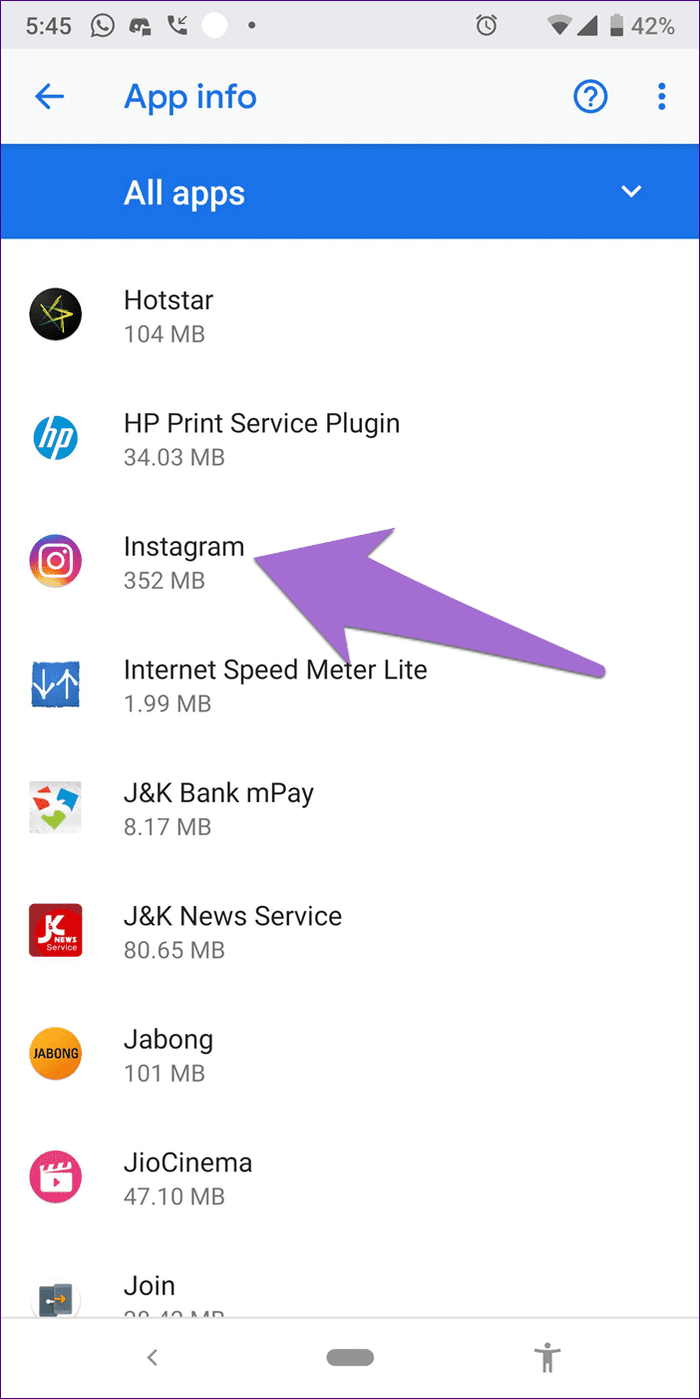
Step 2: Under All apps, look for Instagram. Tap on it.

Instagram keeps logging out 2

Step 3: Tap on Storage followed by Clear cache

Instagram keeps logging out 4

Step 4: Restart your device and try logging in to the Instagram app. If the issue persists, tap on Clear storage or Clear data depending on the option available on your phone. That will make your app behave as if it was freshly installed.

Clear Instagram Cache on iPhone

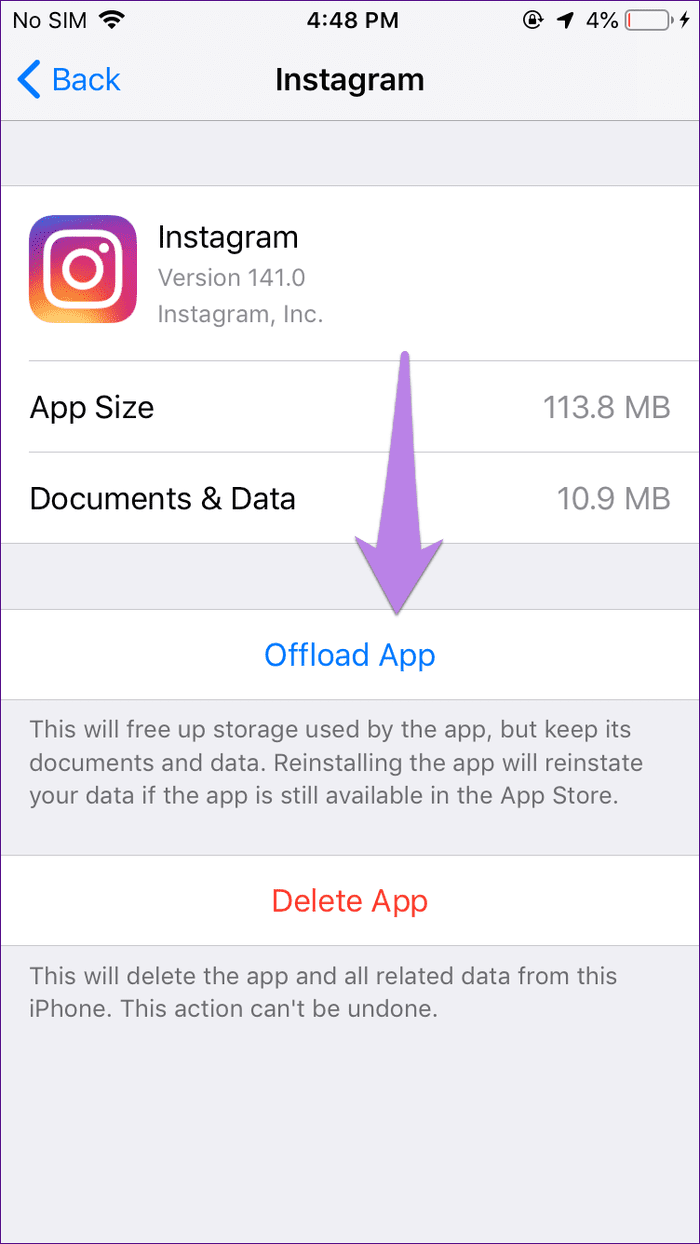
In the case of the iPhone, you need to offload your app. Offloading the app will not delete your data. To do so, follow these steps:

Step 1: Open Settings on your iPhone and go to General.

Instagram keeps logging out 5

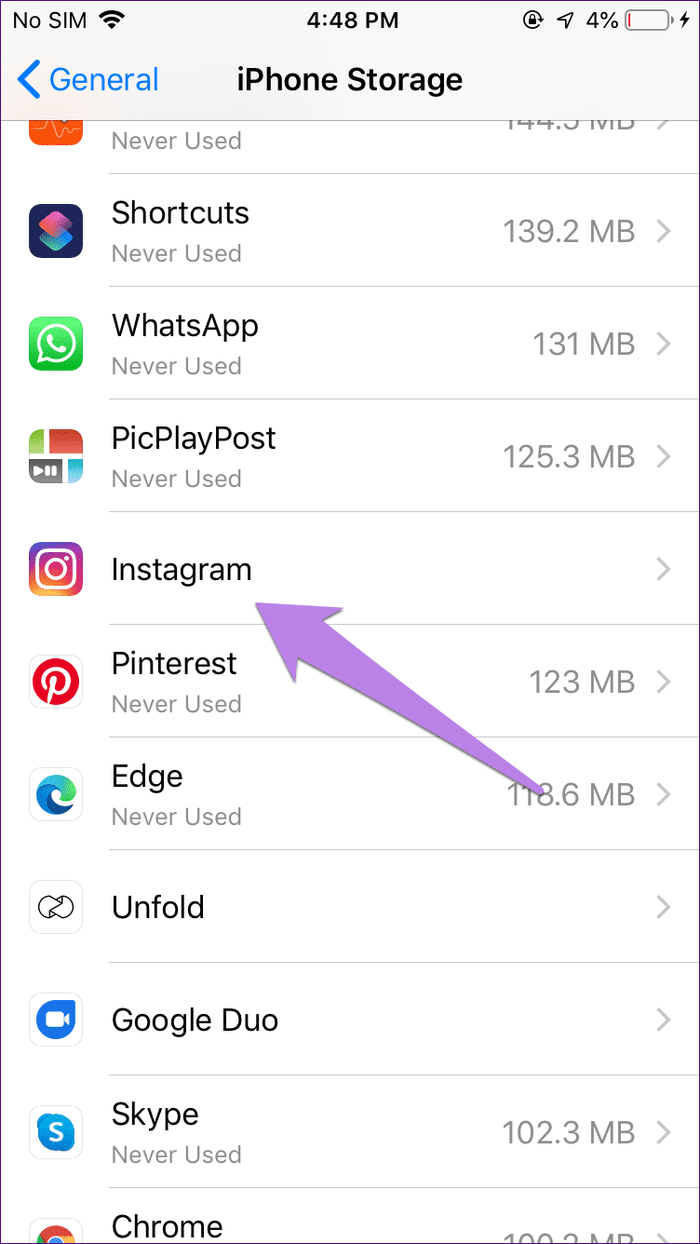
Step 2: Tap on iPhone Storage. Look for Instagram.

Instagram keeps logging out 7

Step 3: Tap on Offload App.

Instagram keeps logging out 8

Step 4: Restart the phone. If the issue continues, tap on Delete App in step 3. Doing so will remove the app from your phone and clear any data associated with the Instagram app on your phone. Make sure to backup your iPhone to save Instagram data.

7. INSTALL INSTAGRAM USING DIFFERENT ACCOUNT

Once you have uninstalled the Instagram app, you should install it on your phone using a different account. That is, log in to a different Apple ID and install the app using that. Similarly, log in to a different Google account on Android and switch accounts in Play Store when installing Instagram.

8. LOG IN WITH YOUR NUMBER

If your phone number is linked with your Instagram account, you can use it to log in. Directly sign in with the phone number instead of your email or username when asked or tap on the Forgot password button. Then, enter the phone number. You will receive a code on your phone. Enter it to log in.

Instagram keeps logging out 9

If your number isn’t linked with your account, log in to your Instagram account from a web browser on your phone or computer. Go to the Edit Profile section and add a new phone number.

Nigeria’s Busha Launches Busha Yield, to Allow Customers Earn up to 10% Annual Interest on Dollar Stablecoins

0

Busha, a crypto exchange in Nigeria with the mission to onboard millions of Africans into the crypto economy has launched a new crypto savings feature Busha Yield to enable customers to earn up to 10% APY — eight times the minimum rate for savings deposits with banks on Dollar stablecoins. 

Everyday Nigerians, as well as crypto investors, can now buy, sell, save, and earn real interest on cryptocurrencies including Dollar equivalent stablecoins through the easy to use, reliable, and secure Busha app. 

With interest being paid out daily, and flexible redemption with no penalties, this arguably will be the best flex savings for Dollar equivalent assets in Nigeria offering high and reasonable yield. 

Michael Adeyeri, CEO of Busha said, “An average Nigerian understands the importance of saving for the future and are constantly looking for the next opportunity to invest in, which is why a lot are susceptible to bad actors, I’m glad that Busha is able to give honest, hardworking Nigerians an opportunity to diversify their portfolio to include crypto without necessarily getting exposed to the volatility of the market while earning decent returns, we wanted to create an experience that allows crypto-curious individuals and skeptics to earn real returns on their assets without being scared of the crazy volatility that’s associated with the asset class.”

Customers can transfer their current USDT/USDC  balances, or easily purchase with Naira to transfer into Busha Yield wallet to earn interest for however long the balance is maintained. Interest is paid out daily, they can also redeem their subscription and withdraw anytime. Over time, Busha Yield will be exposed to institutional customers who want to start earning on dormant balances.

The launch of Busha Yield is the first major product release since the announcement of the seed round investment in Busha late last year led by Chicago-based Jump Capital. This and subsequent releases will further the company’s mission to make crypto mainstream and onboard millions into this new economy.

Busha Yield is immediately available to all customers. Minimum subscription of 10 USDT/USDC is required to get started and no fees to transfer into or redeem from Yield wallet. In the coming months, other crypto assets will be made available on Busha Yield.

Google Honours African Female Entrepreneurs On International Women’s Day

0

Another year, another opportunity to set aside a day to honour the women in our life.

It isn’t enough, yet they are deserving of everything. Did you know that women make up 58 percent of Africa’s entrepreneurs? Google has been trying to empower them with tools, and on International Women’s Day, they are also celebrating them.

Google is famed for their doodles, and they never fail to come up with something memorable no matter what the occasion. Their new doodle, as shown above, expresses their support for women of all ethnicities and religions throughout the world. They are now delving deeper into the topic of African female entrepreneurs.

International Women's Day

Google Honors African Women on International Women’s Day.

Google tells tales of how businesswomen are getting their names out there on this page. Female CEOs, owners, and founders who are building a reputation for themselves are featured in the tales. Serah Muindi, for example, is promoting mental health awareness in Kenya.

Hopewell Counselling Firm was formed by her to provide mental health services to people and communities in Kenya. She is one of a long number of women who are making a difference, and she deserves all of the credit for her efforts. Doodles were first used by Google to honour persons, events, anniversaries, and holidays, and the practice has continued to this day. We’ve seen a number of remarkable folks on that pedestal since then.

M-PESA hits 15 years since launch | Surpasses 51 million customers across Africa

0

M-PESA is now 15 years old, since its launch in Kenya in March 2007 by Safaricom. The peer-to-peer money transfer and payments service has also recorded over 51 million customers, 465,000 businesses, 600,000 agents and 42,000 developers across Kenya, Tanzania, Mozambique, the Democratic Republic of Congo, Lesotho, Ghana and Egypt.

M-PESA also reportedly processes more than 61 million transactions a day making it Africa’s largest fintech provider even as it gears to become Africa’s biggest Super App.

According to Peter Ndegwa, CEO – Safaricom, “We launched M-PESA back in 2007 in a bid to deepen financial inclusion for our customers by connecting them to useful and affordable financial services. In 15 years, we have seen population access to formal financial services grow to as high as 83% as we introduced additional services and reached more customers. Going into the future, we continue to build on our purpose to transform lives by providing our customers with a wide variety of digital solutions that empower them in an increasingly digital world. ”

With more people across the continent shifting to smartphones, 3G and 4G broadband, M-PESA is today evolving to become a digital financial services provider. In 2021, M-PESA Africa launched the M-PESA Super App and an M-PESA Business Super App which enable any business on the service to run a virtual store front providing their services virtually through M-PESA Mini Apps.

The M-PESA Super App is designed to be a customer’s lifestyle companion connecting them to services they need in a typical day including shopping, restaurants and food delivery, transport services, government services and much more. More than 9 million customers and 320,000 businesses have downloaded the M-PESA Super App since its launch.

“In the last 15 years, M-PESA has transformed the lives of millions of customers empowering them with useful and affordable financial services. With increasing smartphone usage across the continent, we are transitioning to be a digital financial services provider connecting customers and businesses in a digital world,” said Sitoyo Lopokoiyit, MD – M-PESA Africa.

In addition to the Super App, M-PESA Africa is revamping the M-PESA platform to support additional digital services, faster development of new products, and to achieve increased stability and reliability. The platform revamp includes expansion of the M-PESA APIs to provide developers with even deeper access to the service enabling them to deploy more innovations on the service..

The Future of eCommerce: Microsoft Dynamics NAV and Salesforce Integration

0

Microsoft Dynamics NAV (formerly Navision) and Salesforce are both titans in their playing fields—enterprise resource management, and customer relationship management, respectively. Salesforce is one of the most popular CRMs, helping thousands upon thousands of companies streamline their marketing and sales operations. Similarly, Microsoft Dynamics NAV and other Dynamics ERPs have cornered the market in terms of high-end ERP solutions. In fact, Dynamics NAV has been the most popular ERP solution in the Dynamics product suite for many years. It is notoriously simple to set up and use, boasting a wide range of supporting partners.

Today, Microsoft Dynamics NAV has been merged into Microsoft Dynamics 365 Business Central. The accompaniment—Microsoft Dynamics 365 for Finance & Operations—is the new face of Microsoft Dynamics AX (formerly Axapta). Dynamics in all of its ERP iterations have a high amount of synergy with Salesforce. Their complementary capabilities mean that many companies choose to implement a Dynamics solution alongside Salesforce; when this is the case, data integration between the two is necessary in order to get the most out of each.

Some businesses opt to create their own costly integration solution, however, companies such as Rapidi offer data integration solutions that circumvent this problem by providing a pre-configured solution that works “out of the box”, with no extra programming needed. Rapidi offers a robust yet flexible integration platform that will work regardless of any customizations made to an organization’s ERP or CRM solution.

Why is Integrating My Dynamics NAV system with Salesforce Such an Important Project?

CRM-ERP integration is vital for establishing a single source of truth from which all your team members can operate. The world of eCommerce is rife with available data pouring in from all sides as people shop for clothing on their phones while waiting in line at the grocery store. Data acquisition itself is rarely an issue; the real problem comes with having to manage all that data pouring in from stores, computers, and mobile devices around the world. Data siloing between platforms (or between departments) can lead to thousands of hours wasted on inter-departmental hassling and confusion over who has the latest information.

For those implementing Salesforce and Microsoft Dynamics NAV, customer information is often stored in certain parts of NAV. Because of this, sales teams may end up having to search both Salesforce and NAV for relevant information. They may not know where the most recent and accurate data is being stored, and this can lead to errors and delays. Plus, the need for redundant data entry across the two platforms inevitably leads to manual mistakes. Even the most adept team member falls prey to human error now and again, but this can mean substantial problems for executives that need to provide timely and relevant information to customers and clients.

Tried and true data integration platforms such as Rapidi empower companies to collect, store, and analyze data in a way that takes full advantage of every facet of a business’s CRM and ERP solutions. Rapidi’s solutions allow companies to offer the best customer service, due to the 360-degree view provided by experts in the field of data integration technology.

What Should I Know Before Embarking on My Dynamics NAV-Salesforce Integration Project?

Because of the popularity of Microsoft Dynamics products and Salesforce, the demand for Dynamics-Salesforce integration is high, especially from those in the realms of retail and eCommerce. There are three levels of relevant integration: user interface, business logic, and direct data. User interface integration provides a single point of entry into all relevant applications, while business logic integration works well for highly complex integration. And lastly, data integration uses REST APIs and SOAP APIs.

Many companies specializing in data integration have stepped up to the plate, claiming that their solution performs across every necessary level of integration. However, while many solutions may get the job done, not all are created equal; while developing RapidiOnline—Rapidi’s integration solution—the company focused on simplification and ease of use, while also ensuring their technology was robust, flexible, and secure. The end result was an integration solution that is reliable and intuitive, giving users ubiquitous visibility and instant access to necessary data.

Data Replication Technology and Microsoft Dynamics NAV

Data replication refers to a process in which data from one source is copied over to a secondary server or cloud. Replication ensures that users across a variety of locations all have access to the same, up-to-date information.

In order to run their business properly, many retail and eCommerce companies need to exchange data with their central Dynamics NAV system, moving data en masse between stores, headquarters, and back again. In this situation, it’s absolutely necessary for these companies to have access to up-to-date and accurate data (pricing and product inventory, for example) throughout all of their stores. This kind of information is often controlled at headquarters, registered in a central system but available for users across all stores and points of sale. Information pertaining to sales and employees should likewise be transferred quickly and effectively from each store or point-of-sales to headquarters. In essence, both data replication and data integration are pivotal points upon which an entire business, company, or enterprise hinges.

Rapidi’s data integration and data replication technology have been nearly thirty years in the making. With expertise not only in their own product but with Salesforce (and every Microsoft ERP solution in existence), Rapidi’s technology can help your business get a leg up on the competition. It prides itself on its pre-built integration templates, expedient deployment, fast and efficient data transfers, and secure and encrypted communications. Are you interested in learning more about integration and how it can improve your business’s bottom line? Click here. 

What Can We Only Do on Our Mobile Phones? 

0

Mobile phones can be distractive and valuable at the same time. You can use it as a source of entertainment, make your trip home safer, and instantly track a selfie. It can be helpful or distract you depending on how you use it. Below are some ways to turn a distractive device into a useful one.

Searching Photos by Category 

Looking for a photo and you don’t remember when you took it? Do not worry since using your phone to locate the picture is easy. You simply go to the search icon on your photo app and search by category. For instance, if you took a photo while on vacation, you can type vacation, and all your pictures, from vacation, will appear.

App-less QR Scanning 

Earlier, you had to have a specialized QR scanning app to scan a QR code. However, that is not the case nowadays. You point your phone camera to the code, and then it will take you to the intended website.

You can also scan a code from your Google app. All you have to do is enable the search screen after opening your google app.

Online Gambling

Many sectors utilize technology and mobile phones, and the gambling industry has not been left behind. The traditional casinos are becoming less and less famous, and gamblers embrace mobile casinos. With mobile casinos, you can gamble and bet on your favorite games at the comfort of your home.

All you need to start gambling is your mobile phone and a stable internet network. Some casinos even have a no-deposit rule which allows you to familiarize yourself with the casino before you start putting up your stake. That means that you can start playing at no risk and even get casino bonuses for signing up in the mobile casinos.

Checking Your Remote Batteries 

Have you ever tried to put on your favorite show as it is about to start, but your remote starts misbehaving? Trying to figure out whether it is an issue with your remote or with your service provider can consume even the precious minutes of your show.

However, figuring out the problem can be made faster using your mobile phone. Face the front of your remote to the camera of your phone, and if you see a red infrared light, your remote is doing just fine. If the light is absent, it is time to change your remote batteries.

Screen Mirroring

Thinking about watching a show from your phone, but then you sit and believe that the show would look more epic if it played on a larger screen. Do not worry; you can use the screen-mirroring feature on your phone to protect the contents of your phone on the TV screen.

However, some phones do not have the screen mirroring feature; therefore, you must download apps like chrome cast or use chrome cast enabled devices. You can also download third-party apps like reflector or Airserver.

Diagnosing Your Car Troubles

Have you ever had a car problem and then paid a mechanic a hundred bucks only for them to tell you it is nothing? You do not have to do that again since with an app on your phone, and you can tell what is wrong with your car. Automatic Pro is an app that allows you to plug in an adaptor at the base of the steering column.

When the adaptor is plugged in, the app can remind you where you parked your car, alert your loved ones if you are involved in an accident, and even diagnose engine trouble.

Safety

We all get scared when walking alone at night. However, there is an easy way that your phone can help you feel secure. A safety app can be installed on your phone, and they send invitations to selected contacts to track your location.

These apps can also schedule fake calls so that it looks like you are on a call with someone and set a timer to trigger a call to your loved ones if you are not home at the estimated time of the trip.

Controlling Your House Features

Your house can look occupied even when you are not around and help keep it safe. If you are always away and want to make your house look occupied, you can try installing Wi-Fi-enabled bulbs, thermostats, and air conditioners.

If you have these features, you can control them from your phone no matter where you are. You can also warm up your house a few minutes before you get home. Maintaining these features from your phone can help you conserve energy.

Hanging a Picture Straight

You do not need a level handy to hang a picture straight on your wall. Phones allow you to download apps on your phone to help you get the right angle for the first time and every time. Do not have pictures hanging crookedly on your wall when you could use your phone.

Conclusion

Mobile phones can help us make lives easier if used correctly. They can be our companions, helpers, and so much more. However, limit the time you take on your mobile screen to not become a problem instead.

5 Best Freelance Skills To Learn In 2022

0

If you want to change careers this year, the first thing you need to do is locate and devise a skill.

This piece will highlight some of the best freelancing talents you may master this year to launch a new profession and generate more revenue as a freelancer.

Moreover, you need tracking services for your parcels, such as laptops and gears, accessories, etc. speedpak tracking is the best option for this purpose. It ensures your parcel’s safety.

Best Freelancing Skills To Learn

Knowing the best skills will help you in the process of making a fortune being a freelancer. Here is the list of the top skills to learn this year.

1. JavaScript, HTML, and CSS

Web development remains one of the best, most in-demand freelance careers.

JavaScript programming and CSS and HTML coding abilities were among the top 15 most in-demand talents on UpWork in 2020.

As many companies are experimenting with interactive components on their websites, JavaScript was at the top of the list. It can be the year to hone your JavaScript abilities and capitalize on market prospects.

Take note that with more demand comes increased competition. You may have to vie with multitudes of other freelancers for web development jobs.

If you want to stand out from the rest, find ways to be distinctive and extraordinary as a freelancer.

2. Web App Development

Since the outbreak, many companies have shifted to offering their goods and services online. It included converting their websites into web applications.

Many companies, including restaurants, pizza parlors, and even grocery stores, employed web applications to let consumers buy online and deliver their purchases to their homes.

It’s one of the primary reasons why the demand for web app development is expected to increase in 2020. And it will remain thus for a long time while we acclimatize to the new normal.

The amazing thing about web applications is that they function like mobile apps on phones. It lowers the cost of creating native Android and iOS applications for companies.

Web app development is not a new concept, but there are several methods to investigate this field to discover the proper talents to launch a career.

3. WordPress Design And Development

WordPress is one of the quickest and most convenient methods for creating websites.

It is also quite inexpensive to create a website using WordPress. Consequently, it is the preferred platform for creating websites for small enterprises.

WordPress theme design, complicated website development, online shop creation, and membership platform development are excellent methods to initiate as a freelancer in WordPress development.

4. Cloud Computing

When it pertains to cloud computing, there are a plethora of distinct niches to investigate.

You should primarily concentrate on studying cloud computing, Amazon Web Services (AWS), Azure, and the abilities required to become a cloud computing engineer or even a programmer.

Then you can look for opportunities to work with SaaS (Software as a Service) companies and startups to help them develop their projects. AngelList has a myriad of opportunities for such individuals.

5. Administrative Assistance

Administrative assistants normally handle activities in an office, except that everything now takes place online.

Your duty as an administrative assistant is to look after customers, administer social media, keep track of your teams, provide virtual support, accounting, and other duties.

While it may seem to be a simple profession, it requires a high level of competence and the ability to multitask.

Over To You

Finding the correct expertise in high demand is critical to generating revenue as a freelancer. However, it is much more crucial to choose something you like doing.

If you are not interested in learning these talents, do not attempt to learn them. Learn what you want to do, and never have to “work” again.

Give Your Creativity a Boost Using the B.U.I.L.D. Model

0
Infographic brought to you by Wrike free project management tool

Give Your Creativity a Boost Using the B.U.I.L.D. Model - by Wrike project management tools

Google announces $1m grant funding for women entrepreneurs.

0

As part of a series of new initiatives aimed at supporting women-owned businesses, Google’s philanthropic arm, Google.org, has committed $1 million in charitable funding to support programs that help women entrepreneurs build their enterprises.

“Research shows that 58% of small and medium-sized business (SMB) entrepreneurs in Africa are women,” says Mojolaoluwa Aderemi-Makinde, Head Brand and Reputation, Africa – Google. “Despite this, women-run businesses show, on average, 34% lower profits than those run by their male counterparts. They are also less likely to receive funding and investment. This is why we are announcing a series of initiatives today, aimed at providing the support women need to grow their businesses.”

In addition to the funding announcement, Google has also announced #LookMeUp, a campaign to showcase women entrepreneurs and tell their stories. These stories feature women like Vivian Nwakah in Nigeria, who launched Medsaf, a pharma supply chain solution to help Nigerians get access to quality pharmaceutical health care services, Mary Mwange, CEO and founder of Data Integrated who is driving innovation in the mobile payments sector in Nairobi, Kenya, and Mosa Mkhize in South Africa, who launched Origins Publishers to provide her children – and others like them – with books in their home languages.

“Google is also providing free tools to support women entrepreneurs to grow their businesses and has launched an intensive program to drive the discovery of women-owned businesses through Google Business Profiles,” Makinde says. 

These tools include Google Business Profile, which helps businesses create a free webpage to make them easier to find online, and Primer, an app-based skills-building platform,  which allows business owners to access a series of free, custom designed, bite-sized lessons on the go. 

To help women business owners to develop their skills, Google has also dedicated the March cohort of the Hustle Academy to women-owned SMBs. The Hustle Academy, launched last month, is a free, week-long bootcamp designed to help SMBs build the expertise they need to expand their businesses.