Payments processor Interswitch has put aside US$10 million to fuel your payment startup anywhere in Africa whatever your growth stage.
According to the firm, the ‘ePayment Growth Fund will be a catalyst for funding innovation and disruptive business concepts within the payment industry across Africa in a move aimed at helping developing innovative products and services.
Interswitch also thinks the African payment industry is the future.
Mitchell Elegbe, Group Managing Director, Interswitch, said:“Interswitch is committed to encouraging innovative ideas and developing start-ups across Africa. We created the US$10 million e-payment growth fund to do just that, and it is with great excitement that today we can announce our first investment. ACE is exactly the sort of business we want to support: dynamic, energetic and dedicated to breaking barriers for e-commerce in the African market.”
Interswitch yesterday announced they had invested $850k into Tunde Kehinde and Ercin Eksin’s ACE. The cash is the first of the US$2.6 million fundingInterswitch will pour into the logistics startup to accelerate its expansion through Nigeria and beyond into West Africa.
Pan-African payment processor, Interswitch today launched a new US$10 million ‘ePayment Growth Fund’ to fuel startups in the payments and ecommerce sector in Africa and as well invested $850k in ‘Africa Courier Express’ (ACE), formerly A-Post.
ACE will use the initial investment of US$850,000 to expand across West Africa.
In a statement, Tunde Kehinde and Ercin Eksin, Founders, ACE, said:“We are delighted and very proud to be selected as the first investment from the Interswitch ePayment Growth Fund. This new capital provided through our new partnership with Interswitch, and which is part of a larger US$2.6 million funding, will enable us to accelerate our expansion through Nigeria and beyond into West Africa.”
Launched in November 2013 by Kehinde and Eksin, ACE provides reliable third-party logistics, tracking and pay-on-delivery (cash and electronic) services for retail businesses in Nigeria. The firm is now present in 5 cities across Nigeria and has shipped to almost 100,000 customers, and is currently one of Nigeria’s largest ecommerce logistics management companies.
The investment by the Interswitch fund will enable ACE to grow the West Africa’s retail market by allowing retailers to focus on their core business of purchasing and managing inventory.
ACE has distribution hubs in major cities across Nigeria (Lagos, Abuja, Port Harcourt, Ibadan and Abeokuta), developed a world class IT backbone infrastructure to support transparent tracking of packages, acquired anchor clients, and hired experienced logistics staff to launch and run the business. The company is currently supporting a number of blue chip clients and is experiencing growing demand for its services across several sectors.
In a statement Mitchell Elegbe, Group Managing Director, Interswitch, said:“Interswitch is committed to encouraging innovative ideas and developing start-ups across Africa. We created the US$10 million e-payment growth fund to do just that, and it is with great excitement that today we can announce our first investment. ACE is exactly the sort of business we want to support: dynamic, energetic and dedicated to breaking barriers for e-commerce in the African market.”
Kenya’s biggest entertainment blog by unique visitors and revenue has announced a huge milestone amidst growing competition and backlash due to the raunchy content the site publishes.
Sam Majani, the founder and CEO said,”Just three months ago I was sitting in the office with only one writer after all my editorial staff were poached! Today we have nearly doubled or traffic since, to become the first blog in Kenya to clock 2 million readers!”
Ghafla would have closed shop when all its writers were poached to Radio Africa outfit but Majani moved door to door until he hired a whole new team which he says has been intrumental for this growth. He also remembers the dear move from a lyrics site to gossip publishing, a move he had rejected several times until his investors added the push.
“Well initially Ghafla started off as a lyrics site. I thought lyrics was a big unfilled gap in local content online. We did lyrics for four months till about February. The whole time, my investors had been begging me to switch to news. I was adamant about lyrics, and it was only when Nikolai Barnwell from 88mph came to our Nailab office and staged a sit in protest that I buckled. He said he wasn’t going to leave my desk till I created a news section! By the way he was red in the face when telling me this! ”
So the Ghafla we know today was born out of the slight pivot. And the readers came pouring in with every new gossip story going live. The professional look had to die, but it wasn’t an easy death.
“I had taken on investors at a 10 million shilling valuation. From my basic knowledge of fiduciary duty, I knew that they’d make a good return on investment if I grew the company to 100 million valuation. That meant Ghafla needed to go big, no, go HUGE, or go home.
And Majani says its the readers who wanted gossip and they would ask him everytime if the site had latest scoops on Kenyan celebrities and it grew.
“And I did it with a slightly heavy heart, for that was not exactly what I had dreamt I would build, but the people had spoken. The market expectation of an entertainment news site is to not just report on entertainment, but to actually BE the entertainment, through gossip.” said Majani. “And at least underneath it all, I’d be working in two areas that I loved: software and entertainment.”
So in October 2012, he went all-out with Kaz’s nude photo‘s then Vera Sidika‘s identity in the You Guy Video and then came the millions of readers.
“Soon we had the erection shaped usage graph coveted by all startups. And thus my biggest lesson in business was learned: In business you get nowhere trying to ram your personal preferences down other people’s throats. In its simplest form, all business boils down to the basic equation of supply and demand. People want what they want and only by being the supply to the demand is when you get paid. Which demands are right and which demands are wrong? That is a tricky question to answer, as one man’s meat is another man’s poison. Some may see socialites as the scum of the earth. Others may see socialites as leaders in the push to get plump ladies accepted as beautiful in the fashion industry,” Majani said.
And the numbers are good for his business too as online advertisers want HUGE numbers, especially given the prevalence of multinationals like Google and Facebook. If he had stuck to professional content he would have 100,000 readers even if they were quality readers. This to advertisers doesn’t make sense. Apart from the 2 million readers, Majani also says Ghafla has eight figures in the bank, seven figures in receivables, eight figures in annual revenues(in mandatory VAT bracket), three serious acquisition offers by the biggest media houses in Kenya, 50 million total of venture capital offered by different funds, all giving close to 100 million valuation, but declined and 20 jobs created.
Though he sounds like he is boating, other bloggers in the gossip scene are not doing as big. Niaje, one Ghafla’s competitors went offline for sometime due to financial issues. Niaje has also decided to do the same Ghafla content to stay afloat.
With all this cash, Ghafla can do better with its own Radio station something like Ghafla Radio but Majani says his forte is new media not Radio.
Zamzam Rashid Yarrow launched her blog Zaraya’s hijab to write about the joys and experiences of the hijab to the adolescent and adult muslim girls. It helped explain to the world why as a muslim you ought not to shake hands with any man or hug them.
It aimed to explain the muslim world to both the muslim and to the public who come from variuous religions.
As a Muslim girl of Somali descent growing up in Kenya, a largely Christian country, there is little awareness about life as Muslim.
After sometime, Zamzam suddenly began thinking about women empowerement, relationships, and instead of trying to explain herself from a religious viewpoint,opened out the world of issues women of somali decent were facing. In June 2014, She changed the blog from Zaraya’s hijab what it is today-Zarayas world.
From a place to be full of poetry, Zamzam shifted the blog to more serious issues facing the muslim women than just the hijab and the public misconceptions about the hijab and the muslim world in general.
Though using her own savings now, Zamzam hopes to monetize her blog by charging for sponsored content, accept firms to advertise their products and services to her audience and as well do social media promotions and event listings.
“I aim to help people look at the muslim woman differently than just the hijab or buibui.”
We are not sure if her moves will be termed anti-muslim as the religion holds anything to do women sensitive but Zamzam, herself a staunch muslim might be on the right and might even be using scriptures to correct a society that’s slowly turning lawless and cruel by the day.
As a single muslim girl in business, there is also a probe of not being taken serious by her fellow muslims. The site aims to cover fashion, travel and photography, life,business and relationships says the USIU International Relations bachelors holder.
Following the Supreme Court ruling on Friday 13th that directed that digital migration takes place as scheduled by the Communications Authority of Kenya, the Authority moved fast to implement the same by issuing a statement calling on all broadcasters that were still broadcasting on analogue to switch to digital broadcasting latest midnight in compliance with the ruling.
Predictably, Africa Digital Networks representing KTN, NTV and Citizen in a rejoinder accused the Authority of selectively applying the ruling on the dispute. As a result, the three aforementioned media houses continue to broadcast on analogue whereas other 8 broadcasters have already complied and switched off their analogue broadcasts as per the phase 1 and 2 schedule.
In their defense, the three media houses claim this action will plunge 90 percent of the viewers into darkness. This is misleading given the fact that uptake of set top boxes has been on the rise since the Communication Authority announced plans for the phased analogue switch off. Over 700,000 out of 1.2 million households in Nairobi alone today access digital television using type approved set top boxes and will therefore not be affected by the analogue switch off.
The three media houses seem to have exhausted their tactics to further delay this transition, initial arguments for their non-compliance was based on cost of set top boxes which have since dropped considerably between 1,700 and 4,000 depending on the model of choice. The three later opted for a lengthy court process that resulted in their award for a self-provisioning license, they now want more time to import their own set top boxes!
These delay tactics have worked against them as what the three media houses are most afraid of is a drop in viewership numbers that attracts advertising revenue. Instead of injecting this energy in developing competitive content that will retain their viewership numbers, they are fighting to retain the status quo as they stare at increased competition from new broadcasters who have already started their operations and their viewership is growing.
Reality will soon dawn on the three seeing that digital migration will open grounds for increased number of broadcast television stations and no particular broadcaster will claim to be more superior than the other in terms of coverage since the digital television signal will be uniform across all broadcasters, therefore, audience reach will be based on interesting content that Kenyans will deem relevant to them.
The growth in number of free to air television channels will see the broadcasters share the spoils as only those that invest in premium and relevant content will attract a high number of viewership and therefore claim dominance and subsequent advertising revenue. With the successful migration, more broadcasters will invest in the sector and upset the status quo and only the most competitive will remain authoritative.
Current analogue coverage against digital coverage
Interestingly, the current analogue signal coverage is way lower than the 70 percent digital television signal coverage as covered by the two signal distributors Signet and PANG, it has only taken the two just over 3 years to surpass the analogue transmission coverage and 100 percent coverage in the country will soon be achieved as they continue to expand to beat the 3rd phase analogue switch off set for 30th March 2015.
Migrating to digital will also significantly lower the cost of setting up a broadcast station. Unlike before where an investor would have to erect transmission masts across the country, what one requires during the digital era is to sign up with either Signet or PANG who have already set up the masts and effectively reach similar audience as the traditional media players.
This is a significant step towards creating employment opportunities for Kenyans who will work in the broadcast stations as well as creating demand for content that will be required to air across these channels. Content developers will have booming business as local drama, series, comedy shows and music find a ready market that will absorb the audience through the respective stations.
It is therefore important that as a country, we do not continue to be held at ransom by the interests of just a few players at the expense of national development. There are enough affordable type approved set top boxes in the country and individual stakeholders in the sector are ready to see a smooth transition from analogue to digital broadcasting.
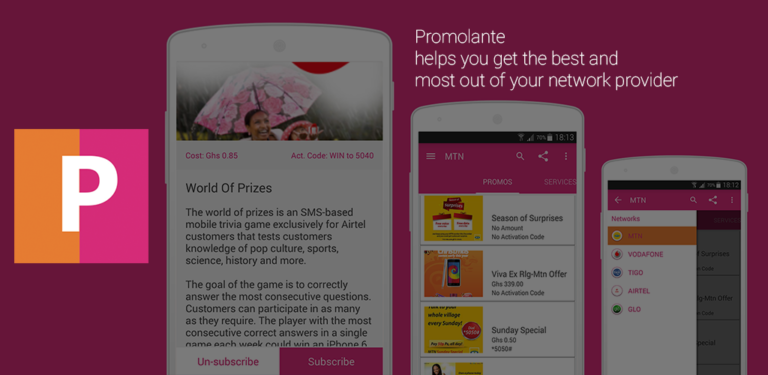
In a move expected to help users save on their airtime, Promolante has launched in Ghana to help Ghanaian phone users get the best and most out of their network provider by making it easy for users to easily discover, subscribe and unsubscribe from promos and services, activate and deactivate data bundles and find relevant shortcodes.
Abdul-Rahim Sulemana, CEO of Promolante said in a statement, “After we launched the web app, Promolante.com, we had many users asking for a mobile app. Now these users have all the convenience of the Promolante product on their smartphones. No more missing out on promos or calling of friends for shortcodes.”
The Promolante app placed third at the recently held Samsung Developer Challenge in Accra where judges believed the app will greatly benefit Ghanaian phone users.
Some of the features of the app include an instant subscribe. Users of the app can easily activate or deactivate a promo or data bundle. This takes away the burden of having to keep many shortcodes in memory in other to use telco offers. The offline access feature also saves all the offers that is being checked out so when the user is offline, all those offers would still be relevant.
KejaHunt, a web and mobile real estate listing site has finally grown up. The startup’s CEO Joshua Mutua last week went to Facebook to announce the paid house hunting than just listing properties, something Nigeria Tolet does.
According to Mutua, the shift to paid house seraches has been gradual and experimental as a number of users have been paying them to do the search and now the startup is becoming an online real estate agent not a classifieds portal for listings.
“You see, our business model was charging the landlord a standard listing fee, then providing these houses to you the tenant FREE of charge. That worked perfectly when we had a smaller market to address,” said Mutua.”Presently With a weekly inquiry and placement of 30 people, we are easily able to serve and place you in the house of your need. However, we have a large group of over a thousand people left out who we are not able to cater to due to the nature of our present business model.”
Started almost a year ago, Kejahunt has raised some seed funding from Nailab and is set to raise more to help it achieve its new mission. Mutua says Kejahunt is still focused on helping users save their time and money by going all the way to get them vacant houses for rent.
Unlike its competitors like BuyRentKenya, Anza, Nsoko, Property24 and Lamudi, Kejahunt is solely focused on the young generation who are looking for their first house after leaving campus or on campus.The site does list properties for sell but its focus is on rentals. I has a roommate feature to help tenants find roomates via Facebook matching.
This shift will help Kejahunt help young guys find houses for FREE without the hustle of using agents.
As a business we are at that critical point where we ask ourselves: to change or not to change our business model. This means we’ll be shifting to the agency model: pay us 1k or 2k to do a house search for you but maintain our integrity and the same value service you have been receiving. And seeing that you, our customer are at the core of our business, we would like to walk this journey with you.”
The Most African problems can be solved by increasing the amount of energy each country produces; and speaking of energy we are talking about the basic energy of lighting. Many use Kerosene lamps which is hazardous to both the health and the environment.
More than 500 million Africans cannot afford to get electricity in their home and solar powered lighting is not pocket friendly either due to their initial cost; that is why Tanzanian Start up, ‘KARIBU Solar Power’ wants to bring solar energy to the locals.
KARIBU helps the Tanzanian Citizens to buy the solar lamps in instalments by dividing the lamp into three parts, the solar panel, the battery and the lamp itself. This is how it works, a customer will rent the battery and the lamp at a small fee and will take the battery to be charged everyday which they will have to pay. As the customer pays for the charging everyday they keep redeeming the total cost of the whole lamp and when they reach the total amount (cost price of the lamp), the customer gets to keep the lamp, battery and KARIBU will give them the solar panel to charge the battery.
“By splitting up the conventional solar lamp into its components, we split up the payments, replicating the cash flow for kerosene, which in turn make the solar affordable,” says the company.
KARIBU Solar Power was founded by Adam Camenzuli, who lives and works in Tanzania; although the company takes care of the East African market mostly in the rural areas where lighting is very expensive.
The other part of the team include; Ricki Tatz, Sameer Gulamani- founded enerprises in East Africa, Afzal Habib –operational expert, Oluwaseum Kolarinwa and Andrew Clark.
The Users and Survivors of Psychiatry in Kenya organization is appealing to Kenyan telecoms to install toll free call services to rescue individuals living with mental disorders, following increasing reports of suicide cases in the country and topped with limited intervention on mental health.
“Many people in the streets are suffering from schizophrenia, with no one to assist them,” explained Macharia Njoroge during an annual USP Kenya meeting held on 13 February 2015, Nairobi, noting that local media has reported high cases of suicide and mental health.
According to USP Kenya, mental illness is a risk factor for suicide with reports indicating that nine out of ten suicide cases have a mental illness. At a time when reported cases of mental health have been on the increase, the USP members shared concerns that despite reports, stigma is dominant amongst those affected of which could be avoided in conjunction with the help media.
Mental illness associated with suicide includes depression, alcoholism, schizophrenia and personality disorder. However, various cultures in the country still view mental illness as a curse or a taboo, leading to stigma and discrimination. Yet, the leading cause of suicide involves untreated depression of which can be triggered by stigma and environmental factors, notes USP Kenya.
“Don’t scold the sufferers, it’s not a celebration,” explained USP Kenya member, Pauline, “Bring out the condition as a problem.”
Based on USP Kenya reports, in just a period of three months, there were a total of 107 published news articles and features that reported on mental disability, mental health and suicide.
Noting the severity of mental health, other USP reports analysed in 2013, revealed that of the Star’s 59 articles, 41 per cent were news reports on suicide. The DailyNation newspaper on the other hand, had 48 articles analyzed in which 15 (31 per cent) were reports on suicide while 33 per cent mentioned cases of mental health illness.
USP Kenya noted that despite media reporting on suicide cases, there has been failure to include advice, information and counseling contacts for readers especially on reports on suicide. To date, there have not been many call/help centers that assist people living with mental health challenges. For instance, reports indicate that there are at least 76 trained psychiatrists in the country.
Nevertheless, as a solution to reducing unattended cases of mental health and suicide cases, USP Kenya suggests that hotline numbers accessible to the public be installed by local mobile or telephone networks with Safaricom as an example. Thus, individuals would be able to have access to mental health services so as to reduce the suicide scourge.
Cape-Town based start-up wants to better public Wi-Fi system by providing tools to the service as well as monitoring the performance of the hotspots.
The start-up, called Asimmetric, has experts in the telecommunications industry and has financial support from angel investors. It has also secured a contract with a large South African Wi-Fi network operator; details have not been revealed.
The company’s solution is already installed in shopping malls, hospitals, hotels and restaurants in Johannesburg, Cape Town and Durban.
“Wi-Fi providers lack the tools to understand how users experience their networks,” says Asimmetric co-founder David Wilson. “Users can get stuck, unable to connect, login, access Facebook or stream YouTube, and the Wi-Fi provider doesn’t realise there’s even a problem.”
Founded by David Wilson, Ross Douglas, Michael Champanis and Fouad Zreik, Asimmetric have spent the past couple of years designing and building both the hardware and the software to provide detailed remote reporting, including analytics, about Wi-Fi hotspots to operators.
They have developed the “Bot”, a piece of hardware that is installed at a Wi-Fi hotspot. The Bot monitors the hotspot and uses services such as YouTube and Facebook, mimicking the actions of a human user.
The solution can even detect interference from other networks, allowing support engineers to troubleshoot workarounds remotely.The software evaluates the Wi-Fi user experience in real time on a series of dashboards, and alerts the provider to any issues. It also offers analytics to help diagnose problems.
“There are something like 50m public Wi-Fi hotspots worldwide; there’ll be 340m by 2018,” says Wilson. “Less than 15% of those hotspots are carrier grade today; more than 70% will be carrier grade by 2018. There will be huge demand for Wi-Fi offering an excellent quality of experience.”
Malawi’s state house has denied news by the National Newspaper that alleged someone had hacked into statehouse computers saying that the man had instead impersonated the president.
In a press statement, Acting Presidential Press Secretary, Timpunza Mwansambo said “Hacking is the practice of modifying the features of a computersystem in order to accomplish a goal outside of the creator’s original purpose which the arrested man did not do. The man has so far been charged with impersonation by the Malawi Police Services, contrary to assertions that he hacked the computer systems as alleged in the news article.”
He added that with technology people can create email accounts using a fake name and that is not hacking and the man who was impersonating State President Prof. Peter Mutharika had created an email address
“As we are aware, the State President’s Surname does not have an “h” at the end. The suspect had other fake email addresses which include;
“All these do not belong to the state president, the state house or theoffice of the president and cabinet. This man who Nation Newspaper alleges to have hacked state house computers was arrested by the Malawi Police for impersonating the President by communicating with his victims through these fake email addresses and not hacking the state house computer,” he said.
He added the arrested man who was impersonating the president was getting money from the victims through the following Bank account, Robert Seleman, Standard Bank, Mzuzu Branch, Current Account number 0140020445700 which in anyway does not belong to the State President, the state house or related to the concept of hacking.
On Saturday 15 February 2015 Kenyans still watching KTN , NTV, QTV and Citizen channels dramatically saw the channels disappear starting with NTV followed by Citizen and Finally KTN and no the channels could not be found on pay TV channels either.
Startled viewers were left frantically hitting their remotes, adjusting their signals and calling their loved ones and contacts to find out what was happening.
This came in the wake of a ruling by the Communications Authority of Kenya by the Supreme Court on Friday 13th February 2015, on Petition number 14 of 2014 that had been brought before them by The Royal Media Services Ltd, the Standard Media Services Ltd and the Nation Media Services on digital migration in which they sought more time to set up their own digital migration infrastructure.
The Supreme court however ruled that “It is clear to us that, following the judgement of this Court, and the appropriate acts of compliance which have been summarised in this ruling, the stage was properly set for migration from analogue to the digital platform in broadcast transmissions, and there was, and is, a new national and international reality in that regard, to be adopted and internalised by all parties who have come before us. From the foregoing observation, and from our Ruling as a whole, it should be clear that there is in place no cogent foundation for the application filed by the 1st, 2nd and 3rd respondents (Royal Media Services Ltd, Standard Media Services Ltd and Nation Media Services Ltd.) before this apex appellate Court. From the terms of this Ruling, the Orders of which we set out below, it will be evident that no matter is pending before this Court, to be preserved by interim Orders.”
The forceful switch off carried by Communications Authority of Kenya in the company of police was therefore done to ensure that the digital migration timetable was adhered to but in turn the three media houses have since not migrated to the digital platform causing some sort of blackout to Kenyan content for millions of viewers who like the stations and therefore a myriad of reactions for and against the black out.
While some Kenyans felt that the switch off was hurried and the three media houses should be given time to get their affairs in order so as to get a seamless transition, others felt that the time for migration had come.
A majority of Kenyans have been left confused as they stay in the dark wondering if they will be forced to have two set top boxes so as to access local content and international content. Meanwhile those not on pay TV are in the dark save for a few stations.
In his reaction Information and Communications Cabinet Secretary Fred Matinagi said : “The CA did not ask any of the BSDs to remove the 3 media houses from their platforms. In addition to switching themselves off the digital transmission, the 3 media houses opted to screen inaccurate and misleading messages in a deliberate effort to incite the public and portray the regulator in negative and bad light.”
Both switching themselves off the digital transmission and screening inaccurate messages is both illegal and in blatant breach of the conditions of their licensing. The government notes this with great concern and hopes the CA will take independent regulatory action on the same. The conduct of the 3 media houses is contemptuous to the Supreme Court. It is irrational and perhaps intended to incite public opinion against the regulator and the government.
Leader of the official opposition Raila Odinga said: “Jubilee must explain what its interests are in keeping Kenyans in information darkness and Kenyans must demand their right to information,” said Mr Odinga in a statement to newsrooms.
In a reply to Matiangi, the three media houses said: The three media houses have been broadcasting on ANALOGUE platform and the dismantling of the equipment by the CA in Limuru effectively switched off our transmission. We have NOT been broadcasting on digital and the application that was before the Supreme Court was about being afforded adequate time to order, import and install digital broadcast equipment.”
“The forceful shutdown of analogue broadcasting was clearly calculated at forcing the three media houses to avail their signal for distribution by the government-owned SIGNET and the government’s preferred Chinese-owned distributor Pan Africa Group PANG that also operates Pay TV service Star Times,” read a part of the statement.
“We note with concern that the statement by the Cabinet Secretary is laced with threats aimed at intimidating the three media houses into giving in to the contentious, pre-determined and altogether unacceptable position taken by the Communications Authority on digital signal distribution.
Finally, to our viewers, we regret the inconvenience caused by the unfortunate developments arising entirely from the gross mishandling of the digital migration process by the Communications Authority and other forces. The three media houses have been and will always remain committed to digital migration and we are doing everything possible to get your channels back on air,” read another part.
As the various parties squabble with accusations and counter accusations they forget a very important stakeholder; the consumer. S anyone out there addressing the concerns of the consumer as the prices of set top boxes, will they need two what about the local content they are missing?
This is the last time we are talking BebaPay, the guys at Google Kenya couldn’t help save it as any techies so Google’s BebaPay will on March 15th, 2015 be off the streets and replaced by a MasterCard which will allow users to transact at all outlets accepting MasterCard®.
To migrate from your BebaPay Card to the Equity prepaid Card, please visit a BebaPay agent with your BebaPay Card and National I.D. before 15th March, 2015.
If you choose not to sign up for the new Equity prepaid MasterCard®, Google wants you to exhaust your balance on any BebaPay accepting buses before 15th March, 2015 or get a refund after 28th March, 2015.
Kindly take note of the following important dates related to the use of your BebaPay card:
13th February, 2015: Last date to top up your BebaPay card through an agent
20th February, 2015: Last date to top up your BebaPay card through mobile money
15th March, 2015: Last date that you can pay with your BebaPay card
1st April, 2015: Last date that you can access your BebaPay account online on www.bebapay.co.ke
BebaPay bus lines included Channai Travellers, Citi Hoppa, City Star Shuttle, Compliant, Destination Connect
Forward Travellers, JulimaKimisa Sacco, Manchester Travellers, Meru Nissan Sacco,Mwi Sacco
Nangkis Sacco, NNK, Paradise System, RasasiStar Bus, Sunbird Services, Super Highway 45
Sweet Heavens Buses, Ummoiner Sacco, Unified POA and Zam Zam 45
Canada’s Transit App has launched in Kenya to help braing sanity to Nairobi traffic where bus timetables don’t exist.
Founded in 2012 by Guillaume Campagna and Samuel Dionne, Transit is a mobile alternative to paper timetables and signposts to help people see upcoming departures leveraging user’s location.
According to the founders, “Building more roads and adding more cars will not solve the transportation woes of the modern city. With 80% of the world’s population living in urban areas by 2030, only effective mass transit can move cities forward. We believe the smartphone is the foundation for urban mobility in the 21st century, and it will help define our urban future.”
The Canadian firm is live in Paris, New York, London and several other cities and aims to help Nairobi commuters to improve their trips using public transit data. The firm aims to work with a local transit agency and as well acquire their open data then design an app that’s specific to Kenya.
“Being headquartered in Montreal, we’re used to looking up a bus schedule and hopping on whatever ride comes in the right direction bearing the appropriate route number. If you live in the West, your experience is probably similar. But in Nairobi, things aren’t so straightforward. Commuters have to figure out everything for themselves,” the firm says.
Using Digital Matatu project data Transit App says it will be the first public transportation app to integrate Nairobi’s transit system in a move that will help commuters plan their commute earlier before they leave their homes.
The app will help users find “find which ride will get them to their destination at their own personal convenience. They can access a list of nearby routes — where to board, how frequently they arrive, and where they’ll stop.”
The app also has a trip planner to help commuters choose the most efficient routes than just boarding matatus out of need. The firm has designed the app to match Nairobi’s traffic needs plus schedules and regional color coding with stop locations, and route maps all offline . The app will in time offer real-time transit information.
Transit App will finally do what Ma3Route was supposed to do.
It is not easy for most people to understand the daily job of supporting tech entrepreneurs in Africa. Indeed, this fascinating mission only concerns a couple of business angels, venture capitalists, advisors of any kind and, of course, incubating teams. .
This, to me, is the most engaging job in the world: you deal with dozens of brilliant entrepreneurs and visionaries, are in touch with a lot of technologies and business models, get to know them on a personal level and sometimes become friends with some of them.
However it can also be the most ungrateful job on earth. Here are several reasons:
1) The majority of us will never get rich doing what we do! Indeed, only a very little portion of us invest their own money and have shares in the companies that we support. The rest are either volunteers, employees, mentors, etc and most of our tech hubs are non-profit organizations. The funny thing is that sometimes, when you try to have an entrepreneurial approach and make your hub sustainable, people tell you that you aren’t social enough!
2) You will be judged if your startups fail and forgotten if they succeed. No need to elaborate on this, I think you understand. Entrepreneurs all have their reasons not to show that you helped them when they were hitting rock bottom, when they were in a burnout, when they were fighting with their partners and employees, when they just needed someone to talk to. Yet, you were there for them all the time. But I understand that. Like us they evolve in a very uncertain and high pressure environment. Some of them just can’t allow to blame themselves for things that did not work out or to be grateful for something other than their own genius when they succeed.
3) You can always do better. And that’s a good thing in fact. Your job and performance will always be challenged and therefore, you’re always required to improve and rarely congratulated for your actions. And again, even though it is a highly ungrateful situation, it is a good one. You keep on getting better and better for your new entrepreneurs.
But these are personal feelings that have to be managed at a personal level by each individual. The real question that I want to ask is:
Should we support entrepreneurs – or couldn’t the real entrepreneurs get off the ground by themselves?
1) We all should advize, put pressure, open doors and boost their business, but not run the business for them. Or at least that is the theory. Doing our job you’ll quickly understand that if, at some point, you don’t get your hands dirty and do what has to be done along with your entrepreneurs, you will never have them work on something strategic or gain their respect. In the meantime, however, you have to make sure that you only provide assistance to the ones who are ready to die for their business, at least as much as you’re ready to die for your incubator. Moreover, sometimes, exceptional events make your entrepreneur or his team completely out of operations (burnouts and key employee departures are the most current cases). In those situations, either you watch the business die and tell everybody that is was not your fault, or you go ahead and manage the business during the crisis. Fortunately, we only had to do this once at CTIC in three years of activity. The startup that was in a critical situation at the time is now one of the most successful startups in Senegal.
2) Even the greatest entrepreneurs need assistance at some point.
Some people, mostly in the US, will tell you that an entrepreneur who needs support from an incubator will not succeed anyway. Maybe it’s true – at least over there in North America where incubators, in fact, can be replaced by many other parts of the ecosystem that have been involved for a long time: mentors, family, business angels, teachers, classmates – all play a huge role in building the success stories that we all know.
In Senegal however, and probably in many other countries: we don’t have many of those types of support for startups. Therefore, your incubator can play a tremendous role. But it is also a danger to centralize “entrepreneurs support” in one or two spots in a country. This is why I believe that it is clearly our role to help build this ecosystem and support other organizations, even if, at some point, they may become your competitors. But don’t worry, the work to undertake is gigantic, and the more the merrier right!
3) We should support entrepreneurs like if we had invested a million dollar in them
With passion, dedication and empathy. We have to do this very difficult mental task to put ourselves in the life and brain of our entrepreneurs everytime we meet and work with them. For us at CTIC, it has naturally been much easier to build this “symbiotic” relation with entrepreneurs located in the hub versus with “virtual incubatees”, which have office spaces outside of the incubator.
4) Finally, we should never claim the success of any company.
I heard one time that good incubators and accelerators never speak about themselves more than they speak about their companies. I could not agree more – this is true. I also think that whatever amazing services you provide to your startups, you are not responsible for their success! Great people succeed anyway – you just helped them accelerate their growth and get beyond the tough times.
In a nutshell, this fascinating job is a very difficult one in countries where ecosystems still have to be built. But do it with passion and humility. See the big picture and never discourage yourself. You’re on the good track!
Though we are supposed to be in the age of big data, people still think we have come that we have come to the end of reason. And to many, this looks like the beginning of the battle of gods.
Leila Khalif is a Kenyan practising muslim. She believes in working hard and leaving the rest to God.
As a practicing muslim and a woman, and one of the few muslim women in the service industry using tech, she is not only a figure of hope to her teammates but can easily be trusted being muslim and a woman.
Standing out to gain an education and head to the boardroom straight minus knocking any doors for jobs, Leila is getting hardened and trained as an up and coming business woman as the CEO of TasKwetu, a Kenyan version of TaskRabbit which is based at Nailab. Kibarua Now is a similar company, helping people carry out local tasks and slightly different from TasKwetu. Both were founded by women inspired by their faith, both have strong backing from family and friends.
Great education and experience
Kibarua Now’s founder Shiko Gitau is an experienced tech entrepreneur and consultant, having founded her own companies and worked for behemoth Google for some time. Just like her counterpart, Gitau is a staunch Christian woman and as well hardworking. Gitau believes that with god all things are possible and having the work of her hands blessed by God, every business challenge can hear her voice and obey. This is true in the Christian faith.
Both companies have raised seed funding to prove their businesses. Both started companies after seeing the need to help people manage their lives. Both are women-led teams.
Khalif, busy and down to her business building and surveying, trying out things and taking word out about her company and doing everything to see success. Just like her counterpart, using her wider networks, Gitau has created relationships with local entrepreneurs by hosting them at her office, picking their brains and then going to almost every campus and corporate firms that might need Kibarua Now’s services. Both devout believers, are not sitting back to wait for things to happen but are working and believing that they will reap whatever they saw.
Consumer and merchant awareness
Just like Rocket Internet , Ringier, Naspers and One Africa Media are doing for internet commerce, investing millions of dollars on consumer and merchant awareness, Taskwetu and Kibarua Now are also putting in their time on the same. Something dash2do should have done back in 2011. Dash2do left as quietly as it came.
However, years later, Taskwetu and Kibarua Now are also facing a little competition from jua kali services such as Nitume services, Nitume.co.ke and Eunema Errands who are willing to do a task if or when it comes in but are not ready to go out acquire customers. Many similar competition are still subsistence and are using Facebook groups and referrals to get one or two customers on a good day
As the two close in on the market, gradually small name players like Eunema and Nitume might be forced to close shop and concentrate on their day jobs. But as the two down to business; the biggest challenge will be customer retention after sales. Each will eventually learn another’s USP’s, serve one or two common clients and with the feedback get back to the drawing board-not to introduce themselves or their products and services to the market but who the real task master is-trying to beat their competition. If each decide to raise money-they will get it.
The end of reason
If both decide to turn to networks for support-chances are they will meet the same mentors and if both do traditional visits and promotions-their team will end up exchanging fliers in campuses, hubs and streets. This will be a nice game for the public until things get really ugly.
Ugly in the sense that the market is small to the extent that your competitors know all your strategies, know who you are in talks to raise money, which client came to you from them and what next thing you are planning. If you think your competitor can’t plant a mole in your company wait until you see a similar headline on the The Daily Nation and The Standard, Kenya’s leading dailies. Don’t get paranoid but sometimes employee poaching is induced. Or you are basically being watched however hard you hide.
The Outliers talks of ten thousand hours into mastery of an art but the theory is great for art or talent and not logical in business as both competitors are willing to go all the way to win.
Limitless possibilities
At the end of ten thousand hours of faking it and hard work, experience, reason, USP’s and strategy the only foolish business step is religion. Others term it superstition because though they believe in bets, computer games or positivism for success they say it’s not a faith. Others believe in their earlier success and can be so overconfident. But seems people have to believe in something even if the something is nature or themselves or their lucky pants.
Even Steve Jobs in his 2005 Stanford University commencement address tells students they gotta believe in something. Though most people would turn to some natural force or being to justify or peg their tomorrow on, Muslims and Christians are known for their strong belief in God, albeit through different prophets.
Fasting, prayerful reading and meditation on Holy Scriptures is in both, so is giving and being nice to strangers and your religious leaders/centre.
Both measure success to godliness and obedience.
According to a narration of prophet Muhammed Peace be upon him, “Asked ‘what form of gain is the best? [the Prophet] said, ‘A man’s work with his hands, and every legitimate sale’. (Ahmad, No: 1576)
Joshua 1:8 says: “This book of the law shall not depart out of thy mouth; but thou shalt meditate therein day and night, that thou mayest observe to do according to all that is written therein: for then thou shalt make thy way prosperous, and then thou shalt have good success.”
Other verses include;
The Blessings of Obedience
…11“The LORD will make you abound in prosperity, in the offspring of your body and in the offspring of your beast and in the produce of your ground, in the land which the LORD swore to your fathers to give you. 12“The LORD will open for you His good storehouse, the heavens, to give rain to your land in its season and to bless all the work of your hand; and you shall lend to many nations, but you shall not borrow. 13“The LORD will make you the head and not the tail, and you only will be above, and you will not be underneath, if you listen to the commandments of the LORD your God, which I charge you today, to observe them carefully,…
Cross References
Deuteronomy 11:14
then I will send rain on your land in its season, both autumn and spring rains, so that you may gather in your grain, new wine and olive oil.
Deuteronomy 15:6
For the LORD your God will bless you as he has promised, and you will lend to many nations but will borrow from none. You will rule over many nations but none will rule over you.
Deuteronomy 23:20
You may charge a foreigner interest, but not a fellow Israelite, so that the LORD your God may bless you in everything you put your hand to in the land you are entering to possess.
Be still and know than am god
Back in my campus days one of my professors argued that Max Weber’sThe Protestant Ethic and the Spirit of Capitalism promoted what we see today. People working around the clock to make ends meet and show that God loves them if they are successful and they belong to the devil if they are poor and sickly.
In the book, Weber says some religious ideas led to the capitalistic spirit showing the relationship of a protestant and a business person. Most christians today belief that their right-ness with God will lead them to success and vice versa. Godliness is profitable unto all things says 1 Tim 4:8. Weber portays the pursuit of holiness in the same sights as the pursuit of wealth and acceptance in the society today.
They formed the first formal school, formed the first American College; Harvard in Cambridge, established the first printing press and because religion provided a stimulus and prelude for scientific thought, the Puritans were the first scientists in the Royal Society of London.
Religion and billionaires
According to a January 2015 report by CNBC, the greatest number of billionaires globally are religious. The study found that more than two-thirds of the world’s millionaires are affiliated with a religion. And many others agree that the protestant work ethic is real and is at work in may religious folks lives.
For code and my startup vs For god and my country
Entreprenuers have always belived in something.
Sam Gichuru, co-founder and CEO the Nailab agrees.
“If you don’t stand for something, you’ll fall for anything , having a strong faith is a good foundation for anyone in business and it has been for me.”
Though thousands still believe in great code, business skills and great team work, others argue that the end of reason is the beginning of limitless-that movie!
Printronix Inc. has announced a distribution agreement with Talk Technology, the print technology distribution and channel services specialist, to deliver its print solutions across Africa outside of RSA region.
The agreement is for delivery of TallyGenicom products throughout Africa as part of the Printronix strategy to invest in its African partner base. The Printronix and Talk Technology partnership plan will be to develop a re-certification program across the region. This re-certification program will support the African end-user customers, focusing on product support and providing a cost-effective resource for new sales opportunities. Under the terms of the agreement, Talk Technology will assume all management responsibilities of Printronix warranty programs previously executed by Westcon Africa.
According to Rosemarie Zito, Printronix Vice-President of EMEA Sales & Marketing, the company has partnered with Talk Technology because of their successful track record in the African market and detailed knowledge of businesses throughout the region. “Printronix is looking forward to working with Talk Technology. Their management has a great track record for building channels, which will greatly support our solutions,” said Rosemarie Zito. “Talk Technology has extensive knowledge of the local landscape and with their well-trained partner base will help drive our business within the region.”
Talk Technology will distribute the complete Printronix product offerings, which includes their premium Thermal print solutions.
John Spreadborough, Director, Talk Technology, believes the African IT channels will see significant opportunity through this agreement. Regional partners will now have access to a business with an established customer base throughout Africa. “We are bringing Printronix technology and a highly skilled reseller network together through our sales and warranty management services. This partnership represents a new development in the African channel for Printronix, and we expect both our partners and their customers to benefit from this program.”
The agreement will take effect on January 26th, 2015 with immediate benefits available to both resellers and their customers.
Apart from sharing the happy moments, saying what your feeling, posting photos, connecting with your friends; Facebook wants to help you honour those we have lost by make their Facebook account a memorial page of their life, friendships and experiences.
The social Media Company has unveiled a new feature that lets people choose a legacy contact—a family member or friend who can manage their account when they pass away. Once someone tells Facebook that a person has passed away, the company will memorialize the account and the person responsible will be able to:
Write a post to display at the top of the memorialized Timeline (for example, to announce a memorial service or share a special message)
Respond to new friend requests from family members and friends who were not yet connected on Facebook
Update the profile picture and cover photo
If someone chooses, they may give their legacy contact permission to download an archive of the photos, posts and profile information they shared on Facebook. Other settings will remain the same as before the account was memorialized. The legacy contact will not be able to log in as the person who passed away or see that person’s private messages.
Alternatively, people can let us know if they’d prefer to have their Facebook account permanently deleted after death.
To choose a legacy contact one will
Open your settings.
Choose Security
Legacy Contact at the bottom of the page.
After choosing your legacy contact, you’ll have the option to send a message to that person.
You may give your legacy contact permission to download an archive of the posts, photos and profile info you’ve shared on Facebook.
We’ve also redesigned memorialized profiles to pay tribute to the deceased by adding “Remembering” above their name and making it possible for their legacy contact to pin a post to the top of their Timeline.
We’re introducing legacy contacts in the US first and look forward to expanding to more countries. Setting up a legacy contact is completely optional.
Our team at Facebook is grateful and humbled to be working on these improvements. We hope this work will help people experience loss with a greater sense of possibility, comfort and support.
According to a research by Pyramid Research has predicted the Nigerian telecom market will generate $10.9 billion in 2019 against $9.2 billion in 2013.
The report says that the growth in the Nigerian telecom market will be slightly reduced in 2015, as the market recovers from the large number of fixed-line disconnections, long-term growth of the telecom sector will not to be affected.
The telecoms market will grow at a Compound Annual Growth Rate (CAGR) of 2 percent over the next five years, with mobile data increasing at 16 percent up until 2019. Growth of around 6.8 percent per year for the period between 2014 and 2019 will be supported by an increase in mobile user base. The mobile subscriber base will be growing to 182 million in the coming five years.
“Political instability and low oil prices have led to a depreciation of the Naira against the US Dollar, but the telecommunications market will remain an integral part of the country’s efforts to diversify its sources of growth,” said Severin Luebke, analyst at Pyramid Research.
Nigeria will remain the biggest market for mobile subscription on the African continent. Mobile data will be one of the focus areas for telecoms in Nigeria.
Rwandan farmers’ cooperatives will now access the financing and training they need to expand food production as the IFC, a member of the World Bank Group, and the private sector window of the Global Agriculture and Food Security Program are set to invest $9.2 million in a program with KCB Bank for them.
With the partnership, KCB Bank Rwanda will offer affordable financing to 11 farmer cooperatives in eastern Rwanda, helping more than 12,000 small-holder famers gain access to improved seeds and fertilizer and to training in better farming practices.
The cooperatives will supply maize and soybeans to a food processing plant that aims to produce fortified cereals for people suffering from malnutrition—particularly babies and children.
“Supporting local grain production can have a significant impact on food security in Rwanda, a country where 45 percent of people live in poverty and malnutrition is widespread,” said Ethiopis Tafara, IFC Vice President for Corporate Risk and Sustainability. “IFC and GAFSP’s partnership with KCB Bank Rwanda Ltd will play an important role in expanding financing for farmers.”
KCB Bank Rwanda’s Managing Director, Maurice Toroitich, said: “Access to financing will enable farmers to improve maize and soybean productivity, earn more income, and support their families. KCB Bank Rwanda is pleased to support farmers in partnership with IFC.”
The bank’s loans will help farmers gain working capital for seeds, fertilizers, land preparation, weeding, and harvesting, among other things.
In addition, farmers will receive technical advice through a comprehensive advisory services program provided by IFC and other partners. IFC, with support from GAFSP, plans to support the construction and operation of the processing plant.
With a crowdfunding target of $26000 Mitu Yilma wants to build Addis Ideas, a mobile application that crowd sources African development ideas from African nationals and the African diaspora and we can help him do it by donating to his initiative NOW.
Yilma and his business partner Tia are building the app after they “grew tired of seeing the same cycle of inefficacy repeat itself in our homeland of Ethiopia. A few months ago, we reached a point where we were done talking about stalled development, red tape, and the lack of African voices in African development.”
They want Addis Ideas to be a revolutionary home for new and necessary African ideas to empower African mobile phone users who are estimated to be 635 million, become problem solvers in their areas by just going through ideas and putting them into practice.
Addis Ideas also aims to empower organisations who each year waste billions of dollars on failed development projects most of them foreign investments sourced from donations rom kind people allover the world. With just $850 raised (at the moment of publishing), Yilma believes Africa is able to solve Africa’s problems because they have sufficient knowledge of local conditions and have development at their heart.
The platform works simply.
Users submit ideas to solve issues in their local area such as building a school or dispensary. Give a detailed description of the problem and the solution and then the ideas are published to a live feed against other popular ideas in that area. Users than start sharing ideas or collaborate with each other upon request to allow idea publishers work with interested persons/ institutions to impliment it.
According to the two, NGOs, government agencies and the private sector can also use the platform as verified sponsors to search ideas and fund them either with money or mentorship to ensure they come to life. The app is yet to be launched on Google Play but the team says when it goes live, they will start with Ethiopia then make it available throughout Sub Saharan Africa.
The SPRING consortium is sponsored by DFID, USAID and NIKE Foundation and aim to give technical and financial support to early stage enterprises developing innovative products and services towards economic empowerment for girls aged 10-19 years, in East Africa.
SPRING’s business accelerator which is open for applications, will give financial planning, world-class mentors, and leading experts in business growth, design, and marketing and a variable grant funding of an average of USD $80,000 per business to support growth and scale.
SPRING says the move aims to enable girls to learn, save, invest and stay safe.
If you want to meet the SPRING team follow them here;
For more information, feel free to reach out to Patricia Jumi, country manager, SPRING – Kenya through her email here.
Here are the things you wanted to know…
Q. What is the Spring Accelerator program all about and for how long will it run?
SPRING is a pioneering business accelerator. It supports early to mid-stage ventures that will improve the lives of girls in poverty, through market-based solutions. Over 250 million girls live in poverty globally – our goal is to enable entrepreneurs to scale their products and services to reach this large untapped market over our five year programme. In doing so, we’ll be delivering life-changing resources and financial opportunities directly to girls in an effort to transform markets, and ultimately to take a step toward ending the cycle of poverty forever.
Q. What is the main objective of the project?
SPRING’s aim is to help early to mid-stage ventures reach 200,000 adolescent girls living in poverty across eight countries during our five year programme. Our ambition is to reach 50 million girls by 2030.
Q. Is it the first of its kind in Kenya and if so, what makes Kenya a great place to have the project?
SPRING is the first of its kind not just in Kenya but across the world. Never before has a business accelerator programme focused specifically on providing economic empowement to girls living in poverty.
Kenya is the perfect location for this exciting venture for many reasons: Nairobi is a regional hub for investors, foundations and corporates, it has a large entreprenurial community and is filled with innovative social enterprises. Kenya is also home to over 5 million girls living in poverty, according to World Bank estimates, who could directly benefit from the SPRING programme.
Q. What kind of businesses will be targeted by the project and how many will be picked from Kenya alone?
SPRING is seeking the best and the brightest entrepreneurs who are ready to scale their ventures and change the world for girls. We’ll be looking for businesses with products or services that help adolescent girls do one or more of the following: generate income, save time or labour (giving them more time to study or secure employment), accrue savings and assets and feel safe and secure. Girls need to be the existing or potential target market for the business, and we’ll be targeting ventures that have been generating revenue for a minimum of 1 year.
50 finalists will be selected from Kenya, Rwanda and Uganda to join us in Nairobi for the selection camp, from this shortlist we will select our final 18 businesses to join the inagural SPRING cohort. Of this selection, there is no fixed applicant quota for each of the regions, we’ll select the best businesses depending on the calibre of the cohort as a whole.
Q. What steps will be taken to shortlist businesses assuming very many will apply.
Our 2015 SPRING finalists will represent the smartest, most scaleable businesses in East Africa. They will have demonstrated their potential and determination to change the world for girls with their products and services. It’s going to be a highly competitive process, with only 50 ventures shortlisted to join us at selection camp stage, and only 18 of those making it through to participate in the inagural SPRING cohort. Ventures will be assessed based on:
Viability of business: from financial viability to how well the solution addresses the need
Potential for impact: including evidence their product can reach girls in a safe and secure manner
Strength of leadership & team: we need to see demonstrated ability to lead and inspire a team and implement the vision
Q. When is the programme scheduled to kick off?
We’re delighted to say that SPRING has now launched. We kicked off in Kenya, Rwanda and Uganda in January 2015. Our website is up and running and the application process is open. Information on how to enter is here, and applications for this year’s cohort close on 16 March 2015.
Q. What does the business need to have to qualify for the project?
Businesses need to meet our comprehensive eligibility criteria in order to apply. This includes being able to demonstrate a minimum of 1 year generating revenue from their venture, and clearly showing how their product or service will directly improve the lives of girls in poverty.
Q. What activities will the selected businesses be involved in for the period set for the project?
Successful SPRING entrepreneurs will receive world-class support to strengthen their designs and business models. This includes access to funding and training, accomplished mentors, leading experts in business growth, design, marketing and more. They will be guided from boot camp in Nairobi to investment pitch stage nine months later, securing the tools, knowledge and capital to implement their game-changing solutions along the way.
Q. What is the cost of the whole project?
We’ve pledged up to $80,000 per business to support these ventures.
Q. Are you looking to make any local partnerships for the sake of the project and if yes who and why?
Absolutely. In order for SPRING to be a success we need to work with local organisations and individuals. By gaining local support we can spread the word about SPRING and entice the best and brightest entrepreneurs to apply. A project this ambitious also requires financial investment, so we’re seeking local investors who believe that the right support can propel entreprenures and their ventures to achieve global impact. Together, we can change the lives of girls forever.
Gemalto has released a report of the Breach Level Index and it has revealed that more than 1,500 data breaches led to one billion data records compromised worldwide during 2014. These shows that it has experienced a 49 percent increase in data breaches and a 78 percent increase in data records that were either stolen or lost compared to 2013.
Continuing with this industry-leading benchmarking from SafeNet following its acquisition by Gemalto, the Breach Level Index (BLI) is a global database of data breaches as they happen and provides a methodology for security professionals to score the severity of breaches and see where they rank among publicly disclosed breaches. The BLI calculates the severity of data breaches across multiple dimensions based on breach disclosure information.
According to data in the BLI originally developed by SafeNet, the main motivation for cybercriminals in 2014 was identity theft with 54% of the all data breaches being identity theft-based, more than any breach category including access to financial data. In addition, identity theft breaches also accounted for one-third of the most severe data breaches categorized by the BLI as either Catastrophic (with a BLI score of between 9.0 and 10) or Severe (7.0 to 8.9). Secure breaches, which involved breaches of perimeter security where compromised data was encrypted in full or in part, increased to 4% from 1%.
“We’re clearly seeing a shift in the tactics of cybercriminals, with long-term identity theft becoming more of a goal than the immediacy of stealing a credit card number,” said Tsion Gonen, Vice-President of Strategy for Identity and Data Protection at Gemalto. “Identity theft could lead to the opening of new fraudulent credit accounts, creating false identities for criminal enterprises, or a host of other serious crimes. As data breaches become more personal, we’re starting to see that the universe of risk exposure for the average person is expanding.”
In addition to the shift toward identity theft, breaches also became more severe last year with two-thirds of the 50 most severe breaches according to their BLI score having occurred in 2014. Also, the number of data breaches involving more than 100 million compromised data records doubled compared to 2013.
In terms of industries, retail and financial services experienced the most noticeable trends compared to other industry sectors in 2014. Retail experienced a slight increase in data breaches compared to last year, accounting for 11% of all data breaches in 2014. However, in terms of data records compromised, the retail industry saw its share increase to 55% compared to 29% last year due to an increased number of attacks that targeted point-of-sale systems. For the Financial Services sector, the number of data breaches remained relatively flat year over year, but the average number of records lost per breach increased ten-fold to 1.1 million from 112,000.
The government of Kenya is working to have its services availed online and to have them paid through cashless means in a view to enhance efficiency and stop corruption.
Huduma centres, e-procuremnt are some o the ongoing services while the latest is online renewal of driving licenses.
Kenyans can now renew their licenses online via the eCitizen portal, a move by the National Transport and Safety Authority that promises more convenience to road users.
In a public notice, the NTSA said: “This is to notify the Public that you can now renew your Driving License online from the comfort of your home, office, or Cybercafé and pay using mobile money, Debit cards, Credit cards or Mobile banking.”
Payments can be done using mobile money, Debit cards, Credit cards or Mobile banking.
The NTSA has also made it possible to for road users to apply and pay for your provisional driving license (PDL), book your driving test and download your interim driving license online .
By 2030, 2 billion people who don’t have a bank account today will be storing money and making payment with their phones.
This is according to the Co-founder of the Bill and Melinda Gates foundation, Bill Gates who also observed that by then, mobile money providers will be offering the full range of financial services, from interest-bearing savings accounts to credit to insurance.
“In the next 15 years, digital banking will give the poor more control over their assets and help them transform their lives,” said Gates.
According to Gates, the situation is that traditional banks cannot afford to serve the poor because of their costs. That’s why 2.5 billion adults don’t currently have a bank account. In villages where people borrow or save in tiny denominations, building and maintaining a bank branch just doesn’t make sense. And when most people think about financial services specifically for the poor, they think of microcredit, such as small loans to businesswomen in poor countries.
Indeed, small loans have helped millions of people, but loans are only one of the financial services the poor need, interest rates are relatively high, and these services have reached only a small fraction of the poorest.
The companies pioneering mobile banking find it profitable to serve the poor because the marginal cost of processing a digital transaction is near zero. And because so many people in developing countries have mobile phones — more than 70 percent of adults in many countries are subscribers now — the volume of transactions can be very high.
“By making small commissions on millions and millions of transactions, mobile money providers can make a profit serving poor customers, just as brick-and-mortar banks do serving the wealthy. Once these services get going, then there will be competitive innovation in offerings like special savings or credit plans related to farming or education,” said Gates.
The European Investment Bank (EIB) and South African PTA bank are looking at making investment reachable to more than 12 African countries. They have started a lending programme for African investors who are looking to expand their business tp promote innovation, create jobs and poverty allevation.
EIB will provide 150 million Euros for a new lending programme that will see businesses secure foreign currency. The bank which is the world’s largest public lender and owned directly by European Union member states formally signed the grant with the same amount to be provided by PTA Bank, a trade and development financial institution in Africa.
In addition the scheme is expected to offer both foreign and local currency long-term loans and will see a wide range of sectors eligible. This is said to be the largest such lending initiative ever to be agreed by the EIB in Africa.
“The criteria of choosing the projects will be to discuss with PTA Bank about the projects in the pipeline and choose according to priority. Provide technical funds to PTA Bank to help promote, identify and appraise projects,” said Patt Walsh, Director EIB.
Moreover, firms interested in the lending programme will have to contact PTA offices in their local country to see how they can apply and what needs to be done. Some of these countries are Eritrea, Ethiopia, Mozambique, Zambia and Kenya.
“Due diligence has been carried out on PTA Bank. Stringent clauses are also in the agreement against corruption and fraud,” Walsh explained.
The EIB has been working closely with leading banks and financial institutions across Africa. Last year the lender provided 1.1 billion Euros for investment in sub-Saharan Africa which supported a number of investments both in the private and public sector.
Admassu Tadesse, president of PTA Bank said in a statement, “We are delighted to join forces with the EIB to give a much needed boost to increased investment in the real economies of eastern and southern Africa which is key to job creation and economic transformation.”
“This programme is a strong addition to other lending programmes we have launched with other funding partners.”
IBM will unveil a new laboratory in Johannesburg beginning April 2015as part of its effort to expand its research in the country that will focus on advancing Big Data, cloud and mobile technologies to support South Africa’s national priorities, drive skills development and foster innovation-based economic growth.
It is a part of a 10-year investment program through the Department of Trade and Industry and working closely with the Department of Science and Technology, the new research facility will be based at the University of Witwatersrand (Wits).
The new lab will be located in the Tshimologong Precinct in Braamfontein – an inner-city area which is today re-emerging as one of Johannesburg’s most dynamic and vibrant districts.
“IBM considers two factors when deciding where to place research labs: access to world-class skills and talent and the ability to work on pressing business and societal challenges that can be best addressed through advanced information technology,” said Dr. John E. Kelly III, Senior Vice President of IBM Solutions Portfolio and Research.
“South Africa provides an exciting backdrop as we look to expand our research efforts in the region. Our Africa-based researchers are part of a global community of IBM scientists who are forging the future of our company and ensuring that we remain at the forefront of scientific discovery.”
“South Africa is amongst the most technologically and scientifically advanced countries in the world,” said Naledi Pandor, Minister of Science and Technology. “However, it is essential to increase research and development activities in order to foster innovation and support the further diversification of the economy. We welcome IBM Research to South Africa and offer our very best scientific talent to ensure its long-term success.”
Fostering Innovation IBM’s South Africa researchers will partner extensively with local universities, research institutions, innovation centers, start-ups and government agencies, thus bolstering South Africa’s emerging innovation ecosystem and helping to develop next generation technology skills.
The company has already struck up agreements with Wits University, the Department of Science and Technology (DST) and the Council for Scientific and Industrial Research (CSIR) to collaborate on research programs and skills development.
“The development of a successful innovation ecosystem is crucial to the further development of the South African economy and the country’s international competitiveness,” said Professor Adam Habib, Vice Chancellor and Principal, Wits University. “IBM Research’s decision to locate in Johannesburg will give a huge boost to a dynamic community of programmers, designers, developers, entrepreneurs and start-ups.”
The lab’s inner-city location will allow IBM’s new researchers to form part of a ‘living lab’ that will explore the role of advanced digital technologies and Big Data analytics in urban renewal. Mobile technologies, global positioning systems, cameras and sensors are becoming ubiquitous in cities, thereby providing opportunities to re-imagine the delivery of services such as transportation, energy and security.
Techzim and TBWA Zimbabwe, will host what’s been billed as “the largest gathering of digital media minds in Zimbabwe”, at a conference and training event called Digital Future that will feature thought leading insights from leading digital media professionals from across the world on the 17th and 18th of March 2015. The event will be sponsored by NetOne, Zimbabwe’s second largest mobile operator.
There will be twenty experts who will speak on a number of digital media themes via thought provoking keynotes and interactive discussions, all focusing on the future trajectory in the development of digital media in Zimbabwe. The conference will bring together digital media professionals to discuss the latest ideas and practice around digital media and how marketers, content creators and publishers can utilize these for growth.
Some of the confirmed speakers include Supa Mandiwanzira, Zimbabwe’s Minister of ICT; Teju Ajani, YouTube’s Head of Content Partnerships for Africa; Eunene Levine, Managing Director of Tequila Digital Marketing which is part of TBWA Group of Companies; Nyasha Mtsekwa, Aflix’s Head of Business Development; Denny Marandure, CEO of ZOL Zimbabwe; Nikki Kershaw, Co-Founder of C2 Media; Veronica Mantiziba, Digital Media Manager at Econet Zimbabwe and Darlick Marandure, CTO of Zimpapers.
The conference will also feature insights from emerging and born digital publishers and content creators like HerZimbabwe, Nafuna TV, TV Yangu, @263Chat, amongst others.
“We are delighted with the number and quality of speakers we have secured for the Digital Future event. I have no doubt that they inspire all delegates to reach best practice level as far as publishing and marketing in the digital media space”, says Limbikani Makani, CEO of Techzim.
The conference will be segmented into independently hosted 2 – 3 hour sessions, a move expected to give delegates the flexibility to attend the sessions that are most relevant to them, as Digital Media has a lot of different fields.
The sessions and training seminars on Digital Marketing will be hosted by TBWA and will feature insights from local and regional experts on mobile marketing, online reputation management and most current trends in the digital marketing field.
“We are excited to be part of Digital Future 2015. The mixture of keynote speakers and workshop for Digital Marketing ensures that those who do attend will have real hands on training they can definitely use in their day to day work. We have a representatives from our Africa offices coming through. They have digital marketing experience working within Africa and we get to benefit and share this with colleagues in our market. This shows how collaborative the TBWA Africa network is”, says Sapi Bachi, Managing Director of TBWA Zimbabwe.
Other sessions will be on digital broadcasting and digital publishing. These will focus on emerging technology for publishers, digital migration and the opportunities it presence for content creators.
The Digital Future conference and training takes place on the 17th and 18th of March 2015 Cresta Lodge, Sango Conference Center, Msasa, Harare. The event’s main sponsor is NetOne, Zimbabwe’s second largest Mobile Network Operator and it’s also supported by GTel and Cyrex Business. The event has also been supported and endorsed by the Marketers Association of Zimbabwe and Star FM, Nafuma TV and Alpha Media Holdings (AMH) are coming in as the official media partners.
A research done by Canalys says that in 2014, more that 720,000 Android Wear devices were shipped out of a total 4.6 million smart wearable bands. Motorola was the leader among the Android Wear vendors.
The LG’s round G Watch R performed significantly better than its original G Watch, while Asus and Sony entered the market with their own Android Wear devices. Pebble meanwhile shipped a total of 1 million units from its 2013 launch through to the end of 2014. Continual software updates, more apps in its app store and price cuts in the fall helped maintain strong sales in the second half of the year. ‘Samsung has launched six devices in just 14 months, on different platforms and still leads the smart band market. But it has struggled to keep consumers engaged and must work hard to attract developers while it focuses on Tizen for its wearables.’ said Canalys VP and Principal Analyst Chris Jones.
Following a completely different strategy to other vendors, Xiaomi shipped over a million units of its Mi Band, the colorful and affordable basic band. This included one day of sales of over 103,000 units. ‘Though the Mi Band is a lower-margin product than competing devices, Xiaomi entered the wearables market with a unique strategy, and its shipment volumes show how quickly a company can become a major force in a segment based solely on the size of the Chinese market,’ said Canalys Research Analyst Jason Low. Fitbit remained the global leader in the basic wearable band market.
All eyes are now on Apple, which will reveal further details about the Apple Watch prior to its release in April. The product will dramatically grow the market for smart bands and wearables overall. ‘Apple made the right decisions with its WatchKit software development kit to maximize battery life for the platform, and the Apple Watch will offer leading energy efficiency,’ said Canalys Analyst Daniel Matte. ‘Android Wear will need to improve significantly in the future, and we believe it will do so.’
Wearable band shipment data is taken from Canalys’ Wearable Technology Analysis service, which provides quarterly market tracking, including country-level estimates. Canalys defines basic wearable bands as devices serving a specific set of purposes that act as accessories to smart devices, are designed to be worn on the body and not carried, and that cannot run third-party computing applications. Smart wearable bands are multi-purpose devices that serve as accessories to smart devices, are designed to be worn on the body and not carried, and are capable of running third-party computing applications. Bands are wearables designed to be wrapped around the body and do not include activity trackers in the form of clips.
Mobile advertising platform InMobi has announced over one billion unique mobile devices on its network in Q4 2014, making it the only mobile-first advertising platform to reach this landmark milestone
Reaching over a billion mobile devices significantly impacts the scale InMobi is able to provide to advertisers, brands and app developers. App developers in need of users in their preferred markets can now choose from one billion mobile devices to install campaigns. Brands looking to access broader mobile audiences can tap into InMobi’s highly engaged, global network. 43% of unique mobile devices on InMobi’s network come from advanced mobile markets in North America and Western Europe. Asia Pacific, which accounts for 38% of InMobi’s audience, is the second largest contributor, while Latin America makes up a further 10%. Machine Zone, the developer of Game of War – Fire Age, a top-ranking game on the App Store with nearly 19,000 new users every day, has endorsed the global scale and reach that InMobi provides its advertisers. “Working with InMobi team has been an absolute pleasure. InMobi has helped us acquire quality users at scale for Game of War – Fire Age, in all our key markets,” said Deepak Gupta, ChiefRevenue Officer, Machine Zone . InMobi supports Machine Zone in its User Acquisition efforts across 26 countries including US, UK, Russia, Japan and Korea. “Our commitment to creating a rich and unique mobile ecosystem is what sets us apart and has helped us reach this milestone,” said Naveen Tewari, Founder and CEO, InMobi. “We are reimagining advertising at its core, and now, with over one billion devices on our network, we are well-positioned to deliver on that promise.” A typical consumer on the InMobi network has six or more touch points with InMobi on any given day. A touch point is an interaction that a consumer has with the InMobi network through a mobile app or mobile site. Likewise, 33% of messaging app users and 16.5% of gaming users, respectively, has four or more touch points with the InMobi network on a day.



 Payments processor Interswitch has put aside US$10 million to fuel your payment startup anywhere in Africa whatever your growth stage.