Home Blog Page 839

Computer Warehouse Group (CWG) & MTN Nigeria Unveil M-Commerce Platform to Simplify Payments

0

xaas

Computer Warehouse Group (CWG) and MTN Nigeria have come together in pursuit of making payment easier for the citizens of the country; the two parties have unveiled the M-Commerce which is in conjuction with MTN XaaS platform.

This comes after the Central Bank of Nigeria (CBN) showed concern over improving the country’s payment systems as well as the service industry, through mobile payment systems.

The Pan African ICT Company, CWG, said that it has seen the growth potential in the payment solutions space in the banking and finance sector in the country.

MTN’s XaaS platform, powered by CWG technology,  is a solution made for Microfinance, Savings and Loans, Cooperative and other small scale financial institution and is showing strong penetration in Nigeria market.

CWG partnership with MTN is to jointly create a business model that will set new paradigms for mobile commerce.

MTN XaaS, the mobile commerce and MFB platform with CWG Digital Commerce at its core will enable millions of ‘bank and mobile network customers’ to make cashless payments and settlements through their mobile phones.

The platform also empowers banks and Mobile Money operators to roll out innovative mobile financial services to their numerous customers via mobile telephony, one of which is the just launched MTN Yellow Diamond Account, which offers the 55 million MTN subscribers with the opportunity of financial inclusiveness.

Jumia debut Playstation 4 in Nigeria, organizes gaming tournament

0

ps4Nigeria’s online ecommerce platform, JUMIA has become the first ecommerce site in Nigeria to launch Playstation Console PS4. In a statement issued this morning, the company said being the first platform to offer its users PS4 shows its commitment towards enhancing best shopping experience.

“JUMIA continues to bring the best shopping experience to their customers in Nigeria by being the first company to offer PlayStation 4. The long awaited game console was released in USA on Tuesday selling out in 24 hours. Now the new PS4 is available on the Nigerian market with customers being able to start ordering and have it delivered anywhere in the country,” JUMIA said in a statement.

To celebrate the launch, the company said it is organizing a gaming competition at the Nigerian Comic Con 2013.

“The gaming tournament is in partnership with Nigerian Gaming Network and Nigerian Comic Con where JUMIA customers will play series of PS4 games. The grand prize is a new PS4 Console along with new games,” JUMIA said.

Ore Odusanya, Head Of Gaming & Electronics JUMIA Nigeria, expressed the company’s excitement with being the first to offer PS4.

“We are very excited to be the first company to have the latest PlayStation console available in Nigeria. Every day we strive to make the online shopping experience better for our customers and we are happy to now provide a requested world known product on the Nigerian market,” Odusanya said.

The long awaited game console was released in USA on Tuesday and it sold out within 24 hours.

“Sony packaged the new PlayStation 4 with the latest Sony operating system ‘Orbis S’ along with other key features such as PlayStation Plus which connects all players online, Dual shock 4 wireless controller, and PlayStation motion sensing camera with 1280x800px lense making the new console one of the best to be seen in the gaming world,” JUMIA said.

Private Equity Africa to host inaugural fundraising forum in London

0

PEA-Logo-2013_-FFPrivate Equity Africa, the industry publication for fund managers, investors and advisors will on November 28 host an inagural fundraising forum  in London.

Dubbed ‘Executing a Successful Fundraising Strategy’ will bring together: leading industry experts, investors and advisors from some of Europe and Africa’s top private equity firms, fund-of-fund managers and law firms to discuss the latest trends and best practice in: fundraising, fund marketing, due diligence and investor and media relations.

The forum is expected to take new mangers through fundraising strategy for successful investment in Africa.

Gail Mwamba, Editor of Private Equity Africa in a statement to TechMoran said: “We are delighted to be announcing our first ever conference which will provide fund managers with valuable insight into how to successfully raise an Africa fund. We are looking forward to bringing together some of the industry’s top experts to discuss the latest issues, trends and best practice.”

“Despite the opportunities that Africa offers as one of the great frontier markets, many fund managers find it difficult to raise funds for Africa, with over 200 managers looking to fundraise in excess of $5billion for Africa. The idea of the ‘Executing a Successful Fundraising Strategy’ forum was born out of the need to help first time managers map out a successful strategy.”

The conference will include a fundraising masterclass which will cover best practice in fund marketing regulations, compliance and reporting. The masterclass will be followed by a series of presentations and panel discussions led by industry specialists, analysis of LP allocation strategies and case studies from leading funds on how they have successfully raised money.

Speakers have been carefully been chosen either for their track records in establishing successful funds or for investing and advising on some of Africa’s largest funds.

Confirmed speakers include:

·         James Moore, Co-Head Private Funds, UBS

·         Marc Nahum, Director, Actis

·         Dushy Sivanithy, Principal, Pantheon Ventures

·         Laurent Demey, Managing Partner, Amethis

·         Geetha Tharmaratnam, Director, Abraaj Group

·         Alexander Wolf, Vice President, HarbourVest Partners

·         Thomas Meyer, Director, LDS Partners

·         Matthew Craig-Greene, Head of IR and Research, Pivot Partners

·         Eve Ellis, Partner, Charles Russell

·         Adrian Mayer, Partner, Charles Russell

·         John Rowland, Managing Partner,White Lake

·         Rajan Rosick, Client Services, Trident Fund Services

·         Nick Lambert, Partner, Bell Pottinger

Kenyan-Nigerian Auditor’s Chaotic Resignation Letter Goes Viral Online

0

A Kenyan-Nigerian woman has lit the internet on fire as she wrote a dramatic “I quit” email to her employer PricewaterhouseCoopers (PwC). The woman then sent a hashtag laden email to her colleagues at PWC. Glory explains she was only in accounting “because of family and cultural pressure from her Kenyan mother and Nigerian father. See her story below.

The Hollywood trope for epically quitting a job is hard to beat. From Bridget Jones telling her boss, “Frankly, I’d rather have a job wiping Saddam Hussein’s a–,” to Andy in “The Devil Wears Prada” throwing her cell phone in the Place de la Concorde fountain, these carefully constructed scenes would be hard to replicate in real life. But a young woman from Texas proved that it’s not entirely impossible. Glory — a name she coined to keep her anonymity — resigned from her position as an associate auditor at PricewaterhouseCoopers (PwC) by sending out an eyebrow-raising email to her colleagues, complete with hashtags, describing her hatred of auditing and her “#chattycathy” co-workers, as well as the 10 reasons why Beyoncé is the queen of the world.

GloryThe over-the-top email which talked about “fake” colleagues who “stink” and who are “so in love with their animals” made its way to various blogs and Glory found herself on YouTube, explaining her actions to thousands.

In two separate videos, Glory admits that after joining PwC in September, she “had been planning to quit since I started.” And while her bluntness may lead some to think this drama is a hoax, Glory’s email appears to be 100 percent real.

In response to questions submitted by a blogger, Glory doesn’t hold back. A few highlights from the interview:

How are you handling the exposure to Internet infamy? “85 percent of the comments are racist,” she says, explaining that for every person who has been motivated to follow in her footsteps, there have been five times more haters, which really shocked her. She added that some people accused her of being a “diversity hire,” but she responded by saying Caucasian people are crazy, too.

Why would you become an accountant after you didn’t like your previous two internships in the field?
Because of family and cultural pressure from her Kenyan mother and Nigerian father, Glory says. Her parents wanted her to pursue a professional career like going to law school or becoming a nurse, she said, “things that Nigerians really promote.” She ended up taking the position at PwC to make her father happy, but it clearly didn’t work out. “I’ve quickly learned throughout all of my experiences that at the end of the day, it’s me. So now I’m living for myself and I’m doing things that I love to do and accounting isn’t one of them.”

Your mindset when you wrote the email?
“I wasn’t mad or sad,” Glory says. After missing a flight to a conference, she decided she was comfortable staying in bed and sent out the email instead. “When I pressed the send button I felt a sense of liberation. I was just living my truth at that moment. I pressed send and I felt so free. Do I have any regrets? No I don’t have any regrets.”

Your response to people saying that the email is immature and unprofessional?
“I truly wouldn’t argue that. …I was just wanting to be uncut, raw, myself, unedited, I didn’t really care about professionalism, or whatever. …When you die, ‘professional’ isn’t written on your tombstone.”

What about future employers? “I’ve been keeping track of my Google search results. …At this point in my life I just can’t be bothered by that.” Glory claims that “this email does not define me, the email does not define my work ethic, it does not define my competency.” Clearly.

Responses to Glory’s quitting strategy have been mixed. Uriah Muhammad, who commented on NoirCPA, an accounting site for the black community that exclusively interviewed Glory for the Youtube videos, says, “I’ve been in external/internal accounting field for over 5 years now and each year there is a crazy email or two. I always wonder WHO wrote or if it was authentic or not. This is an awesome behind the scenes.” And Gennatay, a commenter, commiserates with Glory: “I felt like writing one of these emails when I left an employer, so glad I didn’t. But I 1000% know wheres she’s coming from.” Awesomerobot, on the other hand, says, “Sounds like she wanted attention more than she wanted to quit her job. The email almost entirely consists of superficial personal attacks. Really petty stuff.”

Glory may not be pursuing another job in the auditing sector, but if history is any indication she may have a job offer already on the way. Last month, Marina Shiffrin, the woman who posted a YouTube video of an interpretive ‘I Quit’ dance set to Kanye West’s “Gone” that subsequently went viral, received a job offer from “The Queen Latifah Show” just five days after resigning. Internet notoriety definitely has its perks. Zach Hodskins, a one-handed basketball player extraordinaire, was recruited to the University of Florida team after staffers saw a video of him showing off his dribbling and shooting skills.

Here is Glory’s entire email (names redacted, along with profanity, genitalia, and explicit remarks). You can see the unedited version on GoingConcern, where it was originally posted earlier this month.

See the original email here..GoingConcern

Source:JamboNewsSpot

 

StartupBus Africa’s Sterio.Me Launches a ‘Skype’ For Rural African Learners & Teachers

0
sterioIn rural Africa, teachers face a substantial difficulties engaging learners out of the classroom and an even bigger difficulty tracking their performance. There are some solutions on the market using data, video streaming etc., which offer open-source and free educational materials, however not all learners have access to a smartphone or even stable data connections required to consume content. Using only GSM voice signal for quick quiz delivery, we are able to cover almost the entirety of the African continent.
Sterio.me enables teachers to pre-record lessons and provide learners with a unique SMS code that routes to the quiz. When a learner texts this code, an automated and free VOIP call from our servers to the learner is triggered. This VOIP call is interactive, including multiple-choice answers and open-ended questions in the same way a call from a bank would work, but with the familiar voice of their teacher.
streThe teachers receive real-time analytics on our platform. These analytics empower teachers to measure how their individual learners understand class content, as well as providing regional and national comparisons with other learners using the platform, allowing long-term tracking and measurable learning improvement.
This is a free platform for both for teachers and learners, with monetization generated from both professional Sterio creation and advertisements. As such, we operate as a social, for-profit, enterprise.
There will also be a marketplace for teachers to share their Sterio quizzes amongst each other. In addition, Sterio.Me will work with local celebrity-created content to increase learner engagement in education and public information via Sterio.Me.
Learn more about StartupBus Africa here.

Nigeria’s online malls can consolidate, not merge – Netplus Advisory

0

online shoppingWole Faroun, managing director of Netplus Advisory, the company responsible for WebMallNG, Medenhanz and U-Mall has revealed that while it is possible to consolidate online malls in Nigeria, current online malls cannot come together to form a mega online mall.

In an exclusive interview, Faroun said the nation is too big for just one online mall.

He said: “I can’t say that we will have one online mall – the market is simply too big for that. It’s a growing market and as such more entrants will come into the space.”

He however revealed that market maturity would companies to merge in order to provide services that are robust.

“As the market matures, companies will merge to provide more robust solution with huge customer base. And I think that’s important for any growing market,” he said.

He said his company is working with financial institutions to release other innovative e-business solutions.

Liquid Telecom Takes another Award at the Global Carrier Awards

0

LiquidTelecom

The pan African broadband connectivity company has been named as the Best African Wholesale Carrier at the annual Global Carrier Awards for the second year running.

The company was able to beat off competition from other great players including WIOCC, Orange and PCCW Global.

“Liquid Telecom has again shown great promise and ambitious plans for development in Africa. It has aggressively targeted expansion of its fibre footprint in the continent and is attempting to access a range of countries where infrastructure maintenance remains the most challenging in the world,” the judges viewed.

The company welcomed this new endorsement from the awards.

Nic Rudnick, Liquid Telecom’s CEO, said, “At Liquid Telecom we celebrate the people who make it happen.  This award is a real team effort and recognises our company’s drive and ambition to provide internet connectivity across the whole of Africa”.

The company recently received an award for Best Connectivity Solution in Africa for building the longest fibre links in Africa at the recent AfricaCom Awards in South Africa.

Nigeria’s TradeStable Says Peer-to-peer services & Businesses Growing

0

Tradestable-NigeriaNigeria’s online marketplace TradeStable.co.ng has said the popularity of peer-to-peer services arae hitting an all time high in the country as people shift to riends than professionals for decisions on what to buy where.

The firm said peer-to-peer services have switched from computer networks to people, with apps and websites allowing users to receive services such as accommodation and traffic tips or purchase items such as clothes, electronic devices and cars not from professional service providers and shops but from other users.

Users are the main characters of this “peer-to-peer economy”, and led to the extreme success of sites such as Airbnb,  CourchSurfing, Waze – recently purchased by Google – and the Nigeria peer-2-peer shopping site TradeStable, on which thousands of users buy cars, clothes and mobile phones from each-other.

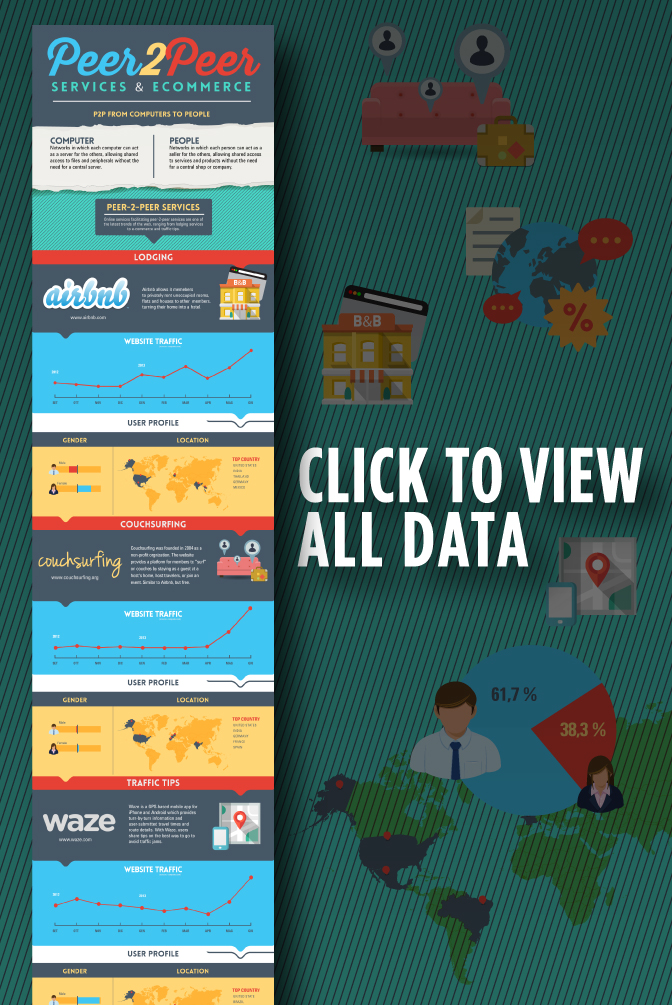
Infographic_SCM-PreviewThe in-depth survey by TradeStable on the phenomena of peer-to-peer services and e-commerce shows results in an infographic above highlighting the growth, user data and top popular countries of all most popular services. Spring 2013 seems to be the period in which peer-to-peer services really “took off”, with couchsurfing and airbnb quickly reaching respectively 300.000 and 600.000 unique visitors per month, and the free classifieds sites of Schibsted Media Group – to which TradeStable belongs – reaching all-time-highs in traffic.

Tradestable also had an in-depth look at the Nigerian market revealing electronic items, clothes and cars as the products most often sold online. On the opposite side of the trade are shoppers, especially eager to buy TVs, iPhones, iPads, Bags and Shoes – these the most search-for items in the electronics and apparel categories. The research also traced a detailed portrait of Nigeria’s typical online shopper: mostly male and below the age of 30, shopping online on a monthly basis, with a very high a mount of shoppers under the age of 20.

Opera Releases Its Android Web Browser for Tablets

0

opera-18-for-android-off-roadOpera has released, Opera 18, an updated version of its web browser for Android tablets.

The firm says the full-featured Opera for Android browser is the go-to choice for easy access thousands of websites via Android tablets. Opera for Android tablet version has been tailored for great user experience to the tablet form factor and is so different from the smartphone or desktop browser.

Johan Schön, SVP for Mobile Consumer Browsers, Opera Software said, “The size of devices and mindset of users make the tablet very different from its smaller cousin, the smartphone, and we have to respect that. In Opera 18 for Android, we have spent hours and hours tweaking, and fiddling with the placement of, even the most minute detail, just to get that top tablet feel”.

Schön adds that its user interface is meticulously planned and the menu page is conveniently located for users fingers to naturally rest while using a tablet and also enables easy access to functions. Some of the features include Discover, which  is a one-stop shop for news, sports and interesting feature stories. The Off-Road mode lets users go online in rough conditions, such as a crowded, free Wi-Fi hotspot in a café, and saves users money while roaming with their data plans by compressing the data traffic, while the Speed Dial feature allows one to easily to add, organize and access their most frequently visited webpages.

Opera 18 is part of the Opera browser lineup with full-fledged Opera browsers for Windows, Mac and Android and is now available for download from Google Play or m.opera.com.

Engineering Body to Unveil New TV Series in Kenya

0

AWEsome

AWEsome will be the latest production by the Institute of Engineering of Kenya to hit the country’s television sets as part of celebrating Kenya @50.

The television docu-drama series will show case buildings, defining agricultural projects, ICT, Housing, Education, Transport and Financial technologies among other developments.

The ten AWEsome episodes, the Institution of Engineers of Kenya Chairman, Engineer Julius Riungu said, will cover diverse topics such as energy, water, industry, roads, communication, transport, agriculture, business & finance, housing and education.

“I am optimistic that with sound national development blueprints such as Vision 2030, we will undoubtedly achieve our growth plans especially with the current level of government allocated resources towards improving infrastructure in counties, cities and urban centres,” said Engineer Irungu.

“We are telling a powerful, entertaining, and uplifting story, and we wanted it to come from the engineers,” says the show’s producer, Justus Tharao.

“For entertainment purposes, we have chosen to tell this story from the perspective of the results we can see and touch in order to bring out a believable and emotional narrative that resonates with Kenyans. And just like in any other world-class documentary, AWEsome is about more than just processes and accomplishments. It is a story worth telling.”

The show is expected to premier on November 29th 2013 at the Sankara Hotel, Nairobi. The show is expected to air on NTV Kenya on November 30th at 6.30pm.

Kenya to Host US Power Africa Project

0

Electricity

Nairobi is set to be the host of the US Power Africa Project, announced by American President Barack Obama in his last visit to the continent.

The project as set out by the US president aims to inject about 5000MW in the power grid of six countries including: Kenya and Tanzania, Ghana, Ethiopia, Nigeria and Liberia

The initiative’s headquarters will be at the US Embassy in Nairobi. Which the coordinator of Power Africa and Trade Africa, Mr Andrew Herscowitz, said it was the first time a US presidential initiative will be led from the field.

“For the first phase, the US government has committed over Sh602 billion ($7 billion) in financial support and loan guarantees in addition to the coordinated support of other 12 US government agencies for the entire region,” Mr Herscowitz said.

The American government has committed to spend Sh604,099,766,213 over the next five years for this project that expected to touch millions of lives in Sub Saharan Africa.

Savannah Fund’s Second Accelerator Class Launches

0

savannah-fund

Savannah Fund, a Nairobi-based seed fund investing $25,000-US$500,000 into Africa-focused early stage web and mobile startups yesterday  launched t the public its four startups from its second accelerator class.

The four startups selected from a bunch of over 80 were from Kenya, Uganda and Ghana. Two of their startups Zatiti and InstaAid, were founded in Kenya,  while Zished was founded in Ghana and is built for West Africa while the Kampala-founded Inforex Africa is East Africa-focused and is launching in Nairobi in a few days. The startups are also seeking investments to scale their operations across the continent.

Investors present their launch was William Paladino of MIH Internet Africa (Naspers) and 88mph’s Nikolai Barnwell.

Erik Hersman, Savannah Fund’s Managing Partner, speaking on the launch yesterday said the startups had been mentored by teams from Silicon Valley and from Across Africa and that the three-month acceleration took the startups through market positioning, product and business development, PR, strategy among others. Some of them emerged with completely different business models. The fund now has a total number of nine startups to its portfolio including Binu, Kola Studios, Ahonya, Eneza Education and SafariDesk.

The startups also attended Afrikoin, an Africa-focused event on the future of payments and eComerce in Africa.

The startups include;

  • ZishedA gifting e-commerce platform enabling the African diaspora to remain connected and able to share in moments with loved ones back home. Currently piloting in Ghana, Zished was founded in 2013 by Kojo Ayirebi (B.A. Economics, 4 years financial services and consulting experience – Citigroup N.A. and RSL) and Christiane Koenig (B.A. Economics & French, 2 years marketing and sales experience – Wells Fargo and Diageo). Truston Ailende (B.Sc. Systems Engineering, 6 years software development experience) serves as CTO. Zished is headquartered in Accra, Ghana.
  • Inforex: A platform connecting Forex Bureaus within Africa allowing them to check and trade currencies, and enabling them to trade currency with private companies at the best available rates. Inforex also offers a mobile and web solution for individuals interested in locating Bureaus and with the best rates. The company Inforex Africa, headquartered in Kampala, Uganda, was founded in 2012 by Allan Amayo (B.A. Comms, 1 year Forex Bureau experience), Samuel Odeke (6 years dev experience), Christine Nafuna (B.IT, 2 years sales & marketing experience), Tony Rukera (B.IT, 3 years project mgmt experience), and Kenneth Manana (2 years advertising & marketing experience).
  • InstAid: A secure SMS and USSD solution that enables organizations to create and manage distribution of e-vouchers for medical and nutritional supplies to reach 100% of their intended population. InstAid also enables individuals to purchase and send specific medical and nutritional vouchers to friends and family members. The company CardPlanet Solutions, headquartered in Nairobi, Kenya, was founded in 2012 by Rodgers Muhadi (B.S. Electronics Engineering, four years of payments industry experience) and Sam Masinde (B.S. Computer Science).
  • ZatitiA web and mobile site builder and e-commerce platform enabling small merchants in Africa to have a presence and ability to sell online. No technical skills are needed to create a site that is search engine optimized and can reach customers on mobile phones, tablets, and desktops. The company Gereji Limited, headquartered in Nairobi, Kenya, was founded in 2013 by David Njuguna (Bsc. Computer Science, 11 years Web Software Development Engineering) and Grace Kiburi (B.Sc. Information Technology, 5 years in online marketing and customer relations).

Google Launches Super-First Fibre Internet in Uganda

0

Google-logo1Google has launched project Link in Uganda to enable residents get access to fast and reliable internet access.

 The move, announced yesterday and dubbed Project Link, is a super-fast, high-capacity fiber network that will enable mobile operators and Internet service providers to connect users in Uganda to a faster, more reliable Internet.

According to Google, Project Link will connect the ISPs long-distance fiber lines, equipping them with near-unlimited capacity to build and expand services to Ugandans. Google’s decision to launch Project Link was to strengthen Africa’s Internet supply chain which is being served by undersea cables across the continent. The firm also added that it has built quality infrastructure between Africa’s undersea cables to its Project Link  for greater speed and capacity for the latest and greatest of the web.

“Project Link goes beyond basic access,” Kai Wulff, Google’s Access Field Director said in a blogpost. “It enables local providers to offer new mobile data plans or high-speed Internet for office buildings and universities, and support newer technologies as they come to market. For Kampala, we hope it’s a foundation to support the needs of a new crop of entrepreneurs and innovators: the media-rich projects of a successful musician, fast connections for local hospitals, or new digital learning tools for students.”

With just 16 percent of over one billion accessing internet in Africa, Project Link will help connect Kampala’s 3 million people to news, job opportunities, eCommerce, innovations and content creation.

Mobile money users are 9 times more active than others, says Eskimi CEO

0

Vytas, Eskimi CEOVytas Paukstys, the chief executive officer of Eskimi has revealed that mobile money users on the platform are nine times more active than other categories of users. In an exclusive interview, Vytas said despite the high rate of activity among mobile money users, there is shortage of services. This he said is responsible for the low number of active users.

“The users are about nine times more active than those acquired through traditional means like outdoor, radio or TV,” he said. He added: “There are not enough services, so the overall number of active users is still small.”

He said the nation’s second leading social media platform currently allows users to purchase airtime and perform mobile money transactions.

“They mainly buy airtime, send money to other mobile money accounts and bank accounts,” he said.

Concerning m-commerce in Nigeria, he said it is not yet fully explored in Nigeria and his company cannot do much about championing it since it is not a mobile money service provider.

He said: “This is not exactly our business to do that. We developed a great tool to educate, acquire and retain users on mobile money. This is our primary goal.”

However, he said Eskimi has been in talk with the various mobile money service providers in Nigeria for the past two years and some of them are already on the platform.

Genomic Technology Could Save Newborns In Future, Say Researchers

0

As we mark the International Children’s Day today on 20 November 2013, scientists from Missouri are promising a brighter future for ill children in hospitals in years to come, as they have discovered new technology using DNA sequencing and analysis that could cut down infant mortality rates.

Scientists for the next five years, from the Children’s Mercy will be analyzing the genomes of about 1,000 of babies born with disorders to fully understand the benefits of two-day genomic diagnosis, following a $5 million grant from the National Institutes of Health to carry out research on the outcomes of using rapid genomic sequencing on newborns with disorders.

This technology that uses rapid DNA sequencing and analysis is able to identify genetic mutation that keeps babies from developing properly in addition to analyzing critically ill infants’ genomes using fast whole genome analysis treatment.  in last year September the National institutes of Health offered a grant of $18.7 million USD for research projects to improve human gene sequencing.

Reports indicate that the hospital team identified the cause of one infant’s problems that involved a genetic disorder that is treatable with intensive treatment that includes nutritional support that would in turn stimulate her cells mitochondria while ruling out other progressive and fatal conditions. The genomic diagnosis helped shape her clinical care giving advice on what nutritional supplements the she was to take.

As the gene tests and genome analyses take weeks, the hospital claims to use more efficient tech tools that can quickly identify potentially medically relevant variation in a patient’s three billion base pairs of DNA.

Yet, many countries have experienced high infant mortality rates. But this new procedure would see the death rates dwindle further, especially in Africa and Asia, not just the USA.  There has been progress in reducing infant mortality rates in urban areas of Africa, Americas and Asia. The urban poorest that makes four fifths of Africa’s population has on average witnessed a decrease in infant mortality rate from 99 per 1000 live births in the 1990s to 70 per 1000 live births in 2000-2007. While in Asia, the poorest four fifths in urban areas have experienced a fall in infant mortality rates from 81 to 51 per 1000 live births between 1990s and 2000-2007, on average says a WHO report.

When it comes to applying the genome technology, the challenge however lies in the fact that few people worldwide have had whole genome sequencing, scientists in need of millions of patients especially infants with various conditions before knowing what the whole human genome sequences are needed, say.

In all, a robust “bioinformatics infrastructure” that includes computing power and high level expertise will be key for labs that are interested in running the next generation sequencing of DNA, say reports.

Africa Records A High Internet Growth Rate

0

Africa as a whole in the past few quarters has transformed itself from merely a tourism resort into a hub of internet savvy subscribers due to an increase in mobile operators, investment in fibre optic networks, and ICT projects, reports say.

According to Mushroom Networks, the continent by the year 2012 had more than 167 million Internet subscribers making about 15 per cent of the population. That marked an increase by four percent since 2011. Today, the countries leading in internet penetration growth in Africa include Nigeria with 48.4 million users, followed by Egypt with 29.8 million, then Morocco with 16.5 million users, Kenya with over 12 million and South Africa with 8.5 million users.

Despite reports indicating that only seven per cent of local households in Africa have internet access, a boost in ICT growth and the mobile telephone population is likely to change the scene, overtaking fixed phone-lines making the 650 million mobile phone subscribers outnumber those in Europe and the US. The continent.

While the internet scene is largely dominated by youth and startups, one report indicated that Africa is fond of Social media such as Twitter and Facebook. There are currently 51.5 million Facebook subscribers. And last year alone, a report entitled “How Africa Tweets” stated that more than 11.5 million tweets originated from Africa. it discovered that South Africa had the most Active Twitter population in the continent, with Kenya ranking second.

Internet subscriptions have been on the increase too, in countries like Kenya. According to a CCK Quarterly Sector Statistics Report for the fourth quarter of the 2012/13 financial year of April to June 2013 released this week, the number of internet subscribers in Kenya alone showed an increase from 9.6 million to 12.4 million over the past three months – a 28.4 per cent increase. Moreover, the number of broadband subscriptions grew by 36.9 per cent from the previous quarter to 1.39 million. Compared to the same period last year, the sector showed a 92.5 per cent growth from 726,802 subscriptions.

During the same period, the mobile phone industry in the country the number of subscribers increased by 2.3 per cent from 29.8 million to 30.5 million, attributed to a combination of new subscribers and possible re-subscription by those whose phones had been deactivated during the subscriber registration campaign. Due to ease of access, the pre-paid services have continued to dominate mobile subscription, accounting for 99 per cent of the total mobile subscriptions, said the report

Mobile money transfer subscribers increased from 23.2 million the previous quarter to 24.8 million the quarter under review, recording a 6.8 per cent growth, consistent with the positive subscriber growth patterns. According to the report, while the number of mobile money transfer agents has risen to more than 88,000 from about 74,000 during the previous quarter, a growth of 19.2 per cent.

Like other countries, a report on Kenya internet penetration states that the coming quarter is expected to record similar positive trends as internet uptake increases thanks to the on-going ICT for schools project and increased investment in fibre optic networks across the country.

But Africa still has a long way to go as the number of internet subscribers is still considered low despite a high growth rate.In South Africa for instance, Eleven percent of the population uses the Internet which is still a low figure. Of the eleven per cent Internet users, about 19 per cent access it at work while less than 10 per cent use it at home.  Although postal and courier sector has continued to decline in the number of letters sent and received locally and internationally, a small population is able to purchase goods online from overseas using services like PayPal.

Nevertheless, despite slow internet speed rate in Africa the average download speed of 1.6 Mbps in which the slowest speeds in the world are the be found in Zambia, at an average 0.26 Mbps, the growth in broadband subscriptions are expected to continue increasing indicating that customers are not only demanding for internet connections but higher capacity connections.

BIDCO ACHIEVES FASTEST MULTI-LOCATIONAL FMCG IMPLEMENTATION OF SAP

0

Vimal Shah CEO Bidco Oil Refineries and Michael Kaniu Head of Ecosystems and ChannelSAP Eastern Africa displaying how the SAP system works during the regional press tour at Bidco Oil Refineries.


Kenya’s Bidco Group, a market leader in edible oils, fats, soaps, margarine and detergents in East and Central Africa, has decided to move from its existing Enterprise Resource Planning (ERP) legacy to SAP.  

The company today showcased the benefits derived from implementing SAP (and other technologies such as Microsoft and IBM) across the organization at its headquarters.

Vimal Shah, CEO, BIDCO, said: “We have reaped plentiful benefits by being at the forefront of adapting newer technologies to assist in our manufacturing and marketing endeavors.  Our IT initiative has helped Bidco being real time online to reduce waste (MUDA) from the business processes and make it very efficient. We have created consistent and transparent availability of information across the organization for on-line reporting at various levels. Integration with other technology helps automate the processes to increase productivity of the employees. Knowledge transfer is the key for the employee to resolves their day-to-day operation making each of them a knowledge worker.”

“Bidco is a good example and role model of local enterprise obtaining value by implementing SAP in 90 days. They were the first and the fastest to accomplish this momentous task. They have proved beyond doubt that African companies have come of age and that it is possible for African companies to walk shoulder to shoulder with the best of enterprises across the world and be World Class,” said Michael Kaniu, head Ecosystems & Channels, SAP, East Africa.

 Bidco’s CEO added that SAP has enabled them to improve of customer satisfaction, human resource efficiency as well as supply chain management.

Government Services Will Make $50 Billion Worth Of Savings

0

 egov

Governments of Africa should listen to this, if they apply eGovernance in their services they will be able to save $50 billion annually by 2020; says the global research from the Secure Identity Alliance.

The report reveals the role of trusted digital identity in enabling effective and secure eService deployment.

 “Whether we’re logging into eServices to perform healthcare claims, to vote or sign a digital transaction, pay taxes, book or buy goods or services, our digital identity will be absolutely central in the years to come. Convenience, privacy protection and security are therefore of paramount importance for trust in modern and efficient electronic government services. And as we move further towards 2020 the role of digital identity intensifies as the cost savings mount up,” said Frédéric Trojani, Chairman of the Board of the Alliance.

The prominence of the egovernance services as the researchers put it, is entirely dependant on the development of a trust framework which will combine governance, standards, business processes and technical capabilities.

“While it’s true we’ll see multiple identities from multiple providers, the root identity – the one trusted digital identity upon which all are based – starts with Government. Strategies must be put in place now to assure those processes are robust and trusted by the citizens. The Secure Identity Alliance shall be the reference partner for Governments looking to offer cutting-edge technology in e-documents and e-services to their citizens”, adds the Chairman.

South Africa’s Paramount Group Buys Majority Stake In Nautic Africa

0

paramount group

Nautic Africa will soon start seeing more of the Paramonut Group; as the group has purchased a majority stake in Nautic Africa.

Paramount Group is the largest privately owned defense and aerospace company in Africa. It had initially started in the land forces environment before switching to aerospace, this year, with the acquisition of Advanced Technology and Engineering (ATE), which is now Paramont Advanced Technologies.

Started by James Fisher, who is the CEO, Nautic Africa was established in 2008 and provides high-speed, ballistic protected aluminum patrol vessels to the military, Coast Guard and oil and gas communities.

The Executive Chairman of Paramont, Ivor Ichikowitz, said that his company had wanted to move to maritime arena but didn’t want to start from the beginning.

He noted that the biggest threats comes from piracy, theft of marine resources and drug trafficking.

The thought of acquiring Nautic Africa came early 2013, but the formal announcement was made on Thursday.

The acquisition, Ichikowitz said, will combine Paramount’s global market reach and strong track record in Africa with the engineering and design skills of Nautic Africa. This, he continued, will stimulate global demand for Africa’s naval solutions.

The ship builder will be able to leverage off Paramount to strengthen their systems and administrative support, as well as gaining access to markets they could not easily access before.

Nautic Africa recently concluded an R600 million deal to build seven 35 metre multi-role patrol vessels for West African clients and is actively working on new orders. The acquisition will further create jobs in the maritime industry as well as the general defence and systems industry.

The South African Navy (SAN) has expressed a desire for a strong local maritime industry and Fisher is interested in pursuing relationships with the SAN. In order to grow its capabilities, Nautic Africa have partnered with DCNS of France for Project Biro, the acquisition of Offshore Patrol Vessels (OPV). Austal of Australia has also expressed interest in partnering with the Cape Company.

The Nautic Africa brand will continue to be used for commercial activities, whilst military markets will use the new Paramount Naval Systems brand.

The down side of free Wi-Fi

0

Jonas Thulin HD Profile PhotoThis is a guest post by Jonas Thulin Security Consultant at Fortinet

As the public and private sector strive to deliver internet access to all, Wi-Fi hotspots present a viable solution to the challenge of cost-effectively delivering access to the many. Free Wi-Fi was recently rolled out in parts of Cape Town, for example, with free or low cost Wi-Fi networks intended to be rolled out in lower income residential areas such as Khayelitsha and Mitchells Plain too.

While access for all is a commendable goal, there are security risks in extending free and low-cost Wi-Fi access in public places. Frequently, the cost of the service is kept to a minimum by eliminating ‘extras’ – like effective security. In addition, many people who will now be using the internet for the first time as a result of the free access, may not have been informed about the risks of cyber crime, and so could be vulnerable to identity theft, fraud and abuse.

Cyber criminals tend to look for individual, high end victims or launch mass attacks on a large number of low end users. In an inadequately secured free Wi-Fi hotspot, this puts large numbers of new internet users at risk. Those who have not been introduced to the need for anti-virus tools, secure passwords and the risk of phishing are liable to fall victim to even simple social engineering as they embrace the benefits of online banking, shopping and mobile money.

An increasingly common tactic abroad is to remotely lock users’ devices and demand a ‘ransom’ in order for them to access the device again. While this has focused mainly on PCs and laptops in the past, we can expect this practice to move to mobile phones next. There is also the risk of devices being infected with botnets, which are becoming more commonplace. Botnets are extremely difficult to detect, and run in the background, connecting the victim’s device to command and control centres, who can harvest information or use the devices for denial of service attacks or for sending spam. Botnets are also moving from the domain of the PC to mobile devices – typically those running Android.

When more schools begin rolling out tablets and other devices to school pupils, the beneficiaries will also be put at risk once they leave their schools’ controlled Wi-Fi zones and use their devices in unsecured hotspots. They need to be protected from inappropriate content, bullying and abuse.

Education is the most effective tool for countering cyber crime and protecting users. New internet users need to be informed of the risks of identity theft, cyber crime and bullying. The onus is on the public and private sector, as well as the media, to inform people of the dangers online, and outline ways to secure their transactions and avoid falling victim to cyber criminals.

Ideally, the entity rolling out a free Wi-Fi hotspots will ensure that the public network is as secure as possible, even going so far as to enforce safe search on the network, to protect children from inappropriate content. Building Wi-Fi hotspots without ensuring that the users are educated and the networks are as secure as possible would be rather like giving people cars without their needing drivers’ licences – sooner or later, somebody will get hurt.


MoboFree to Launch Black Database of Scammers to Make Online Trading in Africa Safe

0

mobofree_whitebg_transparent

MoboFree – social marketplace with 2.5 million African users has disclosed plans to launch a database of scammers to allow its users check credibility of buyers and sellers in Nigeria, Ghana, Kenya and Zimbabwe.

According to Wilfred Tchasse, co-founder of MoboFree, “MoboFree users upload up to 1000 new classifieds per day in Nigeria only, and only 20-30 % of those ads goes live” – discloses. Others are identified as scam by our special internal algorithm, scam control staff and MoboFree users–volunteers who help to ensure reliability of ads.”

“We noticed that after banishment from MoboFree frauders move to other boards of classifieds and successfully proceed with their business. Such situation makes big harm to all online trading/classifieds ecosystem. People loose trust in online buying and selling as effective and safe way to buy, sell and swap stuff. And what’s the most important – people loose their hardly accumulated savings.” – says Wilfred Tchasse.

“Scammers database” service will be accessible free of charge and will be based on checking phone numbers – when buying or selling something via blind boards of classifieds phone number usually is the only thing which is known for sure.  Usually scammers work in two directions – pretending a seller and pretending a buyer. In the first case buyers loose money and in the second case sellers use their goods. “Scammers database” will help to protect from both categories of frauders. Service will be opened not only for MoboFee users but also for users of other boards of classifieds.


Nigeria’s Smart ID Project on Course with New Tech Players

0

Smart ID

Nigerians are closer in achieving the smart ID project now that the Nigerian Identity Management Commission has made good progress in integrating the technology behind the project. The commission will now use SPS (Smart Packaging Solutions), NXP Semiconductors and MasterCard.

SPS is specialized in eCards and banking cards while NXP is an American listed company with experience in innovation in the automotive, identification and mobile industries. MasterCard brings the financial transaction part of the project.

The body has identified the technology that they will use to roll out the pilot project aimed to give 13 million citizens the digitally advanced identity cards. The cards will also have MasterCard capabilities being one of its kind in Africa.

The card includes a MasterCard prepaid functionality as well as 12 other applications. The pilot is bound to be a success as 21 local financial institutions have applied for licenses

“The National Identity Smart Card project will support financial inclusion as it allows us to bring financial services to all classes of the Nigerian population. Nigeria is home to the largest roll-out of a combination of electronic ID card with a formal electronic payment solution in the world,” Chris ‘E Onyemenam, the Director General and Chief Executive of the National Identity Management Commission, said

“This represents the broadest financial inclusion initiative in Africa. We are very happy to have technology experts such as SPS, NXP Semiconductors and MasterCard aboard the Nigerian eID card project as this will ensure the technical success of the roll out program that will mean the issuance of over 100 million cards.”

Cloud Solutions Firm Capillary Technologies Launches In South Africa

0


Aneesh Reddy, Co-founder & CEO Capillary Technologies

Cloud software solutions firm Capillary Technologies, helping firms engage intelligently with their customers through mobile, social and in-store channels, has announced its entry into the South African market with new offices in Johannesburg and a strategic new partnership with Blue Label Engage for their turnkey (direct to consumer) retail customer engagement solution.

The firm’s international clients include Benetton, Jack Wills, Marks & Spencer, Nicole Miller, Nike, Puma, Nokia, Pizza Hut and KFC. The firms use Capillary’s cloud platform which integrates everything that retail marketers and operators require to engage with their customers, weaving social and mobile experiences into virtually any point of sale device, from legacy terminals to the latest POS devices and mobile tablets.

Capillary’s suite of Intelligent Customer Engagement™ solutions offers real-time loyalty, high quality data capture, actionable analytics, instant cross-sell solutions, and instant shopper gratification to generate significant ROI within weeks of implementation.

Capillary is already working with South African retailers like Keedo, UMS and Roots to help them drive better customer loyalty, superior sales growth and a definitive competitive advantage.

Blue Label Engage, a subsidiary of the JSE listed, Blue Label Telecoms Limited with over 150 000 points of presence in South Africa and is a leading distributor of airtime and electricity through physical and virtual pre-paid solutions. The firm also assists with driving consumer acquisition and loyalty, through Consumer Engagement Solutions, delivered by Blue Label Engage.

“We are very excited with our latest presence in South Africa and to have Blue Label Engage as one of our key partners,” says Aneesh Reddy, Cofounder & CEO of Capillary Technologies. “Retailers in South Africa are hugely interested in state-of-the-art loyalty and customer relationship management (CRM) solutions and will benefit greatly from the proven best practices that Capillary and this partnership offers, leveraging technology to drive revenue. Having a presence in Johannesburg will enable us to better serve our growing South African client base. As the African continent’s largest economy and biggest recipient of foreign direct investment, South Africa is the logical point of departure for our expansion plans across the continent.”

Changing retail dynamics have altered the definition of CRM solutions in today’s world. Retailers in South Africa realize the importance of shedding one-size-fits-all ways of thinking. They want to understand and connect with customers personally, gain mindshare among consumers and influence purchase decisions to drive revenue growth and profitability. Capillary’s global experience and inherent cloud advantages bring tremendous opportunities for consumer-facing businesses in South Africa to tap into emerging global best practices from the Americas, Europe and Asia-Pacific, and achieve significant top-line performance improvement through Capillary and Blue Label’ “Retail Engage” solution.

Blue Label Engage and Capillary aim to help retailers capitalize on Intelligent CRM and integrated engagement solutions in South Africa according to John Shaw, Marketing Director of Blue Label Engage.

FNB Launches Its Mobile Banking Platform in East Africa

0

FNB-apps2

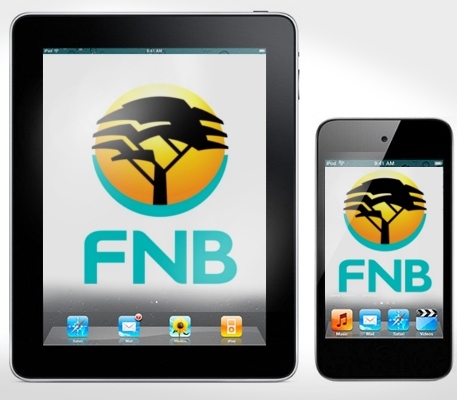
South Africa’s First National Bank (FNB) has launched its mobile apps and mobile banking platform in Tanzania and Mozambique after amassing over 600,000 active users in South Africa after its launch in July 2011.

The app has also been extended to Zambia, Namibia, Botswana, Swaziland, Lesotho in the Southern Africa market.

The App and .Mobi site is part of a larger digital banking strategy for the bank and gives customers anytime, anywhere, safe, and affordable banking. The Mobi site which works on all internet enabled cell phones, including smartphones and feature phones is also available for customers.”We are excited to be taking digital banking to these markets and to be empowering our clients with our world class mobile solutions such as the App and Mobi. This is an opportunity to contribute meaningfully towards the banking sector in our African subsidiaries,” says Leonard Haynes, COO, FNB Africa.

Africa has an estimated 700 million subscribers is the second largest market by connections after Asia and also the fastest growing market in the world according to GSMA. Smartphone penetration in Africa is also on the increase. According to Research Company ABI estimate that by 2018 low cost smartphones will account for 44% of all smartphone shipments, as the market looks to capture the next billion smartphone users.Mobile is therefore the future of mobile.

“Global trends indicate that Apps and digital in Africa should not be ignored. We foresee that eventually as supply increases and prices of smart devices fall that more people will have access to these devices to be able to transact using our digital channels,” says Michael Kloeck, Head of Expansion, FNB Mobile and Connect. “We see this as a step in the right direction and preparation for the future of Banking in Africa.”

“Africa is on the verge of a technology explosion, despite the well known documented challenges with connectivity. Our smartphone App includes an eWallet, which enables us to reach the underserviced and underbanked with a mobile money solution. Our African customers will also have access to value added services such as free messages and calls between App users, aimed at addressing African problems of high costs of communication as well as Geo Payments, our unique person-to-person cashless mobile money solution,” says Kloeck.

“When our in house FNB App was designed, specific considerations were scalability and quick deployment into African territories so this is the beginning of a long term strategy. FNB is now a global bank and with this technology we are delighted to be taking our world class mobile solutions to our African clients,” concludes Haynes.

bINu app now free on Etisalat Nigeria

0

Etisalat Nigeria has announced it is offering its subscribers free access to the cloud based bINu mobile application. In a release, it said the offer is valid until December 6, 2013.


“biNu is a cloud based mobile application that works on Java and Android phones to deliver a wide range of content while using a very small amount of data, providing a superior user experience on low-end phones, even with only a 2G (Edge and GPRS) data connection,” Etisalat stated.

The app which has its own social network, email and chat solutions also gives users access to Facebook, Twitter, Wikipedia, Google search and free books.

In an exclusive chat with Jeremy George, biNu’s vice president for Africa, he said the decision to offer users free access to the app was reached in order to address the skepticism of users who are afraid of the app eroding their airtime. He added that the move was also made to get more data users in Nigeria to use the app.

He said: “It was based on the realization that people are nervous of having all their airtime eroded by data costs, and the need to get more people using data.”

He noted that while the company is consolidating on its areas that work well, it believes that the offer on Etisalat network would be successful if the campaign is well promoted.

“The success is dependent on how well they publicize this. If people don’t know about it, then it will make no difference. I am working with Etisalat to try and get the message out there,” he said.

Nigeria and Kenya to Become Biggest Cloud Users by 2014

0

Cloud Computing

In a recent survey by World Wide Worx, Kenya and Nigeria will see its businesses use cloud services greatly by the end of 2014.

In 2014, 80 percent of the respondents say they will switch to cloud services compared to 72 percent in Kenya and 66 percent in South Africa.

The research that interviewed top business executives from Kenya, Nigeria and South Africa showed that currently, South Africa has the highest people using cloud service. 50 percent of the businesses interview in South Africa are comfortable using the cloud.

Only 48 percent in Kenya and 36 percent in Nigeria are comfortable with the cloud system. The research shows that Nigeria will outpace South Africa in the usage of cloud services.

The announcement comes days after Cisco announced its Application Centric Infrastructure (ACI) that will enable business easily use cloud services more efficiently.

With the cloud greatly demystified, Cisco projects that nearly two-thirds of all data center workloads will be processed in the cloud.

“A new paradigm shift drive by cloud, mobility and big data is redefining IT, with the web-based economy shifting to an app-based economy,” said Sabrina Dar, Cisco General Manager, East Africa.

This new technology will assure that application are stored and processed in the cloud regardless of the technology behind the servers or application.

Ten Annoying Selfies On the Internet Today

0

1. This image of a guy shouting– We won, we won, we won!!!!!!!!!!  as if he was part of any team!

cat1


2.This young dude who is rich enough to buy all tailored suits but pretends to be naked-broke!

justin-bieber-topless-selfie--instagram-1373362270-custom-0

3. This young cop who says has nothing to do with the Nazi…..I have nothing to do with the Nazi, trust me!

police

4. This young Asian chick who’s hating her own looks….OMG, is that me!

ugle

5. This famous woman roaring at herself and forcing her pet to do the same uncomfortably…..Nghraaah Nghraaa Nghraaaa!

tumblr_mso6lkS7gg1safocco1_500


6. This family taking selfies in the car

kim-car-selfies

7.This cereal-full dude feeling good alone at home while everyone is at work!

lazy

 8.This ugly shaven man driving a very hot car…. but do I say!

cat2


9.This puppy pretending to be your playmate!

cat7


10.This drunk guy and the two girls admiring themselves in the mirror….Yeah baby, we own the world!cat9

Nigeria Turns To New Technology to Fight Polio

0


Nigeria is the world’s last three countries where polio is endemic. But some new technology has seen the polio figures drastically drop in a few months note medics running a door to door immunization project in remote parts of the country.

According to the Global Polio Eradication Initiative, Nigeria had 51 out of 328 cases of the disease worldwide this year 2013, a drastic drop from 121 out of 223 in the past one year.

The drop has been attributed to the use of state of art technology and phone tracking of volunteers that administer the vaccine all viewed from a computer screen, especially in areas like Nigeria’s northern Kano state that reports high polio figures. Yet, Nigeria, Pakistan and Afghanistan are the world’s last three countries where polio remains endemic. Thus, they have been the focus of efforts to eradicate the disease of which reports say has incidents have risen in Somalia and Syria.

Nevertheless, while the phone-tracking idea is the brainchild of the World Health Organization (WHO), the billionaire Microsoft founder and his wife’s charitable foundation is helping to fund the four-year project.

Given the high cost of the tracking project, the Gates Foundation have focused on 40 high-risk areas in eight northern states. Kano state has been highly targeted due to its high prevalence of polio suspicious beliefs and controversies about immunization programs. However, a number of teams are more often than ever, going door-to-door to immunise every child aged under-five, as part of an aggressive push to eradicate the debilitating disease.

Through the screen of this state of art technology, medics can track which homes have received the vaccine. On the screen, yellow electronic dots appear on the satellite maps of each of Kano’s six target districts each time a vaccination team stays at a location for more than two minutes, while green horizontal and vertical grid lines divide an area into squares, with each box representing a house. In one section, the screen shows that only half of the houses were visited despite a succession of yellow dots on the Google Maps software, reports say.

Laboratory analysis both in and outside Nigeria confirmed the vaccine was safe and incidents of quacks and falsified data would be reduced, thanks to phone tracking using state of art technology.

With renewed awareness and support by local political leaders, Nigeria’s President Goodluck Jonathan said that there was no reason as to why polio could not be wiped out in a year’s time.

Malawi’s Newborn Babies’ Respiratory Distress Device Receives Innovation Award

0


The Malawian “bubble” Continuous Positive Airway Pressure or bCPAP that helps babies in respiratory distress has made it to one of the five projects from a list of nearly 100 applications from 29 countries across the developing world, that has just earned the highest fund in the first GSK and Save the Children $1million Healthcare Innovation Award.

The organisation behind the innovation and recipients of a $400,000 share of the $1 million award is Friends of Sick Children, Malawi – a partnership between the pediatric department of Queen Elizabeth Central Hospital in Blantyre, Malawi, Rice 360°: Institute for Global Health Technologies in the United States and the University of Malawi College of Medicine.

While newborn mortality rates have been a challenge in the developing world in which three million babies died in their first 28 days of life in 2012, The life-saving kit, ‘bCPAP’, has been designed to help babies in respiratory distress, which is often caused by acute respiratory infections like pneumonia. CPAP devices use air pressure to keep patients airways open, and as there are few wall-mounted air supplies in Malawi hospitals, the newly innovated bCPAP air pump works on its own. It’s also made of durable materials that are inexpensive and easy to repair.

The judging panel of experts from the fields of public health and development,  co-chaired by Sir Andrew Witty, CEO of GSK, and Justin Forsyth, Chief Executive of Save the Children,  were impressed with the bCPAP device’s impact on tackling newborn deaths, and the associated comprehensive training and education programme on premature child-care.

“Despite huge progress being made in under-five mortality in the past ten years, there hasn’t been the same progress made in the number of newborn babies dying in poor countries in the first 28 days of life,” said Chief Executive of Save the Children, Justin Forsyth,  “This is an area that needs urgent attention, so it is heartening that all five winning innovations from this award concentrate on the area of newborn care.  It is also inspiring to see countries finding solutions to their own challenges and partnering with other countries in the developing world to replicate and champion new innovations.”

Despite a similar version is already commonly used in developed countries where they cost at least $6,000 each this innovative low-cost ‘bubble’ CPAP adaptation can be produced for approximately $400.

Moreover, the funding from the Healthcare Innovation Award, along with backing from the Ministry of Health in Malawi, will mean use of the device can be replicated and expanded to Tanzania, Zambia and South Africa of which, is likely to reduce child mortality rates.

Exited about receiving the award, The Friends of Sick Children, Malawi and the bCPAP team said that the award money would help them replicate and begin scaling up their programme across Africa, ensuring that they reach and save even more children’s lives.

“We are delighted to be the recipients of the first GSK-Save the Children Healthcare Innovation Award,” the team said, “To be recognised for the work that we do and to hopefully inspire others around the world is an honour.”


Nigeria’s 21st Century Unveils Online Mega Mart

0


 online shopping

Nigerians will have a time of their life when shopping; 21st Century Technologies Limited has launched an online market place called 21st Century Mart.

21st Century Technologies Limited is Nigeria’s information technology powerhouse. They will concentrate on digital technology products for home & office and will then issue micro-sites dedicated to books, fashion, children toys, lifestyle – luxury goods, office supplies, health care, cars & automobiles and properties.

Shoppers will browse on collections of over 100,000 electronics, office equipment, home appliances and digital lifestyle, combining product information and pricing. Discounts are also immense discount as well as a ‘same day or next day delivery service’ but is restricted to a few areas.

 “At 21stCentury Mart, we promise only what we can deliver,” said Wale Ajisebutu, vice chairman and CEO, 21st Century Technologies. “This entire business is built on an unwavering commitment to customer satisfaction. We have taken online shopping to a new level. No long story, we deliver on our promises, we are engaging online shoppers with custom, in-the-moment experiences.”

With population of over 168 million and fast growing internet penetration, Nigeria has the potential to be a lucrative e-commerce market, as the sector is growing at rate of about 25 percent every year.

The online shopping portal has tied up with Aramex for logistics and distribution services, Skye Bank for online payment processing and has also set-up a dedicated call centre for customer service and support.

Along with online presence, 21stCenturyMart will also have Customer Experience Centre’s spread across Nigeria where customers can look, touch and feel products before buying.

21stCenturyMart will also launch native mobile apps, enabling users to shop online from their mobile devices.