back to top
Saturday, April 4, 2026
spot_imgspot_imgspot_imgspot_img
Home Blog Page 634

The new Blackberry KEYone is not for you

1

Blackberry has admittedly not been having a good run, it had to abandon their OS to try their luck with Android through the Blackberry Priv.

The company has continued its efforts to save the brand and it lead them to licensing the Blackberry name to TCL, the parent company of Alcatel phones. Through this partnership, the company has come up with the repackaged the Alcatel Idol 4 to become the Blackberry DTEK50.

DTEK is a software solution that was developed to monitor a smartphone’s security, a staple feature of all Blackberry phones. The partnership has now produced another product, the new Blackberry KEYone that was launched at MWC.

blackberry_keyone_1_575px

The KEYone is the first product to be created from ground-up since the two companies joined hands. It retains some signature Blackberry features such as a physical keyboard which also doubles as a track pad thanks to its touch sensitive stainless-steel strips in between the key rows. Above the display is a 4.5 inch LCD screen with a full HD resolution, an unorthodox 1620 * 1080 to be exact, resulting to a 434 pixel per inch sharpness.

blackberry_keyone_5_575px

The phone is built with a metallic frame; the back hosts a leather-like texture that not only aides with better hand grip but also gives the phone a break from the monotony of glass and aluminum phones every other manufacturer is producing nowadays.

The back also holds a 12MP camera, it’s the Sony Exmor IMX378 which is the same one used by the latest Xiaomi Mi 5S, the new HTC U ultra, and the winner of 2016 photography, the Google Pixel series of phones. The front is a generous 8MP camera which is graced with a selfie flash.

Under the hood we get a Snapdragon 625 which is a champ in battery saving features, coupled with a 3 GB RAM and 32GB internal storage which is expandable to 256 GB. With such a chipset, the latest Android 7.1, and a huge 3505 mAH battery, you can rest assured that the KEYone will have amazing battery longevity. Moreover, fast charge is on board too.

Finally, Blackberry decided to keep the 3.5mm headphone jack intact unlike the likes of Motorola and Apple that ditched it.

On matters of price, Blackberry will go for KES 54,900 ($549) and has been confirmed for the North America and the Asian Markets.

This is not a mass market phone but might be targeting security sensitive personnel or agents.


Why Uber is under attack.

0

Online ride-hailing service, Uber has of late been trying to weather the storm with attacks from seemingly all directions. The company which is valued at over $60 billion has been suffering a barrage of attacks and criticisms about its modus operandi. From accusations of blatantly flouting laws governing taxis, to benefitting from allegedly stolen data, Uber’s executives and legal team are bracing themselves for a tough time ahead.

Trump factor.

Uber CEO Travis Kalanick resigned from US president Trump’s economic advisory council which comprises 17 captains of industry like Tesla Founder and CEO Elon Musk. This came after concerted pressure from Uber staff and users who heavily criticized Mr. Kalanick and Uber as a whole of trying to benefit from an executive order by Trump that temporarily banned immigrants, refugees and citizens from Sudan, Somalia, Libya, Yemen, Iran, Iraq and Syria. At the tail end of protests on Saturday 28th January against that executive order, Uber twitted that its surge pricing was off. This was seen as Uber making the most of a less than ideal situation. This led to #DeleteUber being the trending hashtag that weekend. Reportedly 200,000 users deleted their accounts and I hazard a guess that these users went straight for Uber’s rival Lyft.

Prejudiced corporate culture.

Susan Fowler, a reliability engineer at Uber quit her job in December 2016 after about 13 months. This is because she claims she was sexual harassed by her bosses from the get go. Though she reported the matter to the HR manager and other senior management staff, her claims were never adequately addressed. She was told that her boss was a top performer at the company and that it was an innocent mistake. After numerous complaints, she decided to quit and has a new job at technology company Stripe. She noted that since she joined Uber in November 2015, the number of female personnel has dropped from 25 percent to a meager less than 6 percent. This can be attributed to the sexism that seems to plague the tech giant. Uber has hired a legal team to look into her claims, which she documented in her blog in an article titled “Reflecting On One Very, Very Strange Year At Uber”.

Uber’s senior vice president of engineering Amit Singhal was asked to resign by the company’s CEO one year into the job. This is after Uber was informed of sexual harassment accusations which were levelled against Mr. Singhal by a female employee at Google where he was vice president of search. He resigned from Google in February 2016 ,after 15 years.

Greyball.

Uber has been using software called Greyball as part of its violation of terms of service (VTOS) program. This software reportedly uses geolocation, credit card and other data from users to identify and side step authorities who are investigating Uber for breaking the law in areas where the ride-hailing service is not approved by law or banned altogether.

Greyball identifies and tags users who are linked to law enforcement organizations based on geofence data, credit card information, social media profiles and other data that can be found on the Internet. When a tagged user hails for a ride, Uber serves up a different version of the app which shows ghost cars or even shows that cars are unavailable. However, if a tagged user manages to get a request to a driver, Uber calls the driver with instructions to cancel the request.

In a rebuttal, Uber said “This program denies ride requests to users who are violating our terms of service — whether that’s people aiming to physically harm drivers, competitors looking to disrupt our operations, or opponents who collude with officials on secret ‘stings’ meant to entrap drivers.” . Perhaps the Greyball program was created with the intention of protecting drivers from violent attacks in countries like France, India and Kenya but it has allegedly been used to evade law enforcement officers which makes its legality not only a grey area but also brings to the fore other ethical issues.

Google suit.

Google‘s self-driving car program currently a subsidiary known as Waymo has sued Uber after alleging that Uber is using technology stolen from Waymo to grow its autonomous car program.

Anthony Levandowski who worked in Google’s self-driving cars program which began in 2009 quit in January 2016 without notice after 9 years at the tech giant. He immediately co-founded Otto, a self-driving truck startup with three other ex-Google employees. Google alleges that Levandowski downloaded confidential information before leaving. In August 2016, Uber acquired Otto in a $680 million deal. In December 2016, Waymo was inadvertently copied in an email which had schematics of Uber’s Light Detection and Ranging (LiDAR) technology which is crucial to the self-driving cars.

Uber’s on its part says that Otto’s LiDAR technology was acquired from Tyto which has a patent for a LiDAR scanner  .However if Google can proved that Uber’s LiDAR technology was stolen intellectual property, the Uber faces a suit that could potentially cost it millions or billions of dollars.


FunKidz Scoops Women4Technology Award Through Advertising On Facebook.

0

FunKidz is an Innovative children’s brand opened 5 years ago. FunKidz provide high quality children’s furniture designed and manufactured in Kenya founded by Owner Ciiru Waithaka and started advertising in 2013 with great success. Since then, Funky expanded into export markets such as Uganda and Rwanda, as a direct result of Facebook.

Facebook announced that there are over three million businesses the vast majority of which are small and Medium Business – actively advertising on Facebook, up 50% in just one year. Seventy percent of these three million companies are from outside the U.S. Currently more than 50   million small businesses use Facebook’s free Pages product to grow.

Facebook is the bridge to the new mobile economy for small business, helping them communicate with customers anytime, anywhere. More than one billion people on Facebook are connected to at least one business.  And, in the U.S., over 80% of people of Facebook are connected to a small business.

FunKidz, and Eat out Kenya are the small and medium businesses showcased rapid growth in market share accelerated by Facebook business page in Kenya.

Glomo Awards, the industry’s leading stage for innovation, excellence and achievement, are presented at Mobile World Congress.This Category recognizes best practices in terms of initiatives, programmes and policies by organisations and companies.

The GSMA Women4Tech – Mobile Industry Leadership Award, was presented to both an individual and organisation, who have demonstrated outstanding contributions to closing the gender gap. FunKidz for Kidz Go Tech, was announced as the winner of the GSMA Glomo Awards Women4Tech category. Among the nominated Organizations in this category, was Safaricom’s Women in IT and Digital Leadership Institute.

Speaking at the event, Michael O’Hara, Chief Marketing Officer at GSMA said “Our congratulations to all of the winners and nominees of the GSMA’s Glomo Awards at Mobile World Congress this week. The Glomo Awards truly showcase those companies and individuals that are driving innovation in the rapidly evolving mobile industry. We thank all of our entrants, judges, sponsors and partners for supporting the 2017 Glomo Awards.”

Last year, First Lady Michelle Obama delivering remarks at The United State of Women Dinner, as part of The White House’s The United State of Women Summit, at the U.S. Department of State. The dinner, co-hosted by the State Department’s Bureau of Educational and Cultural Affairs and Goldman Sachs 10,000 Women were highlighted women’s economic empowerment and the government-wide efforts surrounding Let Girls Learn. During Michelle remarks ciiru was recognized for her success and funding of a program for kids from struggling families to teach them about innovation and technology of which she has reached more than 350.

Get on the search engine’s good side

0

You know that you need to optimize your site for search engines, but what exactly are the search engines looking for? Companies like bluehatmarketing will tell you that, by and large, the search engines are looking for the following things from a properly optimized site. These criteria help search engines to do their jobs by helping to refer users to different websites containing content that is the most relevant to their search. But how do the search engines determine what is relevant? It is through a combination of the following factors.

Good content

A site’s content is determined by the theme, the actual text that appears on the page, and the titles/descriptions contained on the page.

Good performance

Does your site load quickly? Is it responsive? A site that performs well will be looked upon favourably by the search engine over those that contain broken links, that take too long to load, or that otherwise don’t perform well.

High authority

Authority basically refers to how well respected your website is among your peer in your niche. That respect is shown through backlinks and references to your site from other high-authority sites in your niche. The more of these links you can achieve, the more authority your site will have and the more weight it will carry with the search engines.

Good user experience

The experience your users have on your site is very important to the success of your website. Think about it like a restaurant. If a restaurant opens up, customers flood in, and then they spend the evening enduring bad service, a lousy atmosphere, and bad food, they aren’t likely to a) stay very long, or b) come back. Right? Your website is like that restaurant. Even if you are successful in driving traffic to your site (think of it like a well-advertised grand opening) if the experience you users have when they get there isn’t favourable, they won’t stick around. That will contribute to a high bounce rate for your site, which is bad news. Make sure your site is well designed, easy to navigate, looks credible, and provides something of value to your users. All of these things together with ensure not only that your users have a good experience, but also that you benefit from their word-of-mouth recommendations, too.

What search engines don’t like

Equally as important as knowing what searching engines are looking for is know what they are not looking for, those things that will deter a search engine spider from ranking your site highly. Steer clear of the following if you want the search engines to take positive notice of your site.

Keyword stuffing

If you are optimizing your site for certain keywords, it can be very tempting to use those keywords as often as possible in an effort to maximize their impact. The truth is, taking part in this “keyword stuffing” practice will actually work against you. Search engines can detect a stuffed website a mile away, and they don’t like it.

Purchased links

You can buy links for your website, but that doesn’t mean you should. Doing so will not help you gain ground with the search engines, so don’t waste your time or money.

Excessive use of ads

Not only are lots of ads annoying to users, they will increase your bounce rate. Sites with a high bounce rate will not get highly ranked by the search engines.

In conclusion, it’s always best to keep best practices on the front burner hen you are optimizing your website. Otherwise, you’ll lose credibility and will never get the kind of search engine rankings you are seeking.


Banking Industry Unveils payment solution, Pesalink, and goes live.

0

Kenya Bankers Association (KBA) has unveiled the PesaLink brand and kicked-off a phased rollout of the digital payments platform that is expected to cut the cost of transactions and transform the way consumers interact with their banks.

PesaLink will enable customers to make payments between banks in real-time, around the clock, without having to go through intermediaries. The peer-to-peer (P2P) product is offered by Integrated Payment Services Limited (IPSL), a subsidiary of KBA formed to implement the interbank payments platform upon which this and other digital innovations will run.

With PesaLink, one is able to transfer as little as 10 shillings up to 999,999 shillings at an extremely low cost of 0 to 152 shillings, depending on the amount being transferred. In addition to this, one is also able to make payments directly from their Bank accounts to any local bank account instantly from as little as 10 shillings up to 999,999 shillings.

“What PesaLink demonstrates is that KBA and the member banks are aware of their duty to serve customers, innovate and create value for our economy,” says KBA vice chairman John Gachora. “PesaLink is proof that the banking industry has embraced the technology revolution sweeping across the payments industry.”

The 12 banks set to begin implementation of PesaLink are Standard Chartered Bank, Co-Operative Bank, Barclays Bank, Commercial Bank of Africa (CBA), I & M Bank, Diamond Trust Bank, Gulf African Bank, Guardian Bank, Victoria Commercial Bank, Credit Bank, Prime Bank and Middle East Bank.

“As the first set of banks roll out the product to their customers, the rest of the banks are in various stages of testing the system,” IPSL adds.

When linking the Co-op Bank account, simply go to MCo-op Cash via *667# or one can as well use their MCo-op Cash app then select PESALINK and finally link your Co-op bank accounts to your mobile number. The linking process is easy and free of charge.

The convenience with linking Co-op bank accounts with PesaLink is that one will be able to have access services from all Co-op bank channels including Co-op kwa Jirani agents, ATM’s, mobile banking services (Mc-op Cash) and all Co-op Bank branches across the country.

Co-op Bank Account to PesaLink from a Co-op bank ATM

  1. Insert Co-op Bank Visa Card and input PIN
  2. Select ‘Other Transactions’
  3. Select ‘PESALINK’
  4. Select ‘link phone’
  5. Input the phone number to be linked.
  6. Confirm to make the account the primary account.
  7. You will receive a confirmation message
  8. Select the option of doing another transaction
  9. Select Primary Account Option on the upper right hand side of the screen.
  10. Input the phone number to be linked to the account
  11. Confirm that you wish to make that Account the Primary Account by clicking Okay button.
  12. You will then get a confirmation message on the screen that the linking was successful

Co-op Bank Account to PesaLink Via MCo-op Cash

  1. Go to MCo-op Cash app or dial *667# to access MCo-op Cash Ussd
  2. Select ‘PesaLink’ Menu
  3. Select ‘Link your phone’.
  4. Select the account number you want linked.
  5. Select ‘yes’ to make the account the primary account.
  6. A confirmation with details will be displayed on the phone.
  7. You will then receive an SMS confirmation of the linking

This peer-to-peer (P2P) product is offered by Integrated Payment Services Limited (IPSL), a fully-owned subsidiary of KBA created to implement the platform


Google expands Launchpad Accelerator program to Africa,

0

Google is expanding its Launchpad Accelerator program to two more continents. African and European countries have been added to the lineup. They include Kenya, Nigeria, South Africa, Poland, Czech Republic, and Hungary.

The Google Launchpad accelerator is a program that was introduced by Google in late 2015, to give select startups from around the world the best resources, access to great mentors, and help accelerating their product.

Google’s target is to help startups build products on its platform and become successful doing it and ensuing that every startup has access to the best resources that the ecosystem can provide. Startups participating in the accelerator receive $250,000 worth of assistance, including $50,000 in seed funding with zero equity taken, credits to use Google products, physical space in their country to work, access to a two-week boot camp in Mountain View, California, and six months of mentorship in the program before they graduate.

The tech giant announced today that it will be expanding to include startups from certain European and African countries. Now, entrepreneurs from these regions can join the 47 graduates and 31 startups currently participating.

In addition to the mentoring, participants receive credits for Google products, PR assistance, and continued support from Google back in their home country. These are the markets that can apply starting today: Entries are open until April 24. If you’re interested, you can apply here. Training at the Google campus in San Francisco begins on July 17.

Sony Xperia XZ Premium comes with 4K HDR & 960fps Super Slo-Mo videos

0

Sony took the floor at MWC to launch the world’s first 4K HDR mobile phone display. This technological milestone was fitted in the new Sony Xperia XZ Premium, a successor to the Sony Xperia Z5 Premium which also had a 4K display without the HDR. Well you might be wondering what the fuss with HDR is; it’s the display technology that came after 4K, some manufacturers even market it as ‘Beyond 4K Screens’. HDR displays have a wider and richer range of colors than the standard screens, 138% wider color range. They give images you are viewing a more dynamic look and deeper colors, not to mention a whopping 807 PPI on the 5.5 inch screen of the Xperia XZ Premium.

sony-xperia-z5-premium

Sony did not stop there, they introduced the world’s first 960fps slo-mo camera on a mobile phone. Most other phones with slo-mo recording cap at 240fps. At this extreme slow motion, if you record a water bubble being busted, you can see the individual micro droplets of the bubble disintegrating during playback; it’s quite amazing as you can see in this video that Sony made. All this tech has been built into a 19MP Motion Eye camera, yes 19 not 20 megapixels. The front facing camera is a whopping 13MP and can record full HD videos.

gsmarena_006

The rest of the phone is still very top notch too, the build breathtaking with a Gorilla glass 5 on the front and a chrome-like shinny one on the back. You also get the new Snapdragon 835 chipset, which would make the Xperia XZ Premium the first phone have it. RAM is at 4GB, 64 GB internal memory that can be expanded via a Micro SD card slot of up to 256 GB.

sony-xperia-xz-premium-2017-2

A 3.5 mm headphone jack is still in place together with a USB-Type C that comes with Quick Charge 3.0 which will come in handy when filling up the 3230 Mah battery. Security matters are handled by a fingerprint sensor that is placed on the side on the power button. Lastly, the phone is water and dust resistant with IP68 rating.


5 things that would make the Fero Iris greater

0

In order to deliver a well informed and comprehensive review of a phone, I get the pleasure of using that very device as my daily driver for a while, during this time, I get a first-hand experience of the strengths and weaknesses of that gadget. This week I am using the Fero Iris and these are the 5 aspects that I think would have made this phone greater.

Bigger battery

The Fero Iris only packs 2500 mAH battery, this setup can take you through a whole day if and only if you use the phone sparingly. Leaving the 4G data on all day will get you looking for a wall socket by mid-afternoon. A 3000 mAH battery would have done the trick.

Fast charging

We are living in the era where 5 minutes of charge enables a user to have 10 hours of call time like on the Infinix Note 3. Other phones like the LG V20 take around 90 minutes to charge from zero to 100%. The Fero Iris takes nearly 3 hours from 0-100% charge, its excruciatingly slow. Infinix produces budget oriented phones and they manage to have some form of fast charging feature built in so Fero has no excuse.

Better selfie camera

Selfies are all the rage nowadays, companies have been built around this trend alone. A decent selfie camera has become a standard in all phones the same way flash become a mandatory complement of the rear cameras. Fero Iris has a 2MP camera that does terrible photos. The 2MP part is not the issue since the Samsung Galaxy S4 has the same resolution but stil manages to produce beautiful selfies, the Fero team either used a weak sensor or they did not work on the photo processing software bit. If only they released an update that makes the selfies to have less noise and retain more detail, that would be great.

More RAM

Fero Iris only brings 1GB RAM to the table, this amount is sufficient for doing mundane tasks but start multitasking like switching between the Google Keep note taking app to Google Play music and you will notice a stutter of the interface. I can only imagine playing games while doing other background tasks will not be pleasant. 2GB RAM would have been great, there are phones that cost less than 10,000 like the Infinix Hot 4 that come with double the 1GB RAM that the Iris offers.

Fully stock software

The Fero Iris comes with stock software, that’s true for the most part but there are some inconsistencies. For instance, the launcher has no app drawer which means that all your apps are scattered on the home screen, It can be a mess real quick. In addition, the android navigation buttons have been altered such that the multitasking button has to be pressed and held to bring up the multitasking panel, a single touch brings up menus. Basically, the button works the same way as menu key that used to be in older android versions. Android 6.0, which is running on the Iris, only needs one tap to take you to the multitasking panel, but Fero changed that.

Fero Iris: Unboxing and First Impressions

0

Fero Iris was launched early this week in Kenya by Midcom  targeting to gain market share against players TECNO , Samsung and Infinix.

The device comes with a 5-inch HD display with a 1GB RAM and is powered by a 2500mAh battery. The phone retails at  KES 8,999.

We got a review unit and here is a brief introduction about the device.

Key Specs

Dimensions 1.44729.0mm

Dual sim

5.0 inch HD IPS Display

Android 6.0

Mediatek MTK6737

1.3GHZ Quad Core

1 GB RAM

Internal storage  8GB

External storage upto 32GB

8.0 MP Rear camera

2.0 MP Front camera with Iris Scanner

2500 mAH battery

Price: KES 8,999 Exclusively at Jumia

DSC_0336sj

DSC_0325sj

In the box

Battery

Screen protector

Clear cover

Earpjones

Quick start guide

DSC_0314sj

DSC_0334sj

Display and design

The Fero Iris comes with a plastic body which might trick one into thinking it’s of metallic build thanks to the aluminium looking back cover. In fact Fero really wanted people to think it’s metallic that they even added faux brushed surface on the back cover. Fortunately, the ‘brushed’ texture, enhances the grip of the phone.

DSC_0332sj


On the front we have a 5.0 inch IPS display of 720p, otherwise called HD, resolution. That might not sound much but my goodness that screen is beautiful! The colors are very punchy, at first I even thought that the screen was AMOLED when it was being unveiled on stage. I think the display alone is enough to persuade buyers to settle on this phone it’s not only saturated, but also bright too; you can use it under bright sunlight without legibility issues. The only caveat with the display is that it gets oily smudges really fast.

Performance

Under the hood, Fero Iris comes with a Mediatek 6737, it’s a quad core 64 bit chip that uses four A53 cores coupled with 1 GB RAM.  This setup can easily handle a HD screen with no lag as evidenced from the hands on moment we had, however, people looking for hardcore gaming should look elsewhere. Nonetheless, we are going to try some gaming in preparation for the main review and report the findings.

Software

The OS running things in Fero Iris is the android 6.0. Honestly, no phone being launched at 2017 should come with anything less than android 7.0 nougat, in fact android 7.1 is already running on other phones, it’s a let down from Fero. On a happy note, the OS on the Iris is basically stock with a light launcher skin that does not have an app drawer. Going stock keeps things running lean and smooth, but it also makes you wonder what excuse Fero has for not just booting android 7.0 stock right out of the box, its not like they needed time to tweak the interface.

Camera

The 8MP rear camera has very beautiful photos when in good lighting. The autofocus is fast and accurate and the HDR mode is present too. Low light pictures are a no go zone, they come out grainy and with lots of noise.

The selfie camera is capped at 2MP, as expected with such a low resolution, the pictures are not good, the subjects end up with washed out details.

Battery

Iris comes with a 2500 mAH battery which is small in today’s standards. However, the A53 cores in it have proven to be power efficient in other phones. At the launch event, the battery levels decreased at a low rate so that’s a good sign. We will put the phone under rigorous use and update you on battery matters in the full review.

DSC_0350sj

The Iris Scanner

This is perhaps the part you have been keenly looking forward to. Well, no disappointments here, the iris scanner truly live up to the phones name.  In the past, only countable phones have offered such a feature, most notable among them is the the Samsung Galaxy Note 7, a phone whose price tag was north of KES 80,000, does a phone that costs a tenth of that deliver? The answer is a resounding yes! At the launch event, the head of Fero demonstrated, multiple times, how to unlock the phone with the eyes. The Fero Iris responded positively every time, it even works with people wearing glasses. During the keynote, a person from  the audience was called to try unlocking with their eyes, the phone rejected them instantly. I personally set up the device with my eyes and after completing the process, the iris unlocking feature worked every time. It’s a remarkable achievement from such an affordable phone.

The Competition

The Fero Iris will have to compete with the likes of Infinix Hot 4 lite, Hot 3 which offer bigger batteries (3000 and 4000m AH respectively) , bigger screens (5.5 inches) and better cameras (8MP with better quality photos) at a slightly cheaper price not to mention a manufacturer that has become a household name in the Kenyan market.

Cubot Note S is also a phone that has been advertised heavily and falls in the same price category. The Cubot however has a bigger battery (4000Mah) , bigger screen (5.5 inches) and much svelte body (8.8mm) than the Fero Iris.

X-Tigi  A10 also brings the heat at this price tag but packs bigger screen (5.5 inch), bigger battery (3800 mAH) and higher resolution camera (13MP )

It will be interesting to see if the beautiful, saturated display and the iris scanner will be enough to sway the customers to the Fero Iris.


African startup to use Artificial Intelligence Robots for News

0

A tech startup in Africa known as controvert media has implemented the use of artificial intelligence robots to automatically write and post news articles on the internet. Artificial Intelligence robots are known by software developers in order to take on repetitive tasks that would ordinarily be carried out by people. Some of the content produced has been appearing on soccer24.co.zw which is a popular football blog in Zimbabwe.

Other websites that have used this new application is Pindula.com which is a Southern Afrocentric profiles and news website. This new way of creating content works in a very intriguing way where the AFCON bot creates a basic yet useful reports on final match scores, scoring players and other information about the matches.

Using artificial intelligence , Godwin Chiparaushe, expressed the startup’s elation regarding the milestone. “We’re excited about this achievement. Our journalists get to focus on the more complicated aspects of the game, and the more opinion-driven content that we provide our readers,” he expressed. “There are just things that bots can’t do as well as humans. For example, a bot can’t tell the heavy emotions around a near miss by a losing team, and/or the despair expressed by the coach as a country nears their exit from a tournament. The bot is freeing our journalists to do this kind of content which our readers really appreciate,” Mr. Chiparaushe added.

Speaking about the introduction of the artificial intelligence bot, Controvert Media CEO William Chui highlighted that contrary to the belief that that artificial intelligence apps will push people out of jobs – an opinion held by many – the AI apps will actually create job opportunities.

“Yes, other jobs will disappear in the future, but new jobs will be created as well,” Mr. Chui emphasised. Think about it; in 1999, all the jobs brought about by the internet today didn’t exist at all then. Jobs like ‘social media manager’, ‘blogger’ or ‘mobile app developer’, or the possibility to do animation for a film studio in Hollywood while you’re in Zimbabwe, were beyond our imagination.

“Back then, people had jobs at post offices where they’d sell stamps, and the postman would deliver letters. If anything, internet technology has brought about more jobs. Artificial Intelligence will certainly have the same effect of creating more jobs,” Mr. Chui concluded.

Mr. Chiparaushe articulated that deploying the bot was not without its challenges. With only basic data available for the matches at the tournament, the data just wasn’t comprehensive. This created a challenge for the startup’s engineering team, as the bot depends on adequate data.

“Data is a big challenge in Africa, and we had challenges working with the data available. We are currently working on technologies to make it easier to gather this data ourselves,” Mr. Chiparaushe affirmed. Even for a tournament as big as AFCON, data is surprisingly limited compared to other international tournaments and leagues.

This new method will produce news faster and more accurate.

Motorola is back into the Kenyan Market with a Bang! It unveils super slim phone with modular hardware attachments.

0

It has been a while since Motorola phones graced the Kenyan stores. The company has been going through a transition from being bought by Google and later being sold to Lenovo. This new owner already has a presence in Kenya; it was therefore a  matter of time before they brought back the Motorola brand. In the early hours of Tuesday, Lenovo through its subsidiary Motorola Mobility launched the Moto Z; a super slim flagship phone with modular technology in the name of ‘moto mods’ that attach on its rear to add functionality and open a world of possibilities.

Untitled

Moto Z is an aluminium phone that has stainless steel frame outline cramped into one of the thinnest bodies on a phone so far, 5.19mm to be precise. Despite the super slim dimensions, Moto Z comes with cutting edge features which includes a 5.5 inch Quad HD AMOLED screen which shares the same resolution and display technology as the Samsung Galaxy S7. Powering the beautiful screen is the Snapdragon 820 coupled with 4GB RAM and a choice of between 32GB and 64GB internal storage. In case you need more space, a micro SD card slot that can hold up to 2TB of space is at your disposal. Perhaps the only demerit with the specs sheet so far is it’s lowly 2600 mAH battery, a far car from the 3000+ mAH other flagships are launching with nowadays. Fortunately, the phone has fast charging technology on-board. On a sad note, Moto Z does not come with a 3.5 mm head phone jack, users have to use the USB Type-C port to listen to audio or go completely wireless with Bluetooth earphones. Only wired earphones are bundled in the box.

In the camera department, the Moto Z comes with 13MP camera with laser autofocus and optical image stabilisation (OIS) for stable photos and video shooting. On the front is a 5MP wide angle lens camera that comes with a flash for better low light selfies.

Unlike the Apple iPhone 7 and the Samsung Galaxy S7, Moto Z does not offer immersion waterproofing; however, it will survive splashes, rain, and spills thanks to a water repellent coating on its entire body. A fingerprint sensor is here as well now that biometric security is becoming standard on flagships nowadays.

Now on to the really fun part, the moto mods; these are hardware attachments that snap on to the back of the Moto Z via magnets. Motorola made the process as hassle free as possible, a simple magnet attachment instantly integrates the phone with the features of the add-on. Various moto mods were launched, each comes with its unique bundle of possibilities. These mods include:

Hassleblad True Zoom

Carousel-Image-Desktop-2x-Magnets-US-91216-D-Q7MFUmh2gd

  • Has 10 times optical zoom
  • Xenon flash which traditionally has better object illuminating than LED flash
  • RAW format photo capture support
  • Has a physical shutter button as well as zoom controls
  • Comes with Hassleblad’s Phocus software for editing photos
  • Has automatic and unlimited free storage for 2 years courtesy of Google Photos

JBL Sound Boost

moto-mods-jbl-speaker

  • Has stereo speakers
  • A kickstand
  • A built-in battery that Motorola claims can add 10 hours of music playback
  • Has a speakerphone for answering calls
  • Costs Kshs. 15,000

Insta-Share Projector

Moto-Z-Moto-Mods-Moto-Insta-Share-projector-840x472

  • Projects up to 70 degrees on a flat surface
  • Has a kickstand to adjust angle of projection
  • Has a built-in battery that offers one extra hour of projection time.
  • Costs Kshs. 26,000

Moto-Z-Incipio-offGRID-Power-Pack-840x529k

There are some moto mods that are available in other countries but are yet to be launched locally such as the Incipio Offgrid Power Pack mod which adds a 2200 mAH battery to the 2600 mAH of the Moto Z making a total of 4800 mAH effectively overcoming the main demerit of the phone. As far as price goes, the phone is selling a Kshs. 69,999.


Get The Best Offer On Subscription-Based Streaming By Opting For Playster

0

Entertainment providers can prove to be expensive and subscribing for a lot of different services can set you back a large amount of money. Luckily, a new subscription-based entertainment provider is looking to change that.

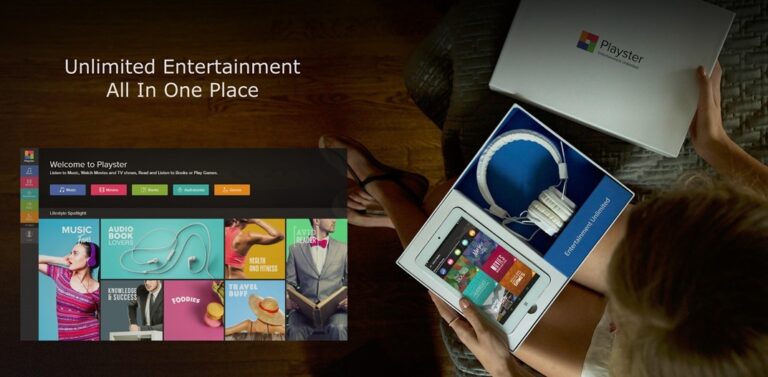
Playster offers a wide array of content, which includes the likes of music, books, audiobooks, movies  and games, all combined into one simple app that’s easy to use and boasts convenience as its main quality. While all other streaming services, like Netflix, Spotify, Scribd and Hulu, offer just one type of media to their users, Playster is hoping to save you money and make streaming more convenient by offering access to all media types for one low price — just $24.95 per month.

This low price tag offers unlimited access to Playster’s entire catalog and, bearing in mind that the first 30 days are completely free,  it is surely worth giving the service a try.

Playster’s subscription content can be accessed from any device. All you need is a good internet connection to endlessly stream music, read books or watch movies. You can even save content to your device if you want to make use of it later on while offline. Playster offers custom apps for both Android and iOS and the subscription starts at just $3.95 per month for the movie package.

There are millions of titles to choose from, all neatly sorted into categories that make browsing effortless. The streaming experience is great from what we’ve tested and include content such as documentaries, books designed for children and all of today’s biggest singles and albums.

No matter if you are a young adult, fiction, thriller, romance or comedy book fan, Playster has something for you. Its selection of books is fantastic and everything is smartly sorted and highlighted in the library. The library also features a wide selection of audiobooks for you to listen to while you are on the go.

Playster really did a great job when in terms of its music library too, as it includes artists from all major labels, as well as timeless classics and independent artists. Not only does it offer a lot of amazing artists to discover, but it also has a neat feature that recommends playlists based on your current mood. Playster will do all the work for you and offer up a bunch of songs related to what mood you are in.

Not only does this service come with innovative features, but it also offers such a wide variety of content that it is sure to entertain even the most pretentious of users.

We highly recommend subscribing to this service, bearing in mind that you’ll receive a 30-day free trial to kick things off. During this time, you’ll have full access to the platform and you’ll be able to judge for yourself if this service is right for you.

Based on everything they’ve accomplished so far, it’s only a matter of time before Playster dethrones some of today’s most popular streaming services.

GDGLagos and Devcenter To Host Machine Learning Event

0

Machine Learning is at the heart of the next computing revolution. From cars that drive themselves, to chat bots and recommendation engines on e-commerce sites, Machine Learning will drive innovation across the world as computers take on human tasks. Devcenter  teamed up with GDG Lagos and the Together with Google Developers program to host a TensorFlow viewing party in Lagos, Nigeria.

TensorFlow is a programming system that makes complex mathematical computations easier by representing them as graphs. For machines to learn and behave like humans, it requires heavy computer processing power which most developers don’t have access to.

TensorFlow makes it easier to create, analyse and use machine learning models that run on everyday computers. TensorFlow is open source and is the number one Deep Learning framework in the world.The viewing party is an Extended Viewing Party for those who can’t make it to the actual Google event. Beginners will also learn about Machine Learning using TensorFlow; showing real life scenarios as mathematical models for learning.

The event featured Tomiwa Ijaware who’s a Senior Digital Analyst at McKinsey Digital Labs and Farouq Oyebiyi who builds recommendation and personalisation sytems to improve User Experiences at Konga. Both speakers shared their knowledge about Machine Learning. For more information check  https://www.eventbrite.com/e/tensorflow-dev-summit-viewing-party-tickets-31780268639.


Annual Cyber security Report: Chief Security Officers Reveal True Cost of Breaches

0

Cisco released the 2017 Annual Cyber security Report (ACR) during the Cisco Connect East Africa 2017. According to the Cisco®2017 ACR, over one-third of organizations that experienced a breach in 2016 reported substantial customer, opportunity and revenue loss of more than 20 percent. 90 percent of these organizations are improving threat defense technologies and processes after attacks by separating IT and security functions (38 percent), increasing security awareness training for employees (38 percent), and implementing risk mitigation techniques (37 percent).

The report surveyed nearly 3,000 chief security officers (CSOs) and security operations leaders from 13 countries in the Security Capabilities Benchmark Study, part of the Cisco ACR.

Now in its 10th year, the global report highlights challenges and opportunities for security teams to defend against the relentless evolution of cyber crime and shifting attack modes. CSOs cite budget constraints, poor compatibility of systems, and a lack of trained talent as the biggest barriers to advancing their security postures.

Leaders also reveal that their security departments are increasingly complex environments with 65 percent of organizations using from six to more than 50 security products, increasing the potential for security effectiveness gaps.To exploit these gaps, ACR data shows criminals leading a resurgence of “classic” attack vectors, such as adware and email spam, the latter at levels not seen since 2010. Spam accounts for nearly two-thirds (65 percent) of email with eight to ten percent cited as malicious. Global spam volume is rising, often spread by large and thriving botnets.

Measuring effectiveness of security practices in the face of these attacks is critical. Cisco tracks progress in reducing “time to detection” (TTD), the window of time between a compromise and the detection of a threat. Faster time to detection is critical to constrain attackers’ operational space and minimize damage from intrusions. Cisco has successfully lowered the TTD from a median of 14 hours in early 2016 to as low as six hours in the last half of the year.

The 2017 ACR reported that just 56 percent of security alerts are investigated and less than half of legitimate alerts re-mediated. Defenders, while confident in their tools, battle complexity and manpower challenges, leaving gaps of time and space for attackers to utilize to their advantage. Cisco advises these steps to prevent, detect, and mitigate threats and minimize risk:

  • Make security a business priority: Executive leadership must own and evangelize security and fund it as a priority.
  • Measure operational discipline: Review security practices, patch, and control access points to network systems, applications, functions, and data.
  • Test security effectiveness: Establish clear metrics. Use them to validate and improve security practices.
  • Adopt an integrated defense approach: Make integration and automation high on the list of assessment criteria to increase visibility, streamline interchangeability, and reduce the time to detect and stop attacks. Security teams then can focus on investigating and resolving true threats.

Apple Watch has its best quarter and takes nearly 80% of total smartwatch revenue in Q4

0

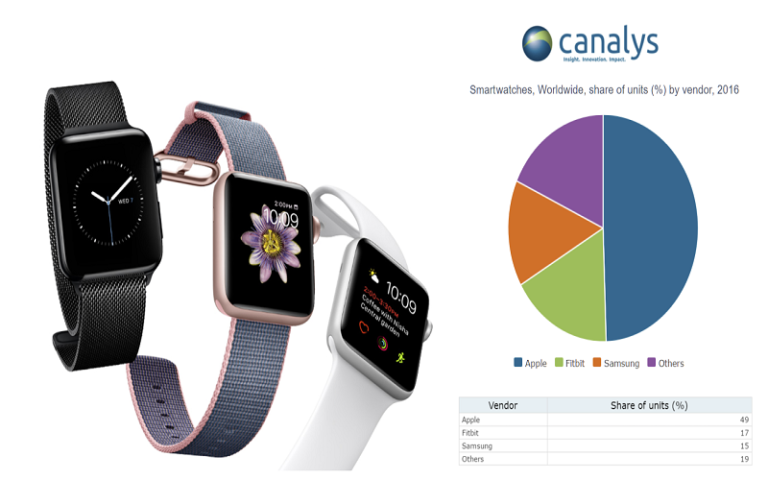
Apple set a new quarterly shipment record in Q4 2016, contributing to total smartwatch shipments exceeding 9 million units. This global market figure was largely driven by Apple’s 6 million shipments, representing year-on-year growth of 12%. It was the Apple Watch’s best quarter despite being significantly handicapped by supply constraints, even though Apple simultaneously expanded its supply chain. According to Canalys estimates, the Apple Watch generated more than US$2.6 billion in revenue for Apple in Q4 2016, making up nearly 80% of total smartwatch revenue.

“Apart from the hardware and software improvements of the new models, Apple succeeded mainly due to its streamlined marketing and re-aligned pricing, which helped it address a wider audience,” said Analyst Jason Low.

Xiaomi also enjoyed a record quarter of its own for basic band shipments, reaching 5.5 million Mi Bands. “New batches of Mi Band 2s were shipped in time for the Singles’ Day shopping festival in China”, according to Analyst Jason Low. “Building on the success of its first-generation Mi Band, Xiaomi quickly expanded the availability of the Mi Band 2 across Asia Pacific and Central and Eastern Europe. India, Poland and Russia were key markets where the device was introduced alongside the company’s Mi and Redmi smartphones through direct and third-party online channels.”

In the coming quarters, Samsung is expected to push shipments of its Gear S3 Classic and Frontier. Also, Android Wear shipment volumes will bounce back significantly, as new products that were postponed due to the delay of Android Wear 2.0 will soon be launched. Apple’s smartwatch lead will increasingly be challenged by the rebounding competition.

Canalys defines smartwatches as multi-purpose devices that serve as accessories to smart devices, are designed to be worn on the body and not carried, run an operating system and can run third-party computing applications. Basic bands are devices serving a specific set of purposes that act as accessories to smart devices, are designed to be worn on the body and not carried, and cannot run third-party computing applications. Bands are wearables designed to be wrapped around the body, including watches, and do not include activity trackers in the form of clips.

Social Media is the Primary source of information for African youth

0

According to a recent GeoPoll rapid survey that was  carried out among youth in five Sub-Sahara African countries there has been an increased dependency on technology for young people between the ages of 18-35. From the African millennial series, Africa has the highest population in the world with 200 million people aged between the ages of 15-24. The current trend indicates that this figure will double by 2045, according to the 2012 Afican Economic outlook report by experts from the African Development Bank.

Millennials across the world are defined by their uptake of technology. Affinity to technology by millennials world-wide and specifically so in the west is a study that is currently ongoing and continues to be a fascinating undertaking especially in regards to the African Millennials.

Despite lack of access to smartphones and reliable internet connectivity, the level of uptake and penetration in Africa has hit major milestones in the last 5 years.  According to a report published by GSMA on Africa’s mobile economy in 2016, smartphone adoption in Africa has doubled in two years. Among Sub-Sahara African countries, South Africa has the highest number of smartphone subscribers at 34% followed by Nigeria, Senegal and Kenya.

African millennials are increasingly using download sites to access video entertainment and social media sites as tools for communication and a source of news and information. Mobile data continues to be the most used means through which African millennials access the internet. Social network platforms such as Facebook, WhatsApp and twitter have become an integral part of everyday life with over 60% using social media as their primary source of information. Television comes a distant 2nd at 25% with newspapers being the least important source 6%.

The second screen phenomenon though not highly prevalent among African Millennials, is one that might change with time. 57% of African Millennials say they sometimes use their smartphone while watching TV, 35% said they are always on their phone. This can be attributed to data costs which are still relatively high in many African countries compared to the rest of the world as well as changing preference among this group on choice of entertainment.

The use of social media platforms such as has become second nature to African Millennials’ lives; WhatsApp and Facebook rank among the platforms with the most usage. 56% have created and are most active on WhatsApp  , while 31% are active on Facebook. Not only do African millennials spend more time on their smartphones than on any other gadget on a daily basis, but they are also more likely to be on WhatsApp chatting. A majority (46%) are actively engaged daily in at least 1-3 WhatsApp groups.

Part of this study was to determine whether or not Sub-Sahara African millennials are addicted to their phones with typical signs of addiction being how often they use their phones, if they took their phones with them to the bathroom, where they placed their phones while sleeping, and if they walk around with a power bank. Whilst this survey does not serve as a psychiatric evaluation, 81% said they place their phone next to their bed while sleeping, 48% carry their phones with them to the washroom and 31% walk around with a power bank in case their phone runs out of battery power.

African Millennials are vanguards of a future Africa and technology is becoming an integral part of it all. As younger millennials continue to make their impact felt in almost every sector, a mobile first approach is crucial for any company that seeks to reach this culture rich group of image conscious, educated and opinionated individuals.s


The best seat in the IMAX theatre to watch the movie.

0

2017 is an epic year for films. Movie-going will be filled with upshots, superheroes, and reboots. More than 20 follow-ups are coming throughout the year. The Fast & Furious gang, Transformers’ Autobots and the evil Decepticons and Pirates of the Caribbean crew return during the spring and summer months. Nevertheless, this remain a question to many. Which will it be the best seat in the IMAX theatre to watch the movie in 3D?
The IMAX screen appears large even from the back. The apparent depth increases the further you are from the screen, and with a screen that big you never feel far from it. There’s something magical about sitting in the pitch black of the cinema while new worlds unfold around you and envelope you in their wonders. With tickets expensive, plus pricy popcorn, in this age of VOD services you can watch on home cinema systems growing more impressive by the day, you would expect nothing less from a trip to the movies.
When I first went to the movies I didn’t have any seating position preference, I was just happy I was at the movie theatre, luckily one of my friend a movie junkie was quick to correct that mistake. Where you seat in a movie theatre matters a lot. Ill jump straight into IMAX since that’s the highest movie technology we in Kenya.
If you have been to the IMAX theatre in Nairobi you might have realised that it’s a whole new experience, it makes you feel like you are in the movie literally. This is largely due to the surround sound technology as opposed to the screen technology.
I went on and I did some research on how the technology works, I am a firm believer if I know how things work I’ll understand or get the best out of them/it. Apparently the normal humans have a horizontal view of 180 degrees, i.e. you can perceive things from the far right to the far left. Our central view (front view) spans across only 10 degrees but we still have the ability to see across the remaining 175 degrees on either side. Human start to detect motion after a 30 degrees view and Imax screens are made to bend so that you can perceive the images and motion up to a 70 degrees on either side, That combined with the surrounds sound system make the ‘like in a movie feeling’
For you to experience 100% of this you need to be seated strategically in the theatre, here is the guide my movie junkie friend recommended to me, the best seating position have been selected after considering all factors that makes Imax such and experience technologically and psychologically. Distance to the screen, angle views and IMAX Kenya theatre geometry

imax-comparison-fov
Red: best seating positions – try and get the middle seat if you can, F15-16, G15-16
Green – Second best seating position
Yellow – worst seating position
What to remember;
The more central you are both horizontally and vertically the better
Next time you are planning a trip to the movies, try the red seat, thank me later.

Inside Uber’s Revamped Hailing App

0

Uber has become a household name; its cab hailing service has gained a popularity over the years despite competitors popping up left and right.

Uber intends to maintain its market leading position by constantly innovating new features and refining old ones. We looked at the new app to see what new updates the app has and if its any better to its competitors or to its old version.

Screenshot_2017-02-27-12-48-55

Interface

The interface is crucial to every app, it’s the first impression a user gets even before they try out the features. Uber has made their interface very simple and straightforward for new users; the moment you open the app you will get the Uber logo and a space to enter your phone number. You then proceed to type a code sent via SMS and then key in your email and password and you are set.

Screenshot_2017-02-27-15-01-48

The home screen interface of the app is dead simple, you get a “where to” text space to fill your destination and below it is a messages tab  that informs you of tips and tricks of making the most out of the app. The remaining graphical aspects of this home page include a hidden slide out menu, and a small icon on the top left to switch between your personal and work Uber profiles. The simplistic and uncluttered interface might fool one into thinking that the app is bare-bones but once you start booking rides, things start building up.

Screenshot_2017-02-27-12-36-52

Screenshot_2017-02-27-12-39-37

The navigation through the interface is simple, it’s a combination of swipes and icon presses. Swiping up bring up the messages, whereas swiping from left to right reveals a menu which includes ‘payment’ section which lets you choose your preferred method of payment; ‘your trips’ section which lists down your rides history and gives you a chance to file a complaint; ‘free rides’ section lets you redeem codes in exchange for free transport services; a ‘help’ section which offers guides and, a settings menu.

Screenshot_2017-02-27-12-39-08

Settings menu has a section for defining your personal and work profiles. Additionally, families can have one Uber account where they can share payments and track each others rides. In the settings menu resides a sub-menu labelled ‘advanced settings’ it enables the user to delete any contacts they might have saved into the app.

Functionality

Screenshot_2017-02-27-12-36-01

Uber has been expanding the scope of its services. They want to transform from a ride sharing company to offering a bouquet of services that may appeal to people when traveling. Ordering a ride has been made very intuitive. Once you type in your destination in the ‘where to’ section, a card pops up with the information of fare price estimate, car capacity, car category and the Uber profile you are using. Most Kenyan destinations only offer the UberX category which fortunately is the most affordable class. In other markets, you get three tabs namely, Economy, Premium and Extra seats and More. Each category is self-explanatory but the ‘More’ section offers specialized transport for people who may need a wheelchair-accessible vehicle or a baby car seat.

Screenshot_2017-02-27-12-36-23

Once you choose your category, you are prompted to confirm pickup and the fare estimate. This is the part that the Uber magic then happens; a ride is searched for you based on your current location; you get your drivers profile details, an estimate of how long they will take to get to you and the option to cancel the ride in case you change your mind. However be cautious about cancelling too many times, Uber gets angry and stops you from requesting a ride for some time. But if you follow through your trip, payment is deducted automatically from your credit card and you get a chance to rate your driver.

Uber has included some value adding features into its latest app update.

A user can stream music through Pandora while on transit. You can also learn about places of interest of your destination through Foursquare. In case you are meeting up with a friend, you can have the driver take you to them by having your friend share his or her location with you within the app.

UberEATS enables you to find places to order food so that you can have it arrive at your destination the moment you get there. The app has also gotten smarter at its core ride sharing feature, now you can see shortcuts to your destination as well as the various pricing options for each route. Also, instead of simply rating a driver, you can comment on them too.

Pros

  • One of the fastest ways to get a ride.
  • Simplistic and intuitive user interface.
  • A very informative help section to guide you through the app
  • Chock full of value adding features such as music streaming and food ordering.
  • Many sharing options from sharing of fare prices, to sharing locations.
  • Constant updates mean that the app will only keep getting better.

Cons

  • The fare price surges can be very high at times.
  • Not all Kenyan towns have Uber services at the time of writing.
  • Other Uber car categories are yet to be introduced in Kenya.
  • Competing ride hauling apps have lower fare prices.


Current Prices for pay TV services In Kenya and their packages.

0

Kenya has the most competitive pay TV field. On the other hand, the market is overcrowded considering the relatively-limited rewards on offer. As competition bites, most operators are reducing subscription fees despite depreciation of the local currency. Kenya is experiencing a digital TV boom due to the launches of DTT and satellite TV platforms.

As the premier league tension increase, we have decided to compile a list of the different pay TV services and their packages offer here in Kenya to give you an idea of which one is perfect for you.

Zuku.

Zuku offers satellite and cable Pay TV services. Zuku Satellite has four packages namely: smart pack which has 42 TV channels and 18 radio for ksh 399 Zuku; Classic which has 76 TV channels and 55 radio channels for KSh 999 monthly fee; Zuku Premium has 97 TV channels and 55 radio channels for KSh 1,399; and Asia package with 26+ channels for KSh 999.

The cable option, Zuku Fiber, offers internet, TV and telephone services in Nairobi and parts of Mombasa. The prices range from KSh 4,499 for home basic (15 Mbps internet, 62 television channels and free Zuku calls) home preferred (30Mbps internet and similar number of channels); (KSh 5,699) and home premium for (KSh 9,999).

Star Times

StarTimes has two services: the Digital terrestrial television (DTT) and the Satellite TV (known as StarSat). DTT uses and aerial while the StarSat uses a satellite dish.

The least costly DTT option is it’s the Nyota Bouquet which charges KSh 259 monthly for 10+ channels. Basic Bouquet costs KSh 599 for about 33 +local and international channels while Classic Bouquet goes for KSh 999 for 57 + channels with dedicated sports channels like Star Times Sport 2, Euro Sports News, Fox Sports and NBA TV.

StarTimes’ most priced DTT option is the Unique Bouquet that goes for KSh 1,499 to access 76 channels. StarSat options are: Nova (KSh 399 monthly for 35 channels), Smart (KSh 899 for 69 channels), Super (KSh 1,499 for 100 channels) and Chinese (KSh 1,999 for 12 Chinese channels and 69 other international ones). Indian (ksh 899 monthly for 7 channels.

GOTV

GOtv is a Multichoice’s DTT product that offers three packages; GOtv Lite, Plus and Value. Users pay an annual fee of KSh 220 to get 16 general entertainment and 2 local television channel on GOtv Lite per month. GOtv Plus has 40 television channels for KSh 699 monthly while the Value package charges KSh 470 monthly for 28 television channels.

DSTV

DStv (Digital Satellite Television) is Multichoice’s digital satellite TV service in Africa, launched in 1995, providing various bouquets offering general entertainment, movies, lifestyle & culture, sport, documentaries, news & commerce, children, music, religion and consumer channels to MultiChoice subscribers. DSTV product offers the following packages; Compact PLUS at a monthly subscription on KSh 5,425 while Compact goes for KSh 3,550.DSTV Family KSh 1,900, and DSTV Premium KSh 8,180.

Catch up with the latest buzz, movies and episodes on your favorite mobile device on the go using a cloud hosted virtual desktop with windows applications from CloudDesktopOnline and access your essential documents with Office 365 by O365CloudExperts with endurable tech-support from Apps4Rent.com.

How growth in e-commerce offers new opportunities for entrepreneurs.

0

This may be surprising to hear, and even superior to see that entrepreneurs are maximizing the benefit of Internet presence. It has been pointed out that those taking advantage of it, are really experiencing significant gains. Entrepreneurs can often be emotional with the harsh reality of market struggle, but they just have to keep the lights on.

Online marketing and digital technology are complex and even to some extent unclear to the general public not everybody wants to spend their weekend figuring out how to optimize a market set out, and others, well, they are just not necessarily built for it.

Kenya’s electronic commerce market is geared up for major growth in the next five years as mobile internet performance continues to improve, a proposed national addressing system comes into existence, and people become more comfortable with digital transactions.

Kenyan’s eager adoption of person-to-person mobile payments creates a solid base for the growth of mobile and electronic commerce. “We’re seeing more and more Kenyans go online, thanks to cheaper smartphones and mobile data,” Divisional Director Sage Dr. Rutendo Hwindingwi said. Combine that with Kenyans’ comfort with electronic transactions after years of using mobile data, and we can expect to see digital shopping and commerce really start to take off.

Digital transactions in Kenya take place via smartphones and mobile broadband. This because of low fixed-line and Personal Computer penetration. However, the mobile experience has improved dramatically in recent years and it has become simple and enjoyable to shop from a smartphone.  With mobile money providers like M-PESA now adding APIs for smartphones to their products, they are opening up a range of new e-commerce applications and services.

Small and Medium Businesses are able to take advantage of the digital commerce wave as larger businesses. Platforms such as Facebook make it easy for entrepreneur’s interaction with customers, while affordable, packaged offerings like Sage Online Tools make it easy to construct and launch a marketing and mobile-ready e-commerce site.

For example, visualize being able to immediately check stock levels while standing next to a customer who found the business online, from a mobile device, then placing an order, running an invoice and accepting a payment – with all of these functions happening simultaneously via the cloud to sync with the accounting package.

According to the Communications Authority of Kenya, the e-commerce market in Kenya was worth around Ksh.4.3 billion in 2014. But with internet penetration of 82.6% and 35.5 million users (according to the authority), Kenya is one of the African countries best placed for a digital commerce explosion, ‘’Sh3billion in mobile transactions have already taken place in the country each day, according to statistics from the Communications Authority’’. Dr. Rutendo Hwindingwi.


Impacts of Fake News on Social Media.

0

Consumption of fake news and answers to it will often implicate the freedom of expression. Control designed to combat fake news can hinder the universal right to freedom of expression. At the same time, propaganda spread by fake news can impact perceptions of governments, elections, and overall attitudes within societies, undermining the integrity of the democratic process.

social media accounts has evolved from a place to post selfie, travel pics, and what you ate for dinner to a platform that people are using to make big money through adverts and now the latest trend driving out shocking, garbage with a goal of going viral.

Fake news, once confined to parody of the internet, has quickly become a challenger for the most powerful expression of the year, after it was revealed that it had an effect on the US General Elections which is a terrifying position to be in. Some of fake news going round on social media includes;


When Joko Widodo, Indonesia’s president, was running for office in 2014, he was accused through social media of being a Chinese Christian and a communist — severe criticism in the deeply Islamic country. The Indonesian politician released his marriage certificate to prove he wasn’t Chinese and made a pilgrimage to Mecca just before voting.

“The fake news had a very big impact in our campaign,” said Tubagus Ramadhan, who helped Mr. Widodo run his social media campaign during the election.

Even in long-established democracies like Germany, Spain and Italy, have reported false news reports and hate speech on social media have whipped up grass-roots populist movements, which have often targeted the recent arrival of Middle Eastern refugees, to save wider election support.

Kenya is one of the several countries having an election this year and it will be great if they rolled out the feature to curb fake news soon enough before the election. Social medial have a huge presence in Kenya. Restricting the spreading of fake news could have a positive impact in the curbing of scam.

These’s a big risk —that social media will hollow out existing gaps in these civilizations. WherePeople are still learning how to use social media, so many can easily fall for hoaxes.

LG G6: Leaks and rumors round-up.

0

It’s a new year and as customary to the mobile phone industry, new hardware is released to keep up with the technology advancements. LG is prepping up to announce their flag bearer for 2017, the LG G6, it’s the successor to the very innovative LG G5. The phone is scheduled to be unveiled this coming Sunday, 26th February, at the Mobile World Conference in Barcelona . Many rumors and leaks have cropped up as the day of the announcement nears, we have gathered all the information you need to know to paint a clear picture of what to expect that day.

Design

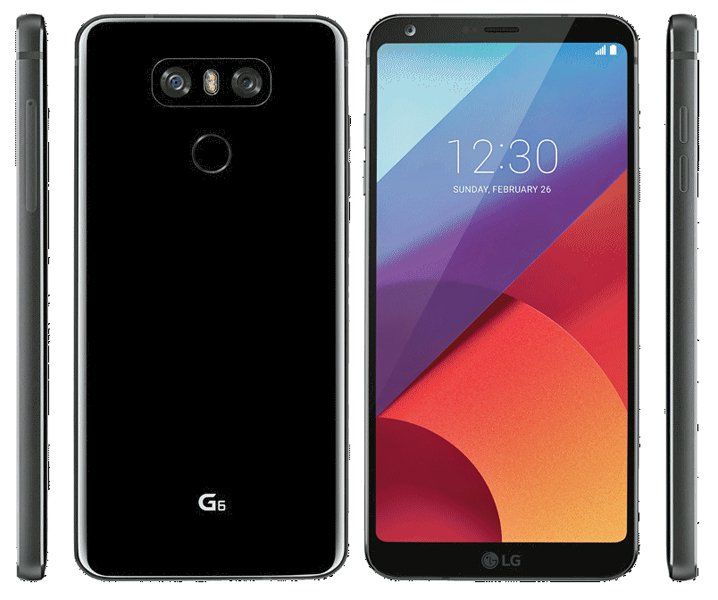
lg_g6_leak

Just as the LG G5 last year, the new LG G6 will also come in a full metal unibody. LG went ahead to include a brushed rear surface to give the phone a more premium feel to the hand. Speaking of the rear, the company designed the fingerprint sensor to reside at this location, it will also double as a power button.

Display

lg_g6_day_mwc_2017

The phone will come with a new display named FullVision, it’s a 5.7 inch QHD+ display with a resolution of 2880 * 1440. The most appealing feature of the display is its super slim bezels, the thinnest of any LG made phone. The minimal bezels have made it possible for LG to fit a 5.7 inch screen on a body form factor that will have no trouble fitting on the average sized hands. The display comes with a rather unusual 18:9 aspect ratio that Juno Cho, president of LG Electronics Mobile Communication Company, says it is the perfect format for watching cinematic content as recommended by the movie industry.

Camera

lg-g6-proto3

LG G6 maintains the dual camera legacy of recent LG high end devices. It comes with dual 13MP rear camera one of which has a 125 degrees wide field of view for covering more objects within the shots. The front camera is rumored to be 13MP with a 100 degrees wide field of view to make sure all your friends fit in the selfie.

Processor

lg-g6-vs.-galaxy-s8

The best offering from Qualcomm so far is the Snapdragon 835, unfortunately, Samsung has reserved all of these chipsets for the Galaxy S8 and the S8+; this leaves the LG G6 to settle for the Snapdragon 821 but with a whopping 6GB RAM. This chipset is already powering some already released smartphones such as the Xiaomi Mi 5s and 5S Plus as well as the Google Pixel and the Pixel XL. The chipset has been documented to be a powerful option despite having only 4 cores; LG fans should not take it as a deal breaker since it can handle pretty much all applications and games that android has to offer.

Software

g6 live

Since LG has already launched a phone with the latest android 7.0 nougat, the LG G6 is expected to build up on that development. The G6 is rumored to put a high emphasis on Artificial Intelligence this year through a partnership with Amazon for its Alexa voice assistant. The software will also be made in a way that utilizes the 18:9 screen ratio. This screen ratio makes it possible to have perfect squares during split screen multitasking and camera modes.

Battery

lg-g6-case-leak-evleaks

Unlike the LG G5, the G6 will have a non-removable battery. This is a first from LG which has maintained removable batteries since the dawn of android and it will be interesting to see how legacy LG fans will react from the move. Fortunately, there are signs that the G6 will come with wireless charging owing to the fact that LG released a charging pad in October yet none of its devices utilizes it .

Extra features

LG G6 has been confirmed to come with IP68 water and dust resistance by a teaser video released by LG. Additionally, the company will introduce the perfect audio capabilities of the V series line to the G6 through a 32bit Quad DAC chip and tuning by Bang and Olufsen (B&O), and yes, the 3.5mm jack will remain intact unlike the iPhone 7 and 7 Plus.

Price and Release date

The LG G6 will be announced at February but will be in stores at April as per the rumors. The price has been pegged at 60,000 or $600 which is about the same as LG G5 at the time of its release.

Airtel Stamps its Support for Digital Literacy in the Region

0

Airtel Kenya, a leading telecommunications service provider has extended its support for digital literacy in rural and urban communities across Kenya by offering more routers and 3G connectivity to ensure free internet connection services to the Intel Mobile Caravan under the She Will Connect program.

Following the official launch of the Intel Mobile Caravan in September 2016, between Airtel, Intel and other partners, a three day training for trainers was organized between 7th and 10th February to equip the trainers on the new content, platform and schedules that will be adopted in the next phase campaign for the caravan and the BRCK KIO kits.

The training culminated in a breakfast meeting whereby the pilot phase report on the caravan and BRCK kits was shared highlighting the successes and challenges of the initial roll out project. It was reported that the pilot phase program had impacted the lives of 3200 beneficiaries in the four counties namely, Narok, Nairobi, Muranga and Machakos where the caravan toured.

Intel Mobile Caravan targets women, teachers as well as students and provides free ICT training. Airtel Kenya will provide high speed 3G connectivity to an additional 10 BRCK KIO kits that will be taken round various counties in the next phase of the campaign. The next phase campaign will target eight counties including Uasin Gishu, Trans Nzoia, Kakamega, Narok, Embu, Nyandarua, Homabay and Tharaka Nithi.

Speaking during the event, JoyWo CEO, Mr. Abraham Samoei applauded the great success that was achieved by the Intel Mobile Caravan and the three day training for the JoyWo trainers. “I am very pleased with the great report that has been shared on the pilot phase of this initiative that is aimed at empowering women and children with ICT skills. To know that women and children are empowered with technical skills that have helped them to improve their lives is very encouraging.”

“We would also like to thank our partners Intel and Airtel for their continued support and we continue to assure you that we will endeavor to reach out to even more Kenyans in order to empower them and help them transform their lives and your support is highly appreciated.” Abraham added.

In a statement, Airtel Kenya, Managing Director, Prasanta Das Sarma pledged Airtel’s continued support in the initiative that seeks to enrich lives in the communities.“As a company we are devoted to delivering solutions that enrich the communities that we serve. As such we remain committed to this partnership with Intel and other key partners to continue offering internet connectivity for this initiative. We are delighted that this initiative has so far impacted the lives of many people by empowering them to reap the benefits and access the boundless opportunities that come with being connected to the Internet.” said Prasanta.

Airtel also continues to support the youth in education through its CSR program that offers FREE internet to schools. So far, the company has covered over 340 schools and impacted the lives of over 270,000 students all over Kenya.

Other key partners in the initiative include the Kenya Institute of Curriculum development (KICD) charged with ensuring coordination with schools and providing digital educational content, JoyWo (Joyful Women Organization) run by Mrs. Ruto in the mobilization of women in the respective communities to attend the training sessions to be held at community centres and Global Peace Foundation which is involved in developing and executing training modules for the target audiences.

Intel Corporation has been impacting the lives of women and girls through the Intel® She Will Connect program that empowers women and girls with digital literacy thus enabling them to receive better education, enhance their political participation, have a stronger voice in their communities, and increase their income by connecting to new economic opportunities. The program has so far impacted over 150, 000 women in Kenya, Nigeria and South Africa through face to face training.


Samsung New QLED TV Becomes the First‘100 Percent Color Volume’-Verified TV

0

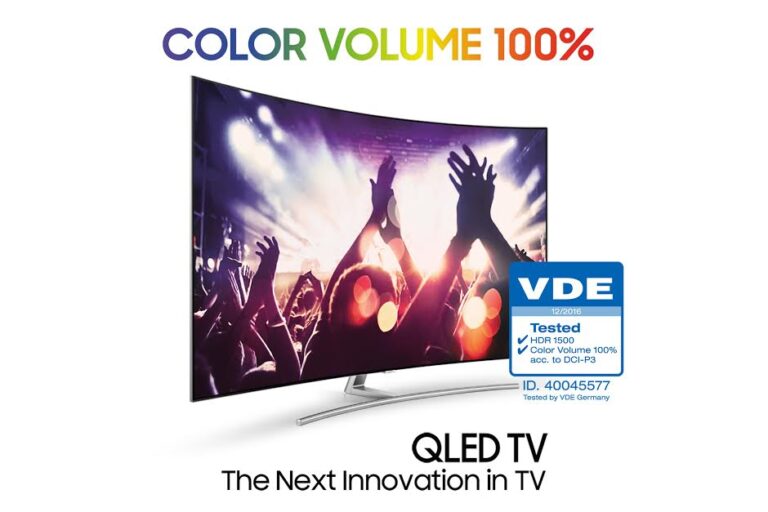
Samsung Electronics has announced that its 2017 QLED TV, first unveiled at CES 2017, has received verification from world-class testing and certification association, Verband Deutscher Elektrotechniker (VDE), for its ability to produce 100 percent color volume.VDE provided verification for Samsung’s QLED TV based on the organization’s expertise in color volume testing. The verification is a mark of the QLED TV’s ability to provide a consistently high quality picture to viewers.

Color volume, which is the exacting standard of color expression, measures two elements of the TV with three-dimensional space – the color gamut and the brightness level. The color gamut looks at the largest amount of colors that can be displayed physically. The peak brightness represents the display’s maximum brightness level. The larger the color gamut and the higher the brightness, the bigger the color volume of the TV. The QLED TV’s expanded color volume results in more realistic, accurate and vibrant HDR images as the director or content producer intended, in both bright and dark scenes.

For example, a leaf can be perceived as different colors, from yellowish green to turquoise, depending on the brightness of the light. The Samsung QLED TV can capture even the subtlest differences in color pertaining to brightness – something that is not easily depicted in traditional 2D color space – thus deliver the most true HDR picture quality as the director intended.

Generally, a TV’s color-rendering capabilities diminish as brightness levels go up, leading to color distortion on-screen. The Samsung QLED TV overcomes the trade-off between brightness level and color. With a peak brightness of 1,500 to 2,000nit, the QLED TV can express 100 percent color volume – a TV industry first.

Samsung’s QLED TV uses a new metal Quantum Dot material – making it possible for the TV to express a significantly improved range of color and peak brightness with much greater detail compared to conventional TVs. The new Quantum dots also allow the Samsung QLED TV to express deep blacks regardless of how light or dark the scene is, or whether the content is played in a brightly lit or dark room. Best of all, QLED delivers this level of performance no matter where the viewer is sitting, offering consistent color and quality from any viewing angle.

“The ‘100 percent color volume’ verification awarded to Samsung’s QLED TV signifies the excellence of our product and its revolutionary picture quality. As the global TV market leader for 11 consecutive years, we are thrilled to be leading the TV industry into a world of Quantum dot-powered displays featuring the best available picture quality,” said Jung Hyun Park, Vice President and Managing Director of Samsung Electronics East Africa Ltd.


Ecobank Kenya launches innovative digital product

0

Ecobank Kenya has launched Ecobank Mobile App, a convenient and instant way of banking via the mobile phone. The app integrates many functions, including Masterpass QR, a mobile payment solution designed and operated in partnership with MasterCard. Ecobank Kenya is the first bank in the country to launch the Masterpass QR.

The Ecobank Mobile App opens up huge opportunities for customers by allowing them to shop, transact and do business without cash. It is the first unified app delivered by any institution for use in 33 countries. This also lowers security risks as business owners can now handle their business without interacting with actual cash.

Sam Adjei, Ecobank Kenya’s Managing Director said: “We are proud to launch this innovative digital product in Kenya. The Ecobank Mobile App is part of Ecobank’s digital offerings. Known as Ecobank_on, the array supports our drive to digitalise banking in the country and across the continent. By leveraging the power of digital, we are enabling our customers, including our important merchant segment, to grow their businesses and live life with convenience. As the government continues to grow the nation’s economy, one of the fastest-growing in Central and Eastern Africa, Ecobank Kenya is here to support that expansion.”

Humphrey Muturi, Executive Director Commercial Banking at Ecobank Kenya, said: “The Ecobank Mobile App provides real convenience for customers. It empowers them to carry out financial transactions that could only be done previously in banking halls.”

This new Ecobank Mobile App enables customers to send and receive money instantly across 32 other African countries, other than Kenya. Customers can also use the app to open a free digital account – Ecobank Xpress Account. The beauty of this unique account is that it can be opened instantly with no references, or paperwork.

It is also the first bank in Africa to partner with Mastercard, a leader in global payments and technology, to bring its customers Masterpass QR. This new, cashless solution makes payments possible in-store and online via a mobile phone. Ecobank Kenya provides products and services through 29 branches and 65 ATMs in Kenya. With the app, customers now have the opportunity to carry out various transactions on their phone.


German firm Krones to train Wings to Fly graduates

0

Six Wings to Fly graduates received admission letters to enroll in a diploma course in mechatronics at Krones Academy, a Technical and Vocational Education and Training Institute. The graduates received their letters from the German Minister for Economic Co-operation and Development, Gerd Muller, at the Academy grounds in Ruiru.

While presenting the letters to the Wings to Fly graduates, Mr. Muller urged them to engage their heart and hands to secure their livelihoods. “Young people like you have a strong brain to work theoretically and your hands to work in a practical way.”

This vocational education and training brings together the aspects of practical and theory to help in the development of a country. The Ruiru establishment is a public private partnership initiative by the German Government, KfW (German Development Bank) and DEG (German Investment and Development Co-operation). Admission of the apprentices at Krones is part of an Africa-wide programme.

On his part, the Executive Chairman of Equity Group Foundation, Dr. James Mwangi, represented by Philemon Kibiru, Senior Manager for Learning and Mentor Management Programme, urged the scholars to maximize on the new opportunity granted. “Remember that your efforts in the institution you are joining will determine your entry and success in furthering your education or entry into the job market. Make full use of Krones and its facilities to further discover, develop and exploit your talents and capabilities” said Dr Mwangi.

“Given the high rates of youth unemployment, skills-based training offers the fastest way to secure jobs and to advance in a technical skills-based career path. We have partnered in designing a program with several elements to ensure successful transitions through school and into the work place,” he added.

This event came hot on the heels of the launch by Equity Group for nearly 3,000 Wings to Fly graduates of 2016 transitioning into various TVET Institutions countrywide. The programme is supported by the Ministry of Education, Science and Technology (MoEST) and the German Government through its implementing agency KfW.

While some of them enrolled for 3-month certificate courses, others were admitted to longer-term diploma courses.The objective of the launch was to provide the Wings to Fly alumni (whether headed for further education, employment, or entrepreneurial opportunities) with exposure and skills.

African Entrepreneurs Receive $1 million Prize from BMCE Bank African Entrepreneurship Award 2017

0

If you have been seeking an opportunity to implement and fund your business then this may be what you need.

The 2nd edition of The African Entrepreneurship Award is back for you. This platform is powered by BMCE Bank of Africa and supports Africans that have solutions to problems such as unemployment.

The primary goal is to give all Africans a chance to make this continent better by even allowing Africans abroad to create jobs for other people. The award partners will have leading entrepreneurs, business leaders and academics from Africa, Asia, Americas and Europe.

Coupled together this great team will support African entrepreneurs through coaching, mentoring and business programs.

If you’re an interested entrepreneur then your business must match the following criteria.

  • Be a citizen of an African country
  • Minimum age is 18 as from October 1st, 2017
  • Must be applicable in an African country
  • Must include a technological component
  • Business must be for profit
  • Your business must be relevant to either Education, Environment or Uncharted

For more information visit this site. Application deadline is April 28th. This is a great chance to push a project or launch an idea that could grow globally, apply and see what awaits.

Vodafone marks 10 years in mobile money service

0

After 10 years of progression in the mobile money service, Vodafone finally marks the 10th anniversary of M-Pesa as the world’s leading service. It has been revealed that a record 614 million M-pesa transactions were processed last year, December 2016.

Vodafone has tremendously grown that it now offers M-pesa in 10 countries: India, Albania, the Democratic Republic of Congo, Egypt, Ghana, Kenya, Lesotho, Mozambique, Romania and Tanzania. By the end of December 2016, M-pesa had served almost 29.5 million active customers through a network of more than 287,400 agents.

The service was designed to enable customers to transact safely and securely to send, receive and store money via a basic mobile phone and, more recently in some markets, using a smartphone app.
Customers can visit an M-Pesa agent to top up their M-Pesa account and can use their mobile phone to pay for bills, shop or send money to other users.
M-Pesa has also helped reduce the potential risks of street robbery, burglary and petty corruption within cash-based economies where people are limited.
So far, only a small proportion of the population benefit from access to conventional financial services. M-Pesa has been a great initiative that has empowered tens of millions of people in the poorest communities in the world to start and gown businesses and gain greater financial resilience.

Interswitch & BBM introduce cardless cash withdrawal service in Nigeria

0

A new financial service has been introduced in BBM for Nigerians. This service which is also known as Paycode, enables cardless cash withdrawals at ATMs as well as cardless/cashless payments in participating in real-world stores.

Paycode is a service from Interswitch Ltd which has made all this possible. Nigerians can find Paycode on their Discover menu today. Interswitch currently procides BBM users with airtime top-up and a money trasnsfer service. Later this spring a bill payment solution is expected from this partnership.

These impressive improvements are meant to establish BBM as a leading messaging platform for mobile payments and further to give BBM customers a better app experience. Eventually it is expected to be the gateway to a better digital world.

Nigeria and South Africa have been leading the biggest mobile markets in Africa. Since both promise lots of growth for mobile services it has proven to be the key markets to invest in.

Like most of the rest of the world, Africans are enthusiastic mobile users. According to Deloitte’s Game of Phones: Mobile Consumer Survey 2015/2016:

  • More than half of consumers in the region check their phones within 5 minutes of waking up in the morning, and going to bed at night.
  • Instant messaging has overtaken traditional text as the preferred method of communication in all African markets except Kenya and Uganda. Usage rates continue to grow in all markets.
  • Consumption of internet media via mobile devices is also on the rise. News (text and video) and other short-form video are the most popular content, followed by music streaming.
  • Africans are interested in mobile money solutions, both payment and transfer services. The study showed 50% or more are willing to use these kinds of services.

For all the above reasons, BBM has been working hard to serve their African customers.

As for Nigeria and South Africa, more content and services will be offered at a steady clip. Currently in Nigeria, BBM is working with Interswitch and other partners to introduce travel services, lottery, sales, shopping, food delivery, sports betting, hotel booking and ticket purchasing for movies and other events. South Africans will soon get to enjoy multiple types of video, games and editorial such as content about sports, lifestyle, culture, music, entertainment, kids, food, and cars.

If you’re in Nigeria, be sure to try Paycode today. We’ll let you know here as we release the other services we have lined up this year, so keep checking back.

National Bank unveils cash management solutions for counties, Ministries, Government Agencies and Departments

0

National Bank has launched cashlite payment solutions suite for county governments, Ministries, Government Agencies and Departments that support their business processes and cash management to cater for their collections requirements.

Ministries have already started implementing solutions that the bank created. The solutions which have been used by other agencies and departments, county governments and Higher Learning Institutions now enable most agencies to collects KEBS levy, sugar levy, land rent, turnover tax, stamp duty and motor vehicle fees.

National Bank Managing Director and Chief Executive Wilfred Musau said that “They currently collect on behalf of state agencies and our solutions are fully integrated to their ERP systems for real time updating of transactions as they happen and support in day to day reconciliation. This has been successful because of the host to host system connectivity between the bank and these agencies and counties.”

The Chief Executive said the end consumer is expecting flexibility and a wide range of choices when it comes to how they pay for goods and services. “So we work with institutions and large organizations to give them the receivables solutions that let their customers pay how they want,” he said.

So far the bank has provided a variety of options for payments including mobile money, smart cards and e-wallet and cash options. As Kenya’s demand for mobile technology grows expectations for convenient mobile and online payments are appreciated. In order to capture Higher Learning Institutions National Bank has also implemented a collections cashlite system. This will cater for a cashlite environment within the university’s premises and campuses and other value add services like student registration and other school based customization. Targeting students and lecturers, the bank has effectively developed a smart card solution that enables students to access various services such as entering/exiting campus premises (acts as an identification card), managing HELB  wallets (tuition, accommodation, upkeep), access to library services, access to cafeteria services, gym services, exam/class attendance, paying school fees, accommodation, penalties, etc.

Over the next few months the bank is embarking on re-engineering of the Self service channels for its customers to make it more efficient and attractive in terms of richness of functionality for the customers.