back to top
Thursday, June 11, 2026
Home Blog Page 134

Dash, the ‘Alipay for Africa’ calls it a day after squandering over $86m

0

Dash, a Ghanaian fintech startup has officially shut down its operations after raising $86 million cumulatively after being in operation for five years.

Most recently, the cross-border payments startup with a dream to connect mobile money wallets across Africa, laid off 50% of its work staff and had its CEO suspended for financial impropriety and its failure to acquire license from the Bank of Ghana, the country’s financial services regulator.

In March last year, Dash announced it had raised $32.8 million in an oversubscribed seed round led by New York-based global private equity and venture capital firm Insight Venture Partners, with participation from Global Founders Capital and 4DX Ventures. Other investors in the round include ASK Capital, Techstars, Guillaume Pousaz’s Zinal Growth Partners, Jitendra Gupta of Jupiter Money, Amrish Rau, CEO of Pine Labs, the founders of Moss, executives from ProcessOut (acquired by Checkout.com), and the founders of PennyLane.

Founded by Prince Boakye Boampong with a bid to create a unified payments app to increase efficiency and accessibility for the estimated 1.3 billion Africans currently transacting via digital payments, Dash was inpired by M-PESA when in 2014, Mr. Boampong, while in Kenya witnessed the way most unbanked Kenyans were sending money and paying bills with M-PESA.

According to Prince Boakye Boampong, Founder, Dash at the time of the launch, “Once I saw that mobile money was more accessible to the average Kenyan, and allowed for faster transactions, without the need for traditional banking, I knew that it was forever going to change the financial landscape in Africa, however, I also recognized that interoperability would immediately pose a challenge.”

In 2020, Prince creates Dash to be a unique alternative payment network that brings together mobile money and traditional banks, to facilitate the processing of transactions for consumers and businesses. Dash went on to raise funds to expand to new markets such as Tanzania and South Africa, as well as get the licenses necessary to operate there, build out its team, invest in technology, and launch new features.

“We’re building this interoperability so a Kenyan traveling to Ghana or Ghanaian traveling to Kenya would be able to pay for stuff without having to change currencies or setting up accounts when they touch the ground .We’re taking a page from AliPay and PayTm by building features that will make the lives of our users easier without having to switch from different providers.” Prince added.

Earlier, Dash had raised an undisclosed seed round and $8 million seed fund at a later date. At its initial stages the firm recorded 200,000 users who had executed transactions worth $250 million. Then in 2021 it hit 1 million+ customers who were processing over $1 billion. In January 2022, Dash had operations in Kenya, Ghana, and Nigeria and was reporting a Total Processed Volume (TPV) of over $300 million, up 3X on a monthly basis from Q4 2021.

Deven Parekh, Managing Director, Insight Partners, said “Dash stands out against competitors with its consumer-friendly, highly flexible wallet offerings to meet the needs of African consumers. Dash’s platform acts as infrastructure for the large percentage of Africans that are unbanked, removing the barriers associated with daily transactions and cash utilization. We look forward to working with Prince and the Dash team as they continue to grow and scale up.”

Before its $32.8 million raise, Dash had raised 8 million and $500,000 pre-seed round at launch. However, Crunchbase reports show that Dash had raised a total of $86.1M in funding over 6 rounds. Their latest funding was raised on Oct 24, 2022 from a Debt Financing round. In total, Dash is funded by 29 investors. TriplePoint Capital and Thierry Déo are the most recent investors with $20 million debt Financing raised announced on Oct 24, 2022. 

On its launch in Kenya and Ghana, Dash promised to help users simplify money remittances, bill payments and allow them to send, receive, spend and save their money, all in a single app, with full transparency and security. Modeled on AliPay, the founder said he was building the AliPay for Africa, a unified wallet that works seamlessly across the continent, works seamlessly with all major Mobile Money accounts, debit and credit cards and bank accounts. In two years, the startup aimed to be in at least 8 African countries with over 10 million users using Dash to streamline their finances on a day-to-day basis. However, Prince didn’t see the end coming., so soon!

Dash worked so simply.

Sending and receiving money to/from a dash user was FREE. Users could send money across countries instantaneously and could also send money to any Mobile Money user, 80% cheaper than traditional means. Dash also allowed users to send money to bank accounts and PayPal accounts instantly and cheaper as well.

For Bill Payments, Dash App allowed users to pay, automate and split bills with friends. Users could buy airtime, pay for their Zuku, KPLC Postpaid & Tokens, DStv, GOtv, StarTimes, Safaricom Home and Nairobi Water bills. It also allowed users to automate these bills and would notify them 5 days before the bills are due.

Dash also had Dash for business, allowing payments such as Paybill accounts & Buy Goods Till numbers straight from the Dash app. Users could also save in two ways using Dash app. Saving for a goal, allowed one to save towards that trip, fees, sneakers etc, daily, weekly or monthly.

Dash automated the savings to fit one’s budget, users could earn 5% per annum. Savings for interest earned up to 15% per annum using this saving method. Dash Reserve gave users 3.5% per annum interest on app deposits monthly, no strings attached. Users could also cancel, withdraw and lock their savings at any time. Dash Pots had no withdrawal and deposit fees. You could save with friends and family as well.

Users were able to get rewards whenever they transact. One could redeem rewards anytime when they reached a threshold. You could redeem airtime, data bundles, KPLC tokens and more. The app also had monthly expense reports, where users could see where their money went to with a full visual breakdown of their expenses. With a customer support line, users could contact them when they want a refund or have an issue.

Saving on Dash also gave higher returns than that of Money Market funds and T-Bills/Fixed deposits from banks. In summary, Dash had built a great infrastructure and exciting features and were launching micro-insurance and micro investments in both local and international stocks before they went burst. Had it not been for the founders alleged financial impropriety, Dash had a big future in Africa.

Prince has had a long history in the African startup scene and could have been used to starting ventures for his personal gains. In  April 11, 2014 his startup BiGxGh.com then touted as Ghana’s number one music website, was part of Savannah Fund’s third accelerator class with Nigeria’s UniSmart and Kenya’s Zevan. BiGxGh.com, co-founded with Jesse Ahin Ghansah and Prince and it aimed at empowering Ghanaian musicians by providing them with a platform to display their art to Ghana music fans worldwide. BiGxGh.com had become the go-to online destination for Ghana music related content and a promotional powerhouse for both established and up-and-coming artists. In 2013, the site had over 20 million site views. The most downloaded song on the website has over 523,000 downloads. BiGxGh.com had been able to accumulate one of the largest communities of Ghana music enthusiasts on the Internet and serves as a direct-link between artists and their fans. At one point, Google Ghana ranked “BiGxGhTV” as one of “Top 4 YouTube Channels in Ghana.”

Prince Boakye Boampong’s BiGxGh.com was also part of the 18 startups at Seed Stars World (SSW) Nairobi. Later in the same year, Bigxgh.com was re-launched as Bigx.com.gh in a move to make it simple for fans to discover and share music online with just a click of a button. The relaunch was to allow lovers of authentic Ghanaian music worldwide to create personalized playlists easily, chat with their friends in real-time and as well curate the playlists they want. Users can also listen to uninterrupted music, enjoy the latest gossip, watch videos, read the news and much more.

“We have built the first music-streaming platform for Ghanaian music. So just click PLAY to start listening to your favorite Ghanaian tunes without hassle. Anytime, anywhere,” said Prince Boakye Boampong and Dominic Mensah who co-founded the streaming service.

After Bigxgh.com, Prince and Jesse co-founded OMG Voice which at one time was touted as Africa’s Buzzfeed before its closure due to alleged misappropriation of funds. However, his co-founder Jesse Ghansah went on to start Float, a Ghanaian fintech startup which acquired Accounteer, a Nigerian cloud-based accounting service that combines bookkeeping, tax prep, and financial advisory services all in one platform, for an undisclosed amount. Jesse Ghansah’s Float also went on to raise US$17 million in debt and equity seed funding to accelerate its development and launch additional products. 

Earlier, Float received US$6 million in credit spend and cash advances for businesses, and its payment transaction volume has increased 26 times as more customers utilize Float to manage both local and international business payments.

In February this year, Prince Boakye Boampong was suspended as Dash’s CEO after internal audits revealed exaggerated user numbers and misappropriation of company funds and a humongous CEO monthly salary of up to $50,000 when the firm had no tangible revenues. Kenya’s Kenneth Kinyua, who had joined the firm from Kopo Kopo, was made the interim CEO. Kinyua would later find that Dash had a monthly burn rate of over $500,000 and at least $25 million missing and unaccounted for leading to its shutdown.

How to Make Money Playing Video Games

0

What was once a relaxing activity in the world of gaming has evolved into a growing industry that offers individuals the chance to turn their passion into money. Here are five fascinating methods to earn money playing video games if you’re a serious gamer trying to capitalize on your abilities and dedication:

Competitive gaming and Esports

If you are good at a certain game, you might want to explore the esports scene. Professional gaming tournaments provide elite players with large cash prizes and sponsorships. Whether you excel at Fortnite building, League of Legends strategy, or Counter-Strike shooting, a career in professional gaming can be financially rewarding if you’re among the best.

Content creation and Twitch Streaming

Platforms like Twitch, YouTube, and Facebook Gaming have made content creation and video game streaming into respectable professions. You can make money via commercials, contributions, and subscriber fees by streaming your games, offering comments, and interacting with your audience. Success in this cutthroat industry depends on cultivating a following of devoted followers and producing entertaining material.

Quality Assurance and Game Testing

Before a game is released, testers are used by video game creators to find bugs, glitches, and other problems. As a game tester, you can play upcoming games and offer insightful feedback. It’s a unique method to make money and support the industry because many game firms pay quality assurance testers.

In-Game Items and Skins Trading

Players can buy and trade in-game items, cosmetics, and skins in a number of games, primarily first-person shooters (FPS) and multiplayer online battle arenas (MOBAs). You can buy, sell, or trade these virtual assets on a variety of venues, such as the Steam marketplace or third-party websites, to make money if you have a sharp eye for market trends and rarity.

Game Development and Modding

Consider making your own games or mods (modifications) for games that already exist if you have an aptitude for game design and coding. Developers and modders can make money off of their work via websites like Steam Workshop or Nexus Mods. Even though it could take a substantial initial time and effort investment, successful independent games or mods can generate substantial payouts.

Understanding Inflation: How to Mitigate the Impact of Inflation.

0

Everyday people, businesses, and entire economies are impacted by inflation. Although it could appear to be an abstract idea, its effects on your day-to-day activities are extremely tangible. In this post, we’ll examine what inflation is and how it gradually reduces the purchasing power of your money.

A currency’s purchasing power is reduced by inflation, which is the rate at which prices for goods and services increase generally. Simply put, each unit of currency buys fewer goods and services as inflation rises. It is frequently stated as a yearly percentage.

Your purchasing power is one of the most significant ways inflation has an impact on you. Say you now have $100 and the inflation rate is 2%. Therefore, the same goods and services that now cost $100 will now cost $102 after a year. Therefore, you can buy significantly less with $100 than you could previously.

You might need to modify your financial plans to counteract the damaging effects of inflation:

  • Invest Wisely: Take into account assets like equities, real estate, or Treasury Inflation-Protected Securities (TIPS) that have a history of outpacing inflation.
  • Create a budget that takes inflation into consideration, and save and invest as necessary. Keep as little of your wealth as possible in low-yield accounts.
  • Diversify: By capturing potential profits that outperform inflation, diversification can help distribute risk.
  • Consider TIPS: Government bonds with a special inflation protection feature are known as Treasury Inflation-Protected Securities. They offer a guaranteed return that is higher than the rate of inflation and adjust for inflation.
  • examine and Adjust: To keep up with shifting economic conditions, periodically examine your financial strategy and make any necessary adjustments.

In conclusion, inflation is a pervasive factor that over time can reduce the value of your money. You may lessen the impact of inflation and safeguard your financial future by being aware of its consequences and adopting proactive measures to preserve your finances, such as investing intelligently and creating an effective budget.

A step-by-step guide to obtaining a gun license in Kenya in 2023.

0

Gun ownership is a privilege afforded to a chosen few in Kenya. Only a small number of applications for self-protection are authorized because police personnel are required to protect people. The applicant’s status-related danger cases are among those that have been approved. For example, one becomes an elected Member of Parliament or Senate or a prominent business person. 

A gun or firearm license is a sanctioned official authorization granted by the designated government authority of a certain country that permits the applicant to acquire, possess, or carry a handgun. 

In Kenya, the manufacturing, transportation, importation, exportation, repair, sale, storage, possession, and use of ammunition, firearms, airguns, and destructive devices are all subject to license, regulation, and control by the Firearms license Board (FLB). Gun ownership and use are regulated in Kenya by the Security Amendment Act and the Firearms Act. 

For the average Kenyan, owning a gun is incredibly expensive. When purchased lawfully, it will cost you between Ksh100,000 and Ksh350,0000. You may spend anywhere from Ksh 160 000 to Ksh 350 000 on short firearms. J.J. Okwaro & Co., Spy Shop Limited, and Kenya Bunduki are a few of the gun stores in Kenya. 

An applicant must meet a set of requirements for the vetting process by the Firearm Licensing Board in Kenya if they want to have the freedom of walking around with a gun. 

The requirements include;

  • a copy of an Identification card or passport 
  • Certificate of Good Conduct from the Director of Criminal Investigation (DCI) 
  • Psychiatric report from a government hospital
  •  Tax Compliance Certificate (TCC)

If a candidate wants to be allowed to carry guns freely in Kenya, they must fulfill a number of criteria for the Firearm Licensing Board’s vetting process. A candidate also needs to be at least 21 years old and have some experience handling a gun. Despite fulfilling the aforementioned conditions, Kenya’s firearms act forbids people from possessing weapons used by security forces, such as the MP5, AK47, and G3. 

A step-by-step process to become a licensed gun owner in Kenya is provided below. 

1.Send a request to the Firearms Bureau: To apply for a license to possess a firearm, go to the Kenya Firearms Bureau, which is located in the Nairobi Area Station. Your specified application form will be given to you by the Chief Licensing Officer for completion.

 2. Obtain a clearance with the CID by having your fingerprints taken and paying Ksh. 1050 to the DCI for a Certificate of Good Conduct. It takes at least two weeks to complete. 

3. Submit the properly filled application form: Bring the following documents to the police station closest to your home, along with the properly filled out application form: 

4.Application review: The County Security Committee and the District Security Intelligence Committee thoroughly examine the application before approving or rejecting it.

 5. Inspector General of Police clearances: The names of people who have undergone background checks and have been given the all-clear to apply for a license to possess firearms are sent to the Inspector General of Police, who has the last say in directing the Chief Licensing Officer to clear the applicants. 

6.The issuance of the firearm certificate or license: Upon receiving the Inspector General’s approval, a candidate will be granted a gun license in Kenya. 

There are situations where an application might be turned down. Typical explanations for rejecting an application include the following: 

  • The candidate is crazy 
  • He or she is temperamental 
  • He or she is unable to securely handle or store the handgun.

The following justifications could lead to the request being withdrawn: 

  • using a weapon while intoxicated 
  • If someone doesn’t renew their license 
  • Inconsiderate storing that could endanger the public 
  • Misconduct 
  • When the gun’s serial number is taken off, 
  • When a holder poses a danger to the general population 

The Kenyan Firearms Act must be strictly followed in order to grant a firearms license. In this country, not everyone has the right to own a firearm. You can become a licensed gun owner with the help of the aforementioned instructions.

Fintech Firm MOGO Unveils New Measures for Responsible Lending

0

Financial services firm MOGO, has reaffirmed its commitment to responsible lending by implementing a range of customer-centric measures aimed at ensuring transparency, protecting customers from over indebtedness, and empowering customers to make informed
financial decisions.


The company said it believes in providing a clear and transparent process that enables customers to fully comprehend the terms of their loan contracts. This approach is designed to prevent customers from facing financial hardships in the future, ensuring that their financial
commitments are sustainable and in their best interests.


Mr Chris Murimi, MOGO’s Head of Underwriting, emphasized the company’s dedication to responsible lending, stating, “We have implemented several measures to assess our customers’ ability to repay loans effectively. Our credit analysts evaluate customers’ income statements for the past six months, and we utilize artificial intelligence technology to improve credit scoring models and ensure thorough evaluations are done before approving new loan applications.”


One key aspect of MOGO’s responsible lending strategy is to provide customers with clear and comprehensive information about the loans terms upfront. “Before customers enter into any agreement, we furnish them with all the loan details, including preliminary offers that outline the terms. This approach ensures that customers understand the installment payments, associated fees, and the long-term benefits of the loan,” said Mr Murimi.


MOGO goes beyond traditional lending practices by offering flexible repayment terms – providing customers with the option of longer repayment periods, and advising them to choose plans that align with their income.
MOGO also launched a free to use financial literacy tool in February 2023, enabling customers to assess their financial creditworthiness independently. Customers can access the tool through MOGO’s website.

In cases where unforeseen hardships arise during loan repayment, MOGO offers support through tools such as loan temporary payment adjustments. This approach helps customers facing income reductions due to job loss, rising cost of living and inflation, or business
challenges by extending their loan terms and reducing their monthly obligations.


To further enhance responsible lending practices, MOGO engages customers through outreach events to sensitize them about financial literacy, and stays updated with industry regulations and best practices to ensure compliance. The company’s vision for responsible lending is to focus on assisting customers in making sound borrowing decisions to protect them from financial commitments they cannot afford to meet.
“To achieve our mission of facilitating upward social mobility across Kenyan communities, MOGO remains dedicated to fostering a transparent, customer-focused lending environment, prioritizing the financial well-being of its customers,” added Mr Murimi.

Strathmore University and eGAZ Partner to Boost Technology and Innovation in Zanzibar

0

Strathmore University and the Zanzibar eGovernment Agency (eGAZ) have announced an important partnership aimed at advancing technology in Zanzibar.

The collaboration seeks to harness the power of technology, research, and innovation for the benefit of Zanzibar.

The signing ceremony for this collaboration occurred at @iLabAfrica, the innovation hub at Strathmore University and was attended by key figures, including Dr Joseph Sevilla, Director of iLabAfrica; Jevis Omondi Okoth, Lead Consultant Fintech and Exponential Technologies at eGAZ and Dr Bill Kiwia, PhD, Commissioner Public Private Partnerships, Government of Zanzibar, along with heads of departments from @iLabAfrica.

eGAZ is a public institution responsible for coordinating and promoting e-government initiatives, as well as enforcing related policies and regulations.

The two organizations are set to embark on various initiatives designed to transform the digital landscape and drive progress in several key areas.

The two parties have laid the foundation for a cooperative framework that facilitates the exchange of technology, knowledge, research, and innovation.

A pivotal outcome of this partnership is the establishment of a cutting-edge data centre, a facility crucial for ensuring the reliability, security, and accessibility of critical government data and services.

Additionally, the collaboration aims to enhance high-speed broadband connectivity in the region, a vital component for the seamless delivery of digital services to the public and will provide valuable insights to inform other strategic government initiatives.

One of the standout projects in this partnership is the creation of the Unified Government Platform (UGP-eCitizen)Services, led by @iLabAfrica.

“This transformative initiative will offer a wide range of digital services to Zanzibar’s citizens, merchants, businesses, tourists, and residents through a user-friendly digital hub.”

It will also introduce a national QR code standard and a unique identification system, enhancing the security and efficiency of e-service transactions conducted through the UGP.

Deputy Director at @iLabAfrica, Emmanuel Kweyu expressed enthusiasm about the collaboration, stating that it presents an exciting opportunity to advance digital services and infrastructure in Zanzibar, underscoring @iLabAfrica’s commitment to promoting innovation.

Executive Director of the Zanzibar Internet Agency, Said Sief Said emphasized eGAZ’s dedication to improving the digital landscape in Zanzibar through this partnership, which is expected to bring fresh insights and expertise to their initiatives, ultimately benefiting the citizens and businesses of Zanzibar.

SwahiliPot Hub Signs MOU with UNICAF to Empower Youth Through Mentorship and Scholarships

0

SwahiliPot Hub, a prominent innovation and technology centre in Mombasa has taken a significant step towards empowering the youth of the region.

During the fourth edition of Pwani Innovation Week 2023, a Memorandum of Understanding (MOU) was signed between SwahiliPot Hub and UNICAF, marking the beginning of a transformative partnership.

Under this partnership, UNICAF will provide 80% scholarships to SwahiliPot Hub community members, enabling them to pursue undergraduate, master’s and even PhD studies at various universities worldwide.

The scholarships will also encompass virtual courses, opening up opportunities for learners in various fields.

Also, during the tech week, Mahmoud Noor, the Chief Mentor and Founder of SwahiliPot Hub announced plans for the training of 150 case managers (mentors) within a one-year timeframe, in partnership with the Conrad N. Hilton Foundation.

“The primary objective of this initiative is to produce an additional 150 professionals,” Mr Noor alias Mentor001 noted.

“I hope to reach 300 mentors and engage 20,000 young people across Mombasa, Kilifi, and Kwale, providing them all with access to mentors.”

This mentorship initiative is set to empower and support youth across Mombasa County.

The theme of this year’s Pwani Innovation Week, “Sailing Beyond Borders: Empowering Youth in the Digital Economy for a Sustainable Future,” aligns perfectly with the goals of this partnership.

Mentorship, as highlighted during the event, plays a pivotal role in shaping the future of youth.

Speaking at the event, Secretary To The Cabinet, Republic Of Kenya, Mercy Wanjau said, “Change is the only constant in life. Then that mentorship, like everything else, has evolved with the times. Mentorship is a relationship between people, where the mentor provides advice and guidance to their mentee to help them grow, learn, and develop.”

Chief Executive Officer (CEO) of Pwani Youth Network, Alfred Sigo emphasized the importance of mentors’ sincere efforts in ensuring the success of their mentees.

He stated, “Making sincere efforts to ensure mentees succeed is what being a mentor is all about. It is as much their success as yours. Mentors always have their mentees’ best interests at heart and will support them with their time and resources. Let’s explore the idea of a mentor and what it entails. Leaders are servers. Be the change you want to see.”

On his part, Kaye Matereke, Senior Partner at Tactive Consulting, emphasized the collaborative nature of mentorship, saying, “Mentorship thrives on the collaborative effort between a stakeholder and an individual aspiring for growth. To realize its full potential, both parties must invest their energy and commitment. Trusting your mentee is the best gift you can give them. Feeling like someone trusts you is the best motivation you can have in your job. Today, these are the things I try to act on with my team.”

In conclusion, the partnership between SwahiliPot Hub and UNICAForg represents a significant stride in promoting education, mentorship, and youth empowerment in the coastal region of Kenya. As the program unfolds, it is expected to provide valuable opportunities and guidance to aspiring youth, paving the way for a brighter and more sustainable future.

Kenya Red Cross Launches I.O.Me001, a Revolutionary Innovation Hub in Mombasa

0

The Kenya Red Cross has taken a giant leap forward in fostering innovation and empowerment with the official launch of the I.O.Me001 Innovation Center in Mombasa. 

This groundbreaking initiative, a part of the International Federation of Red Cross and Red Crescent Societies (IFRC), represents a significant step towards building a brighter future for the local community.

I.O.Me001 is the second Humanitarian Innovation Fab Lab introduced by the Kenya Red Cross, with the first being I.O.Me005 in Lamu. 

Over the last three years before the official launch, these centres have empowered more than 3,000 youth and women through skills training, job opportunities, and knowledge sharing.

What sets I.O.Me001 apart is the fact that it was designed and set up entirely by the Kenya Red Cross team, comprising staff, volunteers, members, donors, service providers, partners, and well-wishers. 

From the selection of wall stickers to the production of furniture, every aspect of the centre was handled in-house, with machines from I.O.Me005 contributing to the production process.

The centre’s 100% upcycled furniture, made using plastic lumbar, bottles, and tires, was crafted by youth volunteers, while beneficiaries of the Women Social Entrepreneurship Institute contributed to the cushions. 

The artistry and aesthetics of the centre were brought to life by talented artists who collaborated closely with the Kenya Red Cross team, including an interactive wall and the innovative “turtle game.”

I.O.Me001, known as the Social Humanitarian Innovation Centre, Phase 1, features a co-working space to support Small and Medium Enterprises (SMEs) in developing their business ideas, networking and growing their enterprises. 

It also houses a fabrication lab equipped with machinery, enabling community members to transform their concepts into prototypes. An open space for outdoor activities, events, and training sessions, as well as a waste management centre promoting upcycling, are also integral parts of Phase 1.

Phase 2 of the centre will encompass additional facilities, including a workshop room, training room, computer lab, and coffee shop, further enhancing the opportunities for community development.

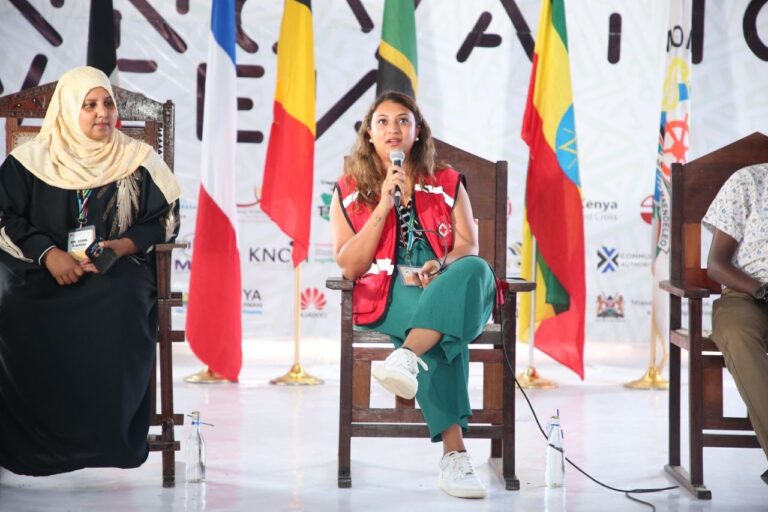
Priyanka Patel, Innovation Manager at the Kenya Red Cross Society, expressed her pride in the project, saying, “I am extremely proud of the launch of I.O.Me001 Innovation Centre under I.O.Me254, Kenya Red Cross. The dream to set up this space in Mombasa has been there since 2019, and finally, Phase 1 has been launched thanks to partnerships with Croix-Rouge française, France In Kenya, and CMA CGM Foundation.”

She continued, “This project has been personal to me, as I strongly believe in empowering communities, our fellow youths, women, and children through skills and resources. Africa has so much more to offer, and we can fill the gap in exposure and resources through humanitarian efforts, creating a haven for our communities where they can learn, teach, share, develop, grow, network, and much more.”

Speaking at the Pwani Innovation Week 2023, Ms Patel said, “We are partnering with existing organizations to give the youth and community knowledge, that will build them with the capacity to be better responders on climate change .”

I.O.Me001 was among the innovation hubs that graced the iconic coastal tech week. The official launch event was on September 11, 2023 and it saw the participation of key figures, including the French Ambassador to Kenya, the County Governor of Mombasa, MD CMA CGM, representatives from the French Red Cross, and the Secretary-General of KRCS. 

“The success of Phase 1 of I.O.Me001 reflects the dedication and hard work of the entire innovation team and support teams, who have tirelessly worked to make this vision a reality.”

I.O.Me001 stands as a beacon of hope, innovation, and empowerment, demonstrating the Kenya Red Cross‘s commitment to improving the lives of the community members it serves. 

With Phase 1 now complete, the centre is poised to make a lasting impact on the people of Mombasa and beyond, offering them a platform to thrive and excel in various aspects of life.

NSSF: A Comprehensive Overview of Kenya’s Social Security Fund

0

The National Social Security Fund (NSSF) has been a cornerstone of Kenya’s social security landscape since its establishment in 1965 through an Act of Parliament, known as Cap 258 of the Laws of Kenya. 

Originally operating as a department under the Ministry of Labor, the NSSF underwent a significant transformation in 1987 when it became a State Corporation managed by a Board of Trustees.

The fundamental purpose of the NSSF has always been to provide Kenyan citizens with a financial safety net upon retirement. 

Initially established as a Provident Fund, it granted retirees a lump-sum payment. However, recognizing the need to enhance the adequacy of benefits and expand coverage, the NSSF Act underwent revisions in 2013, leading to the enactment of NSSF Act No. 45 of 2013.

The objectives of this new Act were multi-faceted:

  1. Broaden Benefit Coverage: The Act aimed to extend the range and scope of benefits provided by the NSSF.
  2. Enhance Benefit Adequacy: It sought to improve the adequacy of benefits paid out to beneficiaries, ensuring that retirees had sufficient financial resources in their old age.
  3. Incorporate Self-Employed Individuals: The Act included provisions to bring self-employed individuals under the NSSF’s coverage, thereby increasing their financial security.
  4. Provide Opt-Out for Employers: Employers already contributing to approved pension schemes were given the option to opt out of Tier II contributions.
  5. Strengthen Corporate Governance: The Act aimed to bolster the corporate governance framework of the NSSF.

However, the implementation of the 2013 Act faced legal challenges. It was suspended shortly after enactment following a series of constitutional concerns raised by the courts. 

In September 2022, after years of dormancy, the NSSF Act No. 45 of 2013 was revived. However, it faced another legal battle when it was declared unconstitutional on several grounds.

Among them were issues related to finance matters affecting county governments, the requirement for mandatory NSSF registration, and Cabinet Secretary’s involvement in approving the salary of the NSSF’s Board of Trustees.

In February 2023, the Court of Appeal ruled in favour of the NSSF, declaring that the Labour Court lacked jurisdiction in the case and that the Act’s provisions did not require the involvement of the Senate. 

This ruling effectively reinstated the NSSF Act No. 45 of 2013, repealing the previous NSSF Act (Cap 258) and introducing a new Pension Fund and Provident Fund. These classifications offered distinct benefits to members.

Pension Fund: Under this plan, retirees could access only a third of their benefits at retirement, with the remainder going toward purchasing an annuity from insurance companies or authorized issuers. This annuity provided retirees with periodic payments throughout the contract’s duration, ensuring financial security in their retirement.

Provident Fund: Members of this plan received the total amount of savings along with accrued interest, offering flexibility in managing their retirement funds.

The new Act also introduced various benefits, including an invalidity pension, survivor’s pension, emigration benefit, and withdrawal benefit, provided members met certain criteria. 

Importantly, both the invalidity and survivor’s benefits offered additional benefits for members who had contributed for a minimum of 36 months.

In terms of contributions, the Act introduced a new structure that gradually increases over five years, starting in 2023.

Contributions are now set at 12% of Pensionable Earnings, with employers and employees each contributing 6%. 

The Act defines pensionable earnings as remuneration not subject to fluctuation, capped at the Upper Earnings Limit.

Key to this contribution system are the two tiers:

  1. Tier I: Covers earnings up to the Lower Earnings Limit.
  2. Tier II: Covers earnings above the Lower Limit up to the Upper Limit.

Both Tier I and Tier II contributions are paid directly to the NSSF unless an employer opts out of Tier II contributions, in which case funds are directed to an employer-chosen retirement scheme.

Under the Act, contributions have become tax-deductible expenses, providing members with a reduction in their taxable income and lower tax payments. 

Membership eligibility extends to all employees, whether on contract or not, and individuals who are self-employed or retired from employment.

The Act also allows employers to contract out of Tier II contributions, providing certain conditions are met. Employers opting for this route need to notify the Authority in advance, ensure the contracted-out scheme meets specific requirements, and transfer Tier II Pension Fund contributions to the approved contracted-out scheme.

Several pension schemes have received approval from the Retirement Benefits Authority for employers who choose to contract out of NSSF Tier II contributions, including the Enwealth Umbrella Retirement Benefits Scheme, Minet Kenya, Octagon Africa Umbrella Retirement Benefits Scheme and Zimele Guaranteed Personal Pension Plan.

As the NSSF Act No. 45 of 2013 finds its footing once again, it continues to play a crucial role in Kenya’s social security landscape, offering citizens a path to financial security in their retirement years.

The Pros and Cons of DIY Tax Filing vs. Hiring a Tax Accountant

0

Tax filing is an essential part of running a business, and it’s crucial to decide whether to do it yourself or hire a professional. The big question is – should you roll up your sleeves and tackle it solo or enlist the expertise of a seasoned tax accountant? 

The only way to make informed decisions is by weighing the pros and cons of both prospects. And that is precisely what we are about to do in this article. 

So, let’s get to it!

Filing Tax on Your Own – Pros and Cons

If you choose to do your own taxes, you can both save money and understand your business finances better. But, just like driving solo has its ups and downs, DIY tax filing does too. In this section, we’ll look at the good and not-so-good things about doing your own taxes, so you can decide if it’s the right road for your business.

Advantages:

1. Saving Money: Going the DIY route means keeping those professional fees in your wallet. For businesses grappling with complex finances, these fees can really add up over time.

2. Being in Command: DIY tax filing empowers you to meticulously review your financial records, making sure that every bit of income and every expense are correctly tallied.

3. Ease of Tax Preparation Software: Tax preparation software has made DIY tax filing more accessible than ever. These software programs offer user-friendly interfaces that guide you step by step through the tax filing process. 

They provide intuitive prompts and checklists, making it simpler to complete your taxes accurately and efficiently. The software also performs calculations for you, reducing the risk of mathematical errors.

4. Identifying Deductions and Credits:  Finding Tax Savings: DIY tax software programs are designed to ask for relevant information to ensure you claim every deduction and credit you’re eligible for. This careful scrutiny often results in significant tax savings for your business, putting more money back in your pocket.

5. IRS Resources: These resources include guides, forms, and publications that are readily available online. These materials are designed to help you understand the tax code, navigate complex tax situations, and complete your taxes correctly. 

Disadvantages:

1. Risk of Errors and Omissions: Tax laws and forms can be complex and ever-changing, making it easy to make mistakes that could result in incorrect filings. These errors may lead to costly consequences, including audits, penalties, and interest charges. Omissions may cause you to miss out on eligible deductions and credits.

2. Lack of Expertise in Complex Tax Situations: Businesses with complex financial structures, investments, or international operations may face complexities that go beyond the capabilities of layman’s tax preparation software. 

Handling such complex situations without professional expertise can lead to mistakes and missed opportunities for tax optimization.

3. Responsibility Falls on You: When you file taxes on your own, the full responsibility for the accuracy and timeliness of your returns rests squarely on your shoulders. Any errors or oversights can lead to legal and financial consequences that you must address independently.

How Does Hiring a Tax Accountant Help? – Pros & Cons

Looking to avoid the tax maze’s potential pitfalls? Consider bringing a tax accountant on board. In this section, we’ll learn how a tax accountant can be a game-changer for your business and financial well-being.

The Benefits:

1. Expert Guidance: Tax accountants are your tax experts. They stay up-to-date with the latest tax laws and regulations of Green Bay, equipped to tackle complex tax scenarios. They’re also your strategic allies, advising on tax planning to optimize your finances, uncover deductions, and claim credits that boost your financial health.

2. Time Savings: Filing your own tax returns can be a time-consuming, stressful ordeal, especially with complex finances. A tax accountant Green Bay, WI, takes care of the paperwork and calculations, ensuring on-time, compliant tax filings. This frees your time and energy for more critical tasks.

3. Future Planning: Tax accountants don’t just focus on today; they help you shape your tax strategy for tomorrow. They minimize your tax burden over the long haul and keep you in the know about tax law changes that could impact your finances.

The Disadvantages:

1. The Cost: One major factor is the high cost of professional fees, which can be substantial, especially for businesses with intricate tax needs. Furthermore, engaging a tax accountant means sharing confidential financial details, a potential worry for certain business owners.

2. You Won’t Be Completely Free of Responsibilities: Even when you hire a tax accountant, the responsibility for your tax matters remains with you. You are accountable for any mistakes, omissions, or fraudulent activities in your tax filings. It’s also your duty to stay informed about tax deadlines, payments, and refunds. 

In Conclusion

In the end, your choice between hiring a pro vs DIY hinges on your unique business circumstances. Consider your comfort level, the complexity of your finances, and the resources available. Making an informed decision now can safeguard your financial stability and set your business on the path to success. Good luck!

Daniel Motaung, the Facebook whistleblower, honored in Mozilla’s Rise 25 Awards

Daniel Motaung, the South African who was working for Meta/ Facebook as content moderator in Kenya has been honored in the 2023 Mozilla Rise 25 Awards for his whistleblower role and as part of the people shaping the future of the internet to be more ethical, responsible and inclusive, ensuring a positive future for all. 

The 25 artists, activists, creators builders and advocates will be celebrated at event in Berlin, Germany on Friday, Oct. 13, 2023 at the Rise 25 Awards. The awards will be held during Mozilla’s Reclaim the Internet, a five day-long event in Berlin, Germany, is part of Mozilla’s 25th anniversary celebration.

“At a time when many feel they’ve lost control over their digital lives, it’s easy to forget about all that’s wonderful online,” said Mitchell Baker, CEO of Mozilla. “That’s why we are honoring these individuals who are doing work that unlocks the internet as a powerful vehicle of imagination and connection. They are 25 people who are reclaiming an internet that is open, accessible and meaningful to everyone.”

Mozilla says it believes the most groundbreaking innovations arise when people of diverse backgrounds come together to collaborate and openly trade ideas. This approach to innovation — grounded in strong pillars of experimentation and community — has defined its work over the past 25 years, fueling global movements around open-source innovation, online privacy and trustworthy AI

Motaung who claimed that he was paid about $2.20 per hour to review posts including beheadings and child abuse sued his then Kenyan-based employer Sama, which had been contracted by Meta for content moderation. His case follows 2020’s suit in the US that saw Meta pay $52m to content moderators who claimed mental health issues caused by their job at Meta.

Motaung said he was exposed to among other things “a live video of someone being beheaded” and suffered flashbacks of the gory images and videos. He was diagnosed with post-traumatic stress disorder and believed that many of his co-workers also struggled with the same. Foxglove, a UK registered non-profit community interest company, helped the South African whistleblower in the case against Sama, his ex-Kenyan employer and US-based Meta/Facebook.

Motaung asked Meta to bring in mental health support for content moderators, Meta and Sama were asked to end their illegal union-busting activity, and Meta and Sama were required to appoint independent human rights and psychological care consultants to end the toxic working environment and Meta and Sama were to pay any unlawfully kept wages from content moderators and any work-related damages and mental health support for former and existing content moderators affected. Sama agreed to efefct the changes and also bumped up content moderators’ pay at its Nairobi office by 30-50%. For his activism work, Motaung was named in the prestigious 2022 “TIME100 Next” list.

Here are the honorees:

Artists

  • Sylvia Grace Borda (Canada) explores cultural policy through photography, environmental art and community engagement.
  • Marlena Myles (USA) is a Native American artist dedicated to honoring Indigenous history and traditions. 
  • Julia Janssen (Netherlands) seeks to make our digital society’s challenges tangible through art.
  • Dries Depoorter (Belgium) melds technology and art to highlight digital modern concerns.
  • Marek Tuszynski (Germany) is an artist, designer and curator working at the intersection of technology and activism.

These artists are being honored for creating innovative and thought-provoking digital artwork, using the internet as their canvas to inspire others and rethink what’s possible online.

Activists

  • Daniel Motaung (South Africa) is an ex-Facebook moderator and whistleblower who fights for more ethical online practices.
  • Ahmad Hegab (Egypt) works to combat technology-facilitated, gender-based violence in the Middle East and North Africa region with the SecDev Foundation and Harassmap. 
  • Sneha Revanur (USA) leads Encode Justice, which aims to elevate youth voices in support of  human-centered AI.
  • Chris Smalls (USA) is an Amazon Labor Union founder and president who advocates for workers’ rights and conditions.
  • Larissa May (USA) works to empower the next generation’s healthy relationship with social media through her nonprofit, #HalfTheStory.

These activists are being honored for using the internet as a tool to amplify their voices in order to drive social and political change.

Creators

  • Abbie Spector Richards (USA) is a TikTok misinformation researcher sharing educational content on the platform.
  • Kay López (USA) of Latinas Poderosas empowers Latinas by celebrating their heritage and accomplishments.
  • Vitus “V” Spehar (USA) makes news accessible and less intimidating with their TikTok channel Under The Desk News, standing out as a unique voice in journalism.
  • Rachel Hislop (USA) is a writer, strategist and public speaker. She has spearheaded dynamic editorial strategies to propel brands to new heights at places like OkayPlayer and Parkwood Entertainment.
  • Nyamekye Wilson (USA) develops educational programs for Black women around the world with her nonprofit, Black Sisters in STEM.

These creators are being honored for using storytelling to build community online, inspiring their audiences and sparking important conversations.

Builders

  • Rob Morris (USA) is the CEO of Koko, which provides mental health support to more than 2 million young people online.
  • Andy Yen (Switzerland) is the founder and CEO of Proton, which offers a privacy-by-default online ecosystem.
  • Trisha Prabhu (USA) is the founder and CEO of ReThink, a patented app that proactively combats cyberbullying.
  • Raphael Mimoun (USA) is the founder of Horizontal, a nonprofit organization dedicated to building tools that empower journalists and human rights defenders.
  • Keoni Mahelona (New Zealand) develops tech tools to protect and promote indigenous languages and knowledge.

These builders are being honored for making the web more secure and accessible to everyone.

Advocates

  • Finn Lützow-Holm Myrstad (Norway) leads the development of more ethical digital policies at the Norwegian Consumer Council.
  • Fanny Hidvégi (Belgium) leads the European policy strategy of Access Now, an organization defending the digital rights of at-risk communities.
  • Natalia Domagala (UK) is a global digital policy specialist, who launched the first national-level public sector data ethicist role in the UK and led the development of one of the first national standards for algorithmic transparency. 
  • Charlotte Slaiman (USA) is vice president at Public Knowledge, developing tools for the democratization of knowledge.
  • Dr. J. Nathan Matias (USA) leads the Citizens and Technology Lab at Cornell University and champions independent technology research.

“These advocates are being honored for shaping the regulations and policies governing the internet, fighting to keep it open and free,” said Mozilla in a statement to TechMoran. “We believe that we all have a role to play in reclaiming the internet. This celebration isn’t just about Mozilla; it’s about all the innovators, advocates, creators and communities who are working to build a happier, healthier web.”

The Rise 25 Awards will be livestreamed on Mozilla’s YouTube channel on Oct. 13 beginning at 8:30 p.m. CET/2:30 p.m. ET. The full show recording will be available on the channel shortly after. The livestream will be available to watch on the Washington Post’s homepage as well and on social media using the hashtag #reclaimtheinternet.

Baobab Network Doubles Its Tickets To $100,000 As Y-Combinator (YC) Pulls Back From Africa

0

Baobab Network, an early-stage investor and accelerator that backs technology companies across Africa, has announced plans to invest in 1000 companies between now and 2033 providing $100,000 in funding for each company that goes through its 12-week accelerator program.

Having launched their accelerator in 2019, Baobab has consistently been one of the most active investors across Africa, backing locally led companies from day one designed to set each business up for scale.

Announcing their latest 5 investments, Toby Hanington (Co-founder, Baobab) said they now have the platform to dramatically scale the number of investments they review and execute across Africa.

Baobab’s new cohort includes Brandrive, PocketFood and Bunce (all Nigeria), as well as Kawu (Uganda) & Alal (Senegal). Each company has received $50,000 directly from Baobab, with another $50,000 investment from their newly launched Co-Investment Vehicle.

YC retreating, and other market dynamics behind Baobab’s bullishness

Africa has not been immune to global market dynamics, but Baobab continues to be one of the most active pre-seed investors in Africa. Baobab Network has already completed 10 deals this year, with another larger cohort expected in Q4.

Additionally, Baobab recently hired Niama El Bassunie as Managing Partner – a YC alumni and one of Africa’s exited entrepreneur to drive its growth on the continent.

Launched in 2016, and based out of offices in Nairobi, Lagos and London, Baobab is a sector and geographically agnostic investor within Africa, and entrepreneurs that join Baobab’s accelerator receive $100,000 USD in funding as well as access to a global network of partners and co-investors. Baobab’s vision is to build a multi-product investment business, investing in 1000 startups in Africa over the next 10 years.

Morocco-based logistics startup Colis.ma recently received $50,000 from Kenya’s The Baobab Network as part of its accelerator programme. In September 2022, its four investees secured $50,000 USD in funding each. They included Nigeria’s Oval Interactive, an interactive MarTech platform enabling people to earn and learn while providing brands with an opportunity to engage with consumers under their flagship product Trivia Billionia. Two South African start-ups, Lemon, a platform enabling businesses to purchase industrial supplies with ease,  and Local Knowledge, a TravelTech supporting digital travellers to explore Africa and enrich the lives of locals and Shemach, a marketplace making it easier for small retailers in Ethiopia to order, warehouse and pay for inventory. 

In May 2022, Baobab’s cohort of five investees received US$25,000 each. They included Nigeria’s Sidebrief, which helps African companies build across borders by streamlining legals, incorporation, company admin, banking and regulation through their APIs; Lendha, a full-stack, tech-led lending platform; and GoodTalent, a talent marketplace for companies to crowdsource, screen, hire and pay engineering talents globally, for full-time, remote, and contract roles. Also selected were Egypt’s Opus Analytics, which is building HR and people analytics software for SMEs and corporates in the MENA region and beyond; and Zambia’s Mighty Finance, a lending platform for SMEs.

Other startups that received $50,000 USD capital injection from Baobab include Kenya’s Afrigility, which is revolutionising East African logistics with its novel asset-light technology, offering B2B e-commerce fulfilment and on-demand warehousing solutions. Togo’s Eazy Chain formerly Togo Cargo, which provides an integrated logistics solution offering air, sea, and road freight services, facilitating seamless cargo transportation. Nigeria’s ePoultry, an agriculture marketplace offering poultry farmers input credits, advisory services, and a dynamic B2B marketplace to eliminate systemic inefficiencies by leveraging data from its +1000 farmers and Guinea Conakry’s MuduPay, a platform that enables Africans to move money via online payments from anywhere using their world-class technology tech stack.

Applications Open For The African Master’s In Machine Intelligence Program

0

The African Institute for Mathematical Sciences (AIMS)  opened applications for the African Master’s in Machine Intelligence  (AMMI) program, welcoming prospective students to embark on a transformative journey towards becoming experts in machine intelligence. 

AMMI, a groundbreaking one-year, fully funded graduate program, is designed to equip  exceptional young Africans with cutting-edge training in machine learning and its applications.  With the mission of harnessing the potential of Artificial Intelligence (AI) to improve lives in  Africa and beyond, AMMI strives to empower its students to shape a future characterized by  fairness and prosperity. 

Professor Moustapha Cisse, Founder and Director of the African Masters of Machine Intelligence (AMMI) program, emphasizes the significance of this program, stating that, “Now is the time to build a foundation that ensures that Artificial Intelligence (AI) helps bring better lives in Africa and beyond. With foresight and planning, the technological revolution that AI brings will be a force to empower a fair and prosperous society.” 

New Cohort Commences in January 2024. Applications are open starting from October 1, 2023, with the application deadline set for October 31, 2023. The selected candidates will commence their studies in January 2024 at the AIMS Senegal campus in Mbour, under the mentorship of world-class instructors. 

To be eligible for the program, applicants must possess a minimum of a Bachelor’s degree in mathematics, computer science or a related field, demonstrate a strong interest in artificial intelligence and machine learning, and exhibit leadership skills coupled with a Pan-African perspective.

Upcoming Global Black Impact Summit to celebrate remarkable achievements and ongoing efforts by Black women in STEM

For centuries, Black women have been at the helm of groundbreaking discoveries, specifically in the fields of Science, Technology, Engineering, and Mathematics (STEM). Overcoming racial barriers and gender biases, Black women from across the world continue to make great strides in these fields, unlocking innovation and fostering new levels of collaboration. While progress has been made to advance equality and eliminate barriers to entry, much more needs to be done to promote participation by Black women in STEM and related fields.

The Global Black Impact Summit (GBIS) which will take place from November 30 to December 1 in Dubai – celebrates the remarkable achievements and ongoing efforts by Black women in STEM while offering a platform for greater collaboration and professional advancement. Themed, Black Excellence: Unleashing the Unexplored Potential for Global Unity, the summit features a strong lineup of thought leaders, experts and innovators in STEM. Delegates stand the chance to network with some of the best in the industry while opening up pathways for partnerships and investment.

Black women have been trailblazers in STEM for decades, breaking barriers and unlocking waves of societal advancements. From pioneering computer scientists like Dr. Shirley Jackson to the visionary aerospace engineer Mary Jackson, their impact has been profound. Katherine Johnson completed the NASA calculations that made it possible for land on the moon in 1969 while Dr Gladys West spearheaded the mathematics that enabled the invention of the Global Positioning System. These women, along with many others, have demonstrated that excellence knows no bounds, irrespective of gender. They serve as role models, inspiring countless young Black girls to dream big and reach for the stars. Their stories epitomize the essence of Black Excellence.

Today, we see a new generation of formidable figures, such as Dr. Mae Jemison, the first Black woman in space, and Dr. Jedidah Isler, an astrophysicist breaking new ground in the study of supermassive black holes. In 2021, Senamile Masango became the first Black women to ever have worked on a project at the European Organization for Nuclear Research in Switzerland, having obtained her Masters in Nuclear Physics. Charlette N’Guessan Desiree won the Royal Academy of Engineering’s Africa prize for engineering innovation in 2020, becoming the first women to ever win the award. Her work in facial recognition technology through her company BACE Group continues to set a strong precedent in the field of tech.

These women and many more STEM innovators are a testament to the critical role Black women play in this field, and the GBIS 2023 aims to promote the achievements made, drive engagement and inclusion while inspiring innovation for years to come.

GBIS 2023 provides a unique platform for Black women in STEM to share their experiences, knowledge and expertise. The event brings together a diverse array of professionals, researchers, and entrepreneurs from around the world, creating a fertile ground for the exchange of ideas and collaboration. Workshops, panel discussions, and networking sessions will facilitate meaningful engagement, enabling attendees to forge valuable connections.

Inclusivity is a core principle of the summit. It acknowledges that diversity is not only a moral imperative, but opens new opportunities for innovation and creativity. Collaboration across different STEM disciplines, as well as with industries and institutions, will pave the way for groundbreaking discoveries and advancements. In this regard, the event serves as a launchpad for initiatives that support and empower Black women in STEM. From mentorship programs to scholarships and grants, the summit aims to provide tangible resources and opportunities that will help bridge gaps and propel careers forward.

Winners of the second edition of the Africa Young Innovators for Health Award announced

0

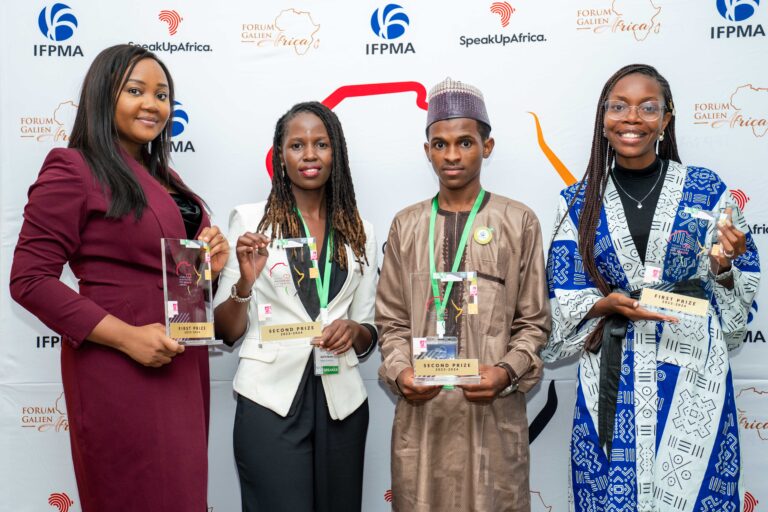
The International Federation of Pharmaceutical Manufacturers and Associations (IFPMA) and Speak Up Africa have announced the winners of the second edition of the Africa Young Innovators for Health Award for contributions to Universal Health Coverage.

Mrs Teniola Aderonke Adedeji (Nigeria) and Dr. Ochora Moses (Uganda) have been announced as first prize winners and Mrs Izath Nura (Uganda) and M. Abdullahi Muhammad Habibu (Nigeria) as second prize winners.

“Winning the first prize of the Award further validates Pharmarun’s mission of providing fast and easy access to medication. We are committed to ensuring medication access through fostering more collaborations among pharmacies to ensure universal health coverage, beginning with medication and pharmaceutical care,” said Mrs Teniola Aderonke Adedeji, CEO of Pharmarun (Nigeria), an on-demand platform that offers a convenient solution to fragmented access to essential medications, and first prize winner of the Award.

The announcement was made at the Galien Forum Africa, which celebrates creativity and excellence in science in Africa. The Africa Young Innovators for Health Award supports pioneering young entrepreneurs with financial and in-kind opportunities they need to advance their innovations for better health outcomes in their communities.

For its second edition, the Award focused on innovations to achieve Universal Health Coverage (UHC) in Africa. Many African governments have shown their commitment to achieving UHC by 2030, but progress needs to be accelerated. The Award focused on innovation that can help extend population coverage, extend service coverage, and ensure financial protection for patients.

“The Photo-Kabada team is humbled by this Award. This is an opportunity for us to move closer to our dreams of getting out of the lab into the clinical space where sick babies are. The Award is also a testament to the fact that homegrown solutions are part of the drivers of Universal Health Coverage,” said Dr. Moses Ochora, first prize winner of the Award and Co-Founder and CEO of Photo-Kabada (Uganda), a hybrid remotely monitored, phototherapy device created as a solution to reduce the burden, morbidity, and mortality associated with neonatal jaundice especially in low and middle-income countries.

Congratulating the winners, Award partners said: “Reaching the goal of UHC by 2030 requires substantial public sector investment and accelerated action by governments and partners, building on solid evidence and reorienting health systems to a primary health care approach, to advance equity in both the delivery of essential health services and financial protection. It also requires fresh, bold, and fit-for-purpose health innovations, and this is why the Award’s second edition was based on this theme,” said Yacine Djibo, Executive Director and Founder of Speak Up Africa.

“Huge congratulations to the winners of this year’s Africa Young Innovators for Health Award. We wanted to guarantee gender equality in this year’s awards, and I’m delighted that two women and two men have won. IFPMA continues to be committed to accelerating innovation as part of delivering Universal Healthcare Coverage, and today’s Award winners will undoubtedly make a huge contribution to this goal,” said Thomas Cueni, Director General, IFPMA.

“Achieving universal health coverage by 2030 is crucial for fulfilling the promise of the 2030 Agenda for Sustainable Development and realizing the fundamental human right to health. I am very thankful and supportive of such program that significantly contributes in the achievement of our common goals through tangible and intangible support to African entrepreneurs,” said Dr. Ibrahima Socé Fall, Director, Neglected Tropical Disease at the World Health Organization and Jury Member of the second edition

How to Use Your NTSA TIMS Account to Apply for a Change in Car Color

0

Kenyan legislation stipulates that you must have the following in order to change your car’s color:

  • Original Logbook.
  • National ID copy.
  • Log in to the NTSA application.
  • 1,000 shilling application cost, plus 600 shillings for a duplicate log book and 400 shillings for a change in color.
  • When you want to change the color of your car, these factors are crucial.

Steps to Change Color

  • Log in to NTSA TIMS online system(see how to log in) if you haven’t signed up see How to register
  •  After successful login, on the left hand column click on “Apply for change of particulars“.
  •  On the right hand column click on ‘create new’
  • Click on the vehicle and choose the details you would like to change(follow the directions given on the website)

Things You Must Know Before Changing Car Color

  • Colors like Olive green are not permitted as they are meant for defense.
  • Black color has disadvantages of dust cleaning after wax.
  • Get you car painted with the same color as it is approved.
  • Get a letter of approval from the RTO that issued your RC book then head to your workshop and repaint your car.

In the end, it is that simple to change the color of your car because occasionally you may possess one whose color you dislike. Additionally, you should be aware that when you wish to sell the vehicle as a secondhand vehicle, changing the color of your car can cause its worth to decrease by a specific proportion.

How to Apply to the Diversity Visa Lottery or Green Card Program 2023.

0

You might be wondering how to enter the Diversity Visa or Green Card Lottery Program if you wish to obtain a permanent residency card, sometimes referred to as a “green card,” in order to remain in the United States. This is particularly true if you are from a nation with a low rate of immigration to the US, which is the group that the diversity visa lottery is intended to attract.

You can fill out the entry form for the DV Lottery Program with the help of iVisa.com’s straightforward and user-friendly application process.

The amount of documentation needed in the procedure could make you feel overburdened. The application procedure requires you to complete multiple forms with a lot of information and involves numerous steps from beginning to end. You will be guided through the procedure by iVisa.com.

Just keep in mind that filling out the entry form is only the first stage in the procedure; if your application is approved, you will also need to complete other steps.

COMPLETE THE ENTRY FORM.

Filling out a short form is the first step in applying for the DV Lottery Program.Some basic information about yourself will be requested of you. Visit the list of green card lottery countries to see if citizens of your nation can participate in the *Diversity Visa or Green Card lottery program.

GET PHOTOS OF YOUR ID

You may make sure that all of your images are in a format that is acceptable to the government by using the iVisa.com Passport Photo Service. The pictures must adhere to a strict set of guidelines in order to be considered as part of the application.

Be aware that having the appropriate images is a top consideration while learning how to apply to the Diversity Visa or Green Card Lottery Program.

It really is that simple. Although using the iVisa.com DV lottery program photo service will make your life much easier, you can of course shoot these images yourself.

TAKE THE NEXT STEPS

Only the entry form and a preparation guide are included in the iVisa.com application form for the Diversity Visa or Green Card Lottery Program. If your application is chosen, the preparation guide will explain how to proceed with obtaining a US green card.

The U.S. Department of State randomly selects applicants, and you must check the green card lottery results to find out if your application was selected. This is why it’s crucial that you adhere to all instructions while applying for the Green Card or Diversity Visa Lottery Program. Each year, there are up to 50,000 Diversity Visas** made available. By following the directions in the preparation guide we will send you, you can check the status of your DV lottery application and learn if you have been chosen.

The Diversity Visa is not guaranteed to you even if you are chosen. If your Diversity Visa is approved, you have to go into the country and submit an application for entry before the visa’s printed expiration date. Typically, a diversity visa is valid for up to 6 months after it is issued.

You would have fulfilled all the prerequisites and successfully learned how to apply to the Diversity Visa or Green Card lottery program after completing the above-described processes.

How to make money with Remotask in 2023

0

Remotask.com is an online site that lets users earn money by performing basic tasks while working from home.

These assignments are provided by a wide range of clients for RemoTasks, including numerous creative start-up businesses. The main need for joining the RemoTasks team is to be fluent in and have a working knowledge of the English language.

Remotask Login Requirements

  • Remotask Login online website address
  • You need to possess an Email address and password valid to be able to use Remotask Login.
  • The latest version of the browser
  • Personal computer or smart device such as mobile or laptop
  • High-speed internet connection

You can follow these general steps to set up a Remotasks account:

  • Visit Remotasks’ website here. Enter “Remotasks” into your favourite search engine to access the official Remotasks website.
  • Sign up: On the Remotasks homepage, look for the “Sign up” or “Create an account” button. To start the registration procedure, click on it.
  • Give the relevant details: Your name, email address, and other relevant details must be entered into the registration form accurately. During the registration procedure, pay attention to the instructions given.
  • If you are given the chance to select your location, pick the United States as your home country or the nation you want to collaborate with.
  • Complete the registration process: Submit the registration form after providing all the necessary information. It might be necessary for you to validate your email address by clicking on a link that has been provided to your inbox.
  • Create a profile: Log into your newly formed Remotasks account and finish filling out your profile by adding details about your skills, past work, and any relevant qualifications. Remotasks will use this information to match you with appropriate assignments.
  • Start your work: After completing your profile, you may browse the tasks on the Remotasks platform and start working on assignments that suit your interests and skill set.

After signing up, please be sure to add a PayPal email on your profile. This is as easy as going to your “Account” page in your Dashboard and entering your PayPal email address and country details. Make sure to save the changes and you’ll be able to receive your payouts the following payday.

TLcom Announces Africa Tech Female Founder Summit 2023

0

TLcom Capital, the Africa-focused venture capital firm, has announced its fifth annual Africa Tech Female Founder Summit set to hold on Tuesday 14th November 2022 in Lagos, Nigeria.

The headline session will feature a fireside conversation with Julia Collins, who will share valuable insights on her experience as a successful serial tech entrepreneur. The event is expected to be the largest gathering of women in tech in Africa.

With the current global macroeconomic environment in mind, the theme for the 2023 Africa Tech Female Founder Summit is Building Resilience: Adapting to New Realities, which addresses head on the challenges African founders and operators are currently facing, as well as providing timely and practical advice and support from experienced global and African business leaders. 

Julia Collins,the first black woman to build a unicorn,   will give this year’s keynote, as well as host a masterclass session on Getting to Product Market Fit. Julia is now building Planet FWD, a leading decarbonization  platform for consumer companies. She will be joined on the day by Cikü Mugambi [Kobo360], Enas Siam [FlexStock], and Thomas Njeru [Pula], who will hold a panel on “When the going gets tough”, whilst Tokunbo Ishmael [Alithea Capital] will discuss the Importance of Investing in Women. In addition, this year the Africa Tech Female Founder Summit will host a number of masterclasses, held by TLcom Partners such as Eloho Omame, as well as a special focus on Building & Leveraging Networks, by leading Executive Visibility expert, Glory Edozien.   

Having hosted the summit with 150+ African female founders and operators in Nairobi in 2022, this year sees the event move west to Lagos, Nigeria.  Applications to attend the event are now open.  

Speaking on the upcoming event, Omobola Johnson, Senior Partner at TLcom Capital, says, “2023 has been a challenging year for founders across the continent, so this year we will be gathering our community of women in tech in Africa to share experiences, learn from experts in their fields and develop coping tactics that will help build resilient businesses to weather this current climate. We want to discuss in depth what resilience means, how it can be infused into businesses, their leaders, and their teams.” 

Andreata Muforo, Partner at TLcom Capital, adds, “At this year’s Africa Tech Female Founder Summit, we will not only be discussing business survival, but also business growth; there are opportunities for founders, even during more turbulent economic times. We’re excited to be hosting the continent’s largest gathering of women in tech, bringing some truly experienced and inspiring speakers to the table. We want all attendees to leave with not only a vision and renewed sense of community support, but also with actionable insights that will benefit their businesses”.  

TLcom’s TIDE Africa Fund II, which is one of the most active funds across Africa, boasts a leadership team which is 60% female. The firm has actively supported female founders not only through its annual summit, but notably through its track record of investing in some of Africa’s top female-led startups such as Okra and Pula. In 2022, TLcom also doubled down on its drive to address the severe funding gap for Africa’s female tech entrepreneurs with a co-investment commitment to support the launch of FirstCheck Africa’s debut fund. 

Currently, TLcom manages total commitments of approximately $350mn and holds several African startups in its portfolio including Andela, Ajua, Autochek, Ilara Health, Kobo360, Okra, Pastel, Pula, Seamless HR, Shara, Terragon Group, Twiga Foods, uLesson and Vendease. With an on-the-ground presence in Kenya and Nigeria as well as offices in the UK, the firm invests across all stages of the venture capital cycle with a focus on Seed and Series A. TLcom also invests across a wide range of industries including agriculture, education, fintech, data analytics and logistics targeting high-growth, tech-enabled startups across Africa.    

Kenya Power to fast-track meter installation for new connections across the country

0

Kenya Power is implementing a Rapid Results Initiative (RRI) to fast-track meter installation for new connections across the country.

Speaking at Stima Plaza during an event to kick start the Customer Service Week, Kenya Power’s Managing Director & CEO, Dr. (Eng.) Joseph Siror said that the initiative will see pending connections cleared within 90 days.

“In the recent past, we have experienced challenges with the procurement of critical materials which has negatively impacted our drive to onboard new customers. I am happy to note that these challenges have been addressed and we have started receiving meters, which we are deploying to clear pending connections,” said Dr. (Eng.) Siror.

During the period, the Company will connect over 320,000 customers using meters that were procured recently. Currently, the total pending new connections stand at 236,924. Through the RRI that commenced this week, the Company has installed 10,759 meters for new connections.

Despite the Company’s campaign to raise the national electricity access rate, many customers have been forced to wait for long periods as protracted court battles hindered procurement of meters and other materials.

Fak’ugesi African Digital Innovation Festival Announces 2023 Winners

0

The Fak’ugesi African Digital Innovation Festival, founded in 2014 to showcase and develop skills in technology, art and culture in Africa, announced the winners of the Fak’ugesi 2023 Awards for Digital Creativity.

The winning projects spanning Animation, Video Games, Visual Arts, Music, and XR (AR/VR) categories illuminated the 10th-anniversary celebrations of the Fak’ugesi African Digital Innovation Festival, now in its 10th year and co-founded by the Tshimologong Precinct and the Wits School of Arts, Digital Arts Department.

According to Fak’ugesi’s Festival Director Eduardo Cachucho, “Over the past decade since our inception, we’ve witnessed and celebrated the phenomenal growth of African creativity in the digital space. This year’s nominees showcased an exceptional standard, seamlessly blending multidisciplinary practices with digital creativity to celebrate the richness of African culture.”

The awards, now in its second year following a successful debut in 2022, holds the distinction of being the sole award of its kind on the continent, recognising exceptional digital innovation within Africa’s creative landscape.

Selected and scored by esteemed panel of external judges, who are leaders in their respective fields, these visionary individuals are recognised for their groundbreaking achievements in their chosen fields and having masterfully infused creativity and digital art to reshape the landscape of African innovation.

Animation

Arowan Parker, a South African animator, storyteller, and writer, is the creative mind behind ‘The Present’. This award-winning project explores the escape into fictional narratives, the rediscovery of human connections and finding beauty in the present moment.

Nkem Nwaturuocha, Co-founder and Creative Director of Disrupt DNA, is a passionate storyteller across advertising, film, and animation. ‘The Song Maiden’ is a short, animated film depicting the struggles of a young girl caught between cultural norms, offering a compelling story of resilience and personal growth.

Lola Aikins, a talented 2D animator and visual development artist, is on a mission to promote authentic African aesthetics in animation. Her debut short film, ‘NALEDI’ delves into the story of a star athlete who must confront her overwhelming grief to regain confidence and finish her race.

Video Games

Kushal Jeethendra Sithlu, a multifaceted creative as a Game Designer, Writer, and Founder of Pineapple on Pizza Studios. His latest project, ‘The Null Factor’ is an action-packed adventure in a post-pandemic world against a rogue AI.

Alkemaize, a game development studio, is on a mission to create inspirational and educational games that challenge perceptions. Their latest project, ‘Rapz!’ follows the story of Rapulani, a young girl with a magical afro. The game aims to promote self-love, especially among young girls dealing with hair-related challenges.

Visual Arts

Diane Cescutti, is a French visual artist of Cameroonian-Italian and French heritage. Her latest project, ‘Nosukaay’ explores the links between Manjak weaving and computer technology using a Manjak cloth as a keyboard.

XR

Agnes Ndegwa is an imaginative 3D artist, VR content creator, and Illustrator, whose brainchild ‘Young Haven’ ventures into the realm of virtual reality with a profound focus on children’s mental health and emotional acumen. It serves as a sanctuary for children to play, relax, and communicate with their guardians, fostering open and expressive dialogues.

A Johannesburg-based digital artist and game developer, Aluta utilises various digital mediums, from extended reality to video games, to convey their distinctive perspectives on politics, perception, and pop culture. Their latest project, PHANTOM, is a digital art endeavour that delves into the complexities of mental health disintegration employing extended reality as a means to draw parallels between the elusive nature of mental illness and haunting, ethereal apparitions.

Hailing from Kenya, Baruu Collective is a dynamic production and creative agency on a mission to redefine and rekindle African narratives rooted in cultural heritage. ‘If Objects Could Speak’ follows daring filmmakers who unearth Kenyan artifacts from a German museum cellar, using immersive AR to revitalise them and embark on a journey to share this cultural treasure in Kenya’s communities.

Music

|Kx’am, a non-profit organisation, is dedicated to researching, restoring, and promoting |Xam and Khoe knowledge systems, culture, art, and heritage through new media. Their multimedia exhibition, !Habesi (roots), showcases fine art, photography, poetry, indigenous instruments, and augmented reality, shedding light on |Xam and Khoe land rights and honouring Ouma Katrina.

“As we celebrate the outstanding winners of the Fak’ugesi Digital Creativity Awards, we recognise that their exceptional projects not only captivate local audiences but also resonate on the global stage. With opportunities for international residencies and participation in industry events, these innovators are poised to showcase their talents to the world. Recognition in these awards underscores Fak’ugesi’s pivotal role in shaping the future of digital creativity, while these projects stand as powerful examples of how local perspectives can speak to audiences across the African continent,” says Cachucho.

Google Announces 11 African Startups for Inaugural Africa AI First Accelerator program

0

Google has announced 11 African startups for its Inaugural Africa AI First accelerator program which will see them undergo a 10-week accelerator program where they will learn from Google’s AI expertise, get technical guidance and a $350k allocation in Google Cloud Credits.

The 11 startups, picked from a vast pool of innovative talent, are using cutting-edge Artificial Intelligence to address both Africa’s challenges and broader global issues.

The selected startups are;

  • Avalon Health (South Africa): Empowers patients with streamlined online healthcare access and offers doctors digital tools to enhance care.
  • Chatbots Africa (Ghana): Spearheading SMEs’ transition into the Social Commerce era with AI-driven online storefronts.
  • Dial Afrika Inc (Kenya): Tailoring customer support tools for global businesses, with a focus on African SMBs.
  • Famasi Africa (Nigeria): Building the OS for pharmacies in emerging markets.
  • Fastagger Inc (Kenya): Using AI to amplify sales and loyalty, supporting MSMEs’ growth.
  • Garri Logistics (Ethiopia): Digitalizing freight brokerage and transport services.
  • Izifin (Nigeria): Providing an end-to-end credit infrastructure via API for small businesses.
  • Lengo AI (Senegal): Launching the first Data-Driven OS for the Informal Sector.
  • Logistify AI (Uganda): Minimising inventory losses in industrial facilities.
  • Telliscope (Ethiopia): Offering an AI-enabled business intelligence platform.
  • Vzy (Nigeria): Revolutionising website building with AI-driven tools that craft sites in mere minutes.

Since 2017, Google has consistently supported African startups across diverse programs. Collectively, these startups have raised $263 million and created over 2,800 job opportunities. The transformative power of AI in Africa is highlighted by a McKinsey report which suggests that AI could add $1.3 trillion to Africa’s GDP by 2030.

Folarin Aiyegbusi, Head of Startup Ecosystem, Africa, remarks, “At Google we’ve been working on AI for over a decade, and we’ve shown how useful AI is in our products and for developers externally. AI is not only a powerful enabler, it’s also a major platform shift. That’s why we’re focused on making it easy and scalable for others to innovate with AI. Our chosen startups for the ‘AI First’ program embody this vision, leveraging AI in pioneering ways to address both local and global challenges.  We’re here excited to support and amplify their impact.”

Speaking on the selection: Adeola Ayoola, CEO/Co-founder of Famasi Africa (Nigeria): “Famasi Africa is scaling AI-powered digital health solutions to reach more underserved communities. . Joining the Google for Startups Accelerator: AI First program represents a significant step towards realising that dream. With Google’s mentorship, we’re confident of scaling our solutions, reaching more pharmacies, and ultimately improving healthcare outcomes.”

  • Avalon Health (South Africa): “”Avalon Health is scaling AI-powered digital healthcare solutions to reach every South African.With the support and mentorship from the Google for Startups Accelerator: AI First program, we believe we can scale our solutions even further, ensuring every South African has access to top-tier healthcare services.”
  • Japheth Dibo, CEO & Co-Founder of Dial Afrika (Kenya): “Dial Afrika is revolutionising customer support in Africa with cutting-edge AI-powered solutions.Being selected for the Google for Startups Accelerator: AI First program will allow us to leverage advanced AI technology to make this vision a reality. With this support and mentorship, we aim to revolutionise customer support and equip businesses across the African continent with the tools to thrive and excel.”

Spotify Premium subscription now offers access to a library of over 150,000 audiobooks

0

Spotify has revealed that it’s expanding its offerings to include a vast library of audiobooks for Premium users.

This will enable individuals with Premium subscriptions as well as those managing Family and Duo accounts, will have access to 15 hours of audiobook listening every month, allowing them to enjoy a wide range of titles within that monthly allocation.

This enhancement adds significant value to Premium subscriptions, which already grant users access to an extensive catalogue of over 100 million songs, 5 million podcasts, and now, over 150,000 audiobooks.

This feature is already available to Premium users in the U.K. and Australia, with plans to roll it out in the U.S. later in the year. The rest of the world will follow, as announced by Spotify Chief Executive Officer (CEO), Daniel Ek on his Twitter account.

“To discover audiobooks within the Spotify Premium catalogue, look for titles marked as “Included in Premium.” The collection currently includes more than 70% of bestselling books, including works from major publishers like Hachette and HarperCollins Publishers, among others.”

To start listening to your chosen audiobook, simply search for the title and press play on the first chapter or listen to a preview to ensure it meets your preferences.

You can also easily explore audiobook recommendations on your Spotify Home feed or visit the Spotify audiobooks hub for curated selections of top titles.

With 15 hours of monthly listening, you have the freedom to explore multiple audiobooks or stick with one and listen from start to finish. If you happen to use up your 15-hour allocation before your billing cycle refreshes, you can purchase a 10-hour top-up. You can keep track of your remaining hours at any time in your in-app settings.

Please note that to access this feature, you must have a Premium individual account or be the plan manager for a Family or Duo account.

While Spotify is actively working on more ways to offer access to Premium audiobooks in the future, primary account holders on Family and Duo plans will currently receive the monthly audiobook allocation.

These audiobooks are available on the go, with Spotify compatible on over 2,000 devices from more than 200 brands.

Premium audiobook users can also download audiobooks for offline listening. Additionally, Spotify’s automatic bookmarking feature ensures that your progress is saved, allowing you to seamlessly continue from where you left off.

You can also take advantage of the “end of chapter” function within the Spotify Sleep Timer to fall asleep peacefully while enjoying your favourite stories without worrying about rewinding in the morning and potentially missing parts of the narrative.

It’s worth noting that audiobooks were introduced to Spotify in September 2022 following the acquisition of the audiobook platform Findaway in 2021.

UAE firm buys a majority stake in Telkom Kenya after the cancellation of the nationalization deal with Helios

0

Telkom is poised to undergo a significant ownership change as the Infrastructure Corporation of Africa LLC (ICA), headquartered in the United Arab Emirates, is on track to acquire a 60% stake in the company from the London-based private equity firm, Helios.

This acquisition has been confirmed by the Treasury after a competitive process.

In a noteworthy development, the Kenyan cabinet has recently nullified a previous agreement between the government and Helios for the nationalization of Telkom Kenya.

This decision was made due to concerns over “governance challenges” associated with the earlier deal.

This alteration in ownership may introduce an element of uncertainty for foreign investors, as sudden shifts in government policies and the cancellation of established agreements are generally viewed unfavourably when a new administration takes office, according to legal experts based in Nairobi.

The Treasury clarified that it had chosen to abandon the nationalization plans for the company and had initiated a search for a new strategic investor in January of this year. After the evaluation process, ICA emerged as the selected investor.

The Treasury explained, “ICA’s offer includes injecting capital to support Telkom’s essential infrastructure and overall improvement of the company’s capabilities, as well as addressing some of the company’s outstanding debts.”

Under the revised arrangement, Helios will transfer the majority of its stake to ICA, and the financial specifics of this deal with the UAE company have not been disclosed.

As of now, Helios, which acquired the 60% stake from Orange in 2016, has not made any public statements regarding the government’s decision to revoke the previous agreement.

Additionally, the government, while retaining a 40% shareholding, intends to lead regulatory reforms aimed at rectifying imbalances in the telecommunications industry, as announced by the Treasury.

Telkom, despite being the smallest operator compared to Safaricom and Airtel, manages crucial assets vital for government communications, including a national fibre-optic network.

Its management has long advocated for industry reforms to reduce the dominance of Safaricom, which holds a significant share of revenue and users in the telecommunications sector.

Netflix to discontinue its free offering in Kenya

0

Netflix has decided to terminate its complimentary plan in Kenya, which has been available since 2021.

Starting next month, this move is poised to affect a substantial number of subscribers who have been enjoying free access.

In an email sent out earlier this week, Netflix informed its users that once the free service is discontinued, their memberships will be automatically cancelled. Subscribers are encouraged to upgrade to one of the paid subscription options.

In the communication sent to subscribers, it was conveyed that starting from November 1, 2023, the Free Plan will cease to be accessible, resulting in the automatic cancellation of their memberships.

If subscribers wish to discontinue, they don’t need to take any action, as their membership will be automatically terminated when the free plan is no longer available. To continue enjoying content, they are encouraged to consider upgrading to one of Netflix’s paid plans, which start at just Sh200 per month.

This upgrade would grant them access to the entire range of shows and movies, additional features, and the flexibility to watch on various devices such as phones, TVs or laptops.

The introduction of the free plan in the Kenyan market in September 2021 was a groundbreaking move by Netflix, making Kenya the first country in the world to offer such an option.

This free plan allows users to access a limited selection of content without needing to pay for a subscription, to capture the growing streaming market and introduce potential customers to Netflix‘s extensive library of movies and TV shows.

The discontinuation of the free plan marks a strategic shift for the streaming giant as it redirects its efforts toward converting these users into paying customers.

This decision follows Netflix‘s earlier announcement to reduce subscription prices for its Kenyan audience by an average of 37 per cent, a response to increasing competition in the streaming industry.

Introduced in February of this year, this effort was designed with the dual purpose of enticing new users and keeping its current subscriber roster intact.

BFA Global, FSD Africa, and IUCN Unveil ‘Africa Blue Wave’: A $1 Million Initiative Driving Ocean Sustainability

0

BFA Global, FSD Africa and the International Union for Conservation of Nature (IUCN) have teamed up to launch the Africa Blue Wave, an exciting $1 million initiative aimed at bolstering sustainability in the ocean and water resources sector.

This initiative, generously funded by FSD Africa and the Canadian Government, builds upon the success of the Triggering Exponential Climate Action (TECA) program’s previous efforts in promoting innovation in the blue economy.

“The Africa Blue Wave is dedicated to nurturing passionate individuals committed to addressing climate challenges within Africa’s blue economy.”

This initiative will be spearheaded by Triggering Exponential Climate Action (TECA), an initiative by BFA Global, with valuable support from OceanHub Africa.

In its inaugural phase, the Africa Blue Wave will scout for 40 innovators hailing from Kenya, Tanzania, Comoros, Madagascar and Mozambique.

These selected participants will be provided with personalized support in the form of mentorship, guidance from industry experts, networking opportunities, and initial capital investments to help bring their climate and ocean-related solutions to fruition.

At the culmination of the program, these participants will be allowed to showcase their innovative solutions and pitch their businesses to potential investors, partners, and industry leaders, thereby securing further support and investment.

TECA Program Director at BFA Global, Shirley Mburu expressed optimism about the project, saying, “As we embark on the Africa Blue Wave, we carry with us the invaluable lessons learned from our inaugural wave. These insights will be the cornerstone of our commitment to making this new wave bigger, better and more impactful than ever before. We’ve demonstrated that solutions can be homegrown by local talent, and I am excited to work with innovators to create more solutions that contribute meaningfully to local and global climate challenges.”

Director of Digital Innovation at FSD Africa, Juliet Munro underscored the importance of this investment, stating, “Our investment in TECA is core to our mission of financing innovation and supporting innovation in finance. Through our seeding of TECA’s first blue wave this past year, we have seen firsthand the power of combining young African talent with access to expertise, networks and finance, creating new tech-enabled businesses that are solving climate issues. We are excited to partner with IUCN and BFA Global on the Africa Blue Wave, extending TECA’s reach to new geographies, new challenges and new innovators, leading to more, new genuinely African climate solutions.”

On his part, Thomas Sberna, Regional Head of Coastal and Ocean Resilience at IUCN Eastern and Southern Africa, outlined the initiative’s broader goals, saying, “The initiative aims to invest in Africa’s young innovators to catalyze solutions to address ocean challenges and achieve sustained ocean health across five priority seascape areas in Comoros, Kenya, Madagascar, Mozambique, and Tanzania. Our long-term goal, as envisaged in the Great Blue Wall initiative, is to transform coastal economies into drivers of positive conservation and socioeconomic development. We commend and greatly support Africa’s leadership and efforts in accelerating the development of a regenerative blue economy on the continent.”

The application process for the Africa Blue Wave is currently open and will close on October 15, 2023.

Individuals interested in participating can find more information about the program and submit their applications online here.

President Ruto Inaugurates AWS Nairobi Development Center, Paving the Way for Job Opportunities

0

Amazon has unveiled a new development centre in Kenya as part of its commitment to the country’s information and communications technology (ICT) sector.

This centre, operated by Amazon Web Services (AWS), will serve as a hub for AWS Research and Development teams, generating employment opportunities in software development, cloud support, and software engineering.

The goal is to provide innovative solutions for customers and partners worldwide.

Inaugurating the launch, President William Ruto expressed optimism about the Kenyan technology sector’s growth and job creation potential.

He emphasized the significance of AWS’s decision to establish a development centre in Kenya, reflecting their trust in the country’s people and economy.

The president said, “The decision to open a new development centre in Kenya is evidence of the trust that AWS has in our people and our economy. I look forward to our continued collaboration with AWS as it deepens their commitment to our country.”

Vice President of Global Services at AWS, Uwem Ukpong highlighted the collaboration between the tech firm and its partners in fostering high-tech job creation in Kenya.

The VP noted that the centre aims to tap into Kenya’s pool of technical talent, contributing to the country’s economic development.

On his part, Robin Njiru, Public Sector Lead for West, East, and Central Africa at AWS stressed the increasing demand for technical skills in Kenya and the positive impact of this investment on local talent, innovation, and economic growth.

Chief Executive Officer (CEO) of Halcyon, Kate Goodall emphasized the partnership between Halcyon and AWS in supporting socially-driven ventures across Africa.

The new centre in Kenya will enhance its joint efforts in nurturing the next generation of social entrepreneurs.

AWS’s commitment to Kenya includes initiatives such as AWS re/Start, a workforce development training program, and the launch of AWS Local Zones cloud infrastructure in Nairobi.

“These initiatives aim to empower Kenyan youths with cloud computing skills, create job opportunities, and provide low-latency cloud services to local and regional customers.”

Furthermore, AWS is collaborating with the Kenyan government’s Ajira Digital program to upskill 10,000 students using AWS Academy. This program equips students with cloud computing skills and AWS certifications to prepare them for careers in the rapidly growing technology industry.

In August 2023, AWS customer Hurone AI expanded its presence in Kenya, supported by AWS cloud credits. This strategic partnership with the Government of Kisumu aims to improve cancer care through technology, enhancing patient outcomes and operational efficiency.

Amazon’s commitment to Kenya extends across various sectors, aiming to drive economic development, empower local talent, and advance technology solutions for the benefit of the country and the African continent as a whole.

Africa’s Sustainable Development Goals progress uneven- report

0

Africa’s progress on the Sustainable Development Goals (SDGs) and the African Union’s Agenda 2063 aspirations has been uneven, with significant differences among subregions, countries, and rural and urban areas. This calls for accelerated efforts to ensure that Africa achieves the global goals by the 2030 deadline, the latest Africa Sustainable Development report has stated.

The report assessed Africa’s progress in implementing five main SDGs, highlighting progress, the challenges, and the numerous opportunities for improving Africa’s development prospects. Its findings suggest steady progress on key SDG targets, particularly on 4G mobile network coverage, and access to potable water and electricity.

“Africa’s steady progress on the SDGs is commendable. It is heartening to learn that the continent is on track to achieving some targets, particularly the goals related to innovation and technology, which are powerful enablers for advancing sustainable development,” noted Ms Ahunna EziakonwaAssistant Administrator and Regional Director for Africa, UNDP.

The report warns that although Africa is progressing toward achieving the SDGs, the number of on-track targets is less than those requiring acceleration or reversal.

 It calls for timely interventions to accelerate countries’ progress on key SDGs and the Agenda 2063 aspirations, goals, and targets.  

António Pedro, Acting Executive Secretary of ECA, stated: “Africa must create green growth by adding value to its green minerals. This green growth through green minerals must be central to Africa’s SDG rescue strategy. Africa also needs scaled-up concessional financing to regain momentum on the SDGs and the Agenda 2063.”

Albert M. Muchanga, Commissioner for Trade and Industry of the African Union Commission, called for improved communication between parties working on Africa’s sustainable development. “The time has come for the Agenda 2063, the 2030 Agenda, and the African Development Bank’s ‘High 5’ agenda to be aligned to make it easier for member states to domesticate,” he reiterated.

Key findings: 

On SDG 6 (clean water and sanitation), African countries have improved access to safely managed drinking water services, but a significant disparity remains between rural and urban areas. Three in five Africans, or 411 million people, still lack safely managed drinking water. Also, only Egypt and Tunisia out of the 48 countries assessed are on track to achieve universal basic sanitation by 2030. The report calls on African countries to invest in water, sanitation, and hygiene infrastructure and to strengthen integrated water resource management capacity.

On affordable and clean energy (SDG 7), the report finds that electrification rates have increased, but the use of clean cooking fuels and technologies remains limited. Also, the shift from non-renewable to renewable energy is slow. The report calls for funding increases for infrastructure and technology to boost sustainable power generation across Africa.

For innovation, industry, and infrastructure (SDG 9), the report reveals that Africa is on track in terms of its mobile network coverage, and based on current trends, the continent will meet the relevant Goal 9 target by 2030. The report, therefore, calls for the acceleration of rural road construction and expansion to achieve rural connectivity and regional integration to bridge the urban-rural divide. According to the report, this will advance intra-African trade and thus facilitate the full implementation of the African Continental Free Trade Area (AfCFTA) agreement.

Regarding sustainable cities and communities (SDG 11), the report’s findings suggest a modest overall decline in the share of Africans living in urban slums. It recommends greater investment in infrastructure to improve access to public transport, waste management and air quality in African cities.

Concerning partnerships (SDG 17), mobilizing funding remains challenging for African countries. The report calls for higher domestic resource mobilization and efforts to address debt vulnerabilities.

Amazon Launches New Development Center In Kenya

0

Amazon Web Services (AWS) has launched  a development centre in Nairobi intended to create jobs in software development, cloud support, software engineering and telecommunicatons.

The center  which is the second to be launched  by Amazon in Africa ,is aimed to serve the East African region .

 Kenya’s President William Ruto who presided over the event said,”The Kenyan technology sector continues to be a source of growth and job creation at a time when there is so much uncertainty in the world,”

According to president Ruto,“This decision to open a new development center in Kenya demonstrates the trust that AWS has in our people and in our economy.

AWS vice president Uwem Ukpong said the centre will enable the local market to tap into an incredible pool of technical talent.

“Together with our AWS partners, we’re thrilled to be creating new high-tech jobs in one of Africa’s most prominent tech hubs.

According to the President,the government intends to persue reforms that will turn Kenya into a regional business hub.

”Kenya is economically stable, entrepreneurial, secure, innovative with a favorable tax environment,” he said.

Amazon Web Services (AWS) is the world’s most comprehensive and broadly adopted cloud, offering over 200 fully featured services from data centers globally. Millions of customers—including the fastest-growing startups, largest enterprises, and leading government agencies such as Netflix NFLX.O, General Electric GE.N and Sony 6758.T use AWS to lower costs, become more agile, and innovate faster.

Senegal’s Lengo AI secures funding from Egypt’s VC firm Acasia Ventures to enter new African markets

0

Senegal’s Lengo AI ,an AI-driven FMCG intelligence platform. has secured a pre-seed investment from Egypt-based Early-stage venture capital firm Acasia Ventures ,co-led by Ventures Platform and joined by P1 Ventures, Launch Africa, Voltron Capital and a number of other VCs and angel investors.

The investment will be used to expand the company’s tech and sales teams, further develop the AI portion of the product, and enter new African markets.

“Lengo AI’s platform already provides near real-time market monitoring from a ground-level perspective for over 2,000 products. Now we are working on leveraging AI to connect at scale with the last node of the retail network: the corner shops,” Smith explains. “We’re building a very low friction technology with retailers and actively recruiting for the best AI and Software Engineers! Thanks to the support from Acasia Ventures, we hope to gain expertise in Nigeria and Egypt, and accordingly, make the right connections in both countries to expand our product for shopkeepers and work with brands to stop guessing Africa.”

The startup was founded in 2022 by Max Smith (CEO), who has an extensive background in sales and market research across Africa, Roger Xavier Macia (CCO, former CCO at Jumia in Senegal), and Ismaila Seck (CTO), who is a veteran of Senegal’s AI community with a PhD in machine and deep learning. Lengo AI is the first data-driven operating system for informal retail in Africa.

It aims to provide intelligence and highly actionable insights to FMCG brands coming from the thousands of corner shops that make up 90 per cent of purchases across the continent. The software-as-a-service platform uses a hybrid approach of Lengo Eagles (field agents) and AI to connect retailers and FMCG companies with real-time performance data on the sales of products.

By joining the Lengo Club, shopkeepers, who are at the heart of the social and economic fabric of African countries, can increase their revenues by benefiting from insights on customer behaviours, alerts on new products and a loyalty point system.

On the corporate end, it helps local companies in the FMCG sector optimise their resources and provides purchasing behaviour data to international companies aiming to invest in Africa.

The company was the first to map out corner shops selling FMCG products in Dakar and is in the process of mapping out an additional six cities. Today, Lengo AI accounted for and mapped out over 30,000 corner shops. 

“When I met Max almost a year ago in Dakar, I was immediately excited by what he was building. In the following months, once my team and I got to dig deeper into the market, look under the hood of the product and meet Xavier and Ismaila, it was clear that we were working with a very special team working on a unique solution in one of the largest sectors in Africa,” said Aly El Shalakany, Managing Partner of Acasia Ventures. “We worked with Lengo to bring in some of the very top VCs operating on the continent so that we could work collaboratively to execute the ambitious business plan. We are delighted to be joining the board to help the team further develop the strategy and open new and exciting markets for the company.”