In Kenya, Wi-Fi connection first crept into expats’ homes and offices. Then, last year from the start of October, it became possible for businessmen to eatout at five star joints while enjoying free Wi-Fi connection thanks to an initiative EatOut Kenya, Google and Wazi WiFi had just rolled out. Today – a year later, matatus have joined the trend drawing the common mwananchi to their public means of transport with the help of Wi-Fi stickers and connections.
In the drive to assist developing countries to fuel the growth of internet infrastructure in diverse regions, the University of the Gambia Technology Association in collaboration with the Network Startup Resource Centre at the University of Oregon US have made the first step in donating networking books to the university’s ICT School.
Game lovers, it’s now your time to have fun on your mobile as warner bros Interactive Entertainment and DC Entertainment has announced the availability of Batman: Arkham Origins for iPad, iPhone and iPod touch.
The mobile game is a free-to-play brawler which was developed by NetherRealm Studios who also developed the Injustice: Gods Among Us and Batman: Arkham City Lockdown. The game delivers the dramatic graphics and quality gameplay.
The Batman: Arkham Origins mobile game pits players, as Batman, against a number of DC Comics’ most deadly assassins as they fight their way through Gotham City’s most dangerous locales.
In progression, the gamers can upgrade their character to become the most punishing crime fighter in the world by unlocking a number of unique Batsuits and earning in-game currency and rewards.
In addition, those who also own the console versions of the game and are registered for a Warner Bros. ID (WBID) account will be able to access exclusive content not available elsewhere.
“We created an integrated gaming ecosystem between the Batman: Arkham Origins mobile and console games, which delivers rewards and unlocks that provide greater experiences for players,” said Ed Boon, Creative Director, NetherRealm Studios.
He added that the mobile game goes together with what is offered in other platforms.
As of 25th October this year, the console version will be available worldwide for PlayStation 3, Xbox360, Wii U system.
Kenya’s Davis and Shirtliff, a supplier of water related and alternative energy equipment and Lorentz, a solar pump manufacturer have together launched a new application that can help borehole owners remotely manage their boreholes by phone.
Dubbed the Lorentz pump scanner application, the Android app is expected to help customers and technicians to remotely monitor borehole performance and stem water wastage from boreholes.
According to Alec Davis, CEO Davis and Shirtliff Group, “Customers are now able to track the pump performance and get a technician on site. Whenever they note an abnormal trend in their boreholes output, unlike before, when the biggest problem with boreholes has been that when they malfunction, a technician has to check all parts.”
The PS controller application can store data for up to 2 years, keeps records of the pumping activities showing how much water is being produced, at what rate, the amount of power being used, and the length of each pumping session. Once a pump is switched on, the app sends data on voltage and pump rotation via GPS to the Lorentz database, where it is stored. It is then sent to the clients’ laptop or phone.
Costing just cost of Sh60,000 with a monthly service charge of Sh2,600 shillings, the PS controller application also enables one to remotely switch off a borehole thus enabling control of the amount of time a borehole is functioning.
“We developed the technology for preventive maintenance for clients and also to give customers more control of their pumps,” said Kai Reinecke Channel Manager at Lorentz. The remote pump controller replaces site technicians whenever there is an abnormal output, or a pump had broken down.
Davis and Shirtliff recently partnered with World Vision on a Sh3 million solar powered borehole pumping installation providing water to 2000 people and 20,000 livestock with 80m3 of water per day in Wajir, Northern Kenya.
Orange has launched the Custom Ring Back Tone (RBT) service for its Orange mobile subscribers, set to enable the users to modify their ring tones by making their own content.
Conventional tones hold clips of pre-recorded and pre-selected music or other audio content that replace the standard ringing sound that incoming callers would normally hear while waiting for their calls to be answered.
“The Custom RBT service therefore goes to demonstrate our commitment to our customers by delivering a stronger value proposition that is focused on more service options available to them,” said Orange CEO, Mickael Ghossien.
Also known as Caller Tunes, the Custom Ring Back Tones allows customers to control and extend their branding, promotional and advertising initiatives through this communications platform.
“Our customers will be able to make use of this service as a platform through which their businesses or commercial ventures can be advertised when calls are made to their phone,” says Ghossein.
In order to this, customers sends an SMS to 1352, which costs Ksh.20, stating the message content to be recorded. The tone is recorded within 24 hours and a code is sent to the customer. They then send the code given to 7700 to set the tone as their default RBT.
The custom tone is valid for 30 days where a daily subscription fee of KSh 1.67 is charged to the customer for having the tone. A user can continue with the current subscription at the end of the validity period or change the ring back tone or unsubscribe from it. A three day grace period is provided to allow for renewal of the subscription.
Orange has taken this advertising to another level, and made it very cheap, it has beaten Safaricom in its own game, the Skiza tune, business is always good when you are leading, let’s see how far Orange will go and it it will get more subscribers from the business entity.
October 22nd it the date to mark, that is if you are a gadget and technology fan, as Apple is set in unveiling the new iPad as well as other Mac offering.
The grapevine says that the new device will be lighter and thinner than the predecessor. The specs of the tablet expected is said to have an improved camera and will use Apple’s new 64-bit A7 chip, which can also be found in the iPhone 5s.
The device is said to have the Retina Display and powered by the A7 chip, well, now that it will use some of the features that the iPhone 5s has, it is yet to be established if the device will have the Touch ID fingerprint sensor which is on the iPhone.
Whether the tablet will be the iPhone 5s in a bigger size or has new features that surpass the current iPad is yet to seen and criticized, lets leave all this for 22nd October.
Microsoft Corp. has expanded its Microsoft Ventures partnership program into Africa after selecting 88mph as its first African accelerator partner.
The firm said it chose 88mph for its proven model of helping launch and secure funding for innovative African startups. The two will provide startups with mentorship, technology guidance, seed funding, joint selling opportunities and more.
Microsoft Ventures takes a holistic approach to helping startups get off the ground through a community evangelism program including Microsoft BizSpark, an accelerator program and a seed fund that works with startups worldwide. The expansion into Africa was conducted as part of the recently launched Microsoft 4Afrika Initiative and will therefore prioritize startups in key sectors including agriculture, education and healthcare.
“Through the 4Afrika Initiative, we are deeply committed to fostering African innovation and to fueling Africa’s economic growth and competitiveness, and we are very proud to see Microsoft Ventures extend its reach into the African continent,” said Amrote Abdella, director, 4Afrika Venture Capital and Startup Programs. “We strongly believe that with the right support, African startups hold tremendous potential to impact both their local economies and the world’s perception of African-led innovation and entrepreneurship.”
To qualify for selection into this program startups must have have a full-time founding team, a bold vision for tackling a real problem, technologically driven solutions and less than $1 million raised. They should also have solutions that can scale across and even outside the African continent.
“Microsoft is a company that deeply understands the value of the ecosystem, and we believe that by working together, 88mph and Microsoft can offer a world-class launch pad to African startups looking to achieve true scale,” said Nikolai Barnwell, Nairobi director, 88mph. “We share a deep commitment to the African startup community and look forward to showcasing more and more African innovators on the world stage.”
The graduating startups from 88mph’s most recent accelerator class will participate in a DemoDay on Dec. 5 in Nairobi where, with Microsoft’s help, the startups will present their businesses and opportunities to invited investors.
Through the BizSpark program, the company has already helped support 625 African startups to date by providing access to Microsoft tools and technologies, and this program will continue. And for the second consecutive year, the company is also a sponsor of DEMO Africa, a startup competition taking place Oct. 24–25 in Nairobi.
CAF together with SPORTFIVE Africa have come together to bring the lovers of this sport the Pepsi Football NOW APP.
It is a live prediction game and can be downloaded form Google Play and also the App Store at no cost.
All the people who will download the application have the advantage of being able to predict the outcome of every match.
For every correct predictions, the gamers will earn themselves Pepsi points, which allows them to collect Pepsi FootballNOW badges. The badges come in Bronze, Silver, Gold and Platinum, and are awarded according to the points won during a single match. During competitions, new badges will be unlocked.
There are other prizes to be won, including a tablet, tickets for the finals of the two competitions and official match balls.
Following the official Orange African Cup of Nations, SOUTH AFRICA 2013 App, CAF and SPORTFIVE Africa are once again using mobile platforms to help bring African football to life for as many fans as possible, by creating an innovative new “second screen” experience. New functions will be released soon and a new version will be available for the next season including for the Orange CAF Super Cup.
With football one cannot make mistakes in Africa, it is a sport that people would do anything for. The possibility of a success in this venture looks quite promising, most especially the prices but is this to make the Pepsi brand big or make people drink Pepsi? Coke should be watching this it already lost its number one position in biggest brands to Apple.
Kenya’s RECON-Digital,an animation studio established in 2009, has today launched “Spotkick Challenge” under its CHEZA.NET brand.
According to the firm, Spotkick Challenge or SKC is an easy to play penalty shootout game designed to deliver the fun of Online Social Gaming. Players can either directly challenge an opponent or allow the computer to randomly pair them with other challengers. Points are earned for every CHALLENGE and TOURNAMENT win thus presenting a great opportunity for some serious rivalry to fuel the fun.
“Spotkick Challenge has been under development for quite some time and we are excited to finally share the fun,” said Gatumia Gatumia
CEO RECON-Digital. “We invite people to play the game and give us feedback while we continue refining the product. We especially encourage groups of “soccer buddies” to sign up and challenge each other.”
The game is available for PC Internet Browsers running the Java™ plug-in and for devices running Android™. The PC Browser version of Spotkick Challenge can be found at www.cheza.net while the version for Android devices can be downloaded from the link located at the same web address.
Zambia’s first educational tablet dubbed ZEduPad has launched with over 1 1000s of lessons of Zambian school syllabus and teacher resources.
The touch-screen tablet computer has primary school lessons for Grade 1-7, including early grades in eight local languages, and has many other apps for education, farming and health. Its 1000s of lessons have multi-media sound and graphics covering the entire Zambian school syllabus plus lesson plans for teachers. The tablets also have apps for homework, fun and interactive educational games.
With accounts either for techer’s or pupil’s. The tablet also comes with an iConnect.zm internet access. The 7″ touch-screen tablet also has a camera, for video and has great sound, its WiFi enabled with restricted safe browsing, iSchool lessons for the Zambian curriculum and Educational and family-friendly apps and software.
The tablet was launched by iSchool.zm, a Zambian online multi-media eLearning package for Zambian school curriculum with teacher and student plans. If you are in Zambia and want to pre-order a ZEduPad, for just K1,200, check out their site www.zedupad.com for details.
Kenya’s myTichaa mobile app wants to teach kids 3-9 years Swahili in a fun and engaging way. Developed by Kevin Mukhwana and Allan Mukhwana, the app has over 200 colourful puzzle pieces, over 20 jigsaw puzzles of various objects with Swahili names and has no Ads or In-App purchases.
The app has an easy to use interface with no confusing menus and kids can use it on tablets and any phone with a big screen. Though build specifically for preschoolers parents can play with their kids to help them develop spatial recognition, matching, tactile, and fine-motor skills.
Kids see an outline of an image, slide and snap colorful puzzle pieces into place to reveal the image, then a Swahili word appears at the bottom of the image, and a voice reads the word aloud to teach the child. The voice also congratulates the kid for completing the puzzle.
“Children enjoy success time after time and receive positive reinforcement from the clapping and cheering so they want to keep playing and learning,” the developers added.
Allan told TechMoran that they are working on a paid version of the app which they will soon release into the market.
India’s KooKoo, an Indian-based startup that takes phone commands from you and executes them on your behalf to the caller, serving notable clients in India raised funds in different ways. We found them outstanding and knew you would enjoy them this Saturday, so we have republished their blog post on just how they did it.
1. Bootstrap/Self:
This is the primary source of funds for us. We have a cloud telephony platform, and a couple of products, a cloud call center and a cloud PBX which have proven useful enough to businesses that they are paying us a monthly fee for using those products :). From the beginning, we have run a lean process and had one eye on our expenses so that our expenses were never too much over our revenues. During the initial stages when we were building the product and doing R&D, we used the savings of the founders to fund KooKoo.
2. Friends and Family: The advantage of doing a business in India is that family will always help you out. We the founders have borrowed heavily from friends and family who just loaned us the money with out any questions(and without any interest :)). Most of the loans have now been re-payed.
3. Employees: At one point in our journey, in our second year of KooKoo, we needed to raise more money. So instead of going the normal route, we gave an option to the employees to buy some stock. We were surprised at the enthusiasm. Guess, people just believed in what they were building 🙂
We raised ~$75K using this means.
4. Customers:
After our second year, we reached out to our top 10 paying customers and gave them an offer of 20% discount if they pay yearly. 4 took the offer and 1 customer(well known in startup circles,sorry can’t disclose the name) did an Angel investment.
5. Angels: A couple of HNIs who are also friends with the founders have pumped in $300K as Angels.
The one segment from which we have not yet raised funds from is vendors. Though it was not because of a lack on interest, the terms just did not work out.
As you can see, if we think creatively, we can raise money needed for a business in different ways.
Startups ought to know the importance of starting first and remaining fast. A lesson ,most startups should learn instead of waiting for clients to come for them. Below is a blog post on why startups should start selling before they launch.
***
This was something that my ex-boss drilled into my head at my previous startup. It took me some time to appreciate the power behind this one simple sentence, and I was lucky enough to implement and benefit from it while launching LocalOye!
At LocalOye we are building a commerce engine for the events industry and launched recently with the first feature, a platform to discover and book venues. We went from idea to live platform in 4 weeks; and we could have waited for the launch before we go on sales mode. But we did not; and reached out to venue seekers and event planners from Day 0 itself – we set up a one pager website, specd out the detailed designs and started building it. Parallely, we built out Google Forms and PDF templates to suggest venues to people who were signing up. We even did small Google Adwords and Social Media pushes which got us 11 active leads. We sent emails to the leads, went to the venues with them personally, and even got on late night skype calls! Out of the 10 leads, we were able to service 6, and convert 2! Which meant we actually had a small amount of revenue, even before launching the product! 🙂 The amount was nominal (thankfully the ticket price of this industry is pretty big, with an average of Rs. 50,000/- per event) but it was revenue nonetheless and gave us great confidence.
Why should every new startup idea follow a similar approach, you ask? Well read below! Of course, there are times where this is not applicable like B2B solutions (enterprise sales sometimes need you to have a perfect product) and SaaS tools – but the following points should serve as a good template to keep in mind if you are building a digital product.
1. Helps validate your idea
No matter how awesome you think your idea is, it is NOT unless and until a few people out there have said that they will pay for it! 🙂 By quickly hashing out a rough and manual process for the product, you save time and money while also validating the startup idea. We have seen way too many ideas that sound great on paper, but fizzle away during execution over a few months. Or worse, they were simply not feasible because of legal or scalablity issues.
2. Helps improve your product
Talking to your end customers while you are making your product is a great way to know which feature set to launch with. It will help you narrow down on what is the MAIN pain point the user faces and what is the BEST way to solve that. It helped us to define the product roadmap at LocalOye immensely, and we could make decisions based on actual feedback and not just gut calls.
3. Helps you move faster than your competition
Time is your biggest enemy. Most startups fail not because they run out of money, but they ran out of time to figure out what to build and sell. Keeping an approach of always selling-always building will make sure that you are always running and focusing on keeping the momentum alive. And especially in the world of digital products, the barrier to entry is very low and most of the times your idea has already been done before.
4. You build a good pre sales lead pipeline
I think this is the best part 🙂 By keeping in touch with your potential customers they already know about your product and is a sure shot entry into the door when you have a proper product to pitch to them. Even if some potential customers give you bad feedback because your manual process/hack did not work properly, they will still remember you!
5. Gives you a really good high and confidence!
This one is pretty obvious, no? That feeling you and your team will get when a customer comes to you and says that they really needed this solution. Or better, they are happy with your service! That euphoria itself can carry you over a few more rough patches, which you will surely hit before you launch.
What do you guys think? Have you had a similar experience for the better or for the worse?
*****
This blog post was first published on LocalOye.com. A marketplace for venues based in India.
The Samsung Galaxy Note 3 is on sale in Kenya at leading Samsung Dealers countrywide. Available in elegant Jet Black and Classic White color options the Galaxy Note 3 has a large 5.7″ display, an internal capacity of 2GB RAM and an 3,200 mAh battery.
The Galaxy Note 3 runs on Android 4.3 Jelly Bean with Touchwiz, and is 4G LTE and NFC enabled. The phone size is 151.2 x 79.2 x 8.3mm (5.95 x 3.12 x 0.33in) and weighs just 168g. For those who want moments recorded in a snap, the phone has an S Pen and 13 MP camera.
With the launch of the Galaxy Note 3 Smartphone, the company is looking to provide its consumers with a first of its kind customer service that will demonstrate the very best service level through the revamped Accidental Damage from Handling.
“I am excited to announce that our consumers will enjoy a revamped Accidental Damage from handling warranty dubbed Samsung Premium, which has three elements; Smart swap, ADH and Smart value. The Smart Swap service, the first in the industry, will ensure that Galaxy Note 3 owners will receive up to 2 new devices if their current new device gets liquid or screen damage.
The ADH feature consists of two free repairs in case of liquid or screen damage to the Galaxy Note 3, within a 24-month period. In addition Galaxy Note 3 owners have the chance to accumulate their ADH incidents to their next flagship device, in case they are not used up within the 24 months period.
Finally under the Samsung Value service, customers will receive future guaranteed buy-back on the Galaxy Note 3 and an extended 25% discount on the next flagship model.
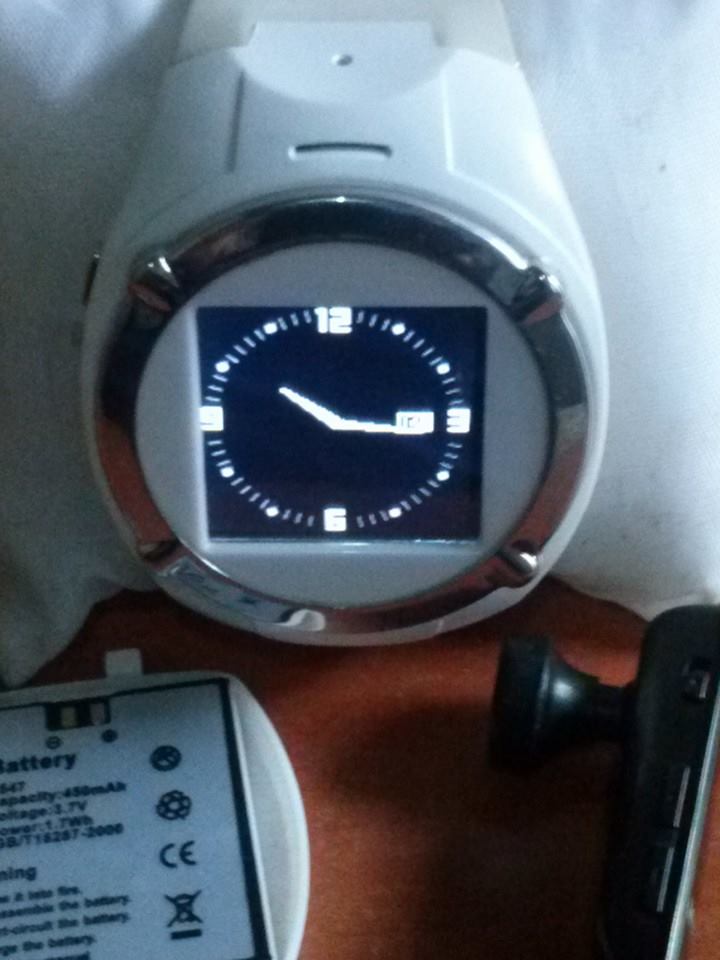
A private investigation firm is for the first time offering all Facebook users in Kenya a chance to win and walk away with a give-away prize of a digital wrist watch that spies use to nab fraudsters or cheating spouses.
South African mobile service provider Cell C passed a complaint with the Competition Commission against mobile operators, MTN and Vodacom, for anti-competitive conduct.
The complaint was directed to the manner in which the mobile operators discriminate between their on-net and off-net effective prices, which has a direct impact on smaller operators’ ability to acquire new customers.
“The two dominant incumbents discount their effective on-net prices substantially while charging a premium for their customers to call off-net. This amounts to discriminatory pricing and is without doubt anti-competitive when adopted by dominant operators,” says Cell C CEO Alan Knott-Craig.
Cell C has been intensely competing on all fronts with the ultimate aim of driving down prices for the consumer, which is also beneficial for Cell C.
“Customers that call off-net are being penalized often without them realizing it. With number portability, customers don’t always know if they are calling on- or off-net anymore, so they don’t actually know what rate they are paying,” says Knott-Craig.
Regulators, in many mobile markets, are opposed to differential on-net and off-net pricing, and in some instances, dominant mobile network operators are facing stiff fines for this kind of discriminatory pricing, which locks in customers and prevents switching.
Kenyan sweet manufacturer, Kenafric Industries Limited, has been sued by New-York’s Time Warner over the use of its cartoon trademarks, testing the application of global copyright laws in Kenya.
The Cartoon Network Inc, a TV unit of the American company wants Kenafric Industries Limited stopped from wrapping its sweets with packages branded BEN 10; which is a flagship cartoon channel of the US giant.
The TV unit says that what the sweet company is doing can damage the reputation of the BEN 10 cartoon characteras well asthe goods branded with the label toys, video games and clothing which have a value of KSh275 billion.
In a document filed in court, the Cartoon Networks vice president Louise Sams said: “The defendant’s (Kenafric) use of the name BEN 10 amounts to trade mark infringement of BEN 10 Trademarks, the unauthorized reproduction or adaptation or publication or broadcast or sale or distribution or possession or importation of the offending chewing gum constitutes copyright infringement.”
He claims further that both Kenafric and Cartoon Network use the same distribution channels, which it says could easily lead to the association of the Kenafric chewing gums with its cartoons.
Cartoon Network is relying on Madrid Agreement on International registration of Trade Mark adopted in April 1891 and the International registration of Trade Marks adopted in Madrid in June 1989.
The Madrid Protocol says that once a trademark is registered in a country which is signatory to Madrid Protocol, it becomes protected in all other countries which have adopted the treaty. The company, therefore, says having registered its BEN 10 as a trademark in United States, it becomes a protected in Kenya too.
Kenafric Industries Limited is yet to respond to Cartoon Network’s claims.
This calls for the attention of the government of Kenya to start enforcing the copyright laws.
SIM card activation and deactivation has become the treading news in Kenya after the attack in the West-gate shopping mall.
This has created a possible judgment that the West-gate terrorist could have used unregistered SIM cards as a mode of communication prior as well as during the attack.
Police investigating the terror attack lack information on the people who bought the SIM cards and that information would have assisted with their investigations in to the attack.
Wangusi could not confirm if the mall attackers did in fact make use of unregistered SIM cards.
“We were not officially alerted that the mall attackers used unregistered Sims. We also heard that from the media,” he said.
However the four major mobile service operators are claiming that they have complied with regulations set forth by the Communications Commission of Kenya (CCK), which was dismissed by the regulatory body.
“We are putting sustained pressure on the four mobile companies to switch off unregistered Sims and if they don’t, we will go to the last resort of suspending their licenses,” said CCK director general Francis Wangusi.
In the course of the week, the CEO’s of the four mobile network operators were questioned by CID detectives over the alleged violation of SIM Card registration.
“We have arrested and prosecuted a number of vendors who were selling these SIM cards and we summoned the CEOs of these firms to explain what they have done to stop the crime,” said Kenya’s director of the criminal investigations department (cid) ndegwa muhoro.
At this point in time it is wise not to point fingers instead carry on with the investigations, but the issue of unregistered SIM cards cannot afford to be overlooked.
In a bid to compensate for acute water shortage that the city of Dakar in Senegal has experienced over the past month due to a burst pipe, a new app has been rolled out serving as a relief to homes experiencing water shortage.
Kenya’s Digital Vision EA has developed a web application expected to automate the management of investment groups in the country.
The application dubbed Chamasoft, enables local investment groups or ‘Chamas’ in Swahili, to monitor collection and investment of funds and track group income and expenditure. The application uses cloud based software which allows chama members to view group accounts on a dashboard showing group statements, how much they contributed throughout their chama lifetime, penalties contributed and all other financials pertaining to the members and group.
According to Martin Njuguna, founder of Digital Vision EA, the company behind Chamasoft, the service was created to enable groups overcome challenges they face such as transparency, communication and the lack of a simple system where they can check their balances and receive automated reminders on group activities.
“We found that a lot of chama’s have big plans but they have no secretariat. Most people have day job’s and can only attend one or two monthly meetings. We created Chamasoft to solve this problem. Chamasoft is an online office which any chama member can visit virtually and monitor group financial activities. We are very impressed by the feedback so far and the uptake has been incredible,” he said.
Chamasoft also offers free SMS and email alerts and tracks member invitations. The software has automated the processes of issuance and tracking of loans and monitoring of Chama assets and liabilities.
“We tried as much as possible to understand how chamas work and the challenges they face. From the feedback we have received so far, we have been able to improve chamasoft to truly fit the needs of a chama. There is nothing like this in the market. We believe we will have a first mover advantage,” said Njuguna
Chama’s are common in Kenya and have evolved from the traditional women groups where women saved and borrowed funds for household utensils to groups that have acquired millions of shillings worth of assets.
Notable investment groups in Kenya include the Nairobi Securities Exchange listed Transcentury Limited Group, a multi-million dollar worth company, that was founded by a group of 29 Kenyans 16 year ago who raised $280,000 to start an investment company.
The US$690 million worth Thika Greens Golf Estate project in Thika also traces its roots to an investment group.
Across Kenya, people interested in acquiring assets, are turning to investment groups which enable them to pool resources easily, get better loan facilities and invest in capital intensive projects. Popular investment attractions include purchasing land, construction, transport services, establishing schools, managing hotels and purchasing stocks.
“We believe there is a very big opportunity in the market and this has been validated by the fact that financial institutions like banks have come up with specific products for chamas. They have launched chama accounts with specific advantages and financing terms. So, we know the opportunity is there,” said Njuguna.
Martin Njuguna
Chamasoft basic is available for as low as Ksh100 (US$1.2) per user per month while an advanced package with more features goes for Ksh.250 (US$2.9) per user per month.
The service is simple to use, one has to log into the chamasoft website and register their group. They will then receive a notification via email and SMS. One would then be able to invite their group members to register and personalize their chamasoft account to indicate how often they meet, upload their current financial records, state rules for penalties and loan application files.
Njuguna said the Chamasoft team is working on improving the product further to make it possible for auditors, banks and financial analysts to use the data collected and stored for auditing, advisory and lending approvals. He reckoned that a mobile version will be launched soon.
“We want to have a comprehensive product. The service will evolve with the kind of feedback we get. We want to make sure that this product is a one stop shop for all Chama needs,” he added.
Chamasoft is one of the 40 technology startups set to officially launch at the Demo Africa conference in Nairobi later this month.
Rocket Internet’sJUMIA, which operates in Nigeria, Morocco, Ivory Coast, Egypt and Kenya has won the “The Best Retail Launch of the Year” at the World Retail Congress in Paris yesterday, making it the first African company to win such a global award.
ASOS, Migros, NikeTown, Woolworths or Zappos.com are some of the former winners of the EMAP run event discussing the international retail industry.
Elated at the milestone, Jeremy Hodara, co-founder of JUMIA said the award was a historic moment to Jumia and for the whole of Africa.
He said, “Only thanks to our incredible teams and partners, who made online shopping in Africa easy. This award makes us incredibly proud and reinforces us in what we do. We are number one in Nigeria now and we will continue to grow and deliver our products all across Africa.”
The World Retail Congress’s jury said JUMIA sets the highest benchmark when it comes to retailing in Africa: their excellency in online marketing, IT and operations are key drivers for JUMIA’s sharp growth rates and the company’s rising brand awareness throughout the whole of Africa.
“We are delighted with the wide international reach of this year’s winners and that for the first time, we are presenting an award to an African retailer,” said Ian McGarrigle, chairman of the World Retail Congress.
Launched last year, Jumia has over 100,000 unique visits daily and a daily subscriber base of more than 400,000 people. The portal allows shoppers to buy from an array of products including fashion itmes, consumer electronics, home appliances to beauty products.
MainOne fibre optic company has made plans to use $100 loan from four Nigerian banks in order to expand its business across the country.
The company offers telcom services and networks solutions for businesses in the Western part of Africa.
The banks being Skye Bank Plc, Standard Chartered Bank Limited, First Bank of Nigeria Limited and First City Monument Bank gave the company the millions of shillings jointly yesterday.
Chief executive officer of MainOne, Funke Opeke, hinted that part of the fund would be used to complete a data centre project.
Opeke added that the fund is planned help make interconnectivity easier and internet access faster and more efficient for the company’s clients.
Pancontinental Oil and Gas is set in increasing its ownership in Kenya’s offshore L8 Block if American explorer Apache Corp gives up its 50 percent shareholdings. The company said that Apache Corp has not mentioned any plans of selling off its shares in the block.
According to Reuters , Apache Corp was to abandone its search for hydrocarbons in Kenya whichi is the only venture in Sub-Saharan Africa.
“Apache has not yet given written notification of its withdrawal to the L8 Joint Venture nor has it given written notice of its resignation as Operator under the Joint Operating Agreement (JOA),” said Barry Rushworth, chief executive officer.
Tullow and the Pancontinental company have 15 percent shareholdings each in Kenya’s offshoreL8 Block; Origin Limited also carries 20 percent of the L8 Block.
Mr Rushworth said that Apache is expected to give the notices but the withdrawal from the JOA requires 60 days’ written notice and resignation as operator requires a 90 days’ notice.
“The L8 Joint Venture will discuss the best way forward and determine the new operator of the Licence after it has been formally notified by Apache of its intention to withdraw. Subject to ministerial consent Pancontinental expects to increase its interest in the L8 licence on a pro-rata basis, at no material cost,” said Mr Rushworth.
Bob Dye, senior vice president of corporate affairs at Apache said that the company had informed the Kenyan government of the move on Sept. 27.
Other companies that own exploration blocks or are prospecting for oil and gas in on the Kenyan coastline include FAR Limited which is listed on the Australian Stock Exchange.
In June this year, FAR Limited and Pancontinental announced that they are seeking to sell part of their exploration rights on a block off the coast of Kenya, to raise funds that will be used in drilling.
From Left Agatha Gikunda Software Services Group Lead Intel EA Suraj Shah Corporate Affairs Manager Intel EA and Linda Kamau Vice-President of Akirachix
Intel has launched the ‘she will connect’ initiative to celebrate the United Nations’ second International Day of the Girl on October 11.
The company also said it has partnered with Kenya’s girl geek group Akirachix to launch a countrywide initiative that will see more Kenyan girls start to develop technology applications. Akirachix will host 2-day free training sessions annaully in Nairobi, Eldoret, Nakuru, Kisumu and Mombasa to help girls learn computer code. The sessions will be limited to 25 girls per class.
Agatha Gikunda, Intel East Africa’s Software and Services Lead said: “Diversity is crucial to succeed in new technologies. We are convinced that technology and education have real power to fuel transformative change and hence the reason Intel is collaborating with other industry players such as Akirachix to see as many girls as possible make a mark in the technology world.”
This launch comes after last week’s global announcement by Intel Corporation on a new program dubbed She Will Connect that commits to expand digital literacy skills to young women in developing countries.
Intel will begin the initiative in Africa, by aiming to reach 5 million women and reduce the gender gap by 50 percent. To achieve this, Intel will work with a diverse set of partners including global and local NGOs and governments.
She Will Connect will test a new model that integrates digital literacy with gender and development programming targeting women and girls, Including online gaming platforms, to innovate the delivery of digital literacy content through an interactive, engaging approach for smartphones and tablets in a game-infused environment; Peer Network, to integrate World Pulse’s digital empowerment training into existing digital literacy programs and connect women to a safe and supportive peer network.
“In a continent where women form a majority of the population and half of the workforce, it is an anomaly that the percentage of women working in technology is less than 15%. Technology is one of the key factors driving Africa’s projected economic rise. As such, we welcome Intel’s partnership as we believe there is enormous potential for maximizing the growth of technology through increasing the number and quality of women in technology within programs that collaborate with like-minded organizations.” said Linda Kamau, Vice-President of Akirachix.
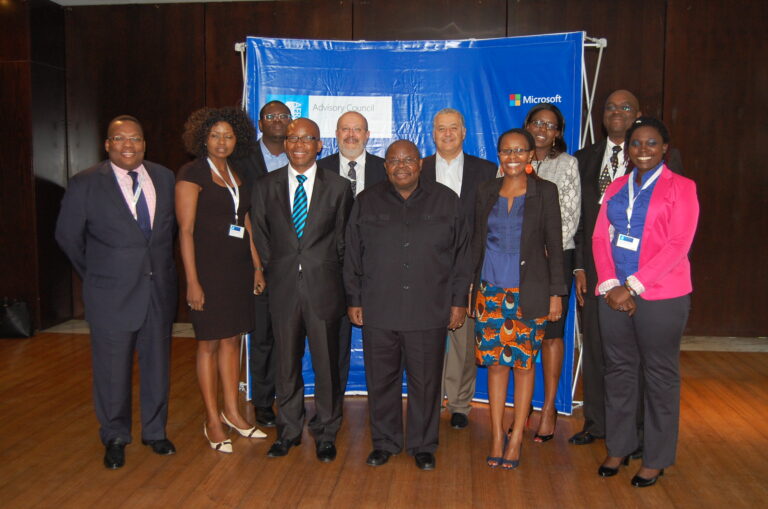
Microsoft has unveiled the Advisory Council for the 4Afrika initiative. The advisory council will be external and are tasked with guiding strategic investments undertaken by the Microsoft 4Afrika Initiative across the continent as well as ensuring 4Afrika is closely aligned to broad African development goals.
His Excellency Benjamin Mkapa, former president of the United Republic of Tanzania is the board chair, and Mteto Nyati, managing director of Microsoft South Africa, serves as the vice chair.
The company chose to form the advisory to solicit external input and guidance form a respected group of regional influencers as well as help ensure the initiative meets its critical goals.
Other members of the 4Afrika Advisory Council include Juliana Rotich, executive director for Ushahidi and senior TED fellow from Kenya; Hanan Abdelmeguid, CEO of Orascom Telecom Ventures in Egypt; Bright Simons, social innovator, entrepreneur, writer and researcher in Ghana; Florence Iwegbue, co-founder LiveWello LLC in Nigeria; Marieme Jamme, Senegalese-born and London-based CEO, blogger, technologist and social entrepreneur; Luís Lélis, executive director at Banco Angolano de Investimentos in Angola; Phuti Mahanyele, CEO of Shanduka Group in South Africa; Richard Attias, founder of The New York Forum and Moroccan events producer; Benjamin Mophatlane, CEO of Business Connexion in South Africa; and Monica Musonda, CEO of Java Foods and board member of the Bank of Zambia. Louis Otieno, director of Legal and Corporate affairs for Microsoft Africa, will serve as the council secretary.
“I am deeply honored to chair the 4Afrika Advisory Council and to represent this prestigious group of council members because we all believe deeply in Microsoft 4Afrika’s mission to help Africa improve its global competitiveness,” Mkapa said. “Together with the Microsoft team, we look forward to helping to grow African leaders, encourage and support African businesses and highlight African innovation here on the continent and on the world stage.”
The council first meeting was held in Dar es asalaam on 4th October and will have such meetings twice annually and will also hold regionally focused meetings at other times in the year.
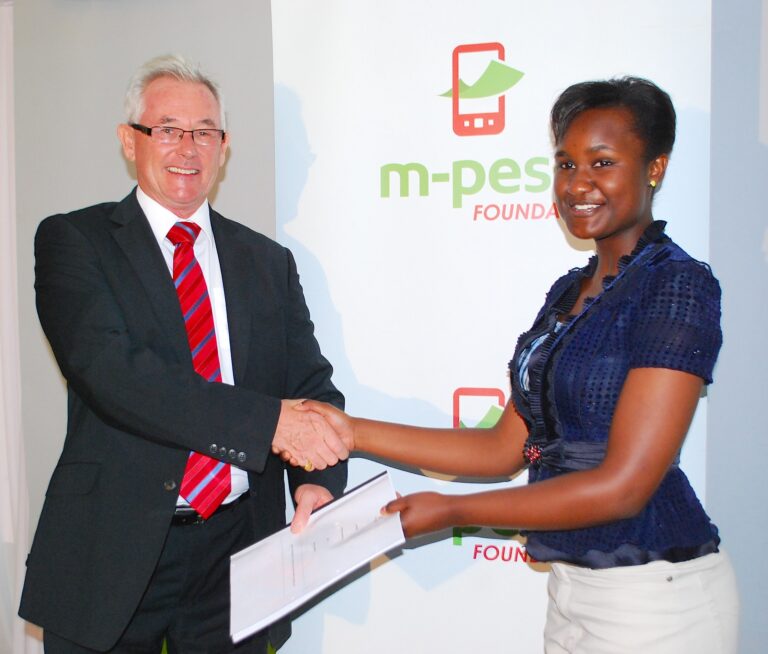
Kenyan agribusiness startup, M-Farm has today received Ksh 20 million in grants from M-Pesa’s charity arm, M-Pesa Foundation in a move expected to improve agri-business among small scale farmers in the country.
M-Farm will use the cash grant to pilot the Farm Agent and Quality Control Model to deliver information and better prices to smallholder farmers through mobile technology. With this grant, M-Farm will make agriculture a viable business option especially for small scale farmers who have over the years suffered exploitation by middlemen which has left them making low profit margins.
According to M-Pesa Foundation Executive Director Les Baillie, “M-Pesa Foundation is bridging the digital divide between agricultural sector and the ICT sector by partnering with M-Farm Limited to support agribusiness. We are about transforming lives and we believe this will change the lives of farmers for the better.”
The partnership is touted to increase transparency in the agricultural crop market and ensure best practices in agriculture using web and mobile technology, share crop prices throughout the country, train farmers and exchange platform for commodities.
“This software will ensure that farmers are no longer exploited by middlemen who make away with all the profits leaving the small scale farmers with little if any income,” said M-Farm CEO Jamilla Abbas.
Run separately from Safaricom Foundation, M-Pesa Foundation implements large scale and long term high impact social projects in the areas of education, health and environmental conservation for the social and economic benefit of Kenyans. It also promotes projects that use mobile communications technology that lead to social and economic development.
Bango, mobile payments firm powering payment for Facebook, Google Play, Firefox Marketplace, EA Sports and BlackBerry World and MMIT, an African based mobile payment software developer have together launched M-Iflọ, an online billing mechanism and verification portal for digital wallets.
M-Iflọ is designed to fit the cash-exchange culture of Africa and offer reassurance to app stores and digital merchants and give millions of Africans the ability to make mobile payments for apps, games and other smartphone content in Kenya and Nigeria, and soon in Uganda, Tanzania, and Zambia.
According to Bango CEO Ray Anderson, “There’s a smartphone boom in Africa and a frustrated demand for digital content. App stores and other merchants have been waiting for the reassurance of M-Iflọ, which limits the risk of doing business in Africa, and has been designed to suit the ‘cash up front’ instincts of the African market.”
Integrated with mobile wallet providers such as Mobipay in Kenya, Stanbic IBTC Mobile Money in Nigeria, M-Iflọ will act as a payment verification portal for mobile content providers to reach the African market. It allows consumers with a mobile wallet account in Africa to pick their wallet provider as a payment option at the checkout page of a content site. The wallet holder enters their mobile wallet number for account verification and obtains the content.M-Iflọ acts as an intermediary between mobile merchants and mobile wallet providers.
“Merchants in the western market are yearning for a suitable payment process platform that minimizes their risk in the African market,” said Jide Akindele, CEO of MMIT. “We believe that our M-Iflọ platform gives our clients that capability to do so. We look forward to opening up access to content store owners that are looking at the African market via Bango and MMIT’s Mobile money payment processing platform.”
M-Iflọ is expected to minimize risks and allows merchants to be paid up front, neatly sidestepping the complexity of doing business in Africa. The result is that app stores and other merchants no longer need to fear that payment will be held up in another country based on bureaucracy, fraud or changes in regulation, thus furthering Africa’s mobile commerce growth.
It has been predominantly impossible to guess and crack any scratch card code by chance, but not to one IT guru. At a time when the purchasing phone credit scratch cards is now common in every high day and holiday, he has discovered a simple mathematical formula that could break the Safaricom scratch card codes which could earn you free airtime.
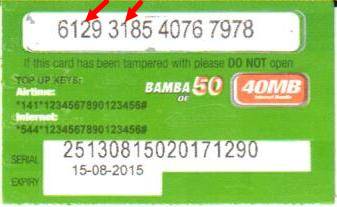
Based on an analysis of a collection of 448 Safaricom scratch cards, Chris Orwa a software engineer has recently informed followers on his blog that he noticed a trend that the 16 digit scratch card’s hidden codes followed. In his analysis, he found that the digit codes introduced a weakness in the scratch card security that could reveal the hidden reload number code.
Yet, nearly two years ago, Safaricom extended its scratch card digit code from 12 digits to 16 in order to increase the computational time required to break the code, making it more secure, noted Orwa. But while the new system reveals a number of drawbacks based on his analysis, the mobile phone airtime service company may need to turn back.
Statistics show that at least one in three Kenyans owns a mobile phone with the figure expected to rise as ICT spreads to rural areas. More so, over a span of 10 years, mobile phone penetration has risen to 89 per cent service coverage nationwide and over 10 million estimated subscribers according to CCK, despite the Kenya Bureau of statistics stating that four in ten Kenyans currently live below the poverty line surviving on less than one US dollar a day.
Thus, cracking a mobile phone scratch card code could spell huge profit losses in the airtime service industry, yet be a fete for those living on less that KSh89 a day. For instance if one in three Kenyans attempted to discover the hidden code of any Sh100 scratch card, companies would risk losing at least KSh130 million in a day. With that effect, strict safety measures have been placed to protect the secret codes, occasionally leading to a fine if one tried to “guess” or “crack” any hidden code by chance.
Nevertheless, in the zealous software engineer’s analysis, a few assumptions that led him to draw conclusions that supported his theory of having the ability to break the hidden Safaricom scratch card codes, were formulated.
Based on Orwa’s assumptions, by understanding that each digit has relevance to its position, he created a data set with 16 variables, each holding the positional value of the digits in addition to a column that indicated the sum of the digits.
In his analysis, mapping the total figures of the digits showed that the digits were actually randomly selected. However, he discovered that within the digits was a pair that was linearly or otherwise dependent. Thus with the help of some software, he did an analysis using an algorithm that brought him closer to his conclusions.
From his results, he discovered a relationship between the third and sixth digit was based on a linear equation, concluding that if the third number in the scratch card is greater than zero, then the sixth number is the third number minus one. While if the third number is zero, then the sixth number would be nine. However, while he has only discovered a trend of the third and sixth digit, he and many others IT or mathematicians are yet to discover the hidden code trend of the remaining 14 digits.
However, his new discovery has generated mixed reactions on social media, with many stating that it’s all a hoax, as a few swear that trying to crack the hidden codes could have your phone blocked.
Taxi aggregating app, SnappCab has launched in Johannesburg, in a move the founders say will revolutionize South Africa’s cab industry forever.
The free app, available for Apple and Android enabled smart phones, with Blackberry and Windows launching shortly after offers commuters with smart phones the ability to order, track and pay for cabs easily and quickly. After Johannesburg, the app is set to launch in Cape Town and Durban in the following weeks.
Founded by Anton van Metzinger, Nathan Sasto and David Storey, the app aims to get more South Africans out of their privately owned cars using cab services, and create jobs.
“South Africans are relatively new to the use of metered cabs. While the industry is growing, people are often wary of using a cab service largely because of lack of accessibility, variable quality and non-transparent pricing,” says van Metzinger. “Our intention is that SnappCabwill provide cab users with an easy, safe and reliable means of hailing a cab, while at the same time supporting the development and growth of the industry.”
Easy to use
SnappCab is easy to use and will make commuting quick and convenient. After downloading, one only needs to log into the app and register their details once, and their account will be automatically activated.
Then to hail a a cab, one has to log into the app on their smartphone, and see their location automatically, then click on “e-hail” a cab button, and then the user will be automatically connected to the closest cabs near their physical location. Users can request any cab in the area, or specify their preferred cab companies, which can be pre-selected and saved.
Highly secure
After a cab driver accepts the call with his/her mobile device, locations are shared between the two parties along with the estimated time of arrival, identifying photos, names and contact details. The user can then track the cab’s progress as it approaches, making sure that it is easy for them to connect. In case one’s attention wanders, or their phone goes to sleep, an SMS will alert them once the cab is arrives. For safety, vehicle tracking continues while you are in transit, as the SnappCab operations centre monitors the vehicle’s location for the duration of your journey.
Nathan Sasto and Anton van Metzinger, founders of SnappCab
Once the journey is complete, commuters can pay for the service using cash or by using a credit card – which they can load onto their account with SnappCabat any time. Credit card details are kept safely and securely with MyGate – a Level 1 PCI Certified South African payment gateway.
Family account
SnappCab can allow more than one person to use it, so school going children can carry a phone loaded with the application and call a cab when they are ready to go home after classes or social activity, saving working parents time. Businesses can also use such an account.
SnappMiles for loyal users
Frequent users, and credit card payments, are rewarded by earning SnappMiles, which they will be able to redeem for services as the application evolves.
“What we are hoping for is a positive and mutually beneficial relationship,” says van Metzinger. “We envisage the steady adoption of the app which will spur on cab companies to join the network. In turn this will encourage more commuters to use this fun, efficient and easy means to access public transport.”
“We have conducted extensive research into similar applications that are available abroad in cities where cabs are a part of everyday life. By applying this knowledge we are developing a locally relevant service that supports all South Africans, and that will help grow the cab industry to its full potential,” he concludes.
Nigeria’s online mall, Konga.com has been listed as top trafficked startup in Nigeria according to new startup rankings released by Startuprankings.com, a global startup ranking website.
According to the report Konga beat several other startups in the county to emerge the best via SRWeb (Startup rank on the web) and SRSocial (Startup rank on Social) which also tallies with Alexa.com.
Other startups that made the top ten list are; Jobberman, iROKOtv, DealDey, Tolet, Sturvs,VoguePay, Hotel.ng, Paga and Evansakanno.com. Popular Nigerian forum site Nairaland was not on the list.
Konga.com is an online mall selling phones, electronics,fashion, laptops, blackberry, computers, baby items, books and everything else. The firm recently launched its massive warehouse and countrywide pick-up/delivery points. It also organized Nigeria’s first e-commerce conference and its CEO Simdul Shagaya is on the among discussants at the Customer Centricity Summit 2013 event which began yesterday Oct 8 to Oct 10, 2013 at the Intercontinental Hotel in Lagos.
Shagaya will join other panelists like Okechukwu Eneanya, Chief Operations Officer, Wakanow.com,Tayo Oviosu, CEO, PagaTech and Yemi Odubiyi, Chief Operating Officer, Sterling Bank to discuss “Redefining customer relationships through adaptability, customer collaboration, personalization”.
The summit aims to look at the role of social media platforms to offer different customer service models, how to foster online and mobile solutions for creating the customer feedback loop, using multichannel platforms to develop and improve knowledge management systems and improve personalization and how to convert customer feedback into improved service quality.
Konga.com has also partnered with the Nigerian Blog Awards to honour the country’s top bloggers. Please nominate TechMoran.com October 13th, 2013.







 Kenya’s