In this day and age we are all using social media to measure our success and to rate people’s lives and relationships. Millenials who constantly post their relationships online are more likely to breakup because of putting themselves out there. Privacy is such a sacred thing in any relationship and should not be taken for granted. Whether you realize it or not, here’s how social media is ruining your relationship.
When you’re in a relationship that you keep posting online you end up seeking validation by the number of likes you keep getting online. You find yourself wanting to be acknowledged as a couple all the time and this becomes a toxic cycle.
2. You stalk your other half and it creates arguments
Ever found yourself stalking your other half online? You keep checking to see if him or her liked their exes pictures? You get upset if they don’t like your photos or they didn’t comment? Some people who have been in long lasting relationships claimed that it helped that they didn’t follow each other on social media.
3. You measure your love by how often your spouse posts you
Before you know it you get upset if your other half never posts you on social media again adding unnecessary pressure on your relationship which then becomes toxic.
4. When you’re together you probably spend more time on social media than with each other
We understand that in this day and age it is almost impossible to live without social media. However, when you’re with your partner it is important to be present rather than ignoring the other person rather than ignoring him/her for online friends.
WhatsApp is honestly one of the most popular used methods of communication these days because one can literally do everything, text, voice note, and video call.
One of the notable points is the fact that it works regardless of the type of phone you have, iPhones, Androids and so on, meaning it replaced iMessages and standard texts of course.
If WhatsApp is currently active on your iOS 8 device or Android versions 2.3.7 and older, you will only be able to use it until February 1, 2020.
Announcing the news in a blog post on the WhatsApp website, the company notes that because they won’t be developing for the aforementioned operating systems, the app could cease to work at any stage. Meaning that after February 1st, 2020, users of these phones will no longer be able to create new accounts or reverify them.
This measure is given with the objective that the company, now belonging to Facebook, can improve its service and the privacy of the application.
“On iOS 8, you can no longer create new accounts or reverify existing accounts. For the best experience, we recommend you use the latest version of iOS available for your phone.
We don’t explicitly restrict the use of jailbroken or unlocked devices. However, because these modifications might affect the functionality of your device, we can’t provide support for devices using modified versions of the iPhone’s operating system.”
Previously for Whatsapp to work on older devices, the company had to create a special update for the smartphones with the operating system mentioned. But the Facebook-owned app will no longer support them.
WhatsApp recommends changing to either Android running OS 4.0, iPhone running iOS 8 or Windows Phone 8.1+.
The company also mentions that Windows phones will no longer have more updates for WhatsApp after December 31, 2019. The company had also said that WhatsApp will not be available in the Microsoft Store after July 1, 2019.
No support for iOS 8! You can still use WhatsApp on iOS 8, but if you reinstall the app, you will no longer able to verify your account. The iOS 8 compatibility will be fully removed in February 1, 2020. Windows Phone is confirmed to be deprecated after December 31, 2019. pic.twitter.com/JGRoSBAmMm
WhatsApp has regularly been adding up new features and some of them require powerful phones as well as newer Android and iOS versions to function properly. Features like picture-in-picture video within chats, fingerprint authentications etc are resource heavy and require powerful phones with enough RAM and newer OS. Thus the company is ending the support because some of the phones won’t be able to support the features it plans to bring in the future.
“We’ll no longer actively develop for these operating systems; some features might stop functioning at any time. If you currently use an older operating system, we recommend upgrading to a newer version…,” WhatsApp said on its support page.
However, WhatsApp has said that its decision to end support of the Facebook-owned app for these Android phones and iPhones will not affect many users but only those people who are still using old Android phones and iPhones.
Unfortunately or fortunately the only solution for people with a device that has a backward operating system is to buy a new mobile with the updated software.
Also if you’re a hoarder and hold onto your messages from way back when… sadly you can’t export them to the new device. But, there is the option of sending your chat history in an email format (learn more about that here.)
How to know what version of Android I have
Open the “Settings” app.
Go to “System.”
In the search engine that will appear at the top, type “Android version”. Click on the access that will appear in the search results.
Then, your mobile will show the version of Android that you have installed
The Chinese smartphone maker’s three-storey flagship store has been in the works since 2017. It spans 1,300 square meters and is manned by 120 consultants who hail from various fields including hotel, art, and aviation.
Chinese manufacturing giant, Huawei, officially opened its global flagship store on Saturday morning at Vientiane, the heart of Shenzhen’s vibrant MixC World and it is Huawei’s first direct-sale store in the world. Shenzhen is a huge commercial Chinese city and the Shenzhen Vientiane World was opened on September 27, 2017.
The Store which covers a total area of 1300 square meters has been in preparation since 2017 and customers can explore Huawei’s latest and most comprehensive products, experience the fastest 5G connection, relax and meet up with friends. Huawei’s global flagship store will have anything and everything with the Huawei label on it, hence why it is a “global flagship store”. According to the company, in the future, more major Chinese cities will have one Huawei flagship store.
“Shenzhen is an international technology and innovation center, we believe that Huawei Global Flagship Store will become the new Connecting Hub between Huawei and customers. MixC World is a gathering place where fashion, technology, and liberal art meet together and Huawei Global Flagship Store will become Huawei’s city living room connecting the consumers.”
Richard Yu, CEO of Huawei Consumer Business Group
Huawei Global Flagship Store is a three-storey single-family building that adopts the design concept of “City Square”, which combines the traditional Chinese and western architectural philosophy. The facade adopts a large area of high transmission glass with rounded corners, feels like an exquisite Glass Enamel.
Huawei Global Flagship Store
It has a unique semi-open staircase that connects the square and the surrounding environment, presenting a borderless community atmosphere whereby customers can walk into the store without any restrictions, relax and meet up with friends.
The Shenzhen store boasts full 5G coverage and is equipped with Huawei’s Intelligent Environmental Control System, which runs on the vendor’s HiLink technology to automatically adjust the brightness, temperature, and humidity within the retail site.
5G is HERE – and it's shockingly fast! Watch our attendees experience the sheer speed firsthand at our Huawei Global Flagship Store ???#HUAWEIFlagshippic.twitter.com/PfWqg9sBqi
Huawei added that the store was built on environmentally friendly and recyclable materials. For instance, its ceilings and walls used felt made of recyclable plastic parts, while tables used nano boards that were touted to last more than 10 years.
The Chinese smartphone maker described the store as its first “direct-sale store in the world”, but it currently operates 11 “concept stores” in Singapore, from which customers can purchase its products including the Huawei Mate 30 Pro and P30 Pro.
According to the company, its products and services are available in more than 170 countries and it has 16 research and development facilities worldwide, including in India, Germany, Sweden, and the US.
On the open day of the global flagship store, there were already long queues of people who looking to purchase the Huawei Mate 30 and Mate 30 Pro flagship smartphones. This is all because the launch of the new Global Flagship Store coincided with the Mate 30 series launch in China. So it’s no surprise that fans flooded the store in the hopes of getting a unit.
Huawei’s CEO, Yu Chengdong, spoke at the opening on the Huawei Mate 30 series. According to him, the Mate 30 series is already in short supply and the pre-sale volume is six times that of the P30 series. Within just three hours, pre-orders for the Mate 30 and Mate 30 Pro exceeded 1 million units. As always, the camera is the biggest selling point of the new Huawei models. In fact, the Mate 30 Pro has also surpassed the Galaxy Note 10+ 5G to become the highest-rated camera smartphone on DxOMark today.
Huawei has a 20 million shipment target for the Mate 30 series, and Huawei Mall announced that the sale amount for the Mate 30 series exceeded 500 million yuan ($70 million) in one minute. This just shows the popularity of the Mate 30 series, at least in China. According to Huawei officials, its latest series required a considerable amount of energy and research. About 3,000 people invested in the research and development of this series and the R&D cost exceed 2.1 billion yuan ($294 million).
Early this month at IFA 2019, Huawei unveiled a new P30 Pro that shipped with Google’s Android 10 mobile OS, despite a US trade ban that barred US companies such as Google and Microsoft from supplying technology to Huawei. Last month, Google said its license exempting it from the export restrictions still prevented it from supplying software for new products.
Despite all these, Huawei has been developing its alternative Harmony OS, which recently was described as “completely different” from Android and Apple iOS. Yu said at the company’s developer conference in Dongguan: “It is a microkernel-based, distributed OS that delivers a smooth experience across all scenarios. It has a trustworthy and secure architecture and supports seamless collaboration across devices. You can develop your apps once, then flexibly deploy them across a range of different devices.”
Search engine giant Google is celebrating its 21st birthday today with a special Doodle of a throwback photo of a bulky computer, which shows a Google search screen.
Google celebrates it’s 21st birth anniversary today with a special doodle of a throwback photo of a bulky computer, showing a Google search screen.
Funny thing is that the real date when Google was founded remains something of a mystery that even the company admits it does not know exactly when it began.
The search engine was founded in September 1998 by two Ph.D. students, Larry Page, and Sergey Brin, in their dormitories at California’s Stanford University. And Google usually marks its birthday on September 27 each year.
Although without much explanation, Google’s birth date has changed over the years. In 2005 it marked the anniversary on September 7, supposedly marking the day it became an incorporated company.
However, the company actually filed incorporation papers on September 4, 1998, but has never used this date as its birthday. Additionally, to confuse us more, Google sent out their celebratory doodle on September 8 in 2003, and a day earlier in 2004.
Nevertheless, September 27 appears to have stuck through chance, because that’s the date when the company first celebrated its birthday, back in 2002.
“Still, while there are some differing opinions about when to bust out the candles and cake, one fun fact is that our first Doodle was posted even before Google was officially incorporated (30 August, 1998 vs 4 September, 1998).”
1998 was a time when the World Wide Web was still an infant, but Page and Brin’s idealistic goal was to “organize the world’s information and make it universally accessible and useful”.
Two years earlier, Page and Brin had developed a search algorithm known as ‘Backrub’ and therefore chose the name Google for their new project because it recalled the word ‘googol’; a mathematical term meaning ‘10 raised to the power of 100’.
The verb ‘google’, meaning ‘to search for something online’, has become so widely used that it was added to the Merriam-Webster dictionary and Oxford English Dictionary in 2006.
Initially, the search giant was overshadowed by rival search engines such as Yahoo and Ask Jeeves, but Google has grown to become the world’s most popular website, with more than 63,000 searches made every second.
Today, Google operates all over the world and in over 100 languages, answering trillions of search queries each year.
As of September 2019, Google’s net worth is estimated at around $300 billion and the parent company Alphabet is estimated to be worth $900 billion making them the third most valuable company after Amazon and Apple
“The relentless search for better answers continues to be at the core of everything we do. Today, with more than 60,000 employees in 50 different countries, Google makes hundreds of products used by billions of people across the globe, from YouTube and Android to Smartbox and, of course, Google Search.”
Google introduced the Android Go program nearly two years ago and is now bringing the latest build of its mobile OS tailored for budget devices, Android 10 (Go edition) which focuses on improved data encryption for users with Google’s Adiantum encryption system.
Sagar Kamdar, Director of Product Management (Android) at Google, wrote in a blog post that Android 10 (Go Edition) is aimed at further improving the experience for entry-level phone users.
By Google putting work into a modified version of its platform, Android Go edition, the company has definitely backed one thing the tech sector loves to talk about; how the next billion smartphone users will come online. With over 80% of entry-level Android phone purchases in the last 18 months, the company has been able to claim success with Go. And now that Google has given Android 10 its own Go edition, hoping to capitalize on recent performance improvements, feature additions, and size savings to its apps, this hot topic in the tech sector might just bear some factual answers.
This particular version of Android 10 puts a strong focus on speed, with faster and more memory-efficient app switching as well as launching that’s 10 percent faster than in Android 9 Go. It should also be more reliable.
Another key thing is that Android 10 now requires all devices to have encryption, the latest Go edition will take advantage of Google’s new Adiantum method. The Android 10 Go edition Adiantum encryption system should be able to secure data without affecting performance or requiring special hardware. Meaning that you won’t have to worry that your sensitive info is vulnerable simply because you bought an entry-level device.
Another key feature is the reworked app launch, which is now reportedly 10% quicker. Google claims that app switching is now more fluid as it managed to cut down pre-installed app sizes by half, leaving more storage out the box for users.
The search engine giant has also emphasized that recent app updates play an important role. Google Go has an AI-based read-aloud feature as well as Lens visual searches, while Gallery Go uses AI to organize your photos (offline or otherwise).
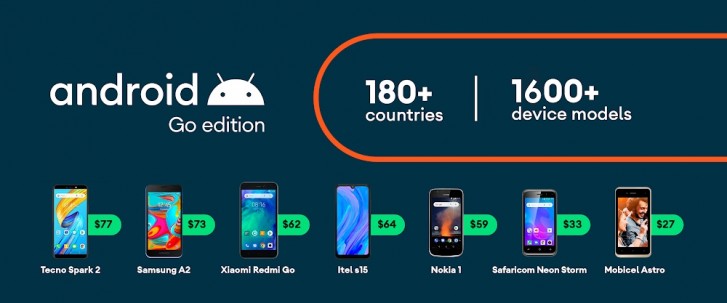
Android 10 Go edition, intended for use on devices with 1.5GB of RAM or less, and broad range of devices based on the Android 10 Go edition is expected to arrive later in the fall from a growing list of manufacturers in over 180 countries.
The devices will come with all the standard Google Go apps like Gallery Go, YouTube Go and Maps Go as well as the new Google Files app. Peer-to-peer sharing support for files is also available, and an improved data saver. Google is looking to team up with even more developers to bring a larger selection of Go apps.
Facebook on Monday announced the acquisition of CTRL Labs, a New York startup that builds technology that can help your electronic device read your brain waves.
Andrew “Boz” Bosworth, Facebook’s head of augmented reality and virtual reality, officially made the announcement about the acquisition on Facebook (Obviously) and revealed the startup will be joining the Facebook Reality Labs team in hopes of accelerating its development and availability to consumers. CNBC got information from sources familiar with the matter that the deal was worth somewhere between $500 million and $1 billion, although a Facebook spokesperson claimed it was actually less than a billion.
“Technology like this has the potential to open up new creative possibilities and reimagine 19th-century inventions in a 21st-century world,” said Mr. Bosworth in a post announcing the acquisition. “This is how our interactions in VR and AR can one day look. It can change the way we connect.”
Thomas Reardon and Patrick Kaifosh, who both received their PhDs in neuroscience from Columbia University founded CTRL-labs in 2015. Earlier in his career, Reardon spent nine years at Microsoft and was then technology chief at Openwave Systems.
New York-based CTRL-labs is among a growing number of groups using neurotechnology to try to connect human thoughts to computers. The company differs from others in that it only uses non-invasive technologies that do not require surgery, focusing on the development of a wristband that reads electrical signals from a user’s brain to map and move a digital arm on a screen, even if the person is not moving.
“The field is moving very fast,” CTRL-labs’ chief executive Thomas Reardon told the Financial Times in July. “We can do things we could not have contemplated just five years ago.”
CTRL-labs has raised $67m over three funding rounds, the latest of which was $28m in February this year from Alphabet’s GV and Amazon’s Alexa Fund. Now that it will become part of Facebook’s Reality Labs team, the researchers and engineers at Facebook are tasked with developing AR glasses, according to Mr. Bosworth.
The vision for CTRL-labs’ technology is that it will use a wristband that allows people to control their devices, Bosworth said.
“Here’s how it’ll work: You have neurons in your spinal cord that send electrical signals to your hand muscles telling them to move in specific ways such as to click a mouse or press a button.
The wristband will decode those signals and translate them into a digital signal your device can understand, empowering you with control over your digital life. It captures your intention so you can share a photo with a friend using an imperceptible movement or just by, well, intending to.”
The deal comes at an interesting regulatory moment as Attorneys general in a number of U.S. states announced earlier this month that they are opening antitrust investigations into Facebook, including scrutinies into whether it used acquisitions of rivals including Instagram, WhatsApp, and Onavo to eliminate competition. Although the acquisitions were given the green light by regulators at the time, these scrutinies are something that is bound to keep acquisitions like this one under critical observation.
It looks like other companies that found themselves under investigation by various world governments after a series of privacy scandals might ease up a little on the development of products that seek to read our minds. Although to Mark Zuckerberg, the risk that the company might fall behind on next-generation computing technologies is too scary to ignore.
Zuckerberg’s company has been working on brain-computing technology since 2016 as part of the company’s Building 8 division, which was a skunkworks lab launched to boost the company’s efforts in developing consumer hardware products. In July, Facebook provided an update on its brain-computing efforts saying that research conducted with the University of California San Francisco showed promising progress, but was still years away from commercialization.
If CTRL-Labs succeeds in building the thing it’s working on now and cements Facebook’s position as the market leader in AR and VR, maybe we will wish the Federal Trade Commission had blocked the sale, or even put conditions on it. Just maybe!
Apple’s iPhone 11 Pro was in stores from Sept 20 and just like Samsung’s pitch in favor of the Galaxy Note 10, it is being touted as the device for people who rely on their smartphone to get things done.
Apple came out swinging just this month with the announcement of its new smartphones, and they are now firmly placed among the top handsets on the market. Considering the competition out here in the smartphone market, this is quite impressive.
Nevertheless, does the new 11 Pro stack up against the Galaxy Note 10? Well, read on to find out.
The $999, 5.8-inch iPhone sports an all-new triple-lens camera system, refined design, and Apple’s new A13 Bionic chipset stated to be the most powerful the company has ever embedded into a phone.
On the other hand, the $949, 6.3-inch Note 10 is an absolute powerhouse device packed full of excellent features, a super-powered camera and an efficient processor chip to keep things running smoothly. It also has its signature S Pen stylus, the narrowest bezels we’ve seen on a flagship handset this year (maybe this is thanks to the Infinity-O front-facing camera cutout) and comes standard with four times the storage of the iPhone 11 Pro.
Which new phone is the best for anyone who’s looking for a lot of features packed into their handset? Here’s how the iPhone 11 Pro and Galaxy Note 10 compare.
iPhone 11 Pro vs Samsung Galaxy Note 10 display: Which looks best?
The Galaxy is bigger but has roughly the same technology behind the display as compared to the iPhone 11 Pro which is shorter than the Galaxy Note 10, but both devices are just about equally wide and thick. Although despite the fact that Note 10 is carrying an entire stylus, Apple’s handset turns out to be noticeably heavier; 6.63 ounces to the Note’s 5.93.
Additionally, we can’t deny the fact that the Note 10 offers a fresher design, too, with slimmer bezels, a larger screen-to-body ratio, and no notch. Samsung opted for a very small hole punch-style camera within the display.
The Note 10 has a 6.3-inch Dynamic AMOLED display that houses 2280×1080 pixels and the screen stretches out of the entire front of the phone. It is a super expansive screen and has HDR+ and a massive range of color and TrueTone, meaning games, pictures, and Netflix all look amazing on-screen.
When it comes to the iPhone 11 Pro, it has a smaller, more refined display, measuring 5.8-inches. Apple released a new bit of screen tech with the 11 series, bringing in the Super Retina XDR OLED display which has more pixels stuffed into it (2436×1125).
However, depending on which phone you choose, both are super-powered OLED displays with HDR capabilities that look bright and powerful. The displays will perform incredibly well no matter where you are using it because each is capable of looking bright and clear in extreme sunlight or pitch blackness.
But you might want to keep that in mind that if you watch a lot of content on your phone, the iPhone 11 Pro might look a bit clearer because of its smaller screen size and with more pixels back in.
iPhone 11 Pro vs Samsung Galaxy Note 10 camera: Triple threats or Nah?
Of course, the biggest difference with the iPhone 11 Pro’s design comes courtesy of its triple-lens cameras which appears to be a trend for smartphones recently; each of which protrudes out of a larger, sculpted ugly square base. It doesn’t look as bad as we feared it might from leaked renders, though compared to the Note 10’s much more streamlined approach, it sticks out like a sore thumb!
However, the iPhone 11 Pro received its “Pro” status thanks to its camera, and we do feel that this device might just be the better option if you like taking snaps.
Apple packed a trio of 12-megapixel cameras into its 2019 flagship; a telephoto capable of 2x optical zoom, and another that is tied to a 120-degree ultra-wide lens that can pull out to 0.5x zoom. The front-facing camera has also been upgraded, up from a 7-MP sensor in the iPhone XS to a new 12-MP one capable of slow-motion video touted “slofies”.
The 11 Pro also has a dedicated Night Mode which takes incredible photos at ultra-low-light, meaning those night-club snaps and sunset selfies will glow and look bright, without losing quality. Apparently there’s a software behind the camera that makes this smartphone impressive. Machine learning, artificial intelligence, and a new advancement called Deep Fusion; which will take several photos before you even click the shutter button, piecing together the best pixels from each shot to give you the optimum image. We have no idea how this tech works, but this technical wizardry makes pictures look incredible.
Another improvement on the iPhone 11 is the taking of videos, as you can film from both lenses at the same time, giving you different perspectives from the same angle. For example, if you are filming a football match in a stadium, you can use the regular wide lens and seamlessly switch to the ultra-wide without losing quality or time in the shot to get that full-pitch angle.
Now in comparison, the Galaxy Note 10 also has three lenses on the rear a bit similar to Apple’s. The primary 12-MP lens is flanked by 12-MP telephoto and 16-MP ultra-wide shooters, the last of which pulls out to a 123-degree field of view.
Although the difference is that Samsung has an aperture advantage as well; while the iPhone’s main lens is fixed at ƒ/1.8, the Note’s can switch from ƒ/1.5 to ƒ/2.4, depending on the lighting of the scene.
Note 10 also has similar software features like Light Mode, but sadly the phone has lacked quality in recent tests and doesn’t hold up as expected.
iPhone 11 Pro vs Samsung Galaxy Note 10 battery: Which one lasts longer?
Note 10 has an outrageously large 3,500mAh battery that sees it get a day’s average use. If you use it heavily with games and apps running on a bright screen you should expect around 9 hours of use. The Galaxy phone also comes with a 25W charger so it will charge super-fast (you get about 50% of your battery in half an hour).
On the other hand, Apple may not be advertising it, but the iPhone 11 Pro has a bigger battery than its predecessor, rated at 3,046 mAh. If that’s true, the new iPhone’s battery is more than 400 mAh bigger than the one in the iPhone XS, and about 400 mAh smaller than the one inside the Galaxy Note 10.
Nevertheless, the company is really pushing the battery power with the iPhone 11 pro, claiming it is the longest-lasting battery the company has ever built. At the Apple Event, Apple CEO Tim Cook claimed you would get an average of four hours more battery from the iPhone 11 Pro compared to last year’s 5.8-inch model. And for the first time, Cupertino is shipping these premium models with 18-watt USB Type-C chargers in the box.
Previously, iPhone owners had to buy their own fast chargers, although the 6.1-inch iPhone 11 still doesn’t come with one. This faster charger gets the device to 55% capacity in a half-hour according to tests. The Galaxy Note 10’s 25W brick got the phone to 47% in the same amount of time.
Both devices may support wireless charging, but only the Note 10 can wirelessly charge other devices.
iPhone 11 Pro vs Samsung Galaxy Note 10 conclusion: So which smartphone should you get?
The iPhone 11 Pro ships with iOS 13 on board, which offers new features like Dark Mode, Look Around in Maps, Voice Control for hands-free system navigation and swipe typing.
BTW iOS 13 just came out recently, Sept. 19, for current iPhones, a day before the new models arrived in stores.
The Galaxy Note 10 sports Samsung’s One UI interface atop Android 9 Pie, with Android 10 likely to come next year.
Nonetheless, the device’s S Pen feature is what really differentiates it from other phones on the market, like the ability to transcribe notes and navigate some apps using the stylus’ Air Gestures. There’s also Samsung’s Dex Mode, which allows you to access a desktop interface for your Note when plugged into a monitor or PC.
However, whether you’re into Apple products or not you’ll have to bear with our honesty, we do think the iPhone 11 Pro is a better handset.
It may be much more expensive, but Apple has pulled the stops out with the new handsets and made the battle for the best smartphone much more interesting, especially if taking the best possible photos is extremely important to you. Or if you’re an iPhone user who could really use some extra battery life, the iPhone 11 Pro presents a worthwhile upgrade.
Bigger battery, more compact and punchy screen and the fantastic camera (ignoring how ugly the square bump is) all definitely makes this a worthy upgrade.
Although there’s no objection if you want to stay loyal to Android because you will not be upset with the Note 10, as it is still the best device from that OS.
Based on its more futuristic design, the Galaxy Note 10 isn’t a bad choice either as the added functionality of the S Pen and all the extra storage you get for $200 less than you’d have to pay for a similar iPhone. Those especially concerned with price can take the camera and performance shortcomings in stride knowing they got the best bang for their mullah.
If you have budget restrictions go for the Galaxy Note 10, but if you want to treat yourself, we suggest the iPhone 11 Pro.
KiwiPay, a Laos-based payment solution provider is set to launch in seven African countries in its global expansion move.
KiwiPay has signed an agreement with Laos Central Bank, Laos Ministry of Finance and the Lao Development Bank to provide an easy cashless solution for visa processing in Laos borders and cashless payment capabilities.
The firm is also working with governments in several other frontier markets in South-East Asia and up to 7 countries in Africa to launch the service there.
According to Gregory Schmidt, CEO & Founder of Kiwi Group, “The solutions has proven the ability to speed up and ease the visa process for tourists. We are now testing the solutions with governments in several other frontier markets in South-East Asia and up to 7 countries in Africa.”
Its cashless visa payment solution in Vientiane’s Wattay International airport has been used for Chinese tourists using Alipay’s facial recognition feature. In 2018, more than 900,000 Chinese citizens have visited the country of Laos and the government is targeting more than 1.2 million Chinese tourists in 2019.
KiwiPay aims to tap into these growing Chinese visitors to Africa for trade and tourism.
KiwiPay helps SMEs to digitize their payments by providing dynamic QR code solutions to thousands of retail shops, hotels & restaurants by enabling foreign e-wallet solutions such as Alipay, SamsungPay, ApplePay, WeChatPay and more.
KiwiPay is already processing more than US$200 million worth of transactions yearly, and growing fast monthly, based on a commission fee business model, allowing countries to move to cashless economies using their own currencies.
Earlier this year Kiwi Group also entered a joint-venture with Meal Temple Group (www.mealtemple-group.com), one of the leading startups in the food delivery space in frontier asian markets, allowing hundreds of restaurants to use the KiwiPay solutions, including PoS devices for cashless payments.
Tala, a mobile-based online lending firm has announced that it is shutting down its operations in Tanzania and no explanation has been given as to why this is happening.
“We regret to inform you that Tala is currently not offering loans in Tanzania.”
Despite this, customers with pending loans in Tanzania will still be required to clear their debts.
“We appreciate the opportunity to serve you, and wish our loyal customers continued success in your financial journeys. You can use the following paybill number to pay outstanding balances.”
An official from the company confirmed the announcement posted on social media and added, “Yes, we are no longer offering loans in Tanzania. Unfortunately, due to legal reasons, we cannot divulge any more information other than what was communicated on social media.”
We regret to inform you that Tala is no longer offering loans in Tanzania. We appreciate the opportunity to serve you, and wish our loyal customers continued success in your financial journeys. You can use the following paybill number to pay outstanding balances. pic.twitter.com/EHLJFYZe2i
The Citizen, a Tanzanian newspaper reports that the company is expected to issue a statement later on explaining the reason behind the closure.
Formerly Mkopo Rahisi (Inventure) Tala currently operates in East Africa and Southeast Asia with its main top markets being Nairobi, Kenya, Manila in the Philippines, Mexico, and India, providing fast personalized loans to approved borrowers mainly entrepreneurs by allowing users to access finances for personal and business use.
In September 2015, Inventure raised $10M series A round to launch into additional markets in Sub-Saharan Africa and Asia. The Series A round was led by Data Collective with participation from Chris Sacca’s Lowercase Capital; Facebook co-founder and independent investor Chris Hughes; Palantir and Paypal co-founder Nathan Gettings and former Citigroup CEO Vikram Pandit among others.
Today, Tala’s Android app aggregates more than 10,000 different data points on a customer’s device, including financial transactions, savings, network diversity, and geographic patterns, and builds a customized credit score, or financial identity. Once a customer has been scored through the app, he or she can quickly apply for credit and receive an instant decision. The size and terms of the credit product are customized based on a customer’s risk and capacity. Credit is disbursed directly to customers’ mobile money accounts in less than 5 minutes, and customers repay their loans directly from the app.
Considering that no collateral is required the lending app attracts over 27 million people around the globe. Its major competitor is Branch, another US-based firm operating in Africa and Safaricom’s Mshwari.
If
you’re building an app for your business, or
developing for a client, you need some technical help via development tools to
ensure efficiency, collaboration, and updates are met and maintained.
And
app development is no easy task, whether desktop or mobile. But in today’s
digital age, with over 96 percent of Americans owning smartphones, having an
app is pretty much required at this point.
“A
growing share of Americans now use smartphones as their primary means of online
access at home,” Pew
Research Center explained. “Today roughly one-in-five
American adults are “smartphone-only” internet users – meaning they own a
smartphone, but do not have traditional home broadband service.”
To
help app developers and business owners ease the process of building an app, we
compiled a list of DevOps tools
to consider for your upcoming app project. Let’s dive in!
1. JQuery Mobile
Most
app developers are familiar with or heard of JQuery Mobile.
It’s quite possibly the most seasoned of all app DevOps tools around, mainly
because of its functionality. It can be used by app developers like a
multi-tool of functions and features to make development easier.
Most
of the mobile components of JQuery Mobile are CSS and HTML. However, it does
present issues when it comes to native functions and advanced UI. The main
attraction for developers is that they can write the app once and run it
anywhere. Not a bad DevOps tool to have handy.
2. Docker
When
it comes to deployment of applications, Docker
can be very useful. It’s a container tool that makes distributed development
and automation streamlined in the app development space. You can use Docker to
isolate apps into separate containers, creating a more secure and portable
ecosystem, thus eliminating virtual machines.
And
dependencies are eliminated as well. The dependencies in an application
container is sent solo, giving you more run options with a seamless development
experience. You can also use Docker with Bamboo and Jenkins, other automation
DevOps tools.
3. BuildFire.js
BuildFire.js is great for building out custom
functionality. You can pretty much have limitless customization without needing
anything except JavaScript. This makes this top app developer tool one of the
best for implementing frameworks.
It’s
utilized with the BuildFire platform, serving up time-sensitive shortcuts for
developers, allowing you to grab nearly 50 open source plugins for
customization needs.
4. Framework 7
If
you’re developing an application for iOS, Framework 7
could be a very helpful DevOps tool. There is also Android support, but this is
mainly for iOS app developers that want a
sleek, tightened up application. Many of the best looking iOS apps, like Kidoverse,
OnePile, Link, and more used Framework 7.
Using
this developer tool is even easier if you have a pretty good understanding of
HTML, CSS, or JavaScript. With features like 1:1 page animation, XHR caching,
and Material Design UI, Framework 7 delivers a lot of benefits for any DevOps
team.
5. Ionic
Ionic can give your app
development team a competitive edge when building your next app. Its
cross-platform hybrid delivery is all about providing progressive web apps to
end users. Ionic lets you run your app across a multitude of operating systems
with ease of use, as well as AngularJS integration for more advanced app
builds.
There’s
a big library available with Ionic with HTML, CSS, and JS CSS mobile optimization.
You can also utilize the command-line interface features they provide in the
Ionic developer tool for live reload, emulators, logging, and the list goes on.
6. Mobile Angular UI
Ready
for some HTML5 app development? Mobile Angular
UI is a great tool for app developers to use when
building HTML5 mobile apps via Bootstrap and AngularJS. It’s similar to JQuery
Mobile, but with its own unique features in some respects.
Mobile
Angular UI features include absolute positioned top and bottom navigation,
bounceless navigation bar scroll, overlays, switches, sidebars, and responsive
transitions between desktop and mobile.
What DevOps Tools Are You Using?
There
is certainly no shortage of DevOps tools available. The question is, which
developer tools are right for my business and developer teams. The above tools
are only a small range, but they are among the most valuable to employ for your
current and future application builds.
Others
app development tools to look into are Xamarin, Mag+, Unity, Cordova, and
Sencha Touch. However, be sure to do your due diligence before paying for any
tool, and get your team’s input. What development tools have you used to build
great apps? We want to hear from you.
Andela, the Venture-backed firm that builds distributed engineering teams with Africa’s top software engineers, is set to potentially let go of approximately 420 junior engineers and staff to deliver stronger engineering support for its clients.
Around 250 of this will come from its Nigeria and Uganda hubs with another 170 potentially impacted in Kenya. A company spokesperson tells TechMoran no one has been let go as we speak and the firm says the position might change and the numbers might reduce or a different solution might be found for its staff and developers.
In a statement, the firm’s CEO Jeremy Johnson said the move aims to help it restructure its talent pool to more closely align with global market demand for senior quality talent fit for its engineering-as-a-service model.
“It has also become clear, however, that the majority of the demand is for more experienced talent, and to keep up with it, we need to grow our senior talent base even faster,” he said.
“This shift in demand also means that we now have more junior talent than we are able to place. This is a challenge for the business, and for these junior engineers who want, and deserve, authentic work experiences that we are not able to provide.”
The firm says its working with all impacted junior engineers and staff to provide them a holistic professional and financial support package.
The firm has been reaching out to job boards and recruitment platforms to get the affected teams placement and job opportunities. Andela is also working with Nigeria’s CcHUB, Kenya’s iHub and Uganda’s Innovation Village to help connect impacted developers with opportunities in their local ecosystems. These hubs have identified over 60 companies who are looking to hire top quality junior engineering talent.
These hubs will also offer impacted engineers the opportunity to use their co-working spaces free of charge for the next three months as they look for their next big opportunities or innovations.
Just yesterday, ex-Andela engineers launched Eden, a TaskRabbit for Nigeria. The team describes Eden as an automation for house chores, they call it a room service for homes.
To make up for this, Andela plans to hire an additional 700 experienced engineers by the end of 2020 to meet its customers’ demands.
Janet Maingi, Andela Kenya Country Director said, “Andela is a community as much as we are a business and, as such, our immediate priority is to provide support to those potentially affected by today’s news and the means for them to find stability. Change in an organization is not easy, but almost always inevitable to maintain performance and growth. We believe our most recent change in strategy positions us to be a stronger engineering organisation.”
Moving forward, the company will continue to invest in the Andela Learning Community (ALC), which has already introduced over 30,000 learners from across the continent to software engineering. Over the next three years, the company expects over 100,000 engineers from across the continent to take advantage of programs within the community.
Johnson concluded, “To succeed in our long-term mission, we have to make tough decisions to continue growing a company that we know will change the way the world thinks about talent.”
The ride-hailing industry is a rather competitive one with new entrants always coming in and trying to get a piece of the pie from the big boys like Uber and Bolt. In efforts of getting a piece of the pie, Little Cab has been trying to be innovative by including new features.
Following its launch in 2016, the Craft Silicon taxi-hailing service introduced a USSD code which enabled Little Cab customers to dial *826# from their mobile phone to hail a cab.
Then recently we saw the launch of Little Longhaul, a shuttle service from Nairobi to Naivasha and Nakuru squarely aimed at PSV services.
Additionally, just this week the local e-hailing taxi firm has introduced an online chat booking platform so as to increase their reservation options for customers amid growing competition in the local market.
Kenyan, Ugandan and Zambian taxi users can now book rides from their WhatsApp by sending their location to a Whatsapp number in an automated process that will scan for vehicles within the rider’s periphery and share the details of vehicle and driver’s contact through the messaging platform.
“All a taxi rider needs to do is save our number 777000777 and share their location through WhatsApp. Once this happens one will automatically be connected to a driver near them.
At the end of the trip a customer will also receive a message telling them how much they need to pay for the trip.”
Craftsilicon ( local tech firm and Little’s parent company) founder Kamal Budhabhatti.
HMD Global, the home of Nokia phones, today announces that Kenyans can now pre-order these new mid-range smartphones from partners.
Nokia 7.2 and 6.2 are finally official as HMD Global announced the two new mid-range Nokia smartphones at IFA 2019 in Berlin less than two weeks ago. They succeed the Nokia 7.1 and 6.1, respectively, that were launched last year.
The two smartphones come with some exciting upgrades over their predecessors such as a premium glass design language, triple rear cameras, and faster Snapdragon processors, among other things.
Nokia smartphone fans who would like to get either the Nokia 7.2 or Nokia 6.2 can reserve their very own handset from Jumia Mall from 17th Sept 2019.
Each successful pre-order of the Nokia Smartphones comes with complimentary award-winning true wireless earbuds for the Nokia 7.2 and a Nokia backpack for the Nokia 6.2 respectively while stocks last.
“We are happy to provide our fans two phones powered by AI and allowing customers to have an enjoyable advanced smartphone experience. The Nokia 7.2 offers fans advanced tools to express their creativity. Everything from the ZEISS Optics, exclusive ZEISS bokeh modes and powerful AI imaging, to its breath-taking PureDisplay technology, makes the Nokia 7.2 a device that truly stands out.
The Nokia 6.2 comes with two exciting firsts: a breath-taking and immersive PureDisplay screen and a powerful AI-powered triple camera. With Nokia 6.2 we’re making sure you get a premium device, that doesn’t compromise on looks or performance. I encourage everyone to go out and order the new Nokia Smartphones we have on offer today. With Nokia Smartphones it just keeps getting better.”
Gopher Ogembo the Senior Business Manager for HMD Global
Nokia 6.2
The Nokia 6.2, is the first 6 series smartphone to premiere a triple camera and PureDisplay technology. It brings always-on HDR to a new smartphone segment, featuring PureDisplay technology powered by a dedicated visual processor that delivers up to one billion shades of color.
With a combination of AI-features and a powerful triple sensor camera, Nokia 6.2 lets fans capture detailed images, bokeh portraits and stunning wide-angle shots that capture more. The phone stays true to its Nordic heritage, joining timeless craftsmanship and cutting-edge materials to deliver a unique and seamless finish.
Nokia 7.2
The Nokia 7.2 will be the first Nokia smartphone to combine a triple camera and PureDisplay featuring a 48MP triple camera with Quad Pixel technology and ZEISS Optics. Nokia 7.2 also premiers a range of ZEISS bokeh styles, exclusive to Nokia smartphones, that recreate the way legendary ZEISS lenses produce high visual impact and signature blur.
Alongside even more AI-powered features such as night mode, fans can get even more creative with their stories. Building on the strengths of its predecessor, Nokia 7.2 combines stunning PureDisplay technology and always-on HDR, with timeless Nordic design to redefine what fans should expect from this smartphone segment.
Pricing and availability
The Nokia 6.2 comes in Ceramic Black and will be available from Kes.24,000 and The Nokia 7.2 comes in Cyan Green and Charcoal and will be available from Kes.34,000 end of September.
Nokia 7.2 and 6.2 Specs
Nokia 7.2
Nokia 6.2
Price
Kes. 34,000/-
Kes. 24,000/-
Display
6.3-inch PureDisplay Full-HD+ LCD with HDR
6.3-inch PureDisplay Full-HD+ LCD with HDR
Rear Cameras
Triple: 48-MP main (ƒ/1.79); 8-MP ultrawide (ƒ/2.2); 5-MP depth sensor
Triple: 16-MP main (ƒ/1.8); 8-MP ultrawide (ƒ/2.2); 5-MP depth sensor
iOS 13, is the newest version of Apple’s iOS operating system for iPhones and iPads, announced on June 3 at the keynote event of the 2019 Worldwide Developers Conference (WWDC). It is a huge overhaul to iOS, with a long list of new and revamped features like a Dark Mode, a Find My app, a revamped Photos app, a new Siri voice, updated privacy features, a new street-level view for Maps, and more.
Importantly, Apple continued on with its optimization trend introduced in iOS 12, making iOS 13 faster and more efficient than ever. For instance;
App update times have improved,
App launch times are two times faster,
App download sizes have been reduced by up to 50 percent, and
New in #iOS13: • Dark mode • New Photos tab • High-key mono portrait mode (for 2018 and newer devices) • More powerful video and photo editing • Memoji stickers • New Reminders app • New Maps (US only) • Arcade Find all new features here: https://t.co/BPMC1iOsb6
The dark mode is a feature we’ve already seen incorporated into the Mac, and some apps like Twitter also have it. But now the iPhone offers it — system-wide, changing the entire look of the operating system from light to dark. Dark mode reduces strain on your eyes and saves your battery.
To enable it, swipe into the Control Center, and then tap the Dark Mode button. You can choose to have Dark Mode come on at sunset or on a customized schedule. All native Apple apps feature Dark Mode support, and third-party apps can use Dark Mode APIs to add Dark Mode integration.
Wi-Fi and Bluetooth selection from the Control Center
This new update solves one of my biggest beef with iOS; not being able to select the WiFi network or Bluetooth connection directly from the control center. But now iOS 13 now gives you the ability to quickly access Wi-Fi and Bluetooth settings through the Control Center.
All you have to do is just swipe down from the top-right corner, long-press on the WiFi/Bluetooth widget to bring up the menu without having to open Settings, then use 3D touch on WiFi or Bluetooth toggles to see the available networks, then select the connection you want.
Stop Unknown Callers
If you are one person who gets a million spam calls, thankfully, iOS 13 combats that. Your iPhone will now be able to block unknown callers who aren’t in your contacts or found in your email.
Under phone settings, you’ll now be able to turn on the ‘Silence unknown callers’ feature. Just go to Settings > Phone > and toggle to Silence Unknown Callers. When on, unknown calls won’t make your phone ring but will be sent straight to voicemail.
Find My …
Apple has merged Find My Friends and Find My iPhone into a single app, called Find My. And on top of combining the apps, Apple added the capability to help find lost devices for people you don’t even know and vice versa.
In the case that you lose your iPhone and have Find My iPhone enabled, you can mark your phone as lost. Apple will then crowdsource its location by asking all Apple devices to look for your phone’s Bluetooth signal. Once another Apple device finds your lost phone, tablet or computer, you’ll receive an alert. However, there is no need to worry because Apple says the service is completely free, anonymous and encrypted.
This is great news because in the past if you lost an iPhone you had to replace your sim card first so as to get the access code that’s usually sent from the Find my iPhone app. Quite frustrating because time is of the essence when dealing with a lost device.
QuickPath
Apple has introduced a QuickPath feature on the iPhone which is a new swipe-based QuickPath keyboard option for quicker text entry. Text editing is easier than ever thanks to the scrolling improvements and more accurate gestures for moving the cursor.
All you need to do is place your finger on the keyboard and swipe from letter to letter to spell out a message. QuickPath is enabled by default after installing iOS 13; you don’t have to turn it on.
Download files in Safari
One can now download files using Safari. When you come across a download link, tap on it to reveal a popup asking if you want to download the file. Just tap on the “Download” button to reveal a new Download icon in the toolbar. From here, you can monitor, control, and open all downloads.
By default, downloaded files go to the Downloads folder in your iCloud Drive. You can switch to the local storage on your iPhone by going to Settings > Safari > Downloads and choosing “On My iPhone”.
Photos app adds video-editing tools
The Photos app received a pretty significant overhaul whereby organizing and surfacing photos are both now easier, and the edit tools have a new look. The most impressive bit is the ability to use all of the picture editing tools you’re familiar with on videos in the Photos app.
Meaning you can apply filters, adjust brightness and even crop a video right in the Photos app.
iOS 13 also adds some new editing tools for adjusting Vibrance, White Balance, Sharpen, Definition, Noise Reduction, and Vignette. Further, Apple now allows iPhone owners to set the intensity for filters.
When you go to the Edit menu while viewing a photo or video, you’ll find a new editor. The redesigned photo editor features a more straightforward Instagram-style interface. Below the image, you’ll notice a carousel of editing tools. Select a tool and then use the slider to set the intensity.
Additionally, all edits for photos and videos are now non-destructive. You can revert to the original media at any given time.
Sign In with Apple won’t share your email address
A new privacy feature called Sign In with Apple logs you into accounts and apps without you having to add your email address. Apple says this will protect users from third-party apps that want to track them.
In a way, this is Apple’s version of logging in with Facebook and Google, with one major exception. Those tools can be used to track you online, but Apple’s version will use your iPhone or iPad to authenticate your credentials when you log in. You tap to authenticate with Face ID without revealing any personal information about yourself.
One may also choose to share or hide their email address, and can ask Apple to create a random email for the app or service that forwards to your actual email address, therefore masking your real identity without your needing to use a junk account.
Apple also blocks apps that track your location from Wi-Fi and Bluetooth and lets you decide if you’d like apps to ask your permission each time they request your location data.
Memoji avatars come to Messages, stickers
iOS 13 will automatically create a sticker pack for every Memoji character (an emoji of your face). This is Apple’s version of Bitmoji stickers. You can find the stickers in the Memoji Stickers app, which puts a thumbnail of your Memoji into the messages app.
New controls let you go in-depth with customization, makeup — even adding braces to your teeth. You also get a sticker pack across your iOS 13 devices.
Apps like WhatsApp will be adding support for Memoji stickers while unsupported apps will allow you to send them as images.
Audio Sharing for AirPods
Apple
If you and your friend both have a pair of AirPods or PowerBeats Pro headphones, you can now connect them to a single iPhone and share the audio to both devices. Also, if both of you have the latest iPhone, you can just put your friend’s handset over yours to get a popup for sharing audio.
This can also be done manually by pairing a second pair of AirPods to your iPhone. Flick open the AirPods case and then press and hold on the Round button at the back of the case. Tap on “Connect” on your iPhone.
Once paired, the AirPods will show up in the AirPlay menu, and you can just select the second pair to share the audio.
Want to try these features in iOS 13?
Once Apple releases iOS 13 on Sept. 19, just open up the Settings app on your phone and move over to General > Software Update > and hit Install. That’s it!
Here’s the official list of devices that will run iOS 13 and iPadOS 13:
kwik Delivery, an on-demand delivery platform focusing on the B2B and B2B2C market has released its Application Programming Interface (API) to merchants and businesses in Lagos to help them seamlessly integrate and power their deliveries.
The move aims to help the on-demand delivery platform save pickup and delivery times from and to their stores.
“The most frequent question we got since our launch last June is ‘When are you guys going to release your API, so that we can integrate seamlessly your service ?'” declares Romain Poirot-Lellig, Founder & CEO of Africa Delivery Technologies, who operates the kwik platform.
“Thanks to this API, merchants and companies from all industrial sectors in need of rapid on-demand deliveries will be able to fully automate implementation of our last-mile, urban delivery solution and integrate it with e-procurement or e-commerce platforms” explains Olivier Decrock, co-founder and CTO of Africa Delivery Technologies.
Launched in Lagos, Nigeria, in June 2019, Kwik Delivery is a B2B, on-demand delivery platform set to allow any merchant with an e-commerce platform or just a POS to integrate its on-demand service and benefit from the flexibility and reliability that are at the core of its service.
kwik Delivery is developed and operated by French-Nigerian company Africa Delivery Technologies SAS. The firm is focused on the rich and diverse B2B and B2B2C market.
Smart Screenshots essentially makes it easy for users to search using screenshots taken via the Google Lens.
Google is working on a few abilities to bring to its upcoming Pixel phones, Google Assistant, and more. The search giant might be about to pair up two mobile screen-related features, “Edit & Share screenshots” and the AI-powered “What’s on my screen,” according to some APK digging by 9 to 5 Google. The latest Google app version 10.61 APK teardown has tipped a new interesting upcoming feature called “Smart Screenshots” with Google Lens integration.
Just like before, you get to edit, share and the option to use your favorite app to send the shot, but there’s a new option with the latest version: Lens. This feature essentially makes it easy for users to perform searches using smart screenshots via Google Lens.
One can perform a search, do optical character recognition (OCR) or find visually similar items by selecting Lens. The current annotating, cropping and sharing editing tools will most probably stay as they are. However, it’s not yet clear whether the new Lens function will work for all screenshots or just those taken in Google Search.
Though its highly likely that eventually, it will become a replacement for screen search, in much the same way that Lens has taken over from other Google Assistant functions.
According to 9 to 5 Google ‘s APK digging, once your screenshot is taken, there will be multiple buttons that will pop up on the screen. A pen-shaped Edit button that will let you open the toolbar for cropping and drawing over the screenshot, a share button that will let you share the screenshot to social channels, and a new ‘Lens’ button that will let you search for objects inside the smart screenshot via Google Lens. It will let you do an OCR (optical character recognition), or find visually “similar items” in the smart screenshot.
The ‘Lens’ tool within the Google Search toolbar. Source: 9 to 5 Google
Additionally, for quick sharing, there will be a fourth button that will show the most used sharing social platform. The report says that it’s unclear if this functionality will be limited to screenshots taken within Search and that there is no word on when this feature will be available for testing or go live for all users.
Moreover, a new redesign in Google Assistant suggestion pop-up was also tipped off to 9to5Google. Reportedly, Google is also working on making changes to the pill-shaped Google Assistant suggestions that pop-up every time we trigger the voice assistant to make more suggestions accessible.
At the moment, when the Google Assistant is triggered, it shows pill-shaped suggestions at the bottom, with a maximum of two suggestions at one time in the Assistant UI. After the redesign, the Google Assistant suggestion pop-up should show circular suggestion placed on top of the UI, instead of the bottom. The small space required by the circular redesign will show up to four suggestions at a time on the screen.
Google Assistant current UI vs Google Assistant new rumored UI Photo Credit: 9to5Google
Although the tipster notes that the feature may still be in the early stage of experimentation as the listed suggestions don’t appear to change, despite location or time of day. Again, there is no word on when all users will be able to see this feature on their phones. But searching online looks like it may just become faster and faster, with Google Search leading the way with just the press of a button.
Lenovo-owned Motorola is set to launch its first smart TV today in India.
It seems that Motorola has followed the example of other smartphone manufacturers with intentions of releasing its first smart TV perhaps making it the third smartphone maker in recent times to venture out in the smart TV space. OnePlus will be launching the OnePlus TV this month while Xiaomi is soon expected to refresh its Mi TV lineup.
OnePlus has been teasing its upcoming OnePlus TV and has already revealed that the smart TV will be based on a customized version of Android and be offered with a 55-inch QLED 4K display. It will also support Dolby Atmos and Dolby Vision. Amazon is going to be the sale partner for the OnePlus TV and the e-retailer has already teased that the OnePlus TV will go on sale during its Great Indian Festival Sale.
As for Motorola, the company hasn’t made official the name of the smart TV but has confirmed via a teaser that it will be sold in partnership with Flipkart. Flipkart is a major eCommerce store that’s owned by Walmart and rivals Amazon in India. The company also offers a range of budget gadgets and tech accessories.
Motorola has kept mum about its new TV because there haven’t been many details about it, although some of the specifications have leaked on the web, giving us a fair idea of what to expect.
The Motorola smart TV will be based on the Android platform, with the leaks suggesting that it will run on Android 9 Pie out-of-the-box. The smart TV also has a built-in 30W soundbar and given that there will be a couple of models with various screen sizes, the soundbar is expected to come with the pricier models. Under the hood is a 2.25GHz octa-core processor paired with a Mali 450GPU and 16GB of onboard storage.
Flipkart said the TV’s in-built Motion Estimation, Motion Compensation (MEMC) technology will help deliver a better picture for gaming and high-motion content. In addition, you’ll get a rechargeable Bluetooth gamepad.
The TV is available in a range of sizes:
32-inch HD: Rs.13,999 ($196)
43-inch Full HD: Rs.24,999 ($350)
43-inch 4K: Rs.29,999 ($420)
50-inch 4K: Rs.33,999 ($476)
55-inch 4K: Rs.39,999 ($560)
65-inch 4K: Rs.64,999 ($910)
These models will all go on sale across India on September 29, on Flipkart.
The company is also launching a new budget smartphone, the Moto E6S, alongside the TV. The Motorola E-series phones are known as a great value for money phones and Moto E6s is not expected to be any different.
Moto E6S launch
The Budget smartphone is being marketed as ‘the smartphone with 64GB of internal storage at a reasonable price’ and was first unveiled at the IFA 2019 tech expo in Berlin
as the Moto E6 Plus.
Other features of the smartphone, as revealed by the company, include a Snapdragon 665 processor, 4GB of RAM and a dual-camera setup on the back. There will be a 13MP primary camera along with a 2MP depth camera combination. The phone will also come with a 6.1-inch HD+ LCD screen with a waterdrop notch that will house an 8MP selfie camera.
Live stream details
On the company’s official YouTube page is where the launch event will be live-streamed. You can click on the link and get redirected to the page or hit play on the embedded video below.
International shipping is the most profitable business these days. If you’re looking to start a business in international shipping, it’s exactly the right time, as the entire world is dependent on shipping for its basic to luxury needs.
However, coming to its financial management you will have to be an expert in math or hire a math expert to calculate shipping costs, delivery costs etc. to make you a pro in this business. Thanks to the ever-evolving e-commerce that the success of the shipping business has taken its graph by leaps and bounds. So, if you are planning to start a shipping business, I have listed some information necessary for you.
Know the Parcel Services & Custom Rates
Once you decide you want to ship products internationally, you first need to have the market knowledge about the products and then its shipping requirements to the country where the products are to be shipped. The customs formalities and the taxes also should be well known before taking up any project. If the cost of the product is less and the taxes are more, the products need to be shipped in bulk. So, before starting the product shipping, all the information that is deemed necessary should to be collected.
Know A Local Shipper
Sometimes international shipping directly to the consumer can be expensive, so you should know or have a tie-up with a local vendor who can help you out to ship each product directly to the customer. Even if you are shipping bulk items to a wholesaler, still a local vendor can be of a lot of help to you, in reducing your costs and in having a significant timely delivery. They also know their local taxes and methods, and can help you out while dealing in those areas.
Use Technology as Much as Possible
Make use of shipping software as much as possible to your benefit. Be it for calculating shipping rates or making sure that the consumer puts in the right address, try to use all possible software that are available in the market. This helps in reducing maximum errors and reduces costs that might happen due to incorrect inputs. A software for making the user input their pin code and check the delivery rates is a must for all shipping businesses. The software actually can even let you know the ways in which the consumer shops and can give you a brief idea of how much the product is worth including the shipping. Another technology to consider are shipping UHF RFID Tags which make it nearly impossible for items damaged by impacts to get past the supply chain.
These are really brief ideas if you want to start a shipping business. Of course, no business is easy to start but if you just do a bit of survey, this business is sure to turn out to be a profitable one. So, go ahead and start shipping internationally and grow your business today. Bio: The author of the article is a freelance writer, having a vast experience in international shipping and logistics management. The author also owns a personal blog to share his expertise and knowledge in the above niche and loves traveling worldwide.
Probably if asked, most drivers would say we parked very well, although the reality is that it is not always the case. Sometimes simply because we can spend a few days, or even weeks, without practicing a certain type of parking. Other times it may simply be that we have had a hard day at work, or come from a long trip and many hours behind the wheel, and we are tired and unwilling to park, that everything is said in passing, sometimes it is not very comfortable.
Or it may also be that that day we are not in fullness of our faculties, for example by being cold, or having a headache, or any other ailment. And although none of this happens, we must not forget that more and more older people drive, and that over the years mobility is reduced, and peripheral vision also, so that things that we did without problems with 20 or 30 years, how to turn your head to look back, with 60 or 70 years they no longer do the same.
And of course, there is also the fact that some people do not like to park and even make them nervous, and that some others, I hope and wish that the least, do not know how to park, I well need a lot of time to perform the maneuver, or well they will hit car park barriers and rub right and left to the cars around them.
For all this, car manufacturers have decided to incorporate automatic parking systems in their models. It is not so many years ago that the first systems arrived at some brands, and although they are increasingly, it is not so widespread.
The steering wheel turns by itself
These systems were an evolution of the first parking attendants, those that incorporated distance sensors in the bumpers and emitted a growing beep when the car approached the obstacle in question. Well, an automatic parking system necessarily requires sensors that measure the distance from the car to the limits of the square, other cars or obstacles, both in the rear bumper and in the front bumper.
These sensors are usually ultrasound and their number and distribution depends on the size and design of the car, although they are usually four or five by bumpers. Sometimes, although it is unusual, a radar can be used as a sensor.
In addition to these, on the sides of the bumper oriented in the transverse direction, there must be more sensors that measure the distance to the side of the car. These sensors measure the parking spaces and allow the system to identify one in which the car fits.
So when the driver activates the system by simply pressing a button, and circulates next to the parking band and passes in front of a hole, the system will tell you on the instrument panel display that this hole is worth it. This is the end of the inconvenience (problem for some drivers) of assessing whether that space has enough measure to enter your car.
The system will control the steering, and will turn the steering wheel as necessary, and when necessary, without error, thanks to an electric motor. Today these systems can park online, and according to the brand also on battery. For example, the Intelligent Parking Assist system available as an option since 2010 in the third-generation Toyota Prius, performs both types, but it is not the only one, for the record.
Every parent is concerned about their child in different ways and for different reasons. However, the main concern of every parent is their child’s safety. With the kids introduced to the virtual world, it has become extremely difficult to keep them safe.
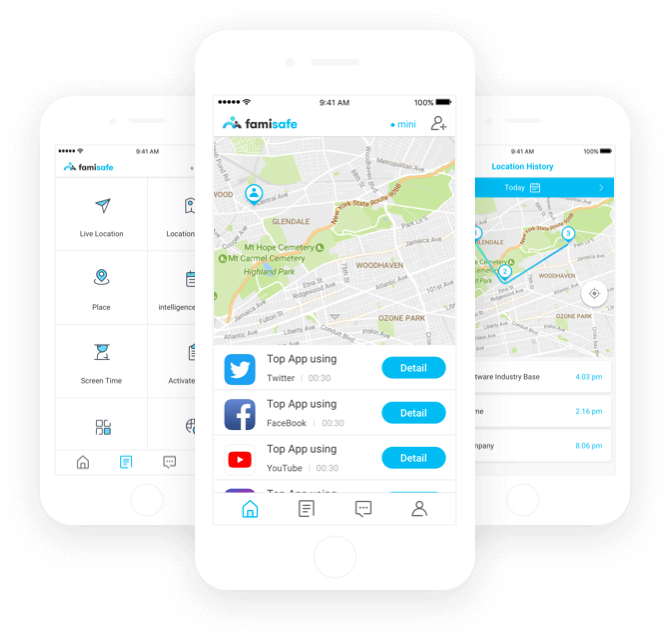
Having an understanding of parent’s concerns, developers of UK based company called WonderShare have come up with an app called FamiSafe. This app will help you protect your child in the virtual world.
You must be wondering how that is possible but looking it is and let us tell you how.
Suspicious Text Alert & Cyberbullying Preventing
If your child by any chance receives inappropriate content like curses, bullying pictures or adult content. The app will notify the parent so that they can rectify the situation.
Real-time Location Tracking & Geo-fencing
FamiSafe app will help you keep track of your child’s location at all times keeping your mind at peace. If in any case you might not be overlooking and your child enters an area that you have marked unsafe by using the geofencing feature. The app will not only notify you but also put an alarm on your phone.
App Blocker & Activity Monitor
Applications and games can be addictive on the phone which can cause harm to your child’s mental health. Hence FamiSafe helps you monitor how much your child is using the app and which app they’re using. Also, with this app, you can block apps off your child’s phone which you don’t want them accessing.
Web Content Filtering
Various websites on the internet are not child-appropriate and as they are innocent. It can have adverse effects on their mental health. FamiSafe will keep your kid away from potential online threats by blocking any unwanted or inappropriate websites with harmful content such as pornography, gambling, violence, etc.
Flexible Remote Control & Personalization Setting
Now you won’t have to take your child’s phone again and again to change the setting you can easily do it using your phone and make changes to the settings as you deem appropriate.
Even with all these amazing features, the app has flexible subscription plans which are as follows
Monthly Subscription Plan
If you opt for their monthly plan it cost only $9.99 and you can avail all their features
Quarterly Subscription Plan
If you opt for their quarterly plan it would cost you only $19.99 which broken down into months cost only $6.66 per month
Yearly Subscription Plan
If you opt for their yearly plan it would cost you $59.99 which when broken down into months costs only $4.99 per month.
However, if you’re still not sure about the app it offers you a free three-day trial with the help of which you can test the app and help you decide whether you want to use the app for your child’s safety or not. But I assure you once you start using it you won’t be able to help yourself
Also to add to the multiple incentives of this app you if you use coupon code ‘SENFSOFF’ you can get a further 20% off on the subscription plans. Knee Pads.
There are lots of enclosures in which for security access should be restricted to unauthorized persons. From physical surveillance, thanks to the development of new technologies, access control systems through electronic devices have been passed. There are different ways to authenticate a person’s permission to access a certain area. The most common was by means of a keyboard, but other types of systems are already being generalized by proximity tags or even biometric variables, more reliable than other systems. In modern industry, everything related to an access permit is very important because any violation of it will cause disaster for the company. Thus investing in related software is recommended regardless of the price to be paid.
There are two large groups of access control systems:
– Autonomous systems: they serve to control one or more accesses, but they are not connected to a PC, so there is no activity log. They are the simplest. – Network access systems: in this case they are interconnected with a PC that, through a specific software, have a control and record of the inputs and outputs with data such as dates, times, etc.
Benefits of access control
To note,access control is a powerful security weapon, but it is not your only advantage. In spaces where the passage of people must be limited, it serves as a barrier to prevent unauthorized access, but example in sensitive areas of hospitals or schools. It also allows controlling the entrances and exits of authorized personnel, so that schedules and their relationship with productivity can be recorded, for example, in authorized departures for breakfast or lunch.
And not only in the pedestrian area, it should be borne in mind that access controls can be installed in places where it is possible to enter by private vehicle, such as, for example, in car parks of companies or public entities. A very particular utility of access control systems must still be taken into account. It is in those places of great affluence of public. Such a system allows the number of people entering the premises to be controlled, so that it is possible that the system will be locked when the maximum number of occupants has been reached and not unlocked until there is no free space.
All these advantages have made access control systems increasingly present in all types of sites, from companies to public buildings, sports centers, places where events are held, etc. In the form of lathes, barriers, swing doors, through card readers, fingerprints or even iris, systems to control inputs and outputs have become essential. And we must not forget that, although they offer many advantages for companies and entities that install them in economic and security matters, they also have them for people in general, who, for example, may not enter carelessly in an area that can be dangerous.
If you want to apply maximum security to your organization, access control is the last thing you want to ignore.
Project management is highly important in organizations. It is also a very necessary tool to develop products or services, projects are becoming a form of strategic work useful to survive in the environment we live today.
Before you start planning a project, you have to know about project management, know what phases make it up and what benefits this management brings. Whether you are getting started in the world of project management or if you have already gained experience, this article is sure to be useful.
The objective that is pursued when project management is carried out, is that an original product be made and that a specific customer need is met. It is usually much more complicated than with the way of marketing the standard, in which a customer buys a product to meet a need.
Project management can be used to generate new services and products, be they development, reorganization or any other type of projects, their management by performing different methodologies aligned with the organizational strategy translates into many advantages for the organization. In addition, it is necessary to serve to manage the change in the company. The software for project management provides different benefits in terms of cost or efficient management of resources, quality or, for example, project compliance, also helps to improve the business itself. Within the context, the use of specific software is the best option for implementing projects efficiently. In many cases, a time management software is needed.
In a basic way, in the same way that a Project manager helps in the design and control of all projects, programs and applications are also a key business management tool for an effective application in the organization.
An adapted software design
Designing a software for project management will be more or less suitable depending on the different characteristics of the project. The development philosophy can obey different basic models, such as:
Waterfall model Prototype model Formal development by stages
They can also be iterative, such as incremental or spiral development. The choice of one or the other is carried out according to the project, in addition the different circumstances and the type of companies in which it should be developed, that is, available time, budgets, customer requirements or objectives that are wanted, must be considered get. A hybrid methodology is also usually chosen if it really adapts to the specific case. Although a priori there is no better option than another, at the time of establishing the software development life cycle each project opts for an approach according to the needs. Compared to traditional solutions, they are associated to the waterfall model, being an agile methodology that is oriented to establish and offer value early. This is a new project management approach that allows changes to be added at any time, in addition to continuous improvement, with the possibility of sticking to time scales and a fixed budget.
Advantages of project managers
The daily work of the project managers makes it necessary that it be carried out optimally, especially when working as a team and that it is necessary that each of the different projects that an organization carries out is controlled. Not surprisingly, meeting all established objectives and efficient project management are essential things to complete them successfully. The application of the appropriate methodology, planning and control will be much simpler through software solutions for project management.
Today, it can be affirmed that project management software is a key element during integral control, effectively and comfortably. The entity covers from the area of planning, development, production and relationship with customers until the coordination of the different projects of the organization is carried out.
Huawei has been spotted selling its flagship laptop series MateBook preinstalled with Deepin Linux in China. Will it be coming to other countries?
Amazingly, some of the best and affordable premium laptops on the market are now shipping with Linux pre-installed. To be specific they are shipping with Deepin, a beautiful and polished desktop Linux distribution. Just like Huawei, they are based in China. As we speak, Huawei is selling three models of MateBook systems with Deepin Linux preinstalled, available at the company’s Chinese shopping site.
No one really knows if this is a result of the ongoing trade feud between the United States and China, but it seems like a great step moving forward for the increase of Linux alternatives promoted by major OEMs like Dell and Lenovo.
The US government even imposed a ban on Huawei earlier this year that sparked a trade war between China and United States of America. Google banned Huawei from using Android and other Google services like Play Store, Gmail etc on Huawei devices. Although it is still not clear if the ban will ever be discontinued as Huawei’s reprieve ends in November.
Maybe one of the main draws for Huawei to Deepin is the recently added Cloud Sync feature allowing you to sync various system settings to the cloud. This covers network settings (such as VPN and WiFi), sound settings, mouse settings, update settings, power settings, corner settings, theme, wallpaper, launcher, and dock. Definitely useful for installing the OS on multiple machines, or easily regaining your customizations after a clean install.
As much as Huawei devices are not all that cheap in terms of pricing, they are by far less expensive than Apple products yet still high-end gadgets. The Huawei MateBook products are available on Amazon but not yet preinstalled with Linux.
Disappointing but, right now these select Huawei laptops with Linux are only rolling out in China, via Huawei’s official e-commerce store VMall.com.
The exact models available with Deepin Linux are the Huawei MateBook X Pro, Huawei MateBook 13 and Huawei MateBook 14. It’s also worth noting that all three of these Huawei laptops run any Linux distribution like a dream, and not just Deepin.
Will we be seeing Linux option on Huawei MateBook in other countries soon? That is something we will keep you up to date on as there is no official announcement from Huawei in this regard so we can only guess at present.
Although this could probably just be a precursor to Huawei offering Linux on select laptops globally. Or it’s possibly a trial run to gauge interest in alternatives to Windows 10, such as its own open-source HarmonyOS.
Cellulant, a pan-African payments firm last evening received the most effective recovery of the year 2019 award from Africa’s Business Continuity Institute Awards (BCI) in Johannesburg, South Africa.
Cellulant received the award for resilience and business continuity following the 15th January terrorist attack at the Dusit Complex that took the lives of 6 staff members.
The BCI Awards is the most prestigious event globally in the business continuity calendar and honours business continuity and resilience professionals and organizations worldwide.
Cellulant wins BCI Africa Award for most effective recovery 2019
Speaking during the award ceremony in Johannesburg South Africa, Cellulant’s Group Head of Technical Operations, George Murage dedicated the award as a tribute to the memory of the Brave 6 who, through their sheer valiance, laid their lives on the line to save their colleagues.
Winners of the BCI Africa awards are automatically entered into the BCI Global Awards that takes place in London each November as part of the BCI Gala Dinner and Awards Ceremony.
Cellulant, Africa’s Phoenix
Despite Cellulant suffering the most number of casualties, from the January terrorist attack at their Kenyan Headquarters, the company became Africa’s phoenix. Their rise from the rubble and ashes at 14 Riverside to their current temporary offices at Delta and West End Towers was through sheer determination, an undying spirit and putting its people first.
Cellulant’s Kenya team at their new temporary offices in West End Towers, Waiyaki Way
TechMoran caught up with Murage for a comment following the award announcement on what it took for the company to recover, how they were able to maintain business continuity and sustain operations.
TechMoran: Cellulant’s payment gateway is one of the major backbones for mobile and online payments in Africa. The events of January dealt a heavy blow with the heaviest toll being the technical departments, how well prepare were you, what are some of the actions you took immediately and afterwards to ensure business continuity, service delivery and assurance to your customers and partners.
Murage: Cellulant has since its inception succeeded in bestowing a very family-oriented culture among its staff. This is one of the main things that helped us ride out the storm. That staff were able to reach out to one another, mourn, console and commiserate with the families that were affected directly by the tragedy. This put a very human face to what was going on. Immediately after the tragedy, we adopted a company-wide counselling program that was mandatory for all staff. At a very basic level, a business is about the people first.
We were thus very clear from the get-go that if our people were not doing well then the business would break. Our priority was thus to literary put our arms around our various teams and assure them that they were not going through this alone and that the business would be there for them, not just through the tragedy but for as long as we had to for the staff to be at a better place, not to work, but because at Cellulant, we look at people as human beings first.
We were fortunate that we have world-class Pan-African talent. We therefore brought in personnel from our other markets in Africa to staff our service desk and to pick up critical functions. We had another layer of a technical team of engineers and developers from Ghana, Zambia, and Uganda to provide cover for the Kenyan technical teams.
One of the biggest moments of retrospective pride for us post January 15th was that, in building out our technology infrastructure, we didn’t want it to be based in one location or in our office. Thus we had distributed our infrastructure to co-location sites. We also use various cloud providers. The only service that was localised within our 14 Riverside headquarters was our telephony which we were able to get back up within a few days following the incident. We did however communicate relentlessly with our customers to inform them that the occurrence had not affected any elements of our service delivery to them.
We had good relationships with our providers such as Internet solutions who came to our aid with co-location space. Various other partners and suppliers offered assistance with whatever they could help to ensure that we got back on our feet. It was very encouraging that most of our suppliers and partners called to offer help with sitting space, co-location and other critical amenities.
Winning this is a great way to uphold the legacy of our Brave 6 whose work continues to transform millions of lives across Africa.
Since January 15th, Cellulant has continued to stand strong and pushed the boundaries on what it means to be a people-first company. Since then, the company continues to stand with the families of the Brave Six and has opened channels for the public to do the same. In honor of the work of the brave 6 they set up a fundraising channel using their last software masterpiece- Mula (now rebranding to Tingg), with the goal of ensuring that the children left behind will be educated, the families receive healthcare and they have shelter for the foreseeable future.
Whether you want to make your home smarter or enhance your smartphone’s usability, technological advancement has come to encompass every need of yours irrespective of how intricate or how simplistic that may be. To the point the gadgets you felt you saw only in pop culture movies are turning into a reality.
Innovative gadgets, while expensive, give a boost to your productivity levels at your workplace and otherwise. The future IS tech and both individuals and organizations need to adopt the modern day changes solely for their own betterment.
Without further ado, if you are curious to know what these emerging tech gadgets are – here is the list with the top 10 futuristic devices to cater to your interest.
1. Zungle Bone Conduction Audio Sunglasses
Audio sunglasses? Sounds like something straight out of the future ain’t it? Zungle has launched a new way to enjoy music in style. Zungle sunglasses are integrated with bone conduction speakers, a technology initially developed for medical purposes which has now shifted towards headphones and speakers. These speakers are not the only unique attribute of these sunglasses. You are given full AI voice control and UV ray protection too. Hence, this futuristic gadget tends to combine both entertainment and eyewear protection.
2. JUNO Smart Makeup Mirror
$79 for a makeup mirror does sound expensive but wait until you realize what this small mirror has to offer. The JUNO smart mirror is attached with three varying levels of lighting perfect for any time of the day. Whether you are sitting in a sun kissed room or a dimly lit area, the smart mirror helps you find the best lighting according to your current light mode. A storage tray is an additional attribute where you can keep your on-the-go makeup items.
3. Sgnl For Quick Phone Calls
While you might think you have seen a similar gadget in the movie Matrix, Sgnl is a smart strap which allows you to make phone calls with the tip of your finger. Can’t believe it? Watch this video and you will. Whenever you receive an incoming call, you can place your fingerprint to your ear and use the built-in microphone to answer. Setting up Sgnl is quite easy as you only require a strong Bluetooth connection.
4. Smart Nora Noise Reduction
Fed up with your significant other’s constant snoring? Well worry no more, Smart Nora is equipped with the solution you have been looking for to be able to sleep peacefully. The device is set up in three different steps. First, you place the ‘Pillow Insert’ under the pillow and the ‘Pebble’ microphone somewhere near your bed such as on a table nearby. Finally, place the ‘Base’ under the bed and it will reduce snoring noise overall. If you think spending $359 is worth sleeping in peace then it would make a pretty cool gift for your partner’s upcoming birthday.
5. Ili Portable Language Translator
You have made travel plans with your friends but concerned about how you will converse while traveling? Ili is a portable online translation device solely designed for travelers. It takes Ili only 0.2 seconds to detect voice input, recognize the language and play the relevant translation through the speaker. Surprisingly, the device requires no Wi-Fi connection so you can take it with you on the subway, to an eatery or a sightseeing spot without having to worry about communicating in a foreign language.
6. SpotMini Intelligent Robot Dog
Are you someone who is eager to keep pets but due to circumstances cannot? Won’t it be cool if you owned a pet ‘robot’? Well, SpotMini is an intelligent robot replicated to act just how a real pet dog would. If you instruct Spot to climb the stairs, it will. If you instruct it to pick up a certain item, it will. It brings a very fun twist to the smart gadgets of today. Surely, the concept of a smart vacuum cleaner or any other smart home appliance is overused. So why not spend your leisure time at home with a robot trotting around.
7. Muzo Vibration Monitoring System
Tired of uninvited disturbances? Muzo has the solution you are looking for. This vibration monitoring system turns any smooth surface into a personalized acoustic environment where you have full control over outside noise, vibrations and sound speed. Certainly, you crave for a time where you can relax and get lost in your thoughts and that’s exactly the core foundation of Muzo’s design. Simply stick the device to a window or any nearby flat surface and experience complete noise reduction – you will find yourself surrounded by total serenity.
8. ORII Voice Assistant Ring
It has become common practice to rely on the built-in voice assistants in your smartphone but at some point or the other, you do become bored of it. ORII, deemed as the ultimate voice assistant ring, uses the same technology but with more portability and comfort. Designed to eliminate the hassle of constantly checking your phone for messages, notifications and phone calls, simply integrate ORII with your phone and acquire the very same features as of your smartphone without having to take it out.
9. Capstone Connected Home Smart Mirror
A smart home device in the form of a mirror, Capstone Connected has released its very first smart mirror integrated with Google support. You can install the mirror on any smooth surface, preferably clear glass or a window. The smart mirror comes with a carbon steel stand, which ensures its durability. Since it is an inter-connected mirror, it requires a stable internet connection. So, before you integrate it with your Google Voice Assistant or run pertinent applications, make sure your internet connection is as stable as the ones offered through buytvinternetphone.
10. Mui Interactive Smart Display
A smart interactive display on a wooden plank..? Futuristic? Unquestionably! Since it is shaped like a wooden plank it does seem a bit odd. But in reality, Mui smart display is an interactive interface, which allows you to not only connect to the internet but also control your home appliances as well as your frequently used smartphone widgets. Suppose, you want to know what time it is or the current weather, simply connect your smartphone’s Google Assistant to Mui, and use the speaker to transfer your instructions over and view the relevant answers on the display.
After a year of Apple’s iPhone 11 rumors, supply chain chatter, mockups, and renders, at a special event on Tuesday, the company unveiled the long-awaited 2019 iPhone lineup; iPhone 11 Pro, iPhone 11 Pro Max, and iPhone 11.
Apple’s new flagship phones need to be compelling enough to draw in new customers or keep current customers interested. Not forgetting that it’s rival Samsung took the capes off its Note 10 Series on Aug. 7, and the phones are looking pretty great so far.
Getting back to this year’s iPhone lineup, we must have all wondered, what the difference is between the iPhone 11, iPhone 11 Pro, and iPhone 11 Pro.
This iPhone line-up features the powerful new A13 Bionic processor, multiple rear cameras and a pack of the camera and video tools like Night Mode.
Apple claims that its new processor, the A13 Bionic is the fastest CPU and GPU in a smartphone. It is powered by 7-nanometer architecture and packs 8.5 billion transistors into the package. This is a massive upgrade compared to the A12 Bionic, which had 6.9 billion transistors.
The A13 Bionic features four high-efficiency cores which are 20 percent faster and consume 40 percent less battery power than the previous generation, and two high-performance cores, which are 20 percent faster and 30 percent more efficient than the A12 Bionic.
The GPU is also 20 percent faster and 40 percent more efficient, while the neural engine comes equipped with eight cores, is 20 percent faster and consumes 15 percent less power.
Here are the different new features, the tech specs, and, importantly, the prices.
The iPhone 11, iPhone 11 Pro and iPhone 11 Pro Max start at $699, $999 and $1,099, respectively. Preorders begin Friday (Tomorrow, Sept 13) and they’ll be available in stores on Sept. 20.
iPhone 11 lineup prices
The major difference that stands out between the 3 is that the iPhone 11 comes with a 6.1-inch LCD display, while the iPhone 11 Pro and iPhone 11 Pro Max come with Super Retina XDR 5.8-inch and 6.5-inch OLED displays, respectively.
Another quite obvious and yet major difference is that the iPhone 11 has two cameras; a wide and ultra-wide, while the iPhone 11 Pro and iPhone 11 Pro Max come with three; wide, ultra-wide, and telephoto.
The phone’s capacities are another important difference. All start with 64GB of storage, but the iPhone 11 also comes with 128GB and 256GB storage, while the Pro versions are available in 256GB and 512GB.
iPhone 11 Specs and features
iPhone 11 6 new colors
6.1-inch LED Retina display
Anodized aluminum
Six new colors
Dolby Atmos
12-megapixel wide camera (26-mm, f1.8, 6-element)
12-megapixel ultra-wide camera (13-mm, f2.4, 5-element, 120-degree view)
Updated image signal processing
Next-generation smart HDR
Portrait Lighting with Light Control
Night mode for low-light photography
4k video at 60fps
12-megapixel front-facing TrueDepth camera with 4K video support and slo-mo selfies (slofies)
A13 Bionic processor (fastest CPU and GPU in a smartphone)
All-day battery life (1 hour more battery life than the iPhone XR)
iPhone 11 Pro & iPhone 11 Pro Max, Specs and features
iPhone 11 Pro and Pro Max color variants
New finishes: Space grey, silver, gold, and midnight green.
5.8- and 6.5-inch Super Retina XDR display, highest pixel density of any display Apple makes
A13 Bionic processor with new Machine Learning Controller and low-power design (most efficient 7nm architecture, 8.5 billion transistors)
All-day battery life (4 hours more battery life than the iPhone XS)
Fast-charge 18W adapter included
12-megapixel wide camera (26-mm, f1.8, 6-element)
12-megapixel telephoto (52-mm, f2.0, 6-element)
12-megapixel ultra-wide camera (13-mm, f2.4, 5-element, 120-degree view)
4K 60fps extended dynamic range video
12-megapixel front-facing TrueDepth camera with 4K video support and slo-mo selfies (slofies)
The 2019 lineup of iPhones compared to last year’s models, all have a 12-megapixel selfie camera that’s been bumped up from last year’s 7-megapixel lens. Each iPhone also has one additional rear camera compared to its 2018 counterpart.
We’ve prepared a chart below for you to see how else they compare to the iPhone XR, XS, and XS Max.
Following the launch of Android 10 last week, many users have been waiting for all of Google’s apps to offer dark mode.
The company teased the dark-themed Gmail app along with others on the Android website when Android 10 launched Sept. 3. But Reddit users were among the first to note that the app had been changed via a server-side update, XDADevelopers reported.
A catch to this is that this is for the Android version of the app only, and you’ll need to be running Android 10. Android 10 will make its way to other Android phones besides the Google Pixel later this year.
Although Android 10 has its own system-wide dark mode, Google had also planned to put up dark mode options for its first-party apps, though dark modes for some features like Gmail and the Google Play Store weren’t ready in time for the Android 10 release. But one week after the launch of Android 10, the latter is finally getting its promised dark theme update.
Similar to other Google apps in recent months, there are three theme options in Gmail: Light, Dark, and System default. The dark theme is pretty straightforward, with the email client adopting a dark grey for the background and navigation drawer.
A red accent color is still leveraged in that latter part of the UI to note what inbox you’re viewing. Other elements like the search bar use a lighter shade of grey to provide a better visual distinction.
Avatars, labels, and other colors in the inbox view have been appropriately tweaked to be less bright and more muted. A similar treatment is applied for all icons and buttons throughout the Android app.
Gmail’s dark theme also extends to the compose screen and messages. While the body of an email leverages white text, signatures can be harder to see.
Version 2019.08.18.267044774 of Gmail is required with that release and it’s now widely available via the Play Store, which is still very white!
Why we might not have seen a similar dark mode roll out for the Play Store app yet might have to do with the interface that relies in large part on the presence of all the app icons, but that’s just a guess as to why that one still hasn’t arrived. Nonetheless, it is positively welcome to see another key app adjust and offer users the choice of an option that’s easier on the eyes.
Considering that Android 10 came with a system-wide dark mode, we’re also now a week out from the release of iOS 13 which will certainly bring a system-wide dark mode to iOS devices. That’s something Apple teased earlier this year in its iOS walkthrough.
Apple in early June this year announced plans to launch a new period-tracking app known as Cycle Tracking that will allow users to record their menstrual cycles and receive notifications when they are fertile.
The new app will be live on September 16, when iOS 13 and WatchOS 6 (for Apple Watch Series 3 and later) will be available to the public. On the Apple Watch, it is a standalone app, while on the iPhone it is built into the Health app.
Together with this new update, Apple is rolling out three health studies that tie into the company’s focus on health:
Apple Hearing Study with the World Health Organization and the University of Michigan,
Apple Women’s Health Study with Harvard and National Institutes of Health, and
Apple Heart and Movement Study with the American Heart Association and Brigham and Women’s Hospital.
You can enroll in studies through the Apple research app later this year.
In the menstrual cycle and ovulation tracking platform, Apple has slackened as compared to other wellness wearables. Fitbit launched its period tracking capability about a year ago. And 10 million users have leveraged the feature, the company said in data provided to MedTech Dive. Garmin also unveiled a similar capacity for Garmin Connect users at the end of April.
Menstrual cycle tracking is an important way for every lady to keep tabs on their health. This is because knowing when your next cycle starts not only helps you always be prepared, but it’s also useful if you are trying to conceive, or are living with conditions like polycystic ovarian syndrome (PCOS) and endometriosis.
“Knowing more about your menstrual cycle gives you a window into your health – from simply ensuring that you’re prepared to understand your personal patterns and irregularities,” said Apple’s VP of Health, Dr. Sumbul Desai at WWDC. She added the new feature “gives you a simple, discreet way to visualize your cycle right on your wrist.”
“As a physician I know that understanding what’s normal for you is critical when making informed clinical decisions, and can really enrich your conversations with your doctor.”
Dr. Sumbul Desai.
Considering that there are diverse App Store alternatives to Apple’s Cycle Tracking, some have taken the heat in recent months for sharing personal data.
Back in February, the Wall Street Journal reported that Flo, a cycle tracking and reproductive health insights app that says it has more than 28 million active monthly users, shared information with Facebook when a user tracked a period or indicated the intention to get pregnant.
Shortly after that in a data privacy statement, Flo said that it had never sold any data point to Facebook as well as never used data from Facebook Analytics for advertisement, and added that it requested all user data be deleted from Facebook Analytics.
Although Apple noted in its presentation at the WWDC that information from Cycle Tracking will be encrypted on-device, and in iCloud in cases when users choose to back up their data.
How to use Apple’s Cycle Tracking app.
Apple’s Cycle Tracking feature is contained within the Health app on iPhone and Apple Watch.
It presents a visual representation of your cycle, with period days shown with a red dot, and fertile days represented with a blue dot.
Some of the days on either side of the period window will be lightly shaded red, to indicate possible period days. In cases where you have an irregular period, the number of shaded days will increase.
Amazingly it is also easy to understand Cycle Tracking from the second youll start using it. It uses straight-forward, plain language to avoid any confusion about what may be going on. There is currently an article within Cycle called “Understanding Your Menstrual Cycle,” which gives a brief run-down of any questions a user may have about their body, perfect for younger users who may still be getting used to the routine.
Users will be able to log key aspects of their period and fertility, including symptoms, and can be notified when it’s about to begin. This information will then be used to provide fertile window predictions, so users are better informed about their chances of getting pregnant.
There’s lots to track in Cycle as well, such as breast tenderness, headaches, and acne. If you’re someone who experiences a lot of symptoms during PMS, your period, or ovulation, this is especially convenient to allow you prepare in advance.
At the start of your period, you can log your flow level and symptoms like cramps or headaches in the Cycle Tracking app. The app will predict when your next period will begin and when you’re ovulating as you log information about your cycle. Thereafter notifications on your iPhone and/or Apple Watch will be generated.
You can log symptoms from your Apple Watch
Fertility stats like basal body temperature or the results from an ovulation test can also be logged as the app uses that information to create a fertility window; the few days each month when you’re most likely to get pregnant. You can see an overview of your cycle in the Apple Health iPhone app, and you can log symptoms directly from your Apple Watch.
A calendar view will also be available so that users will be able to see predictions for their next two periods, based on data they have logged historically.
There is also a statistics page that compiles your typical period length, along with any cycle variations.
Apple’s Cycle Tracking follows a model very similar to other menstruation-tracking apps such as Clue and Eve, both of which use the data you enter to predict when your period will arrive and when you’re ovulating
Clue, which said it currently has 11 million users after becoming the first menstrual cycle tracking app to integrate into Apple’s iOS 9 HealthKit, has “always maintained a positive relationship with Apple” and welcomes “anything which drives the sector forward,” ‘femtech’ advocate and Clue CEO Ida Tin said in a statement emailed to MedTech Dive.
Other health updates for Apple Watch announced, include a Noise app designed to alert users in environments with decibel levels that could be damaging to hearing health, and new trends tracking feature in the Activity app that compares users’ short-term activity behavior to data from the previous year.
“Apple Watch is the most advanced and most loved smartwatch in the world.”
HotelOnline and Key Butler have agreed to merge their Norwegian entities in a European market consolidation move.
Key Butler and HotelOnline merger will form Stay Plus and will target the Scandinavian rental market. only. HotelOmlome will maintain its operations in Africa.
Led by Tore Hofstad, the Chairman of HotelOnline, and a key investor and a former chairman of British-Norwegian traveltech New Mind tellUs, Stay Plus aims to be the biggest platform in the Nordic market.
“Our ambition is to become a leading player in the Nordic market for short-term home rentals”, said Stay Plus Chairman Tore Hofstad. He is also the Chairman of HotelOnline, and a key investor. Hofstad contributed to the 2018 New Mind tellUs merger with Simpleview, creating the world’s largest Destination Marketing Company.
Founded by Norwegian entrepreneurs Endre Opdal and Håvar Bauck, HotelOnline’s Nordic operations include Cityhotels.com (a Nordic OTA), Solferie (a Norwegian vacation rental business ) and the Guestmaker booking technology.
Signing the merger agreement
The new company will be known as Stay Plus and will target the major cities in Norway from the moment go, as well as vacation homes across the country.
“While most homeowners still primarily look to AirBnB for such rentals, Stay Plus will use all major online channels, including Expedia, Booking.com and CTrip, said Klaus Hjermann, new GM Stay Plus.
Stay Plus will offer a turnkey rental solution which includes cleaning, maintenance and key delivery. Hjermann also brings his own rental business, Hjermann Forvaltning into the transaction.
HotelOnline will remain the majority shareholder in Stay Plus. The two companies will remain tightly integrated, and the operations of Stay Plus will be based on HotelOnline’s solutions.
“Our offices in Nairobi, Lagos and Dakar will also be the backoffice of Stay Plus. As for HotelOnline, we will continue focusing on our core markets in Africa and Pakistan, where we see massive growth opportunities”, said HotelOnline co-founder Håvar Bauck.
HotelOnline was founded in 2014 by Endre Opdal and Håvar Bauck to provide e-commerce and digital marketing solutions to small and medium-sized hotels in Africa.
Earlier this year, HotelOnline raised USD 320,000 from a group of investors which included Shravan Shroff, known as the first investor in traveltech unicorn OYO Rooms. The group also included high-profile Norwegian angel investor Trond Riiber Knudsen. Endre and Bauck were among the first entrepreneurs in Africa to have successfully carried out an equity crowdfunding, in 2017.
Technology permeates our lives in almost all spheres today, like for instance from the way we communicate with our friends or close ones to pre-bookings involved when travelling elsewhere. Hence, the fact that technology is also changing the way how enterprises offer corporate training to its employees is not astonishing at all. Giving up the traditional classroom-based approach, organisations have started to opt for technology-enabled classroom learning, thereby giving rise to the trend of e-learning at the workplace.
While this may mean incorporating various authoring tools, employers must go the extra mile and make sure to invest in the development of their assets. Initially, organisations may go ahead with different elearning authoring tools with free license catering to the different needs of its employees. So, to enhance your knowledge in regard to the latest digital transformation, mentioned below are the pros and cons of choosing an e-learning solution for corporate training.
Pros of E-learning: The Corporate Upscaling
When it comes to learning digital and technological skills, e-learning is the method of choice because of the reasons mentioned below.
Easy Access and Scalability: This is one of the most valuable benefits of the program since it is easily accessible to a wide audience just via internet and cloud computing. And, it is extremely beneficial for multinational companies with employees in different continents as they can be provided with the same training material and be equipped with the same knowledge in their own time zones.
Cost Effective: Lower cost involved in elearning is its key advantage as you only have to pay just for the authoring tool and involves no additional costs like that of an instructor or any equipment as witnessed in the traditional classroom training method. Additionally, its cost is inclusive of all the latest updates in the process and you can also opt for elearning authoring tools with free trial initially.
Ease of Use: Given how much we consume technology on a daily basis and how familiar we are with different software applications today, e-learning is no challenge then. By choosing a user-friendly program, organisations can ensure that its employees can easily navigate their way around and learn to use it quickly.
Tailor Made for Businesses: E-learning programs are highly customisable and can be tailored as per your requirements in terms of cost, function, and pretty much everything else. Additionally, these can also be tailored to your employees’ needs at any given point in time, if employees think they are aware of certain topics, they can just skim through it and do not necessarily have to spend extra time on the same. They also get to learn at their own pace which makes it easier for them to balance their work and deadlines simultaneously.
Cons of E-Learning: The Corporate Upheaval
While there are so many advantages associated with e-learning, it is not necessary that it shall fit everyone hence, certain limitations for the program have been summed up below.
One size doesn’t fit all: One of the major disadvantages of e-learning is that this learning style might not be preferred by everyone as it does not appeal to them. Although the majority today is tech savvy and appreciates flexibility, there are people who still opt for classroom based training due to different reasons including more opportunities for interaction with different learners.
Technology Issues: While the idea of using technology is exciting for some, it can be daunting for others as not everyone is a tech-savvy or is comfortable relying too much on technology. Alongside, other potential technological issues include specific browser requirements, slow internet connectivity or a poor device compatibility.
Lack of control: With the approach of e-learning, employers are giving control to the employees to enhance their knowledge at their own pace and in their own time. However this flexibility might have its downsides as there can be times when employees simply go through the material just for the sake of it without really paying attention. This lack of control over employee learning can prove to be a major disadvantage.
Now that you’re aware of the major advantages as well as a few disadvantages associated with this approach, you can easily pick for yourself. However, you must also note that e-learning, when strategically and correctly implemented can step up the corporate training game of any organisation.