Technology has moved at an astounding pace over the last 50 years hasn’t it? It is mind boggling to think that the internet only opened to the public in 1991. It isn’t even so long ago that the world didn’t have mobile phones and social media. What did our thumbs even do before then?!
There’s no doubt, the world of technology is transforming life as we know it.
Here are five incredibly cool technologies that are radically changing how we live today:
Remote Home Locking Systems
Home security used to mean lock and key on a door or a window, built-in or in addition to the physical locks that are present. These days, home security is much more advanced. For example: you can now buy smart bluetooth door locks which enable you to operate your home security remotely from your mobile phone. Home security technology is truly moving into the spotlight at the moment, as homeowners embrace the latest devices to help them keep their property safe.
Robot Vacuum Cleaners
Did you know, Americans spend nearly 6 hours a week cleaning? Robot vacuum cleaners are now taking away some of the strain. Within the last few years, these smart devices have gone from the exclusive domain of the wealthy, to being readily available and within budget for many. Even better, the 49+ million Americans living with disabilities are able to benefit from these and other smart domestic devices, improving overall quality of life day to day.
Fitness Trackers & Smart Watches
Over 800 million people will own fitness trackers by 2020, a key device in the worldwide health trend. The future of smart fitness accessories could have even more of an impact on our lives, with more precise readers and monitors. Currently, patients can identify that they may have a heart problem thanks to developments like the Apple Watch Series 4 with FDA-approved ECG technology. Devices such as this can help millions gain more control over their health and wellbeing.
Virtual Reality
Virtual reality masks were actually invented in the late 60’s, but only recently have they really come into their own. Virtual reality is set to become more realistic and available everywhere. Now, you can use it at home or in special arcades. However, with the addition of 5G, there will be more ability to utilise the cloud in conjunction with portable headsets. At the moment, The technology is mostly limited to VR compatible games, as well as a small number of immersive events and social VR groups. In the future, however, there’s every reason to expect that there could be an entire VR universe like that of film Ready Player One, enabling users to have VR romances, friends and even careers.
Human-Free Retail
There’s already a foretaste of human-free retail in developed countries via self-serve checkouts. Of course, the fact that 95% of purchases will be online by 2040 tells us that brick and mortar retail is becoming far less relevant in our society. However, true human-free retail promises to be a total game-changer. Standard Cognition, Amazon and Zippin are all putting out completely human-free stores you use via a compatible app. You’re monitored via cameras, select the items you want and leave having paid via the app, which also sends you a receipt straight to your inbox.
It is hard to imagine what the world is going to be like in 10 years, 20 years and beyond. In the meantime, we can all enjoy the new conveniences, insights and ease the latest devices provide, which is if anything, a lot of fun, something we could all definitely do with more of.
Chivas Venture, a $1 million global startup competition looking for social startups that blend profit and purpose has launched applications for its 2020 competition.
The 6th edition of Chivas venture is targeting entrepreneurs who are using business to change the world for the better. Like the previous editions, startups stand a chance to win training, funding, and exposure on a global scale.
In a statement, Jean-Christophe Coutures, Chairman and CEO of Chivas Brothers, parent company of Chivas, said: “As we kick off the sixth year of the competition, it is incredibly uplifting to know that so many entrepreneurs across the world are continuing to use business to tackle a whole host of social and environmental issues that threaten our future on this planet.”
To date, Chivas Venture finalists have provided over 34 million litres of safe drinking water, recycled over 1,300 tonnes of waste and provided 75,000 days of education for women and girls.
Sanivation represented Kenya in the 2017 Chivas The Venture global final in Los Angeles competing with 29 other finalists from across six continents for a chance to win a share of a $1 million fund.
“That’s why, through the Chivas Venture, we want to continue to harness the power of the world’s purpose-driven innovators, and help accelerate their impact,” added Coutures.
Ahead of the Chivas Venture Global Final the winning finalist from each participating country will take part in an initial round of public voting for a share of the funding. The finalists will then battle it out at the Global Final for the remainder of the $1m fund.
In 2019, Mexico’s Xilinat received the largest share of the fund, with founder Javier Larragoiti receiving $310,000 towards his business that aims to change the sugar industry. Change Please was the Chivas Venture 2018 winner and was founded by Cemal Ezel.
The tech giant unveiled three new smartphones, a new Apple Watch and more.
Apple unveiled its 2019 iPhone lineup: the iPhone 11 Pro, 11 Pro Max and, iPhone 11.
At the Apple Event this year, which took place yesterday (Sept 10), Apple slightly reshuffled its phone lineup by having all three models called “iPhone 11“. The company refreshed its line of iPhones for 2019 announcing the iPhone 11,iPhone 11 Pro and iPhone 11 Pro Max.
These iPhone’s pricing starts at $699, $999 and $1,099, respectively and this is a unusual price in a world where we’re used to spending $1,000 for an iPhone.
The new iPhones also pick up a fresh palette of colors, longer battery life and an A13 Bionic processor inside that guarantees faster performance. However, more than any other feature, it’s the camera hardware and software that take the leading role on the headlines. On the rear of the Pro phones, there are three cameras and two on the rear of the iPhone 11.
iPhone 11
The iPhone 11 is the successor of the iPhone XR featuring a 6.1-inch LCD display and Apple’s new A13 Bionic processor and GPU costing $50 less than last year’s iPhone XR. Its new chipset is both more powerful and more efficient, which is enough to extend battery life by another hour over the XR. Apple also upgraded the rear camera with a 12-megapixel ultra-wide lens for dual-lens action and Night Mode.
iPhone 11 in six color shades
Apart from the iPhone 11’s dual-camera system, a highlight on it is a feature that will come on all of the new iPhones, the slow-mo selfie videos that Apple has dubbed “slofies.” You can get its aluminum frame in six shades
iPhone 11 Pro and iPhone 11 Pro Max
The 11 Pro models are direct successors to last year’s iPhone XS
phones. The iPhone 11 Pro and Pro Max are powered by Apple’s new A13 Bionic processor, which reportedly is around 20 percent faster than the A12 when it comes to CPU and GPU speeds. Big benefits of the Pro models are the triple camera system; whereby each has a three-camera system, complete with a telephoto, ultra-wide, and regular lenses.
Apple touted that each of the three cameras is capable of shooting in 4K resolution at 60 frames per second, and an onstage demo showed that upcoming software can record different subjects through each lens.
https://youtu.be/cVEemOmHw9Y
The triple cameras are housed in the ugly square camera hump that was rumored months ago, and an upcoming feature called Deep Fusion will use all three at once and then stitch the results together for higher-quality photos.
Another big benefit of the phones is the glorious new Super Retina OLED screens with a 2,000,000:1 contrast ratio and up to 1,200 nits of brightness.
iPhone 11 Pro and Pro Max color variants
The iPhone 11 Pro has a 5.8-inch OLED, and the Pro Max has a 6.5-inch OLED. Additionally, these phones are Apple’s first to come with an 18W fast charger packed in. Both smartphones feature stainless steel cases with a new optical PVD coating for a matte texture. Available in four colors, customers will be able to choose between last year’s colors and a new midnight green.
The Seventh-Gen iPad gets an upgrade
At the 2019 Apple Event, a new entry-level tablet was also unveiled, the iPad 10.2. The new seventh-generation model is 10.2 inches, moving up from the standard 9.7-inch display size and starts at the same price of $329.
A few improvements over the last-generation iPad is that the seventh-generation model has an A10 Bionic processor, which was originally launched in the iPhone 7. It also gets support for the Apple Pencil and has a Smart Connector for you to use with Apple’s magnetically attachable Smart Keyboard cover.
First Apple Watch to support the always-on display function
The new Apple Watch Series 5 which doesn’t look much different from last year’s model houses a few new tricks on the inside. Uniquely, it’s the first Apple Watch to support the always-on display function.
Thanks to more efficient components, the watch offers “all-day” battery life (18 hours), this is because, instead of limiting what’s shown on the display to extend battery life, like most other smartwatches, the Series 5 dims the brightness, while retaining all of the same visuals you’d normally see while using it.
The Series 5 Watch costs $399 for the GPS model and $499 for the GPS + LTE model. Nevertheless, it’s the first Apple Watch to be released with ceramic and titanium finishes, although the prices to these weren’t shared onstage and are expected to be pricier.
Apple TV+ One year trial on Apple purchases
Apple’s original streaming service, Apple TV Plus will launch on November 1st in 100 countries, costing $4.99 per month.
Apple TV+ subscription can be split between up six family members and will be significantly cheaper than the cost of Netflix’s cheapest plan, which is $8.99 in the US.
In an effort to lure subscribers, the company announced a big surprise at the Apple Event which is that a year-long subscription to Apple TV Plus will be included for free if you buy a new Apple product, including new iPads, iPhones, laptops, or desktops. Although considering how the African market misses out on such deals, we are yet to confirm if this applies worldwide or for specific markets.
Many people still don’t understand how making money by posting photos and content on social media. In simple terms, people who are known to have expertise in certain areas keep posting content about what their passionate about then the next thing they get more views then finally they might attract followers and even get commercial work. Of course it’s not as simple as a,b,c, you need to be strategic and plan your content ahead of time.
1. Digital products
Digital products are basically e-products which can be sold online. E-products can be anything from an ebook, downloadable travel guide or workout program, to a one-page meal plan or organizational template.
2. Brand ambassador
Ever noticed some influencers keep pushing certain products? Well, they are usually paid to do that. Brand ambassadors are employed by the brand when they are naturally a good fit and align well with the brand and the target market. They are paid and sometimes given free products so that they can easily advertise their work.
3. Social media sponsored posts
Sponsored posts are usually used for short-term, in this case an inluencer is meant to incorporate the product in his/her posts. You need to develop unique imagery and promote a product
4. Affiliate marketing
This is where you sell a product and get a commission from the product you sell so it’s really about the effort you put in.Affiliate marketing is typically on a pay-per-sale, pay-per-click or pay-per-lead model.
IFA 2019 is wrapping up and we can now drool over all the announcements from one of the world’s biggest annual tech events. A few new phones were announced from some of the biggest companies like Samsung, Nokia and Motorola, and a returning foldable device that we first saw for a minute almost five months ago.
Europe’s biggest electronics show, IFA, isn’t big on phones, but that didn’t stop companies from talking about a major new wireless technology: 5G. However, unlike other trade shows such as Mobile World Congress (MWC), which is an annual show with more of the focus on smartphones, IFA’s 5G focus wasn’t on high-end, expensive 5G phones. Fairly, it was all about making 5G more accessible to the rest of us.
A dominant theme among the IFA 2019 smartphones was that they’re all at the cheaper end of the market, less than $1,000. Well, except for the $2,000 revamped Galaxy Fold. But most of the announced phones were all the kind of phones that most people will buy.
IFA saw the debut of a cheaper 5G phone from Samsung at a time the electronics giant has been releasing pricier products such as the Galaxy Note 10 series. Also, companies like Motorola and Nokia phone maker HMD swore to introduce devices next year that cost less than most 5G phones now.
Mobile chip giant Qualcomm stated it will bring 5G to its cheaper Snapdragon processors for phones next year, while chip rivals Samsung and Huawei made updates to their own 5G modems with integrated versions that typically bring down the cost.
“We accelerated the launch of 5G to 2019, and now we’re accelerating the scaling of 5G.” Qualcomm President Cristiano Amon said in an interview Friday at IFA.
In case you missed out on the electronics show, here’s a recap of what you might have missed from the smartphone announcements.
Samsung
Samsung Galaxy A90 5G
A few days before the show, the Samsung Galaxy A90 5G made an appearance at IFA and it’s the first flagship of the A-series powered by a Snapdragon 855 chipset. It’s also the first phone outside of the Galaxy S and Note series to feature DeX mode. To top that off, it’s a 5G phone, Samsung’s fourth handset to support next-gen networks.
The Samsung Galaxy A90 5G is also one of the first affordable 5G phones. I don’t mean that it sells at a throwaway price, but it’s certainly more affordable than a lot of other 5G handsets. Apart from its connectivity capabilities, the phone has some of the features that make Samsung’s Galaxy A series of handsets real mid-range contenders: there’s a high-quality Super AMOLED display, powerful 4,500mAh battery, and impressive 3-camera array, helmed by a 48MP sensor. Rather than costing more than a super-computer, the Galaxy A90 5G is expected to sell for $799.
Samsung also officially confirmed the relaunch of the Galaxy Fold but created a very messy situation out of it when the company canceled US pre-orders. For going through the trouble of pre-ordering one, consumers got $250 in store credit and apparently needed to join the new pre-orders line if they still wanted one.
Galaxy Tab Pro-Active
The Korean company also unveiled the Galaxy Tab Pro-Active at IFA 2019, a new tough tablet. The tablet features DeX mode, a user-replaceable battery and comes with an S Pen. Being rugged (IP68 and MIL-STD-810G), the device is intended for professionals out in the field.
Motorola
Motorola One Zoom
Moto was not left behind as it unveiled its best Android One phone yet, the Motorola One Zoom.
This is part of the Motorola One series of smartphones and is the company’s attempt to impress in the mid-range segment, considering that this is the company’s first quad-camera phone, and the first to feature a tele camera too.
The device is based on the Moto Z4 with the same 6.4″ OLED screen and Snapdragon 675 chipset, although the 48MP camera on its rear is now joined by a telephoto cam with 3x optical zoom, an ultra-wide camera, and a depth sensor.
With the four cameras packed on this device, you’re probably going to be able to take fantastic pictures. The price tag on the Zoom is 429 euros, although pricing for the U.S. hasn’t been finalized, it will be sold unlocked via Motorola.com.
Motorola Moto E6 Plus
The company also showcased a new entry-level phone, the Motorola E6 Plus. It has a 6.1″ screen with a battery capacity of 3,000mAh.
Despite the battery capacity, the Moto E6 Plus comes with a 12nm Helio P22 chipset with a storage option of 4GB of RAM. Finally, on its rear is a 13MP camera with a depth-sensing friend.
Nokia
HMD Global is one company who’s schedule at IFA 2019 was packed than most as it announced 5 new phones, starting with two Android One handsets; the Nokia 6.2, Nokia 800 Tough, Nokia 2720, Nokia 110 and the Nokia 7.2
Nokia 7.2
Although the Nokia 7.2 leads the pack as it features a 48MP camera, the first to ever grace the rear of a Nokia handset.
This will raise the handset from ‘fine mid-range camera phone’ as the Nokia devices tend to be, to ‘serious mid-range contender’. The phone also packs an 8MP ultra-wide-angle cam (118°) and a depth sensor, which enables ZEISS-branded bokeh effects. The phone will go on sale for 249 euros.
Nokia 800 Tough
HMD also reinforced its KaiOS portfolio with the Nokia 800 Tough which is a rugged phone (IP68 and MIL-STD-810G) that comes with long battery life (2,100mAh, 40+ days of standby).
Who knows, this is probably the next 3310! Though this is a modern device with 4G, VoLTE and a built-in GPS receiver and Google Maps navigation. It will be launched in October at a price of 109 euros.
Nokia 2720 Flip
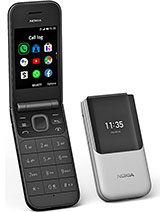
HMD also brought back the clamshell form factor with the Nokia 2720 Flip. The device has a 1.3″ screen outside, and a 2.8″ screen and large tactile keys on the inside.
The device may seem basic but you can chat on WhatsApp and Facebook, call on VoLTE and VoWiFi, use Google Assistant and so on, all part of the Kai ecosystem priced at 89 euros.
Nokia 110 (2019)
The Nokia 110 (2019) is another device HMD showcased offering entertainment on a budget of just $20. That’s $5 less than the Nokia 105, however you get a microSD card slot with MP3 support and a basic camera, plus several games like Snake.
Sony
Sony revealed a handset that takes after the Sony Xperia 1, with similar specs and design, as much as the Xperia 1 was the same size as the Xperia 10 Plus, the Xperia 5 has roughly the same dimensions as the Xperia 10, which is a bit smaller.
This marks the return of the Compact series for Sony. The device packs a triple camera with Eye AF, Snapdragon 855 chipset, stereo speakers, waterproofing and a microSD card slot.
Sony Xperia 5
The screen is a 6.1″ OLED with 1080p+ resolution and the battery is 3,140mAh with 18W fast charging. The phone is perfect for one-handed operations as it’s narrower than both the Galaxy S10e and the iPhone XS, but its screen has more surface area and the phone packs one more camera on its back.
This device has an aluminum chassis with Gorilla Glass and IP68 protection. All the buttons and controls, including a fingerprint reader, are on the right edge. And under the hood, is a Qualcomm Snapdragon 855 with loads of RAM and storage. On the imaging front, the phone has a triple 12MP camera configuration with standard, wide-angle, and telephoto lenses.
Sony says the Xperia 5 will hit Europe this fall and the U.S. in November at a retail price of $799.99.
LG
LG smartphones have struggled to earn interest in recent years as the company has been trying to find new features that will win back its audience.
LG G8X ThinQ
At the moment its pet project is dual-screen tech, the LG G8X ThinQ which has a dual-screen attachment. However, the design can be a bit bulky when you’ve got the second-screen attachment. But if dual-screen tech actually catches on, LG will certainly be at the forefront.
The LG G8X ThinQ has a 6.4″ OLED screen with 1080p resolution. It features a fingerprint reader under the display a notch and a 32MP selfie camera with a Quad Bayer sensor.
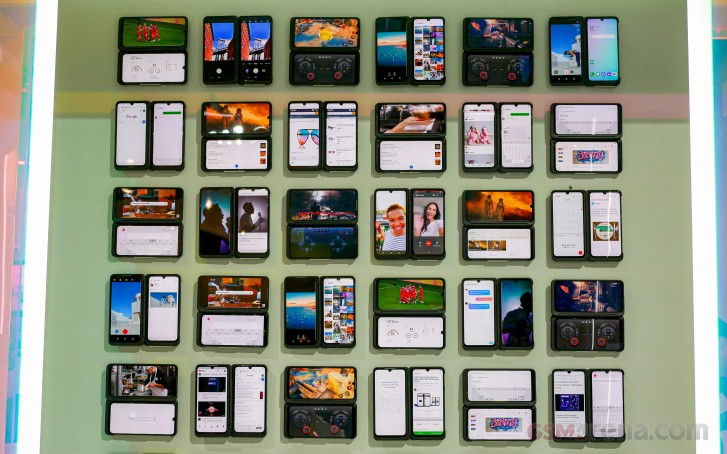
But, the main focus for LG here was on the Dual Screen accessory, which adds a second 6.4″ OLED panel. At IFA 2019, LG even built an impressive demo wall covered with G8X ThinQ phones with Dual Screens, showing off the various uses for the second screen.
Asus
Asus ROG Phone II ZS660KL
At IFA 2019 was also the Asus ROG Phone II which is the ultimate power-user phone. It’s the first with the Snapdragon 855+ chipset and the only one with a 120Hz 10-bit HDR screen.
This device will be available from September 20 for €900, although it’s Ultimate Edition edition doubles the storage to 1TB, speeds up the LTE connection and the price goes up to €1,200.
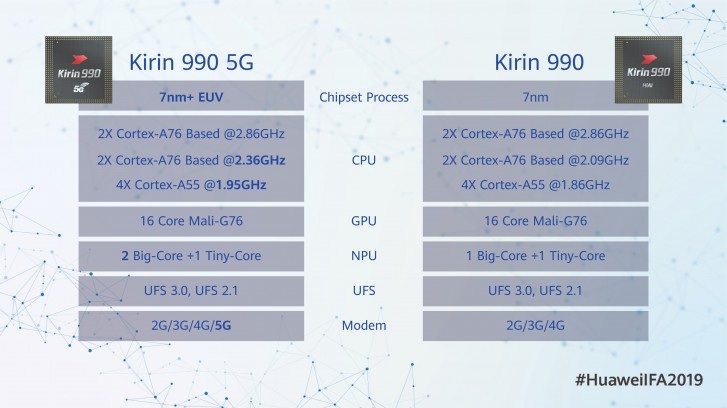
Huawei’s IFA 2019 event was just a teaser for what’s to come as it also unveiled its new Kirin 990 chipset which will be split into two versions – 4G and 5G. The 5G chip will be built on a more advanced 7nm+ EUV process, will run its CPU at higher clock speeds with an additional NPU core. There’s no doubt about it, but this should probably be the chipset to be used in the upcoming Huawei Mate 30 flagships.
When we hear of TCL you probably think of one thing: television sets. Well, it’s not entirely wrong because TCL is a Chinese company that makes TVs and other electronics, but it is also the parent of Alcatel and BlackBerry.
TCL Plex
At IFA 2019, the company took a new direction by unveiling its first self-branded phone, the TCL Plex. The company has mostly been trading under the Alcatel brand, but the TCL Plex bears its own logo.
The device is a solid mid-ranger with a 6.53″ LCD display with Full HD+ resolution and a 395ppi pixel density. The phone stands tall with a screen-to-body ratio of around 90 percent and it is powered by a Qualcomm Snapdragon 675 with 6GB of RAM, 128GB of storage, and a microSD expansion slot. The battery rates 3,820mAh, with Quick Charge 3.0 support, and USB-C charging.
As for imaging, there’s a 48MP main shooter, a 16MP wide-angle sensor, and a 2MP low-light sensor.
This phone retails at about $350 and it aims to tempt mid-range buyers with good looks and a solid set of specs. It comes in obsidian black and opal white colors which shimmer under the curved glass that gives the phone its shape.
At IFA 2019, there were also three new alcatel-branded devices. The alcatel 3x (2019) which is an entry-level phone with a 6.5″ 20:9 screen (720p+) and a triple camera on its back. Its launch will take place in October at a starting price of €159.99. The alcatel 1v (2019) which runs Android Go and will go for a modest price of €80. And finally the basic Smart Tab 7 tablet, which is aimed at kids and features a built-in kickstand at a cost of just €80.
Internet today is filled with loads of content out of
which only some of it is relevant and engaging, rest is just populating the
already populated digital world. Although judging content as ‘good’ or
’horrible’ is easy but to create engaging content of your own is a fairly
difficult task. You want people to like your content and share as well, but do
you really feel that your content is that engaging? How to market your content
correctly?
People generally have a misconception that content
marketing is all about selling. In fact, content marketing is purely focused on
publishing content that’s relatable, educates people and builds a long-term
relationship. If you’re looking for useful tips on how to do that, below are
some points.
Diversify and be creative – If you’re writing on a blog,
avoid sticking to textual content only. Plain text can be a bit boring and
doesn’t catch the reader’s eye. Try adding that little bit of extra spice
to your posts by using emojis, gifs, images, videos, etc.
Be organized – Everyone wants to read something
that is readable and presentable. Avoid clustered text and use multiple
levels of headings. Not just subheadings; use bullets, numbering, etc. to
maintain an organized hierarchy.
Use a CMS – Content is the backbone of any content strategy
but using the right system that fits your content type helps improve your
content performance. This is why you need to find an appropriate Content
Management System (CMS). You need to find something that is highly
customizable as well quick like the Episerver CMS.
Write for the audience – We all know that we need to rank
higher on Google and follow the best SEO practices, but we should never
forget that it is the audience that we are writing about. Write as if you
genuinely care about the topic and your audience. Try to use phrases that
we use while talking in real life to make the reader feel that someone is
actually interacting with him.
Create catchy titles – It is a sad fact that in this
online world, a book is always judged by its cover. You always have to
come up with unique and catchy titles so that the reader is compelled to
look at what’s inside.
Call to action – You need to tell your audience
exactly what you want them to do and why. Always include a small line or
paragraph containing an appropriate call to action (a button or a link).
Internal links – One of the best ways to keep
your audience on your website is by using internal links and redirecting
them to relevant information within your website. This will not only help
you keep people on your website for longer but will also help in driving
more traffic.
Conduct contests or challenges regularly – Competing with others seems like
a part of our DNA and it always gives people a great feeling when they win
something, even if it’s a small prize. Get the help of influencers or
celebrities to promote your contest (if possible) because people care
about their opinion. Otherwise, people will also automatically start
sharing your content for the sake of winning.
Provide trending information – Following the currently trending
topics has become human nature now, be it for whatever reasons. Do your
own analysis and come up with insights that no one offers on such topics.
This will not only make your content unique
but will also let people know that you have a unique opinion to which people will start relating to as well.
Creating content that revolves around or includes examples from trending
topics will help your website gain a lot of loyal readers.
Conclusion
Creating engaging content is one of the most
challenging parts of a marketing campaign. It is a slow process and needs a lot
of effort. With regular posting of original and unique content, you will
eventually reach where you want to. Don’t stick to just one of these tips, use your
creativity to use a mix of these tips.
Apple‘s next big event is happening on Tuesday, September 10 (Tomorrow), where the tech giant will finally reveal its iPhone 11 lineup. Like every year, Apple will be live streaming the iPhone event on its own website, but for the very first time, Apple will also live-stream this year’s keynote on YouTube.
For the iPhone XS event last year, Apple offered live video on Twitter Chrome and Firefox, but as of now, it’s unclear whether that will be the case this year for this year’s iPhone 11 event. Although it is commendable that the company has gradually been growing the number of people able to view the event. Before that viewing of Apple’s events used to be limited to only Safari and Edge.
At tomorrow’s event which will take place at the Steve Jobs Theater in Cupertino, California, it is expected that Apple will unveil three new iPhones (iPhone 11 Pro, 11R and 11 Max), alongside rumored features like its 3D time-of-flight camera and in-display fingerprint scanner.
If interested in watching the stream on YouTube rather than Apple’s own platform, you can visit the company’s page and set a localized reminder for showtime.
Showtime is at 20:00 EAT, and if you’d like to find out the event timing according to your region, click here.
Here’s what we know about Apple’s iPhone 11 lineup so far as per a detailed recent leak:
Leaked specifications and pricing
iPhone 11
Apple iPhone 11 is expected to be the successor of the existing iPhone XR, featuring a 6.1-inch LCD display with a 1792 x 828-pixel resolution at 326 ppi. The smartphone will also feature Face ID and will reportedly be powered by an A13 chipset with 4 GB of RAM and fuelled by a 3,110 mAh battery. Apparently it will be available in three storage variants — 64 GB, 256 GB, 512 GB.
When it comes to optics, it is to sport a 12 MP front camera and a 12 MP dual-rear camera setup. Additionally, it will feature bilateral wireless charging and have support for Wi-Fi 6.
As for the rumored price, Apple iPhone 11 will be priced starting $749.
iPhone 11 Pro
Apple iPhone 11 Pro is to be the successor of the iPhone XS featuring a 5.8-inch OLED display with a resolution of 2436 x 1125 pixels and 458 ppi. Featuring Face ID it is to be powered by A13 chipset and has 6 GB RAM. The device will apparently be available in three storage variants; 128 GB, 256 GB, 512 GB.
For its optics, it will feature a 12 MP selfie camera, and a 12 MP triple camera setup at the rear. Other than that, it will come with bilateral wireless charging, have support for Wi-Fi 6 and on top of that support Apple Pencil.
Fuelling the iPhone 11 Pro is believed to be a 3,190+ mAh battery. Price-wise, it will reportedly be available starting $999.
iPhone 11 Max
This particular iPhone 11 is believed to be the highest-priced variant of the lot that reportedly features a 6.5-inch OLED display with 2,688 x 1,242 resolution and 458 ppi. It is expected to come with Face ID and Apple Pencil support, powered by an A13 chip with 6 GB RAM. It is also to come in three storage options; 128 GB, 256 GB, 512 GB.
For the optics, the iPhone 11 Max is to sport a 12 MP camera for selfies, and a 12 MP triple camera setup at the rear, fuelled by a 3,500 mAh+ battery.
The iPhone 11 Max pricing is believed to start at $1,099.
If you are an Apple Music subscriber, at last, you can listen to Apple Music on the web, in your browser of choice, instead of needing an iOS or Android app, or iTunes app for Mac or Windows.
While iPhone users have traditionally been locked into using iTunes, Apple has never really made a credible argument for why non-Apple customers should make use of their software services. But nearly four years after introducing its music streaming service, Apple Music, back in 2015, a public beta version of Apple Music’s web interface has been rolled out by the Cupertino, California based tech giant which subscribers can access at beta.music.apple.com.
The web interface of the service will allow Apple Music subscribers to access their playlists, new songs, and radio stations without downloading the Apple Music or the iTunes app on their device.
Just like Spotify’s web player, the Apple web player works on any web browser on all platforms including macOS, Windows, Chrome OS, iOS, and Android.
Noticeably, the web player looks pretty similar to the new standalone Music app that replaces iTunes on the upcoming macOS Catalina later this year. The only difference is that instead of the app, the interface is accessible on the web.
Apple Music interface on macOS Catalina.
Apple Music subscribers have access to the service’s entire streaming music collection and radio stations. The web player also syncs playlists and includes personalized recommendations in the “For You” tab just like in the apps.
The web-based interface is accessible not only on Apple’s web browser, Safari but also on other browsers including Google Chrome. Users should also be able to access the service on Android, Windows 10 and Chrome OS.
On the interface, the search bar and all the main sections of the music streaming service are neatly stacked on the left side of the window, while the midsection is reserved for the search results and recommendations, and the top is reserved for music controls and other settings.
Apple Music web player.
Unfortunately, the site is not yet perfected to Apple standards as it lacks some of the features. For one, the web player is missing Apple Music’s Beats 1 live broadcast, Apple’s original music videos, and smart playlists.
As per a report by the Verge
, users cannot access some of Apple’s original music video content, and smart playlists on the website yet. Additionally, one cannot sign in to the service directly from the site. To put it simply, if you are an Apple Music subscriber, you can access all your playlists on the web. But if you are not an Apple Music subscriber you will first have to log in from the app to be able to use the streaming service’s web-based interface.
Now that Apple TV streaming service is a few months away from release, it’s clear that the company has begun to start looking at ways its software can compete with competitors by looking beyond the current Apple audience.
Availability on different platforms is essential in today’s streaming market, as Apple Music faces competition from Spotify, Pandora/SiriusXM, Amazon Music, YouTube Music, and other local players.
From this roll-out, we can say that Apple is playing catch-up in the streaming market, with Spotify which at last count had 108 million paying subscribers in the quarter ending in June, and Apple Music topped 60 million subscribers in late June. We’ll just have to wait and see if they’re able to gain ground.
It’s definitely great to see Apple open up a little to non-Apple users, all that’s left now is for the company to do the same for Apple News+ and Apple TV+.
Same specs on the inside; new Pixel-like finish on the outside.
Huawei Technologies has revealed a “new” redesigned P30 Pro as we await its Mate 30 launch later this month. This is a bit different from the existing P30 Pro as it comes in a two-tone matte and glossy finish. As much as the design is new, this P30 Pro also comes with Android 10 pre-installed; such a smart move for Huawei to launch a “new” device with Google’s latest Android operating system.
The announcement of this “new” Huawei P30 Pro alongside the very latest Android software took place today at IFA 2019. On the device, there will also be Huawei’s EMUI version 10, with its characteristic touch of customization.
The Huawei P30 Pro is getting two brand new colors that look very stylish and refined and the company calls them Misty Lavender and Mystic Blue, In simpler terms, the phone now comes in a gorgeous pink version and a very nice, light blue color.
The two new color choices feature a Google Pixel-style two-tone finish, also looking at the renders, it appears to have a combination of frost and glossy finishes which is somewhat similar to its budget Huawei Y9 Prime 2019.
The top third of the phone, around the camera module, has a glossy polished finish which is contrasted with a frosted, matte finish on the bottom two thirds.
Huawei P30 Pro in Mystic Blue
Huawei P30 Pro in Misty Lavender
This is very unique and feels original as it gives the devices a distinct character making them easy to tell apart from the already existing P30 Pro colors. The in-hand feel is also likely to be less slippery, and also far less prone to getting flooded with finger grease.
The new colors will be available to buy from 20 September. Although, I still feel like the ostentatious “Breathing Crystal” P30 variant was my favorite color variant. But for a less flashy handset, these new designs should be a good fit.
At IFA 2019 today, Huawei also launched its latest Kirin 990 chip, with a built-in 5G modem.
But just like the existing P30 Pro, these new color options will have Huawei’s Kirin 980 processor inside. The new colors will also arrive with the newest EMUI version 10 on top of the Android 10, which is a nice extra. The currently available P30 Pro models run on EMUI 9.1 and will get EMUI 10 as an update.
Apart from that, there are no further changes to these versions as they feature the same Kirin 980 chip, same camera setup with the periscope zoom camera, and the same awesome long-lasting battery.
The exact pricing or availability for this updated P30 Pro hasn’t been given, but Huawei has revealed its latest EMUI10 update (based on Android 10) which will be available in beta this month.
The Kirin 990 processor will power the new Mate 30 when it’s unveiled. Everyone is eagerly awaiting that launch as it’s certainly going to be an interesting one to watch. If you are not yet updated on why, Google revealed last month that Huawei’s Mate 30 won’t be able to ship with Google’s apps and services on board, which means the device isn’t certified for Google Play Store access. This is as a result of the ban placed on Huawei by the U.S Government. Although, we’ll find out exactly what’s going to happen when Huawei launches the Mate 30 on September 19th.
Considering the P30 Pro launched well before the Huawei ban began, these new Huawei P30 Pro colors are not in any way affected by the ban’s limits. This is notably a very smart move by Huawei to gear up some more sales of its biggest flagship device of the year without stepping on the toes of the U.S. government.
But since there are no signs showing that the ban is going away, the question remains as to what Huawei plans to do moving forward. After all, the company can’t release new colors for already existing flagships forever to keep things afloat.
There is quite a bit out there about websites and how to make them, but let’s go back to the basics.
What feels like many eons ago, it was all the rage to use a program called Macromedia Dreamweaver (now owned by Adobe) to create a website. There were no builders such as WordPress, WiX, Shopify and all the others on the market now.
But fast forward to now and there are so many options. We won’t go into each individual product but rather discuss when you should use one of these as opposed to a completely original design using code and a geek.
With over 30% of all websites powered by just WordPress alone; it is easy to see the popularity of builders. They offer some great pros with the biggest being ease and price. If you plan on a blog, or a simple site to have an online presence then the reality is you probably don’t need to look any further than these.
If, however, you have something quite unique or custom then chances are you will need a site designed and developed from the ground up. If not from the ground up; at least some custom functionality added. This can be a bit costlier, but if your business relies on an online presence then… well… it’s a no-brainer.
Ask yourself this of your website
Do I plan on having a site that does something no one (or very few) are doing?
Is my site similar to an App whereby it ‘Does stuff’ and doesn’t just show content?
Is speed mission critical? Bearing in mind this research by Amazon on every second of load time can lead to 10% less site visits.
If my site goes down; will I lose business?
Do I need to hold people’s data, and if so, do I know how to secure it?
If you answered yes to any of these; chances are WordPress and similar won’t be for you and you or a web guru will need to create something.
Should I do it myself?
If you are tech savvy, then yeah of course – it can be rewarding and fun (it can also be frustrating and time consuming but let’s think optimistically); but if not then it is always best to get someone to at least help.
If you know what you are looking for there are ample amounts of resources to look for. If you’re tech savvy you can lookup things like Bootstrap, jQuery, and PHP – I pick these three because they are straight forward and powerful options. It is obviously worth looking into Vue, React and Angular too but this is out of the scope of this article.
There is a lot to a website including: SEO (Search Engine Optimisation), UI/UX (User Interface and User Experience), Load time, Caching, Security, Database design, Content, Hosting, Redundancy, not to mention some phycology on content placement and colours plus a whole lot more.
OK I looked up Bootstrap, jQuery and PHP but they kept on talking about food and cleaning (Especially Cookies, Breadcrumbs, Raspberry Pies, Sanitising and AJAX)
Well, if you looked these up and you found food then it looks like you need a web guru. Now just to find one.
Web design is such a huge field and every web person has their speciality. There are Web Designers who specialise in the look and feel of a website, Web Developers who specialise in the backend and making your website do things, Network Administrators who specialise in making your website accessible, Graphic Designers that specialise in logos, and graphics, Content Specialist that know keyword and SEO and more.
There are other specialities in the field (which by no means are you expected to know) such as framework specialities, security niches and programming language specialities.
You can use a free quoting service such as geekable.com.au to find the right Geek for you. Web Gurus will give you free quotes, and an outline of what technologies they have in mind to achieve your goal. Geekable works by finding the right geek for your project meaning you don’t need to know exactly what kind of web geek you need, Geekable will work it out for you.
When you get quotes from Web Techs, no-one will expect you to know exactly what they are talking about, but it is worth familiarizing yourself with some of the terms used. This can be done by simply googling them.
TCL Communications, the company behind Alcatel’s smartphones and best known for making some of the Industry’s best looking and affordable 4K TVs has stepped out from behind the curtain with its own branded device, the TCL Plex. This is it’s first officially branded smartphone.
TCL announced at IFA 2019 that it’s getting into smartphones unveiling the TCL Plex, a 6.53-inch Android phone that just like the company’s televisions, it’s heavily focused on giving users the best viewing experience possible for a price of $360 (about Ksh.36,000/-). The TCL Plex will be available in either Obsidian Black and Opal White.
TCL Plex in Obsidian Black and Opal White
Running Android 9 Pie, the TCL Plex will be available in select European markets at the start of Q4’19 and the company has even larger mobile ambitions for 2020 that include foldable phones and 5G.
However, the Plex is TCL’s starting point to make a name for itself in phones beyond the Blackberry and Alcatel brands that it owns the rights to.
The Plex is an almost completely bezel-less screen dubbed the TCL Dotch (this is trademarked btw) display serving up a 90% screen-to-body ratio. The only bit of black border you can see is the small bottom chin and the punch hole camera which brings about “dotch” … notch plus dot equals Dotch. (haha!)
Its display is only Full HD in resolution but can display all your standard dynamic range as high-dynamic-range content in real-time. This is a feature called ‘TCL NXTVISION’ and it doesn’t just switch the display into an overly-saturated vivid mode. Rather, NXTVISION converts your still images into HDR by enhancing their color while honing their edges to produce a picture that appears sharper and higher contrast.
The smartphone can also convert video from SDR to HDR in real-time by increasing contrast, amplifying color, brightening highlights, and darkening shadows. Customers will get quite the value bundle for the money, starting with the large 6.53-inch display at 1080 x 2340 pixel resolution.
TCL isn’t exactly a camera company, but it’s still aiming to be “at par” out of the gate. Plex which is a mid-range device sports a somewhat rare camera setup.
TCL Plex rear camera setup
On the back of the phone, the main camera uses a 48MP sensor from Sony for capturing the highest resolution images and 4K video. Alternatively, you can also use this sensor to shoot ultra-slow motion footage at 720p and 960 frames per second.
Next to the main camera is a much lower-resolution 2MP sensor (Yes, 2MP, that was not a mistake!) that’s used entirely for low-light photography, which TCL has labeled ‘Super Night Mode.’
Lastly on the back is a 16MP sensor set behind a 123-degree super wide-angle lens. According to TCL, it captures scenes that are four times larger than the main wide-angle camera can in a single shot.
At the front of the device is a 24MP selfie camera. Interestingly, if you want to capture selfies at night or in dark environments, you can turn the 24MP front camera into an 8MP snapper. The device makes this possible by combining every four tiny pixels into one bigger one that captures more light.
TCL Dotch is powered by Qualcomm’s Snapdragon 675 and features 128GB of storage, 6GB RAM, and a 3,820mAh battery which comes with Qualcomm Quick Charge 3.0 technology. The phone supports microSD storage up to 256GB, and, yes, there’s a headphone jack on it. For that price, you’ll have to live with some other tradeoffs of course, and the most underwhelming spec is the Snapdragon 675 processor powering this thing.
On it is also Bluetooth 5.0, plus TCL says a “Super Bluetooth” option allows for up to four Bluetooth speakers or headphones to connect to the Plex simultaneously.
Not forgetting about the UI, the smartphone comes with a new TCL UI that allows users to further personalize their smartphone through the Smart Panel. Through this, TCL Plex can interact with a Smart TV as well as other smart home devices. The devices can be controlled through the smartphone as well as voice assistant.
The TCL Plex is going to be limited at its launch in four countries in Europe, and Australia. The idea here is for TCL to find its footing with its own brand first, then look into scaling between regions as well as scaling the number of devices. TCL’s aim here is to develop more of a vertically integrated stack for its own-brand smartphone business considering the company is best known for its TVs, it is determined to take the good reputation it earned in the living room and extend that to new categories.
Is Facebook equipped to handle far more intimate personal data after their previous privacy scandals?
Facebook Dating, which has existed in other countries since last year, went live in the US Yesterday, September 5th. This is definitely in the hopes that Facebook can compete with existing dating apps like Tinder, Bumble, and OKCupid.
This announcement comes days after the company admitted to exposing more than 419m user IDs and phone numbers online, a glitch in June 2018 that made private posts of 14 million users public, and another breach in September 2018 which compromised the data of 50 million users.
That not being all, in a separate scandal, in 2018 it was revealed that the company improperly harvested the data of millions of users through a partnership with political campaign firm Cambridge Analytica.
Jason Kelley, a digital strategist, said that the Social Media giant’s phone number breach underlies a concerning inability to determine whether privacy concerns have been effectively resolved. The numbers exposed were hoarded using a tool Facebook disabled in April 2018 after the Cambridge Analytica privacy scandal.
“Facebook says the dating service is secure, but how do we know it won’t realize a few years from now it was not as protected as it thought?” Kelley said. “It gives us pause when things they have changed years ago are still being shown to cause problems in terms of data privacy.”
How will Facebook Dating work?
Facebook being already a part of people’s lives whether they’re looking to date or not makes things a bit unusual. However, the app is making attempts to clear most of those complications by making Dating as separate as possible from its regular app.
First of all, users must opt into the service, then create an entirely distinct profile. Reputably, the dating site does not show users their Facebook friends, and also gives people the ability to remove friends of friends from their potential matches. One also has the option of blocking specific people on Facebook from seeing their dating profile. However, users can message one another without matching first.
Facebook dating links users with potential matches based on location, indicated preferences, events attended, groups, and other factors. It will also integrate with Instagram and offer a feature called ‘Secret Crush‘, allowing users to compile a list of friends they have an interest in (crush on), to be matched with if the crush lists them as well.
On Secret Crush, you can add up to nine Facebook friends or Instagram followers to the list, and if they secretly crush you back, you’ll both get notified. Although, the feature only works if both people have set up Facebook Dating profiles; Crush *A will not get notified if you add his Instagram account to your Secret Crush list, and even then you can only do that if Crush*A is following you.
Yesterday marked the beginning of Facebook Dating’s integration with Instagram, which is owned by Facebook. Users of the dating site can now add their Instagram posts directly to their profiles besides adding IG followers to their crush list. But that’s not all as Facebook says it will include the ability to add Instagram Stories to profiles by the end of the year.
All this is good progress for the company but many of us have a big question at the back of our minds, is Facebook really equipped to handle far more intimate personal data?
The concern is because of the $5 billion Federal Trade Commission
fine Facebook got slapped with, a penalty they settled back in July over privacy concerns. This was by far the largest penalty ever against a tech company, not to forget there is also a new antitrust investigation ongoing.
Anyway, Facebook has praised the new privacy and security features within the dating service, this includes the ability for users to share plans and location with select friends when going on a date. Users can also hide their dating profiles from friends of friends to avoid disclosing sensitive information like sexual orientation.
Notwithstanding all this, you can’t blame the many who are skeptical. A company mired by numerous privacy scandals should not be entrusted with helping users with the private journey of finding love.
“If you’re trying to avoid dating services that have red flags, you can’t really find one that has more red flags than Facebook,” Jason Kelley, a digital strategist at online privacy nonprofit the Electronic Frontier Foundation said.
“They have a terrible track record of keeping user data safe.”
With Facebook hoping to crush Tinder and change the status of the roughly 200 million singles who use it, the company has officially launched its dating service in a select few locations, with other test markets coming soon.
Currently, Facebook Dating has been released in Argentina, Bolivia, Brazil, Canada, Chile, Colombia, Ecuador, Guyana, Laos, Malaysia, Mexico, Paraguay, Peru, Philippines, Singapore, Suriname, Thailand, United States, Uruguay, and Vietnam.
Countries where Facebook Dating’s been released
Upcoming Facebook Dating release dates include Australia, by the end of 2019, and Europe sometime in early 2020.
Are you wondering how to buy Instagram likes? Well, buying Instagram likes has got a whole lot easier recently. The things you need to do this are just to enter the Instagram username that you would like to purchase likes for. Next, select the posts on your profile for which you want to add likes. You have got various payment options. Complete checking out your package through these payment options.If you don’t think it’s worth the money, you can also get Instagram likes free easily and quickly via Instagram likes app.
Buying Instagram likes services give you the number of likes that your page requires. The whole process of buying likes is so easy. Once the payment is completely done your likes will be credited to the selected posts as soon as payment is verified.
Well, there are a variety of sites that provide you with followers and likes. And they take money for it. The cost of money depends upon the number of followers you are buying. Different websites have different rates. Plus, you can get followers from Instagram pages as well. No doubt, it requires money but you won’t regret spending your money onbuying likes or followers.
Why Increase Instagram Likes?
It is not difficult to increase the likes for your posts on the Instagram profile. It is not important to engage with extensive promotional campaigns to get likes. The only thing you need to do is to get the right package available for you from the lists of packages available. There are a lot of different packages that can cater to the specific needs and requirements of every business owner who is struggling with Instagram likes. With Instagram likes your posts will get high-quality likes, and this will make you a reputed business owner.
The likes also help in improving your work. You will start getting more followers. Their feedback will guide you to improve your work. You will get to know from their feedback that which changes in your content will make it more interesting and attractive.
Importance of Auto Likes in Business
Numerous companies offer the services of Buying Instagram Auto likes. But they are not always safe. They are various risks while buying Instagram Auto Likes. There are several ways to get these likes. Even some pages on Instagram are working for it. They provide you with more auto likes and in return, you have to pay them. Buying Auto likes is something customary these days.
Instagram Likes helps in improving your work. You will start getting more followers, views and likes. Their feedback will guide you to improve your work. You will get to know from their feedback that which changes in your content will make it more interesting and attractive.
Buying likes is beneficial in a way that it will make more people reach you out. Buying likes at the start will provide you a beneficial start. By getting likes at the start of your work, will get the things to start rolling in. Your post will be ranked on the Google algorithm. And the likes will start increasing subsequently.
Buy Real Instagram Likes Online
One of the reasons why you should buy instagram likesonline is that online sources provide you with real and genuine likes of real users. Online sources hold a long list of real users. They sell the likes to these real users for small fees. Buying Instagram likes online will get you the real and genuine views from the real users. It would boost your credibility and creditworthiness of your Instagram profile. This also encourages other users to follow you. This will ultimately get you the increased number of users of your Instagram posts and profile.
There is not a lengthy process you need to follow to get the desired number of likes for your Instagram profile. Just find the reliable source online forums where you can purchase the likes of your desire ad select it. As soon as your payment is done, get them added into your profile instantly. The things you need to do are just simply pay for the packages and get the desired number of views with ease.
The inaugural cohort is an assembly of talented founders representing Sub-Saharan Africa, coming from Benin, Nigeria, South Africa and Tanzania. will for the next 16 weeks, will work in the beating heart of one of Francophone Africa’s most modern and tech-oriented cities: Abidjan, Côte d’Ivoire.
The 2019 Spring Fellowship cohort will have access to mentorship, networking and support to help them to accelerate their dreams and scale to the next level. The program will culminate in a Demo Day in Abidjan, where the companies will have the chance to pitch their pilots or proof of concepts to a selected pool of industry leaders and leading investors for follow-on funding.
To help startups grow and scale, Spring Fellowship has the support of 2 leading corporate partners: Nestlé and ELLE.CI. Together with incredible mentors and with Nestlé and ELLE.CI executives, Kinaya Ventures is excited to support these companies in their goal of disrupting the foodtech, retailtech and martech sectors, leveraging on collaborations with industry leaders and major brands in Sub-Saharan Africa.
Here is the first cohort of Spring Fellowship:
Exportunity, Benin
Exportunity
is a B2B2C marketplace with a decentralized blockchain app, mapping, and
facilitating payments & delivery for proximity businesses.
Last mile for BOP, South Africa
Last Mile for
BOP has developed Shopit, which is a mobile application that enables informal
grocery stores in popular and rural areas to compare prices at wholesalers,
order all their stock at the best price from their phone, and get it delivered
to their doorstep within a few hours.
Tracksend, Nigeria
Tracksend has developed a
Mailchimp-like solution for SMS, WhatsApp and Telegram campaigns that helps
marketing teams send messages, track them, re-market contacts, A/B Testing and
measure conversion.
WAFCo, Tanzania
WAFCo has a
nutritious flour branded as TAMA Composite Flour, which provides the
essential nutritional requirements for babies, expectant and lactating mothers.
Safaricom is not opposed to the proposed Telkom and Airtel Kenya merger, according to a statement by its chief executive refuting claims made earlier by Telkom Kenya chief executive.
In a statement, Michael Joseph, CEO – Safaricom PLC, said “Our attention has been drawn to claims by Telkom Kenya that Safaricom is opposed to its proposed merger with Airtel Kenya. We wish to clarify that this is not Safaricom’s position. “
The chief executive added that Safaricom believes in competition based on innovation, investment, focus on brand building and service to the customer. Joseph added that industry players are free to engage and organize themselves as they please, subject to regulatory approvals, to achieve their objectives.
“We have no quarrel at all with our colleagues at Safaricom, we are simply trying to restructure and improve our own business and for the good of the industry. It is unfortunate, however, that Safaricom now wants to delay this process that seeks provide customers with more credible options. Does the dominant player not want to see this sector grow? Is the Dominant player wary of competition, and even more precisely, wary of competitive pricing, choice and value for money for the consumer?” Kibati said.
Joseph denies these allegations and indeed Safaricom worked with the industry regulator Communication Authority of Kenya and Airtel Kenya in 2014 during a similar transaction when Essar Telecom sought to exit the market.
Safaricom’s concerns are the millions owed by the two firms for services it delivered.
Safaricom says the two operators owe it KES 1,297,448,468.88, incurred for the provision of various services including interconnection, co-location and fibre services. This debt is due and payable, based on the agreement to provide services entered into with the two entities as distinct operators.
“Our expectation is that the payment obligations should be settled in full before the transfer of business is effected,” said Joseph.
The second issue, according to Safaricom, is the need to rebalance the frequencies allocation. Post-merger, Airtel-Telkom will jointly hold 77.5 MHz of spectrum against a customer base of 17.3 million, compared to Safaricom’s 57.5 MHz with almost double the customer base at 31.8 million. Given the size of Safaricom’s customer base in comparison to the current spectrum holdings, it is apparent that the transaction will create a disproportionate imbalance in the spectrum allocation, which will be inconsistent with the market share.
Safaricom says it also wants equal treatment of operators and creation of a level playing field within the industry, specifically in relation to licensing and operations requirements.
Yahoo users this morning suffered some fairly spectacular outage, leaving them unable to access their Yahoo Mail accounts. This led to many threatening to shut down their accounts or even move to Gmail, an email client operated by Yahoo’s arch-rival Google.
Reports of problems began this morning, as customers took to social media to say they were unable to log-in or read their mail.
For those of you who aren’t familiar with the platform (Millenials!), Yahoo is a tech company now owned by Verizon Media, and it once operated a dominant search engine but found it difficult to compete in the era Google and Facebook.
Despite its apparent decline, Yahoo’s mail service is still used by hundreds of millions of people. Although, Yahoo Mail has still remained a hugely popular platform for free consumer email, with many users staying loyal for up to two decades.
However, Yahoo remains one of the last major free-mail suppliers that still hasn’t added end-to-end encryption to its interface, this is something that Google users will know its security features flag up at every opportunity.
Yahoo Outage
According to Downdetector, a website that provides information on online outages, today’s problems appear to have started sometime around 7 am, where there was a sudden jump in complaints about Yahoo Mail services, especially in the UK and US.
The website had received more than 5,000 reports of problems related to Yahoo Mail and some 300 users also reported problems with other Yahoo services.
According to one Twitter user, Yahoo had been down for “well over 3 hours” in Australia. Most of the complaints originated in Europe.
Customers found that they couldn’t log in properly and instead of their emails, they were greeted with a message reading “We are experiencing some technical details” with an error code of 15.
The problem appeared to only be affecting the mail service, while the rest of the Yahoo portal worked well. Although, this isn’t their first outage being reported, in 2013, a data breach at Yahoo compromised the accounts of the 3 billion users it had at the time.
The reason for the outage remains unclear, but from those who reported issues, 61% said the problem was with the website, while 38% struggled to log-in.
Yahoo acknowledged the fault, telling Tweeps that:
Roughly an hour later, the company posted another tweet saying that they had identified the issue but could not say how long it would take to resolve it. Thereafter this prompted a fair amount of venom from Twitter users because that’s just how tweeps are!
“What an absolute disaster,” Heather Brandon, a Scotland-based accountant wrote in a tweet to Yahoo.
“I will be switching to Gmail as soon as I can!!!”
“YahooMail is down when I really needed it,’ a Twitter user stated. ‘Guess I’m using Gmail for everything now.”
A spokesperson from Verizon Media representing Yahoo said: “We are aware of a technical issue that is impacting our services.
“We’ve been able to get some services back online already and appreciate our customers’ patience as we work to get everything up and running as soon as possible.”
MoDE, Mobile Decisioning, a Kenyan mobile value-added services firm providing airtime credit to mobile network operators in emerging nations has been acquired by Singapore’s TransferTo, which rebranded recently to DT One.
According to Peter De Caluwe, CEO of DT One: “We are thrilled to have acquired MODE as we see their airtime credit service (ACS) as a key differentiator and growth opportunity given its natural value add to our existing global operations.”
MODE will become the DT One ACS division and full integration is expected to be completed in Q4 of this year. DT One recently partnered with Safaricom to allow PayPal-MPESA transactions in Kenya.
Airtime Credit Services
Founded in 2009 by Pastor Julian Kyula, MoDe is known for its Airtime Credit Service, an emergency airtime credit service advanced to prepaid mobile subscribers and paid on the next reload. The firm has operations in 13 countries across Africa and works with mobile networks such as Airtel and MTN to grow their revenues and talk time.
In 2013, MoDe was the winner of IBM’s SmartCamp and was named IBM Global Entrepreneur of the Year and now claims to serve more than 500 million prepaid mobile users in Africa, Asia and Middle East.
MODE applies data science to provide financial services and is at the forefront of mobile financial technology, providing airtime credit and microloans to millions of mobile phone users across Africa, the Middle East and Asia.
Exit for investors
MODE’s foundation product is Airtime Credit Service (ACS) – a cashless microloan and the company’s mission is to deliver easy and convenient access to financial services through technology. MODE serves more than 500 million prepaid mobile users, across 20 countries in partnership with 26 mobile operators, processing more than 18 million airtime and data loans daily. The firm was earlier backed by Spring Accelerator and Future Fifty.
Cross-border mobile top-up becomes DT One
“MODE is quite a remarkable company, which from its humble roots as a Nairobi startup in 2009, has grown into a highly successful international business and the global leader in airtime credit services – cashless micro airtime or mobile data loans,” De Caluwe, CEO of DT One concluded.
TransferTo had two businesses, a cross-border mobile top-ups and payment solutions network. The rebrand saw it launch two separate company brands, logos and identities, DT One and Thunes.
Founded in 2005, TransferTo’s mobile top-up and rewards business, rebranded to DT One to bolster its global network for mobile top-up solutions and innovative mobile rewards.
The business has been experiencing solid year-on-year growth, and last year delivered more than a 30% increase in both revenue and transaction volume. DT One will continue to focus on building smarter data-driven mobile solutions to enable more people worldwide to have better access to digital communications.
Payment solutions network becomes Thunes
The cross-border payments business, which started in 2016, now operates independently from DT One and was renamed to Thunes. Thunes will focus its efforts on providing better interoperability between diverse payment systems and supplying smarter payment solutions for emerging economies. Since inception, this startup has also delivered exponential growth, and in 2018, saw nearly 900% growth in revenue and processed over $2 billion worth of transactions.
“The decision to rebrand TransferTo and separate the cross-border payments business enables both companies to accelerate growth by independently delivering more targeted solutions to customers and partners,” said DT One CEO and Thunes Executive Chairman, Peter De Caluwe.
“The industry is continually evolving and we see this change as an important next step to better position ourselves to capitilise on the growth opportunities in this rapidly changing market.”
Mobiclicks, a South African mobile advertising agency has launched in Kenya in a move expected to take advantage of East Africas growing mobile sector.
To deepen its skin in the game, Mobiclicks has appointed Allen Kambuni, Bean Interactive’s co-founder and co-director as its regional head.
According to Shaun Rosen, CEO of Mobiclicks, “These are exciting times. When a South African mobile marketing leader believes the next step after Johannesburg and Cape Town is Nairobi, that says the African Renaissance is real and the vision of Africa as the Bright Continent can be achieved. We are thrilled to have Allen on board as he represents our first on-the-ground presence in another African country”.
This is the agency’s first branch outside of South Africa. East Africa is attractive to Mobiclicks due to its affordable Internet and booming mobile sector coupled with an increasing population and economic growth.
“East Africa is a multilayered region, not a single homogenous country and there are complexities involved in successfully navigating the market for mobile advertising products and services,” said Allen Kambuni adding that the business conditions are promising.
With the growing ICT sector, Kambuni sees this as an opportunity for continental mobile marketing agencies to work with local talent and find ways to ways to seamlessly reach consumers using a mix of traditional and mobile advertising platforms.
“Clients are interested in using mobile to seal the deal, so to speak, while still laying much of the brand-building groundwork with traditional media and this collaborative approach suits us just fine,” said Kambuni.
Mobiclicks which will directly compete Bean Interactive, MediaPal among other agencies promises a globally-proven advertising technology platform that delivers results and as well shapes their future digital decision making using data.
Following xenophobia attacks in Gauteng, South African businesses MTN, Multichoice, and Shoprite have closed shops in Nigeria and Zambia as their facilities are being targeted by protestors.
That’s after days of riots in South Africa targeting foreign-owned businesses.
These attacks against foreigners in South Africa flared up this week, with the attacks breaking out in Johannesburg on Sunday. This saw the destruction of more than 50 shops and business premises mainly owned by Africans from countries in the rest of the continent.
Widespread looting took place as cars and properties were torched. The violence against African nationals may be a reaction to extra competition for jobs and services in the country.
According to the head of corporate affairs at Multichoice, Jabavu Heshu, the South African television group has shut its offices and branches in Nigeria and Zambia following protests at the group’s Lagos and Lusaka offices.
Heshu said in a statement on Wednesday that the branches would remain closed until the situation had stabilized. “We have had to shut branches and offices to safeguard customers and staff until further notices.”
“The on-going violence in South Africa against foreign nationals, is against the spirit of Africa, and counter-productive to the decades of work done by African leaders and well-meaning organisations to unite the continent. We are a proudly African company and although our story began in South Africa, today we represent the African continent in all its diversity through our presence across the region.”
Head of corporate affairs at Multichoice, Jabavu Heshu
Meanwhile, in a statement, the MTN Group said that it had closed its stores and service centers in Nigeria until further notice “as a precaution” after four stores in Nigeria were attacked.
The Johannesburg-based company is the continent’s largest mobile phone operator and has more than 60 million subscribers in Nigeria, a country of about 200 million people.
Meaning Nigeria is MTN’s biggest market, with 58 million users in 2018 as it accounts for a third of the South African group’s core profit.
Several of its stores in Johannesburg also remain closed although there were no reported injuries.
“While we remain committed to providing uninterrupted services, the safety and security of our customers, staff, and partners is our primary concern.
As a company, we remain committed to ensuring a peaceful, harmonious and respectful relationship with all our stakeholders across Africa.”
MTN Group
On the other hand, Shoprite also shutdown several stores in Nigeria and Zambia following protest action and extensive damage done to its supermarkets.
“(Shoprite) is highly concerned about the acts of xenophobic violence against foreign nationals that sporadically flare up and the resultant rhetoric of intolerance that is leveled against foreigners and the platform this creates for criminals to exploit this.”
Shoprite
High rates of unemployment have been a major cause of anti-foreigner attacks which have become a regular occurrence as frustration mounts over. But this is not an excuse for xenophobic attacks.
The latest wave of unrest in South Africa has raised fears of a recurrence of violence from 2015 aimed at foreigners and in which at least seven people were killed. Before that, in 2008 about 60 people were killed in a wave of unrest around the country.
The growing backlash to xenophobic violence meted out on African nationals living in South Africa is not only being felt by shop owners but the Johannesburg stock exchange as well. On the JSE, MTN fell as much as 2% after the company closed its offices in Nigeria following attacks on its premises in three cities.
Different African countries and the African Union have called on President Cyril Ramaphosa to take action as citizens from across the continent voiced their anger on social media, with some threatening retaliation.
President Cyril Ramaphosa on Wednesday morning while speaking at a Brand SA breakfast meeting in Cape Town, condemned attacks on foreign nationals living in South Africa, saying SA is a ‘home for all“.
Unfortunately, these attacks in South Africa are an embarrassment for President Cyril Ramaphosa as he hosts leaders and delegates from across the continent at the World Economic Forum Africa summit in Cape Town. The violence has also undermined his assurances that the continent’s most industrialized economy is open for business.
Zambian President Edgar Lungu urged citizens on his Twitter account both locally and abroad to remain calm and disengage from acts of violence as they voice out their grievances. “Those preaching hate must stop.”
Internet giant Google has updated its Gmail app for iOS devices by adding a new image blocking feature to prevent email tracking from automatically loaded images that come as attachments.
Numerous email tracking clients use small, invisible images as a means of tracking when an email has been opened and viewed, allowing for invasive features like read-receipts.
Users can choose to be asked each time whether or not to display external images in an email thanks to the new update. The new setting is meant to counteract the tracking services that embed small invisible images into emails.
“You can now choose to be asked before external images are displayed automatically. To enable this for new incoming messages, go to Settings > specific account > Images and select Ask before displaying external images.”
Apple App Store changelog.
Previously, the image loading setting was restricted to Gmail’s Web version, but most probably this went unnoticed by heavy mobile email users of the iOS app. But as from now, one can get access to this setting on iPhone and iPad devices.
Back in July former Twitter executive Mike Davidson drew attention to how a subscription email service was allowing users to track the location and time of when an email was opened, and this rollout of the feature is almost certainly a response to that controversy.
Gmail’s update will mean the service is able to block unwanted surveillance, which often goes unnoticed by the victim. For instance, tracking pixels, which are tiny images that are embedded in emails or websites.
When loaded, they ping the image server they’re hosted on and send all of the information required to download them such as a device’s IP address and time of download back to the server.
Currently, the update is only live for personal Gmail accounts, however, Google has yet to confirm whether it will roll out to enterprise accounts accessed through its G Suite platform.
According to Google, as reported by The Verge, this is because G Suite admins need to set up their company accounts on the Rapid Release track, which will grant access to newer features faster than standard accounts.
“For this Gmail iOS feature, G Suite administrators who have set up the Rapid Release track on their G Suite domain will already have access to this,” a Google spokesperson said, “while G Suite domains on the Scheduled Release track will see this feature available shortly for their G Suite users.”
The internet giant also says that it runs all messages sent via Gmail through its own proxy servers. This means any location tracking services should be blocked early. The company recently added the ability to stop a sender from being able to precisely locate a recipient via an IP address but says this new move is another step along the improved privacy journey.
Moreover, Google has also rolled out a new feature this month for its G Suite users; a notification will be shown to your contacts in Gmail and Hangouts chats that you are away on vacation.
At the moment it is only available to G Suite (Google’s enterprise customers) but not the ordinary Gmail users, the feature will be fully rolled out globally from September 16.
Gmail can be downloaded from the App Store for free.
Back in July, we reported that mobile gaming and gambling was under threat in Kenya after a crackdown on licenses issued to gambling companies. The Government had ordered that seventeen different betting companies cease operations, and that their directors be deported from the company. While welcomed by some moral campaigners, the news brought the threat of job losses in Kenya’s gambling industry, and also had an unintended knock-on effect on some sports.
One of the companies affected by the licensing issue was gaming giant SportPesa, who reacted to the loss of their license by effectively withdrawing sponsorship from all major sports within the country. Sponsorship money is a vital lifeline to several major Kenyan sports, and the existence of several competitions depends on money coming in from big-name sponsors. The Kenyan Premier League was expecting to be particularly badly hit, with some officials wondering whether it would even be possible to start the season without an official sponsor in place. Fortunately, the season has been able to start regardless – and SportPesa is about to get back to work within Kenya after days of talks with government representatives.
The Revenue Authority Acts
It’s unknown whether SportPesa’s threat to withdraw funding and support had any bearing on the ruminations of the Kenya Revenue Authority, but the regulator has now cleared SportPesa in its ongoing investigation into the tax affairs of several major gambling companies within the country, which has, in turn, cleared the way for SportPesa to resume trading. The next step is for the company to lodge an application to regain its trading license, which it has indicated it will do immediately. That application will have to go before the county’s Betting Control and Licensing Board, but isn’t anticipated to encounter any issues on the way to approval.
The move marks a remarkable turnaround for both the company and the Kenya Revenue Agency in a comparatively short space of time. SportPesa’s license was originally revoked in July after the Government publicly claimed that the company was intentionally failing to comply with tax regulations, and therefore failing to pay its fair share of tax revenue. SportPesa has always denied that charge.
In what appeared to be an act of vengeance, SportPesa announced that it would cancel all of its national and local sporting sponsorship agreements and advertising contracts within Kenya, giving the reason that the Government’s decision had made it impossible for them to make a profit within Kenya, and that the trading environment within the country was ‘unfavorable.’ At that point, it was feared that the company would completely withdraw from the company, resulting in the loss of all related jobs.
A breakthrough appears to have been achieved at some point during the week beginning September 2nd, with SportPesa releasing a statement the following day confirming that there had been a ‘noteworthy improvement’ with licensors and government authorities. The statement went on to say that they’re now committed to helping to ensure that the Government has ‘a better understanding’ of how the gaming industry operates, while at the same time developing a ‘shared perspective’ on tax administration.
In a statement which could be construed as a commitment to renewing its sponsorship and advertising activities, SportPesa closed off their statement by saying that they will ‘support the government’s long term growth agenda,’ although whether that statement will be followed up by the resumption of their previous sponsorships remains to be seen. It’s not out of the question that the Kenya Revenue Authority’s decision to clear the company – or the Betting Control and Licensing Board’s decision to award them a new license – will be conditional on them doing exactly that.
Several More Companies Cleared
Although it’s the news about SportPesa which is generating the most press attention, they are not the only one of the companies who had their licenses withdrawn during July to subsequently regain permission to do business inside Kenya. Ten other companies have also now been cleared, including Bet Boss, Palms Bet, and the much-larger global betting company Betway – all of whom will be eager to pick up where they left off. All of the cleared companies are significant employers within Kenya, and all will generate significant tax revenue if operating within the rules.
Where there still appears to be some confusion is where the law stands on customers who access betting apps through their phones. At the time the companies were banned, it appeared likely that Kenya was about to issue an outright ban on gambling activities performed through mobile phones. This wouldn’t just be bad news for those who bet on sports, but also for those who use their phones to access mobile slots websites. Websites which host mobile slots are seen as a convenient alternative to visiting UK slots casino in person. Thousands of people in Kenya engage with mobile slots websites on a daily basis without developing an unhealthy relationship with the hobby, and they were as unhappy at the prospect of losing access to those mobile slots as the betting companies were about losing access to their players.
The general issues around gambling in the country cannot be solved as easily as restoring licenses to companies which have previously lost them. As we said in July, the Betting, Lotteries and Gaming Act of 1966 is no longer fit for purpose, as it’s been circumvented and rendered obsolete by the invention of the internet. Draft legislation to replace it is working its way through the political system, but the wording of the proposed replacement bill makes it absolutely clear that mobile gaming will be prohibited in Kenya. While there will be fines for firms which offer mobile gaming facilities, individual citizens caught playing mobile betting games may be subject to a fine of up to two million shillings. The bill has not yet become law, but unless it encounters more significant opposition than it has done so far, it will inevitably be passed into law in the near future.
How this might affect companies like SportPesa and Betfair remains to be seen. It’s likely that the ability to offer mobile betting facilities to their customers is integral to their business plan. If that right – and line of profit – is suddenly taken away from them, we might find that the betting companies and the Government will be at loggerheads once again in a few months time. This time, though, it will be the betting companies making demands of the Government instead of vice versa.
The final week of August may have been a momentous one in Kenyan history – but it appears to have been a cause for consternation as much as it was a cause for celebration. As of now, Kenya has joined the world’s ranks of oil-producing nations, but there appear to be many arguments on the horizon about how the potential riches of a Kenyan oil industry might be divided.
Finding oil in the ground has been a surefire way to get rich for centuries. The phrase ‘struck oil’ has long been a metaphor for ‘had a lucky break,’ and many mobile slots games make reference to mining practices in their content.
The connection between playing mobile slots in related casinos or their sister sites and mining is obvious – in both cases, someone is paying money to take an action which may or may not result in them getting rich. Mobile slots players are chasing a jackpot. Miners are looking for oil or other precious materials in the ground.
Kenya has now taken its seat on the casino table, but it appears that the house may not ultimately turn out to be the winner in this gambling scenario.
The shipment of oil which left Kenya last Monday contained 200,000 barrels, and made the country the first-ever East African nation to export oil abroad. It’s a drop in the ocean, however, compared to how much oil is believed to be below the surface within Kenya, waiting for someone to come and drill it out. Before any drilling takes place, though, it seems that officials and ministers may have to think again about the division of wealth.
Under the current laws, which were introduced by President Kenyatta earlier this year, 75% of the value of all oil revenue goes directly to the central Government. Of the money that remains, twenty percent goes to the county that produced the oil, and five percent goes to the community living in the vicinity of the oil field.
There is now some objection to these figures from community leaders in the area which supplied the oil shipment. The oil came from Turkana County, and officials there say that they were promised a different split of the money when the process began.
Using a colorful metaphor, Turkana County’s Deputy Governor Peter Lotethiro said that according to his people’s tradition, the owner of a goat must be left with the legs when a goat is slaughtered to please a visitor. He now wants the Government to ensure that Turkana gets its leg. Whether or not the metaphor is rooted in fact is unclear, but the method is very clear: Lotethiro believes that Turkana should be getting a greater share of the spoils.
President Kenyatta is aware of the comments, and has used the same boat-based imagery in his response. He says that while he appreciates the concerns of local leaders, his responsibility is to ensure that every Kenyan gets a piece of the goat, and that diverting too much wealth to one particular community or region is opening the doors to corruption – and fighting corruption has been one of the recurring themes of his Presidency to date.
The question of who gets what is something of a moot point for the moment. The shipment of oil that was dispatched on Monday was effectively a test load to demonstrate that oil could be obtained, extracted, and shipped from Kenya. Getting more oil out of the ground in sufficient quantities to make the process economically worthwhile will not be possible without considerably more powerful equipment – and the equipment does not yet exist.
To export the shipment that was sold, the oil was taken from the ground, and shipped across the country in trucks – a time consuming, costly, and laborious process. To become a major exporter of oil, Kenya must install oil pipelines. The benefits of doing so are self-evident; experts believe that reserves equivalent to as many as 600 million barrels of oil exist below the ground in Turkana.
At full yield with excellent digging equipment and efficient pipelines, the field should produce 100,000 barrels of oil on a daily basis in five years time, but putting the pipelines and drills in place requires external investment. Accordingly, the Kenyan Government has found expert partners.
One of those partners is the British company Tullow Oil, who have so far spent $2bn in the country to get to this point. It’s anticipated that they’ll now seek to invest more in order to get oil flowing, as will French partners Total SA. It’s hoped that work on the necessary pipes will begin in 2020, with optimum yield achievable by the end of 2024. If successful, the new oil industry will bring significant wealth to Kenya, as well as creating thousands of jobs in and around the oil fields.
Could this be the start of a new golden age in Kenya? It would be foolish to make wild predictions, but history is full of stories of countries and regions who have improved their fortunes with the discovery of oil. Russian oligarchs and Texan oil barons still live off the profits of their lands in their home countries.
We may soon have to consider what the correct label for a Kenyan oil billionaire should be. We should be cautious, though – the oil reserves were first discovered in 2012, and petty squabbles over land ownership rights and security issues prevented any oil being sold for seven years until now. It’s likely there will be more challenges in the future, and so Kenya should not celebrate until a fully-fledged oil industry is in situ in the country.
There’s also the question of environmental damage and the global ambition to move away from fossil fuels, although that may not be an issue for the immediate future. The world at large may be attempting to turn to cleaner and more renewable sources of energy, but the reality is that the point of switchover from oil to renewable power is likely to be decades away. That gives Kenya plenty of time to make the most of its natural gifts, and plenty of opportunities to find people to sell the oil to.
This maiden shipment was sold to China, which may prove to be the largest oil buying nation in the world of the future. While Western pursue cleaner fuels, China and the East still largely run on oil and gas. So long as there’s a need, it appears Kenya may now be well placed to serve it.
Google has now updated the Working Hours feature on its Calendar app making it easier for you to manage your work-life balance. In short, your boss will be reminded of when not to assign you tasks cos you’re out of office. Better yet colleagues will avoid scheduling meetings for you outside your regular office hours.
The feature has been there for a while now, but it was necessary to activate it through the app’s settings and it let you set what times you were available every day for meetings.
When scheduling a meeting in the app, Google will now note other invitees hours in the calendar grid. It also lets you define when you’re going to be available for meetings and other engagements, and when someone attempts to schedule an appointment that goes outside those times, Google Calendar will issue a warning that you might decline.
I must say that it’s a pretty convenient feature. Who doesn’t want help in avoiding the awkwardness of telling someone you’d rather head home and stare at your TV at the end of the day?
This is definitely one place that Google is encouraging Digital Wellbeing and work-life balance considering that the “Working Hours” feature is now more prominent, proactive, and enabled by default.
Even if you haven’t told the app exactly when you clock in and out of the office each day, Work Hours is enabled by default. How? Google will display an estimate of your working hours based on previous appointments and present these times in a pop-up window. If they’re not quite right, you can edit them before progressing.
The new features will make it easier for your colleagues to see when it’s best to work with you. This can help reduce back and forth when finding the right time for a meeting, and help make sure that meetings are scheduled at convenient and productive times for all participants.
An alert notification will also be provided by Calendar when you schedule an event outside the working hours for any of your guests; “Some people might decline”
In other tabs it will be marked by a purple briefcase icon that features a strikethrough and notes “Outside working hours.”
If you are not a fan of the feature, it is also possible to disable it entirely. However, the feature has begun rolling out for all G Suite editions and will be fully available later this month for free.
Accion has announced that its seed-stage investment arm Accion Venture Lab is adding $33M to its initial capital pool, with the launch of a new $23M fund and an additional, separate $10M investment from Accion.
The new fund is targeted at fintech startups that aim to increase the reach, quality, and affordability of financial services for the underserved. In Africa, Accion has invested in Nigeria’s Lidya, an SME e-invoicing and invoice solution.
In Kenya it has invested in Apollo Agriculture- a tech-enabled smallholder agriculture financing, Kopo Kopo- a merchants mobile money acceptance and cash advance service and Pula-an agricultural insurance product to smallholder farmers in Africa and India.
In South Africa, Accion has invested in Lulalend, an online lender for MSMEs and Lumkani-an insurtech company that provides insurance to highly vulnerable, low-income families.
According to Michael Schlein, President and CEO of Accion. “Fintech startups are finding new ways to provide products and services that help these underserved people. Yet often startups lack the capital and strategic support they need to grow and scale their impact. Accion Venture Lab addresses this need.”
Launched in 2012 with $10 million in capital, Accion Venture Lab has emerged as a leader in fintech impact investing at the seed stage. For every dollar Accion Venture Lab has invested, its portfolio companies have raised an additional $13 in equity capital from later-stage investors.
Accion Venture Lab will provide both capital and extensive strategic and operational support across a broad range of functional areas to help the fintech startups reach three billion people who still have no access to financial products.
Accion Venture Lab Managing Director Tahira Dosani. “Capital must be paired with strategic and operational support that is informed by a deep knowledge of the sector, target customer, and a deliberate focus on how new technologies can help the underserved build better lives. We can accelerate the growth trajectories of companies through our capital plus approach to investing.”
Startups that provide ways to save money, get a loan to build a business, pay a bill, or protect their health and property with insurance are the most targeted.
The Venture Lab portfolio focuses on insurtech, agricultural finance, digital lending, holistic MSME finance solutions, and personal financial management among others.
“There is strong potential for inclusive fintech startups to reach historically underserved communities while generating returns, and the oversubscription of the Accion Venture Lab fund is great validation of our early work investing in more than 40 innovative businesses operating in 30 markets,” said Venture Lab Managing Director Vikas Raj. “This new pool of capital enables us to scale our efforts and remain at the forefront of seed stage investing in inclusive fintech.”
Telkom Kenya Limited and Airtel Networks Kenya Limited, announced, on February 8, 2019, an intention to merge their businesses in Kenya and become a force to reckon with.
The two firms were to merge their Mobile, Enterprise and Carrier Services and combine their operations and establish an entity trading as Airtel-Telkom.
The combined entity would invest more into their joint network and accelerate the roll out of future technologies. The joint Enterprise and Carrier Services businesses would benefit from a larger fibre footprint and a diverse portfolio of world-class solutions.
However, the dream has not been realised as Safaricom, the dominant player in the market has continually frustrated the merger according to Telkom Kenya CEO.
In a media briefing yesterday, Mugo Kibati, CEO, Telkom Kenya said, “The intended merger of some of our businesses with Airtel, will result in the formation of an entity with enhanced scale that will enable Kenya’s sector have one last stab at a competitive environment, despite the tough forces at play.”
“We have no quarrel at all with our colleagues at Safaricom, we are simply trying to restructure and improve our own business and for the good of the industry. It is unfortunate, however, that Safaricom now wants to delay this process that seeks provide customers with more credible options. Does the dominant player not want to see this sector grow? Is the Dominant player wary of competition, and even more precisely, wary of competitive pricing, choice and value for money for the consumer?” Kibati added.
Kibati sees the merger as the end of a stunted market where competitive pricing is welcome, unlike price dictation which is the order of the day. The merger will also bring more choice in the market and increase innovation for new products and solutions.
(L-R) Telkom Chief Technology officer John Barorot and Telkom CEO Mugo Kibati
“The telco sector will not grow and expand the market as it should with the introduction of new segments, which could lead to Kenya’s telco sector losing out on the tag of the region’s telecommunications hub and lose out on any other investor looking to venture into this space – at the end of it all,” Kibati added.
Safaricom, which controls more than 90% of the industry’s value and revenue share, on Friday, August 30, 2019, informed the media that it had written to the Communications Authority, to urge the industry regulator not to approve the intended merger of businesses, as it had concerns that it wanted addressed first.
Safaricom, through its acting CEO Michael Joseph claims that the two firms need to settle an Sh1.2 billion debt before their merge. In a letter to the communications Authority, Safaricom claims, Telkom owes it Ksh 906.6 million while Airtel owes it Ksh 390.7 million for interconnection, co-location and fibre services.
In a letter to the regulator, the Safaricom CEO said, “We request the Authority’s intervention in ensuring that all the outstanding debts owed to us in relation to the said services are paid in full as a prerequisite for the approval of this transaction.”
But apart from money, Safaricom also added that Telkom and Airtel’s merger will lead to an imbalance as the two firms combined bandwidth will be at 77.5 percent for its 17. 3 million subscribers compared to its 57.5 percent spectrum for 31.8 million subscribers.
Safaricom wants the imbalance in the spectrum addressed by the CA before the merger.
Away from issues with Safaricom, on August 14, 2019, the Ethics and Anti-Corruption Commission (EACC) wrote to Telkom Kenya in connection with investigations on allegations of misappropriation of Public funds in the process of the recapitalization and restructuring of the balance sheet of Telkom Kenya Limited, in 2012.
This investigation now impacts the progress of the intended Transaction, as the requisite regulatory bodies have since put a pause on the approval process.
“With regard to the ongoing narrative of the Ethics and Anti-Corruption Commission (EACC), we have given the EACC all the information they have requested and will continue to cooperate on the matter up until a substantive conclusion is reached,” said Kibati.
Kibati is now calling for all requisite regulators on the merge to move with speed as a further delay to the approval of this proposed Transaction could find Kenya staring at the potential reversion of the telco sector into a monopoly, impacting negatively on the welfare of the consumer and the economy.
“A monopoly not only poses a systemic risk, price increase, innovation inertia and a stunted market owing to the lack of competition, but ultimately leaves the consumer without choice,” said Kibati. “This integral component of the Transaction now also leaves the future of our staff and their dependents hanging precariously in the balance, with a further possibility of the loss of jobs and negative impact to the rest of the value chain, in an economy that is already quite stretched.”
According to Kibati, the industry is ailing and all stakeholders need to open their eyes to this reality.
“It’s unfortunate that the dominant player appears bent on denying Kenyans the chance to still enjoy the benefits brought by an alternative player, therefore choice. The presence of a strong second player is bound to give Kenyans value for their money,” said Kibati. ” I will reiterate – We call on the relevant regulatory bodies and stakeholders to play their part, expeditiously, as their action or inaction now dictates the future of two businesses: its staff, its partners and its customers, and the reality of a reversion to a monopolistic environment is staring Kenya’s telco sector in the face.”
The latest version of Google’s mobile operating system has started rolling out. Here’s what you’ll see when you upgrade.
Google has just released the latest version of its new operating system for Android phones, Android 10. The OS version has been available as a beta release under the name Android Q, but this makes it the first time in 10 years that the mobile operating system doesn’t have a dessert-themed name.
Google made the switch in the name with an aim to be more globally inclusive and not because picking a Q-named dessert was too difficult. But there’s no doubt that some of its new features are still pretty sweet!
On Google’s original roadmap published a few months ago, the company said that it would ship the next version of its mobile operating system in the third quarter of this year which ends in September.
Yesterday, the Silicon Valley company announced the rollout of the 10th version of Android and also updated Android’s official website with the new logo announced last month and more information about the next evolution of Android.
Though, not all smartphones will be receiving Android 10 immediately.
For a start only the owners of Google’s own Pixel smartphones will be able to update their device to the latest version, this includes:
Google Pixel
Google Pixel XL
Google Pixel 2
Google Pixel 2 XL
Google Pixel 3
Google Pixel 3 XL
Google Pixel 3a
Google Pixel 3a XL
The Android 10 update should already be waiting for you if you bought an unlocked version of the Google Pixel. But, if you bought your Google Pixel from a wireless operator, you’ll have to wait for the carrier to roll it out.
What to expect on Android 10
Here are some of the features to look forward to in Android 10, some of which have been available in the prerelease, plus a couple that were not. Furthermore, keep note that not all of these features are launching right away. When they do they might also just be available only on Google’s own Pixel devices first as mentioned above.
Android 10 Highlights
New Gesture Navigation
Considering that last year’s release of Android 9 included the most significant changes to the Android navigation bar since Android 4.0; 2019, Google is going all-in on gesture navigation, as more and more smartphones ship with “edge-to-edge” displays and lose their chins at the bottom.
Essentially, the company wants to standardize gesture navigation across Android phones and this seems to be controversial in some sort of way.
For instance: On Android 9 Pie, you’d swipe up from the “pill” at the bottom of the screen to view recently-opened apps (less the same as to how you access recent apps on the iPhones without Home buttons). However, there was still a Back button to the left of that pill. Currently, with Android 10, that Back button has been substituted with a side-swipe gesture, which is sometimes confusing.
Google explained this change by stating that Android users rely on the Back button 50 percent more than they do the Home button, thus the company wanted to design this new Back feature to be in the most reachable places on the phone’s screen.
More Dark Mode
We got a system-wide “dark mode” with the rollout of Android 9 Pie, although it applied only to certain elements of the user interface, like a Settings panel and some other menus.
On Android 10, dark mode will apply to both the system UI and specific apps as long as you opt-in. Also on a Pixel running Android 10, if you activate the battery-saving setting, dark mode will be enabled by default.
As from yesterday, September 3, YouTube, Google Fit, Google Keep, and Google Calendar will be available in dark mode. Later this month, Gmail and Chrome will support it too. All of these were spotted in beta versions of the Android 10 OS.
Accessibility Features
Apple and Google have been building more accessibility features directly into their mobile operating systems and with Android 10, Google is rolling out something called Live Captioning.
This is different from Live Transcribe which is another accessibility feature that Google rolled out on Pixel phones earlier this year. It transcribes audio as it’s being shared in your immediate environment. Live Captioning, on the other hand, applies the text to prerecorded videos, such as one your friend just messaged you.
The feature relies on an entirely new, local speech analyzer that recognizes speech on the device. Unfortunately, Live Captioning is also only available only on Pixel devices first and launches later this fall.
Nevertheless, Google says it’s working with other phone manufacturers to bring this to your Android devices. The downside is that no timeline has been given on when that will happen.
The OS will also include a new kind of support for professional hearing aids. It will allow those who wear listening devices to connect to the phone over a specific Bluetooth channel rather than the standard Bluetooth low-energy. It’s supposed to be a more efficient and battery-friendly way of connecting to services on Android.
Privacy and Security
Two of the most user-friendly updates on Android 10 include changes to the way location data is handled in apps and a new approach to making security fixes available.
Android 10 will allow you to select an option to have your location tracked only while you’re using the app rather than just turning off app location-tracking completely. Similarly, Apple is rolling out new location-tracking guardrails in iOS 13, giving users the option of an “allow once” permission.
The play store will be refreshed in such a way that privacy security updates for Android will be sent directly through it rather than users having to wait for entire OS updates before they can access the new features.
Digital Well-Being Expands
According to Google, Android users who have started setting usage timers on apps, a feature that was ushered in with Android 9 Pie, stick to their goals 90 percent of the time.
On Android 10 Google’s Digital Wellbeing initiative will expand, and thanks to Family Link, parents can monitor their kids’ activities from within the Digital Wellbeing app other than having to install or open a separate app.
Back when Android 10 was originally announced at Google I/O in May, a few other features in it didn’t get much attention; like Google highlighting more gender-inclusive emoji.
Google typically rolls out major operating system updates over the course of a few days, so your Pixel phone might not get an update alert right away. But to check on it, you can go to Settings -> System -> Advanced -> System Update.
In the meantime, other Android device manufacturers will announce their rollout plans for Android 10 upgrades separately. This will most likely take weeks or months for the upgrade to arrive in many non-Pixel devices.
Google promised that it is “working with a number of partners to launch or upgrade devices to Android 10 this year”. The initial set beyond Pixel phones are likely to include the following devices, which were part of the Android 10 beta:
Essential Phone – 3 Sept 2019
Sony Xperia XZ3
Huawei Mate 20 Pro
Tecno Spark 3 Pro
LG G8
Vivo X27
Nokia 8.1
Vivo NEX S
OnePlus 6T
Vivo NEX A
Oppo Reno
Xiaomi Mi 9
Asus ZenFone 5Z
Realme 3 Pro
Xiaomi Mi MIX 3 5G
Some devices, including older ones, may not even get the update, but lets wait and see.
AlphaCode, a Rand Merchant Investment Holdings (RMI)’s incubation, acceleration and investment arm has offered R23 million ( $1,519,115) supplier development loans to South Africa’s Zande Africa, Bright On Capital and Livestock Wealth.
According to Dominique Collett, head of AlphaCode, “We have granted Zande and Bright On, with whom we’ve been associated for over four years, around R10 million in supplier development loans each and Livestock Wealth has been granted R2 million. Businesses like these don’t always get the funding they require to grow from commercial funders but as part of our commitment to partner and grow financial services startups, we’ve leveraged our supplier development spending to support them.”
The three fintech startups, businesses have exciting growth stories. Zande Africa started in 2016 with just two founders, Siya Ntutela and Mdu Thabethe. The business provides trade and merchant finance to spaza shops to enable stock purchases. It now has a turnover of R17 million with 71 staff and it is about to open a third depot in Orange Farm, south of Johannesburg, after growing its operations in Nelspruit and Ermelo.
Bright On Capital is an online peer-to-peer lender that provides affordable working capital funding to emerging small supplier businesses with sustainable growth prospects. It has grown its SME lending book beyond R25 million and expects the lending book to exceed R50 million by early 2020, increasing to potentially R100 million in 2021. The team has grown from the initial two co-founders, Tsepo and Koena Headbush, to six permanent staff. Currently four additional candidates are being recruited to join the sales and credit teams.
Livestock Wealth has pioneered investment in cows since October 2015 and now has over 2000 cows at various partner-farms. These are valued at over R40 million and managed like an investment portfolio on behalf of 1200 local and international investors.
Ntutela, CEO of Zande Africa says he plans to use the loan for working capital to set up the third depot and to improve his technology platform. Headbush, CEO of Bright On Capital, says the loan will be used to grow its SME lending book, to develop distribution channels and to grow market reach.
Headbush noted, “In addition to this loan, AlphaCode has provided significant support to Bright On Capital over the past three years. In 2016 we were provided a grant of R500 000. At that stage, the grant was a critical source of seed capital which enabled us to expand our technology and provided us the necessary financial support to further develop the business. In 2017 AlphaCode provided us access to its office space in Sandton, where we could house our growing team. In addition, AlphaCode provided experienced sector specialists to mentor and guide us on where to focus key resources and how to allocate our limited capital to ensure execution of our business plan and maximise the value of our business.”
Ntutela of Zande explains, “In 2016 AlphaCode awarded us R1 million in a pitch competition and we now hope to grow the investment case for our business. Having succeeded in this fundraise, after going through RMI’s rigorous commercial and legal due diligence process, we believe we’re well on the way to having an even more compelling case. AlphaCode also provided office space in Sandton within the fintech community where there are others trying to solve similar problems in financial services.”
Livestock Wealth, CEO, Ntuthuko Shezi says the firm will use the loan to build its team.
Livestock Wealth has been part of AlphaCode since 2015 when it received R500 000. The firm has grown from a platform with 26 customers to over a thousand customers and has moved beyond cows into connecting farmers with investors. The platform has also grown to become a dependable supplier to large off-takers such as Woolworths.
“AlphaCode is a support system for fintech startups that want to scale their businesses. We help to steer raw talent via our Explore programme where we provide the basic skill sets to build a business, our Incubate programme provides grant money of R2 million to get the business going and then the Accelerate programme helps participants to scale. We also provide a full hybrid of support in addition to these programmes providing grant money, equity and debt funding. We are seeing our approach paying dividends and we look forward to providing funding to more exceptional, growing fintechs,” Collett concludes.
Facebook may soon start hiding like counts on News Feed posts to help improve the mental health of its users by protecting them from envy and dissuade them from self-censorship.
The company’s idea is to prevent users from destructively comparing themselves to their friends and possibly feeling worthless if their posts don’t get as many Likes. This could also stop users from deleting posts they think aren’t getting enough Likes or to the extent of not even not sharing on the platform.
Facebook previously tested a similar move on Instagram as a way to help break users’ fixation with getting likes on their pictures.
This is happening in 7 countries including Canada and Brazil, where Instagram is already testing this showing a post’s audience just a few names of mutual friends who’ve Liked it instead of the total number.
The discovery that Facebook is experimenting with the change in its Android app was done by data miner, Jane Manchun Wong on Monday.
Additionally, Facebook confirmed to TechCrunch that it’s considering the test that would hide like counts, but that the test hasn’t started running yet.
If the change is executed, Facebook posts will no longer show the number of likes or reactions. The post creator will be able to see a list of people and their reactions, but a number won’t be displayed to the public or friends list. Instead of a specific number other users will just see a few reaction emoji and a note that it was liked by “[a friend] and others.”
Wong pointed out that likes and reactions on comments were still viewable with this feature turned on.
In August, Facebook said it began the test to “remove the pressure of how many likes a post will receive” on Instagram, and it was “excited by the early test results.”
Killing the public-facing like count could fix some of the pressure for the popularity contests. Better yet this may lead to more posts on Facebook, and more time spent on the platform. And if more time on the platform is what the company wants then we’re likely to see tests like these continue to expand.
However, it’s unclear when the feature will be available on both platforms.
Today, Samsung added a fourth member to its 5G Smartphone portfolio, the Samsung Galaxy A90 5G making it the first premium mid-range smartphone from the South Korean tech giant that supports the next-gen network.
This is the latest addition to the Galaxy A family with 5G connectivity. “We’re excited about the success of the Galaxy A Series – a generation of smartphones built for the new Era of Live that focuses on essential features people want the most, including a high-quality camera, long-lasting battery, and immersive display,” said DJ Koh, President and CEO of IT & Mobile Communications Division at Samsung Electronics.
“Samsung has worked tirelessly with our partners in the 5G ecosystem to bring 5G to as many people as possible, and now we are offering 5G connectivity across the entire Galaxy smartphone portfolio, giving more people high-speed access and connected experiences.”
The already existing three 5G smartphones in Samsungs portfolio are the Galaxy S10 5G, Galaxy Note10 5G, and Galaxy Note10+ 5G.
As much as 5G is at the moment expensive and hard to find, it is still the ultimate early adopter tech. Unlike models including the Galaxy Note 10 Plus 5G or OnePlus 7 Pro 5G, the Galaxy A90 5G is one of the few non-flagship 5G phones available, meaning it might be actually sell at a reasonable price point.
However, it would be a stretch to call the Galaxy A90 5G a mid-tier phone as it is powered by a Snapdragon 855 SoC which is coupled with 6GB or 8GB RAM, runs Android Pie and has 128GB of storage.
The 6GB RAM variant also comes with a microSD card slot, allowing storage expansion by up to 512GB.
As for the display, the Galaxy A90 5G is built around a 6.7″ FHD+ Super AMOLED Infinity-U display with a fingerprint reader embedded in it, and a cut-out at the top housing a 32MP selfie camera.
Samsung Galaxy A90 5G
The back of the phone is covered with glass and has a “unique geometric pattern.” This is home to a state-of-the-art triple camera setup with a 48-megapixel primary sensor, an 8-megapixel ultra-wide camera, and a 5-megapixel depth info sensor.
The rear cameras come with features like Super Steady, Scene Optimizer and Flaw Detector, while the front camera boasts a Live Focus Mode.
The smartphone comes in Black and White color variants and packs a 4,500 mAh battery that supports 25W fast charging.
Samsung Galaxy A90 5G color variants
The Galaxy A90 5G is the first A-series smartphone to support Samsung DeX. Samsung DeX allows users to connect their phones to a PC monitor or TV to expand the phone’s experience to a bigger screen.
The Galaxy A90 5G will arrive in Korea tomorrow, and make an appearance in other countries afterward, though, as per the information available right now, there doesn’t seem to be a 4G version of the Samsung Galaxy A90. Its pricing is currently unknown, but it should be a lot less than the Galaxy Note 10+ 5G.
Samsung Galaxy A90 5G; Specs
Network
5G Non-Standalone (NSA), Sub6
Display
6.7-inch Full HD+ (1080×2400)Super AMOLED Infinity-U Display
Plug and Play, the largest global innovation platform, and Abu Dhabi Global Market (ADGM), the leading international financial centre based in Abu Dhabi, announced today the startups participating in their third FinTech and first Travel & Hospitality accelerator programs.
Plug and Play ADGM kicked off their innovation platform in Q3 2018, and are currently partnered with Abu Dhabi Commercial Bank (ADCB), BNP Paribas, Boubyan Bank, Etihad Airways, Finablr Group, First Abu Dhabi Bank (FAB), Miral and Riyad Bank. These corporate partners are part of Plug and Play’s global ecosystem, amongst more than 100 financial institutions, airlines and hotels across Silicon Valley, New York, Paris, Vienna, Frankfurt, Beijing, Shanghai, Singapore, and Tokyo.
The 11 startups that have been selected to participate in the three-month accelerator will have the opportunity to work alongside Plug and Play ADGM’s corporate partners for a possibility to execute proof of concept or pilot projects.
The program will begin on September 16th, 2019 with the selected startups residing at Hub71 on Al Maryah Island in Abu Dhabi.
The selected startups for the fall 2019 cohort are as follows:
AR4: AR4 is a leader in augmented reality based in Austria and Silicon Valley. AR4 develops B2B solutions for infrastructure remote maintenance in indoor and outdoor scenarios with head-worn devices. www.ar4.io/
Bankify: Bankify offers a set of microservices tailored to millennials, which are designed to improve the user experience of their partners’ digital and mobile banking solutions. www.bankify.io
CyberTalents: CyberTalents is a platform that scores and ranks security professionals based on their technical skills by running capture the flag competitions to help businesses find the talent they’re looking for. The competitions enable companies to hire talent from the region through practical assessment. www.cybertalents.com/
DAPI: Almost every fintech software either requires financial data of its users, or the ability to authorize bank transactions. DAPI has packaged this into one single API that connects fintech apps to banks all over the region. www.dapi.co/
E-bot7: E-bot7 is a solution integrating AI into existing or custom CRM systems to increase the efficiency of customer service operations. The solution quickly classifies support queries, forwards them to the right agents, and suggests the best answers to each query. www.e-bot7.de/en/
Mostly AI: Mostly AI offers a Synthetic Data Engine that can be used to unlock data assets that otherwise have to be locked away for privacy reasons. The engine learns the patterns in the original data to create new synthetic datasets, and can thus be used or shared for any purpose without privacy issues. www.mostly.ai/
Road.Travel: Road.Travel is a trip planning and dynamic packaging platform (white-label) for airlines, hotels, rental cars, travel agencies, tour operators, automotive & MaaS companies. It creates and personalizes complex trips in minutes and adapts trips to user’s budget on the fly. www.time.sc/
Steerpath: Steerpath is a universal indoor positioning platform for all venue types. It allows for asset tracking, way-finding, and staff tracking all in a single platform facilitated by wireless infrastructure and calibration free installation. www.steerpath.com
Toucan Toco: Toucan Toco is a data storytelling platform focused on communicating data to management and aligning teams from top decision makers to operational teams. The company provides a consistent UX, great mobility, and a fully collaborative environment, all centered around the needs of business users. www.toucantoco.com/en/
Ushur: Ushur is a service engagement platform that digitally transforms enterprise workflows by automating back-end processes and customer conversations. www.ushur.com/
Verrency: Verrency is a white-label SaaS that is both an API platform and marketplace, operating live in real-time in the payments authorization flow, enabling issuers to deliver both native and fintech services to their customers. www.verrency.com/