
back to top
Friday, May 15, 2026
spot_imgspot_imgspot_imgspot_img
Home Blog Page 582

Fenix hits 2.5m users|Appoints former Apple exec as CEO to drive pan-African growth

0

Fenix International, an ENGIE-owned firm offering Solar Home Systems across Africa has appointed a former Apple executive as CEO, to drive growth across Africa.

The firm has also announced that it has delivered clean, affordable energy to over 500,000 households or 2.5 million people in six countries across Africa after more than eight years since it launched.

Founded in 2009, Fenix International’s flagship product, ReadyPay Power, is an expandable, lease-to-own solar home system providing lighting, phone charging, TV, and radio, financed through affordable installments over mobile money in Uganda and Zambia.

Fenix combines rich customer payment histories with additional data sources to create a cutting-edge credit score that enables that living off-grid to access both power upgrades and other life-changing loans.

Acquired by French energy group ENGIE , Fenix International was founded in 2009 and employs over 350 people and has its main activities in Uganda where it is the leading SHS player with more than 200,000 customers. The acquisition aimed to fuel its plans to further roll-outs in other countries across Africa to reach millions of customers by 2020 and launch national grids extension, local micro-grids, and solar home systems, depending on the local characteristics of the energy demand across Africa.

Fenix has now appointed co-founder and current COO Brian Warshawsky to the role of CEO to drive the next phase of the company’s ambitious growth plans.

Warshawsky is succeeding Lyndsay Handler who has been with the company for 7 years and served as CEO since 2016. Warshawsky is well-placed to lead the company, having previously spent 5 years at Apple as part of the iPod Operations team before co-founding Fenix International in 2009. Having worked as COO with Fenix from inception, Brian has a deep understanding of the business from product design to manufacturing, country operations, distribution and last-mile customer experience.

Warshawsky is a seasoned entrepreneur, engineer and operations manager with experience in fast-growth, high-volume consumer electronics manufacturing. As an early member of the Apple iPod operations team, he was the operations lead for the development and introduction of the iPod mini and went on to manage the launch of a number of iPod products and manufacturing processes, and was responsible for evaluating and bringing up new production facilities in Taiwan, China, and Europe. Brian Warshawsky has also worked at startups in Boston and San Francisco, including co-founding Potenco. Brian Warshawsky earned a BS from Brown University and MS in Materials Engineering from MIT.

Ivan Topalov, who previously served as Corporate Finance Director has been promoted to Chief Financial Officer following the departure of the previous CFO, Josh Romisher, in June. The company has also appointed a new Head of Customer Credit, Alison Boess, reporting to the CEO.

According to Yoven Moorooven, CEO of ENGIE Africa, “Brian is a highly regarded leader with the right mix of skills and experience to lead this new chapter for Fenix as we continue to establish ourselves as the market leader across Africa. With commercial operations in Uganda, Zambia, Ivory Coast, Nigeria, Benin and Mozambique, Fenix is growing from strength to strength. Under Brian’s leadership I’m incredibly excited for the future of our decentralized energy offering in Africa.”

He continued, “I join everyone at ENGIE and the Fenix team in thanking Lyndsay, Jit and Chris for their many years of dedicated service and commitment to the Fenix Mission. Under their leadership, Fenix transformed millions of lives across the continent and built an inspiring team that is driven to succeed.”

Brian Warshawsky, newly appointed CEO commented, “While it is difficult to say goodbye to such incredible colleagues and collaborators through so many years, I’m proud to be able to continue their legacy. On behalf of the Fenix team I would like to thank Jit for his technology leadership and the work he did to build Fenix Power, our next generation solar home system platform. I would like to thank Chris for his commercial and marketing leadership as Fenix grew from a few customers in Uganda to 500,000 customers across 6 countries in Africa. And I would like to especially thank Lyndsay for leading Fenix through so many milestones, most recently the ENGIE acquisition and establishing Fenix as the strongest off-grid solar home system company in the industry.”

He added, “Backed by a world-class product, a world-class team and with the full support of ENGIE, I am excited for what we will do to take our life changing product to customers across the continent. We are now set for an exciting future as we continue our expansion across Africa and achieving universal energy access for all.”

Lyndsay Handler added, “Building Fenix from 2011 to 2017 and accelerating our growth following the acquisition by ENGIE in 2018 has truly been an honour. Together, we have delivered clean, affordable energy to over 500,000 households or 2.5 million people in six countries across Africa. I am especially proud of the way we built a passionate Fenix team based in Africa who are deeply committed to our mission, values, and customers. Looking ahead, I am happy to pass the torch to our co-founder Brian and I am confident that the entire team will put the customer first in all that we do in Fenix’s next chapter. I hope that Fenix will continue to create new products and drive forward innovation so that clean energy is affordable to all at the last mile.”

Oracle Appoints Cicso’s David Bunei as MD for Kenya

0

Oracle has appointed David Bunei as MD Kenya, in a bid to drive cloud adoption in Kenyan by both public and private sector organizations.

With more than two decades experience in the IT and Telecommunications sector, David has held several leadership roles with leading organisations. Prior to joining Oracle, David was General Manager at Cisco Systems, responsible for business in East Africa and Indian Ocean Islands for almost four years, from September 2015. This position followed other leadership roles at the organisation, in technical and sales management.

Andrew Sordam, Vice President & Regional Managing Director Africa at Oracle, comments, “David Bunei is a strong fit for Oracle. He has demonstrated the same shared commitment to Kenya, as well as a focus on placing customer needs first. We are confident that under his leadership, Oracle will fortify its reputation as a digital business solutions vendor of choice.”

David Bunei responds, “I’m excited for the next chapter of my professional life at Oracle. It’s an opportunity to align more companies with the most relevant cloud solution for their imperatives while building lasting relationships between customers and business partners that deliver mutual success.”

Kenya is one of 10 African nations where Oracle has dedicated offices to serve the local business community. Other countries are Nigeria, Egypt, South Africa, Algeria, Ghana, Ivory Coast, Morocco, Mauritius and Senegal. Oracle’s presence on the African continent dates back 30 years.

Nokia 2.2 specs, price & availability in Kenya

0

HMD Global, the home of Nokia phones recently unveiled the new Nokia 2.2, with AI powered low light imaging and Google Assistant at the press of a button.

Nokia 2.2 is the first 2 series Nokia smartphone to be part of the Android One programme, delivering the latest full Android experience on a modern 5.7” screen with a discreet selfie-notch. Shipping with Android 9 Pie, Nokia 2.2 is Android Q ready and will receive two years of OS upgrades and three years of monthly security updates, ensuring access to all the latest innovations from Android.

The Nokia 2.2 includes features like biometric face unlock with liveliness detection adding extra security to your phone, AI imaging, Google Lens and Google Assistant at the press of a button.

Nokia 2.2 is in the Android One family, and like all Nokia smartphones, comes with two years of OS updates and three years of monthly security updates guaranteed. Nokia 2.2 is Android Q ready.

Nokia 2.2 is available in Tungsten Black, ranging from Ksh10,200. The phone comes in a 2/16GB ROM/RAM variant and will be available in both Safaricom and open channel markets.

Nokia 2.2

DESIGN

  • Size 145.96 x 70.56 x 9.3 mm
  • Weight 153 g
  • Colors Steel; Tungsten Black

PERFORMANCE

  • Operating system Android 9 Pie
  • RAM 2 GB / 3 GB DDR4 RAM
  • CPU MediaTek Helio A22, 4 x A53 cores 2GHz

DISPLAY

  • Size and type 5.71” HD+ with Selfie notch
  • Ratio 19:9

CONNECTIVITY

  • Cable type Micro USB
  • Sensors Accelerometer; Ambient light sensor; Proximity sensor; Face unlock
  • SIM slot Nano SIM, single and dual SIM models available
  • Keys Google Assistant Button
  • Other USB On-the-go

NETWORK AND CONNECTIVITY

  • Network speed CAT 4
  • WiFi 802.11 b/g/n 2.4GHz
  • Bluetooth® 4.2

STORAGE

  • Internal storage 16 GB2
  • MicroSD card slot Supports up to 400 GB

AUDIO

  • Connector 3.5mm audio jack
  • Other FM radio

CAMERA

  • Rear cameras 13 MP AF 1/3” 1.12um f/2.2 with single LED Flash
  • Front-facing camera 5 MP
  • Camera features HDR; Panorama; Low Light enhancement; Time Lapse; Beautification; Google Lens

BATTERY

  • Battery type 3000 mAh3
  • Charging 5 W

WHAT’S IN THE BOX

  • Nokia 2.2
  • 5V 1A Charger
  • Micro USB cable
  • Quick start guide
  • Headset

4 Signs You’re Being Catfished

Do you know if you’re being catfished?

Well, many people are now on online dating and though it may be fun and interesting it can also be dangerous. There are people who are online to ruin your life by that I mean they pretend to be who they are not. There have been several cases where people have been catfished and unfortunately it could be you, see from the signs.

1. They will never pick up your phone call

Obviously if someone is not picking up your phone calls or they refuse to skype then you need to question their identity. A real person will not mind talking or even skyping because they have nothing to hide.


2. They refuse to meet

They always have excuses, they will insist that you cannot meet because they are either traveling or any other flimsy reason. A real person will not minding as soon as possible, otherwise what is the point of meeting online?


3. They don’t have many followers or friends

It is very suspicious when someone in this day and age does not have many followers. If you’re on social media and someone doesn’t have many friends then there is a possibility they created that account to catfish people like you.


4. Their photos are few and they never really like sending you selfies

Nope, they don’t like sending selfies because he/she looks very different from the photos. It is possible they are using someone’s photos or a models photos. It especially makes no sense if they really look fake, there’s that look like they are too perfect. Please be weary.

Most people think that online marketing is super easy and a thoughtless experience.

However, people who have mastered the art of promoting their business online understand that it is never easy. You don’t just wake up and decide to start an online business without a proper strategy. You also cannot just post a product and expect it to sell as soon as you post it. You have probably been posting your products or services online and getting little or no feedback. Try rethinking your strategy using the following steps.

1. You need to reach the right people

You need to reach people who are actually interested in your products, it doesn’t make sense reaching people who like fries yet you’re trying to sell healthy foods. The best way to understand your audience is through research and you get this information from Facebook’s audience insight. From the insight, you get to understand what else your audience likes, which job bracket they fall under and other things. In short, you are basically meant to be obsessed with what your audience is like as this will help you set your target audience wisely and better.

2. Tell a story

Everyone likes an exciting ad, have you noticed how quickly a boring ad becomes annoying and irritating? Stories are essential to capture the interest of your target customers. When you’re planning your Facebook campaigns, think about how you can create a narrative and tell stories within your ads in order to build a stronger connection with your target audience.

3. Monitor your ads

Don’t just post an ad and then leave it and wait for the fruits to yield. From the time you post an ad you can actually monitor the performance in real-time. Rethink your call-to-action and make sure it’s clear to your audience this will help with the clicks you will get, to have a better reach you could create a new ad set with updated creative If your reach is too low and try updating your audience targeting parameters

4. Measure your success

How do you measure the success of your ads? Are your ads successful because of the clicks? or because of the reach and engagement? See the image below, these are the things you need to be looking at when you advertise.  This will help you know where you need to improve and make any necessary adjustments.

If you’re thinking of starting an online business, understand that there’s a process that goes with it. Remember to be strategic, to plan, know your goal and understand your business purpose, you can never just post and go, post with a plan.

Kenya’s “Uber for fashion manufacturers” Ethnic Brand raises $500k seed investment from MAGIC Malaysia

0

The Ethnic Brand, a Kenyan startup that wants to be an Uber for manufacturing, has raised $500,000 from Malaysia’s Magic Accelerator to bring manufacturing as a service to global artisans and fashion gurus.

Ethnic Brand, an offshoot of Alex Mativo’s E-lab which was recycling obsolete electronic devices by turning them into bespoke Jewelry and eradicating e-waste, will now provide virtual factory services for fashion brands and artisans globally.

“We believe that the informal sector is the heartbeat of our economy thus, we aspire to bring such artisans all over Africa under the Ethnic network so as to improve their livelihoods through social and economic inclusion which is now possible only through our platform,” said Mativo.

As part of MAGIC Accelerators 3rd cohort, the Ethnic Brand was among 30 teams selected globally. Each team will receive $ 500,000 and the opportunity to set up in Cyber Jaya, Malaysia to help them tap into the Asian Market.

Ethnic Brand uses mobile phones and a USSD platform to connect highly skilled artisans living in slums across sub-Saharan Africa to global fashion brands. The virtual manufacturer aims to work remotely to help fulfill orders ​for thousands of manufacturers globally.

The firm aims to work with top fashion brands across the world looking to Ethically manufacture their products and reduce the carbon footprint caused by fast fashion. Firms using Ethnic Brand are expected to reduce the costs of sourcing material and labor as well as marketing.

The Ethnic brand is creating a virtual network of factories and skilled artisans across the world complete with a logistics platform to offer its manufacturing as a service solution. These will make manufacturing as easy as shopping online. All a fashion brand would have to do is upload a design pack complete with product details such as digital renders, fabric choice, colors, sizes or different variations.

The Ethnic Brand will do the rest and deliver the product at their doorstep.

“The real benefit of this business model is that it capitalizes on several expensive inefficiencies in the current fashion business model, namely excess materials, factory downtime, complex supply-chains, the oversupply of stock, warehousing and waste disposal. This makes the new business model a winner in sustainability terms, as it utilizes down-time to use up excess materials and lowers the entry barrier to manufacturing in the fashion industry,” said Mativo adding that these efforts will safeguard our planet from the horrendous effects of climate change.

The Ethnic is looking to disrupt manufacturing in the fashion industry through ethical and sustainable production methods. This offers more transparency to the end consumer and also creates unprecedented earnings for millions of artisans who are currently living below the poverty line as a result of fast fashion and cheap labor. The reduced inefficiencies and overhead costs will lead to lower retail prices of major fashion brands.

The Ethnic Brand will launch a beta later in the year with different factories ( In Africa and Asia). It also aims to partner with the social commerce startup Nanasi to give new fashion brands a platform to set up their retail businesses and distribute their products across multiple social networks and high traffic marketplaces.

Huawei’s HongMeng OS is not an Android alternative for Smartphones

0

Ever since President Trump’s ban came into effect, so many of us have been talking about Huawei’s upcoming new Android-based OS for a few weeks now.

The Chinese company was even seen registering a Hongmeng trademark in several markets, and that’s what we’ve been calling the OS ever since.

However, the company just said that it wants to keep using the real Android on its smartphones.

In remarks to the press, according to The South China Morning Post, Huawei confirmed the name of its Android-based OS just a few days after it teased that its software is faster than Android and macOS. Weirdly enough, this is the first time Huawei referred to the OS as Hongmeng.

During a press conference in Shenzhen on Friday, 12th July, Huawei’s chairman Liang Hua said: “We haven’t decided whether to develop Hongmeng into a smartphone OS yet.” This comes off as a strange remark from the company considering that Huawei’s co-founder said in an interview with a French periodical that Huawei’s OS is ‘likely’ to be faster than Google’s Android. Correct us if we are wrong, but we don’t think that the two can be compared if one of them can’t run on smartphones.

Liang also told reporters that this might change if the U.S. blacklisting took another turn and Google’s Android OS fell off the table once again. An upside is that the company recently secured a partial reprieve from the U.S. on blanket supply chain restrictions.

Liang also said that Hongmeng was meant for Internet of Things (IoT) applications and that Huawei still prefers Google’s Android for smartphones.

This came out as he echoed the comments from Huawei’s CEO Ren Zhengfei, who recently told France’s Le Point that, “HongMeng is not designed for phones as everyone thinks. We didn’t develop the OS to replace Google; and if Google does withdraw its OS from Huawei, we will need to start building an ecosystem because we don’t have a clear plan yet.”

The executive’s remarks also echo Huawei’s main problem with Hongmeng. The OS lacks the magic of Google’s Android which is the Play Store and all the Google apps, and not forgetting the credibility that comes with it.

All this comes with a wave of confusion considering that Richard Yu, CEO of Huawei’s consumer business, had told an audience in China back in May that a new OS would be available in the fall of this year and at the latest next spring. He further said that the OS had been in the works since 2012, would be compatible with all Android applications and web applications. In addition to that, its running performance would be improved by more than 60%.

Remember that Huawei had also reached out publicly to the developer community, inviting developers to join its developer portal and help publish apps on it.

We must admit that headlines around the world promised an exciting superfast alternative OS from Huawei, which was to be here in time to accompany the Mate 30 launch later in the year. But Huawei has clearly been relying on a blacklist backtrack from the U.S., on the restrictions being lifted from the consumer business. Meaning the Chinese telecoms giant will stay hopeful that there is not another change of heart in the U.S.because they will now have to make the new mobile OS a reality just as its consumers anticipated.

Although for now, anyone eagerly anticipating the release of Huawei’s new HongMeng mobile operating system, that was to be the Android replacement and faster, this update from company chairman Liang Hua on Friday (July 12) will have come as a major disappointment.

Lateral Capital leads Series A round into Kenya’s blue-collar jobs marketplace Lynk

0

Lateral Capital, which has invested in a number of companies including Appzone, Asoko Insight, Koko Networks, Sparkmeter, Workstyle, Medsaf among others has invested into Kenya’s Lynk, a blue-collar jobs marketplace for local growth.

The investment was led by Lateral Capital’s Samakab Hashi, with participation by Kenyan Cornerstone Group.

“We are excited to continue on our journey with Lynk as they expand beyond Kenya. We are thrilled to announce our 9th portfolio addition with our investment in Kenya’s Lynk. The informal economy represents ~80% of Kenya’s GDP. Lynk’s founding team have deployed a technology solution to gigify the informal economy by rolling out a “trust” platform that unlocks the services and products of informal workers,” said Rob Eloff, Managing Partner at Lateral Capital.

Launched in 2016, Lynk has built a marketplace matching blue-collar workers to gigs according to their experiences and skills. The marketplace, which recently introduced a shop section to promote artisans wares on its platform, has not had a huge reach and impact as expected due to the reach of social media platforms like Facebook Marketplace and Instagram which have a wider and trusted reach than Lynk.

A similar platform, Mercy Corps-backed KibaruaNow shut down after a tough run. The firm unsuccessfully tried to be a TaskRabbit for Kenya and eventually East Africa.

Its closure was followed by a closure of Naspers-backed general classifieds marketplace OLX a few years later which has been replaced by Jiji. Ringier’s PigiaMe hasn’t done much to venture into the gigs section but has remained steady in its general marketplaces market.

Craiglist hasn’t done much either in Kenya and was only popular for its personals section. People seem to go to Facebook Groups to ask for recommendations instead of gigs marketplaces that do very little to vet members or gigs so that they build metrics for competitions and investors.

Another promising player Kisafi has not had much inroad into the Kenyan market since launching. And TaskGuru stopped at launching. Though Kenya’s internet penetration is growing, internet services, especially which require ratings or reviews have failed to pick in the market as word of mouth referrals are still king.

Otherwise, with the investments, Lynk has raised from competitions, angels and grants, its impacts would have been felt already. In the short-run, Lynk’s return to investments will not be as attractive as the gig economy promises or seems to look, profitability might be harder to come by.

Kenyan startup Taskwetu also shut operations a few months after launch. KibaruaNow also had a B2C and B2B focus and had big-name clients in the Kenyan corporate sector but death is not ashamed to go for the mighty. Lynk is likely to see the wrath of Facebook Marketplace when it launches fully locally.

Lateral Capital invests in early and growth-stage technology startups in sub-Saharan Africa in financial services, energy, healthcare, and education.

“Our aim is to partner with visionary entrepreneurs with a demonstrated commitment to our mission and first-principles thinking in profitably solving these pressing challenges,” said the firm. “We make debt and equity investments ranging from $250k-$5m in high-growth, revenue-generating ventures while targeting yield and capital appreciation for our investors. As entrepreneurs ourselves we know that success requires more than capital alone. The people we invest in are the single most important factor in our combined prosperity,” the firm added.

theAsianparent.com raises an 8-figure USD sum to launch in Kenya, Nigeria & South Africa

0

theAsianparent, a Southeast Asia community and content platforms for mums and parents, has announced an 8-figure USD sum to launch in Africa starting with Kenya, Nigeria, and South Africa as well as expand into other parts of Asia.

The Series C round was led by Fosun International, JD.com,  ATM Capital, and Redbadge Pacific, with participation from existing investors Global Grand Leisure and WHG Capital.

According to Roshni Mahtani, Founder and CEO of theAsianparent, “Our move from a content platform to a social network wasn’t an easy one, but has significantly accelerated our business to serve as a leading source of information for parents around Asia and the world. One thing that hasn’t changed is our focus on parenting from an Asian perspective.”

Since its launch as a parenting blog, the platform has grown into a multinational tech company and digital publishing house for parenting content and community forums present in more than 12 countries including Thailand, the Philippines, Malaysia, Indonesia, Vietnam, Hong Kong, Sri Lanka, India, Taiwan, Japan and now Nigeria, Kenya, and South Africa.

The company claims it reaches over 23.5 million users monthly across Southeast Asia, India and Africa. It’s other platforms include Asian Money Guide, HerStyleAsia, and Nonilo.

Last year September, theAsianparent launched its mobile app encompassing a community-driven platform providing news, tips and acting as a support network for parents and parents-to-be.

Apart from expansion into new markets, the funding will also help it develop its recently-launched mobile app.

theAsianparent.com’s parent Tickled Media last year raised more than $6.7 million from Global Grand Leisure, Mountain Pine Capital and Vertex Venture Holdings which also invested in them in 2015.

Snapchat is launching Creator Shows, featuring influencers and celebrities

Yesterday Snapchat announced “Creator Shows“, a new format that will deliver regularly published content from some of Snapchat’s most popular stars. The company wants to take advantage of the fact that in the last year the time spent watching Shows on Snapchat has tripled.

The company isn’t disclosing viewing time or other metrics, although, the social network is aiming to capitalize on its strong ties to young viewers. Snapchat says it reaches 90% of all 13-24 year-olds; more than Facebook, Instagram, and Messenger combined, and 75% of all 13-34-year-olds.

The initiative for the Creators Shows on Snap is to provide a way of giving its most popular creators to extend to their reach, and keep them invested in building their businesses on Snapchat through monetization, as YouTube has done for years.

Snap will provide a revenue share of advertising for Creators Shows but isn’t disclosing terms of the partnerships. However, according to industry sources, Snapchat’s standard deal with media companies is to share 50% of revenue but that can vary. Both Snap Ads and Commercials can appear in Creator Shows.

According to Snap, Creator Shows will be first-person, vertical video shows with themes like beauty, fitness, dance, fashion, and more. It’ll be a new format addition to Snapchat Shows.

Snap is also rolling out a new product update for official accounts, Highlights which is a collection of photo and video content for creators to add to their profiles from their Snap Stories or camera roll. For the first time, creators will be able to save and share their favorite creative moments with new and existing fans. Highlights will show up on the redesigned official accounts profiles, which will also have a link to Creator Shows when they launch.

Just like all Snapchat Shows, the Creator Shows will appear on the Discover page, to the right of the camera. Studios partnering with Snapchat on this includes Brat, BBTV, and Studio71.

Some of the celebrities and influencers on the Creator Shows include:

  • digital native creators, such as Emma Chamberlain, Loren Gray, Rickey Thompson, Baby Ariel, and FaZe Banks;
  • personalities including Maddie Ziegler, Keke Palmer, Mackenzie Ziegler, Jordyn Jones, Denzel Dion, and Chantel Jeffries;
  • athletes like Serena Williams;
  • Hollywood icons like Arnold Schwarzenegger;
  • A-list comedians like Kevin Hart;
  • and international creators like Norway’s GeeohSnap.

The shows will air for three- to five-minute and will have eight to 10 episodes per season which will air starting this summer and they range from sitcoms to mockumentaries to animation.

A selection of Creator Shows rolling out include:  

  • Trend or End with Rickey Thompson
  • Apocalypse Goals with Olivia DeLaurentis and Sydney Heller
  • All Dog$ Get Money Gerald Grissette
  • Relationship Goals with Ben Waller
  • The Daily Realness with Skyler Fulton
  • Glow Up with Loren Gray
  • Throwback Toys with Jordyn Jones; a retro toy unboxing series
  • Keepin’ It Real with Keke Palmer
  • Get Creative with GeeohSnap
  • Rules of Success with Arnold Schwarzenegger; a show featuring motivational advice from the former California governor and bodybuilder
  • Chasing Clout with Spencer Pratt; a show featuring the “pop culture oracle.”
  • In The Wild with The Real Tarzann
  • Yet-to-be-named shows with Serena Williams, Kevin Hart, Maddie Ziegler, Emma Chamberlain, Baby Ariel, Chantel Jeffries, Mackenzie Ziegler, FaZe Banks, Denzel Dion, Teala Dunn, and Jibrizy.

We can all agree that these are pretty big changes for Snapchat, which has renewed its push to compete with competitors like Instagram, whose IGTV has been courting creators to post exclusive content on their platforms, luring them with studio space and money to fund their shoots. Not to be left behind, Facebook has also been working on its own monetization options for creators, with monthly fan subscriptions and packs of Stars that viewers can purchase and gift to their favorite creators.

Telcos ordered by GoK to suspend 27 betting firms’ pay bill numbers

0

Safaricom, Airtel, and Telkom Kenya have been directed by the Kenyan Government to withdraw pay bill numbers and SMS codes of 27 betting companies among them SportPesa, Betin, and 1XBet.

This directive comes just after six months of push-and-pull between the government and betting firms. On Wednesday, the government struck at the heart of the firms’ operations, ordering telcos to shut down the paybill numbers and shortcodes of the 27 companies whose licenses are yet to be renewed after suspension.

The order by the Betting Control and Licensing Board, contained in a letter dated July 10 was signed by its acting Director Liti Wambua. The letter effectively seeks to shut down a multi-billion-shilling industry that has been on a roll.

“We wish to inform you that the licenses for the following betting firms were not renewed until they meet the outstanding renewal requirements as well as the outcome of ongoing due diligence to determine if they are fit and proper to hold a license from this board.

“Consequently, we request you to suspend their pay bills and shortcodes until otherwise advised,” the letter dated July 10 reads in part.

The affected companies are as listed below

  • 1. SportPesa
  • 2. Betin
  • 3. Betway
  • 4. Betpawa
  • 5. Elitebet
  • 6 PremierBet
  • 7. Lucky2u
  • 8. 1xBet
  • 9. MozzartBet
  • 10. Dafabet
  • 11. World Sports Betting
  • 12. Atari Gaming
  • 13. Palms Bet
  • 14. Betboss
  • 15. Kick-Off
  • 16. Millionaire Sports Bet
  • 17 Cheza Cash
  • 18 Betyetu
  • 19. Bungabet
  • 20. Cysabet
  • 21. Saharabet
  • 22. Easibet
  • 23.Easleighbet
  • 24. Sportybet
  • 25. AGB lottery and gaming
  • 26. Atari
  • 27. Kickoff

A report by a multi-agency team tasked to probe the betting firms revealed that the companies had failed to prove that they are tax compliant as required by law. Indicated in the report was that despite the companies making Kes. 204 billion from the business last year, they only remitted Kes.4 billion in taxes.

This comes after Interior Cabinet Secretary Fred Matiang’i had vowed to revoke all licenses for betting firms until they passed a vetting exercise that included them providing a tax compliance certificate.

Sadly enough, all of these companies rely on mobile money services to allow people to stake their bets. And the government cutting this major source of revenue for them will most probably jolt them to comply with the requirements asked of them.

To place bets, gamblers load money into virtual wallets run by mobile money companies. Winners collect their winnings through the same wallets unless the amount won is too big that the payment has to be made through a cheque.

As reported by The Daily Nation, the effect of the order would affect at least 12 million people who have wallets for the betting companies and lock up an unspecified amount of money held in those wallets.

Let’s wait and see if all the 27 companies will prove that they are sufficiently liquid, and have performed well, financially, in the last four years as expected of them by the Kenyan government.

HotelOnline Raises $320,000 from TRK Group, OYO Rooms early investor Shravan Shroff among others

0

Nairobi-based travel tech platform HotelOnline, has raised $320,000 from its existing investors and new investors such as Norway’s Trond Riiber Knudsen Group and Shravan Shroff , an early backer of India’s OYO Rooms, and the co-founder of India’s Venture Nursery, a startup accelerator. Shroff has joined the firm’s board of directors. 

Havar Bauck, co-founder and Chairman of HotelOnline acknowledged that Shravan brings oversight and guidance to its board making it, even more, stronger as HotelOnline transitions into a profitable scale-up from a startup.

“We will use the investment to bolster our existing products and strengthen our focus on delivering outstanding quality to our hotel partners. We will focus on doing what we do best: Creating outstanding value for our hotel partners, and for our shareholders.”

Founded in 2014 by Endre Opdal and Håvar Bauck, the firm rebranded from Savanna Sunrise to HotelOnline after it merged with Polish traveltech startup Hotel Online.

The platform now provides a proprietary cloud-based property management system enabling online bookings for hotels away from its earlier life as an e-commerce and digital marketing outfit in the East African hotel industry.

To expand across Francophone Africa, HotelOnline acquired Senegalese Teranga Solutions to bolster its technology offerings. The two merged to create a traveltech industry leader in the global frontier markets. The companies individually had systems and business models that were complimentary and together they now have a cloud-based ecosystem platform for independent hotels – the first of its kind, making HotelOnline a global leader in frontier markets.

The firm had earlier planned to work with Nigeria’s HotelOga but it later found its structure confusing and abandoned the whole acquisition deal. Bauck said that HotelOga was bound to fail terribly because of that poor structure.

Bauck was also recently behind the acquisition of heartbeat Adventures by local startup Cloud9xp.

An Honest Review of Nine University’s KT V.I.P. Program


https://lh4.googleusercontent.com/Mk4d-33O_4YsoIRZT0h2JgFEELXFxkk2REmQh5Nh28BsXTE5WNdsPRqXW9bh_TxwsRs_igu6AXTN478VKpWaDELNDI7k7mEJpznXGgte3c0xVwS_EtmtnorFZIVXH-PZ0H1BeskE

I’m no stranger to Amazon. For the past few years, I’ve tried my hand at drop-shipping and even buying off liquidation lots. Though I was successful for some time (enough to quit my full-time job), there have also been many lessons and drawbacks. Eventually, the time invested wasn’t worth the little return I was getting, which led me to consider new opportunities with Amazon FBA. 

That’s when I came across Nine University’s KT V.I.P. program through Facebook. It was promoted as a comprehensive, mentor style Amazon FBA online course that would show me step-by-step how to create the perfect private label product to sell on Amazon and how to build a six-figure plus business doing it. 

One of the things that immediately resonated with me was something Kale and Taylor, the founders of Nine University and KT V.I.P., said about the biggest mistakes they see sellers making: choosing the wrong product! After watching the free training. I was sold! 

Another plus was the emphasis on advertising strategies which has been something I’ve struggled with in the past. I was excited.  

Something important to know is just how extensive KT V.I.P. actually is. There are a lot of components to it. But, funnily enough, it never feels overwhelming. Most videos are under 20 minutes and really get straight to the point. 

Other training courses I have taken in the past always seem to drag on and on, and you have to listen to an hour just to get about 5 minutes of good information. On the other hand, KT V.I.P. keeps things upbeat and Kale and Taylor’s motivational personalities really make it easier to watch the videos. 

Let’s be honest, some aspects of Amazon FBA can be boring, but they somehow manage to make it entertaining and engaging. A huge perk is that KT V.I.P. doesn’t end at pre-recorded videos. Anything that you don’t find or still have questions on you can either access in the very helpful Facebook group, or attend a daily livestream where your questions can be answered in real time. I also really like that they actively update the course and provide current information based on what’s working on Amazon TODAY. 

Overall, the entire approach to content feels personalized. Plus, the mentorship really comes in with bi-weekly coaching sessions with a 6-figure seller which will come in handy many times I’m sure. 

I have currently finished all 7 weeks of KT V.I.P. And there’s 7 EXTRA weeks of trainings and other bonus features, too.  I am just starting on the extensive Facebook Ad training. 

I feel like I have already  taken in so much information, but I have only completed 172 out of 337 modules.  There is still so much to learn. 

So, far I’ve launched 2 products, have 3 more in production. We are about to finalize negotiation for 4 more products, and now have a list of over 50 ideas. I’ve started to build our brand, which is in the process of getting trademarked. Advertising is starting to take off on the products we launched and sales are coming in DAILY!!!

My short term goal is to generate $30k in income monthly to cover all of my personal and business overhead. Then it is to get to $100k per month, and I plan on making over $1 mil in profit in 2020. This will require about $7200 per day in sales at our current margins so we have some work to do! 

It’s crazy to think how much ACTION I’ve taken already and I’m not even through with all KT V.I.P. has to offer. 

If you want to learn more about Nine University and all the other perks it includes, head over to http://nineuniversity.com/vip. Highly recommend watching the training if you’re somehow not sold yet by my personal review! 

OPay raises $50m to bolster its mobile payments, ridesharing & food delivery services in Nigeria

0

OPay, a mobile platform powering mobile payments, loans with Okash, transportation with Oride, food & grocery delivery with Ofood, and other important services has raised $50 million to reach more users in Nigeria and expand into new markets across Africa as internet penetration grows across the continent.

Led by IDG Capital, Sequoia China, Source Code Capital, Meituan-Dianping, GSR Ventures and Opera Limited, Opay aims to use the funds to strengthen its position in Nigeria, expand to additional African markets and leverage its brand and app into adjacent verticals beyond motorbike ridesharing and food delivery services.

Competition locally is rife as each new day in Nigeria, there is a new on-demand delivery or payment platform launching every day. Or its competition is raising money from big-name investors to capture the entire market. Opay, however, seems ready for battle whether it’s against Glovo, Max, Gokada, Uber or Bolt which just raised a huge round this week.

Launched in August 2018, OPay recorded to have signed up more than 40,000 active agents and transacting in excess of $5 million in June 2019, less than a year after its launch.

“OPay has successfully built a leading mobile payment business in Nigeria in a short period of time. We are excited to be part of its continued growth, as it provides access to better mobile banking services for Nigeria’s 200 million population, and expands into new areas,” said Qingsheng Zheng, Partner of Sequoia China.

“We are thrilled that IDG Capital, Sequoia China, Source Code Capital and others are coming onboard as investors in OPay. The additional capital will allow OPay to accelerate its growth in mobile payment services and the growth into new verticals, such as motorbike ridesharing and food delivery,” said Yahui Zhou, Chairman and CEO of Opera Limited. “Further, the strength of Opera’s brand and OPay’s emerging position will benefit both companies’ and their visions to lead many internet verticals across Africa.”

Opera currently has significant reach in Africa with more than 120 million users in Africa and more than 350 million worldwide using Opera products, including browsers, the standalone news app and fintech offerings. The firm is launching new products via partnerships and expects to grow and become Africas leading everything app.

Bolt, formerly Taxify raises $67M in funding for international expansion

Bolt, formerly Taxify has raised $67 million in growth funding for its global expansion plans according to a new report by TechCrunch. Bolt says the funding is part of a bigger round which is ongoing but brings the valuation of the company to over $1 billion, joining the unicorn club. 

Four months ago, TechMoran reported that the popular ride-hailing company was rebranding from Taxify to Bolt in line with its vision of the rapidly evolving transportation industry.

Bolt CEO and co-founder, Markus Villig said, “Taxify launched five years ago with a mission to make urban transportation more convenient and affordable. Our first product was a taxi dispatch solution that gave the company its original name.”

Villig said the rebrand to Bolt serves several purposes, among them channeling the basic definition of the word bolt, speed, and electricity.

“We are bullish that the future is fully electric and so we wanted a name that moved us away from the combustion engine,” he said. The shift from using the word taxi also allows the company to explore other modes of transportation aside from cars. The company plans to add smaller vehicles such as scooters to it’s fleet.

In May, Bolt hired Nigerian Olaoluwa Akinnusi as the new Country Manager for Bolt Kenya as the firm looks to expand its operations and business across Kenya.

Prior to joining Bolt, Akinnusi was an employee at Jumia and for the last three years served as their Global Head of Operations & Logistics, where he oversaw supply chain management, operations strategy development, implementation and growth across the 7 African countries within his purview.

After the executive appointment, the firm expanded into 3 major urban centers in Kenya to make it the first ride-hailing platform in Kenya to have the biggest footprint.

According to Ola Akinnusi, the Bolt Country Manager in Kenya, “Launching in these areas will allow us to provide a safe and affordable avenue for passengers to get a ride.”

Akinnusi added that it was natural that Bolt would gradually expand across the country after operations in Nairobi and Mombasa cities. The firm is now looking at building new communities in Kisumu, Kakamega, and Thika as it continues to gain the trust of the Kenyan people. 

Bolt is also widening the scope of the business that now extends to private cars, e-scooters and motorcycles as well as food delivery in some parts of the world. The raise, if confirmed will help bolster these verticals in various markets across Africa.

SoftBank’s ‎$100 Billion Vision Fund to Invest in Delivery Startup Glovo

0

Softbank’$100B Vision Fund is set to take substantial stake in Glovo‎, a Barcelona based online delivery start-up which rivals Sendy, Uber Eats, Bolt and various other players in Egypt, Kenya, Nigeria according to a report by Sky News.

SoftBank‘s $100bn Vision Fund‎ is said to be in preliminary talks with the Japanese company’s founder Masayoshi Son and Glovo CEO Oscar Pierre.

If SoftBank were to proceed with an investment in the delivery platform, it would commit several hundred million dollars to the business.

The reports come after Glovo recently raised $150 million in a Series D funding round, bringing the amount that it has received since its incorporation almost five years ago to around $285 million.

Since being established two years ago, the Vision Fund – which is backed by Saudi Arabia’s state investment vehicle, Apple and Qualcomm – has ‎taken stakes in dozens of start-ups. SoftBank has already taken stakes in a number of delivery startups, including Uber Eats, GrabFood, Grofers and ParkJockey.

Glovo, which is based in Barcelona, differs from food delivery rivals in that it also handles orders for items ‎including groceries and pharmaceuticals.

The firm recently launched in Nairobi’s Central Business District with an innovative approach using skaters who can move to and from restaurants and offices to fulfill orders on behalf of Glovo.

“We are pleased to let you know that we are live and delivering in CBD. You can now enjoy deliveries within minutes right from CBD. In addition, enjoy free deliveries until 20th July on all CBD orders,” the company said in an interview with TechMoran. Adding that apart from its popular food category users can order for anything through its Anything button and have it delivered to them within minutes. ️


Huawei allowed licensed sales by the US, but still remains blacklisted

0

The Trump administration made an announcement to make a significant relaxation of its restrictions on US companies selling to Huawei, saying the ban will only apply to products that are related to national security. Although officials said that the Chinese tech giant would still remain on the Entity List.

The New York Times reported on a speech given on Tuesday by Wilbur Ross, the US commerce secretary, he said that his department will issue licenses where there is no threat to US national security. However, he clarified that Huawei itself remains on the Entity List, and the announcement does not change the scope of items requiring licenses.

These comments definitely clarify President Trump’s surprise announcement last month, after a meeting with Chinese President Xi Jinping, that the United States would relax restrictions on Huawei as part of an effort to restart stalled trade talks with China.

At a CNBC event on the same Tuesday Larry Kudlow, the director of the White House National Economic Council, said that the United States has opened the door, relaxed a bit, the licensing requirements from the Commerce Department for companies that sell to Huawei.

“We are opening that up for a limited time period,” Mr. Kudlow said. Meaning the licenses could stop coming if the trade talks don’t progress smoothly, according to the Financial Times.

The move may be for a limited period of time, but it marks a major victory for technology companies like Intel and Qualcomm that have been lobbying hard to continue selling to Huawei. These companies say that the ban will cut them off from a major source of revenue considering Huawei can easily purchase some less-advanced components from competitors in Japan, South Korea or elsewhere instead. They have also claimed that consumer products like smartphones and computer servers do not present security issues in the same way as critical equipment infrastructure.

Whether those trade talks can result in a trade deal is not yet clear because neither Mr. Ross nor Mr. Kudlow said how long the relaxation to the ban would last. These leaves open the possibility that licenses could dry up once again if there is no progress in the trade talks.

4 Creative Ways Android Smartphones Avoid the Camera Notch

While the Essential phone was the first smartphone to debut with a notch, many people attribute the design trend to Apple. Most manufacturers have gone to great lengths to reduce or entirely remove the appearance of a notch on their more recent smartphones. Let’s take a look at the best notch-less Android phones of 2019 to further complicate your next financial decision when it comes time for your next upgrade. 

Flippable Camera – ASUS ZenFone 6

ASUS took an entirely different approach to remove the notch by making the rear camera flippable. The dual-camera system in the ZenFone 6 features a Sony IMX586 48-megapixel sensor. It also features a 13-megapixel ultrawide secondary camera. The best part about this phone is that the rear camera features a motor that can be used to flip it forward to use as a selfie camera. You can rotate the flippable camera to any angle you want to capture panoramas and ultrawide selfie shots. The angle can be fully controlled from 0-180 degrees. It’s a unique take on offering a new phone that has a great camera but features no notch to mar the screen experience. 

Motorized Camera – OnePlus 7 Pro

OnePlus hopped on board the notch train with the OnePlus 6, but the design trend didn’t stick around for more than a single generation. With the introduction of the OnePlus 7 Pro, the Chinese company showed off their camera engineering. The OnePlus 7 Pro features a motorized front-facing camera that is hidden inside the device, ready to pop out when needed. 

The OnePlus 7 Pro’s rear camera features the Sony IMX586 sensor, an ultrawide and night-time camera. But the real beauty of this device is the pop-up camera hidden in the top left. The downside of this motorized camera is that it can’t be activated manually. You have to set up Face Unlock or open the camera app to take a selfie. 

Hole Punch – Samsung Galaxy S10

Samsung couldn’t quite get away from the notch this year in the form of an under-display selfie camera. The Samsung Galaxy S10 features an 8MP RGB depth camera and a 10MP selfie camera underneath the display. Technically this presentation is notch-less since the cameras aren’t placed in the middle of the screen. The dual lens selfie camera is off on the right side of the screen, and the hole-punch design is interesting, but not the best implementation. Hopefully, Samsung will take some inspiration from OPPO and Xiaomi for the next iteration of the Galaxy smartphone. 

Under the Screen – OPPO & Xiaomi

Chinese smartphone manufacturers OPPO and Xiaomi are working on under-display camera tech that can shoot through screens. While neither OPPO or Xiaomi has a current smartphone with this tech, they have showcased it at trade shows. At MWC Shanghai in June, Oppo showcased an experimental technology that uses custom transparent material. Oppo uses a redesigned pixel structure for screens so that light can get through to the camera. The sensor on these types of devices is larger than other selfie cameras and will reduce photo quality. 

Apple discontinues the 12-inch MacBook and the last-gen MacBook Air

0

Just four years after introducing the laptop as the slimmest in its lineup, Apple has stopped selling the 12-inch MacBook.

The laptop was first introduced in 2015 and ushered in a new era of MacBook design for Apple. It was the first to use USB-C, the first with the controversial and problematic butterfly keyboard, and the first Mac laptop without a glowing Apple logo in years.

Following refreshes to the MacBook Air and entry-level 13-inch MacBook Pro today, Apple appears to have discontinued the  12-inch MacBook and the last-gen MacBook Air which vanished from Apple’s website earlier today as it announced its Back to School promotion.

The refreshed lineup now consists of the Retina 13-inch MacBook Air and 13- and 15-inch MacBook Pro with Touch Bar.

While the old MacBook Air being discontinued doesn’t come as much of a surprise as Apple dropped the entry price of the Retina MacBook Air by $100, the end of the 12-inch MacBook may a disappointment for Apple users who value having the lightest Mac possible. Also, it has video player  which makes it easy to play videos in it.

And with all that said, the 12-inch MacBook’s future became questionable when the 13-inch Retina MacBook Air launched last fall with a lower price, more ports, Touch ID, and longer battery life while being just a bit heavier than the two-pound MacBook.

The base MacBook Pro priced at $1,299 was previously the non-Touch Bar version. Now it features the latest 8th-generation quad-core processors and adds the Touch Bar. Meanwhile, the Retina MacBook Air has gained Apple’s True Tone display tech and received a price drop.

Apple has not formally announced the fate of the previous MacBook Air or 12-inch MacBook, but If you really love the 12-inch MacBook and are lamenting its death, don’t fret just yet because you can still pick one up on Apple’s refurbished products site.

Canon refreshes the PowerShot G Series With YouTube-streaming G7X III and G5X Mark II with popup EVF

0

Canon is starting the week off strong with multiple new releases. Not only did the company just announce the new RF 24-240mm F4-6.3 IS USM lens for full-frame mirrorless cameras, but, today it announced updates to two of their most popular PowerShot models.

Canon unveiled the new PowerShot G5X Mark II and the G7X Mark III, both cameras boast notable shooting quality and 4K video recording, making them ideal assets for any visual creator. 

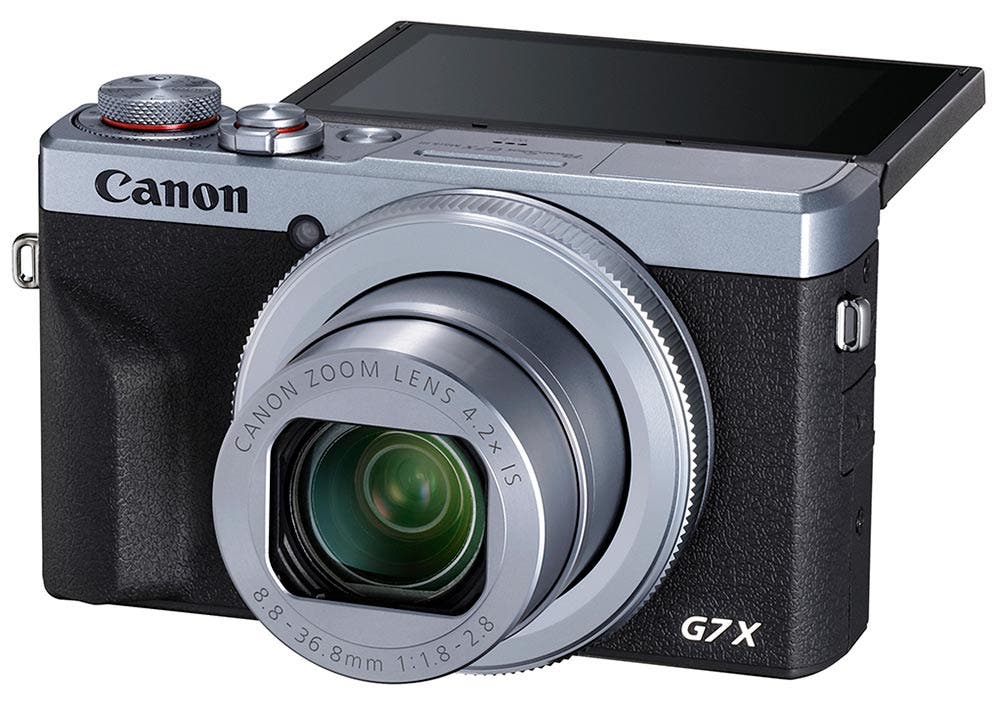
The G7X III is also the first Canon camera of its kind to allow for live streaming to YouTube, while support for vertical shooting is also on hand for those wishing to embed their videos within Instagram Stories. There’s even a pre-record mode, which can capture a second of footage prior to recording being instigated.

As it was with prior generations, both of these models are designed around a common core of specs and features, even though it’s clear that Canon is positioning these two cameras towards different customers. The G7X III remains compact and pocketable just like its predecessor, whereas the G5X II shaves off a few exterior features, such as removing its center-mounted EVF housing and hotshoe in exchange for handy pop-up EVF, to become a similarly-svelte pocketcam.

When it comes to under-the-hood improvements and new features, the updated PowerShot models both sport new 20MP 1-inch-type CMOS sensors with a stacked circuitry design. This allows for faster data readout and overall increased performance.

Both cameras are also powered by Canon’s latest DIGIC 8 image processor, offer enhanced video recording options such as 4Kp30 and 1080p120, are capable of up to 30fps raw capture, and USB-C ports with USB Power Delivery.

Canon PowerShot G5X Mark II:

G5X Mark II
Canon PowerShot G5X Mark II

G5X Mark II Features:

  • 24mm-120mm focal length with max aperture of f/1.8-2.8
  • 5x optical zoom with optical image stabilizer
  • 1-inch, 20.1 megapixel CMOS sensor
  • DIGIC 8 image processor
  • Video recording in 4K at 30p or Full HD at 120p
  • Continuous shooting up to 20fps or 30fps in RAW burst mode
  • Panoramic Shooting mode and Star Shooting mode
  • Pop-up Electronic ViewFinder with 2.36 million dots
  • Touch and Drag AF
  • WiFi and Bluetooth capable
  • Mobile workflow via the Canon Camera Connect app

Picture Quality and Shooting Modes:

Ideal for high-end, skilled amateurs, the new Canon PowerShot G5X Mark II is an adept camera. The ranging focal length paired with a sufficiently shallow aperture creates versatility for the shooter. Users have the freedom to shoot a portrait with an appealing bokeh effect, then capture a wide landscape shot with the same lens.

It’s 1-inch, 20.1 megapixel CMOS sensor paired with a DIGIC 8 image processor ensure clear and detailed images. The optical image stabilizer further improves the precision and clarity of the shot.

G5X Mark II users can take advantage of several shooting modes including Panoramic Shooting mode, Star Shooting mode, and Continuous Shooting mode. The Continuous shooting mode captures up to 20fps or 30fps in RAW burst mode for all those quick-action shots. The G5X is also capable of 4K/30p and FHD/120p video recording.

Canon PowerShot G7X Mark III:

Canon PowerShot G7X Mark III

G7X Mark III Features:

  • 24mm-100mm focal length with max aperture of f/1.8-2.8
  • 3.0-inch LCD touchscreen with 180 degrees of tilt
  • 4.2x optical zoom with optical image stabilizer
  • 1-inch, 20.1 megapixel CMOS sensor
  • DIGIC 8 image processor
  • Video recording in 4K at 30p or Full HD at 120p
  • Continuous shooting up to 20fps
  • External microphone support, clean HDMI output
  • Live streaming abilities
  • Vertical video support for social media
  • WiFi and Bluetooth capable

Streaming Power: 

The Canon PowerShot G7X Mark III is a great gadget for YouTube streamers and all-around content creators. This is because of the features it hosts like live streaming, vertical video support, external microphone connections, and tiltable LCD screen.

An awesome thing is that users can stream their content directly to YouTube. If users want to play back their videos on other social media channels, the Mark III supports Vertical Video to match the dimensions and aspect ratio of the desired platform.

On the production side, the ability to connect an external microphone greatly enhances the overall quality of the content. And lastly, the tiltable, 3.0-inch LCD screen flips 180 degrees so users can easily view a live playback monitor.

Parting Shot

Although the PowerShot G7X Mark III offers a similar array of still-shooting improvements as its G5X II sibling, the G7X III is being marketed heavily as a vlogging camera. Not only does the G7X III offer video recording modes like 4K UHD at 30p, HDR video, 1080p at up to 120fps; all without any cropping, the camera also includes:

  • The ability to connect directly to YouTube’s Live Streaming service via the camera’s built-in Wi-Fi connectivity.
  • Videographers are able to record and stream live video directly from the camera through YouTube, as well as integrate with YouTube Live scheduling directly in-camera.
  • The camera also supports shooting vertical video, which should be handy for Instagram content.
  • Not to forget, the flip-up, front-facing LCD screen is great for self-recording video,
  • and the addition of an on-screen start/stop button makes vlogging much easier.

Both cameras are expected to go on sale in August, with the PowerShot G7X III priced at US$749.99, and will come in silver or black. The PowerShot G5X Mark II will be priced at US$899.99 and will come in black.

Blockchain startup Wala calls it a day after failing to secure funding

0

Wala, South Africa’s blockchain startup has closed down, the startup’s CEO Tricia Martinez has confirmed in a blog post.

The company was founded in 2015 by Tricia Martinez and Samer Saab. It initially provided access to transactional banking, remittances, loans, and insurance, working with specialist providers to offer a full suite of financial services.

In 2017 the startup became crypto-focused with the launch of utility crypto-token Dala, which Wala hoped would support the operationalization and further development of scalable, blockchain-enabled financial platforms for emerging markets.

Wala did this by raising funding from Newtown Partners and with an additional US$1.2 million bagged through a token sale.

In September last year, the startup clinched the $100 000 grand prize in the Zambezi Prize for Innovation in Financial Inclusion. They secured over 150,000 users, mainly residing in Uganda, within months, but founder and chief executive officer (CEO) Tricia Martinez said it soon ran into problems.

In a post on Medium on 24 June titled “Dala: Where Things Went Wrong”, Martinez revealed that following eight months of trying and failing to secure funding, the startup had retrenched employees and turned off its app entirely.

Martinez reported in the post that in the first 4 months Dala token users grew faster than they could imagine. Through the Wala app (a mobile financial services platform), over 150K users, mainly residing in Uganda, signed up and began transacting with Dala. And users would sign up friends and family, transact and send payments to people and receive Dala rewards as an incentive; thanks to the Dala rewards model.

Tricia Martinez; Founder and CEO of cryptocurrency and blockchain company Wala.

“Rewards attracted scammers or people who figured out how to take advantage of a rewards system. This led us to change our rewards model multiple times and have to remove users who were abusing our system,” she said.

“The biggest problem we ran into was infrastructure. Our partners’ systems would regularly turn off due to internet problems or their own poor infrastructure, which meant our users were unable to transact, which was the biggest use case for Dala. This crushed our user engagement and most importantly trust in our system. It also forced us to expand the scope for Dala. We had to build even more infrastructure than we anticipated at the start.”

However, Wala’s main problem and the one that has finally forced the business to close was funding. 

She said the startup survived off very little funding. This came after the company was able to raise just $1.2-million of the $30-million it aimed to net in an initial coin offering (ICO) in 2017.

Writing in the blog post: “We were able to make $1-million go a very very long way. With over 150 000 Dala wallets and more and more partners wanting to work with us we had a lot on our plate with limited resources. It came time to fundraise again and given our rapid growth I expected to find a number of people wanting to support this initiative. But I was wrong. I began fundraising at the start of crypto winter, which certainly didn’t help. For whatever reason, not many investors wanted to back a crypto company let alone a startup focused on African markets.”

“For eight months I traveled across the globe, pitching investors in blockchain, fintech, impact, African-focused… I met and engaged with over 100 investors, and despite our early growth numbers, we couldn’t secure the necessary financial support we needed to continue growing and operating,” she said.

Without the funding the startup had to start cutting back, turning off deposits and laying off most of its team, but on 24th June it turned off its app entirely. 

“Our team was devastated, to say the least, and our users were upset. We provided a free financial payments system to consumers that solved a huge problem for them, but we didn’t have the funding to scale operations and solve the infrastructure problems that existed in these markets,” said Martinez.

Not many leaders in today’s companies are ready to acknowledge failure, but after her frank assessment of why the company had failed, Martinez encouraged readers to leave any questions they had for her below her blog. Stating that she wanted to be transparent about this because she believes it is important for people to learn from failure and bring light to the issues in emerging markets.

Vodacom awaiting for greenlight to launch 5G commercial use in Africa

0

The Vodacom Durban July took place over the weekend and while the event is usually about glitz and glamour, Vodacom, LG, and Nokia took the chance to make it a bit geeky.

At the Durban July, one of South Africa’s biggest horseracing events, Vodacom, partnering with infrastructure provider Nokia and smartphone maker LG, showcased “Africa’s first live, 5G data session on a commercially ready 5G mobile phone and network.”

The trio performed the demo using the LG V50 ThinQ 5G smartphone and was carried using Nokia’s AirScale 5G radio network tech.

The Nokia Airscale 5G radio network solution uses an active antenna, with 128 antenna elements (64 receive and 64 transmit) to deliver the latest 5G mMIMO (Massive Multiple Input Multiple Output) technology.

It also supports the latest 5G new radio (NR) technology and can support concurrent 4G and 5G operation on the same radio.

“We are proud to be part of this Africa-first feat with Vodacom, and are committed to supporting the operator in bringing 5G services to the nation,” said Nokia’s Deon Geyser.

Andries Delport, Vodacom chief technology officer, said that Vodacom has once again demonstrated what is possible when using 5G technology as they did at the Vodacom Durban July by demonstrating Africa’s first live, 5G data session on a commercially ready 5G mobile phone and network.

“Although we are still awaiting the allocation of 5G spectrum to launch the technology in South Africa, the future truly is exciting when we consider what we might be able to achieve once the requisite spectrum becomes available, ” he added.

The LG V50 ThinQ is one of the first commercially 5G-ready smartphones in the world. It has a 6,4-inch OLED FullVision display which uses LG OLED TV technology. The smartphone also has five high-resolution cameras, two at the front and three at the rear. The LG V50 uses AI technology to recommend photo-enhancing filters.

The smartphone features a Qualcomm SDM855 Snapdragon 855 chipset – the world’s first commercial 5G mobile platform. The chipset features the Snapdragon X50 5G modem which supports download speeds of up to 5 gigabits per second.

The Snapdragon X50 5G modem, paired with up to 4 QTM052 mmWave antenna modules, supports advanced mobility features like beam forming, beam steering, and beam tracking.

“LG is very focused on expanding its leadership in 5G by introducing leading-edge devices and forging customer-oriented collaborations with carrier partners such as Vodacom,” says Deon Prinsloo, mobile GM at LG South Africa. “The introduction of 5G in South Africa is sure to improve people’s lives, and will contribute to jobs, entrepreneurship, and create overall economic opportunities.

“Strong collaborations will be required to accelerate 5G commercialization on the continent, and LG is ready to be a key player when 5G service becomes widely available in the region. Once the spectrum is allocated, LG will introduce a range of leading 5G mobile phones ready to usher in a new era of connectivity in Africa.”

Vodacom CTO Andries Delport at the 2019 Durban July 5G demo.

Vodacom’s CTO Andries Delport, however, noted that the company’s still “awaiting the allocation of 5G spectrum to launch the technology in South Africa.”

The live demonstration used a non-standalone network architecture with dual connectivity between the 4G and 5G networks, and which was standardised in 3GPP Release 15. Vodacom also used its live transport and core network elements which have been upgraded for 5G readiness including cloud core technology.

For the purposes of the demonstration at the Vodacom Durban July, Vodacom was granted a temporary spectrum license by Icasa (Independent Communications Authority of South Africa) of 100 MHz in the C-band spectrum range (3.5 GHz range).

This spectrum band is well suited to providing good 5G coverage, unlike higher frequency bands such as mmWave (26 GHz and above) which have poor indoor penetration characteristics.

Vodacom believes this is the first live demonstration of a commercially-ready 5G smartphone working on a commercially ready 5G network in Africa, unlike previous demonstrations which used fixed 5G routers as the customer device.

Although, this isn’t the first time that Vodacom has showcased 5G at the Durban July. The firm showcased the technology at the race last year when it streamed the race at 4K in 360 degrees.

Huawei CEO says HongMeng OS is ‘likely’ faster than Android and MacOS

0

HongMeng OS is the name we’ve come to know as the ‘soon to be ready’ solution to Huawei’s problems in the event the Android ban became a permanent move. That scenario unfolded a few weeks ago when the Trump administration placed China’s largest smartphone vendor on a blacklist that prevents it from importing any technology made in the States, whether it’s software or hardware. Then Huawei registered a “HongMeng” trademark in several countries, which was believed to be the name of its OS, and it looks like HongMeng is coming soon.

Apparently, Huawei in-house OS would not just be suited for smartphones, but for tablets, PCs and IoT solutions, meaning it could provide a connected ecosystem for potentially millions of users, if it got off to a near-perfect start.

In an interview with a French magazine, Le Point, Huawei founder, Ren Zhengfei talks more about HongMeng OS.

Zhengfei reportedly said Hong Meng OS is “likely” to be faster than Android, pointing to a report from the state-operated GlobalTimes that said it was 60% faster. He sounded highly optimistic regarding the performance and optimization of HongMeng OS, claiming that the operating system has a processing delay of fewer than 5 milliseconds. It will be perfectly adapted to the Internet of Things and can also be applied to autonomous driving. Ren Zhengfei pointed out: “We built this system in order to be able to connect all objects simultaneously. This is how we move towards a smart society.”

While Zhengfei boasted that HongMeng is designed to connect across multiple devices, including phones, cars and data centers, he did concede that Huawei lacks a serious alternative to Google’s Play Store and Apple’s App Store. Huawei is now working to create that alternative.

The CEO’s comments mean that, regardless of whether Huawei is lifted from the Department of Commerce’s blacklist, Huawei is likely to push on with its own operating system. As much as some of the company’s phones use Qualcomm chips, most of its flagship phones contain Huawei’s own Kirrin CPUs. The company’s spat with the US government looks to ultimately make it more self-reliant than ever, of course, that is if HongMeng can compete with Android.

Ever since Trump softened the US ban on Huawei, it has been unclear whether future Huawei phones will run on Android or Hongmeng OS. Huawei said earlier this month that it is waiting for the US Department of Commerce to release guidelines for the re-use of Android. Simultaneously, the company is already testing Hongmeng OS in its phones in China. The next big launches for Huawei this year is the Mate X and Mate 30 series and it’s unclear what operating system they will run on.

We are excited to be a first mover in Kinshasa, Africa’s third-biggest city -Barrett Nash CEO CanGo (formerly SafeMotos)

0

SafeMotos, an on-demand ride-hailing system focusing on motorcycle taxis in Kinshasa and Kigali is excited to be a first mover in Kinshasa, Africa’s third-biggest city.

Speaking to TechMoran, Barret Nash, co-founder and CEO CanGo, (formerly SafeMotos) believes that CanGo can grow into being a single app that provides many on-demand services in one. Think Glovo plus Lynk but SafeBoda. 

TechMoran caught up with him and this is what he told us.

What inspired you to launch SafeMotos?

My Kenyan cofounder Peter and I were roommates in Kigali before we launched and would often take motorcycle taxis to meet at our favourite bars. We’d always jump off and go ‘wow, that guy almost killed me’. As aspiring entrepreneurs at the time we decided to do something about it: let’s make motorcycle taxis safe to use. We made a pitch deck, were approached by a startup accelerator, managed to get some seed money and we were off to the races. 

Why motorcycles and not cars?

It’s a question about what do we want to grow into: cars on demand are a great service, but what we are very motivated by is how we can bring additional services to our users from within a single app. As soon as we decided to orient our future towards multiple on-demand services, then it’s a natural choice to focus on motorcycles as they are such a flexible way of moving a huge variety of goods and people.

How did you meet your co-founder? And how similar or different are you as co-founders and how do you support each other as co-founders?

My Kenyan co-founder/CTO Peter Kariuki and I met originally in Kigali as roommates. I was living in Rwanda renting a room from a friend of mine and one day Peter showed up asking why I had stolen his room: our mutual friend had been renting it to both of us while Peter was at university. The solution was to get a bigger house and we became friends, anchored on our passion for entrepreneurship and problem-solving. Peter and I are quite different people, and I think every startup cofounders have their share of ups and downs, but we both have the strong belief that we are stronger together than separate and that we’re on this crazy ride together.

Nash and Peter

What were the key factors for SafeMotos expansion to Kinshasa and not anywhere else?

One of the things about doing a startup is you learn a lot as you grow your business. What we learned in Kigali was that you need to solve real problems. We say ‘we need to be a painkiller, not a vitamin’. In Kigali, transportation is quite good already, and with the limited size of the market it means that we’d set a relatively low ceiling for our ambition. What we also learned was that the opportunity for disruption of on demand companies in African cities is bigger than we expected. We decided we wanted to go to where we could have the biggest impact and fight to own the biggest piece of the economic pie: for us this is Kinshasa, with 14 million people, good 3G/4G, no startups of note and some of the most challenging transportation factors in Africa. 


How different are these two markets in terms of challenges and opportunities?
Kinshasa and Nairobi are very different. While Nairobi is, to me, the king of African startup ecosystem right now, where we even keep our technology team based since there is so much tech talent bursting from every seam, Kinshasa in many ways still feels pre-tech. Peter often says that the Kinshasa today reminds him of the Nairobi of his childhood. In terms of opportunities, obviously, we are hoping that we can turn Kinshasa into a Nairobi, while the challenges are that the startup ecosystem hasn’t been defined yet so there’s very little support infrastructure. Most companies in your space are for-profit ventures.

Why did you choose to be a social enterprise instead?

We are a for-profit entity. 

Are there any plans to go all out and scale across Africa?
For us, the question of scaling is existential to our growth ambitions. However, we feel that first, we need to create a defensible ecosystem of services allowing us to turn Kinshasa into a ‘castle’. I believe there is a major strategic challenge for on-demand companies in that it’s just too easy to have competitors undercut you, we want to nail a defensible ecosystem, then look at the dozens of cities in Africa with more than a million people that don’t have a developed on-demand player yet and turn them into castles as well. 

What led to the start of the SafeMotos Institute? What has been its impact?
The purpose of the SafeMotos Institute is to allow us to have a positive social impact in a way that doesn’t make ourselves as for-profit entrepreneurs have to make a decision between business economics and social impact. While SafeMotos Institute is still early in its impact, we have already trained a cohort of female drivers in Kigali, and are investigating opening a school for drivers in Kinshasa.

How is SafeMotos helping change drivers lives in Rwanda and the DRC?

These stories always make me feel positive. We have examples of drivers getting married and buying houses due to the stability that being with SafeMotos allows them. 

Any programs to help drivers own their own fleet of motorcycles?

I believe that a startup benefits from discipline and focus: right now we’re wanting to nail the core customer experience before looking at widening the suite of services we can provide.

Most urban cities in Africa have banned the use of motorcycles in their central business districts and some sensitive zones. What are you guys doing to reverse this?

We believe that making our drivers recognized as being of a high caliber, as well as getting to the right level of trip volume, allows us to leverage stakeholders to allow access. At the end of the day, SafeMotos is a positive thing for a city as it professionalizes a highly informal marketplace.  

Motorcycles alone cannot solve the urban transport and logistics problem. What do you think needs to be done to improve transport, congestion and logistics in African cities?

If I was a billionaire overnight, I’d put it into zeppelins, which I believe would be a highly viable solution to African intercity and intracity transportation challenges.  

Most tech startups have their IT headquarters in Europe due to a perceived limited IT talent in Africa. Is this true and what do you think needs to be done to address this skills gap problem on the continent?

We’ve got our tech team proudly in Nairobi, which in both my and Peter’s opinion has a great bench of talent. Honestly, I think the bigger challenge is that most startups don’t have technical cofounders like Peter, which makes it very hard to build a tech team from scratch. 

Any plans for an equity raise?

We’re watching with a lot of interest, specifically with how Lagos has boomed overnight. We are very interested in a different subset of markets though than the ones that we already perceive as crowded. As a startup, we’re always raising money and are always on the prowl for strategic investors who share our vision

How well-positioned is SafeMotos compared to its competition in these markets?

For us, we believe it’s still the pioneering days of transportation disruption in Africa. We believe if we can excel in Kinshasa, then we are very well positioned to expand into other challenging markets that have been underserved by technology providers. As with everything in startups, timing is a huge factor, right now we feel like the window of opportunity is open, but we need to move fast if we’re not wanting to miss it.

MEST Africa names Ashwin Ravichandran as new Managing Director

0

MEST Africa has appointed Ashwin Ravichandran as its new Managing Director, in a move to grow and strengthen its portfolio of startups and expand its reach and impact across the continent. 

Ashwin will replace Aaron Fu who TechMoran reported yesterday had left the Pan-African entrepreneurial training program, seed fund and incubator to focus on angel investing.

“We’re thrilled to name Ashwin as Managing Director,” said MEST Founder & Chairman, Jorn Lyseggen. “Over the years, he has been an incredible asset to our management team and an invaluable mentor to founders and Entrepreneurs-in-Training (EITs). Ashwin has a passionate, product-centric approach to entrepreneurship and, combined with a deep belief and dedication to the African continent, he is the right person to take MEST to the next level.”

Ashwin joined MEST in 2015 as a Technology Teaching Fellow and has since served as the Incubator Manager for MEST Accra, and as Director of Portfolio Support and Country Director of Ghana.

Aswin has a background in Computer Science and Engineering and has worked with the innovation team at Honeywell and building startups in India. As a Director of Portfolio Support, Ashwin was in charge of the growth and development of some of MESTs most successful portfolio companies such as Complete Farmer, Asoriba, Leti Arts and Kudobuzz.

DabaDoc nominated “Technology Pioneer” by the World Economic Forum

0

Morocco based health DabaDoc, a startup that connects patients with thousands of doctors across Africa has been nominated as a World Economic Forum 2019 Technology Pioneer becoming one of the two African companies recognized as part of the 2019 Technology Pioneer cohort.

The World Economic Forum’s Technology Pioneers are early to growth-stage companies from around the world that are leaders in the design, development and deployment of new technologies and innovations, and are poised to have a significant impact on business and society.

In recent years, Google, Twitter, Dropbox, AirBnB, Spotify, Palantir, TransferWise, to name a few, have joined the ranks of the World Economic Forum’s Technology Pioneers. The selection committee this year included a wide variety of panelists, including leaders from Huawei Technologies, Stanford University and Nasdaq Inc, amongst others.

“Our new tech pioneers are at the cutting edge of many industries, using their innovations to address serious issues around the world,” says Fulvia Montresor, Head of Technology Pioneers at the World Economic Forum. “This year’s pioneers know that technology is about more than innovation – it is also about application. This is why we believe they’ll shape the future.”

This achievement represents a testament to DabaDoc as a true global leading technology innovator. Following their selection by the World Economic Forum, Technology Pioneer CEOs will be participating in the World Economic Forum Annual Meeting of the New Champions, the “Summer Davos”, being held from 1 to 3 July 2019 in Dalian, China.

Samsung profits down by 56% in Q2 due to Huawei’s US ban

Today, Samsung Electronics said that profits for the three months that ended June more than halved from a year earlier following continued weakness in the price and demand of memory chips.

Memory components, which are used in mobile handsets and enterprise servers, comprise Samsung’s main profit-making business. Analysts say that DRAM and NAND flash chips also saw drastic price drops in the past months leading to decreased earnings.

The Korean tech giant relies heavily on the industry as an estimated two-thirds of its income comes from there. In addition to that, one of its biggest clients – Huawei found itself in trouble following the US ban, which brings more uncertainty heading into the second half of 2019.

According to earnings guidance released by the company today, Samsung the world’s largest smartphone maker and supplier of memory chips said its operating profit was at 6.5 trillion Korean won ($5.56 billion). This was slightly better than an industry estimate of 6 trillion won but was down about 56% from a year earlier.

This would be Samsung’s lowest profit since Q3 2016 when the company was hit by the Galaxy Note 7 debacle. Samsung doesn’t provide full explanations along with its earnings guidance, but analysts have suggested that the Huawei crackdown could have had a significant impact on Samsung’s critical chip business. Although, it’s also likely to help Samsung’s smartphone sales in certain markets.

On a more positive note, things could have been even worse for Samsung this quarter had it not benefited from a one-off gain in the display division that boosted profit. According to analysts who spoke to Reuters, Samsung was reimbursed about 800 billion won ($684 million) by Apple because the US company, which uses Samsung’s OLED screens in its iPhones, missed a sales target that had been agreed upon.

Samsung is also bracing for the impact of tightened Japanese controls on exports of high-tech materials used in semiconductors and displays. The Seoul government sees the Japanese measures, which went into effect on Thursday, as retaliation against South Korean court rulings that called for Japanese companies to compensate aging South Korean plaintiffs for forced labor during World War II. Seoul plans to file a complaint with the World Trade Organization.

The full earnings report is expected by the end of the month. If those numbers match with today’s guidance, as they usually do, it would be the second consecutive quarter where Samsung’s operating profit more than halved from the same period a year earlier.

Glovo expands to more city estates in Nairobi to meet its growing demand

0
On-demand delivery platform Glovo is expanding across various city estates in Nairobi to meet the growing demand, the company told TechMoran.
The firm has launched in Nairobi’s Central Business District with an innovative approach using skaters who can move to and from restaurants and offices to fulfill orders on behalf of Glovo.

“We are pleased to let you know that we are live and delivering in CBD. You can now enjoy deliveries within minutes right from CBD. In addition, enjoy free deliveries until 20th July on all CBD orders,” the company said. adding that apart from its popular food category users can order for anything through its Anything button and have it delivered to them within minutes. ️

Glovo General Manager William Bentall told TechMoran, ” We have launched our courier services in CBD. We are in Thika Road, Ruaka, Eastlands and are expanding to Karen in a week. We are constantly thinking of where next to launch.”

Bentall told TechMoran that the firm recently raised $170m for global expansion and across its individual markets like to major markets across Kenya.

Globally, the firm is looking at expanding into Nigeria, Ghana and South Africa. Glovo believes South Africa is a mature market for its food and everything else delivery business. Glovo chose to launch in Kenya as one of its earliest markets in Africa because Kenyan consumers are already educated and aware of such services. The market is also not as saturated as Brazil in Latin America.

“Kenya is a hub for East Africa and has a pool for riders. Its population is not as big but there is a culture of delivery already from restaurants, pharmacies, drinks and even among offices and online stores. We are now educating consumers to move from telephone orders to everything online and on smartphones,” Bentall said.

The delivery firm is also working with various government agencies in Kenya around the two-wheeler motorcycles which are charged heavily to operate in Nairobi’s CBD. For someone to be licensed to work in CBD, its like buying a new bike.

Glovo says its huge growth is organic and the firm is happy with the growth now. It’s supporting owner riders or independent riders for its 15-minute courier service promise against the normal 1-2 hour maximum time taken by its competition. recently, the firm partnered with Simbisa brands for food delivery.

The firm has a B2B interface for SMEs and corporate firms but at the moment it’s pushing its consumer-facing platform to sign up as many users as possible. Though Glovo has locally marketed itself as a food ordering and delivery app, its platform is being used by SMEs for business to business courier services. The firm recently partnered with Showmax to give credits to both their users and is in talks with a top local FMCG to take over its day-to-day logistical needs.

“We have been meeting regulatory requirements and are going live in CBD with skaters first. We are using skaters in the CBD because of time and efficiency,” Bentall said adding that the firm had signed up over 500 riders already.

Glovo takes a percentage of the merchant’s value sold depending on their agreement with the partners. Glovers, as the firm calls its riders, can work for anyone as long as they are available for their shift. The firm schedules shifts to make sure those working for it are available. A shift can be an hour or a whole morning or afternoon or a whole day. Bentall says control over the shifts helps it to plan to help predict to meet its demand.
“The business is growing in double digits every week and being able to march demand and growth is a challenge,” he said.

With 30 or 40 coming in for training daily, Glovo says its pay is competitive and depends on the riders’ rating according to quality and reliability. It’s delivery fees of Ksh 50 for food and Ksh 100 for everything else is better than its competition the firm says and it also gives a 1hr delivery guarantee.

Huawei Y9 Prime 2019 to be available in retail stores in Kenya on July 6

0

The recently launched Huawei Y9 Prime 2019 will officially be available in all retail stores across the country from 6th July 2019.

This follows a successful one week pre-order period that saw over 1000 devices ordered through various partners including Jumia Online and Lipa Later.

There will be a public launch at Two Rivers Mall on Saturday 6th July followed with a number of mall activations across the country including The Hub Karen, TRM, Sarit Centre Mall and The Junction Mall.  Among those attending the Two Rivers public launch are King Kaka, Nick Mutuma, Jaymo yule Msee and Njugush.

Speaking of the successful pre-order period, Huawei Mobile Country President, Steven Li said, “We would like to appreciate all our partners who ensured, we meet the target during the pre-order period. We are also glad that consumers are still confident in our products as based on the number of pre-orders made across the country. We would like to encourage consumers to turn up in numbers at Two Rivers where we will officially launch the devices and begin sales across the country. We will also have a winner walk away with a Huawei Y9 Prime 2019 after participation in the on ground activities that includes gaming and spin the wheel.”

Aaron Fu leaves MEST to focus on family, health, and friends

Aaron Fu, former Managing Partner, Nest Africa and recent MD of MEST Africa is leaving the pan-African accelerator to focus on his family, friends and his health, TechMoran has learned.

“Coming to the end of a 2 year long amazing journey at MEST Africa that has absolutely changed my life in ways I didn’t imagine possible, challenged what I believed possible, inspired me, humbled me hard,” wrote Aaron Fu in a blog post.

Fu, who has served as the Managing Director at MEST Incubator since September 2017 saw the then Accra-based accelerator expand across Africa, launch a pan-African tech conference and invest in over 25 startups from less than ten. MEST Africa has recorded a number of acquisitions which are expected to grow as the firm bolsters its pan-African reach.

Before his gig at MEST, Fu was the Managing Partner at Nest Ventures heading NEST’s Kenya office. Prior to that he served as Head of Digital Banking for Africa at Standard Chartered PLC where he shaped the firm’s digital sales framework across Africa.

Fu has been good for the African tech ecosystem because of his experience both within investment firms and startups and in conventional corporate roles, including Standard Chartered Bank and Societe Generale, across Asia, Europe, Australia and Africa. He has also lived in most of these markets in Africa.

“I really wanna take a bit of time out to focus on family, health and friends (you know, the important stuff,” Fu said. “I will also be spending more time with my own small startup portfolio — who are doing things I wish I was brave and smart enough to do ?‍♀️?‍♂️. Looking forward to a sprint with Benjamin Fernandes  and the NALA Money team in the coming weeks.”

Fu is looking to work with ventures in Early Stage Smart Capital and especially on how this capital can be unlocked and deployed to the right founders on the continent. He is also looking at ventures in talent development as startups in Africa continue to struggle for talent, and has shown great interest in startups solving this issue such as Andela and Moringa School.

“These are not new questions but certainly ones that have I have been deeply curious about and acutely frustrated about for years, it’s just not right. If you share these frustrations or curiosity, please say hey! This is a journey I’d love to share,” he said in his medium partying shot.

Image credits-medium)

“This isn’t a note about departure — none of that here, but about my gratitude to those who’ve been with me on this journey and my hopes for the future,” he concluded.

Fu is also a founding mentor of XL Africa, a five-month business acceleration program designed by the World Bank to prepare 20 selected startups to raise between $250,000 and $1.5 million in early-stage capital. He is also the founder of Mettā Nairobi, a community-led initiative designed to bring entrepreneurs and the wider startup ecosystem closer together.

Fu has invested in Tanzania’s Nala Money, micro-learning startup Mosabi, enterprise social media platform Ongair in his personal capacity and is an advisor to BuuPass, a bus booking platform for East Africa. With his various experiences, his move into angel investing is a logical next step.

This post has been edited to emphasize that Aaron’s new focus will be family, health